Chapter 1: An Introduction to Accounting Theory Instructor’s Manual
Accounting Theory (9
th
edition) Page 1 of 14
CHAPTER HIGHLIGHTS
The chapter is concerned with what accounting theory is and where it fits within the “structure”
of financial accounting. The definition of accounting theory used in this chapter is broad and
complements the objectives of the text. Theory itself helps to explain and predict phenomena
that exist in a given field, and this likewise holds true in accounting. In accounting, theory can
be developed in response to needs arising from practice, including concepts such as realization
and matching. However, as an “infrastructure” has developed in financial accounting, theory is
formulated in a more institutionalized way by means of the research process.
Along with political factors and economic conditions, accounting theory contributes to the
standard-setting process. The process of developing standards or making rules is itself largely a
deductive process and is certainly concerned with accounting theory.
The various valuation models are presented in Appendix 1-A. The models come under the scope
of accounting theory. In addition, the different models are mentioned in several theory chapters.
QUESTIONS
Q-1 What does the term “social reality” mean and why are accounting and accounting
theory important examples of it?
The term social reality pertains to the measurement of social phenomena and the use of these
measurements. The measurements may be representationally faithful (low in bias) and have a
high degree of objectivity (verifiability). Or the opposite for either or both of these qualities may
be the case. The important thing to grasp, however, is that important consequences stem from
Chapter 1: An Introduction to Accounting Theory Instructor’s Manual
Accounting Theory (9
th
edition) Page 2 of 14
Q-2 Why do the value choices (entry value, exit value, and historical cost) fall within the
domain of accounting theory?
These are examples of different concepts involved with measuring income which have different
Q-3 Of the three inputs to the accounting policy-making function, which do you think is the
most important?
Of the three inputs (economic conditions, political factors, and accounting theory) to the policy-
making function, economic conditions is clearly the most important input. Economic conditions
Q-4 How can political factors be an input into accounting policy-making if the latter is
concerned with governing and making the rules for financial accounting?
Those who are affected by the rules will usually try to influence what those rules will be. The
investment tax credit provides an excellent example. When APB Opinion No. 2 did not allow
Q-5 Is accounting theory, as the term is defined in this text, exclusively developed and
refined through the research process?
Absolutely not. Many concepts such as conservatism and revenue recognition arose on a
“common law” type of basis. They were responses to particular problems. Research has, of
Q-6 What type of measurement is the measurement of objectivity in Equation (1.1):
nominal, ordinal, interval, or ratio scale?
It is ordinal, due to the squaring effect on each individual deviation from the mean. The zero
Chapter 1: An Introduction to Accounting Theory Instructor’s Manual
Accounting Theory (9
th
edition) Page 3 of 14
Q-7 The measurement process itself is quite ordinary and routine in virtually all situations.
Comment on this statement.
This is not necessarily the case. Measurements can be extremely complex. For example,
measuring the temperature of the earth’s atmosphere is extremely difficult. The increasing
temperature has led both to the hypothesis of the greenhouse effect and to the theory that the
warming global temperatures are simply a fluctuation, a naturally occurring variation.
Q-8 Can assessment measures be used for predictive purposes?
Q-9 A great deal of interest is generated each week during the college football and college
basketball seasons by the ratings of the teams by the Associated Press and United Press
International. Sports writers or coaches are polled on what they believe are the top 25
teams in the country. Weightings are assigned (25 points for each first place vote, 24
for each second place vote, . . . one for each 25th place vote) and the results are
tabulated. The results appear as a weekly listing of the top 25 teams in the nation. Do
you think that these polls illustrate the process of measurement? Discuss.
An argument can be made that a number is assigned to a team on the basis of a property that
might be called the “goodness” or “strength” of a team. However, these measurements do not
have a great deal of precision. How good a team is relative to other teams is a property or
Chapter 1: An Introduction to Accounting Theory Instructor’s Manual
Accounting Theory (9
th
edition) Page 4 of 14
Q-10 Accounting practitioners have criticized some proposed accounting standards on the
grounds that they would be difficult to implement because of measurement problems.
They therefore conclude that the underlying theory is inappropriate. Assuming that the
critics are correct about the implementational difficulties, would you agree with their
thinking? Discuss.
This question brings together the relationship among theory, policy, and practice. It also brings
up Larson’s warning of the necessity to differentiate between theory and measurement even
though we believe that Larson’s statement is too strong. Hence, even though the practitioners
Q-11 Some individuals believe that valuation methods proposed by a standard-setting body
such as FASB should be based on those measurement procedures having the highest
degree of objectivity as defined by Equation (1.1). Thus, some assets might be valued
on the basis of replacement cost and others on net realizable value. Do you see any
problems with this proposal? Discuss.
The problem here is basically the opposite of that presented in question 10. In this case, part of
the measurement problem might be solved, but at the cost of sacrificing the theoretical base.
Hence, the cart is put before the horse, conceptually speaking. However, there are other
measurement problems presented by this proposal. It is questionable whether replacement cost
Chapter 1: An Introduction to Accounting Theory Instructor’s Manual
Accounting Theory (9
th
edition) Page 5 of 14
Q-12 What type of measurement scale (nominal, ordinal, interval, or ratio scale) is being
used in the following situations?
a. Musical scales
b. Insurance risk classes for automobile insurance
c. Numbering of pages in a book
d. A grocery scale
e. A grocery scale deliberately set 10 pounds too high
f. Assignment of students to advisers, based on major
a. Musical scales, Interval, there is no natural zero tonal point.
b. Insurance risk classes for automobile insurance: Ordinal, Class 1 is “better” than Class 2 to
the extent that people have had fewer accidents. However, within classes people do not have
uniform accident records, and the “accident interval” between classes is not totally uniform.
Q-13 If general price-level adjustment is concerned with the change over time of the
purchasing power of the monetary unit, why is it not considered to be a current value
approach?
Current value approaches (replacement cost and exit value) are concerned with questions such as
what would it cost to replace an asset today with the same type of asset in the same condition or
Q-14 How do entry- and exit-value approaches differ?
As noted previously, entry value (replacement cost) concerns the cost of replacing an asset
already owned in markets in which the asset is generally acquired by the firm. Exit value is the
Chapter 1: An Introduction to Accounting Theory Instructor’s Manual
Accounting Theory (9
th
edition) Page 6 of 14
Q-15 Why is discounted cash flow extremely difficult to implement in the accounts?
The difficulty relates to measurement. Which discount rate should be used, how far in the future
should one go, and how should one estimate cash flows? In addition, many assets contribute
Q-16 How do measurement and calculation in accounting differ from each other? Give three
examples of each.
Measurement in accounting is concerned with determining real economic phenomena such as
current values (entry and exit values) and discounted cash flows. Calculations are simply
Q-17 Are issues of costliness and timeliness as they pertain to accounting standards part of
accounting theory?
Costliness and timeliness are part of accounting theory (refer to Statement of Financial
Q-18 Do you think that changes brought about in accounting standards by failures of
publicly traded companies such as Enron should be classified under political factors or
economic decisions? Support your position.
We classify these as political factors. The inability to draft workable rules to bring special
Q-19 Political factors are an adverse influence on the accounting standard-setting function.
Discuss this statement.

Chapter 1: An Introduction to Accounting Theory Instructor’s Manual
Accounting Theory (9
th
edition) Page 7 of 14
Q-20 Did the 21
st
century begin on January 1, 2000?
By popular acclamation the 21
st
Century began on January 1, 2000. Since there was no year
Q-21 Do you think that the color-coded terrorist threat system instituted by the Department
of Homeland Security involves a measurement system? Explain.
Absolutely. Different colors refer to different degrees of danger. It would be an ordinal-type
scale because the difference in degrees of danger between color codings is not uniform. For
Q-22 Since the FASB makes the standards that are used by business and industry, they make
accounting theory. Comment on this statement.
FASB uses accounting theory when developing accounting standards, but it does not make it.
CASES, PROBLEMS, AND WRITING ASSIGNMENTS
1. Assume that three accountants have been selected to measure the income of a firm
under two different income measurement systems. The results for the first income
system (M1) were incomes of $3,000, $2,600, and $2,200. Under the second system
(M2), results were $5,000, $4,000, and $3,000. Assume that users of accounting data
believe that dividends of a year are equal to 75 percent of income determined by M1
for the previous year. Users also believe that dividends of a year are equal to 60
percent of income determined by M2 for the previous year. Actual dividends for the
year following the income measurements were $3,000. Determine the objectivity and
bias of each of the two measurement systems for the year under consideration. On the
basis of your examination, which of the two systems would you prefer?
Chapter 1: An Introduction to Accounting Theory Instructor’s Manual
Accounting Theory (9
th
edition) Page 8 of 14
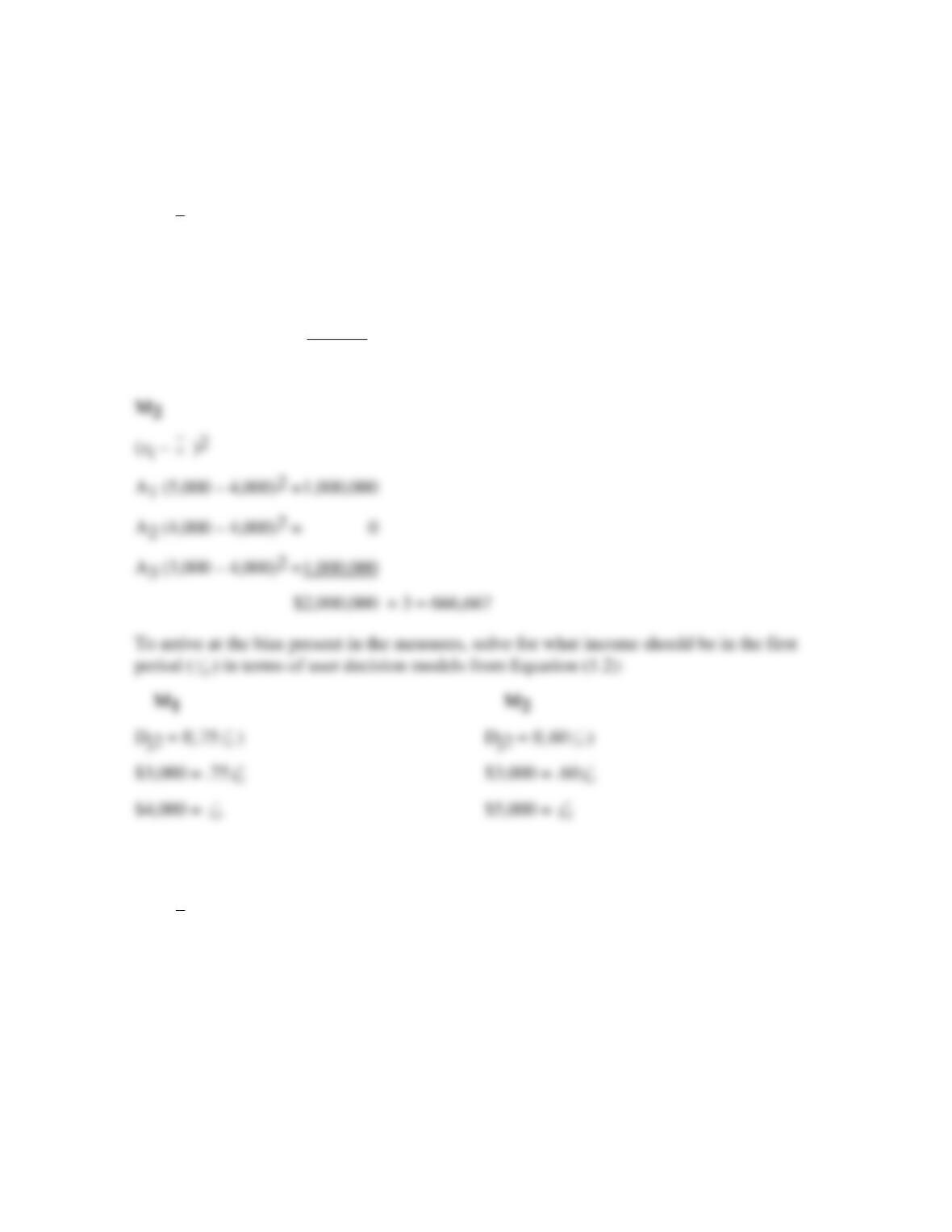
Designating the three accountants as A1 . . . A3 and using Equation (1.1) for measuring
objectivity, we get:
M1
(xi –
x
)2
A1 (3,000 – 2,600)2 = 160,000
A2 (2,600 – 2,600)2 = 0
A3 (2,200 – 2,600)2 = 160,000
$320,000 ÷ 3 = 106,667
Now solve for bias by using Equation (1.3):
B = (
x
– x*)2 i:
M1 (2,600 – 4,000)2 = 1,960,000
M2 (4,000 – 5,000)2 = 1,000,000
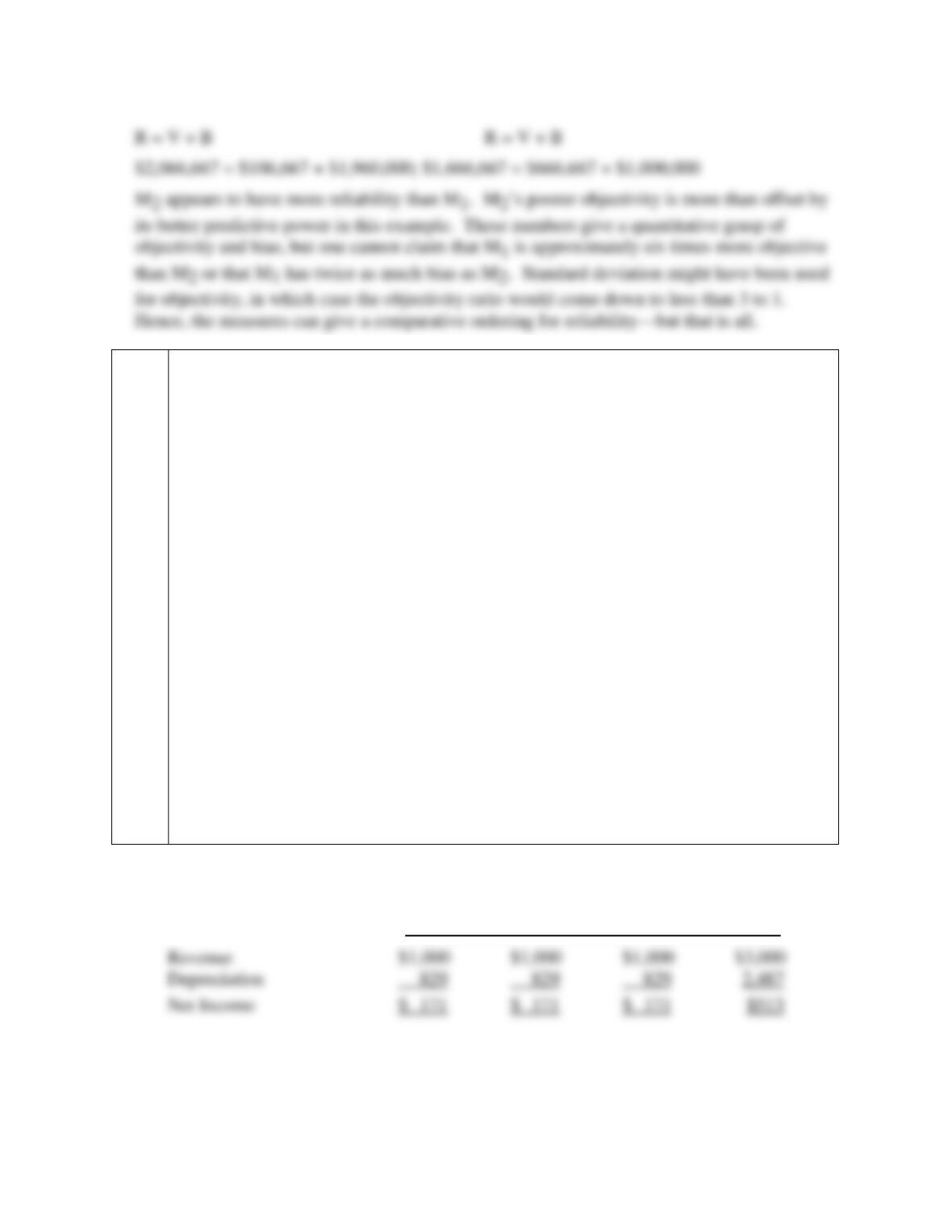
Combining the two measures that are additive to arrive at an overall measure of reliability, we
have:
M1 M2
Chapter 1: An Introduction to Accounting Theory Instructor’s Manual
Accounting Theory (9
th
edition) Page 9 of 14
2. J & J Enterprises is formed on December 31, 2000. At that point it buys one asset
costing $2,487. The asset has a three-year life with no salvage value and is expected to
generate cash flows of $1,000 on December 31 in the years 2001, 2002, and 2003.
Actual results are exactly the same as plan. Depreciation is the firm’s only expense. All
income is to be distributed as dividends on the three dates mentioned. Other
information:
The price index stands at 100 on December 31, 2000. It goes up to 104 and 108 on
January 1, 2002 and 2003, respectively.
Net realizable value of the asset on December 31 in the years 2001, 2002, and 2003 is
$1,500, $600, and 0, respectively.
Replacement cost for a new asset of the same type is $2,700, $3,000, and $3,300 on the
last day of the year in 2001, 2002, and 2003, respectively.
Revenue is $1,000 per year and the internal rate of return is 10% and all cash flows are
received (and distributed) on December 31.
Required:
Income statements for the years 2001, 2002, and 2003 under:
Historical costing
General price-level adjustment
Exit valuation
Replacement cost
Discounted cash flows
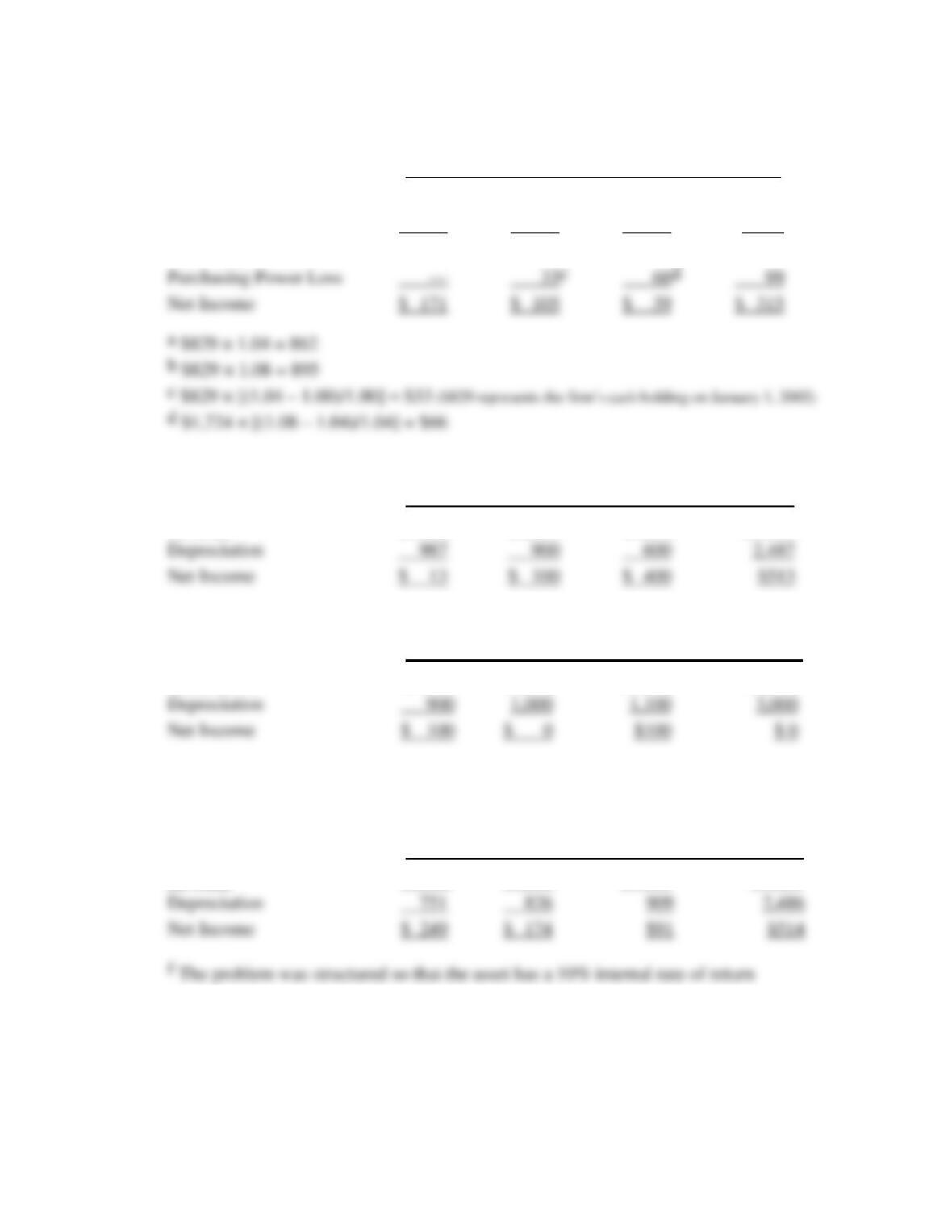
2.1 Historical costing:
2001 2002 2003 Total
Chapter 1: An Introduction to Accounting Theory Instructor’s Manual
Accounting Theory (9
th
edition) Page 10 of 14
2.2 General price level adjustment:
2001 2002 2003 Total
Revenue $1,000 $1,000 $1,000 $3,000
Depreciation 829 862a 895b 2,586
Operating Income $ 171 $ 138 $ 105 $ 414
2.3 Exit valuation:e
2001 2002 2003 Total
Revenue $1,000 $1,000 $1,000 $3,000
2.4 Replacement cost:e
2001 2002 2003 Total
Revenue $1,000 $1,000 $1,000 $3,000
e Purchasing power gains and losses might be computed but are omitted for simplicity here
2.5 Discounted cash flows:f
2001 2002 2003 Total

Chapter 1: An Introduction to Accounting Theory Instructor’s Manual
Accounting Theory (9
th
edition) Page 11 of 14
3. Objectivity (also called “verifiability”) and bias (usefulness) are two extremely
important characteristics of accounting. Discuss each of the following situations in
terms of how you believe they would impact upon objectivity and bias.
The latest standard on troubled debt restructuring, SFAS No. 114, calls for newly
restructured receivables to be discounted at the original or historical discount rate. Two
board members disagreed with the majority position because they thought the discount
rate should be the current discount rate, given the terms of the note and the borrower’s
credit standing.
SFAS No. 115 requires marketable equity securities to be carried at fair value (market
value). Its predecessor, SFAS No. 12, required marketable equity securities to be
carried at lower-of-cost-or-market.
Assume that a new standard would allow only FIFO in inventory and cost of goods
sold accounting with weighted average and LIFO being eliminated (you may ignore
income tax effects).
This situation shows how even a minimum exposure to “accounting theory” can sharpen
reasoning power. Other examples of the type illustrated here can be easily generated.
The original historical rate would be more verifiable since it is precisely determinable, whereas
the current rate would not be exact but should be restricted to a very narrow range. The current
discount rate should be more useful because its use would help to determine the current value of
the restructured debt. On balance, we agree with the dissenters. Verifiability problems with the
current discount rate should be quite small.
4. Accounting theory has several different definitions and approaches. Using Hendriksen
and van Breda (1992, Chapter 1) and Belkaoui (1993, Chapter 3), list and briefly
discuss these definitions and approaches. From the perspective of a professional
accountant, evaluate these approaches in terms of their usefulness.
Chapter 1 in Hendriksen and van Breda is devoted to accounting theory. Accounting theory is
not defined until the conclusion of the chapter on page 21. Using Webster’s Dictionary as a
background, accounting theory is defined as a “. . . coherent set of hypothetical, conceptual, and
Chapter 1: An Introduction to Accounting Theory Instructor’s Manual
Accounting Theory (9
th
edition) Page 12 of 14
5. What theoretical issues are involved in Statement of Financial Accounting Standards
No. 2 which calls for expensing research and development costs?
SFAS No. 2, Accounting for Research and Development Costs, issued in 1974, establishes
standards of financial accounting for research and development (R&D) costs. It requires that
R&D costs be expensed when incurred. It also requires a company to disclose in its financial
6. Read “The Margins of Accounting” by Peter Miller in “The European Accounting
Review (Volume 7, Number 4, 1998). What is Miller’s main point? Discuss the
examples he uses to illustrate his main point including those pertaining to management
accounting. What do you think the significance of his article is for understanding
accounting?
This 17-page reading is available through the EBSCO library database. Miller argues that
practices at the margins of accounting today may be at the core in the future and vice-versa.
Chapter 1: An Introduction to Accounting Theory Instructor’s Manual
Accounting Theory (9
th
edition) Page 13 of 14
CRITICAL THINKING AND ANALYSIS
1. Is accounting theory really necessary for the making of accounting rules? Discuss.
This question should hopefully shake students up. We doubt that a sophisticated answer that
might arise when students have finished Chapter 4 suggesting that regulation, in some views, is
unnecessary—will arise. Even prior to the appearance of any standard-setting agency, unifying
2. Every fall U.S. News and World Report comes out with a much awaited ranking of
American colleges and universities (you may have even used it yourself). While there
has been much criticism of the methodology that the magazine employs as well as
some “fudging” of the numbers by universities in their response to the questionnaire,
this report represents what the chapter calls a “social reality.” What is meant by “social
reality” and why does this college and university ranking provide a good analogy for
accounting?
From Question 1: The term social reality pertains to the measurement of social phenomena and
the use of these measurements. The measurements may be representationally faithful (low in
bias) and have a high degree of objectivity (verifiability). Or the opposite for either or both of
these qualities may be the case. The important thing to grasp, however, is that important
consequences stem from the measurement, whether they are “good” or “bad.” For example, an
excellent year in terms of income could cause management to be highly rated by shareholders
Chapter 1: An Introduction to Accounting Theory Instructor’s Manual
Accounting Theory (9
th
edition) Page 14 of 14
3. Accounting rule making should only be concerned with information for investors and
creditors. Discuss.
This is a good discussion question. You may want to also ask your students to determine who
the two primary standards-setting bodies (FASB and IASB) identify as their primary customers
of standards. Should the customers be all those using the information for making economic