E1-4 Determine the total amount of various types of costs
Knight Company reports the following costs and expenses in May.
Factory utilities $15,500 Direct labor $69,100
Depreciation on factory equipment 12,650 Sales salaries 46,400
Depreciation on delivery truck 3,800
Property taxes on factory building
2,500
Indirect factory labor 48,900 Repairs to office equipment 1,300
Indirect materials 80,800 Factory repairs 2,000
Direct materials used 137,600 Advertising 15,000
Factory manager’s salary 8,000 Office supplies used 2,640
Instructions
From the information, determine the total amount of:
(a) Manufacturing overhead.
(b) Product costs.
(c ) Period costs.
NOTE: Enter a number in cells requesting a value; enter either a number or a formula in cells with a “?” .
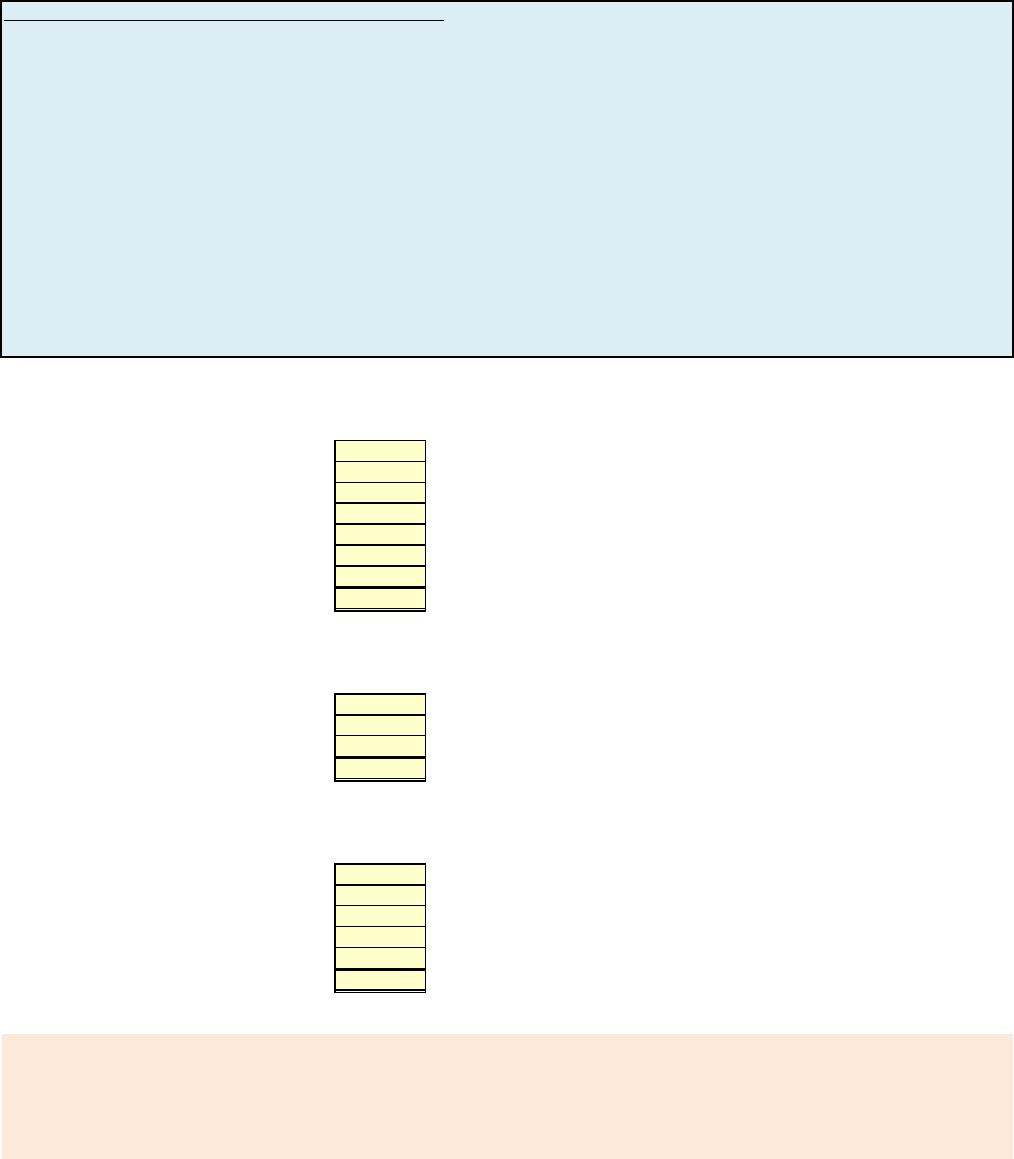
(a) Determine the total amount of manufacturing overhead.
Factory utilities Value
Depreciation on factory equipment Value
Indirect factory labor Value
Indirect materials Value
Factory manager’s salary Value
Property taxes on factory building Value
Factory repairs Value
Manufacturing overhead ?
(b) Determine the total amount of product costs.
Direct materials Value
Direct labor Value
Manufacturing overhead Value
Product costs ?
(c ) Determine the total amount of period costs.
Depreciation on delivery trucks Value
Sales salaries Value
Repair to office equipment Value
Advertising Value
Office supplies used Value
Period costs ?
After you have complete E1-4, consider the additional question.
1.
Assume that the following items changed: factory manager’s salary $16,000; direct materials
$151,000; property taxes $36,000; and, sales salaries $48,000. What impact do these changes
have on manufacturing overhead, product and period costs?
E1-4 Solution
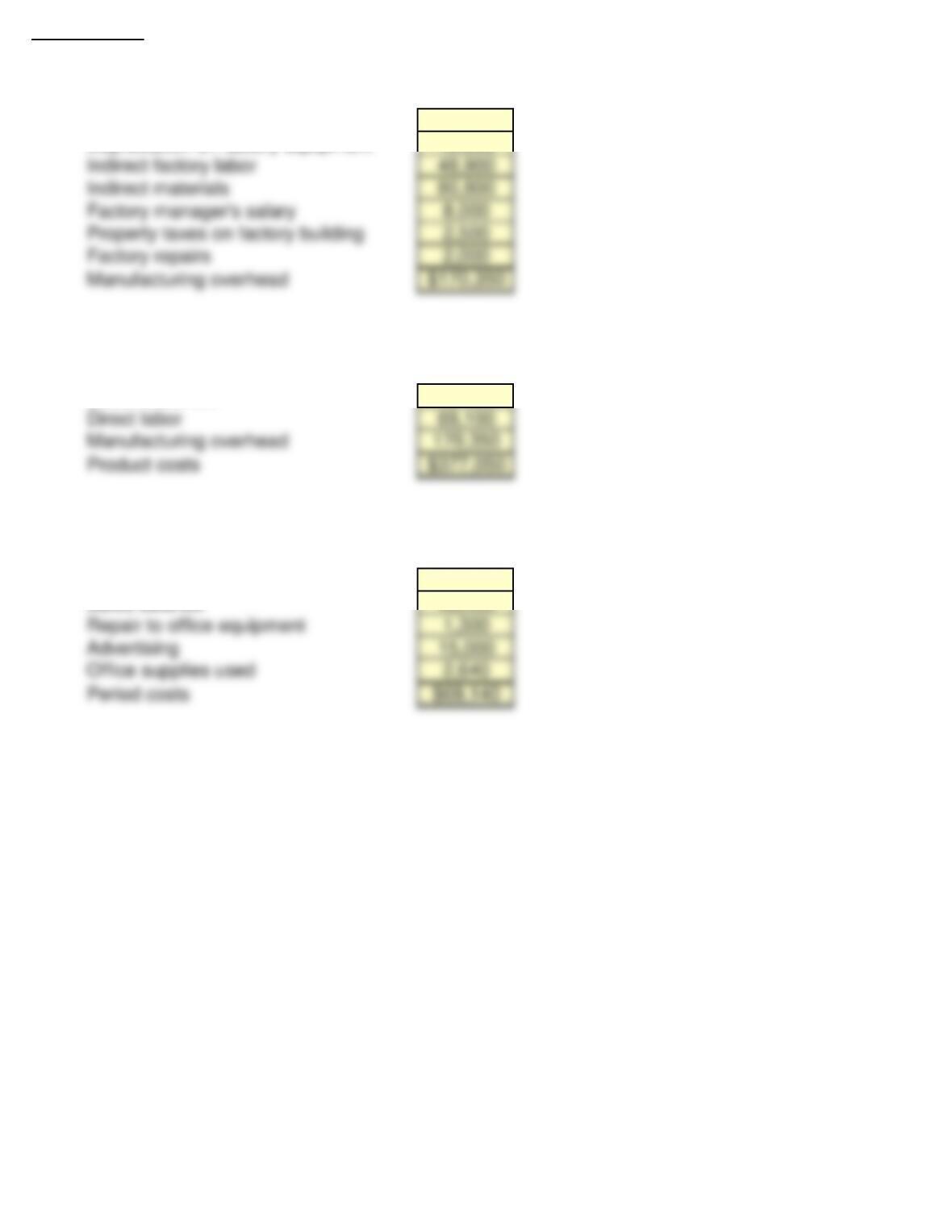
(a) Determine the total amount of manufacturing overhead.
Factory utilities $15,500
Depreciation on factory equipment 12,650
(b) Determine the total amount of product costs.
Direct materials $137,600
(c) Determine the total amount of period costs.
Depreciation on delivery trucks $3,800
Sales salaries 46,400
E1-4 Solution to additional question
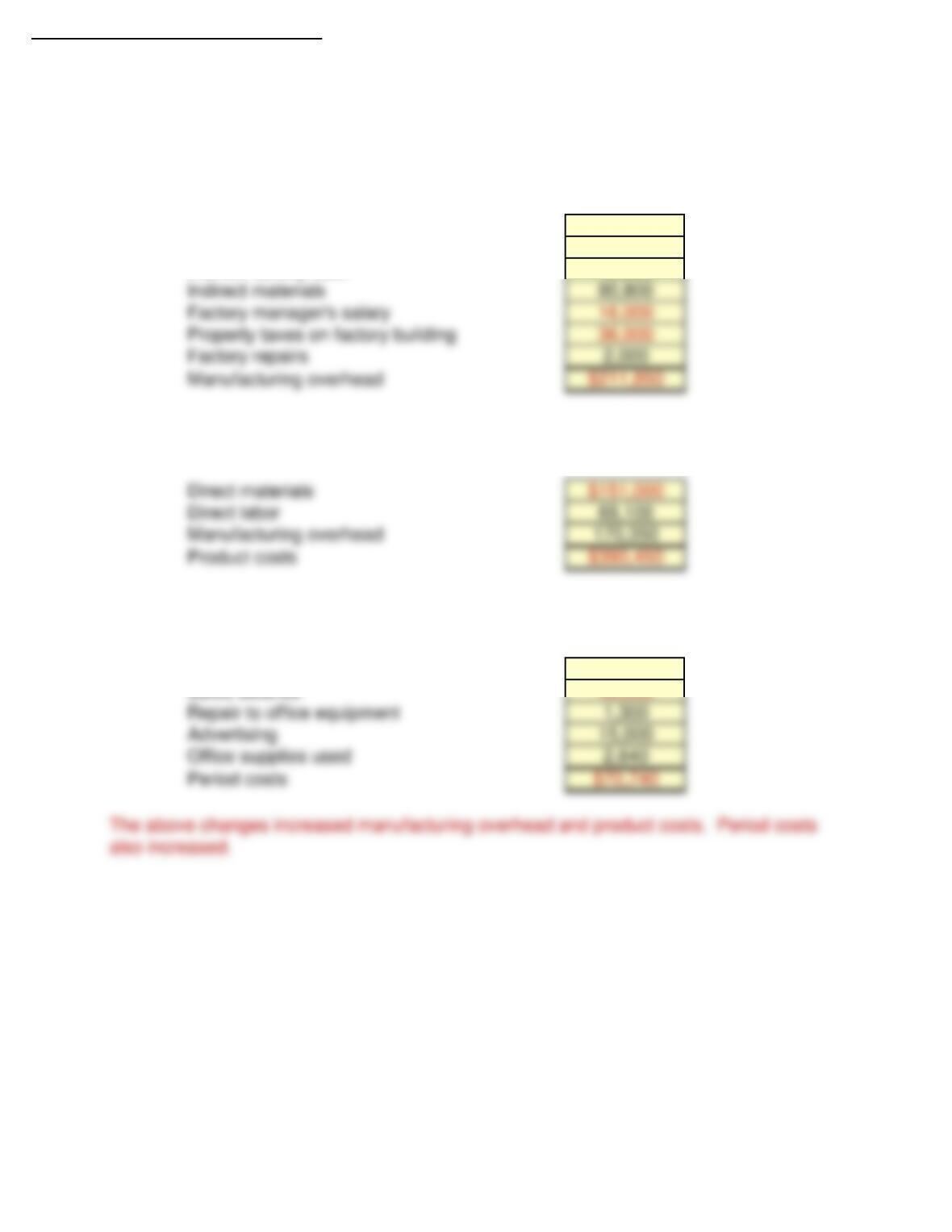
1. Assume that the following items changed: factory manager’s salary $16,000; direct materials
$151,000; property taxes $36,000; and, sales salaries $48,000. What impact do these changes
have on manufacturing overhead, product and period costs?
(a) Determine the total amount of manufacturing overhead.
Factory utilities $15,500
Depreciation on factory equipment 12,650
Indirect factory labor 48,900
(b) Determine the total amount of product costs.
(c) Determine the total amount of period costs.
Depreciation on delivery trucks 3,800
E1-12 Prepare a cost of goods manufactured schedule and a partial income statement
Cepeda Corporation has the following cost records for June 2017.
Indirect factory labor $4,500 Factory utilities $400
Direct materials used 20,000 Depreciation, factory equipment 1,400
Work in process, 6/1/17 3,000 Direct labor 40,000
Work in process, 6/30/17 3,800 Maintenance, factory equipment 1,800
Finished goods, 6/1/17 5,000 Indirect materials 2,200
Finished goods, 6/30/17 7,500 Factory manager’s salary 3,000
Instructions
(a) Prepare a cost of goods manufactured schedule for June 2017.
(b) Prepare an income statement through gross profit for June 2017 assuming sales revenue is
$92,100
NOTE: Enter a number in cells requesting a value; enter either a number or a formula in cells with a “?” .
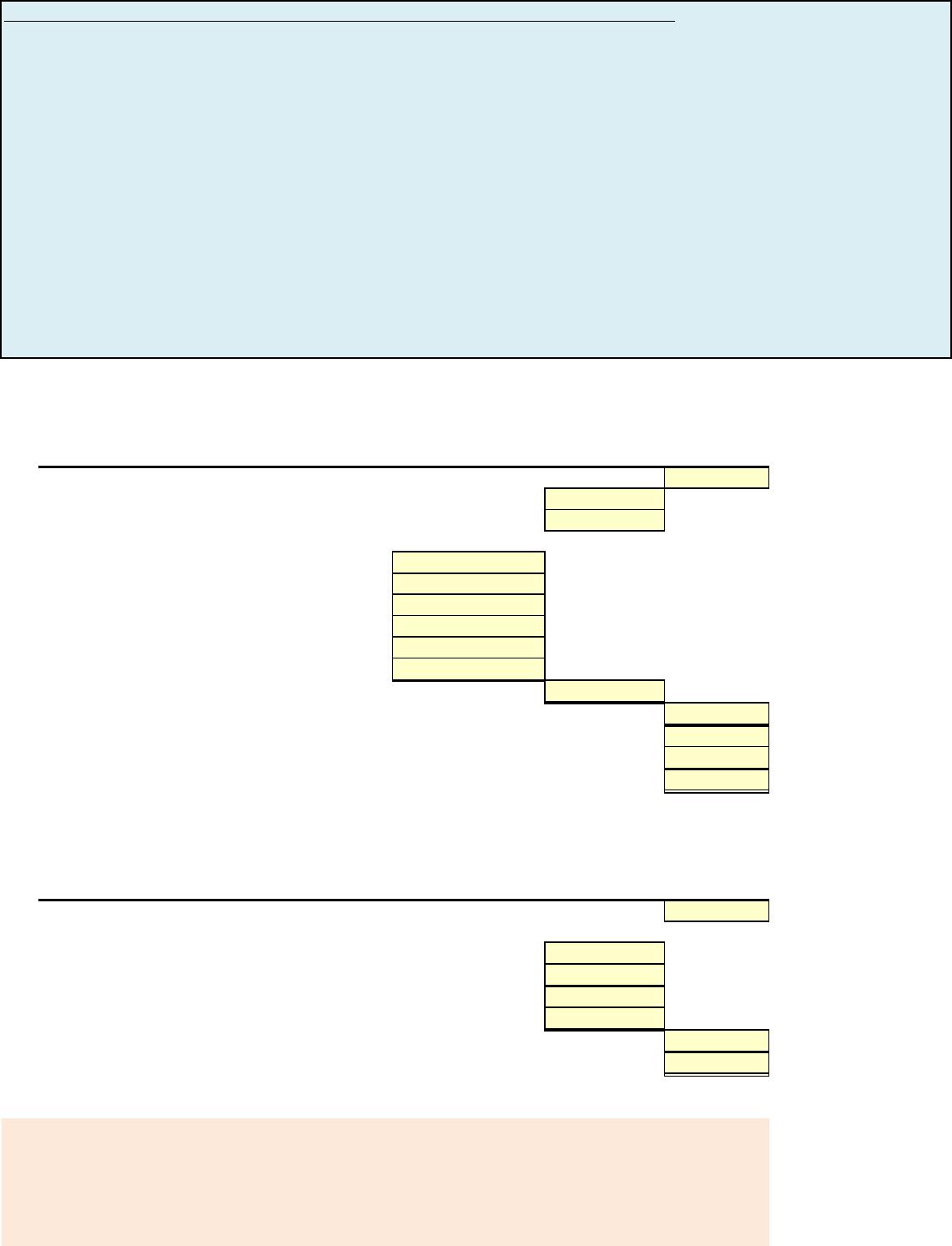
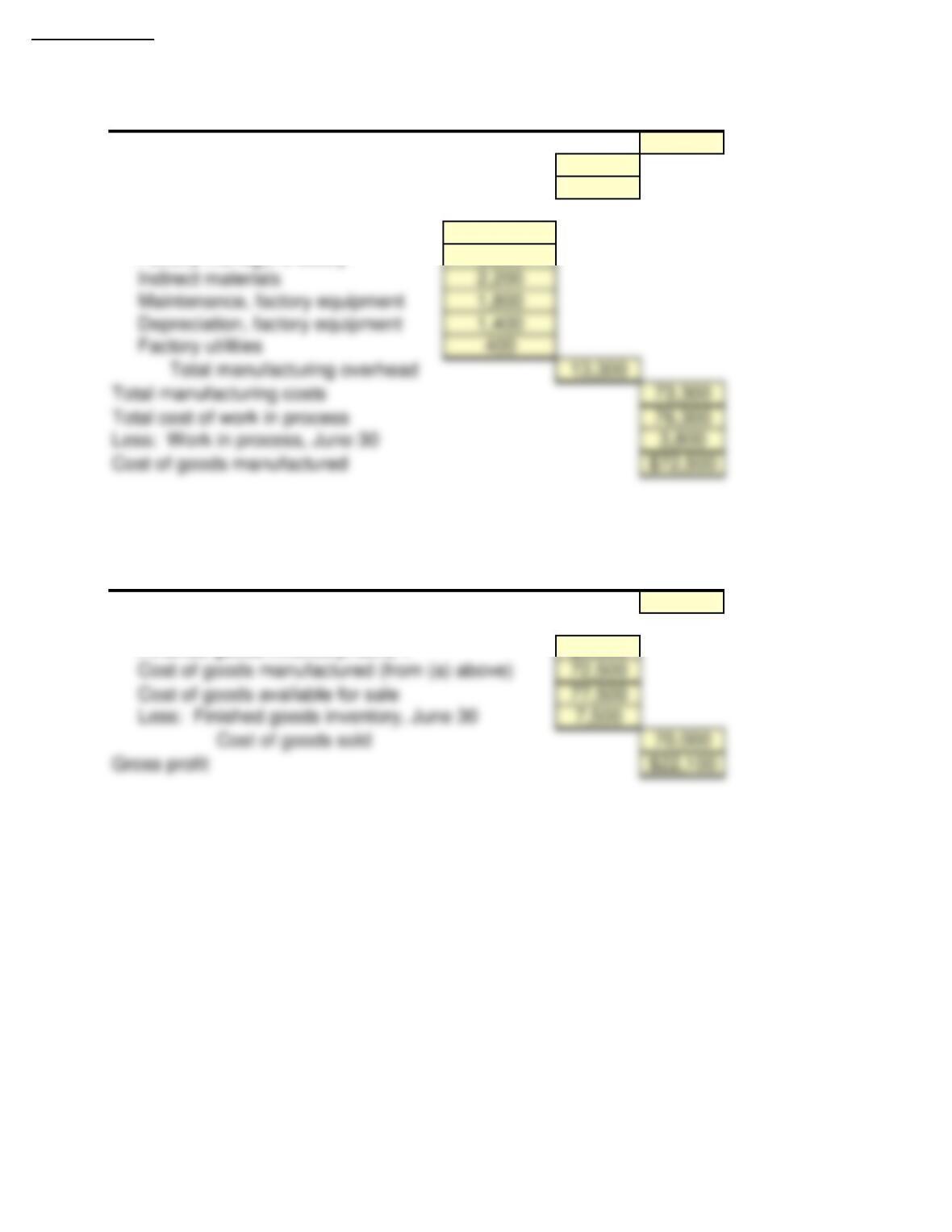
(a)
Work in process, June 1 Value
Direct materials used Value
Direct labor Value
Manufacturing overhead
Indirect labor Value
Factory manager’s salary Value
Indirect materials Value
Maintenance, factory equipment Value
Depreciation, factory equipment Value
Factory utilities Value
Total manufacturing overhead ?
Total manufacturing costs ?
Total cost of work in process ?
Less: Work in process, June 30 Value
Cost of goods manufactured ?
(b)
Sales Revenue Value
Cost of goods sold
Finished goods inventory, June 1 Value
Cost of goods manufactured [from (a) above] Value
Cost of goods available for sale ?
Less: Finished goods inventory, June 30 Value
Cost of goods sold ?
Gross profit ?
After you have completed E1-12, consider the following additional question.
1. Assume the following balances changed: beginning work in process $4,200, direct labor
$39,000, and indirect materials $2,700. Show the impact of these changes on the cost
of goods manufactured schedule.
For the Month Ended June 30, 2017
CEPEDA CORPORATION
Cost of Goods Manufactured Schedule
For the Month Ended June 30, 2017
CEPEDA CORPORATION
Income Statement (partial)
E1-12 Solution
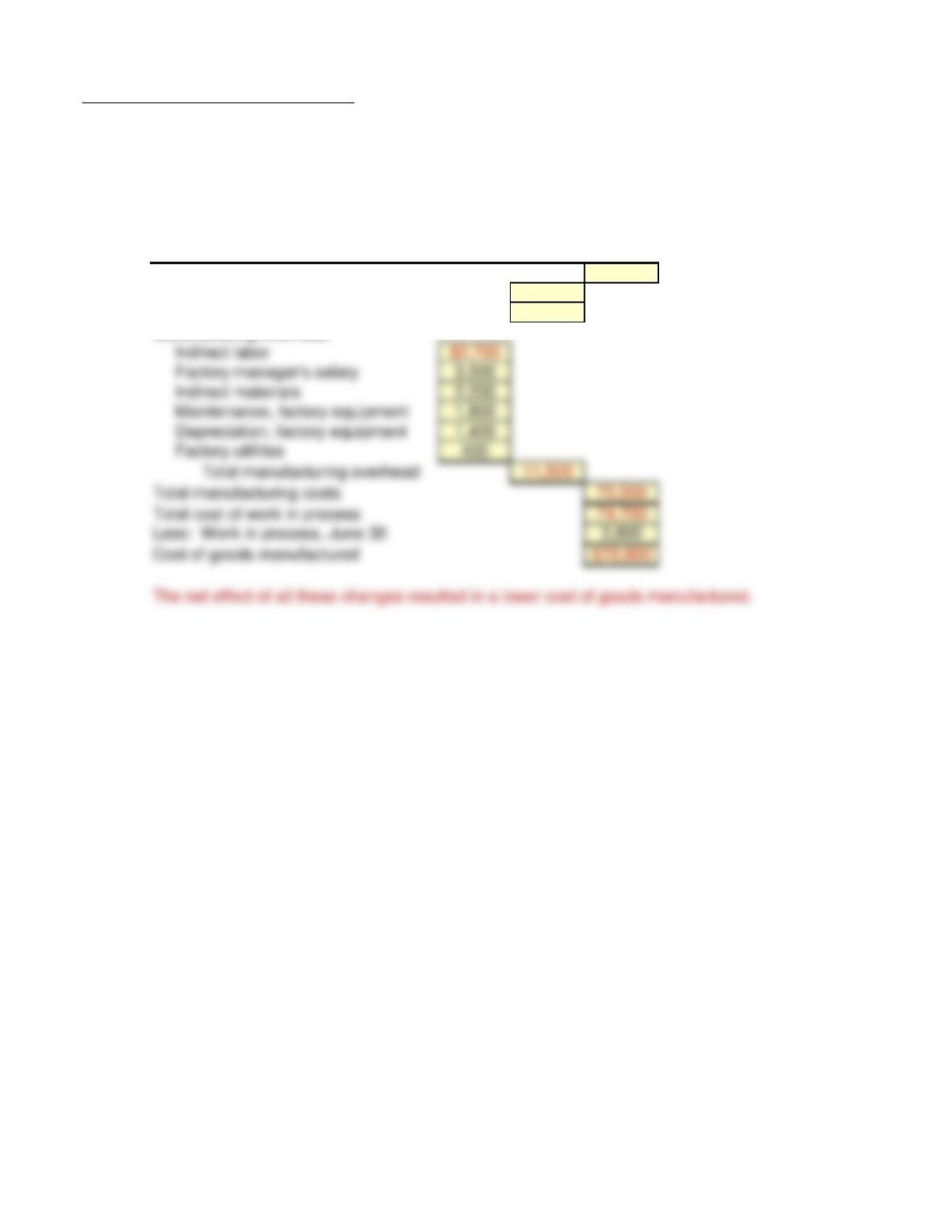
(a)
Work in process, June 1 $3,000
Direct materials used $20,000
Direct labor 40,000
Manufacturing overhead
Indirect labor $4,500
Factory manager’s salary 3,000
(b)
Sales Revenue $92,100
Cost of goods sold
Finished goods inventory, June 1 $5,000
For the Month Ended June 30, 2017
CEPEDA CORPORATION
Cost of Goods Manufactured Schedule
For the Month Ended June 30, 2017
CEPEDA CORPORATION
Income Statement (partial)
E1-12 Solution to additional question
1. Assume the following balances changed: beginning work in process $4,200, direct labor
$39,000, and indirect materials $2,700. Show the impact of these changes on the cost
of goods manufactured schedule.
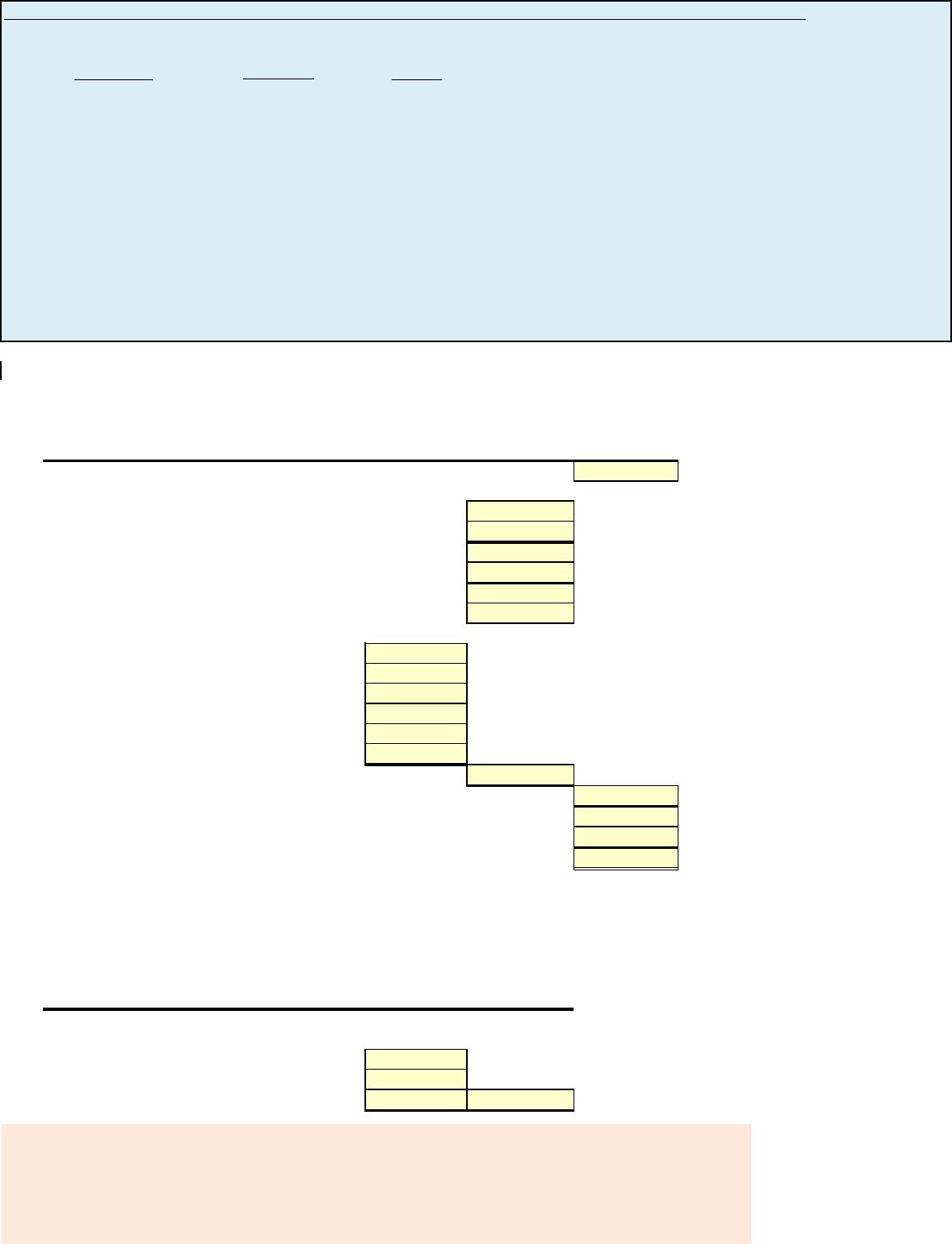
Work in process, June 1 $4,200
Direct materials used $20,000
Direct labor 39,000
Manufacturing overhead
CEPEDA CORPORATION
Cost of Goods Manufactured Schedule
For the Month Ended June 30, 2017
E1-16 Prepare a cost of goods manufactured schedule and present the ending inventories on the balance sheet
An analysis of the accounts of Roberts Company reveals the following manufacturing cost data for the month ended
June 30, 2017.
Inventories Beginning Ending
Raw materials $9,000 $13,100
Work in process 5,000 7,000
Finished goods 9,000 8,000
Costs incurred: raw materials purchases $54,000, direct labor $47,000, manufacturing overhead $19,900. The specific
overhead costs were: indirect labor $5,500, factory insurance, $4,000, machinery depreciation $4,000, machinery
repairs $1,800, factory utilities $3,100, miscellaneous factory costs $1,500. Assume that all raw materials used were
direct materials.
Instructions
(a) Prepare the cost of goods manufactured schedule for the month ended June 30, 2017.
(b) Show the presentation of the ending inventories on the June 30, 2017 balance sheet.
NOTE: Enter a number in cells requesting a value; enter either a number or a formula in cells with a “?” .
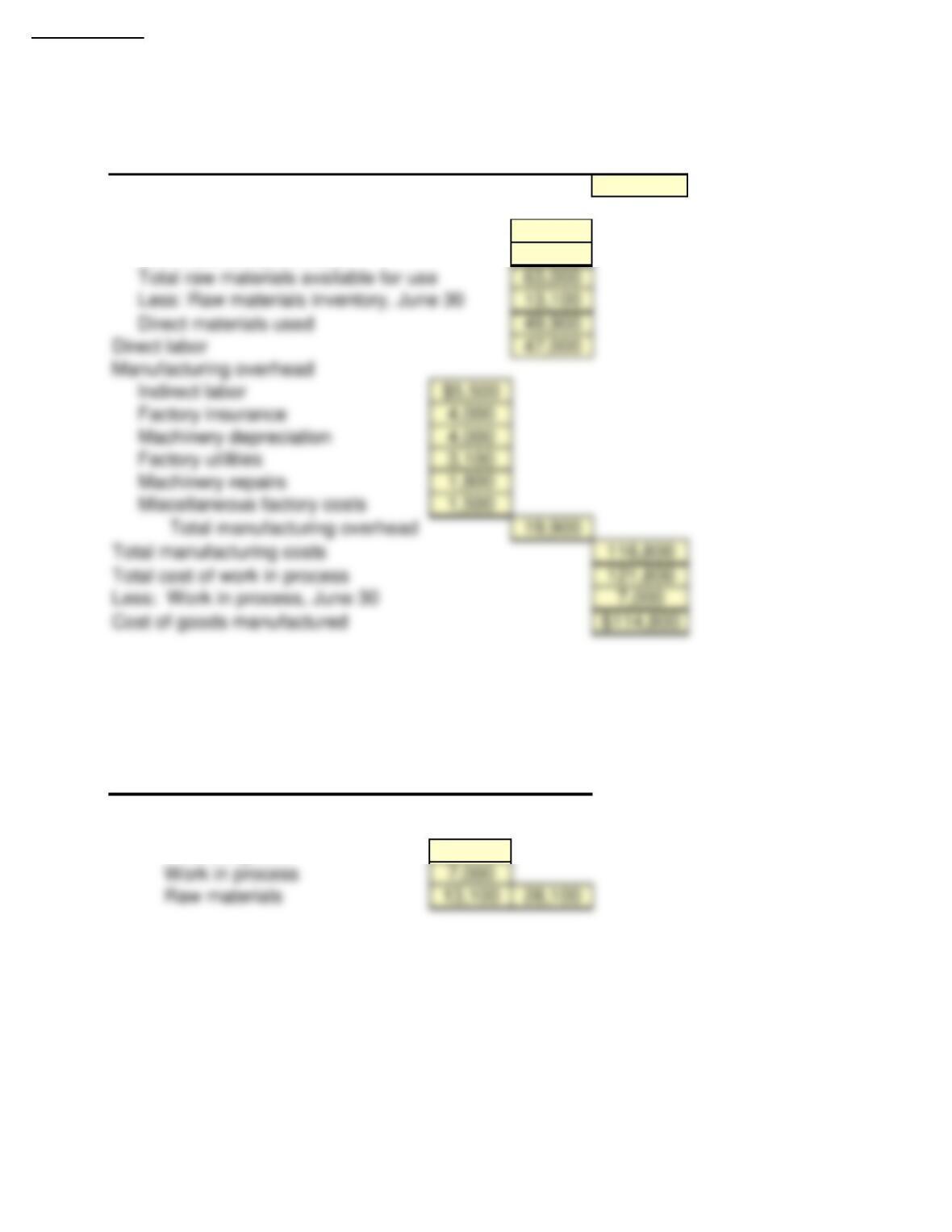
(a) Prepare the cost of goods manufactured schedule for the month ended June 30, 2017.
Work in process inventory, June 1 Value
Direct materials
Raw materials inventory, June 1 Value
Raw materials purchases Value
Total raw materials available for use ?
Less: Raw materials inventory, June 30 Value
Direct materials used
?
Direct labor Value
Manufacturing overhead
Indirect labor Value
Factory insurance Value
Machinery depreciation Value
Factory utilities Value
Machinery repairs Value
Miscellaneous factory costs Value
Total manufacturing overhead ?
Total manufacturing costs ?
Total cost of work in process ?
Less: Work in process, June 30 Value
Cost of goods manufactured ?
(b) Show the presentation of the ending inventories on the June 30, 2017 balance sheet.
Current assets
Inventories
Finished goods Value
Work in process Value
Raw materials Value ?
After you have completed E1-16, consider the additional question.
1. Assume that the inventory balances changed as follows: beginning raw materials $12,000,
ending work in process $6,750 and ending finished goods $10,000. Show the impact of these
changes on the cost of goods manufactured schedule and balance sheet.
June 30, 2017
ROBERTS COMPANY
Cost of Goods Manufactured Schedule
For the Month Ended June 30, 2017
ROBERTS COMPANY
(Partial) Balance Sheet
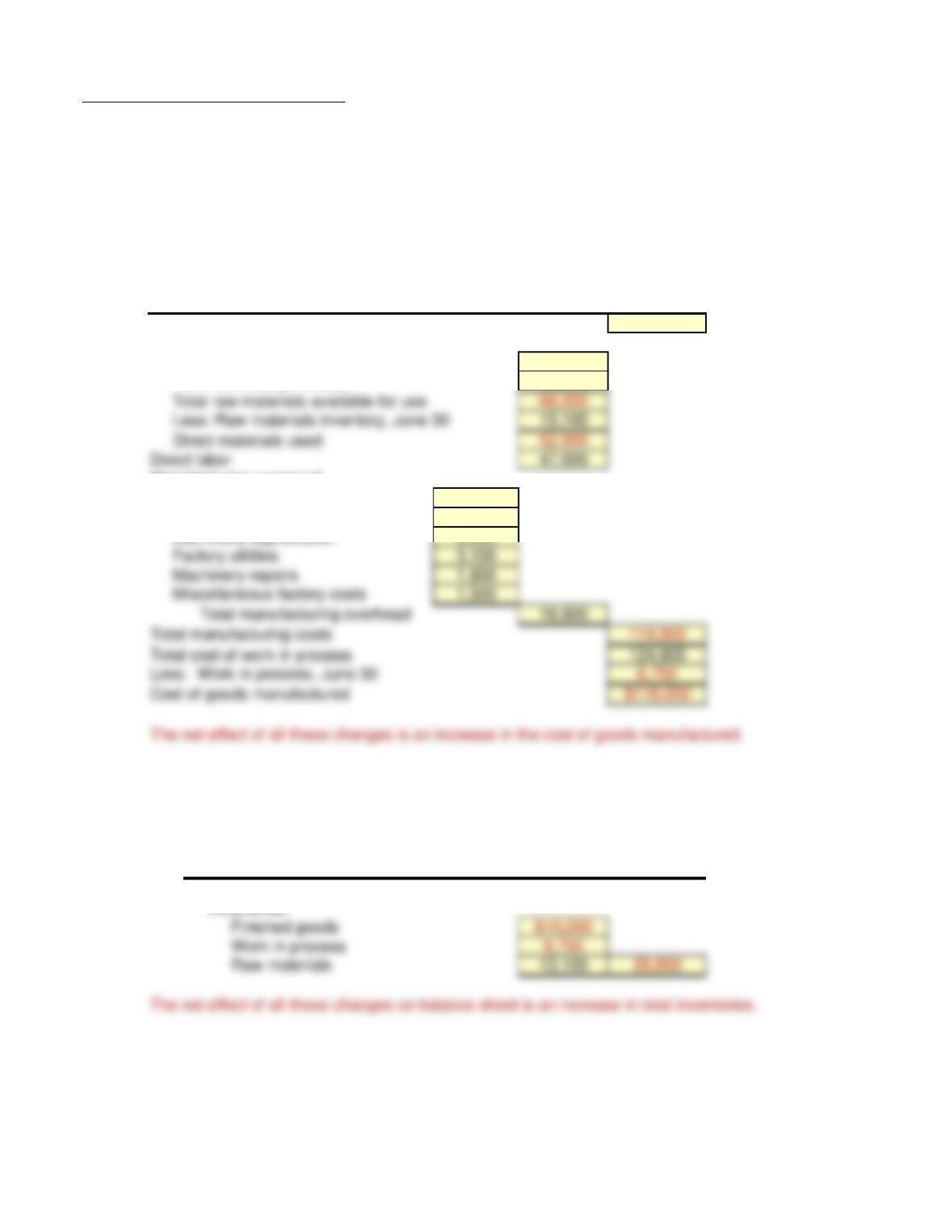
E1-16 Solution
(a) Prepare the cost of goods manufactured schedule for the month ended June 30, 2017.
Work in process inventory, June 1 $5,000
Direct materials
Raw materials inventory, June 1 $9,000
Raw materials purchases
54,000
(b) Show the presentation of the ending inventories on the June 30, 2017 balance sheet.
Current assets
Inventories
Finished goods $8,000
June 30, 2017
ROBERTS COMPANY
Cost of Goods Manufactured Schedule
For the Month Ended June 30, 2017
ROBERTS COMPANY
(Partial) Balance Sheet
Cost of goods manufactured
E1-16 Solution to additional question
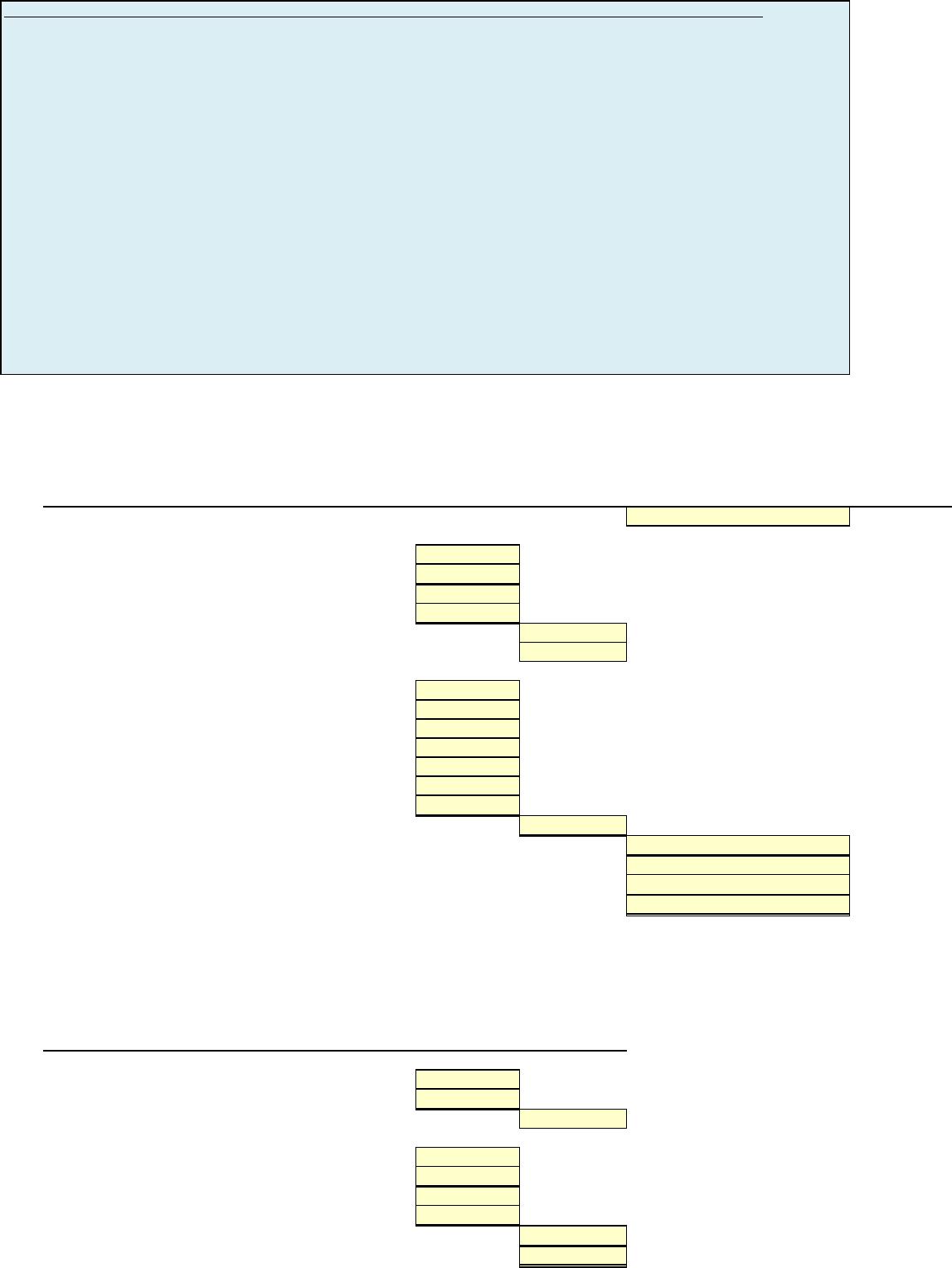
1. Assume that the inventory balances changed as follows: beginning raw materials $12,000,
ending work in process $6,750 and ending finished goods $10,000. Show the impact of these
changes on the cost of goods manufactured schedule and balance sheet.
(a)
Prepare the cost of goods manufactured schedule for the month ended June 30, 2017.
Work in process inventory, June 1 $5,000
Direct materials
Raw materials inventory, June 1 $12,000
Raw materials purchases 54,000
Manufacturing overhead
Indirect labor $5,500
Factory insurance 4,000
(b) Show the presentation of the ending inventories on the June 30, 2017 balance sheet.
Current assets
June 30, 2017
ROBERTS COMPANY
Cost of Goods Manufactured Schedule
For the Month Ended June 30, 2017
ROBERTS COMPANY
(Partial) Balance Sheet
P1-4A Prepare a cost of goods manufactured schedule, a partial income statement, and a partial balance sheet
The following data were taken from the records of Clarkson Company for the fiscal year ended June 30, 2017.
Raw Materials Inventory,7/1/16 $48,000 $16,000
Raw Materials Inventory, 6/30/17 39,600 Factory Utilities 27,600
Finished Goods Inventory, 7/1/16 96,000 Office Utilities Expense 8,650
Finished Goods Inventory, 6/30/17 75,900 Sales Revenue 534,000
Work in Process Inventory, 7/1/16 19,800 Sales Discounts 4,200
Work in Process Inventory, 6/30/17 18,600 Plant Manager’s Salary 58,000
Direct Labor 139,250 Factory Property Taxes 9,600
Indirect Labor 24,460 Factory Repairs 1,400
Accounts Receivable 27,000 Raw Materials Purchases 96,400
Factory Insurance 4,600 Cash 32,000
Instructions
(a) Prepare a cost of goods manufactured schedule. (Assume all raw materials used were direct materials.)
(b) Prepare an income statement through gross profit.
(c) Prepare the current assets section of the balance sheet at June 30, 2017.
NOTE: Enter a number in cells requesting a value; enter either a number or a formula in cells with a “?” .
(a) Prepare a cost of goods manufactured schedule. (Assume all raw materials used were direct materials.)
Work in process inventory, July 1, 2016 Value
Direct materials
Raw materials inventory, July 1, 2016 Value
Raw materials purchases Value
Total raw materials available for use ?
Less: Raw materials inventory, June 30, 2017 Value
Direct materials used ?
Direct labor Value
Manufacturing overhead
Plant manager’s salary Value
Factory utilities Value
Indirect labor Value
Factory machinery depreciation Value
Factory property taxes Value
Factory insurance Value
Factory repairs Value
Total manufacturing overhead ?
Total manufacturing costs ?
Total cost of work in process ?
Less: Work in process, June 30 Value
Cost of goods manufactured ?
(b) Prepare an income statement through gross profit.
Sales Revenues
Sales Revenue Value
Less: Sales discounts Value
Net Sales ?
Cost of goods sold
Finished goods inventory, July 1, 2016 Value
Cost of goods manufactured Value
Cost of goods available for sale ?
Less: Finished goods inventory, June 30, 2017 Value
Cost of goods sold ?
Gross profit ?
Factory Machinery Depreciation
CLARKSON COMPANY
Cost of Goods Manufactured Schedule
For the Year Ended June 30, 2017
CLARKSON COMPANY
(Partial) Income Statement
For the Year Ended June 30, 2017

(c) Prepare the current assets section of the balance sheet at June 30, 2017.
Current assets
Cash Value
Accounts Receivable Value
Inventories
Finished goods Value
Work in process Value
Raw materials Value ?
Total current assets ?
After you have completed P1-4A, consider the additional question.
1. Assume that in preparing the cost of goods manufactured schedule, several errors were made. Raw materials purchases,
sales revenue and factory depreciation should have been $106,400, $584,000 and $18,000 respectively. Show the impact
of these changes on the cost of goods manufactured schedule, income statement and balance sheet.
Assets
CLARKSON COMPANY
(Partial) Balance Sheet
June 30, 2017
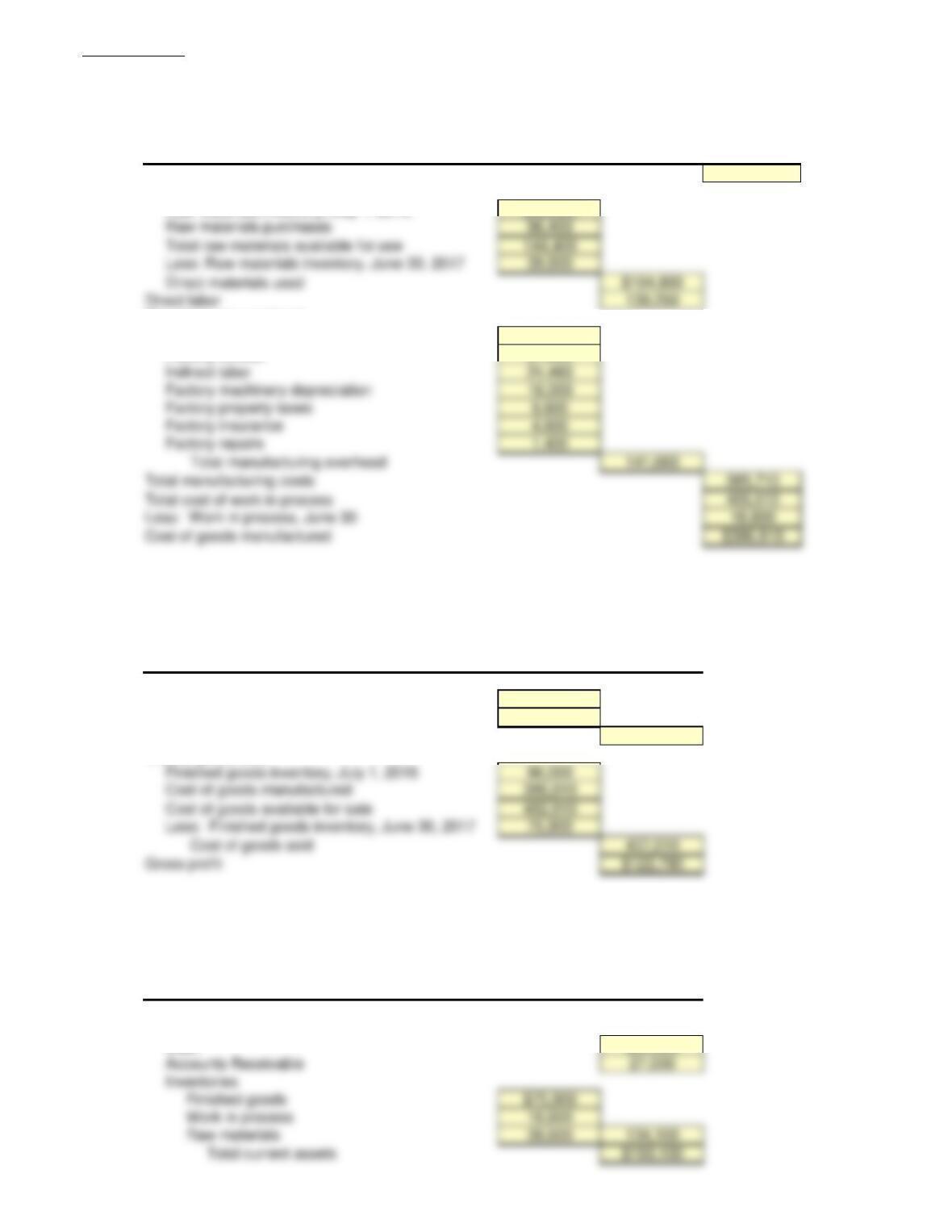
P1-4A Solution
(a) Prepare a cost of goods manufactured schedule. (Assume all raw materials used were direct materials.)
Work in process inventory, July 1, 2016 $19,800
Direct materials
Raw materials inventory, July 1, 2016 $48,000
Manufacturing overhead
Plant manager’s salary $58,000
Factory utilities 27,600
(b) Prepare an income statement through gross profit.
Sales Revenues
Sales Revenue $534,000
Less: Sales discounts 4,200
Net Sales $529,800
Cost of goods sold
(c ) Prepare the current assets section of the balance sheet at June 30, 2017.
Current assets
Cash $32,000
June 30, 2017
Assets
CLARKSON COMPANY
(Partial) Income Statement
For the Year Ended June 30, 2017
CLARKSON COMPANY
Cost of Goods Manufactured Schedule
For the Year Ended June 30, 2017
CLARKSON COMPANY
(Partial) Balance Sheet
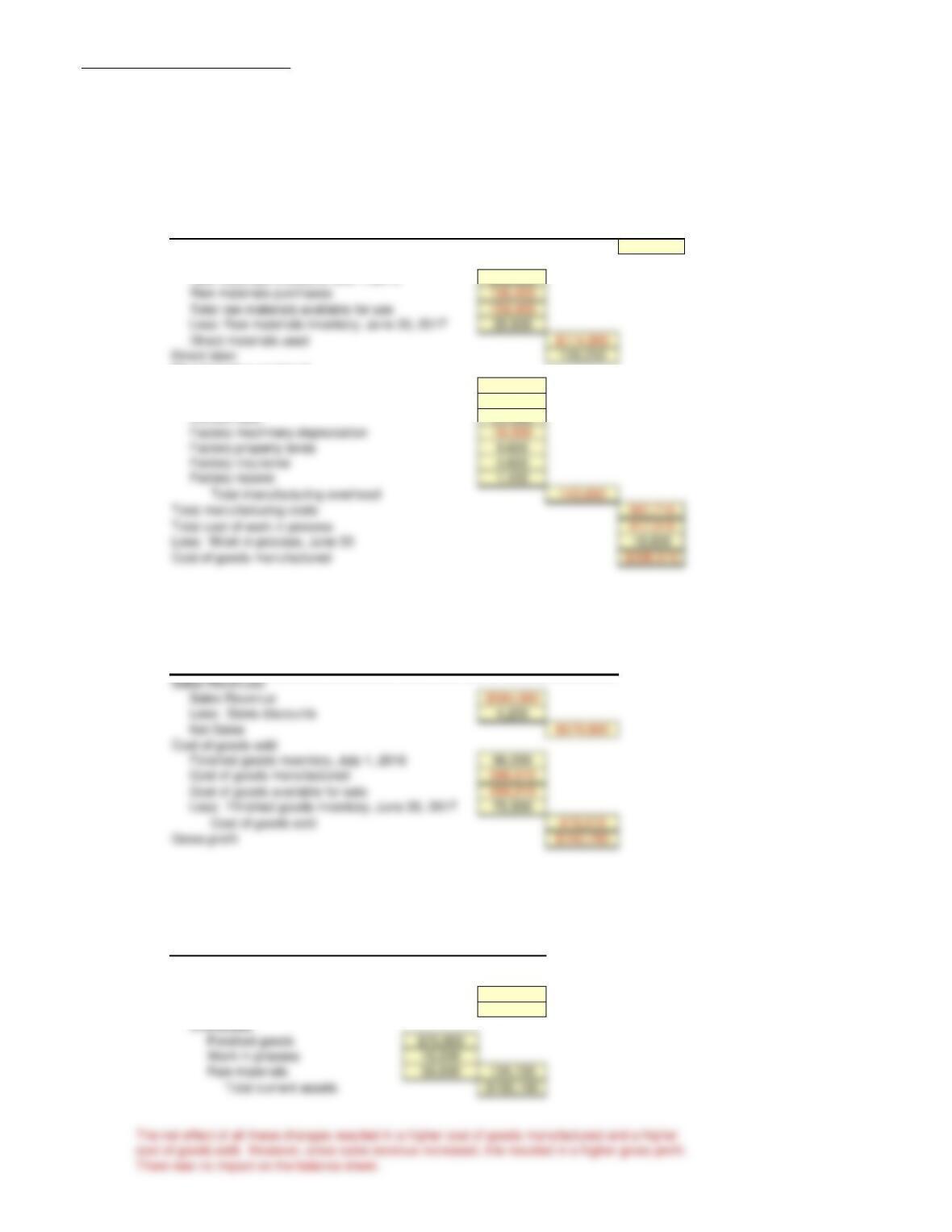
P1-4A Solution to additional question
1. Assume that in preparing the cost of goods manufactured schedule, several errors were made. Raw materials purchases,
sales revenue and factory depreciation should have been $106,400, $584,000 and $18,000 respectively. Show the impact
of these changes on the cost of goods manufactured schedule, income statement and balance sheet.
(a) Prepare a cost of goods manufactured schedule. (Assume all raw materials used were direct materials.)
Work in process inventory, July 1, 2016 $19,800
Direct materials
Raw materials inventory, July 1, 2016
Sales Revenue
Cost of goods sold
$48,000
Manufacturing overhead
Plant manager’s salary $58,000
Factory utilities 27,600
(b) Prepare an income statement through gross profit.
(c ) Prepare the current assets section of the balance sheet at June 30, 2017.
Current assets
Cash $32,000
Accounts Receivable 27,000
For the Year Ended June 30, 2017
CLARKSON COMPANY
(Partial) Balance Sheet
June 30, 2017
Assets
CLARKSON COMPANY
Cost of Goods Manufactured Schedule
For the Year Ended June 30, 2017
CLARKSON COMPANY
(Partial) Income Statement
P1-5A Prepare a cost of goods manufactured schedule and a correct income statement
Empire Company is a manufacturer of smart phones. Its controller resigned in October 2017.
An inexperienced assistant accountant has prepared the following income statement for
the month of October 2017.
Sales Revenue $780,000
Less: Operating Expenses
Raw materials purchases $264,000
Direct labor costs 190,000
Advertising expense 90,000
Selling and administrative salaries 75,000
Rent on factory facilities 60,000
Depreciation on sales equipment 45,000
Depreciation on factory equipment 31,000
Indirect labor cost 28,000
Utilities expense 12,000
Insurance expense 8,000 $803,000
Net loss ($23,000)
Prior to October 2017, the company had been profitable every month. The company‘s president is concerned
about the accuracy of the income statement. As her friend, you have been asked to review the income statement
and make necessary corrections. After examining other manufacturing cost data, you have acquired additional
information as follows.
1. Inventory balances at the beginning and end of October were:
October 1 October 31
Raw materials $18,000 $29,000
Work in process 20,000 14,000
Finished goods 30,000 50,000
2. Only 75% of the utilities expense and 60% of the insurance expense apply to factory
operations. The remaining amounts should be charged to selling and administrative
activities.
Instructions
(a) Prepare a schedule of cost of goods manufactured for October 2017.
(b) Prepare a correct income statement for October 2017.
NOTE: Enter a number in cells requesting a value; enter either a number or a formula in cells with a “?” .
(a) Prepare a schedule of cost of goods manufactured for October 2017.
Work in process inventory, October 1 Value
Direct materials
Raw materials inventory, October 1 Value
Raw materials purchases Value
Total raw materials available for use ?
Less: Raw materials inventory, October 31 Value
Direct materials used ?
Direct labor Value
Manufacturing overhead
Factory facility rent Value
Depreciation on factory equipment Value
For the Month Ended October 31, 2017
EMPIRE COMPANY
income Statement
For the Month Ended October 31, 2017
EMPIRE COMPANY
Cost of Goods Manufactured Schedule
Indirect labor Value
Factory utilities ?
Factory insurance ?
Total manufacturing overhead ?
Total manufacturing costs ?
Total cost of work in process ?
Less: Work in process, October 31 Value
Cost of goods manufactured ?
(b) Prepare a correct income statement for October 2017.
Sales Revenue Value
Cost of goods sold
Finished goods inventory, October 1 Value
Cost of goods manufactured ?
Cost of goods available for sale ?
Less: Finished goods inventory, October 31 Value
Cost of goods sold ?
Gross profit ?
Operating expenses
Advertising expense Value
Selling and administrative salaries Value
Depreciation expense – sales equipment Value
Insurance expense ?
Utilities expense ?
Total operating expenses ?
Net income ?
After you have completed P1-5A, consider the additional question.
1. Assume that utilities expense and insurance expense changed to $15,000 and $9,000 respectively. Also assume
that 80% of utilities expense and 65% of insurance expense apply to factory operations. Show the impact of these
changes on the cost of goods manufactured schedule and the income statement.
For the Month Ended October 31, 2017
EMPIRE COMPANY
Income Statement
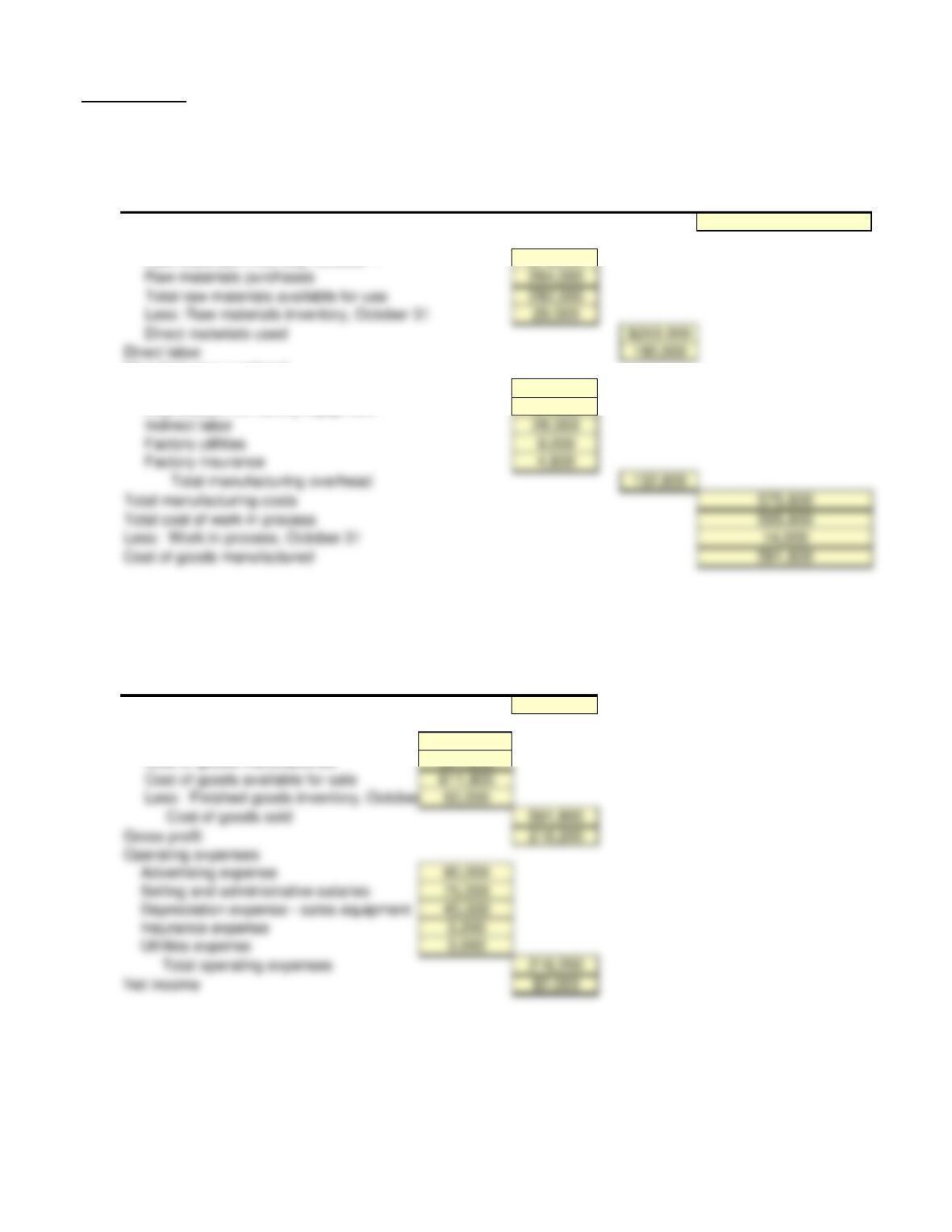
P1-5A Solution
(a) Prepare a schedule of cost of goods manufactured for October 2017.
Work in process inventory, October 1 $20,000
Direct materials
Raw materials inventory, October 1 $18,000
Manufacturing overhead
Factory facility rent $60,000
Depreciation on factory equipment 31,000
(b) Prepare a correct income statement for October 2017.
Sales Revenue $780,000
Cost of goods sold
Finished goods inventory, October 1 $30,000
Cost of goods manufactured 581,800
For the Month Ended October 31, 2017
Income Statement
EMPIRE COMPANY
EMPIRE COMPANY
Cost of Goods Manufactured Schedule
For the Month Ended October 31, 2017
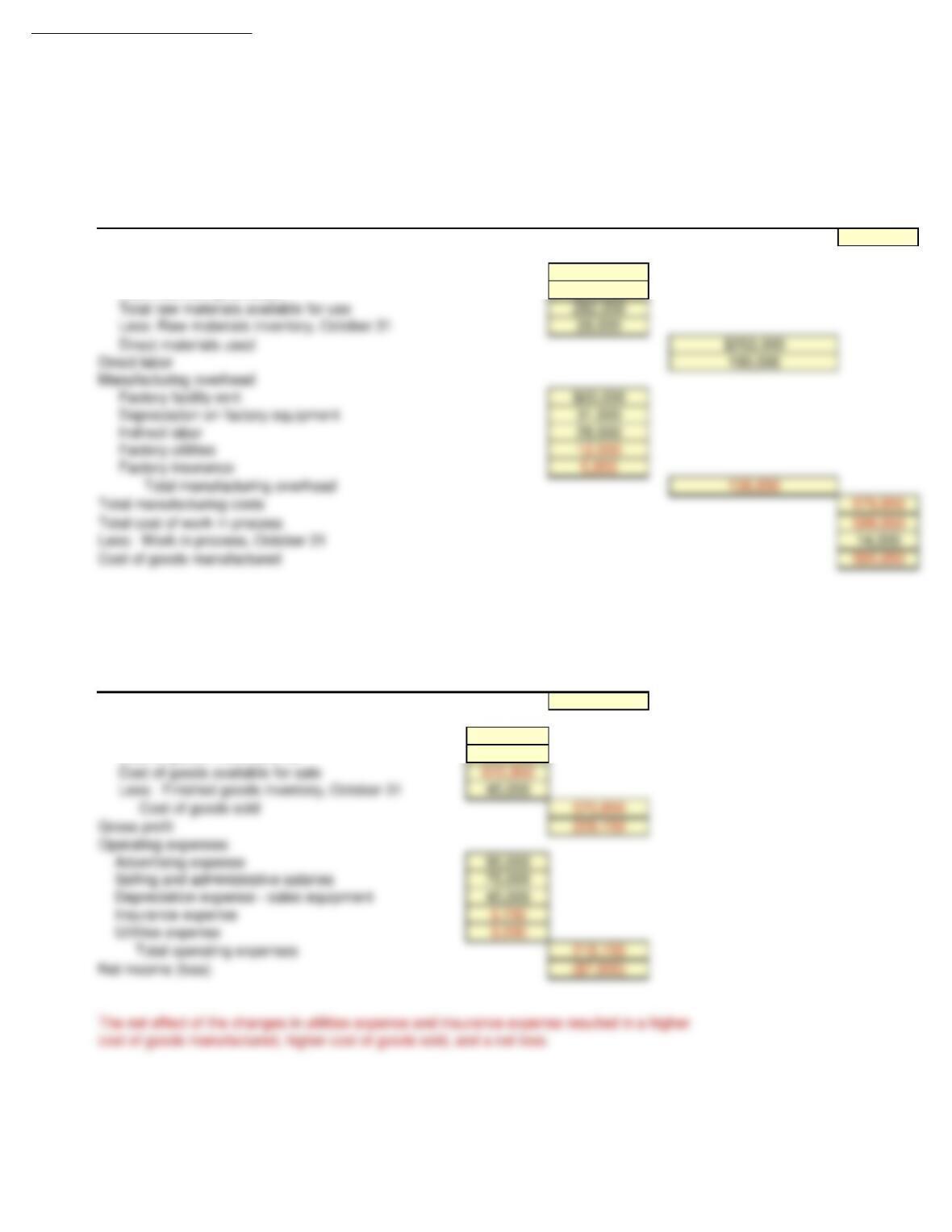
P1-5A Solution to additional question
1. Assume that utilities expense and insurance expense changed to $15,000 and $9,000 respectively. Also assume
that 80% of utilities expense and 65% of insurance expense apply to factory operations. Show the impact of these
changes on the cost of goods manufactured schedule and the income statement.
(a) Prepare a schedule of cost of goods manufactured for October 2017.
Work in process inventory, October 1 $20,000
Direct materials
Raw materials inventory, October 1 $18,000
Raw materials purchases 264,000
(b) Prepare a correct income statement for October 2017.
Sales Revenue $780,000
Cost of goods sold
Finished goods inventory, October 1 $30,000
Cost of goods manufactured 585,850
Income Statement
For the Month Ended October 31, 2017
EMPIRE COMPANY
Cost of Goods Manufactured Schedule
For the Month Ended October 31, 2017
EMPIRE COMPANY

CD1 -Excel Tutorial
Mike Cichanowski founded Wenonah Canoe and later purchased Current designs, a company that designs and
manufactures kayaks. The kayak-manufacturing facility is located just a few minutes from the canoe company‘s
headquarters in Winona, Minnesota.
Current Designs makes kayaks using two different processes. (See www.cdkayak.com/craftsmanship/index.php
for the details of each method.) The rotational molding process uses high temperature to melt polyethylene powder
in a closed rotating metal mold to produce a complete kayak hull and deck in a single piece. These kayaks are less
labor-intensive and less expensive for the company to produce and sell.
Its other kayaks use the vacuum-bagged composite lamination process (which we will refer to as the composite
process). Layers of fiberglass or Kevlar® are carefully placed by hand in a mold and are bonded with resin. Then, a
high-pressure vacuum is used to eliminate any excess resin that would otherwise add weight and reduce strength
of the finished kayak. These kayaks require a great deal of skilled labor as each boat is individually finished. The
exquisite finish of the vacuum-bagged composite kayaks gave rise to Current Designs’ tag line, “A work of art, made
for life.”
Current Designs has the following managers:
Mike Cichanowski, CEO
Diane Buswell, Controller
Deb Welch, Purchasing Manager
Bill Johnson, Sales Manager
Dave Thill, Kayak Plant Manager
Rick Thrune, Production Manager for Composite Kayaks
Instructions
(a) What are the primary information needs of each manager?
(b) Name one special-purpose management accounting report that could be designed for each manager:
Include the name of the report, the information it would contain, and how frequently it should be
issued.
(c ) When Diane Buswell, controller for Current Designs, reviewed the accounting records for a recent period,
she noted the following items. Classify each item as a product cost or a period cost. If an item is a product
cost, note if it is a didrect materials, direct labor, or manufacturing overhead item.
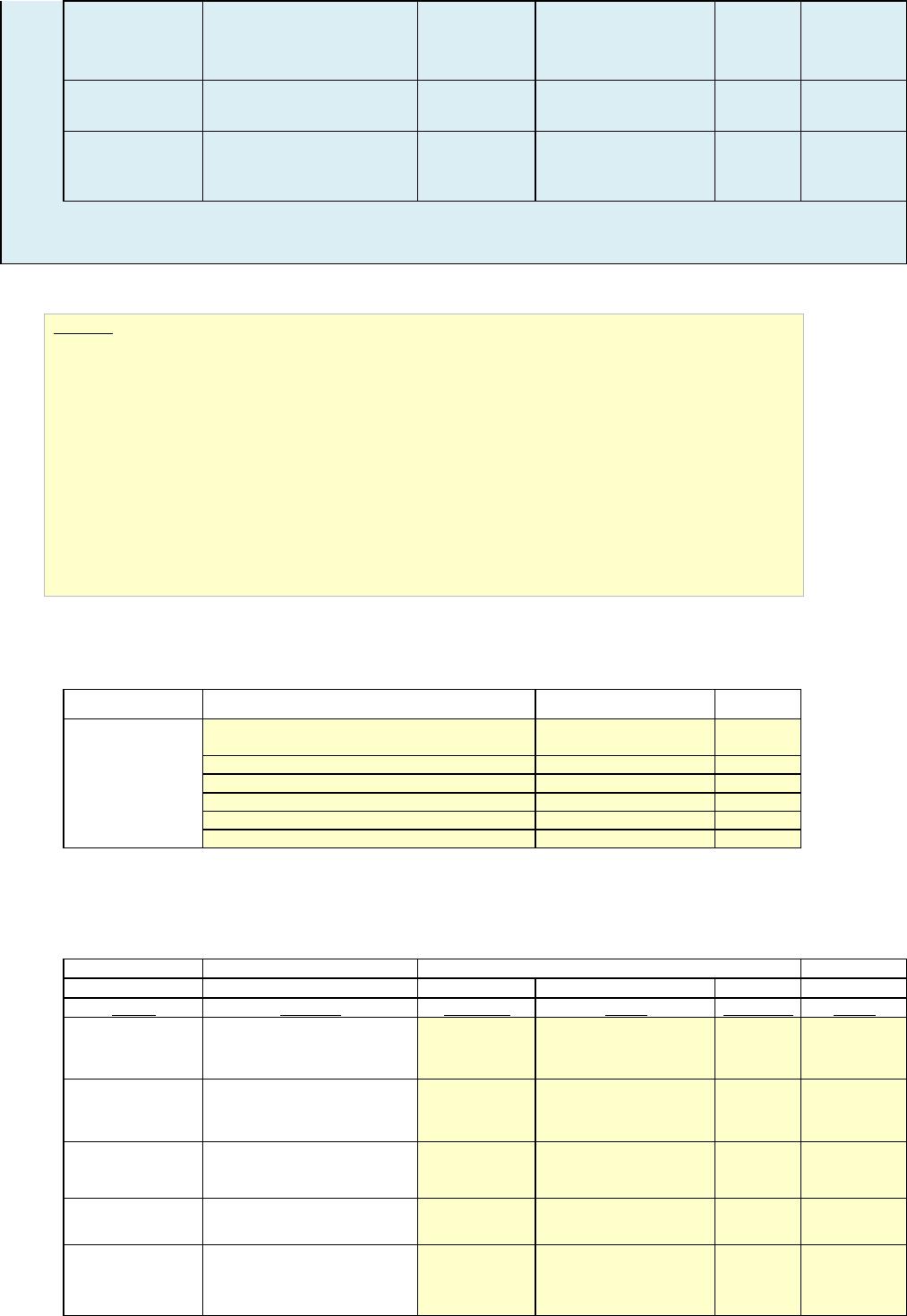
Direct Direct Mfg. Period
Payee Purpose Materials Labor Overhead Costs
Winona Agency
Property insurance for the
manufacturing plant
Bill Johnson (sales
manager)
Payroll check – payment to
sales manager
Xcel Energy
Electricity for manufacturing
plant
Winona Printing Price lists for salespeople
Jim Kaiser (sales
representative)
Sales commissions
Dave Thill (plant
manager)
Payroll check – payment to
plant manager
Dana Schultz
(kayak assembler)
Payroll check – payment to
kayak assembler
Composite One
Bagging film used when
kayaks are assembled; it is
discarded after use.
Fastenal
Shop supplies – brooms, paper
towels, etc.
Ravago
Polyethylene powder which is
the main ingredient for the
rotational molded kayaks.
Winona County
Property taxes on
manufacturing plant
Product Costs
North American
Composites
Kevlar ® fabric for composite
kayaks
Waste
Management
Trash disposal for the
company office building
None
Journal entry to record
depreciation of manufacturing
equipment
NOTE: Enter a number in cells requesting a value; enter either a number or a formula in cells with a “?” .
(a) What are the primary information needs of each manager?
(b) Name one special-purpose management accounting report that could be designed for each manager.
Include the name of the report, the information it would contain, and how frequently it should be issued.
Manager Report content
Report
frequency
Mike Cichanowski
Diane Buswell
Deb Welch
Bill Johnson
Dave Thill
Rick Thrune
(c ) When Diane Buswell, controller for Current Designs, reviewed the accounting records for a recent period, she noted the following items.
Classify each item as a product cost or a period cost. If a cost is a product cost, note if it is a direct materials, direct labor, or manufacturing
overhead item by placing an “X” in the appropriate box below.
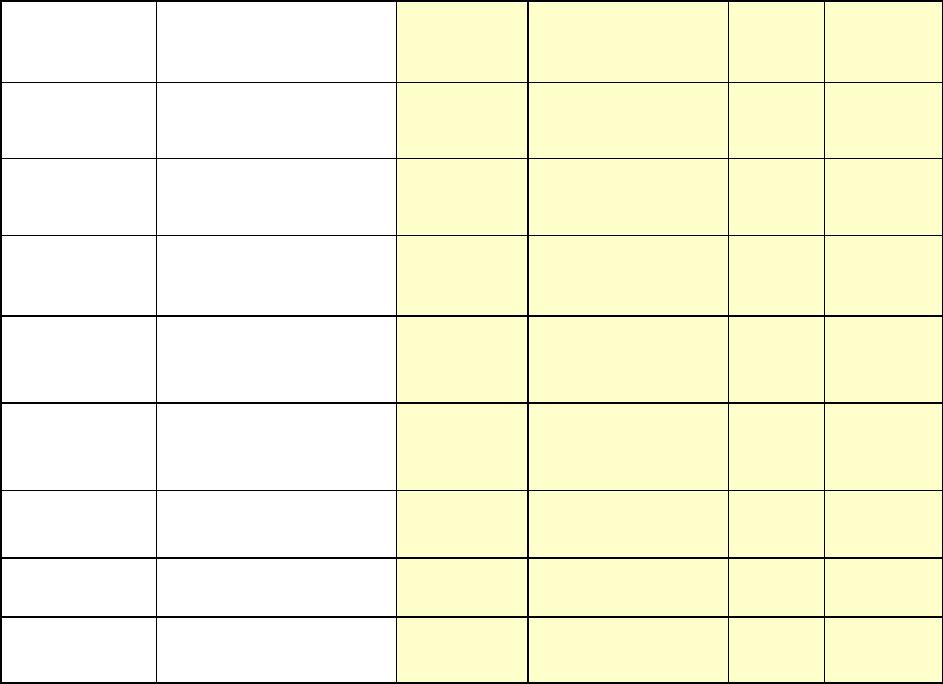
Direct Direct Mfg. Period
Payee Purpose Materials Labor Overhead Costs
Winona Agency
Property insurance for the
manufacturing plant
Bill Johnson (sales
manager)
Payroll check – payment to
sales manager
Xcel Energy
Electricity for manufacturing
plant
Winona Printing Price lists for salespeople
Jim Kaiser (sales
representative)
Sales commissions
Product Costs
Name of report
Response:
Dave Thill (plant
manager)
Payroll check – payment to
plant manager
Dana Schultz
(kayak assembler)
Payroll check – payment to
kayak assembler
Composite One
Bagging film used when
kayaks are assembled; it is
discarded after use.
Fastenal
Shop supplies – brooms, paper
towels, etc.
Ravago
Polyethylene powder which is
the main ingredient for the
rotational molded kayaks.
Winona County
Property taxes on
manufacturing plant
North American
Composites
Kevlar ® fabric for composite
kayaks
Waste
Management
Trash disposal for the
company office building
None
Journal entry to record
depreciation of manufacturing
equipment
CD1 – Solution
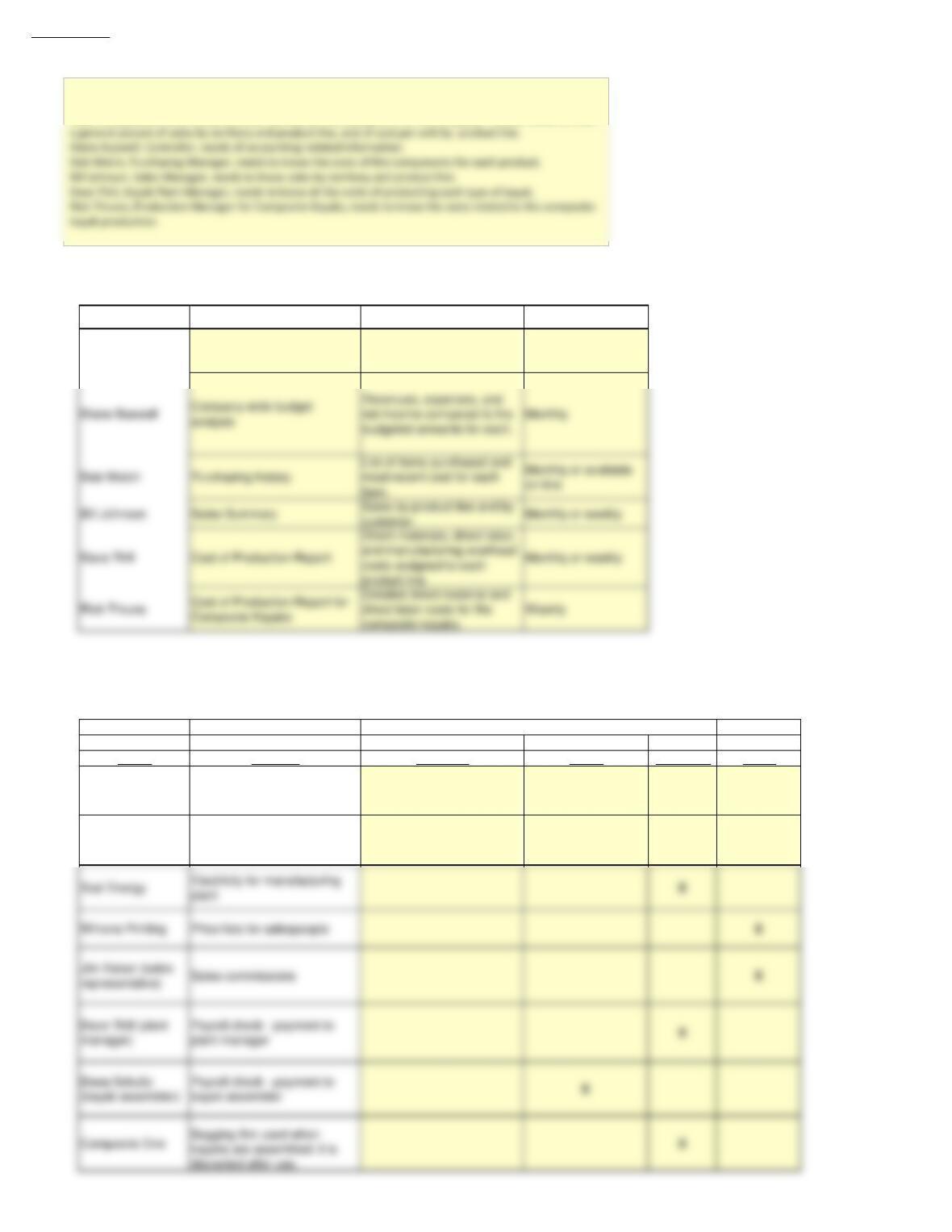
(a) What are the primary information needs of each manager?
(b) Name one special-purpose management accounting report that could be designed for each manager.
Include the name of the report, the information it would contain, and how frequently it should be issued.
Manager Name of report Report content Report frequency
Mike Cichanowski
Analysis of proposed new
product line
Projected revenues and
expenses for a possible new
product line.
As needed and
requested
(c ) When Diane Buswell, controller for Current Designs, reviewed the accounting records for a recent period, she noted the following items.
Classify each item as a product cost or a period cost. If a cost is a product cost, note if it is a direct materials, direct labor, or manufacturing
overhead item by placing an “X” in the appropriate box below.
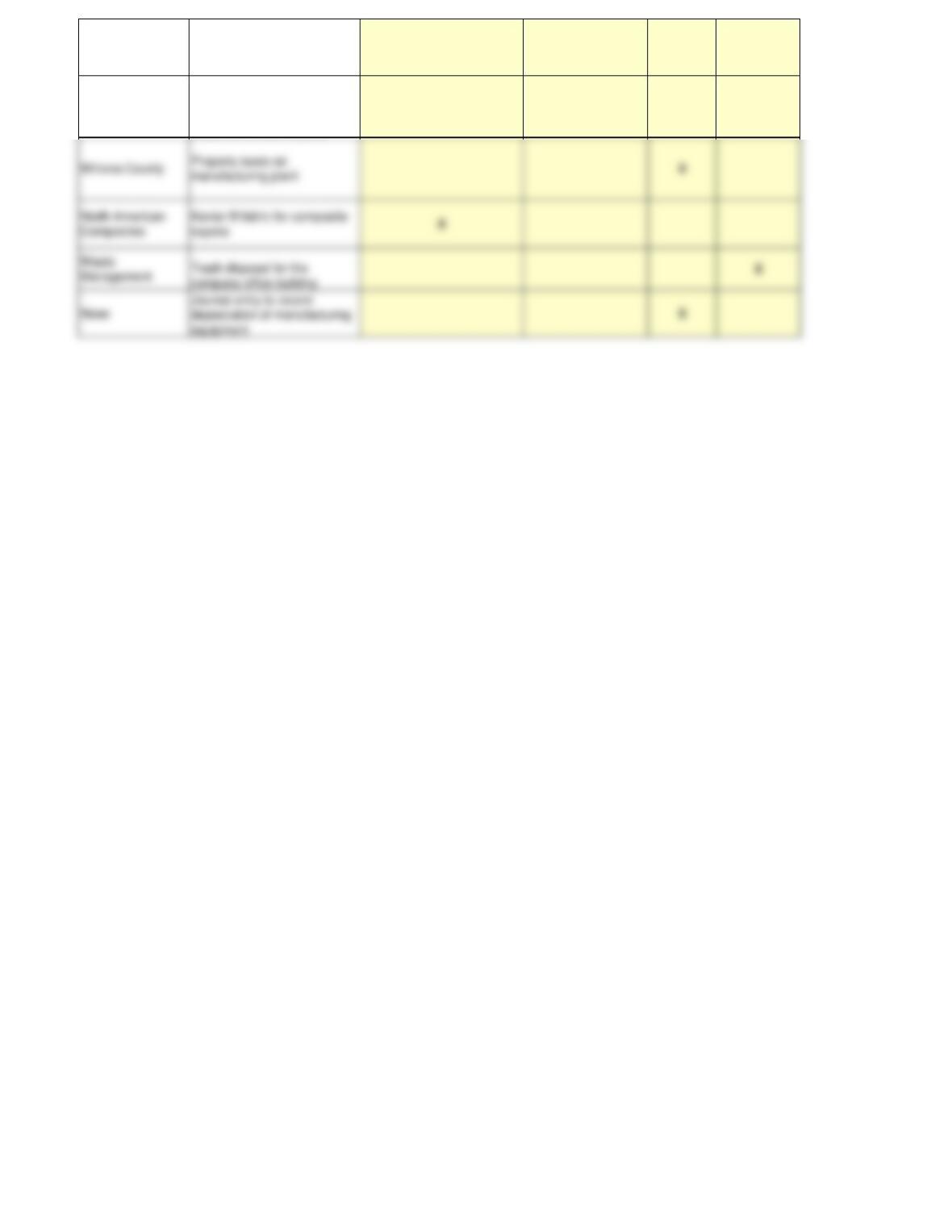
Direct Direct Mfg. Period
Payee Purpose Materials Labor Overhead Costs
Winona Agency
Property insurance for the
manufacturing plant
X
Bill Johnson (sales
manager)
Payroll check – payment to
sales manager
X
Bagging film used when
kayaks are assembled; it is
discarded after use.
Product Costs
Response:
Mike Cichanowski, CEO, needs to know the overall financial
picture of the company. He also needs to have
Deb Welch Purchasing history
List of items purchased and
most recent cost for each
Monthly or available
on-line
Sales by product line and by
Rick Thrune
Cost of Production Report for
Composite Kayaks
Detailed direct material and
direct labor costs for the
composite kayaks.
Fastenal
Shop supplies – brooms, paper
towels, etc.
X
Ravago
Polyethylene powder which is
the main ingredient for the
rotational molded kayaks.
X
company office building