CCC1 CONTINUING COOKIE CHRONICLE
(a) Natalie has a choice between a sole proprietorship and a
corporation. A partnership is not an option since she is the sole
owner of the business.
A proprietorship is easier to create and operate because there are
no formal procedures involved in creating the proprietorship.
However, if she operates the business as a proprietorship she will
(b) Yes, Natalie will need accounting information to help her operate her
business. She will need information concerning her cash balance on
a daily or weekly basis to help her determine if she can pay her bills.
She will need to know the cost of her services so she can establish
her prices. She will need to know revenue and expenses so she can
(c) Assets: Cash, Accounts Receivable, Supplies, Equipment, Prepaid
Insurance
CONTINUING COOKIE CHRONICLE (Continued)
(d) Natalie should have a separate bank account. This will make it easier
to prepare financial statements for her business. The business is a
separate entity from Natalie and must be accounted for separately.
(e) I recommend that Natalie keep the car as a personal asset and pay
for all costs personally. She should keep track of how many miles
she drives for business purposes versus personal use and
determine the percentage of business use versus personal use. She
should keep track of all costs of owning and operating her car
including such things as fuel, insurance, registration, and repairs
BYP 1-1 FINANCIAL REPORTING PROBLEM
(a) Tootsie Roll’s total assets at December 31, 2011 were $857,856,000
and at December 31, 2010 were $857,959,000.
(b) Tootsie Roll had $78,612,000 of cash at December 31, 2011.
BYP 1-2 COMPARATIVE ANALYSIS PROBLEM
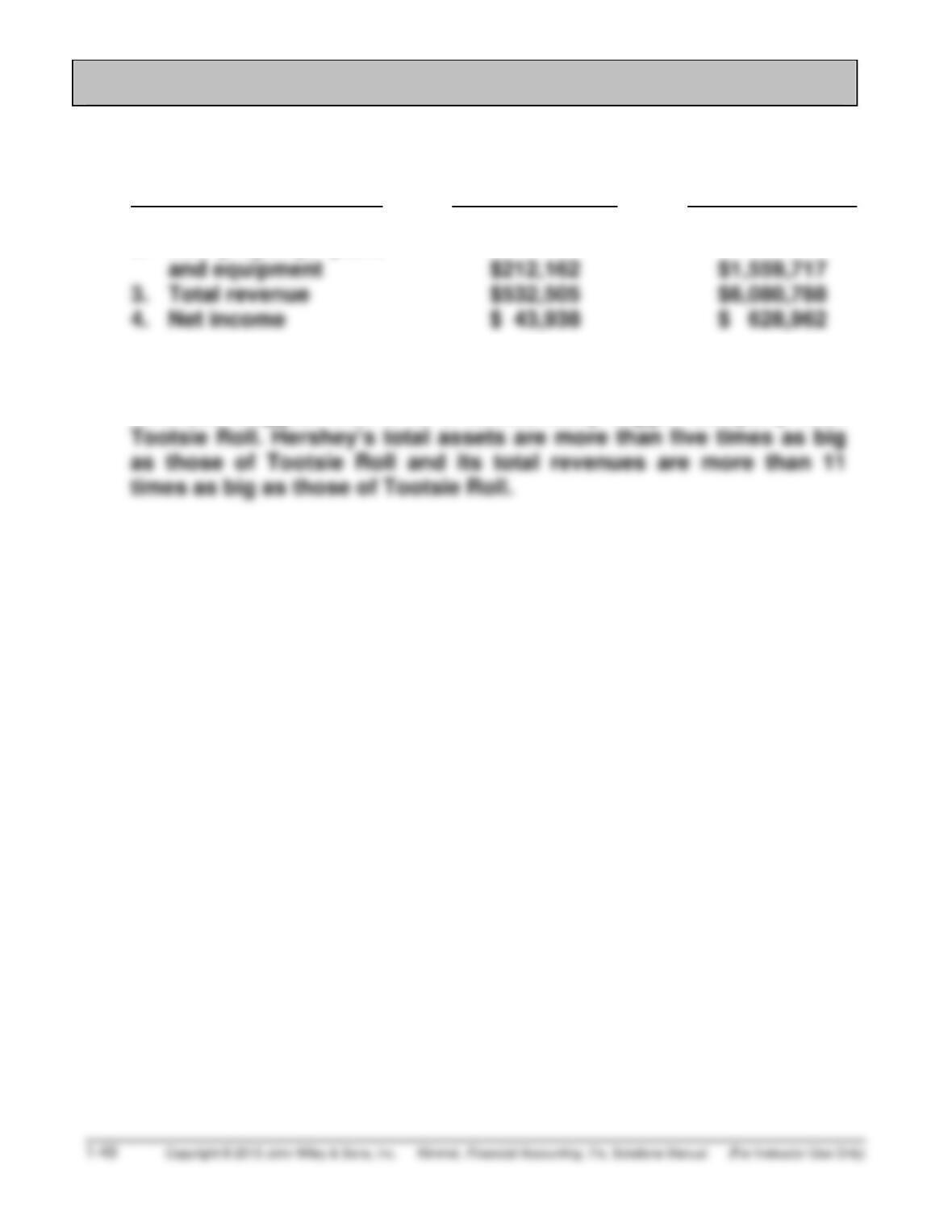
(a)
(amounts in thousands)
Tootsie Roll
Industries, Inc.
The Hershey
Company
1. Total assets
2. Net property, plant
$857,856
$4,412,199
(b) Both companies are profitable. Hershey’s total assets and total
revenues suggest that it is a substantially bigger company than
BYP 1-3 RESEARCH CASE
(a) The ideas that the Public Company Accounting Oversight Board
proposed for expanding the role of auditors in “passing judgement
on more of what a company does and says” include weighing in on
the quality of a company’s disclosures in its earnings releases and
commenting on what the company says in its Management’s
Discussion and Analysis section of its annual report.
(b) Many people were surprised by the fact that many of the financial
institutions that failed or required government support received
(c) The proposed Auditor’s Discussion and Analysis report would
include information about the auditor’s views on the company’s use
of judgments, estimates and accounting policies. The auditor would
also discuss whether it believes the company’s financial reporting
practices are aggressive.
(d) It is likely that auditors would have mixed opinions of these
proposals. On-the-one-hand, the expansion of the auditor’s role
would create new revenue opportunities for auditors. However, the
expansion of duties could very well create additional tension
BYP 1-4 INTERPRETING FINANCIAL STATEMENTS
(a) Creditors lend money to companies with the expectation that they will
be repaid at a specified point in time in the future. If a company is
generating cash from operations in excess of its investing needs, it is
(b) As a stockholder you are interested in the long-term performance of
a company and how that translates into its stock price. Often during
the early years of a company’s life its cash provided by operations is
(c) The statement of cash flows reports information on a cash basis. An
investor cannot get the complete story on the company’s
(d) Xerox is a well known company. It has a past record of paying
dividends. Its management probably decided to continue to pay a
dividend to demonstrate confidence in the company’s future. They
BYP 1-5 REAL-WORLD FOCUS
Answers to this question will differ depending on the companies chosen
by the student, and the year. We provide the following solution for
Tootsie Roll for the year ended December 31, 2011.
(a) During the year ended December 31, 2011, Tootsie Roll reported net
income of $43.9 million.
(b) During the year ended December 31, 2011, Tootsie Roll reported
sales of $532.5 million.
(c) The “Industry” label on the left side of the Profile site tells us that
Tootsie Roll is in the Confectioners industry.
BYP 1-6 DECISION-MAKING ACROSS THE ORGANIZATION
(a) The Report of Independent Accountants indicates that
PriceWaterhouse Coopers LLP performed the audit of Tootsie Roll’s
financial statements.
(b) The Consolidated Statement of Earnings, Comprehensive Earnings
and Retained Earnings states that its earnings per share were $0.76 in
2011.
(c) Note 9 indicates that net sales in foreign countries were $41,184,000
in 2011.
(d) Earnings from operations were $57,966 in 2011 compared to $64,710
in 2010, a decrease of $6,744. Earnings from operations includes $29
and $3,364 in certain deferred compensation expenses in 2011 and
2010, respectively. As discussed above, these deferred compensa-
tion expenses relate to changes in deferred compensation liabilities
Management believes this comparison after adjusting for changes in
deferred compensation is more reflective of the underlying
operations of the company.
(e) Per the Five Year Summary of Earnings and Financial Highlights, Net
Sales in 2007 were $492,742,000.
(f) The Shareholders’ Equity section of the Consolidated Statement of
Financial Position states that 40,000,000 shares were authorized.
BYP 1-7 COMMUNICATION ACTIVITY
To: Lori Milner
From: Student
I have received the balance sheet of Philco Company, Inc. as of
December 31, 2014. The purpose of a balance sheet is to report a
company’s financial position at a point in time. It reports what the
company owns (assets) and what it owes (liabilities) and the net amount
attributed to owners (equity). A number of items in this balance sheet are
not properly reported. They are:
(1) The balance sheet should be dated as of a specific date, not for a
period of time. Therefore, it should be stated “December 31, 2014.”
(4) Accounts payable should be shown as a liability, not an asset.
Therefore, it should be reported in the liability section, after note
payable.
A correct balance sheet is as follows:
BYP 1-7 (Continued)
PHILCO COMPANY, INC.
Balance Sheet
December 31, 2014
Assets
Cash …………………………………………………………………….. $ 9,000
Accounts receivable ……………………………………………… 6,000
Liabilities and Stockholders’ Equity
Liabilities
Notes payable ………………………………………………… $10,000
Accounts payable ………………………………………….. 4,000
Total liabilities ………………………………………… $14,000
Stockholders’ equity
Common stock ………………………………………………. 12,000
BYP 1-8 ETHICS CASE
(a) Investors rely on auditors to perform an independent assessment of
a company. If the auditor owns stock in that company, he or she
might not be able to act in an independent and impartial manner.
(b) There are pros and cons to this argument. On the positive side, it
could be argued that as long as a person has no direct relationship
with a client company, that person will not influence the findings of
(c) The fact that four firms have become so big means that prohibiting
employees of those accounting firms from buying stock in clients of
the firm would bar those employees from investing in roughly 25% of
publicly traded firms. Some have argued that such restrictive rules
(d) Answers to this question will vary. This is a particularly difficult issue
since the rule effectively eliminates the individual’s control over their
investment portfolio. They did nothing wrong when they bought the
shares, but now they are being forced to sell when it is not
advantageous.
(e) The management of PricewaterhouseCoopers noted that auditor inde-
pendence is vitally important to the audit function. If investors don’t
BYP 1-9 ALL ABOUT YOU
(a) Answers to the following will vary depending on students’ opinions.
(i) This does not represent the hiding of assets, but rather a
choice as to the order of use of assets. This would seem to be
ethical.
(ii) This does not represent the hiding of assets, but rather is a
change in the nature of assets. Since the expenditure was
(b) Companies might want to overstate net income in order to
potentially increase the stock price by improving investors’
(c) Sometimes companies want to report a lower income if they are
negotiating with employees. For example, professional sports
teams frequently argue that they cannot increase salaries because
(d) Unfortunately many times people who are otherwise very ethical will
make unethical decisions regarding financial reporting. They might
be driven to do this because of greed. Frequently it is because their
BYP1-11 CONSIDERING PEOPLE, PLANT AND PROFIT
(a) The 5 aspirations relate to the company’s goals related to
sustaining its business, its brands, its people, its community and
the planet.
(b) The annual reports discussed in the chapter report on a company’s
financial results and financial position. Financial annual reports
have a format and content that follows requirements specified by
accounting regulators. The primary contents of a financial annual
(c) i. Support sustainable food and agriculture: Purchased 170 million
pounds of organic ingredients since the company’s inception.
ii. Embrace zero waste business practices: Caddies are 100%
shrink-wrap free and made from 100% recycled paperboard.
IFRS CONCEPTS AND APPLICATION
IFRS1-1
The International Accounting Standards Board, IASB, and the Financial
Accounting Standards Board, FASB, are two key players in developing
international accounting standards. The IASB releases international
IFRS1-2
Accounting standards have developed in different ways because the
standard setters have responded to different user needs. In some
IFRS1-3
A single set of high-quality accounting standards is needed because of
increases in multinational corporations, mergers and acquisitions, use of
information technology, and international financial markets.
IFRS1-4
Currently the internal control standards applicable to Sarbanes-Oxley
(SOX) apply only to large public companies listed on U.S. exchanges. If
such standards were adopted by non-U.S. companies, users of statements
IFRS1-5 INTERNATIONAL FINANCIAL REPORTING PROBLEM
(a) Grant Thornton UK LLP
(b) Note 3.10 states that straight line depreciation is used for freehold
buildings at a rate of 2% per period. A 2% rate indicates a 50 year
life.