Problem 1-4B (20 minutes)
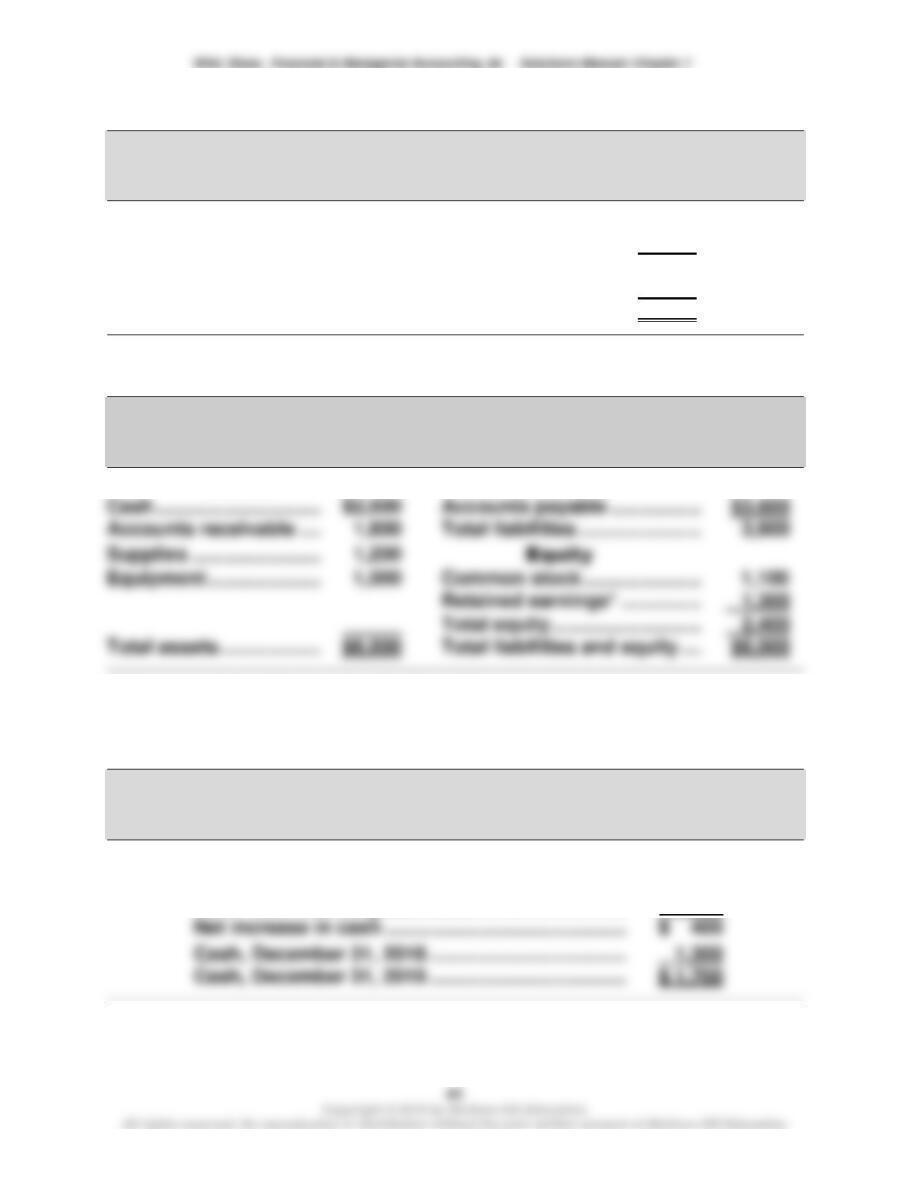
Audi Company
Statement of Retained Earnings
For Year Ended December 31, 2019
Retained earnings, December 31, 2018 ………. $ 900
Add: Net income (from Problem 1-3B) ……….. 3,000
3,900
Less: Dividends ……………………………………. 2,600
Retained earnings, December 31, 2019 ………. $1,300
Problem 1-5B (20 minutes)
Audi Company
Balance Sheet
December 31, 2019
Assets Liabilities
* For computation of this amount see Problem 1-4B.
Problem 1-6B (15 minutes)
Banji Company
Statement of Cash Flows
For Year Ended December 31, 2019
Cash used by operating activities …………………. $(3,000)
Cash from investing activities ……………………….. 1,600
Cash from financing activities ……………………….. 1,800
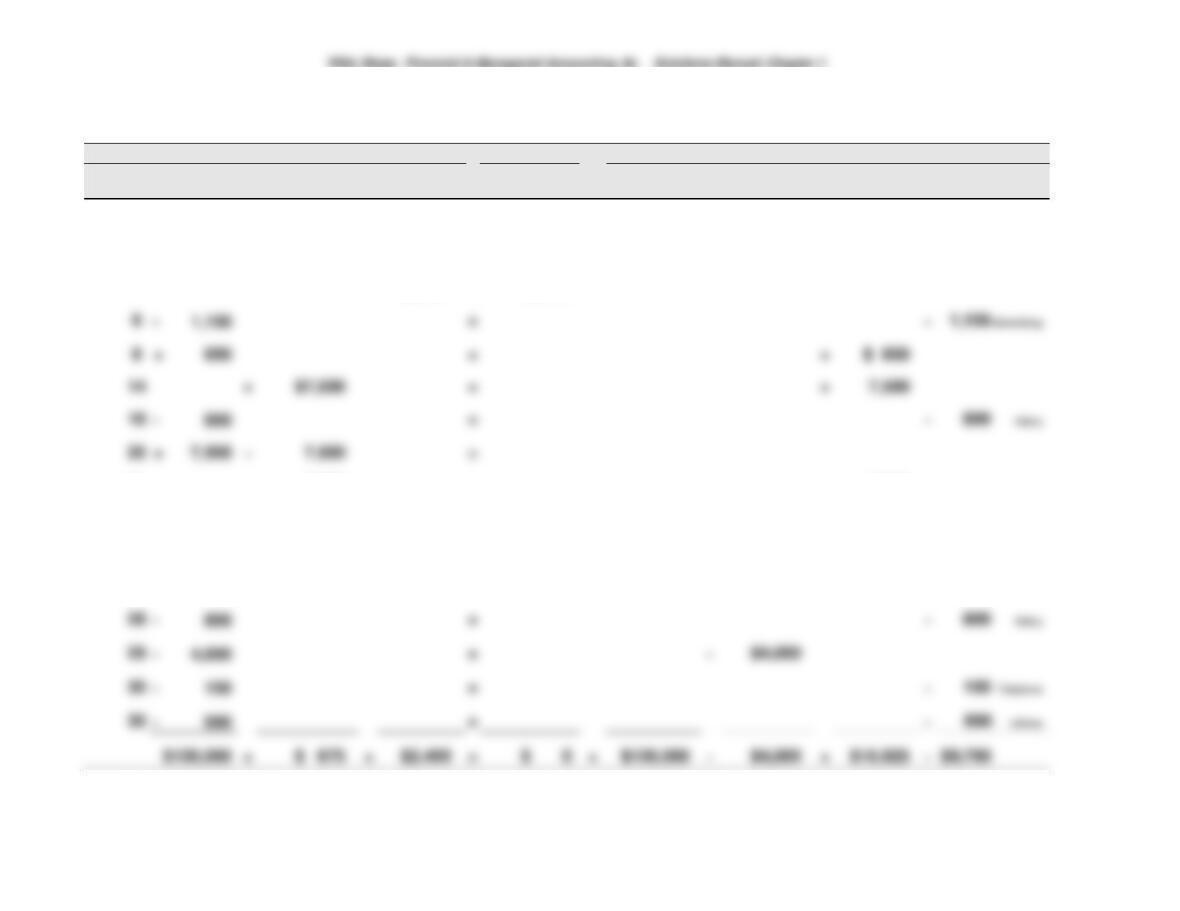
Problem 1-7B (60 minutes) Part 1
Assets
=
Liabilities
+
Equity
Date
Cash
+
Accounts
Receivable
+
Equipment
=
Accounts
Payable
+
Common
Stock
–
Dividends
+
Revenues
–
Expenses
June
1
+$130,000
=
+
$130,000
2
– 6,000
=
–
$6,000 Rent
4
+
$2,400
=
+ $2,400
6
– 1,150
=
–
8
+ 850
=
+
+
=
+
16
– 800
=
–
20
+ 7,500
–
7,500
=
21
+
7,900
=
+
7,900
24
+
675
=
+
675
25
+ 7,900
–
7,900
=
26
– 2,400
=
– 2,400
28
– 800
=
–
29
– 4,000
=
30
– 150
=
–
30
– 890
=
–
Problem 1-7B (Continued)
Part 2
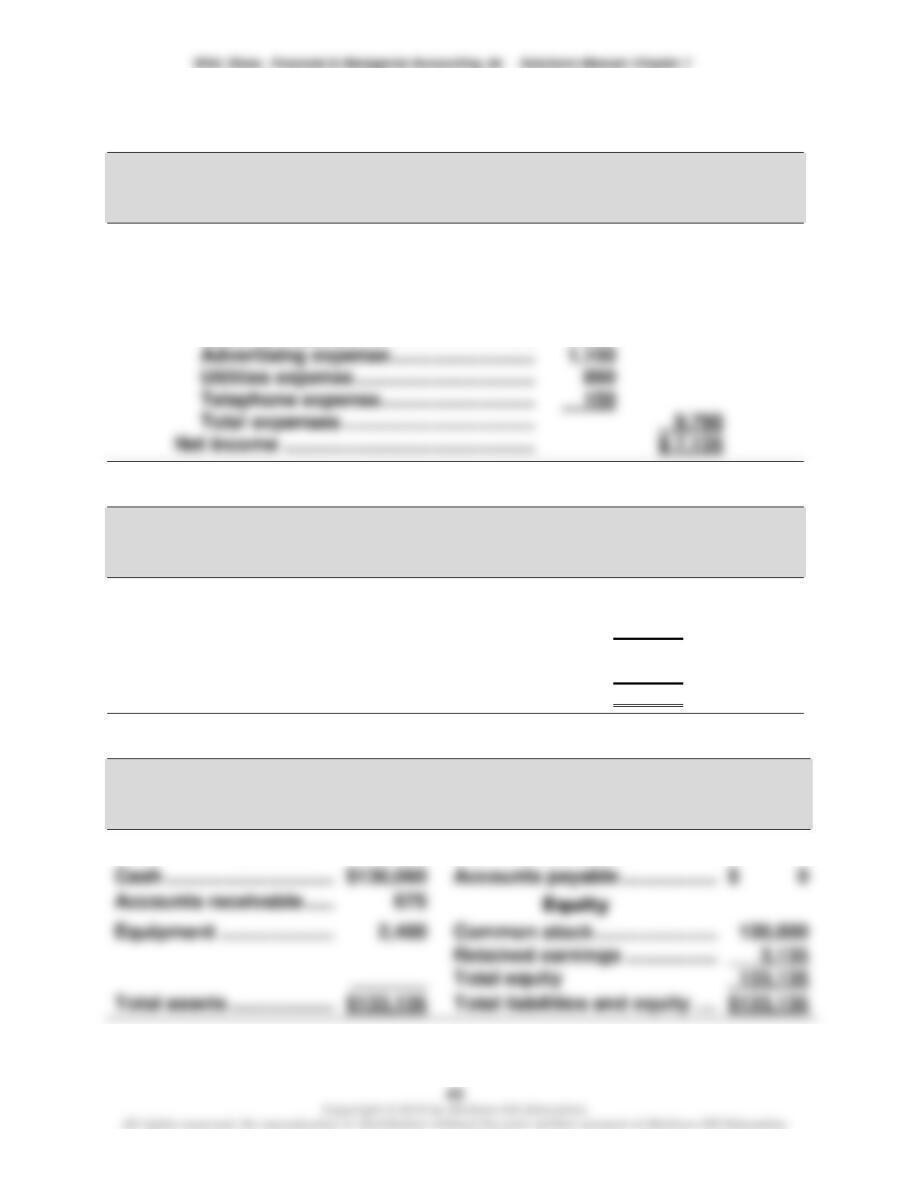
Niko’s Maintenance Co.
Income Statement
For Month Ended June 30
Revenues
Maintenance services revenue ………. $16,925
Expenses
Rent expense ………………………………… $6,000
Salaries expense …………………………... 1,600
Niko’s Maintenance Co.
Statement of Retained Earnings
For Month Ended June 30
Retained earnings, June 1 ………………………….. $ 0
Add: Net income ……………………………………… 7,135
7,135
Less: Dividends ……………………………………….. 4,000
Retained earnings, June 30 ………………………… $ 3,135
Niko’s Maintenance Co.
Balance Sheet
June 30
Assets
Liabilities
Problem 1-7B (Concluded)
Part 3
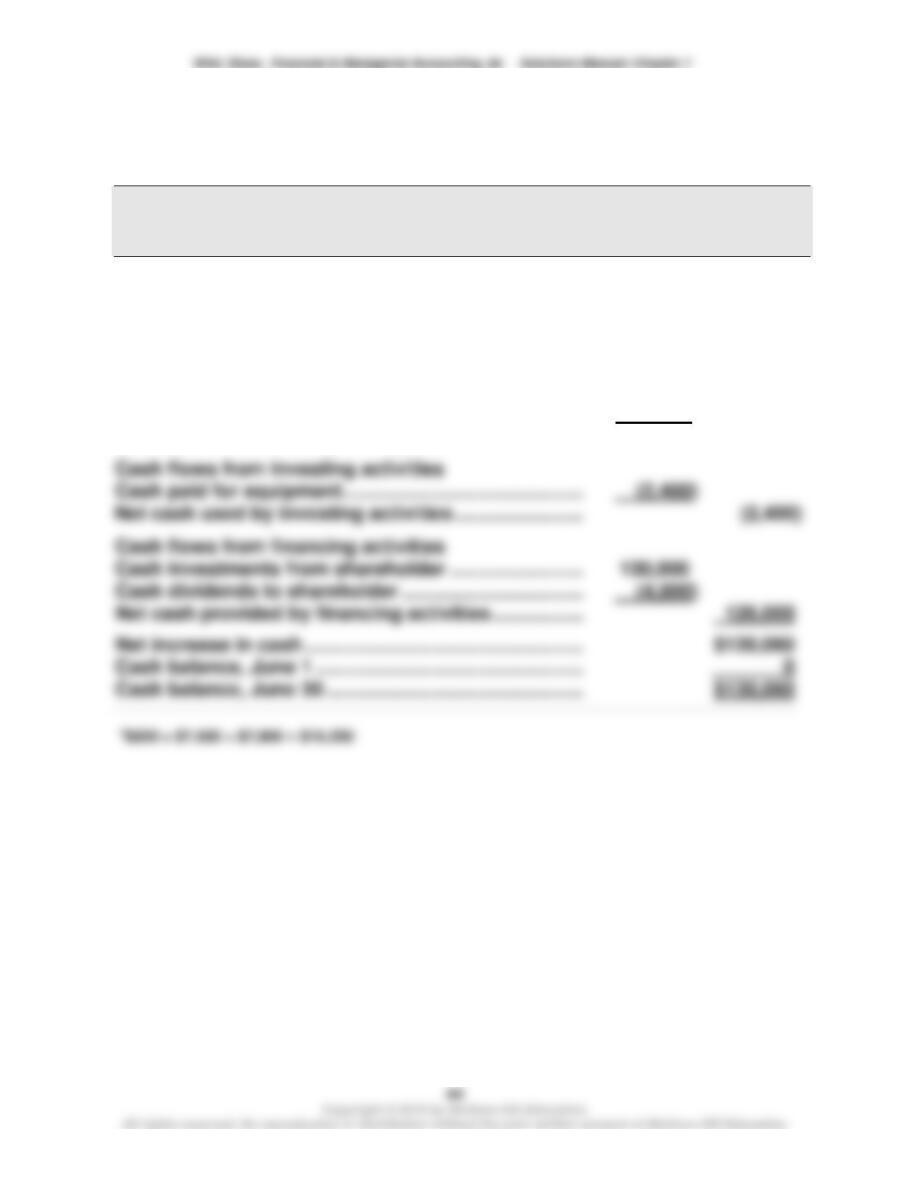
Niko’s Maintenance Co.
Statement of Cash Flows
For Month Ended June 30
Cash flows from operating activities
Cash received from customers1 …………………………...
$ 16,250
Cash paid for rent ………………………………………………..
(6,000)
Cash paid for advertising ……………………………………..
(1,150)
Cash paid for telephone ……………………………………….
(150)
Cash paid for utilities …………………………………………..
(890)
Cash paid to employees ……………………………………….
(1,600)
Net cash provided by operating activities ……………..
$ 6,460
Cash flows from investing activities
Cash paid for equipment ………………………………………
(2,400)
Net cash used by investing activities ……………………
Cash flows from financing activities
Cash investments from shareholder …………………….
Cash dividends to shareholder …………………………….
(4,000)
Net increase in cash …………………………………………….
Cash balance, June 1 …………………………………………..
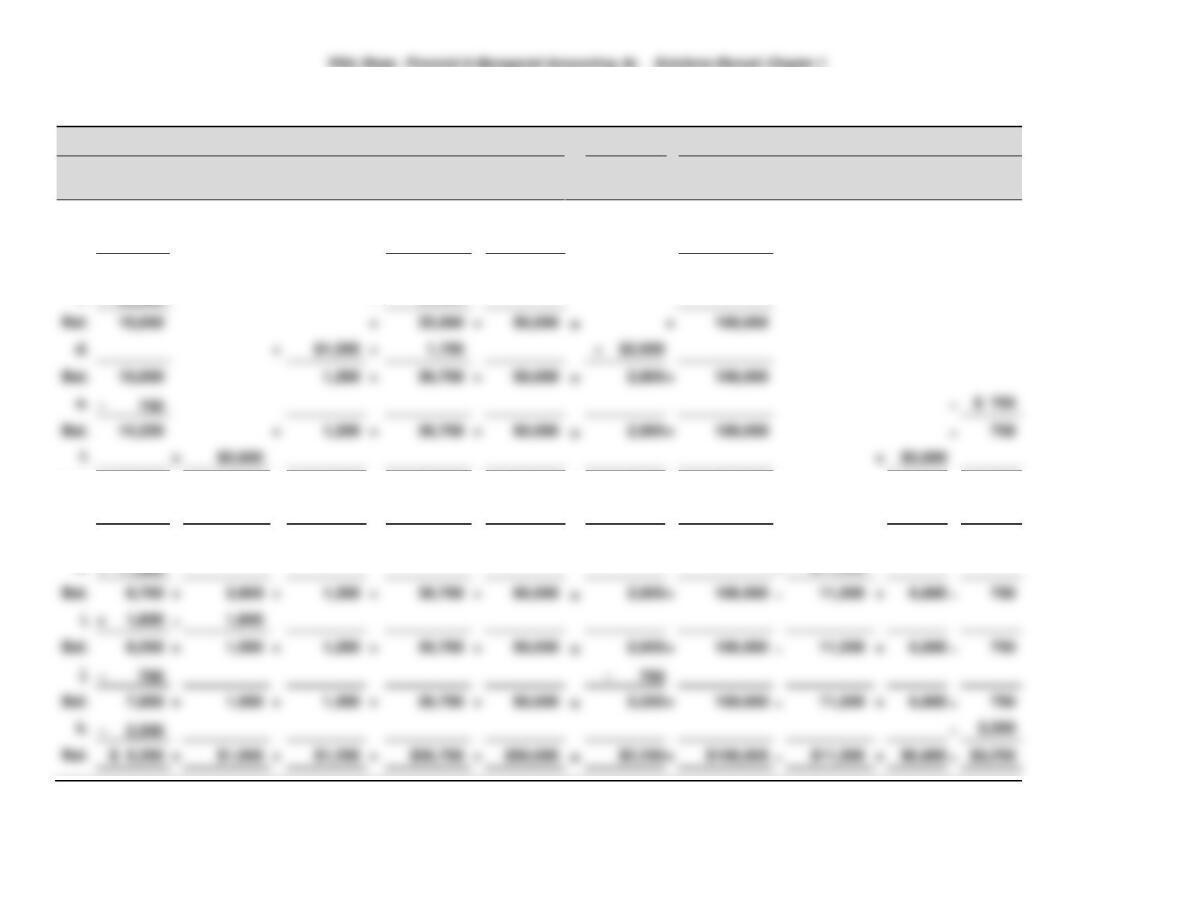
Problem 1-8B (60 minutes) Part 1
Assets
=
Liabilities
+
Equity
Cash
+
Accounts
Receivable
+
Office
Supplies
+
Office
Equipment
+
Office
Suite
=
Accounts
Payable
+
Common
Stock
–
Dividends
+
Reve-
nues
–
Expen-
ses
a.
+ $90,000
+
$10,000
+
$100,000
b.
– 50,000
+
$50,000
Bal.
40,000
+
10,000
+
50,000
=
+
100,000
c.
Bal.
15,000
+
35,000
+
50,000
=
+
100,000
+
+
Bal.
15,000
1,200
+
36,700
+
50,000
=
2,900
+
100,000
– 750
–
Bal.
14,250
+
1,200
+
36,700
+
50,000
=
2,900
+
100,000
–
750
+
$2,800
+
+
25,000
Bal.
14,250
+
2,800
+
1,200
+
36,700
+
50,000
=
2,900
+
100,000
+
2,800
–
750
g.
+ 4,000
+
4,000
Bal.
18,250
+
2,800
+
1,200
+
36,700
+
50,000
=
2,900
+
100,000
+
6,800
–
750
h.
$11,500
Bal.
+
+
+
36,700
+
=
11,500
+
–
+ 1,800
–
1,800
Bal.
+
+
+
36,700
+
=
11,500
+
–
Bal.
+
+
+
36,700
+
=
11,500
+
–
–
2,500

Problem 1-8B (Concluded)
Part 2
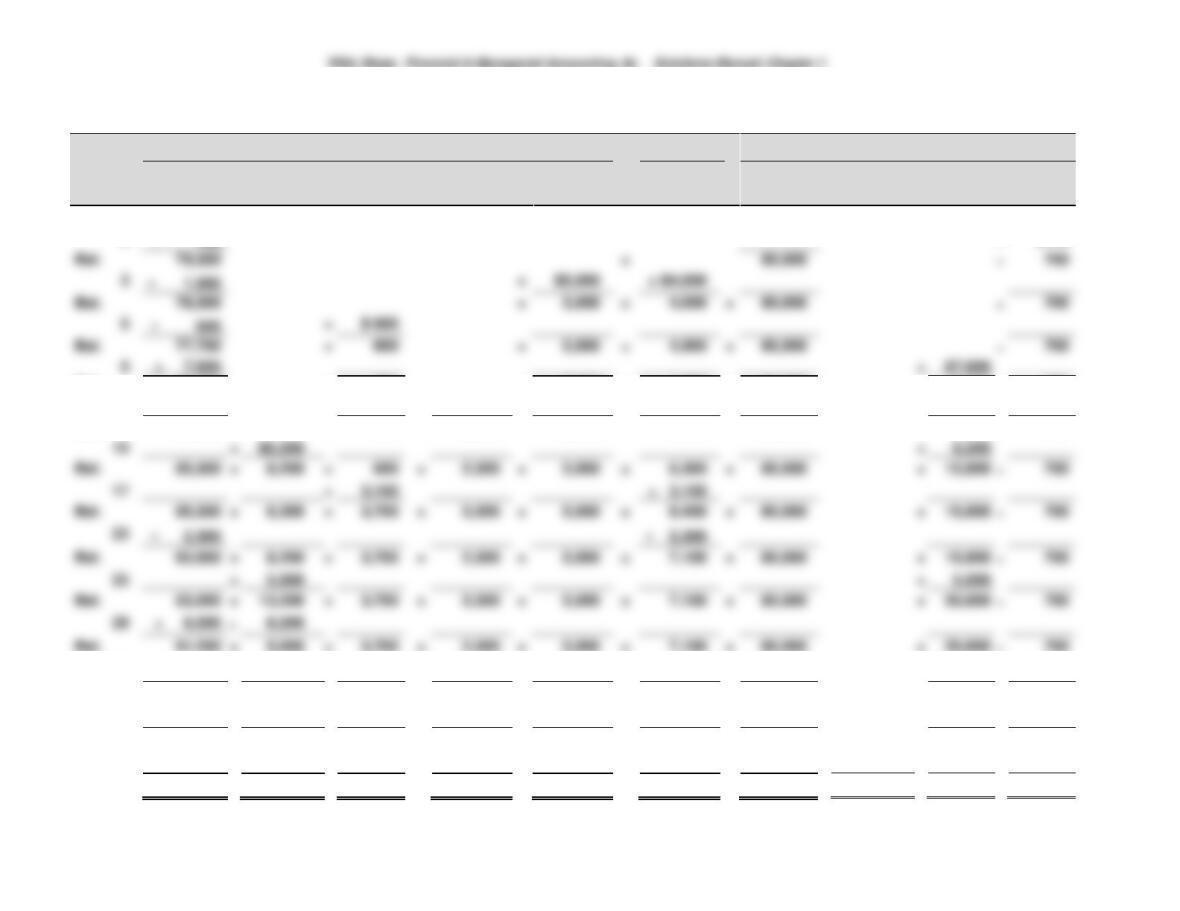
The company’s net income = $6,800 – $3,250 = $3,550
Problem 1-9B (60 minutes) Part 1
Assets
=
Liabilities
+
Equity
Date
Cash
+
Accounts
Receivable
+
Office
Supplies
+
Office
Equipment
+
Roofing
Equipment
=
Accounts
Payable
+
Common
Stock
–
Dividends
+
Revenues
–
Expenses
July
1
+ $80,000
=
+
$80,000
2
– 700
–
Bal.
79,300
=
80,000
–
700
Bal.
78,300
+
=
4,000
+
80,000
–
700
+
Bal.
77,700
+
600
+
5,000
=
4,000
+
80,000
–
700
8
+ 7,600
+
$700
Bal.
85,300
+
600
+
5,000
=
4,000
+
80,000
+
7,600
–
700
10
+
$2,300
+ 2,300
Bal.
85,300
+
600
+
2,300
+
5,000
=
6,300
+
80,000
+
7,600
–
700
15
+
+
Bal.
85,300
+
8,200
+
+
2,300
+
5,000
=
6,300
+
80,000
+
15,800
–
700
17
+ 3,100
Bal.
85,300
+
8,200
+
3,700
+
2,300
+
5,000
=
9,400
+
80,000
+
15,800
–
700
23
Bal.
83,000
+
8,200
+
3,700
+
2,300
+
5,000
=
7,100
+
80,000
+
15,800
–
700
25
+
+
Bal.
83,000
+
+
3,700
+
2,300
+
5,000
=
7,100
+
80,000
+
20,800
–
700
28
+ 8,200
8,200
Bal.
91,200
+
5,000
+
3,700
+
2,300
+
5,000
=
7,100
+
80,000
+
20,800
700
–
30
– 1,560
–
1,560
Bal.
89,640
+
5,000
+
3,700
+
2,300
+
5,000
=
7,100
+
80,000
+
20,800
–
2,260
31
– 295
–
295
Bal.
89,345
+
5,000
+
3,700
+
2,300
+
5,000
=
7,100
+
80,000
+
20,800
–
2,555
31
– 1,800
–
$1,800
Bal.
$87,545
+
$ 5,000
+
$3,700
+
$2,300
+
$5,000
=
$7,100
+
$80,000
–
$1,800
+
$20,800
–
$2,555
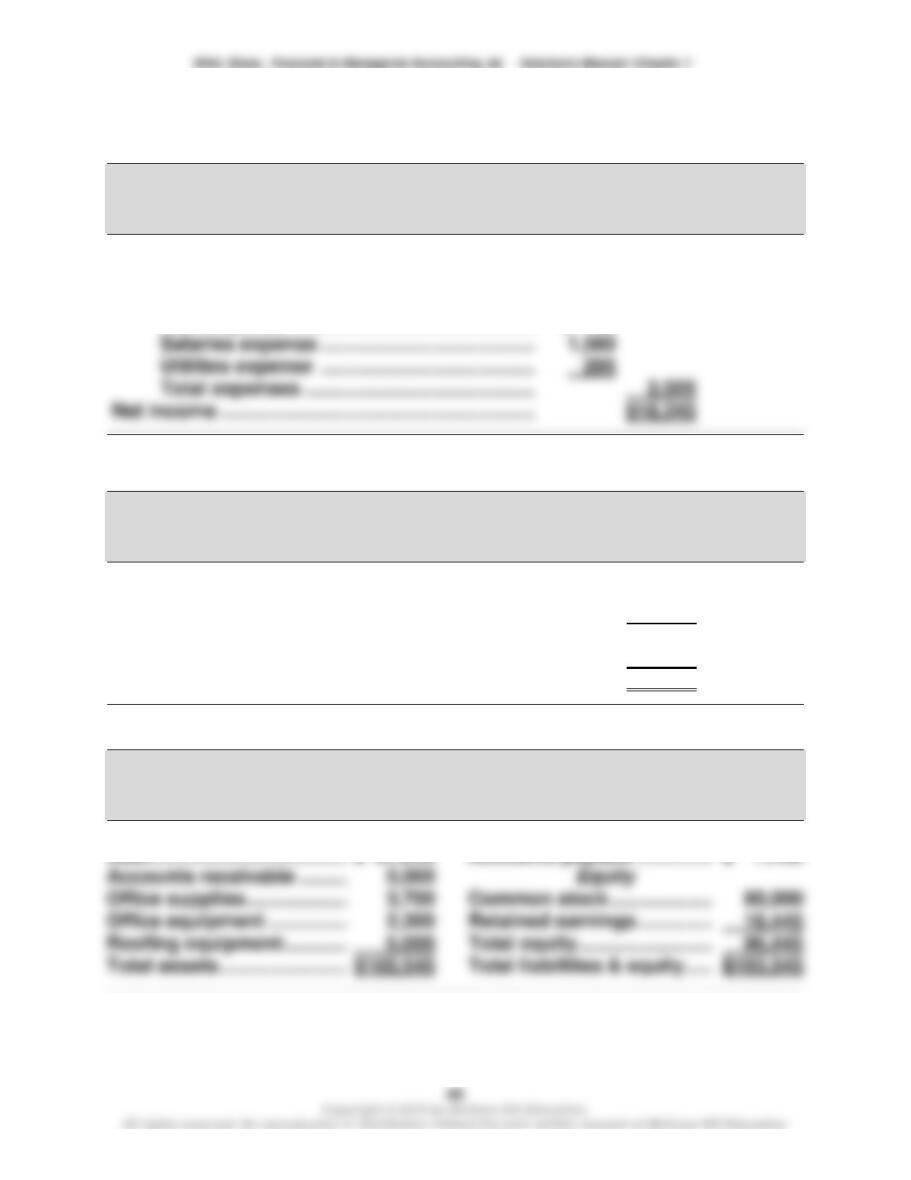
Problem 1-9B (Continued)
Part 2
Rivera Roofing Company
Income Statement
For Month Ended July 31
Revenues
Roofing fees earned ……………………………. $20,800
Expenses
Rent expense ………………………………………. $ 700
Rivera Roofing Company
Statement of Retained Earnings
For Month Ended July 31
Retained earnings, July 1 …………………….. $ 0
Add: Net income ………………………………… 18,245
18,245
Less: Dividends ………………………………….. 1,800
Retained earnings, July 31 …………………… $16,445
Rivera Roofing Company
Balance Sheet
July 31
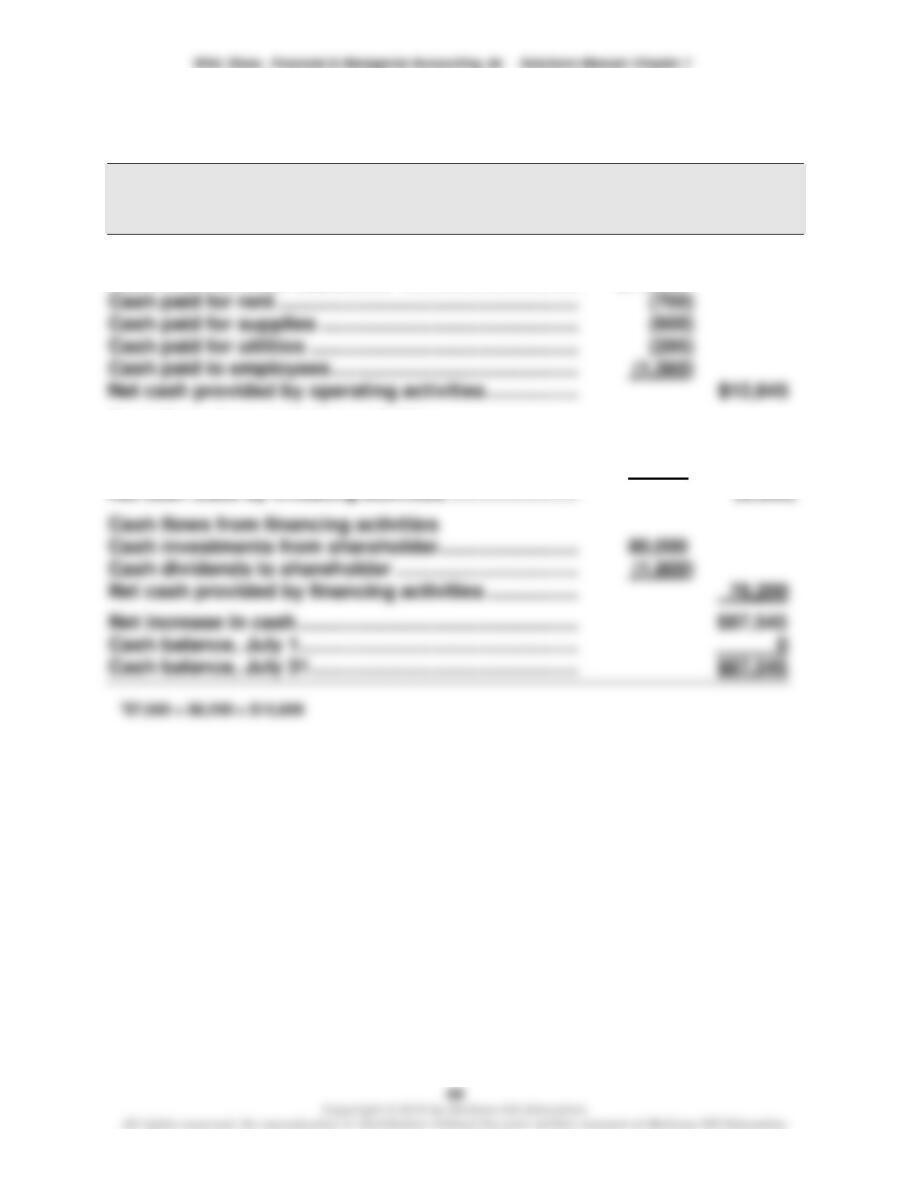
Assets Liabilities
Problem 1-9B (Concluded)
Part 3
Rivera Roofing Company
Statement of Cash Flows
For Month Ended July 31
Cash flows from operating activities
Cash received from customers1 …………………………...
$15,800
Cash paid for rent ………………………………………………..
Cash paid for supplies …………………………………………
Cash paid for utilities …………………………………………..
Cash paid to employees ……………………………………….
(1,560)
Net cash provided by operating activities ……………..
Cash flows from investing activities
Cash paid for roofing equipment ………………………….
(1,000)
Cash paid for office equipment …………………………....
(2,300)
Net cash used by investing activities ……………………
Cash flows from financing activities
Cash investments from shareholder ……………………..
Cash dividends to shareholder …………………………….
(1,800)
Net cash provided by financing activities ……………..
Net increase in cash …………………………………………….
Cash balance, July 1 …………………………………………….
Part 4
If the $5,000 purchase on July 3 had been acquired through an additional
owner investment of cash, then:
(a) Total assets would be greater by $1,000.
(b) Total liabilities would be $4,000 less.
(c) Total equity would be $5,000 greater.
Problem 1-10B (15 minutes)
1. Return on assets is net income divided by average total assets (the
average amount invested). For Ski-Doo Company this return is
computed as:
$201,000 / $3,000,000 = 0.067 or 6.7%.
4. We know from the accounting equation that the total of liabilities plus
equity (financing) must equal the total for assets (investing). Since
average total assets are $3,000,000, we know the average total of
liabilities plus equity (financing) must equal $3,000,000.
Problem 1-11B (15 minutes)
2. On strictly the amount of sales to consumers, AT&T’s sales of
$126,723 are greater than Verizon’s sales of $110,875.
3. Success in returning net income from the amount invested is revealed
by the return on assets ratio. Part 1 showed that AT&T has a much
lower return on assets of 1.6% versus Verizon with a 4.5% return on
assets.
4. The reported figures suggest Verizon is more successful in generating
income based on assets. Based on this information alone, we would be
better advised to invest in Verizon than AT&T.
Problem 1-12BA (5 minutes)
a. 2 Low-risk corporate bond.
b. 1 Stock of a successful company.
c. 4 Money stored in a fireproof vault.
d. 3 U.S. Treasury bond.
Problem 1-13BB (15 minutes)
1.
O Providing client services.
5.
O Supervising workers.
2.
F Obtaining a bank loan.
6.
F Shareholders investing in business.
3.
I Purchasing machinery.
7.
O Renting office space.
4.
O Research for its products.
8.
O Paying utilities expenses.
Problem 1-14BB (15 minutes)
I. Financing Activities
A. Owner financing—owner invests in the company
B. Non-owner (creditor) financing—borrowing money from a bank
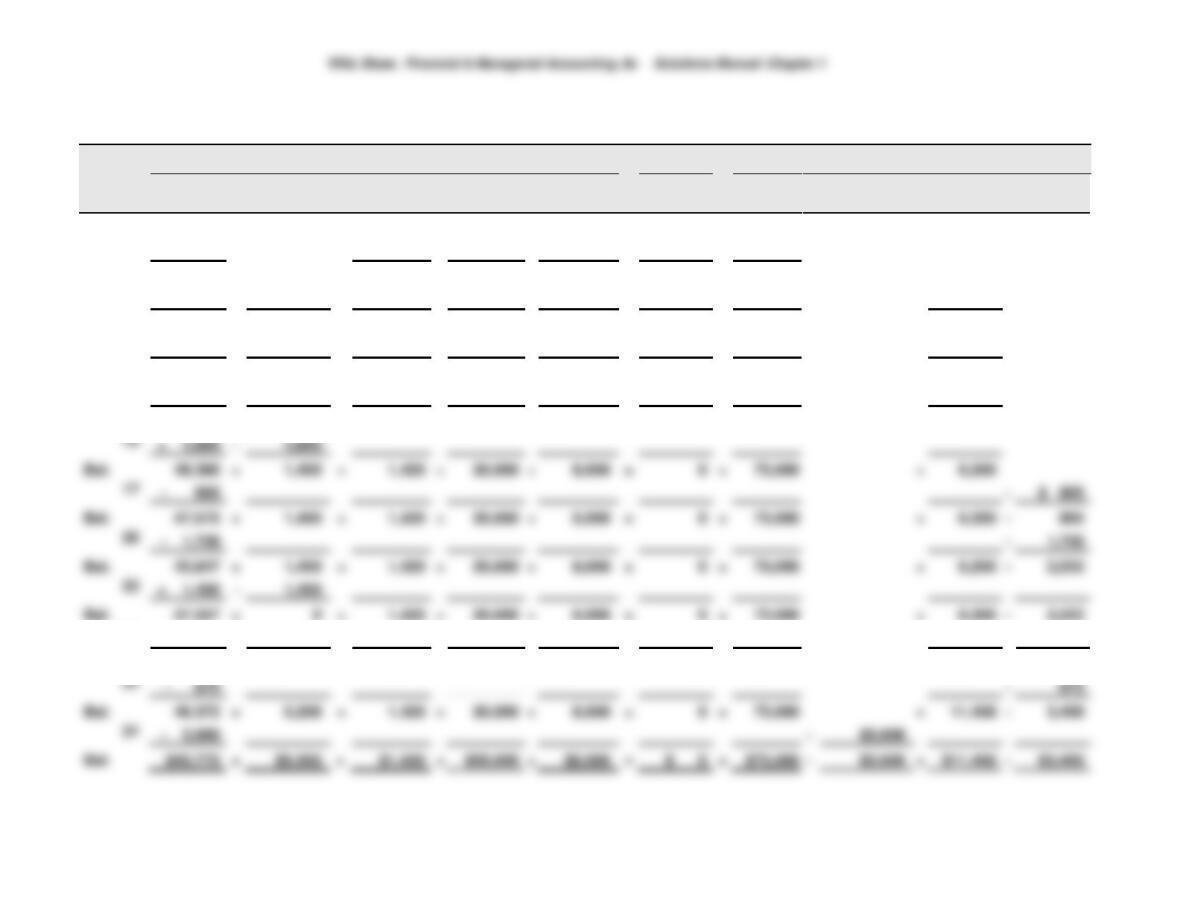
Serial Problem — SP 1 (30 minutes) Business Solutions
Assets
=
Liabilities
+
Equity
Date
Cash
+
Accounts
Receivable
+
Computer
Supplies
+
Computer
System
+
Office
Equipment
=
Accounts
Payable
+
Common
Stock
–
Dividends
+
Revenues
–
Expenses
Oct.
1
+$45,000
$20,000
+
$8,000
+
$73,000
3
+
$1,420
+ $1,420
Bal.
45,000
+
1,420
+
20,000
+
8,000
=
1,420
+
73,000
6
+
$4,800
+
$ 4,800
Bal.
45,000
+
4,800
+
1,420
+
20,000
+
8,000
=
1,420
+
73,000
+
4,800
8
– 1,420
– 1,420
Bal.
43,580
+
4,800
+
1,420
+
20,000
+
8,000
=
0
+
73,000
+
4,800
12
+
1,400
+
1,400
Bal.
43,580
+
6,200
+
1,420
+
20,000
+
8,000
=
0
+
73,000
+
6,200
15
+ 4,800
–
4,800
Bal.
48,380
+
1,400
+
1,420
+
20,000
+
8,000
=
0
+
73,000
+
6,200
17
–
$ 805
47,575
+
+
1,420
+
20,000
+
8,000
=
+
73,000
+
6,200
20
–
1,728
Bal.
45,847
+
1,400
+
1,420
+
20,000
+
8,000
=
0
+
73,000
+
6,200
–
2,533
–
Bal.
47,247
+
+
1,420
+
20,000
+
8,000
=
0
+
73,000
+
6,200
–
2,533
28
+
5,208
+
5,208
Bal.
47,247
+
5,208
+
1,420
+
20,000
+
8,000
=
0
+
73,000
+
11,408
–
2,533
31
–
Bal.
46,372
+
5,208
+
1,420
+
20,000
+
8,000
=
0
+
73,000
+
11,408
–
3,408
31
–
$3,600
Wild, Shaw, Financial & Managerial Accounting, 8e Solutions Manual: Chapter 1
Company Analysis — AA 1-1
1. $375,319 ($ millions)
Explanation: An organization’s total assets always equal total liabilities
plus total equity. Therefore, Apple’s liabilities plus equity equal Apple’s
total assets.
2. 13.9%
3. $180,883 ($ millions)
4. Better
Explanation: Apple’s return on assets of 13.9% is good given that it
exceeds its competitors’ return on assets of 10% for this period.
Wild, Shaw, Financial & Managerial Accounting, 8e Solutions Manual: Chapter 1
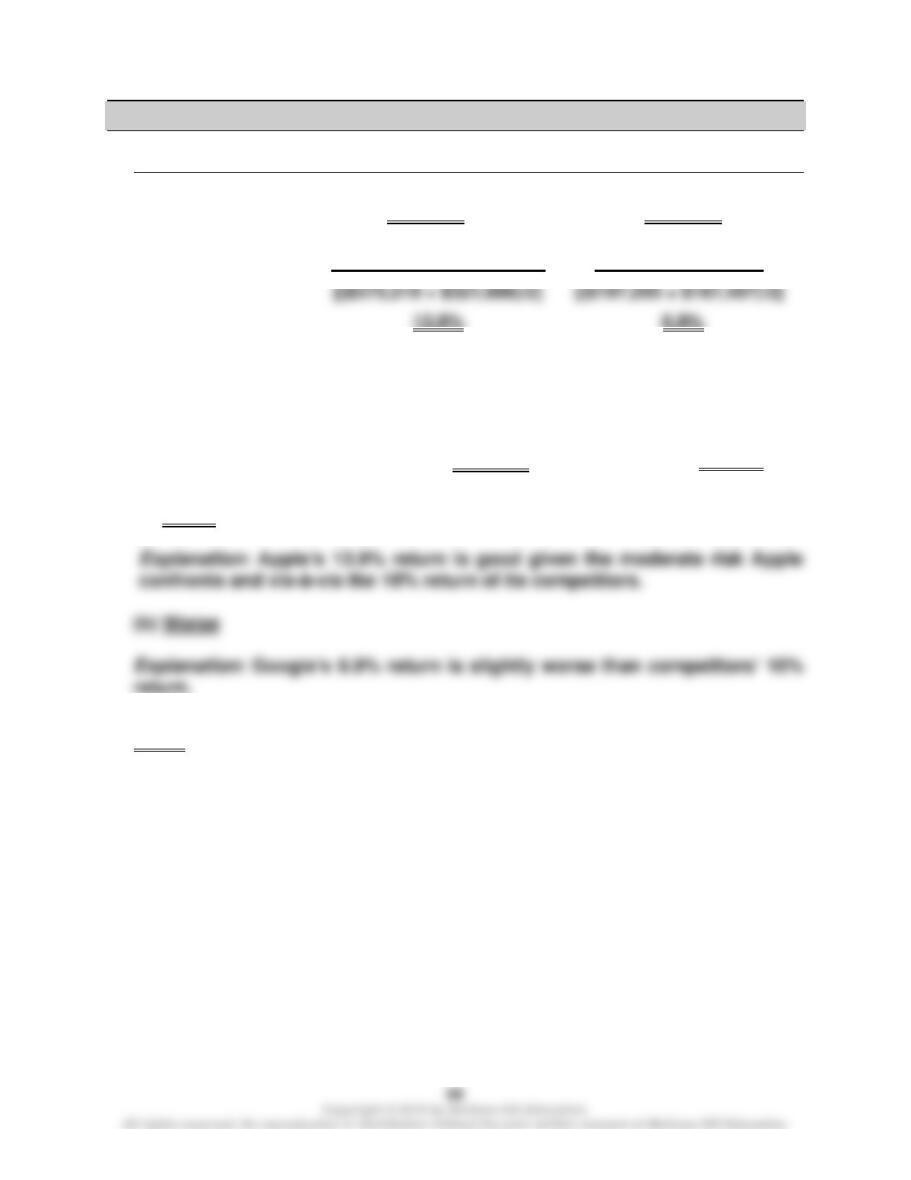
Comparative Analysis — AA 1-2
($ millions)
Apple
Google
1. Total Assets =
Liabilities + Equity
$375,319
$197,295
2. Return on assets
$48,351
$12,662
3. Revenues-Expenses
= Net income
$229,234 – Expenses
= $48,351
$110,855 – Expenses
= $12,662
→ Expenses =
Expenses = $180,883
Expenses = $98,193
4. (a) Better
5. Apple
Explanation: Apple’s return on assets is superior to Google’s return on
assets. Therefore, based only on return on assets, you would invest in
Apple.
Wild, Shaw, Financial & Managerial Accounting, 8e Solutions Manual: Chapter 1
Global Analysis — AA 1-3 (20 minutes)
1. (a) 15.0%
2. Favorable
Explanation: Samsung’s return on assets improved in the current year
versus the prior year.
3. (a) Better
Explanation: Samsung’s return on assets of 15.0% is better than Apple’s
return on assets of 13.9%. Apple’s return on assets is computed:
$48,351 / $348,503 = 0.139 or 13.9%.
Wild, Shaw, Financial & Managerial Accounting, 8e Solutions Manual: Chapter 1
Ethics Challenge — BTN 1-1
1. There are several parties affected. They include the users of financial
statements such as shareholders, lenders, investors, analysts, suppliers,
directors, unions, regulators, and others. They also include the accounting
firm, which can be sued if deemed a party to misleading statements.
3. Thorne should not accept this fee arrangement. To avoid compromising
the auditor’s independence, Thorne should reject it. (Further, the AICPA
Code of Professional Conduct forbids auditors from accepting contingent
fees that depend on amounts reported in a client’s financial statements.
This AICPA Code has been codified into law in most states and, therefore,
this action would also be an illegal act for a CPA.)
Communicating in Practice — BTN 1-2
1. Deciding whether Apple is a good loan risk can be difficult because the
planned expansion is risky if customer demand does not meet
expectations. As a loan officer in this situation you would want information
on the company’s (1) projections of expected cash receipts and cash
payments (best provided on a monthly basis); (2) assessment of the
market, the company’s plans, and a strategy to achieve success; (3) cash
contributions that the owners will make to the business; and (4) a listing of
tangible assets (including their price and useful life) necessary to carry out
the company’s plans.
59
Copyright © 2019 by McGraw-Hill Education.
All rights reserved. No reproduction or distribution without the prior written consent of McGraw-Hill Education.
1.
$ thousands
2017
2016
2015
2014
2013
Revenues …………
$38,296
$40,457
$41,508
$39,185
$36,315
Net income ……….
3,450
4,426
3,938
4,392
1,478
Its revenues grew from 2013 through 2015, and then slightly regressed
in 2016 and again in 2017. Management must work to pursue policies
that grow revenues.
Teamwork in Action — BTN 1-4
Suggestions for forming support/learning teams are in the Instructor’s
Resource Manual (IRM). The IRM provides the master of a Student Data
Form that can be duplicated and used to gather information as a basis for
Wild, Shaw, Financial & Managerial Accounting, 8e Solutions Manual: Chapter 1
Entrepreneurial Decision — BTN 1-5
1. (a) AccountApp’s total amount of liabilities and equity consists of the
bank loan and the owner investments. Specifically:
2. Return on assets = $80,250 / $750,000 = 0.107 = 10.7%
AccountApp’s 10.7% return slightly exceeds its competitors’ average
return of 10%. Assuming the company can continue to earn 10.7% or
more, the owners should consider further investment in the new
company.
Hitting the Road — BTN 1-6
Check each student’s report for the following content:
2. Identification of the reasons why the owner(s) chose this particular
form of business organization.
3. Identification of advantages or disadvantages of the form of business
organization chosen.
Note: Many instructors have students complete this assignment in teams.