Chapter 1
Managerial Accounting in the Information Age
QUESTIONS
1. The goal of managerial accounting is to provide information needed for planning,
control, and decision making.
2. Budgeted performance is a useful benchmark for evaluating current period
performance.
3. This question asks students to identify three differences between financial and
managerial accounting. In the text, five differences are noted:
a) Managerial accounting is directed at internal rather than external users of
accounting information.
b) Managerial accounting may deviate from generally accepted accounting
principles (GAAP).
c) Managerial accounting may present more detailed information.
d) Managerial accounting may present more nonmonetary information.
e) Managerial accounting places more emphasis on the future.
4. Examples of nonmonetary information that might appear in managerial accounting
reports include: the quantity of material consumed in production, the number of
hours worked by the office staff, and the number of product defects.
5. Total variable costs change in proportion to business activity while total fixed costs
do not change.
6. Salaries of the home appliance sales force would be a controllable cost for the
manager of the home appliance department at a Sears store. Depreciation related
to the department store building would be a noncontrollable cost.
7. Incremental analysis involves a comparison of the revenues that change and the
costs that change when a decision alternative is selected. If incremental revenue
exceeds incremental cost, a decision alternative should be undertaken.
8. “You get what you measure!” suggests that managers’ behaviors are affected by
performance measures.
9. Information flows up and down the value chain—between a company and its
suppliers and between a company and its customers. Information technology is
helping companies track buying patterns of customers and send targeted selling
messages to them via email. Information technology is also helping companies
better manage their supply chains and gain internal efficiencies.
10. A legal action is not necessarily ethical. Ethical actions involve “what’s right” while
legal actions involve operating within boundaries of the law.
Jiambalvo Managerial Accounting
1-2
EXERCISES
E1. [LO 3] Suppose the company selected is Microsoft.
Measure 1: Number of errors in a piece of software.
Favorable outcome: Number of errors is reduced.
Unfavorable outcome: Software products are not released on a timely basis.
E2. [LO 2] The only costs that are relevant to a decision are incremental costs—that
E3. [LO 4] The code suggests that Guthrie clarify the ethical issue by confidential
discussion with an objective advisor (this might be the IMA Ethics Counseling
E4. [LO 4] Possible answers include:
The CRM system notes that a customer makes significant wine purchases at
dinners. At her next stay, the hotel provides a complimentary bottle of a limited
release high-end wine resulting in increased customer loyalty.
E5. [LO 1] Megan can prepare a profit budget for each store (planning). At the end of
E6. [LO 1] “c” is false. There are many possible reasons, other than lack of effective
E7. [LO 1] Deidre should not be concerned that cost of sales has increased. Cost of
sales is a variable cost and it is expected that it will increase when sales increase.
E8. [LO 1]. Managerial accounting focuses on accounting information for internal
decision-making. This focus differs from financial accounting in a number of ways.
E9. [LO 1] For purposes of awarding bonuses, it may be advisable to record sales
when orders are placed so that the sales force is rewarded on a timely basis. If the
E10. [LO 2]
a. variable
E11. [LO 2]
a. variable
E12. [LO 2] A cost is controllable by a manager whose actions affect the cost. Thus,
for example, advertising may be a controllable cost for a store manager (who
E13. [LO 2, 3] Takesha should not consider how much he paid for the old machine
E14. [LO 2]
Incremental revenue per day $2,500
Less incremental costs:
E16. [LO 2, 3] The incremental cost per gallon is likely to be less than $6 because part
E17. [LO 3]
E18. [LO 3] The owner of LA Porsche may link Hulmut’s annual bonus to the average
customer satisfaction rating. Thus, there is a link between the measure and
E19. [LO 5] The IMA’s Statement of Ethical Professional Practice does not directly
address this issue so students may take either side of this issue.
Shauna does have obligations: Students could argue that the practice of
E20. [LO 5]. Responses will vary. Examples of Controller duties are as follows: Cost
accounting, preparation of financial statements in accordance with GAAP,
E21. Student answers will vary.
Jiambalvo Managerial Accounting
1-6
PROBLEMS
P1. [LO 1, 2]
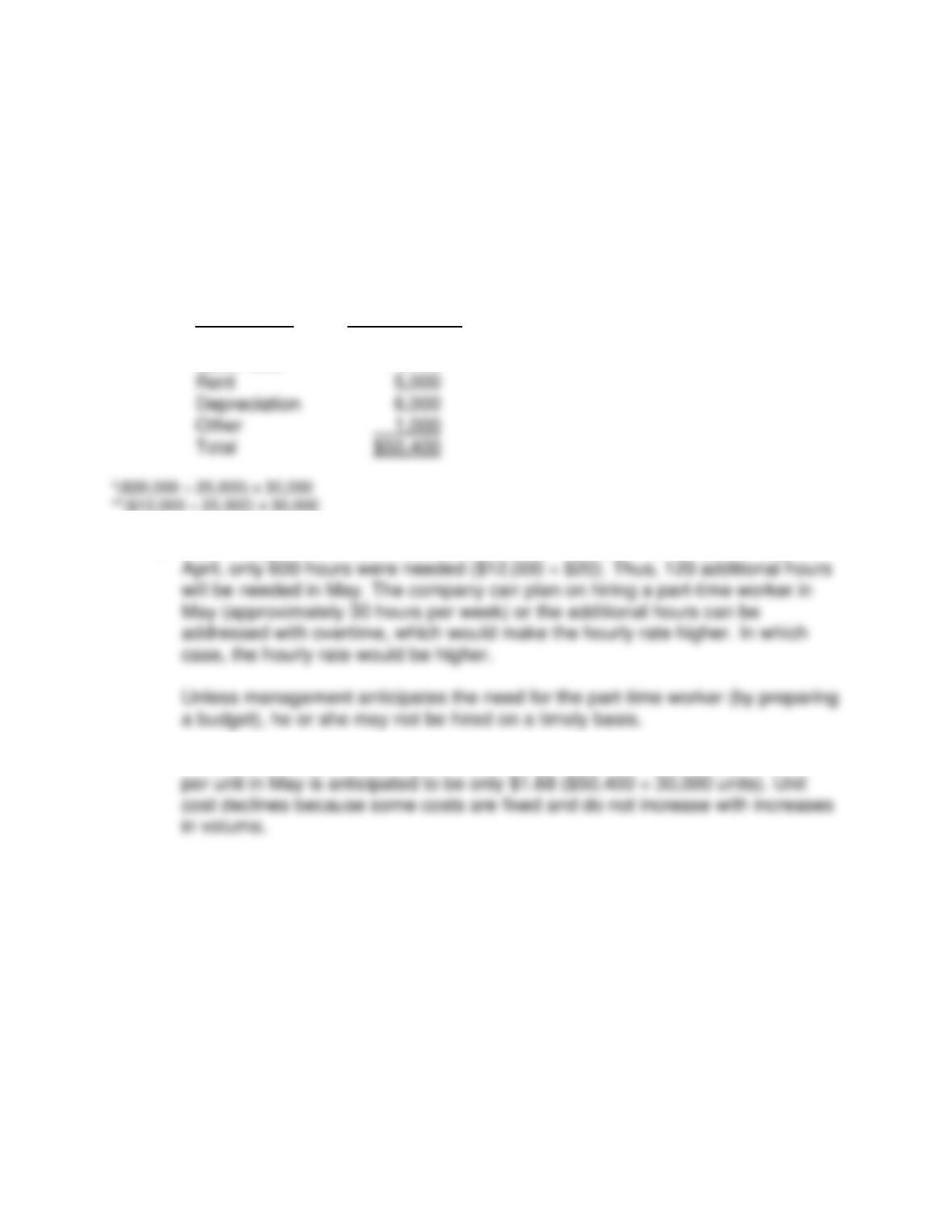
a. Santiago’s Salsa
Budgeted Production Costs
May 2017
30,000
Production Jars of Salsa
Ingredient cost* $24,000
Labor cost** 14,400
**($12,000 ÷ 25,000) x 30,000
b. With a wage rate of $20, 720 hours ($14,400 ÷ $20) will be needed in May. In
c. The actual cost per unit in April was $1.76 ($44,000 ÷ 25,000 units). The cost
P2. [LO 2, 3]
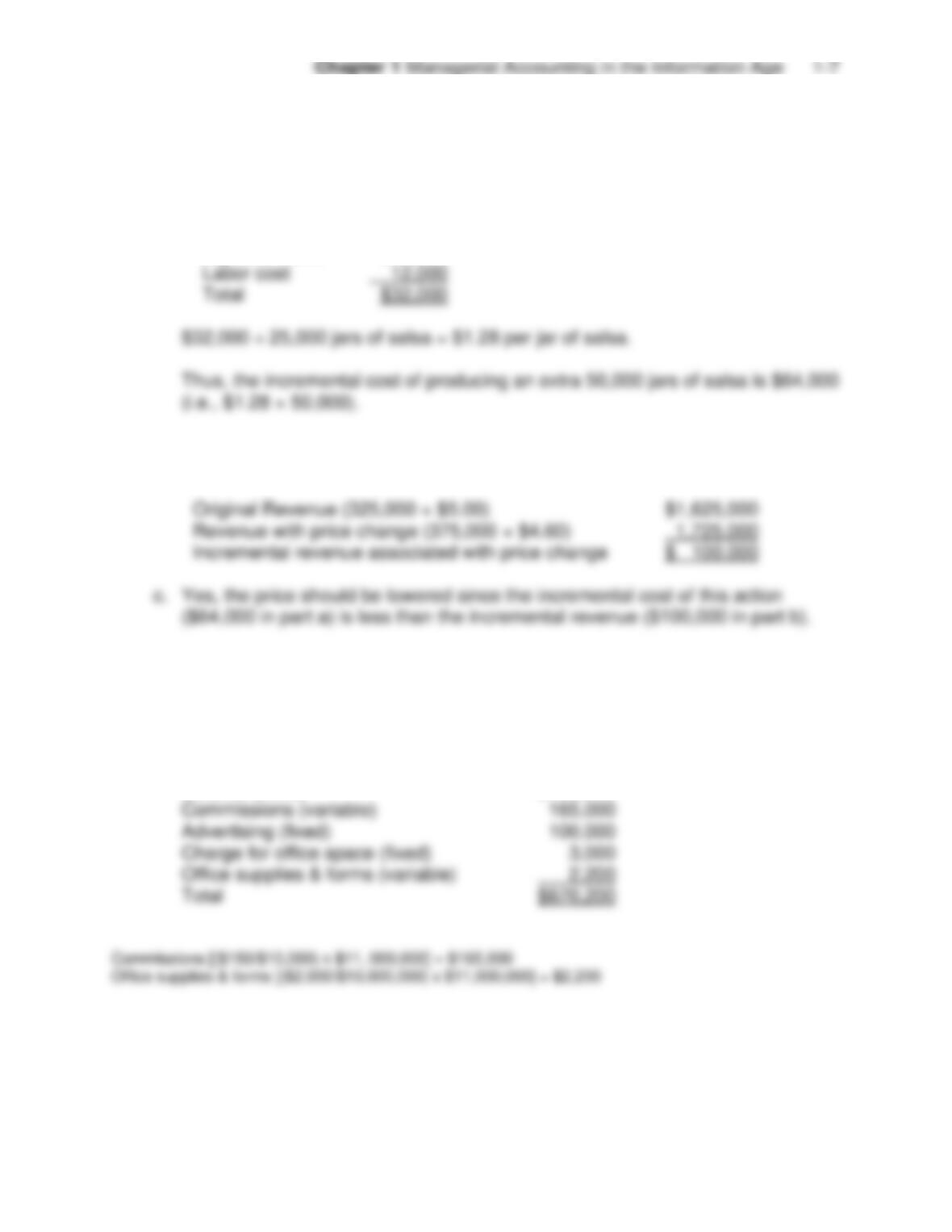
a. The variable costs are $1.28 per jar of salsa as follows:
25,000
Production Jars of Salsa
Ingredient cost $20,000
b. The incremental revenue associated with a price reduction of $0.40 is $100,000
as follows:
P3. [LO 1, 2]
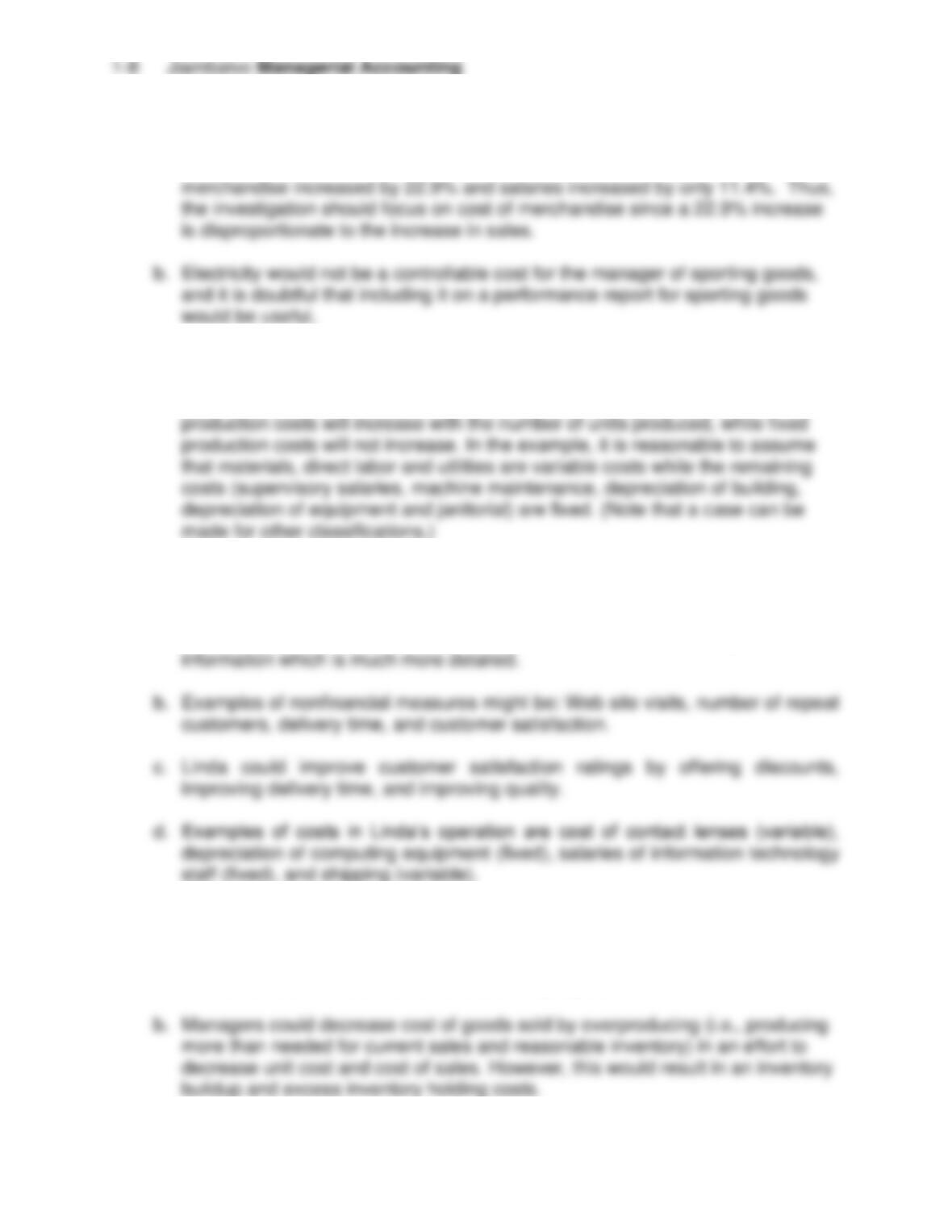
Sales Department
Budgeted Costs, 2017
(Assuming Sales of $11,000,000)
Salaries (fixed) $400,000
P4. [LO 1]
a. Sales exceeded the budget by 10.7% ($75,000 ÷ $700,000), while cost of
P5. [LO 1, 2]
Cyril should expect some costs to be greater than budgeted. Variable
P6. [LO 1, 2, 3]
a. The information on the income statement, balance sheet and statement of cash
flow is highly summarized for the entity as a whole. Linda needs product level
P7. [LO 3]
a. Managers may focus (too much) on new customers and ignore current
customers who account for most of the company’s sales.
P8. [LO 2, 3]
a. Incremental revenue will be $640 ($160 x 4).
P9. [LO 5]
Answers based on Sears Holding Company Code of Conduct.
a. “Associates may not share pricing data among competing vendors.”
Jiambalvo Managerial Accounting
1-10
Case 1-1. [LO 2, 5]
LOCAL 635
Summary
Union is disputing “cost of meal” charges to hotel employees.
Questions to ask students:
1. What is the source of conflict between Local 635 and the Riverside Hotel?
2. What are some examples of variable, fixed, sunk, and opportunity costs in the
context of the Local 635 case?
Discussion
I start this case by asking a student to explain the source of conflict between Local 635
and the Riverside Hotel. The student is likely to explain that while employees are
focused on the incremental cost of a meal, management is focused on various fixed
costs as well as the incremental costs. This leads to a major take away—there is no
generally accepted meaning of the term cost. We know what’s meant by fixed cost,
variable cost, opportunity cost, sunk cost, etc., but there is ambiguity as to what exactly
cost means.
Chapter 1 Managerial Accounting in the Information Age
1-11
customer, who always eats prime rib, comes into the restaurant. If this customer
becomes disgruntled and never returns to the restaurant, the hotel could easily be out
$300 or more in the next few months.
How should the contract be rewritten? Students generally recommend that meal
Jiambalvo Managerial Accounting
1-12
Case 1-2. [LO 3]
BOSWELL PLUMBING PRODUCTS
Summary
A senior manager is requesting information on the “cost” of a product.
Questions to ask students:
1. What did the senior manager ask Nick and how did he reply?
2. Why is Nick’s response “Why do you want to know?” appropriate from the standpoint
of incremental analysis?
Discussion
A senior manager has asked Nick Somner to tell her the cost of the D45 valve. Nick
replies, “Why do you want to know?” This response is appropriate from the standpoint of
incremental analysis. The cost information that the senior manager needs to make a
decision depends on the decision she is facing. Thus, “Why do you want to know?” is
just Nick’s way of asking “What decision are you facing?” If the senior manager is