John J. Wild, Financial Accounting: Information for Decisions, 8th Edition
1-1
CHAPTER 1
INTRODUCING FINANCIAL STATEMENTS
Related Assignment Materials
Student Learning Objectives
Questions
Quick
Studies*
Exercises*
Problems*
Beyond the
Numbers
Conceptual objectives
C1. Explain the purpose and
importance of accounting.
1, 2, 5
1-1
1-1, 1-4, 1-6
1-6
C2. Identify users and uses of, and
opportunities in accounting.
3, 4, 6, 7,
8, 9, 10, 11,
12, 23
1-2
1-2, 1-3, 1-4
1-4, 1-8
accounting.
and apply several accounting
principles.
16, 19, 32
1-6, 1-16,
1-17
SP 1
C5. B Identify and describe the three
major activities in organizations.
(Appendix 1B)
16, 30,
31
1-21
1-13, 1-14
Analytical objectives:
A1. Define and interpret the
accounting equation and each of
its components.
17, 33, 34
1-7, 1-8,
1-9
1-8, 1-9
1-1, 1-2,
1-8, 1-10
1-1, 1-2,
1-4, 1-7,
1-9
A2. Compute and interpret return on
assets.
28
1-15
1-18, 1-14
1-10, 1-11
1-1, 1-2,
1-5, 1-9
A3. A Explain the relation between
return and risk. (Appendix 1A)
29
1-12
1-1, 1-2,
1-9
Procedural objectives:
P1. Analyze business transactions
using the accounting equation.
18
1-10, 1-11
1-10, 1-11,
1-12, 1-13
1-1, 1-2, 1-7,
1-8, 1-9,
SP 1
1-7
how they interrelate.
26, 27, 33,
34, 35
1-19, 1-20
1-9
John J. Wild, Financial Accounting: Information for Decisions, 8th Edition
1-2
Additional Information on Related Assignment Material
Connect
Available on the instructor’s course-specific website) repeats all numerical Quick Studies, all Exercises
and Problems Set A. Connect also provides algorithmic versions for Quick Study, Exercises and
Problems. It allows instructors to monitor, promote, and assess student learning. It can be used in
practice, homework, or exam mode.
Excel Simulations
Assignable within Connect, Excel Simulations allow students to practice their Excel skills—such as basic formulas
and formatting—within the context of accounting. These questions feature animated, narrated Help and Show Me
tutorials (when enabled). Excel Simulations are auto-graded and provide instant feedback to the student.
Synopsis of Chapter Revisions
• Updated opener—Apple
• Updated salary info for accountants and for those with higher degrees.
• Streamlined the Fraud Triangle section.
• Updated ‘Cooking The Books’ box.
John J. Wild, Financial Accounting: Information for Decisions, 8th Edition
1-3
Chapter Outline
Notes
I. Importance of Accounting—we live in the information age, where
information, and its reliability, impacts the financial well-being of us
all.
A. Accounting
Accounting is an information and measurement system that
identifies, records and communicates relevant, reliable, and
comparable information about an organizations business activities.
B. Users of Accounting Information
labor unions, regulators, voters, legislators, government
officials, customers, suppliers, lawyers, brokers, etc.
1. External Information Users—those not directly involved with
running the company. Examples: shareholders (investors),
2. Internal Information Users—those directly involved in
managing and operating an organization. Examples: research
and development managers, purchasing managers, production
1. Private accounting offers the most opportunities.
2. Public accounting offers the next largest number of
opportunities
3. Government (and not-for-profit) agencies, including business
regulation and investigation of law violations also offer
opportunities.
II. Fundamentals of Accounting—accounting is guided by principles,
standards, concepts, and assumptions.
B. Fraud Triangle—model that asserts three factors must exist for
John J. Wild, Financial Accounting: Information for Decisions, 8th Edition
1-4
Chapter Outline
Notes
1. Setting Accounting Principles
c. Differences between U.S. GAAP and IFRS are decreasing
a. In U.S. major rule-setting bodies are the Securities and
Exchange Commission (SEC) and the Financial
Accounting Standards Board (FASB). SEC delegated
2. Conceptual Framework and Convergence—The FASB and
IASB are attempting to converge and enhance the conceptual
framework that guides standard setting. Framework consists
of:
3. Principles and Assumptions of Accounting—two types are
general principles (basic assumptions, concepts and guidelines
for preparing financial statements; stem from long used
accounting practices) and specific principles (detailed rules
used in reporting transactions; from rulings of authoritative
bodies). The four principles discussed in this chapter are:
John J. Wild, Financial Accounting: Information for Decisions, 8th Edition
1-5
Chapter Outline
Notes
independent unbiased evidence: more than someone’s
opinion.
a. Measurement principle also called the cost principle—
financial statements are based on actual costs (with a
some companies express reports in more than one
of other items received.
c. Expense recognition principle, also called matching
principle—prescribes that a company records expenses
incurred to generate revenues it reported.
d. Full disclosure principle—prescribes reporting the details
monetary unit.
c. Time period assumption—the life of the company can be
divided into time periods, such as months and years, and
that useful reports can be prepared for those periods.
d. Business entity assumption—a business is accounted for
separate from other business entities and separate from its
owner. Necessary for good decisions
4. Business Entity Legal Forms
a. Sole proprietorship is a business owned by one person
John J. Wild, Financial Accounting: Information for Decisions, 8th Edition
1-6
Chapter Outline
Notes
b. Partnership is a business owned by two or more people,
called partners, who are subject to unlimited liability. The
business is not subject to an income tax, but the owners
are responsible for personal income tax on their individual
share of the net income of entity.
c. Three special partnership forms that limit liability
i. Limited partnership (LP)—has a general partner(s) with
unlimited liability and a limited partner(s) with limited
e. Corporation is a business that is a separate legal entity
whose owners are called shareholders or stockholders.
These owners have limited liability. The entity is
responsible for a business income tax and the owners are
responsible for personal income tax on profits that are
distributed to them in the form of dividends.
5. Accounting Constraints
There are two basic constraints on financial reporting.
information with benefits of disclosure greater than the
costs of providing it need be disclosed.
a. The materiality constraint prescribes that only information
6. Sarbanes-Oxley (SOX)—Law passed by congress that
requires public companies to apply both accounting oversight
and stringent internal controls to achieve more transparency,
accountability and truthfulness in reporting.
7. Dodd-Frank (Wall Street Reform and Consumer Protection
Act)—Law recently passed as a response to financial systems
near collapse. Details of the law are yet to be set forth by
regulators.
III. Business Transactions and Accounting
A. Accounting equation (Assets = Liabilities + Equity)—elements of
the equation include:
1. Assets—resources a company owns or controls that are
John J. Wild, Financial Accounting: Information for Decisions, 8th Edition
1-7
Chapter Outline
Notes
expected to carry future benefits. (i.e. cash, supplies, equipment
and land)
2. Liabilities—creditors’ claims on assets. These claims reflect
3. Equity—owner’s claim on assets; assets minus liabilities. Also
called stockholders’ equity, shareholders’ equity or capital, net
assets or residual equity. Changes in Equity—result from stock
issuances or owner investments, revenues, dividends, and
expenses. C
a. Common stock—part of contributed capital include cash and
other net assets from stockholders in exchange for stock.
B. Expanded Accounting Equation:
Assets = Liabilities + Common Stock – Dividends + Revenues –
Expenses
C. Transaction Analysis—each transaction and event always leaves
the equation in balance. (Assets = Liabilities + Equity)
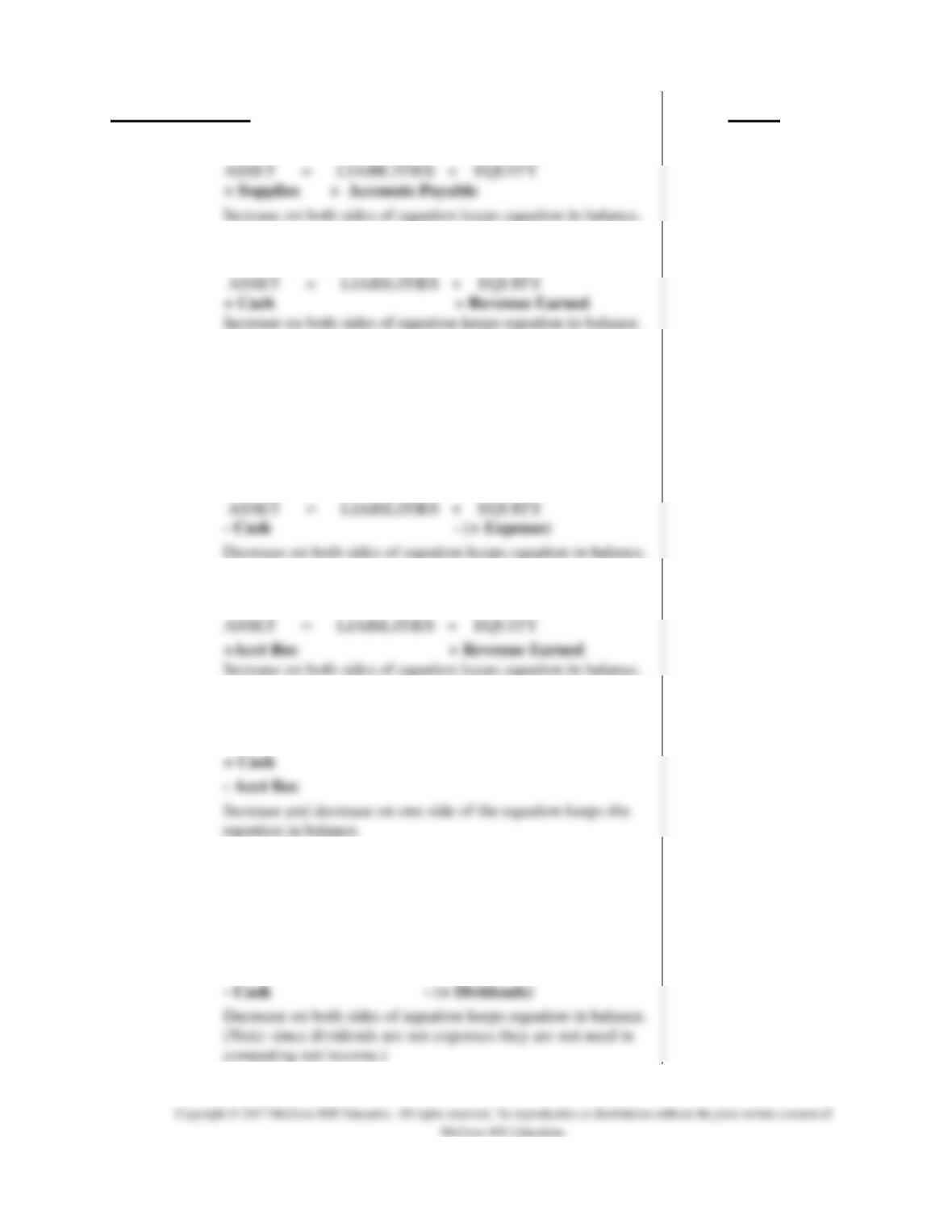
1. Investment by owner:
ASSET = LIABILITIES + EQUITY
2. Purchase supplies for cash:
ASSET = LIABILITIES + EQUITY
3. Purchase equipment for cash:
ASSET = LIABILITIES + EQUITY
John J. Wild, Financial Accounting: Information for Decisions, 8th Edition
1-8
Chapter Outline
Notes
4. Purchase supplies on credit:
5. Provide services for cash:
6. Payment of expense in cash (rent):
ASSET = LIABILITIES + EQUITY
– Cash – (+ Expense)
Decrease on both sides of equation keeps equation in balance.
7. Payment of expense in cash (salaries):
8. Provide services for credit:
9. Receipt of cash from account receivable:
ASSET = LIABILITIES + EQUITY
10. Payment of accounts payable:
ASSET = LIABILITIES + EQUITY
– Cash – Accounts Payable
11. Payment of cash dividend:
ASSET = LIABILITIES + EQUITY
John J. Wild, Financial Accounting: Information for Decisions, 8th Edition
1-9
Chapter Outline
Notes
IV. Communicating with Users
A. The four financial statements and their purposes are:
1. Income Statement—describes a company’s revenues and
expenses along with the resulting net income or loss over a
period of time. (Net income occurs when revenues exceed
expenses. Net loss occurs when expenses exceed revenues.)
2. Statement of Retained Earnings—explains changes in equity
from net income (or loss) and from owner investment and
dividends over a period of time.
3. Balance Sheet—describes a company’s financial position
(types and amounts of assets, liabilities, and equity) at a point
in time.
4. Statement of Cash Flows—identifies cash inflows (receipts)
and cash outflows (payments) over a period of time.
B. Statement Preparation from Transaction Analysis—prepared in the
following order using the procedure indicated below.
1. Income Statement⎯information about revenues and expenses
is conveniently taken from the equity columns. Total revenues
minus total expenses equals net income or loss. Notice that
stockholders’ investments and dividends are not part of
income (or loss).
2. Statement Retained Earnings⎯reports retained earnings
changes over reporting period. Beginning retained earnings,
the balance sheet.
3. Balance Sheet⎯the ending balance of each asset is listed and
the total of this listing equals total assets. The ending balance
of each liability is listed and the total of this listing equals total
cash. The resulting figure should be the ending cash that was
shown on the balance sheet.
4. Statement of Cash Flows⎯the cash column must be carefully
analyzed to organize and report cash flows in categories of
John J. Wild, Financial Accounting: Information for Decisions, 8th Edition
1-10
Chapter Outline
Notes
V. Global View—Financial Accounting using U.S. GAAP is similar, but
not identical to IFRS. Similarities and differences:
A. Basic Principles—both GAAP and IFRS include broad and similar
guidance for accounting.
VI. Decision Analysis—Return on Assets (ROA)—a profitability measure.
Also called Return on Investment (ROI)
A. Useful in evaluating management, analyzing and forecasting profits,
and planning activities.
VII. Return And Risk—Appendix 1A
A. Risk—the uncertainty about the return we will earn on an
investment.
B. The lower the risk, the lower the return.
C. Higher risk implies higher, but riskier implied returns.
VIII. Business Activities—Appendix 1B
A. The accounting equation is derived from business activities.
B. Three major business activities are:
b. Non-owner (or creditor) financing—refers to resources
1. Financing activities—activities that provide the means
organizations use to pay for resources such as land, buildings, and
2. Investing activities—are the acquiring and disposing of resources
(assets) that an organization uses to acquire and sell its products
or services.
3. Operating activities—involve using resources to research,
develop, purchase, produce, distribute, and market products and
John J. Wild, Financial Accounting: Information for Decisions, 8th Edition
1-11
VISUAL #1-1
WARNING: NO MATTER WHAT HAPPENS
ALWAYS KEEP THIS SCALE
IN BALANCE
Basic Accounting Equation
ASSETS = LIABILITIES + EQUITY
TRANSACTION ANALYSIS RULES
1) Every transaction affects at least two items.

John J. Wild, Financial Accounting: Information for Decisions, 8th Edition