CASE 1.5
THE LESLIE FAY COMPANIES
Synopsis
Fred Pomerantz founded Leslie Fay in the mid-1940s and built the company into one of the
leading firms in the highly competitive women’s apparel industry over the next four decades. Fred’s
forced to file for protection from its creditors in federal bankruptcy court. In the meantime,
investigations by law enforcement authorities corroborated Pomerantz’s repeated denials that he was
involved in, or aware of, the fraud. However, those same investigations implicated Polishan in the
fraud. Another party tainted by the investigations was Leslie Fay’s former audit firm, BDO
Seidman. One investigative report noted that negligence on the part of the accounting firm had
Case 1.5 The Leslie Fay Companies
33
The Leslie Fay Companies—Key Facts
2. One of John Pomerantz’s closest associates was Paul Polishan, Leslie Fay’s CFO who ruled the
company’s accounting function with an iron fist.
3. John Pomerantz insisted on doing business the fiold–fashioned way,” which meant that the
4. A growing trend toward more casual fashions eventually created financial problems for Leslie
6. In January 1993, Paul Polishan informed John Pomerantz of a large-scale accounting fraud over
7. Upon learning of the accounting fraud, BDO Seidman withdrew its unqualified audit opinions
8. The centerpiece of the Leslie Fay fraud was intentional overstatements of period-ending
inventories, although several other financial statement items were also intentionally distorted.
9. John Pomerantz was never directly implicated in the fraud, although many critics, including
BDO Seidman, insisted that he had to share some degree of responsibility for it.
10. BDO Seidman ultimately agreed to pay $8 million to a settlement pool to resolve numerous civil
lawsuits stemming from the Leslie Fay fraud that named the accounting firm as a defendant.
12. Leslie Fay emerged from federal bankruptcy court in 1997 but disappeared a few years later
Case 1.5 The Leslie Fay Companies
34
Instructional Objectives
1. To provide students with an opportunity to use analytical procedures as an audit planning tool.
Suggestions for Use
Several of the Section 1 or Comprehensive cases in this text, including the Leslie Fay case,
contain exhibits that present multi-year financial statement data for a given company. These data
provide students an opportunity to apply analytical procedures as a planning tool. Although a central
theme of this casebook is the fipeople” aspect of independent audits, I believe it is also important that
students be exposed to the more mundane, number-crunching aspects of an independent audit. One
way that you can extend Question 1 is to require different groups of students to collect and present
(for the same time frame) the financial ratios shown in Exhibit 2 for several of Leslie Fay’s key
A key feature of this case is the impact that Paul Polishan’s domineering personality had on the
accounting function of Leslie Fay. This fired flag” is among the most common associated with
problem audit clients. Published reports never indicated exactly how Polishan was able to
psychologically control and manipulate Donald Kenia and his other subordinates in fiPoliworld.”
Case 1.5 The Leslie Fay Companies
35
Suggested Solutions to Case Questions
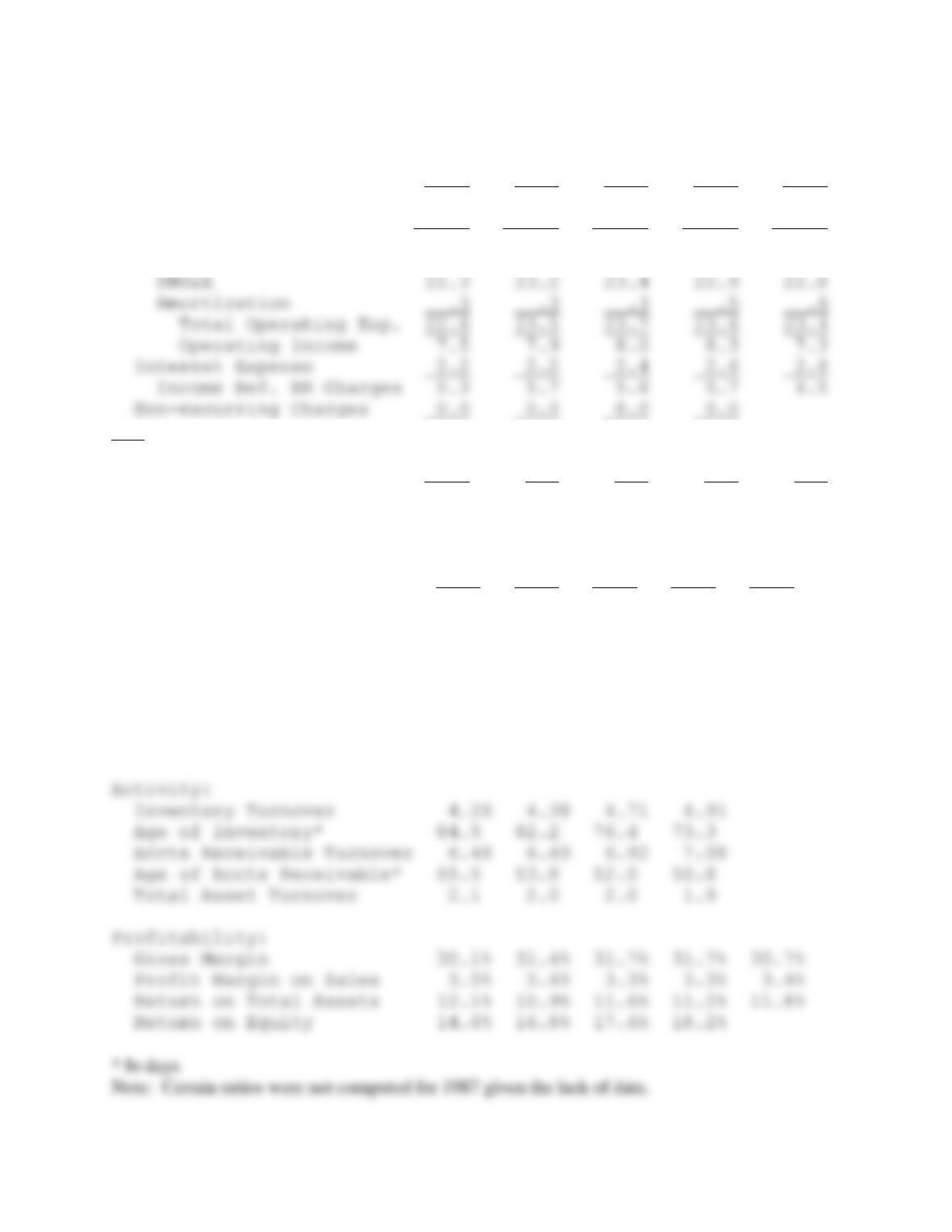
1. Following are common-sized financial statements and the requested financial ratios for Leslie
Fay for the period 1987-1991.
1991 1990 1989 1988 1987
Current Assets:
PP&E 9.9 6.8 7.0 7.1 7.9
Goodwill 20.5 20.1 23.5 25.9 29.6
Deferred Charges, etc. 1.4 1.4 1.5 1.2 1.7
Total Assets 100.0 100.0 100.0 100.0 100.0
Current Liabilities:
Notes Payable 8.8 10.9 5.9 8.0 5.1
Long–term Debt 21.3 29.6 33.2 32.0 38.2
Deferred Credits, etc. .7 .6 .7 1.2 1.6
Stockholders’ Equity:
Common Stock 5.1 4.6 5.2 5.5 6.6
Case 1.5 The Leslie Fay Companies
36
1991 1990 1989 1988 1987
Net Sales 100.0 100.0 100.0 100.0 100.0
Cost of Sales 69.9 68.6 68.3 68.3 69.3
Gross Profit 30.1 31.4 31.7 31.7 30.7
Operating Expenses:
(.9)
Inc. Before Taxes 5.3 5.7 5.6 5.7 5.4
Income Taxes 1.8 2.3 2.3 2.4 2.0
Net Income 3.5 3.4 3.3 3.3 3.4
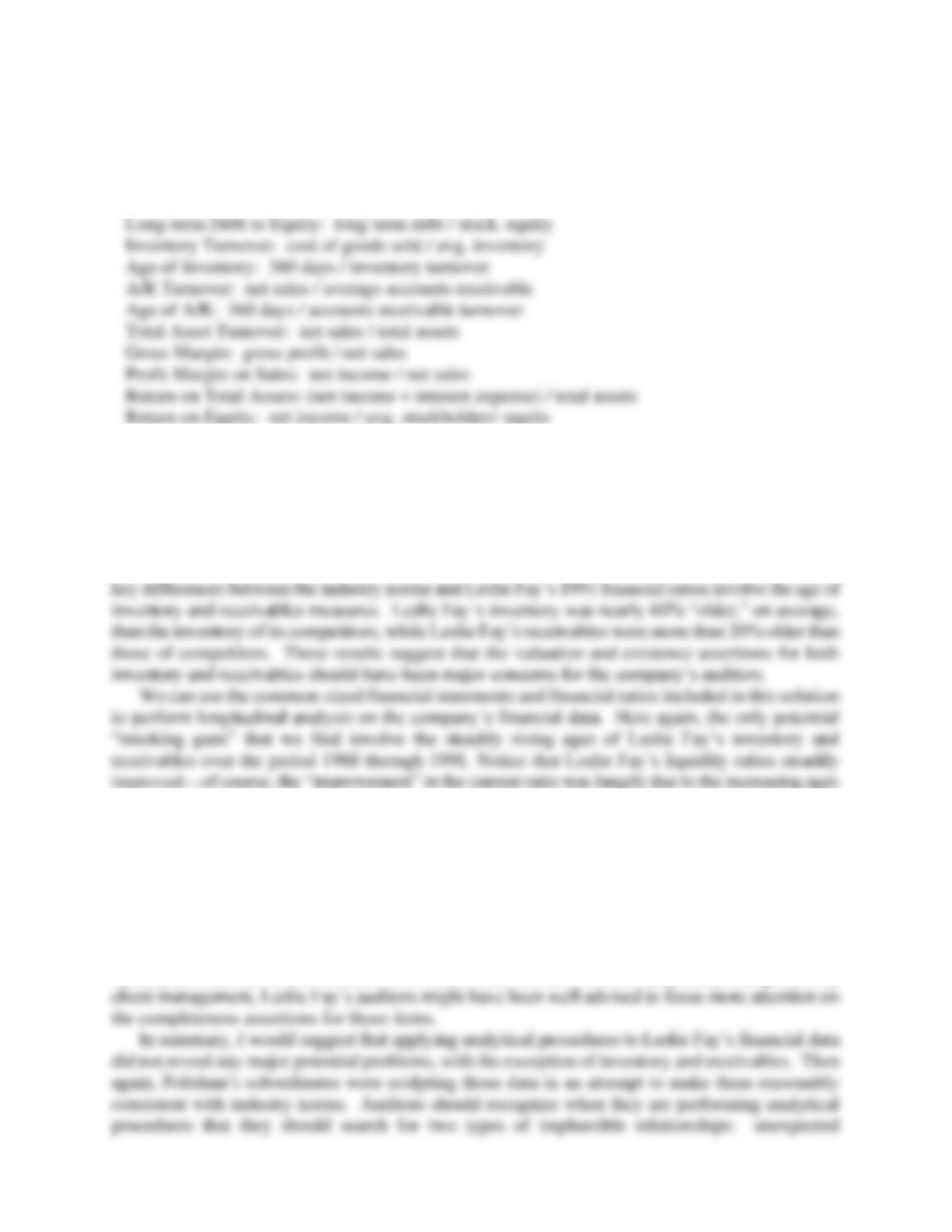
Financial Ratios for Leslie Fay:
1991 1990 1989 1988 1987
Liquidity:
Current 2.9 2.6 2.7 2.2 2.6
Quick 1.5 1.4 1.5 1.2 1.4
Solvency:
Debt to Assets .45 .57 .59 .63 .63
Times Interest Earned 3.4 3.6 3.3 3.1 2.6
Long–term Debt to Equity .39 .69 .81 .87 1.04
Equations:
Case 1.5 The Leslie Fay Companies
37
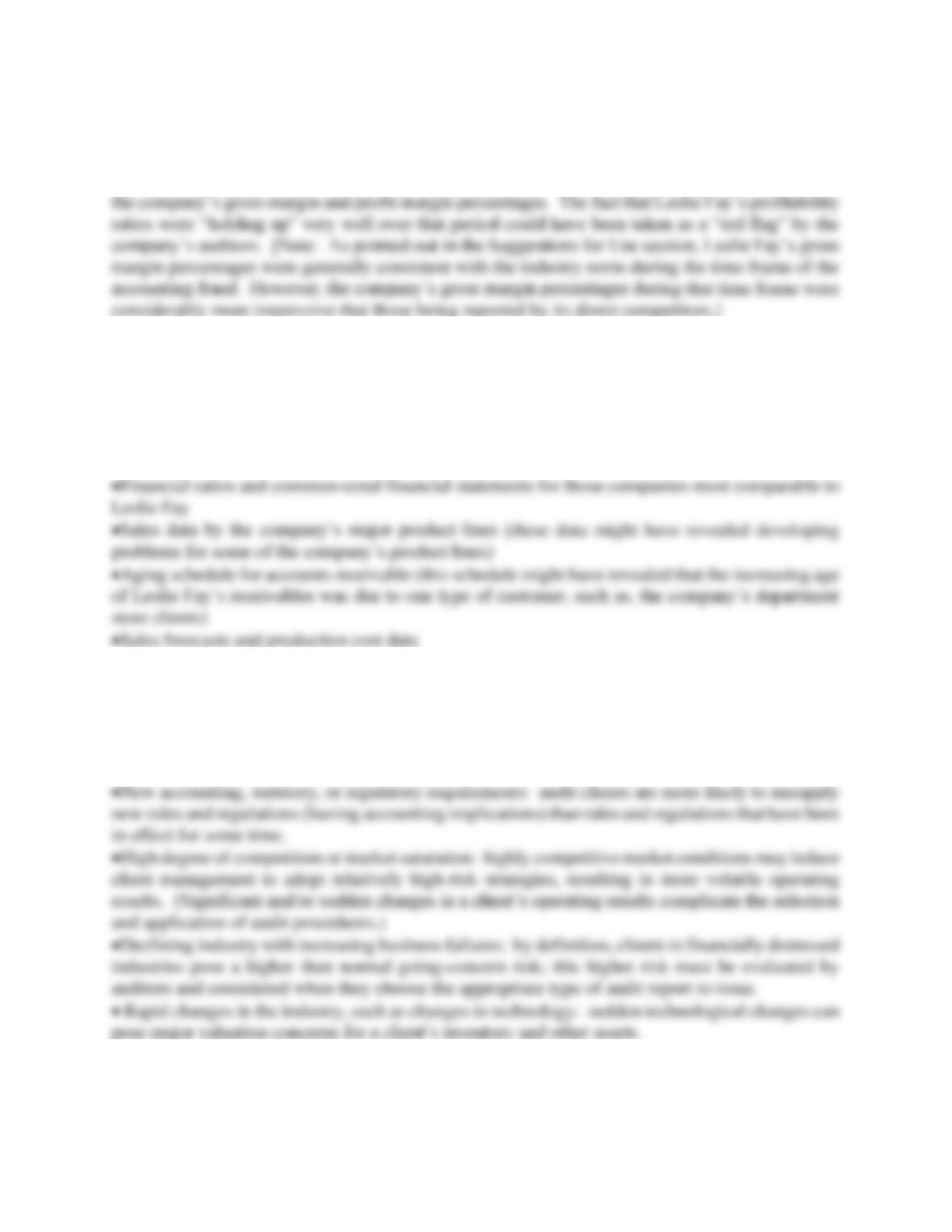
Current Ratio: current assets / current liabilities
Quick Ratio: (current assets – inventory) / current liabilities
Debt to Assets: total debt / total assets
Times Interest Earned: operating income / interest charges
Discussion:
In comparing Leslie Fay’s 1991 financial ratios with the composite industry norms shown in
Exhibit 2, we do not find many stark differences. Overall, Leslie Fay’s liquidity ratios were stronger
than the industry averages, while their solvency ratios were generally a little weaker. Leslie Fay’s
profitability ratios were also reasonably consistent with the corresponding industry averages. The
of receivables and inventory, while the improving quick ratio was largely attributable to the
increasing age of receivables. Leslie Fay’s solvency ratios generally improved during the late 1980s
and early 1990s, while most of the company’s profitability ratios were remarkably consistent over
that time frame.
Leslie Fay’s common-sized financial statements for 1987-1991 do not reveal any major
structural changes in the company’s financial position or operating results over that period. Two
accounts that I would mention that had fiinteresting” profiles in the common-sized balance sheets
were accounts payable and accrued expenses. Notice that the relative balances of those two items
steadily declined between 1988 and 1991. Since those two items can be fairly easily manipulated by
38 Case 1.5 The Leslie Fay Companies
relationships apparent in the client’s financial data and expected relationships that are not apparent in
those data. For example, given the problems facing the women’s apparel industry during the late
1980s and early 1990s, Leslie Fay’s auditors probably should have expected some deterioration in
2. Listed next are examples of other financial information, in addition to that shown in Exhibits 1
and 2, that might have been of considerable interest to Leslie Fay’s auditors.
•Backlog of orders
•Composition of inventory over the previous several years (that is, did one particular component of
inventory, such as, work-in–process or finished goods, account for the increasing age fiissue”?)
3. Listed next are fraud risk factors that relate to the condition of a given audit client’s industry.
Each of these factors is included in the Appendix to AU Section 316, fiConsideration of Fraud in a
Financial Statement Audit,” of the PCAOB’s Interim Standards. Similar fraud risk factors are
reported in AU-C Section 240.A75 of the AICPA Professional Standards.
4. When one individual dominates a client’s accounting and financial reporting, the reliability of
those systems depends upon the integrity and competence of that individual. In such circumstances,
the inherent risk and control risk posed by a client must be carefully assessed by auditors. Even if
Case 1.5 The Leslie Fay Companies 39
5. Co-defendants in a lawsuit often have diverging interests that may eventually result in them
becoming adversaries as the given case develops (which is exactly what happened in the Leslie Fay
case). It is doubtful that auditors can retain their de facto and apparent independence under such