16
PROBLEMS
P1–1
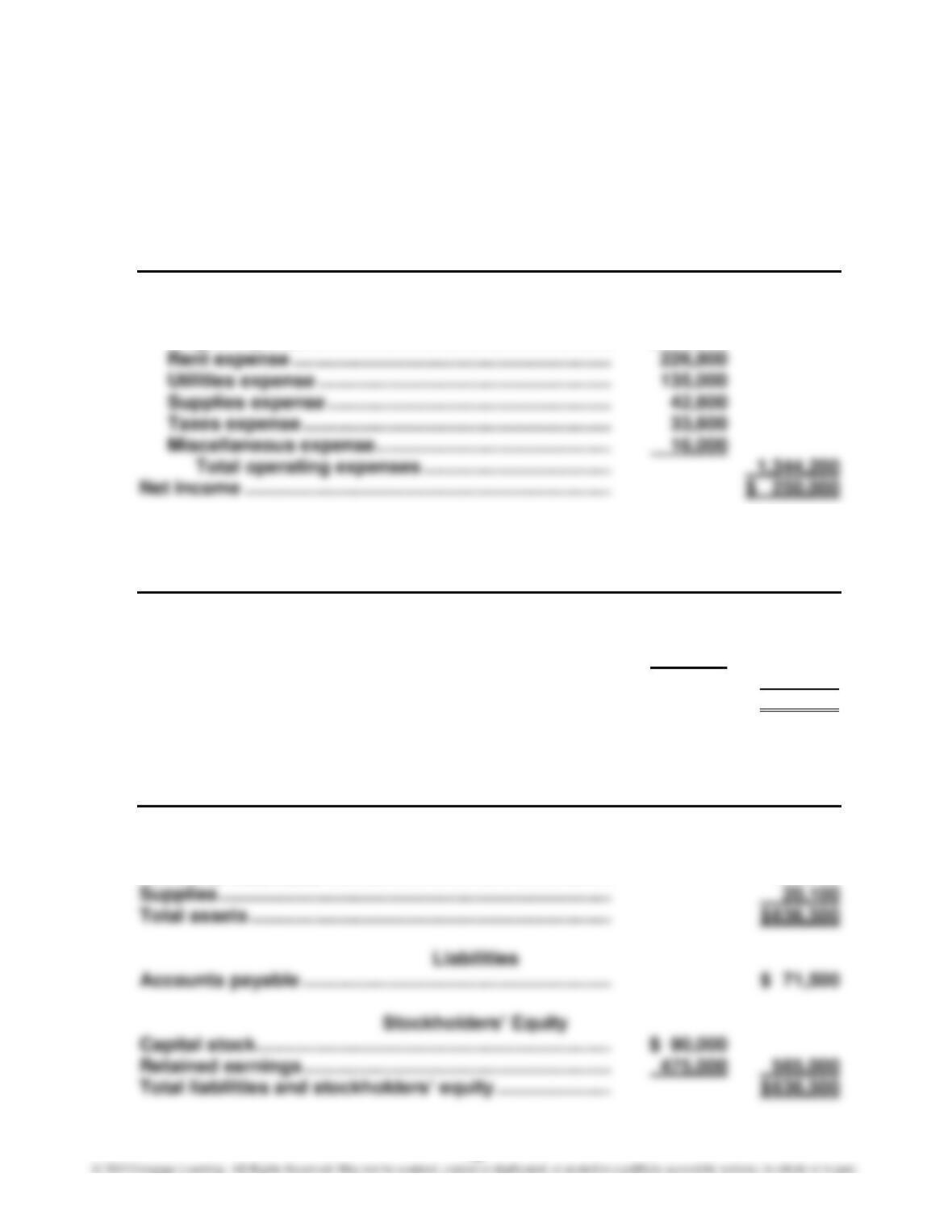
1. UTAH TRAVEL SERVICE
Income Statement
For the Year Ended April 30, 20Y6
Fees earned …………………………………………………………… $ 1,594,200
Operating expenses:
Wages expense …………………………………………………. $890,200
2. UTAH TRAVEL SERVICE
Retained Earnings Statement
For the Year Ended April 30, 20Y6
Retained earnings, May 1, 20Y5………………………………. $ 300,000
Net income for the year ………………………………………….. $250,000
Less dividends ………………………………………………………. 75,000
Increase in retained earnings …………………………………. 175,000
Retained earnings, April 30, 20Y6 …………………………... $ 475,000
3. UTAH TRAVEL SERVICE
Balance Sheet
April 30, 20Y6
Assets
Cash ……………………………………………………………………… $ 428,300
Accounts receivable ………………………………………………. 188,100
P1–2
1. Realty businesses, such as Paradise Realty, are service businesses that aid
their clients in buying or selling real estate.
2. a. Wages expense, $29,850 ($69,300 – $14,400 – $12,000 – $8,100 – $4,950)
b. Net income, $80,000 ($149,300 – $69,300)
c. Net income for November, $80,000
d. Dividends, $36,000
18
P1–3
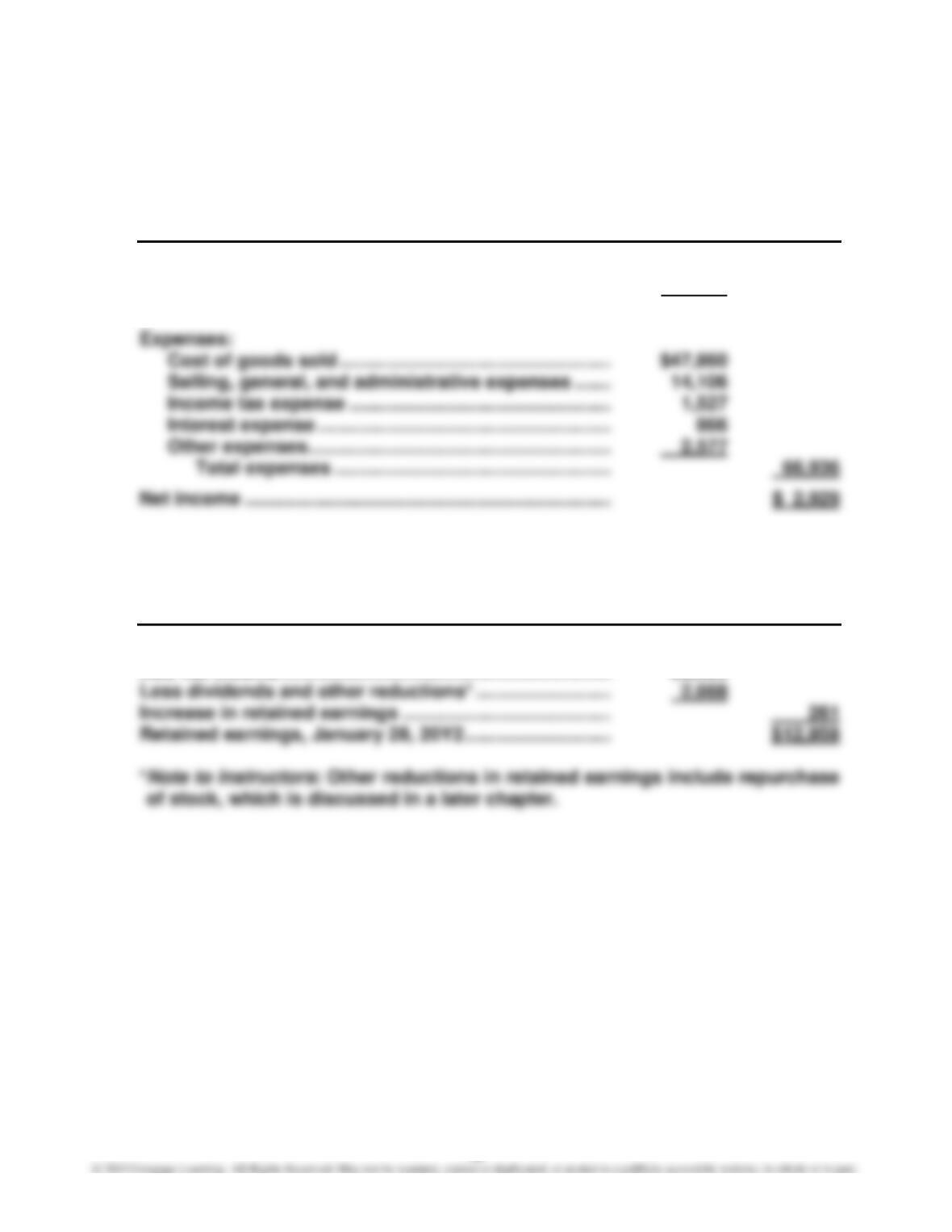
1. TARGET CORPORATION
Income Statement
For the Year Ended January 28, 20Y2
(in millions)
Sales …………………………………………………………………….. $68,466
Other credit card revenue ……………………………………… 1,399
Total revenue ……………………………………………………. $69,865
2. TARGET CORPORATION
Retained Earnings Statement
For the Year Ended January 28, 20Y2
(in millions)
Retained earnings, January 29, 20Y1 ………………………. $ 12,698
Add net income ……………………………………………………… $2,929
19
P1–3, Concluded
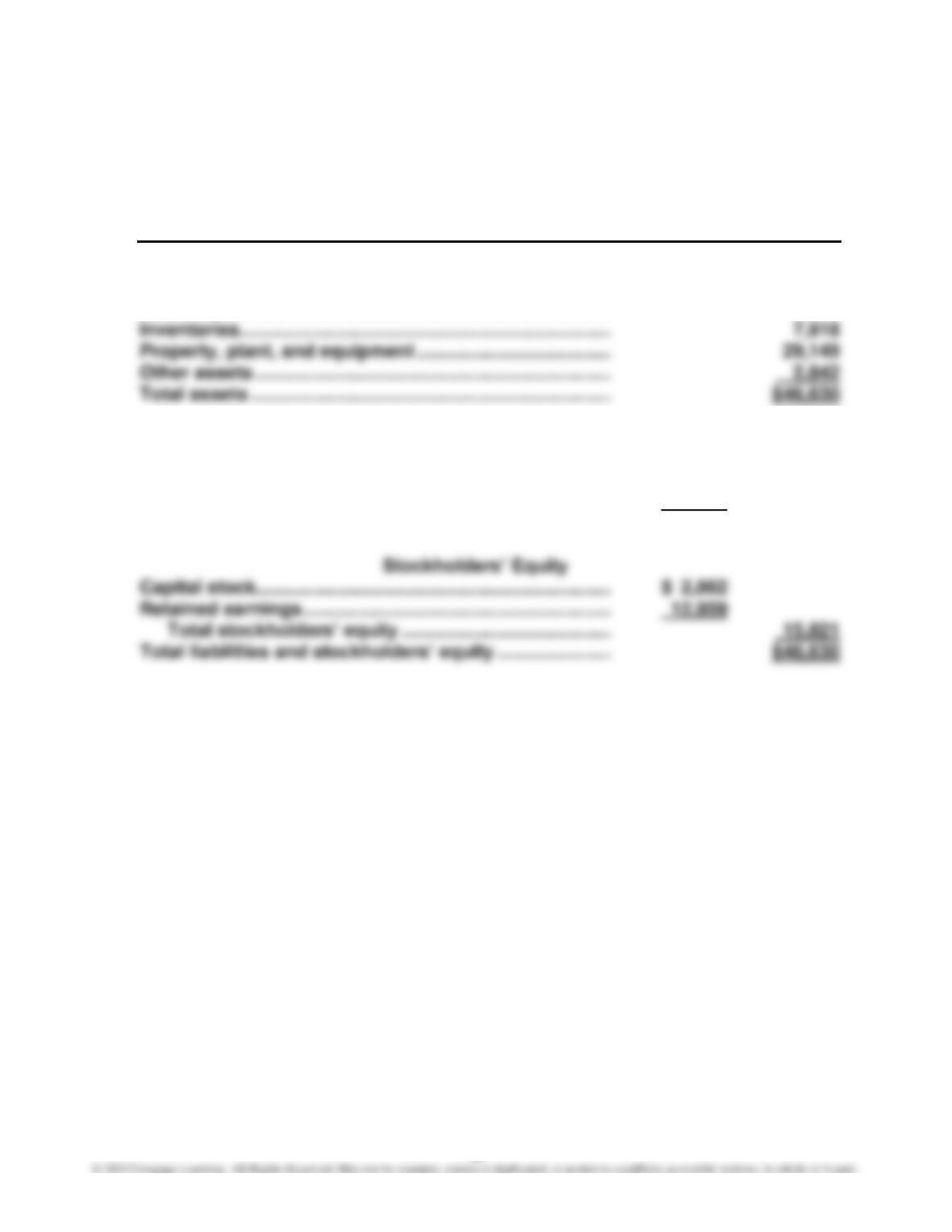
3. TARGET CORPORATION
Balance Sheet
January 28, 20Y2
(in millions)
Assets
Cash ……………………………………………………………………… $ 794
Receivables …………………………………………………………… 5,927
Liabilities
Accounts payable ………………………………………………….. $ 6,857
Debt and other borrowings……………………………….. 17,483
Other liabilities ………………………………………………………. 6,469
Total liabilities …………………………………………………… $30,809
20
P1–4
GOOGLE INC.
Statement of Cash Flows
For the Year Ended December 31, 20Y1
(in millions)
Net cash flows from operating activities …………………………... $ 14,565
Cash flows from investing activities:
Cash purchases for property, plant, and equipment, etc. $(67,787)
Receipts from sale of investments (net) ………………………. 48,746
Net cash flows used for investing activities …………………. (19,041)
21
P1–5
1. CASSANDRA CORPORATION
Income Statement
For the Year Ended December 31, Year 1
Revenue:
Sales …………………………..……………………………………. $800,000
2. CASSANDRA CORPORATION
Retained Earnings Statement
For the Year Ended December 31, Year 1
Retained earnings, January 1, Year 1 ……………………… $ 0
Net income ……………………………………………………………. $230,000
22
P1–5, Continued
3. CASSANDRA CORPORATION
Balance Sheet
December 31, Year 1
Assets
Cash ……………………………………………………………………. $ 40,000
Accounts receivable ………………………………………………. 110,000
Liabilities
Accounts payable …………………………………………………. $ 20,000
Income taxes payable ……………………………………………. 8,000
Note payable (due in 2019) ……………………………………… 50,000
Total liabilities …………………………………………………… $ 78,000
P1–5, Concluded
4. CASSANDRA CORPORATION
Statement of Cash Flows
For the Year Ended December 31, Year 1
Cash flows from operating activities:
Cash receipts from operating activities ……………… $ 690,000
Cash payments for operating activities ………………. (657,000)
Net cash flows from operating activities …………………. $ 33,000
Net cash flows from financing activities …………………. 272,000
Net increase in cash during Year 1 …………………………. $ 40,000
Cash as of January 1, Year 1 ………………………………….. 0
Cash as of December 31, Year 1 ……………………………… $ 40,000
Note to Instructors: The determination of cash receipts and payments from
operating activities is not discussed in Chapter 1 and is beyond the student
level of understanding or comprehension at this point in the text. This topic
24
FINANCIAL ANALYSIS
FA1–1
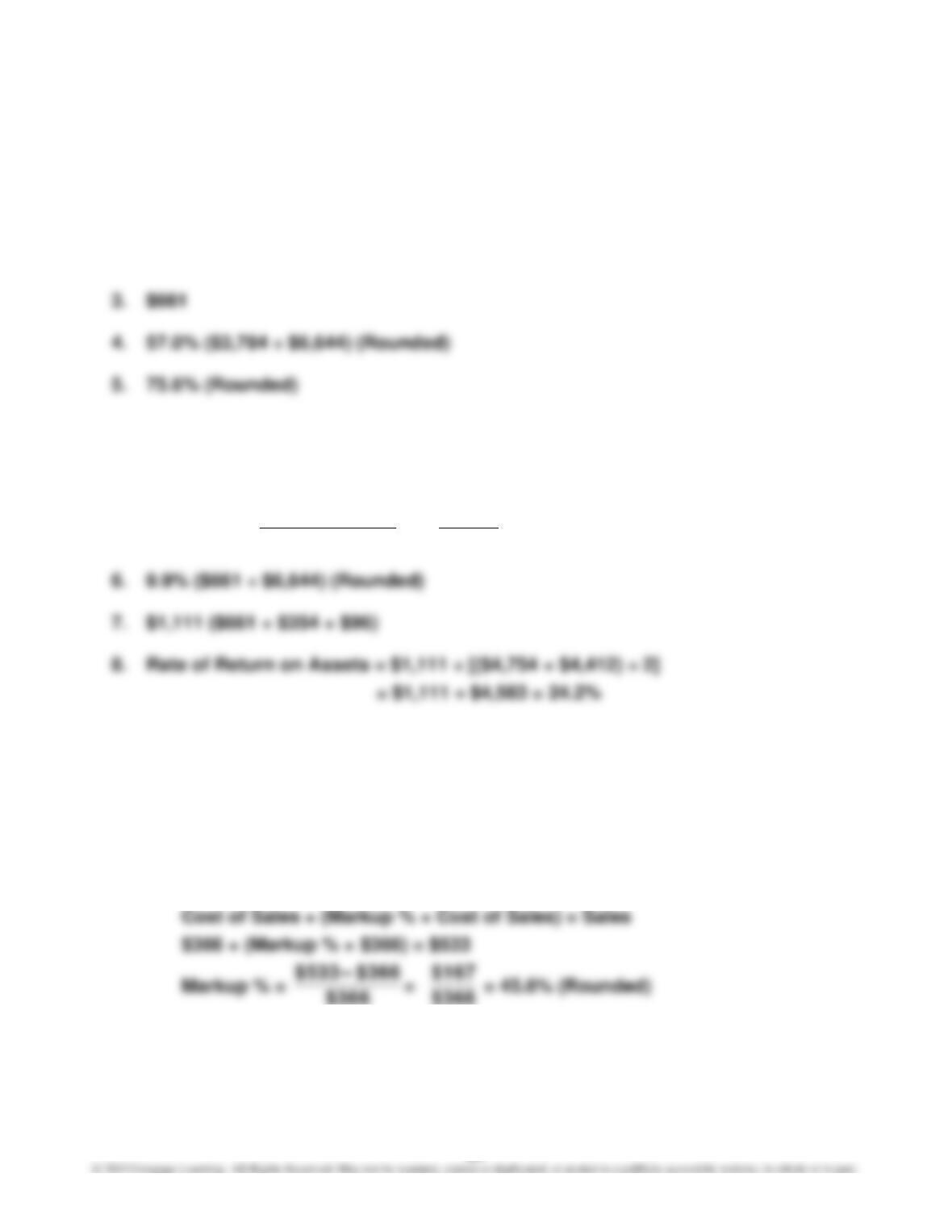
1. $6,644
2. $3,784
The markup percentage is computed as follows:
Cost of Sales + (Markup % × Cost of Sales) = Sales
$3,784 + (Markup % × $3,784) = $6,644
Markup % =
=
$3,784
$3,784 –– $6,644
=
$3,784
$2,860
= 75.6% (Rounded)
FA1–2
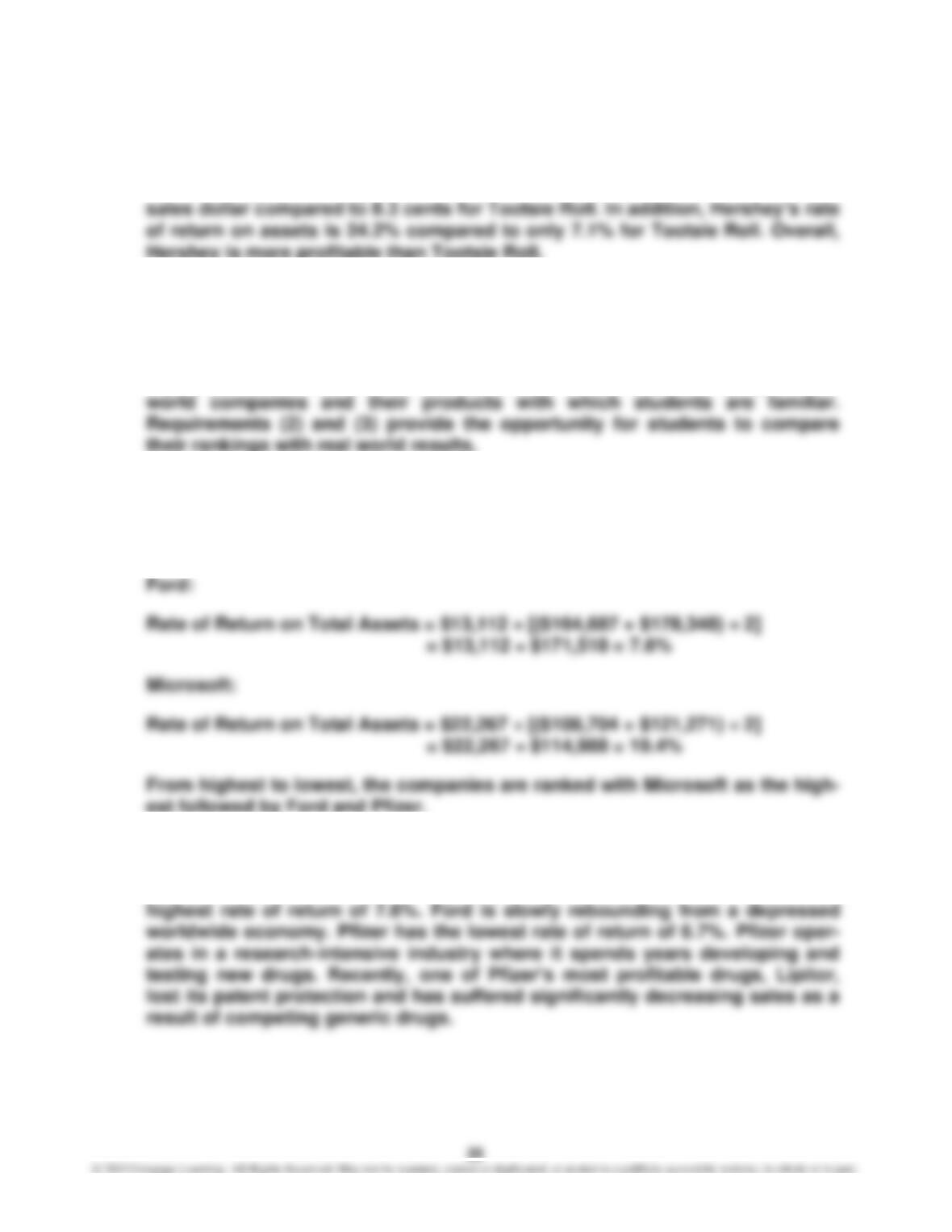
1. 68.7% ($366 ÷ $533) (Rounded)
2. 45.6% (Rounded)
The markup percentage is computed as follows:
3. 8.3% ($44 ÷ $533) (Rounded)
4. Rate of Return on Assets = $61 ÷ $858 = 7.1%
FA1–2, Concluded
5. Hershey’s markup percentage of 75.6% is significantly higher than Tootsie
Roll’s markup percentage of 45.6%. As a result, Hershey earns 9.9 cents per
FA1–3
1. Note to Instructors: The purpose of this requirement is to get students think-
ing about businesses and their profitability. This is done by focusing on real-
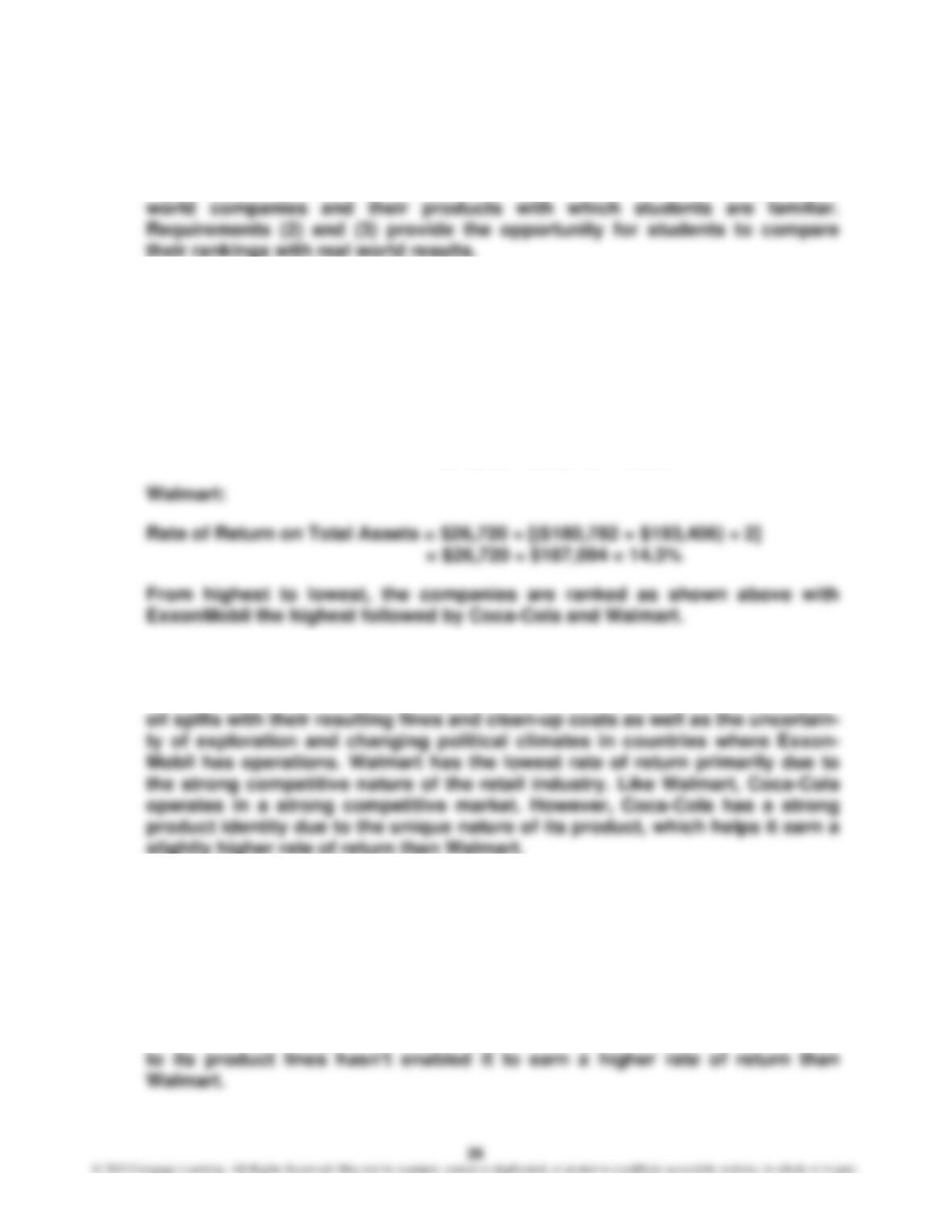
2. Pfizer:
Rate of Return on Total Assets = $12,762 ÷ [($195,014 + $188,002) ÷ 2]
= $12,762 ÷ $191,508 = 6.7%
3. Microsoft has the highest rate of return on total assets of 19.4%. This is due
to the widespread acceptance and use of its products. However, in recent
years Microsoft has been challenged by Google and others. Ford has the next
FA1–4
1. Note to Instructors: The purpose of this requirement is to get students think-
ing about businesses and their profitability. This is done by focusing on real-
2. ExxonMobil:
Rate of Return on Total Assets = $73,504 ÷ [($302,510 + $331,052) ÷ 2]
= $73,504 ÷ $316,781 = 23.2%
Coca-Cola:
Rate of Return on Total Assets = $11,856 ÷ [($72,921 + $79,974) ÷ 2]
= $11,856 ÷ $76,448 = 15.5%
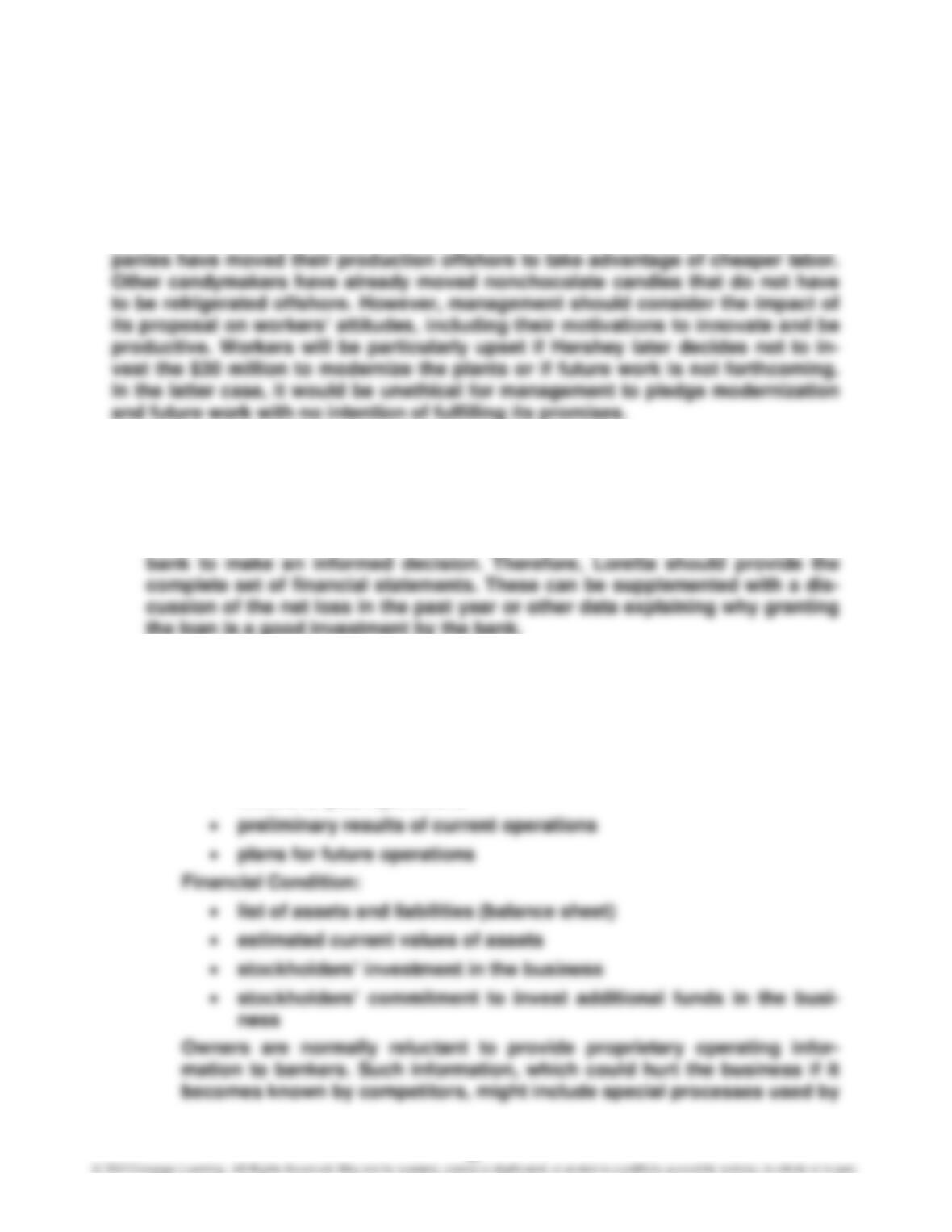
3. ExxonMobil has the highest rate of return on total assets of 23.2%. This is due
to the high demand for petroleum based products. At the same time, Exxon–
Mobil’s operations have the most risks. These risks include such factors as
FA1–5
1. Rate of Return on Total Assets = $5,325 ÷ [($43,705 + $46,630) ÷ 2]
= $5,325 ÷ $45,168 = 11.8%
2. Target’s rate of return on total assets of 11.8% is lower than Walmart’s rate of
return of 14.3%. Target’s recent strategy of adding more upscale merchandise
27
CASES
Case 1–1
Management’s actions are ethical. Management has a responsibility to the com-
pany’s stockholders to remain competitive and profitable. Similarly, many com-
Case 1–2
1. Acceptable professional conduct requires that Loretta Smith supply City
National Bank with all the relevant financial statements necessary for the
2. a. Owners are generally willing to provide bankers with information about
the operating and financial condition of the business, such as the follow-
ing:
Operating Information:
• description of business operations
• results of past operations
28
Case 1–2, Concluded
the business or future plans to expand operations into areas that are not
currently served by a competitor.
Case 1–3
1. In a commodity business like poultry production, the dominant business em-
phasis is a low-cost emphasis. This is because customers cannot differenti-
ate between chickens produced by different companies. The implication of a
2. A major business risk includes the selling of contaminated chickens and the
possibility that competitors will develop lower-cost methods of breeding and
raising chickens. Also, a major cost of raising chickens is the cost of feed.
3. The company could try to differentiate its products by emphasizing that it
raises its chickens with only “natural” feeds without the use of artificial in-
gredients such as steroids, etc. The company could then sell its products as
the “healthy choice” products and probably use a premium-price strategy.
29
Case 1–4
The difference in the two bank balances, $175,000 ($215,000 – $40,000), may not
be pure profit from an accounting perspective. To determine the accounting profit
for the 8-month period, the revenues for the period would need to be matched
with the related expenses. The revenues minus the expenses would indicate
whether the business generated net income (profit) or a net loss for the period.
Case 1–5
Note to Instructors: The purpose of this activity is to show students that the
accounting equation has real world impact. By illustrating how the accounting
equation applies to well-known companies, the importance of accounting and the
concepts discussed in this chapter are emphasized to students.
30
Case 1–6
As can be seen from the balance sheet data in the case, Enron was financed
largely by debt as compared to equity. Specifically, Enron’s stockholders’ equity
represented only 17.5% ($11,470 ÷ $65,503) of Enron’s total assets. The remainder
of Enron’s total assets, 82.5%, was financed by debt. When a company is fi-
nanced largely by debt, it is said to be highly leveraged.
After the allegations of misstatements became public, Enron’s stock rapidly de-
clined and the company filed for bankruptcy. Subsequently, numerous lawsuits
were filed against the company and its management. In addition, the Securities
and Exchange Commission, the Justice Department, and Congress launched in-
vestigations into Enron. As a result, several of Enron’s top executives were crim-
inally prosecuted and were sentenced to prison.