Chapter 1
Introduction
Discussion Questions
1. In the domestic case, accounting is an information service that provides financial information about a
domestic entity to domestic users of that information. International accounting is distinctive in that
2. Advantage: Some might argue that measurement, disclosure, and external auditing are three distinct
(although related) processes, involving different members of the company. For example, corporate
attorneys often are involved in disclosure issues, but seldom intervene in measurement issues. The
Board of Directors works with the external auditors but not necessarily with the comptroller s office.
Thus, discussion of accounting requirements and voluntary accounting choices in different
jurisdictions is simplified by focusing on the three components of accounting.
Disadvantage: measurement, disclosure and auditing are interdependent, and should not be viewed in
isolation of one another. A company choosing to disclose as little as possible, for example, may use
3. Factors contributing to the internationalization of the subject of accounting include: the growth and
4. International trade involves importing and exporting activities. The major accounting issue associated
with foreign trade involves accounting for foreign currency transactions. Foreign direct investment,
5. Students will overwhelmingly argue in favor of harmonization. This is probably a good starting point
6. Recent developments such as the growth and spread of multinational operations, internationalization
of the world’s capital markets, increased cross border mergers and acquisitions, the phenomenon of
global competition, and financial innovation have increased reader dependence on foreign financial
statements. An understanding of accounting differences and their effect on reported measures of
7. Examples of external reporting issues include:
a. Does translation from one set of measurement rules to another change the information content of
the original message?
b. Should accounts of foreign operations be translated to parent currency when consolidated
statements are prepared?
c. Which exchange rates should be employed when translating from one currency to another?
Examples of internal reporting issues include:
a. Which exchange rates should be used for budgeting purposes?
b. Should foreign managers be evaluated in terms of parent currency or the local currency of the
country in which the manager operates?
8. Global capital market activities and transactions reach beyond single political or legal jurisdictions.
For example, global capital market transactions include the following: (1) an American tourist buying
Australian dollars for travel purposes in the South Pacific; (2) a Japanese insurance company buying
German government bonds as an investment; and (3) a Nigerian agricultural development project
receiving cash subsidies from the European Union (EU).
The international equities market is one global capital market. A second such market covers foreign
exchange transactions, that is, when one national currency is exchanged into, traded forward, hedged,
9. Privatizations of state-owned corporations have had dramatic effects on global capital markets. Often,
the privatized entities are large, well-known companies in which the national government retains a
large ownership interest, and retail (individual, noninstitutional) investors often are encouraged to buy
shares in newly privatized entities. As a result, the shareholder base in the market grows dramatically,
investors become more active market participants, and market capitalization increases.
Privatizations also mean that management must now compete in the marketplace for market share,
external capital, and corporate control. In such a world, accounting systems must properly motivate

10. Those opposed to outsourcing see it as a threat to domestic jobs and a form of exploitation by
companies engaged in the practice. Some even see it as a moral issue. However, they miss the point
of international trade. Although outsourcing may reduce jobs in one sector, they reflect differences in
comparative advantage, which ultimately makes possible greater employment in other sectors and or
lower consumer prices which increases real wealth. One need only look at higher education in
America. Whereas stenographers in the United States may be losing jobs to stenographers in India,
more and more Indian families are sending their children to the United States for their higher
education, increasing the demand for support services in the higher education sector.
A look at Exhibit 1-2 shows that over time, countries with greater exports than imports eventually
Exercises
1. For steps one and two in which the idea for the Proliant ML150 is spawned in Singapore and
approved in Texas, differences in legal practices regarding rights and compensation schemes for
intellectual property development may vary between the United States and Singapore as the latter’s
legal system has been influenced by the U.K. system. International tax issues also surface in terms of
royalty payment arrangements and their tax consequences in both Singapore and the United States.
For step three, language communications between Singapore and Taiwan could pose some issues of
interpretation. Production in Taiwan raises internal reporting issues such as should exchange rate
fluctuations between the Taiwanese dollar and the U.S. dollar be incorporated into the cost of
2. The compounded annual growth rate for merchandise exports from 1985 to 2005 was approximately
8.7 percent. The growth rate for merchandise imports was also 8.7 percent. The comparable growth
3. The purpose of this exercise is to get students to check out the wealth of stock related information
available on the Web. They will probably choose the five whose countries are most familiar to them.
Their exchanges will probably be located in highly industrialized economies which afford access to

4. This exercise will require that students combine certain geographic categories of merchandise exports
to achieve some comparability with AKZO Nobel’s disclosures. It would be interesting to poll
students’ ex ante predictions of the correlations and have them ponder reasons for any differences
they find.
Geographic Region MerchandiseExports Geographic Sales for AKZO
Africa and Middle East 8.8% 4.0%
Asia 30.9% 18.9%
Althougth correlations between percentage geographic distributions of merchandise exports and
corporate sales are closer for Europe, there are big differences in corporate sales and merchandise
export patterns for Asia and the Americas. Obviously, one cannot generalize microeconomic behavior
5. The geographic spread of Heineken’s revenue streams suggest that the company is exposed to foreign
exchange rate risk. This complicates the process of forecasting the company’s future earnings and
resultant cash flows. Moreover, the numbers being reported are the results of a consolidation process.
The cardinal rule to remember here is that when exchange rates change, data in parent currency may
change even though local currency amounts may not. For managerial accountants, the conduct of
foreign operations raises numerous issues of financial control. For example, which currency should be
used to evaluate foreign subsidiary performance, the parent currency or the local currency? In
preparing operating budgets, which exchange rate combination should be used to translate original
budgets and subsequently track performance? When planning capital expenditures, how do you factor
inflation, foreign exchange rate risk, and sovereign risk into measures of future project cash flows,
cost of capital estimates, and planned investment outlays? Should capital budgeting decisions be
made from the project’s perspective or a company perspective? Again, this exercise is designed to
6. Issues triggered by Exhibit 1-4 include:
a. What criteria are used to determine when a foreign affiliate is to be consolidated with that of the
parent company? Majority ownership is one criterion for consolidation, do other criteria exist
internationally and why?
b. When consolidating the accounts of a foreign affiliate with that of the parent, should accountants
first restate the accounting measurement rules of the foreign affiliate to the reporting
requirements of the parent company or should the reporting requirements of the affiliate’s country
of domicile prevail? Which method produces the more meaningful information for statement
readers?
c. When consolidating the accounts of a foreign affiliate should the accountant translate the
currency of the affiliate to the reporting currency of the parent company? If so, which exchange
rates should be employed for each balance sheet account? For each income statement account?
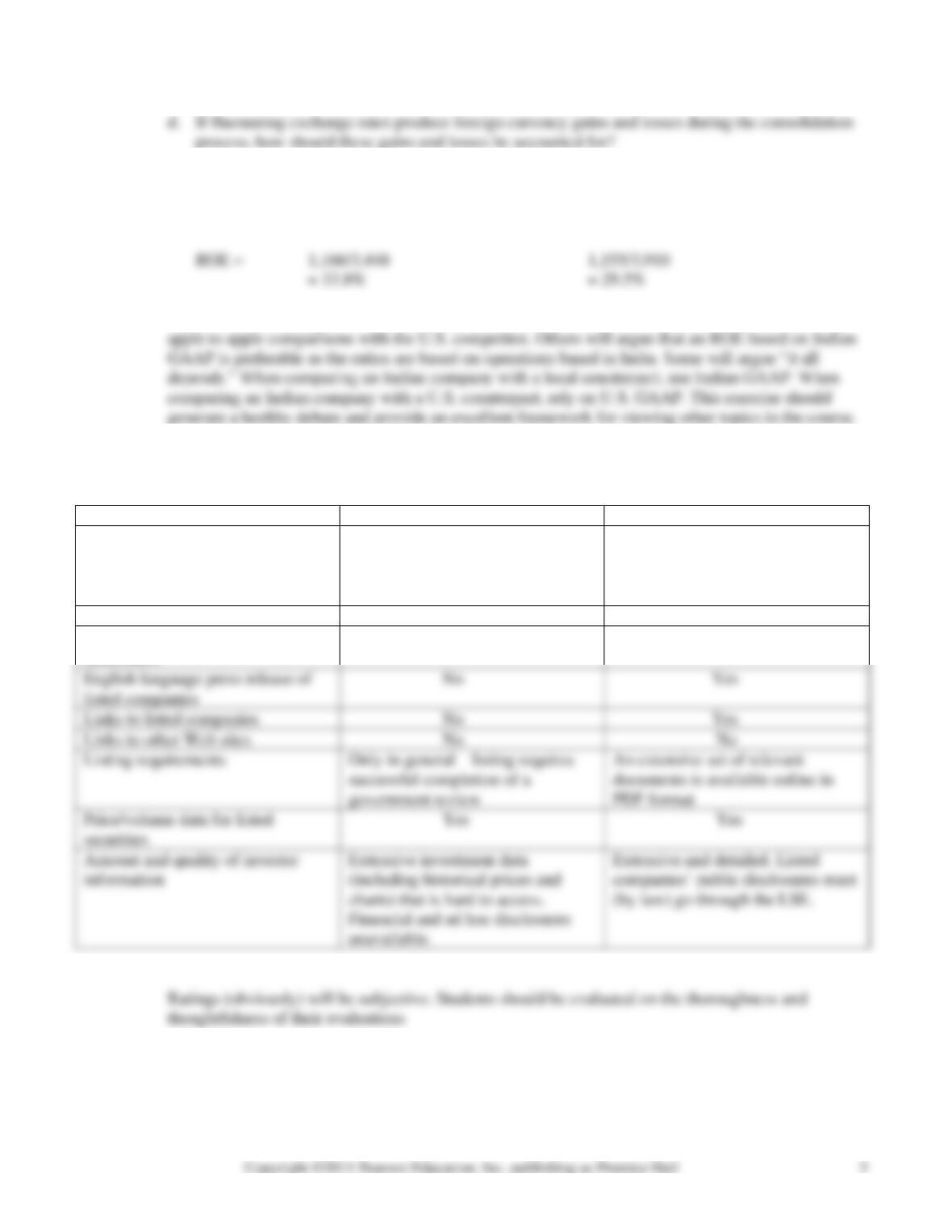
7. The ROE ratios for Infosys based on Indian and U.S. GAAP was derived as follows:
Indian GAAP U.S. GAAP
ROE = 1,166/3,448 1,155/3,910
Some students will argue that an ROE measure based on U.S. GAAP is preferable as this facilitates
8. For an illustrative example, consider the Deutsche Boerse and the London Stock Exchange. Note that
Web sites change continuously. Therefore, the responses shown below are indicative only.
Deutsche Borse
London Stock Exchange
Ease of Use
Good visual layout. Organization of
subjects not always clear or logical.
Many documents available in PDF
format only.
Site is well organized and laid out.
Responsiveness of Web site can be
a problem. Desired information can
be hard to find.
English language Web site
Yes
Yes
English language financial
disclosures
Yes
Yes
English language press release of
listed companies
No
Yes
Links to listed companies
No
Yes
Links to other Web sites
No
No
Listing requirements
Only in general—listing requires
successful completion of a
government review
An extensive set of relevant
documents is available online in
PDF format
Price/volume data for listed
securities
Yes
Yes
Financial and ad hoc disclosures
unavailable.
Ratings (obviously) will be subjective. Students should be evaluated on the thoroughness and
9. If we divide the total foreign company listings for each region by the total listings for that region as
one measure of foreign listings, we would obtain the following results:

10. In addition to eliciting a variety of investment strategies, this question should drive home the
connection between accounting information and international investing. The accounting issues that
Case 1-1 E-Centives, Inc.—Raising Capital in Switzerland
1. Possible factors (from Exhibit 1-7) relevant in e-centives decision to raise capital and list on the Swiss
Exchange s New Market:
a. Ease of raising capital (point 3). The Swiss Exchange s New Market has simple listing
requirements designed to appeal to small companies. The contrast with the complex, detailed
listing and reporting requirements in the United States is striking.
b. Availability of capital (point 4). Switzerland has a large, well-developed capital market.
2. Possible reasons why e-centives chose not to raise public equity in the United States:
a. One possible reason would be to avoid the complex and expensive process of registering
securities with the U.S. Securities and Exchange Commission and keeping up with the
Commission’s periodic reporting requirements.
b. e-centives probably would not satisfy the listing requirements of a U.S. stock exchange (such as
Nasdaq or a regional stock exchange).
c. Management might think that raising money in Switzerland rather than the United States might
give them an appearance of quality, cleverness, and exclusivity that would not be possible with a
U.S. listing. (Your authors believe that such reasoning is far-fetched, but it’s not unknown.)
Possible drawbacks to not raising capital in the U.S. public markets.
3. Advantages and disadvantages to e-centives of using U.S. GAAP.
Advantages: U.S. accounting standards are highly credible and well known, which is important to a
new company seeking investment capital, and would be much more familiar to the company’s
management, outside auditors, and investors domiciled in the United States than any other set of
standards. Use of U.S. GAAP would eliminate some suspicions of the company trying to put
something over on investors by using some other set of GAAP, and U.S. GAAP is accepted explicitly
by the Swiss Exchange.
Disadvantages: U.S. accounting standards are not particularly well known to investors participating
4. Should the Swiss Exchange require e-centives to prepare its financial statements using Swiss
accounting standards?
This is a debatable point. One would expect that investors on the Swiss Exchange would be more
familiar with Swiss accounting standards than with any other, and that requiring Swiss accounting
5. What are listing and financial reporting requirements of the Swiss Exchange’s New Market? Does
e-centives appear to fit the profile of the typical New Market company?
From the case: The New Market is designed to meet the financing needs of rapidly growing
Case 1-2 Infosys Technologies Limited
This case is designed to get students into reading nondomestic financial statements. Many students will be
surprised at the information content of Infosys’ financial statements as the company does not fit the typical
stereotype of subpar financial reporting in emerging markets. Indeed, the company illustrates how competitive the
world of business has become and the success that accrues to firms that base their futures on innovative thinking
and adaptability.
Students unused to seeing the report form of a balance sheet will find it at odds with the classified balance sheet
format that they were taught in class. Other things they will note include but are not limited to: use of a fiscal as
opposed to a calendar year, the fact that the financial statements are signed by every director as opposed to just

On the positive side, students will marvel at the extent of financial disclosures provided. Students should also be
asked to view the entire financial statement section of Infosys whose Web address is infosys.com. They will
marvel at the detail provided on each balance sheet and income statement account. Other disclosures that they will
comment positively on include:
• information on transactions with management personnel,
• a comprehensive risk management report,