Financial and Managerial Accounting, 8th Edition
1-1
CHAPTER 1
ACCOUNTING IN BUSINESS
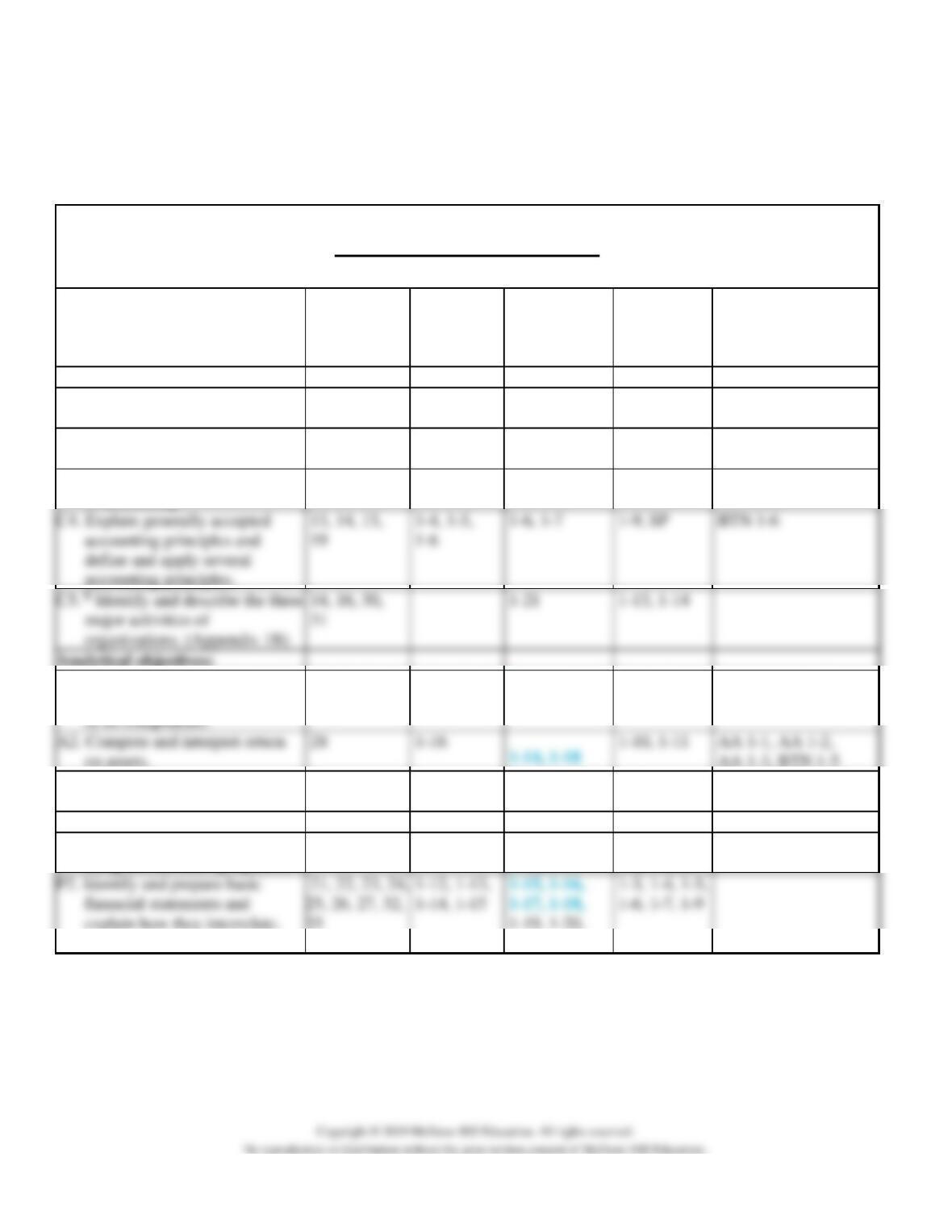
Related Assignment Materials
Student Learning Objectives
Questions
Quick
Studies*
Exercises*
Problems*
AA and BTN
Conceptual objectives:
C1. Explain the purpose and
importance of accounting
1, 2, 4, 5,
1-1
1-1, 1-4, 1-6
BTN 1-4
C2. Identify users and uses of, and
opportunities, in accounting.
3, 6, 7, 8, 9,
10, 12, 23
1-2
1-2, 1-3, 1-4
BTN 1-2, BTN 1-6
C3. Explain why ethics are crucial
to accounting.
11, 14
1-3
1-4, 1-5
BTN 1-1
define and apply several
accounting principles.
19
1-6
major activities of
organizations. (Appendix 1B)
31
Analytical objectives:
A1. Define and interpret the
accounting equation and each
of its components.
A2. Compute and interpret return
on assets.
28
1-16
1-10, 1-11
AA 1-1, AA 1-2,
AA 1-3, BTN 1-5
17, 20, 24
1-7, 1-8,
1-9, 1-17
1-8, 1-9,
1-23
1-1, 1-2,
1-8, 1-10
AA 1-1, AA 1-2,
BTN 1- 5
A3. A Explain the relation between
return and risk. (Appendix 1A)
29
1-12
Procedural objectives:
P1. Analyze business transactions
using the accounting equation.
18
1-10, 1-11
1-10, 1-11,
1-12, 1-13
1-1, 1-2, 1-7,
1-8, 1-9, SP
BTN 5
explain how they interrelate.
33
1-22
*See additional information on next page that pertains to these quick studies, exercises, and problems.
SP refers to the Serial Problem
AA refers to Accounting Analysis
BTN refers to Beyond the Numbers
Questions with Guided Example videos
Financial and Managerial Accounting, 8th Edition
Additional Information on Related Assignment Material available in Connect®
Available on the instructor’s course-specific website, Connect repeats all numerical Quick Studies, all Exercises, and
Problem Set A. Connect also provides algorithmic versions for Quick Study, Exercises, and Problems. It allows
instructors to monitor, promote, and assess student learning. It can be used in practice, homework, or exam mode.
We have a variety of tools available to make updating your course as painless as possible. Our latest tool is the Connect
Pre-Built Course Package. The package includes three tools to get you started with Connect for the new edition. You can
use the pre-built course as is or customize it to meet your needs.
The Connect Orientation Videos provide an introduction for your students for using Connect to complete assignments to
help get your students up and running in the system. There are videos covering:
• End-of-Chapter Assignments
• General Ledger
• Concept Overview Videos
• Excel Simulations
• LearnSmart and Smartbook
Excel Simulations
Assignable within Connect, Excel Simulations allow students to practice their Excel skills—such as basic formulas and formatting—
within the context of accounting. These questions feature animated, narrated Help and Show Me tutorials (when enabled). Excel
Simulations are auto-graded and provide instant feedback to the student.
LearnSmart/Smartbook
Available within Connect, SmartBook makes study time as productive and efficient as possible. SmartBook identifies and closes
knowledge gaps through a continually adapting reading experience that provides personalized learning resources at the precise
moment of need. This ensures that every minute spent with SmartBook is returned to the student as the most value-added minute
possible. The result? More confidence, better grades, and greater success.
Need-to-Know
Need-to-Know demonstrations are located at key junctures in each chapter. These demonstrations pose questions about
the material just presented—content that students “need to know” to learn accounting. Accompanying solutions walk
students through key procedures and analysis necessary to be successful with homework and test materials. Need-to–
Financial and Managerial Accounting, 8th Edition
1-3
Know demonstrations are supplemented with narrated, animated, step-by-step walk-through videos led by an instructor
and available via Connect. Select chapters also include Comprehensive Need-to-Knows that draw on materials from the
entire chapter.
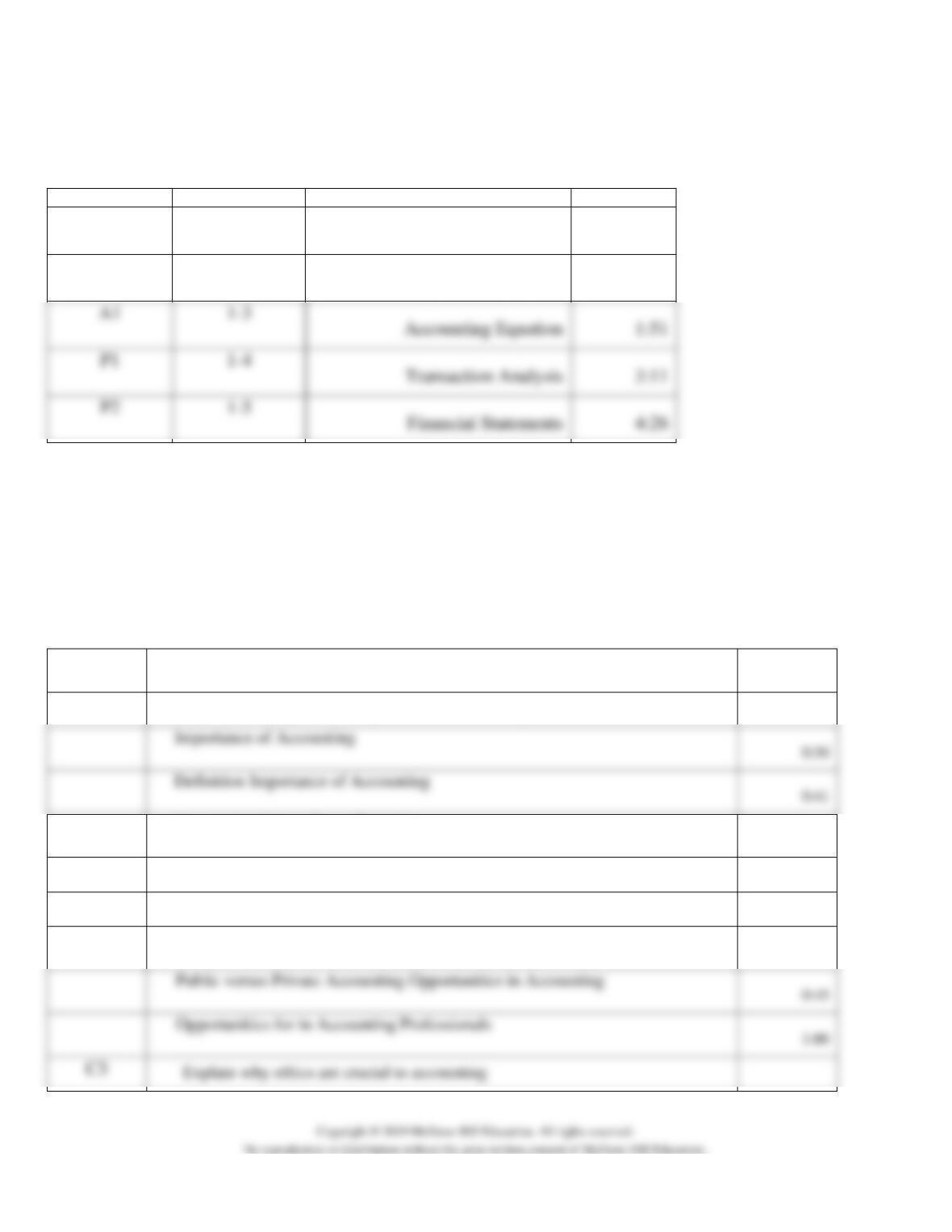
LO
Need–to-Know
Title
Time
C1, C2
1-1
Accounting Users
1:29
C3, C4
1-2
Accounting Guidance
3:59
1-3
1:51
1-5
4:26
Concept Overview
The Concept Overview Videos (COV’s) provide engaging narratives of all chapter learning objectives in an assignable
and interactive online format. The concept overview videos replace the previous edition interactive presentations. They
follow the structure of the text and are organized to match the specific learning objectives within each chapter. The
concept overview videos provide additional explanation and enhancement of material from the chapter, allowing students
to learn, study, and practice with instant feedback, at their own pace. Each video is paired with a Knowledge Check
question.
LO
Title
Time
C1
Explain the purpose and importance of accounting
Importance of Accounting
0:50
Definition Importance of Accounting
0:41
Accounting Versus Recordkeeping
0:58
C2
Identify users and uses of, and opportunities in, accounting.
Information Users
1:34
Opportunities in Accounting
0:45
Opportunities for in Accounting Professionals
1:00
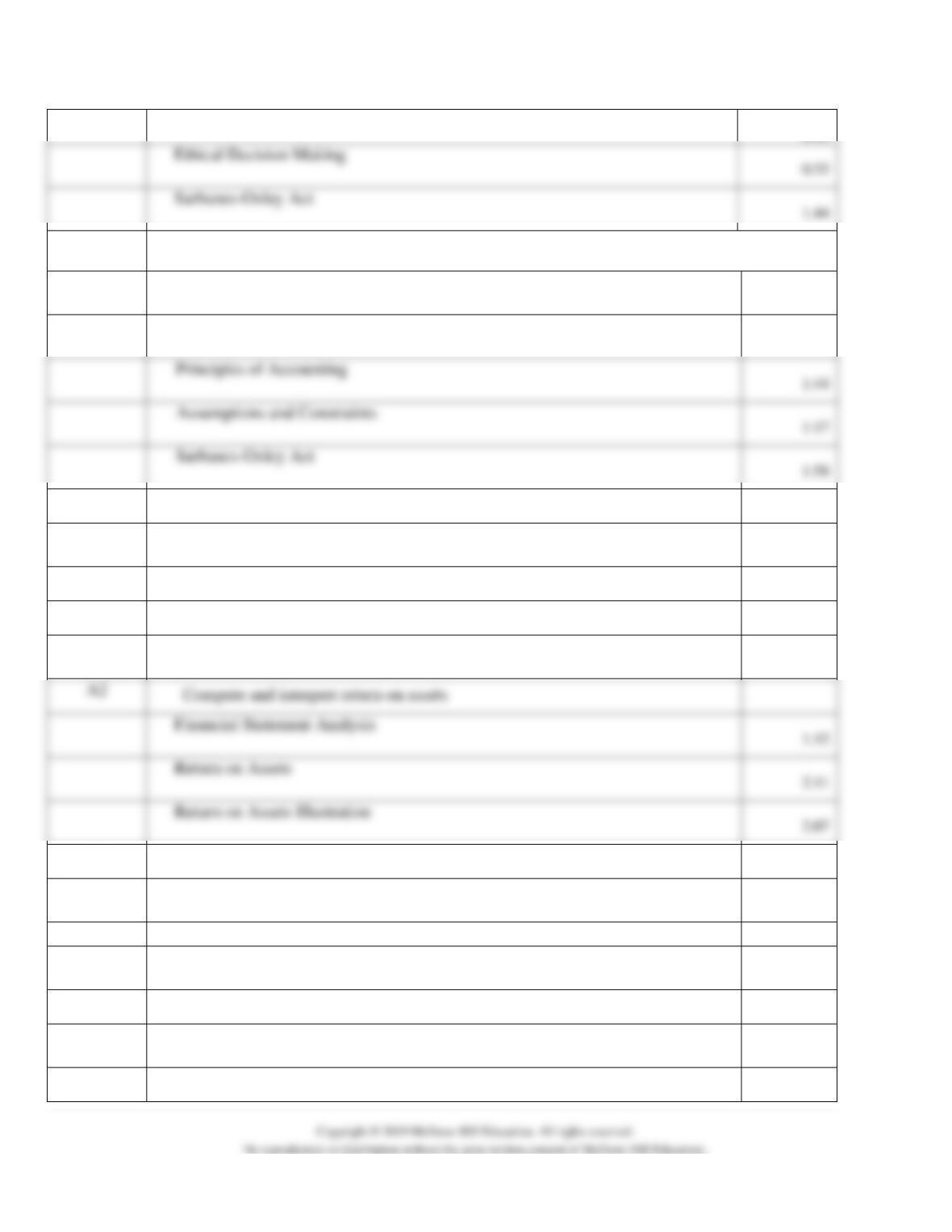
Explain why ethics are crucial to accounting
Financial and Managerial Accounting, 8th Edition
1-4
The Importance of Ethics
Ethical Decision Making
Sarbanes-Oxley Act
C4
Explain generally accepted accounting principles and define and apply several accounting
principles
Generally Accepted Accounting Principles
1:12
International Standards and Convergence
1:41
Assumptions and Constraints
1:17
Sarbanes-Oxley Act
1:58
C5
Appendix 1B—Identify and describe the three major activities of organizations
Business Activities
1:11
A1
Define and interpret the accounting equation and each of its components
Accounting Equation
1:02
The Expanded Accounting Equation
2:07
A2
Compute and interpret return on assets
Financial Statement Analysis
1:15
Return on Assets
2:11
Return on Assets Illustration
2:07
A3
Appendix 1A—Explain the relation between return and risk
Return and Risk
1:04
P1
Analyze business transactions using the accounting equation
Transaction Analysis
0:52
Illustration
1:15
Transaction Summary
2:58
P2
Identify and prepare basic financial statements and explain how they interrelate
Financial and Managerial Accounting, 8th Edition
Financial Statements
0:17
Income Statement
0:42
Statement of Retained Earnings
1:46
Balance Sheet
1:38
Statement of Cash Flows
2:18
Hints/Guided Examples
The Guided Examples in Connect provide a narrated, animated, step-by-step walk-through of select quick studies,
exercises, and general ledger problems similar to those assigned. These short presentations can be turned on or off by
instructors and provide reinforcement when students need it most. Please note that they are labeled as “Hints” in Connect
assignments. The animated PowerPoints without the video and audio functions for the Guided Examples are also available
in the Connect Instructor Library and Exercise Presentations. These are indicated in the Related Assignment Materials
grid on page 1 in blue bold font.
Synopsis of Chapter Revisions
Updated opener—Apple and entrepreneurial assignment.
Updated salary info for accountants.
Revised business entity section along with adding LLC.
Updated section on FASB objectives and accounting constraints.
New layout for introducing the expanded accounting equation.
Chapter Outline
I. Importance of Accounting—we live in the information age in which information, and its reliability,
impacts the financial well-being of us all.
Accounting is an information and measurement system that identifies, records, and communicates an
organization’s business activities.
II. Users of Accounting Information – accounting is called the language of business because it
communicates data the helps users make better decisions. People using accounting information are
divided into two groups:
Financial and Managerial Accounting, 8th Edition
a. Financial Accounting—area of accounting aimed at serving external users by providing them
with general-purpose financial statements.
2. Internal Users—those directly involved in managing and operating an organization. Internal users
include research and development, purchasing, human resource, production, distribution,
marketing, and service managers.
a. Managerial Accounting—area of accounting that serves the decision-making needs of
internal users.
b. Internal Reports—are designed for the special needs of internal users.
3. Opportunities in Accounting— – four broad areas of opportunities are financial, managerial,
taxation, and accounting-related.
a. Private accounting, which are employees working for businesses, offers the most
opportunities.
law violations, also offer opportunities.
III. Fundamentals of Accounting
A. Ethics—A Key concept—Ethics are beliefs that separate right from wrong.
1. Fraud Triangle: Ethics under Attack—model that asserts three factors must exist for a person to
commit fraud: opportunity, pressure, and rationalization.
a. Internal Controls—procedures to protect company property and equipment and ensure
reliable accounting reports, promote efficiency, and encourage adherence to company
policies.
IV. Generally Accepted Accounting Principles (GAAP)—concepts and rules that govern financial
accounting. The purpose of GAAP is to make information in accounting statements relevant, reliable,
and comparable.
A. The Financial Accounting Standards Board (FASB) is given the task of setting GAAP from the
Securities and Exchange Commission (SEC). The SEC oversees proper use of GAAP.
B. International Standards—The International Accounting Standards Board (IASB) issues standards
(International Financial Reporting Standards, or IFRS) that identify preferred accounting practices
in the global economy. IFRS are similar but sometimes different from U.S. GAAP.
C. Conceptual Framework—FASB Conceptual Framework consists of:
a. Objectives—to provide information useful to investors, creditors, and others.
as an element; and how to measure that element.
Financial and Managerial Accounting, 8th Edition
1-7
D. Principles, Assumptions and Constraint—two types are general principles (assumptions, concepts,
and guidelines for preparing financial statements; stem from long-used accounting practices) and
specific principles (detailed rules used in reporting transactions and events).
Accounting Principles—General principles consist of four general principles:
a. Measurement principle (cost principle)—accounting information is based on actual costs
incurred in business transactions. Cost is measured on a cash or equal-to-cash basis.
Information based on cost is considered objective. Objectivity means information is
supported by independent, unbiased evidence.
Accounting Assumptions –
a. Going-concern assumption—accounting information presumes that the business will continue
operating instead of being closed or sold.
as months and years, and useful reports can be prepared for those periods.
d. Business entity assumption—a business is accounted for separately from other business
entities and its owner. Necessary for good decisions.
e. Exhibit 1.8: Types and Attributes of Businesses
i. Sole proprietorship is a business owned by one person that has unlimited liability. It is
not a separate legal entity. The owner has unlimited liability and is, therefore,
personally liable for the business debts.
IV. Corporation is a business that is a separate legal entity whose owners are called
shareholders or stockholders. These owners have limited liability. The entity is
responsible for a business income tax, and the owners are responsible for personal
income tax on profits that are distributed to them in the form of dividends.
f. Accounting Constraints -there are basic constraints on financial reporting.
i. The cost-benefit constraint says that information disclosed by the entity must have
benefits to the user that are greater than the costs of providing it.
ii. The materiality constraint is the ability of information to influence decisions.
Financial and Managerial Accounting, 8th Edition
1-8
iii. Conservatism and industry practices are sometimes referred to as constraints as well.
V. Business Transactions and Accounting
A. Accounting Equation (Assets = Liabilities + Equity)—elements of the equation include:
1. Assets—resources a company owns or controls that are expected to carry future benefits.
Examples: cash, accounts receivable, supplies, equipment, and land).
2. Liabilities—creditors’ claims on assets. These claims reflect obligations to transfer assets or
provide products or services to others. Examples: wages payable, accounts payable, notes payable,
and taxes payable.
3. Equity—owner’s claim on assets; assets minus liabilities. Also called net assets or residual
equity. Increases in equity result from owner investments and revenues. Decreases results from
dividends and expenses. Equity consists of:
a. Common Stock —owner investments are inflows of cash and other net assets from
stockholders, which increase equity.
b. Revenues —increase equity from sales of products and services to customers. Revenues
increase equity (via net income) and result from a company’s earnings activities.
VI. Transaction Analysis—each transaction and event always leaves the equation in balance. (Assets =
Liabilities + Equity)
2. Purchase supplies for cash:
ASSET = LIABILITIES + EQUITY
+ Supplies
− Cash
Increase and decrease on one side of the equation keeps equation in balance.
3. Purchase equipment for cash:
4. Purchase supplies on credit:
ASSET = LIABILITIES + EQUITY
+ Supplies + Accounts Payable
Increase on both sides of equation keeps equation in balance.
5. Provide services for cash:
ASSET = LIABILITIES + EQUITY
+ Cash + Revenue Earned
Financial and Managerial Accounting, 8th Edition
Increase on both sides of equation keeps equation in balance.
6,7. Payment of expenses in cash (salaries, rent, etc.):
ASSET = LIABILITIES + EQUITY
− Cash − (+ Expense)
Decrease on both sides of equation keeps equation in balance.
9. Receipt of cash from accounts receivable (customers paying on their accounts):
ASSET = LIABILITIES + EQUITY
+ Cash
− Acct. Rec
Increase and decrease on one side of the equation keeps equation in balance.
Decrease on both sides of equation keeps equation in balance.
11. Dividends paid to stockholder:
ASSET = LIABILITIES + EQUITY
− Cash − (+ Dividends)
Decrease on both sides of equation keeps equation in balance. (Note: since dividends
are not expenses, they are not used in computing net income.)
VII. Financial Statements
A. The four financial statements and their purposes are:
2. Statement of Retained Earnings —explains changes in equity from net income (or loss),
owner investments, and dividends over a period of time.
3. Balance Sheet—describes a company’s financial position (types and amounts of assets,
liabilities, and equity) at a point in time.
4. Statement of Cash Flows—identifies cash inflows (receipts) and cash outflows (payments)
over a period of time.
B. Statement Preparation from Transaction Analysis—prepared in the following order using the
procedure indicated below.
3. Balance Sheet⎯shows the financial position as of the date of the statement. Includes the
Financial and Managerial Accounting, 8th Edition
1-10
balance of each asset, liability and the ending retained earnings balance (note that this is
taken from the statement of retained earnings), is listed along with common stock and
added to total liabilities to get total liabilities and equity. This total must agree with total
assets to prove the accounting equation. Either the account form or the report form may
be used to prepare the balance sheet.
4. Statement of Cash Flows⎯the cash column must be carefully analyzed to organize and
report cash flows in categories of operating, investing, and financing. The net change in
cash is determined by combining the net cash flow in each of the three categories. This
change is combined with the beginning cash. The resulting figure should be the ending
cash that was shown on the balance sheet.
VIII. Decision Analysis—Return on Assets (ROA)—a profitability measure. Also called Return on
Investment (ROI).
IX. Return and Risk (Appendix 1A)
A. Risk—the uncertainty about the return we will earn on an investment.
B. The lower the risk, the lower the return.
C. Higher risk implies higher, but riskier, returns.
X. Business Activities (Appendix 1B)
The accounting equation is derived from business activities.
Three major business activities are:
b. Nonowner (or creditor) financing—refers to resources loaned by creditors (lenders).
2. Investing activities—are the acquiring and disposing of resources (assets) that an organization uses to
acquire and sell its products or services.
a. Investing (assets) is balanced by Financing (liabilities and equity). Operating activities are
the result of investing and financing.