
Chapter 01 – Introduction to Accounting and Financial Reporting for Government and Not-for-Profit Entities
1-1
CHAPTER 1: INTRODUCTION TO ACCOUNTING AND FINANCIAL
REPORTING FOR GOVERNMENT AND NOT-FOR-
PROFIT ENTITIES
OUTLINE
Number
Topic
Type/Task
Status
(re: 18/e)
Questions:
1-1
Differences between types of organizations
Identify
Same
1-2
Distinguishing between general purpose and
special purpose governments
Identify
Revised
1-3
Standards-setting bodies
Identify
Same
1-4
Not-for-profit financial reports
Identify
New
1-5
Relationship of interperiod equity and fiscal
accountability
Define/Compare
New
1-6
Determining the purpose of the two types of
accountability
Determine
Same
1-7
Primary reporting objectives for NFPs and
governments
Compare
Same
1-8
Objective of federal financial reports
Explain
New
1-9
Federal government performance and
accountability report
Identify/Describe
Same
1-10
NFP reporting of expenses
Explain
Same
Cases:
1-11
Research Case—Accountability Reporting
Report
New
1-12
Research Case—GASB
Analyze
Revised 1-11
1-13
Research Case—FASB
Explain
New
1-14
Research Case—FASB
Analyze
Same
1-16
Research Case—Federal Financial Reporting
Objectives
Analyze
Same
Exercises/Problems:
1-17
Examine the CAFR
Examine
Same
1-18
Financial statement differences
Differentiate
Same
1-19
Various
Multiple Choice
Items 4, and 7
other items
are the same
1-20
Matching concepts and reporting
Classify
Revised
1-21
Matching standards governing organizations
Classify
Revised
Chapter 01 – Introduction to Accounting and Financial Reporting for Government and Not-for-Profit Entities
CHAPTER 1: INTRODUCTION TO ACCOUNTING AND FINANCIAL
REPORTING FOR GOVERNMENT AND NOT-FOR-
PROFIT ENTITIES
Answers to Questions
1-1. Following is a list of some of the differences between business organizations and
government/not-for-profit organizations.
repayment or economic benefits
proportionate to the resources
expect repayment or economic
benefits proportionate to the
equivalent.
resources at liquidation.
General Problem Information: Differences between types of organizations
Learning Objective: 1-1
Topic: Differences Between Governmental and Not-for-Profit Organizations
Bloom’s Taxonomy: Remember
Accreditation Skills tag: AACSB: Communication, AICPA: BB Industry
Level of Difficulty: Easy
1-2. a. GP c. SP e. GP
b. SP d. GP f. SP
General Problem Information: Distinguishing between general purpose and special
Accreditation Skills tag: AACSB: Communication, AICPA: BB Industry
Level of Difficulty: Easy
Business Organizations
Government/Not-for-for profit
Organizations
provided.
resources provided.
Primary operations are undertaken
to provide goods or services at a
profit.
Primary operations are not
undertaken to provide goods or
services at a profit or profit
1-3
1-3. Illustration 1-1 shows the standard-setting jurisdiction of the FASB, GASB and FASAB.
As shown, the FASB has responsibility for setting accounting and financial reporting
standards for business entities and nongovernmental not-for-profit organizations. The
GASB has responsibility for setting standards for state and local governments and
General Problem Information: Standards-setting bodies
Learning Objective: 1-2
1-4. The required financial statements for a not-for-profit (NFP) organization applying the
FASB standards are (1) Statement of financial position or a balance sheet, (2) Statement
of activities, and (3) Statement of cash flows.
Although not a required statement, NFPs are also required to provide information on the
relationship between functional expenses and natural expenses. The FASB allows NFPs
to provide that information using a separate financial statement, a schedule in the notes,
or displayed on the statement of activities.
Bloom’s Taxonomy: Remember
Accreditation Skills tag: AACSB: Communication, AICPA: FN Reporting
Level of Difficulty: Easy
1-5. Interperiod equity is whether current period revenues are sufficient to pay for current
period services, and it is considered an important component of accountability. Failure to
pay for current period services means that the financial burden is being passed to future
year taxpayers who may not receive any benefit from the past services. Interperiod equity

Chapter 01 – Introduction to Accounting and Financial Reporting for Government and Not-for-Profit Entities
1-4
Ch. 1, Answers, Question 1-5 (Cont’d)
General Problem Information: Relationship of interperiod equity and fiscal
Bloom’s Taxonomy: Analyze
Accreditation Skills tag: AACSB: Analytical Thinking, AICPA: BB Critical Thinking
Level of Difficulty: Medium
1-6. The purpose of operational accountability is to assess whether the government has used
its resources efficiently and effectively in meeting its operating objectives. The purpose
of fiscal accountability is to assess the short-term flow of current financial resources.
Government-wide financial statements are primarily focused on providing information to
assess operational accountability, while fund financial statements are focused on
providing information to assess fiscal accountability.
General Problem Information: Determining the purpose of the two types of
accountability
1-7. The primary financial reporting objective for not-for-profit organizations is to provide
decision-useful financial information to resource providers, such as donors, members,
and creditors. The primary financial reporting objective for a government organization is
accountability, but other objectives include providing useful information for economic,
social, and political decisions. Thus, the reporting focus for the two types of
organizations differs in that the not-for-profit organization financial reports are to focus
on providing information that is useful in making decisions; while the government
organization financial reports are to focus primarily on providing information that can be
used to assess whether public resources were raised and used for their intended purposes.
Bloom’s Taxonomy: Understand
Accreditation Skills tag: AACSB: Communication, AICPA: FN Reporting
Level of Difficulty: Medium
1-8. The FASAB indicates that federal financial reports are to help meet the needs of both
external and internal users. As such, financial reports are prepared to provide information
that is useful in assessing accountability, efficiency, effectiveness and the results of
providing and spending federal resources.

Chapter 01 – Introduction to Accounting and Financial Reporting for Government and Not-for-Profit Entities
1-5
Ch. 1, Answers, Question 1-8 (Cont’d)
General Problem Information: Objective of federal financial reports
Learning Objective: 1-5
1-9. The four sections of a federal agency’s performance and accountability report (PAR) are
(1) an MD&A, which provides a brief overview of the entire PAR and describes the
agency’s mission and performance goals, among other items; (2) the performance
section, essentially consisting of the agency’s annual performance report (APR); (3) the
basic financial statements, which are listed in this chapter; and (4) other accompanying
information, such as information about the nation’s tax burden, the tax gap, challenges
facing the agency’s management, and revenue foregone.
General Problem Information: Federal government performance and accountability
report
Learning Objective: 1-5
Topic: Financial Reporting of the Federal Government
1-10. Reporting program expenses separately from management and general expenses and
fund-raising costs provides information to donors, members, and oversight bodies to
assess the effectiveness of the organization in accomplishing its purpose. Most donors
and members wish to have the funds they contribute used for the organizational purpose
rather than supporting management costs or fund-raising expenses. This reporting is also
necessary for oversight bodies, such as the Internal Revenue Service, to permit the
continued existence of the organization as a not-for-profit.
Bloom’s Taxonomy: Understand
Accreditation Skills tag: AACSB: Communication, AICPA: FN Reporting
Level of Difficulty: Medium
Solutions to Cases
1-11. Instructors may want to note that answers for a are found under Impact, b under Datasets,
and c will be determined by the student. As with all websites, the location of the answers
may change. Accessing Open Government will provide students with insight into data
Chapter 01 – Introduction to Accounting and Financial Reporting for Government and Not-for-Profit Entities
1-6
Ch. 1, Solutions, Case 1-11 (Cont’d)
a. Data.gov increases the transparency of government, making it more open and
accountable to citizens, allowing data to have a greater impact. By making data
available, data.gov increases accessibility and transparency of government
information, allowing for more informed and increased public participation on
government policy and issues.
b. Data are available from states, cities, counties, foreign countries, and regions.
General Problem Information: Research Case—Accountability reporting
Learning Objective: 1-4
1-12. Instructors may wish to provide specific instructions for the format of the students’ brief
reports. Only some of the topics covered in the White Paper have been identified for this
assignment.
Major revenue sources – for-profits’ major revenue is generated from the goods or
services provided in exchange transactions. As a result, the principle for recognizing
revenue under the FASB standard is: “Recognize revenue to depict the transfer of
promised goods or services to customers in an amount that reflects the consideration to
which the entity expects to be entitled in exchange for those goods or services.” This is
Chapter 01 – Introduction to Accounting and Financial Reporting for Government and Not-for-Profit Entities
1-7
Ch. 1, Solutions, Case 1-12 (Cont’d)
Postemployment benefits: Although similar in several respects, postemployment benefit
accounting and reporting for government differs due to the longevity of governments, the
importance of information to policymakers and others on the cost of providing the
benefits, and the need to address interperiod equity.
As a result of these different information needs, accounting for postemployment benefits
for governments differs from the FASB standards in two key areas:
• The discount rate used for determining the actuarial present value of postemployment
benefits. The GASB allows the use of expected rate of return as the discount rate,
provided the postemployment plan is projected to have enough resources to cover all
projected benefit payments for current employees and retirees. If all or a portion of
• The effect of the benefit received by the employee for work provided is represented
as a percentage of projected pay over the projected career of the employee. This
differs from the FASB standard that bases the benefits formula on the assignment of
benefits to units of service credits.
General Problem Information: Research Case—GASB Understanding why
government reporting standards are different
Learning Objective: 1-2
1-13. Instructors may wish to provide specific instructions for the format of the students’ brief
reports. The objective of this case is to familiarize students with the FASB website and
allow them to see how standards are ever changing and can differ between for-profit
entities and NFPs. Following are the two updates related to intangible assets and
collections.
2019-06-Intangibles-Goodwill and Other: Extending the Private Company Accounting
Alternatives on Goodwill and Certain Identifiable Intangible Assets to Not-for-Profit
Entities
This update provides not-for-profit entities an alternative to the annual impairment
testing of goodwill that is required of private companies. Under this alternative the
not-for-profit is allowed to amortize goodwill. A not-for-profit entity should
amortize goodwill on a straight-line basis over 10 years, or less than 10 years if the

Chapter 01 – Introduction to Accounting and Financial Reporting for Government and Not-for-Profit Entities
1-8
Ch. 1, Solutions, Case 1-13 (Cont’d)
impairment when a triggering event occurs that indicates that the fair value of the
entity (or a reporting unit) may be below its carrying amount.
2019-03-Not-for-Profit Entities: Updating the Definition of Collections
The amendments in this update modify the definition of the term collections and
require that a collection-holding entity disclose its policy for the use of proceeds
when collection items are removed from a collection. If a collection-holding entity
General Problem Information: Research Case—FASB NFP reporting standards
changes
1-14. Instructors may wish to provide specific instructions for their students’ brief reports.
Unlike for-profit organizations, not-for-profit organizations do not have a profit indicator
such as net income to help users in determining how to allocate their scarce resources.
For this reason, it is important that financial reports assist the users in determining not
only that management has kept safe the assets of the organization, but that it has also
Bloom’s Taxonomy: Analyze
Accreditation Skills tag: AACSB: Communication, AICPA: FN Research
Level of Difficulty: Hard
1-15. Instructors may wish to provide specific instructions for their students’ brief reports.
FASAB’s website may change over time, but the website does provide extensive
information about the board’s mission, structure, and due process. A good source of
information is the Memorandum of Understanding between the Comptroller General,
Chapter 01 – Introduction to Accounting and Financial Reporting for Government and Not-for-Profit Entities
1-9
Ch. 1, Solutions, Case 1-15 (Cont’d)
All statements and other pronouncements of the FASAB are contained in a compendium
of all original pronouncements called Pronouncements as Amended and are available for
downloading from its website at no charge. All due process documents are available at
that site as well.
General Problem Information: Research Case—Understanding FASAB
Learning Objective: 1-2
Topic: Sources of Financial Reporting Standards
1-16. Instructors may wish to provide specific instructions for the format of the students’ brief
reports.
The four major groups of users identified by the board are citizens, Congress, executives,
and program managers.
Citizens – Citizens pay for and receive government services. Therefore, they are
interested in individual government programs, candidates for office, and the fiscal and
operational accountability of their elected officials. They want to know what services are
provided and what the outputs or outcomes of the services are, as well as the efficiency
and effectiveness with which they are provided.
Executives – Executives focus on strategic plans and programs to accomplish specific
goals and implement policies. One primary focus is on budgets, which are used to
provide funding for these plans and programs. They propose funding amounts to
Congress and develop plans for financing and generating revenues to provide the
funding. They are also concerned with the efficiency and effectiveness of plans and
programs.
Chapter 01 – Introduction to Accounting and Financial Reporting for Government and Not-for-Profit Entities
1-10
Ch. 1, Solutions, Case 1-16 (Cont’d)
General Problem Information: Research Case—Federal Financial Reporting
Objectives
Learning Objective: 1-3
Solutions to Exercises and Problems
1-17. As students may have different CAFRs, there is no single solution to this exercise. It
works well to devote class time to asking students some of the questions listed in the
exercise, and perhaps tabulating the number of reports containing statements that are
audited (1) by CPAs, (2) by state auditors, and (3) by employees of the reporting
government. If such a tabulation is made, students may be interested in knowing in which
states the local government units are located that are audited by each of the classes of
General Problem Information: Examine the CAFR
Learning Objective: 1-4
Topic: Financial Reporting of State and Local Governments
Bloom’s Taxonomy: Remember
1-18. Although the major similarities and differences have been provided below, students will
undoubtedly also find additional items that you may wish to discuss.
a. The following represent some of the similarities and differences in Denver’s
Statement of Net Position and the Promote Health Association’s (PHA) Balance
Sheet.
Similarities:
Chapter 01 – Introduction to Accounting and Financial Reporting for Government and Not-for-Profit Entities
1-11
Ch. 1, Solutions, Exercise 1-18 (Cont’d)
Dissimilarities:
• Denver does not provide a comparative year, as does the PHA.
• Denver has additional sections in its statement called Deferred Outflows of
Resources (this appears below Total Assets) and Deferred Inflows of Resources
(this appears below the Total Liabilities). The PHA has nothing similar to this.
b. Other than the name, there are very few similarities between Denver’s Statement of
Activities and the PHA’s Statement of Activities. Listed below are some similarities
and differences.
Similarities:
• Both use accrual accounting.
• Both use the terms revenues and expenses.
Dissimilarities:
• Denver divides its revenues into program revenues (charges for services,
operating grants and contributions, and capital grants and contributions) and
general revenues, whereas the PHA divides its revenues into contributions and
grants, and fees from exchange transactions.
• The general format of the statements is different, with Denver starting the
statement by listing expenses from which it deducts program revenues and
general revenues. The PHA uses the traditional format, starting with revenues and
deducting expenses.
Chapter 01 – Introduction to Accounting and Financial Reporting for Government and Not-for-Profit Entities
1-12
Ch. 1, Solutions, Exercise 1-18 (Cont’d)
General Problem Information: Financial statement differences
Learning Objective: 1-4
2. a. 7. c.
4. a. 9. c.
5. c. 10. d.
General Problem Information: Various
Learning Objective: 1-3
Learning Objective: 1-4
Learning Objective: 1-5
Learning Objective: 1-6
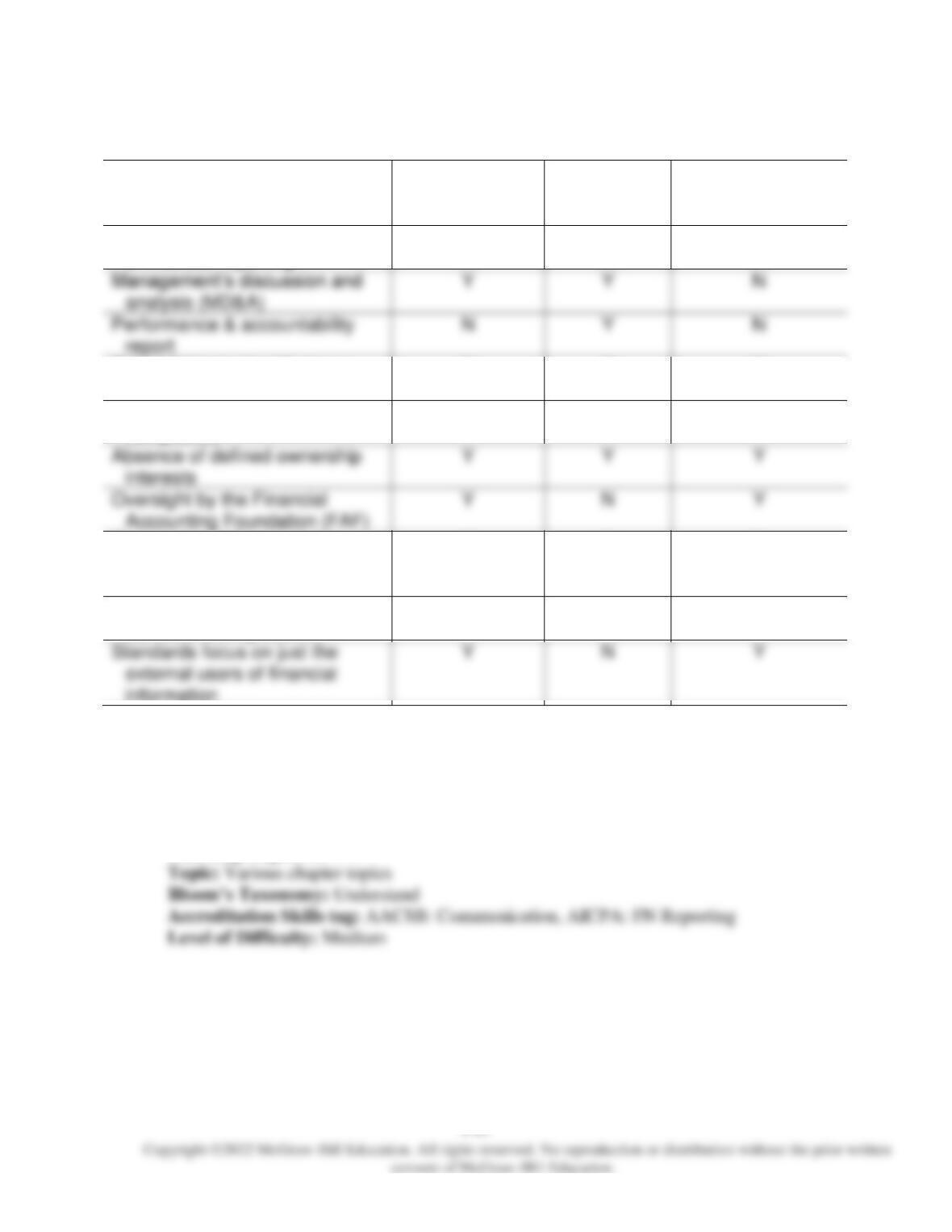
1-20. This is an exercise that may generate considerable discussion in class, as some of the
answers will be absolutely true and others partially true, depending on individual
judgments and interpretations. Keeping this in mind, you may wish to provide some
leeway in grading this exercise, depending on how literally you interpret the particular
item’s relationship to type of organization.
Chapter 01 – Introduction to Accounting and Financial Reporting for Government and Not-for-Profit Entities
Ch. 1, Solutions, Exercise 1-20 (Cont’d)
Characteristic, Concept, or
Financial Reporting
Requirement
State and
Local
Governments
Federal
Government
Nongovernmental
Not-for-profit
Organizations
Accountability is the foundation
of financial reporting
Y
Y
N
analysis (MD&A)
Y
Y
N
Performance & accountability
report
N
Y
N
Stewardship is identified as a
financial statement purpose
N
Y
Y
A concern with budgetary
compliance
Absence of defined ownership
interests
Y
Y
Y
Oversight by the Financial
Accounting Foundation (FAF)
Y
N
Y
Y
Y
N
Required fund financial
statements are presented as
part of the financial report
Y
N
N
Considered private sector
standard-setting boards
Y
N
Y
Standards focus on just the
Y
N
Y
information
General Problem Information: Concepts and reporting characteristics or requirements
for governmental and NFP organizations
Learning Objective: 1-1
Learning Objective: 1-2
Learning Objective: 1-4
Learning Objective: 1-5
1-14
1-21 1. FB
3. FB
5. G
7. G
9. F
General Problem Information: Sources of financial reporting standards for various
organizations
Learning Objective: 1-2
Topic: Sources of Financial Reporting Standards