CHAPTER 1 Introduction to Accounting and Business
Prob. 1-5B (Continued)
2. = +
+++=+ –
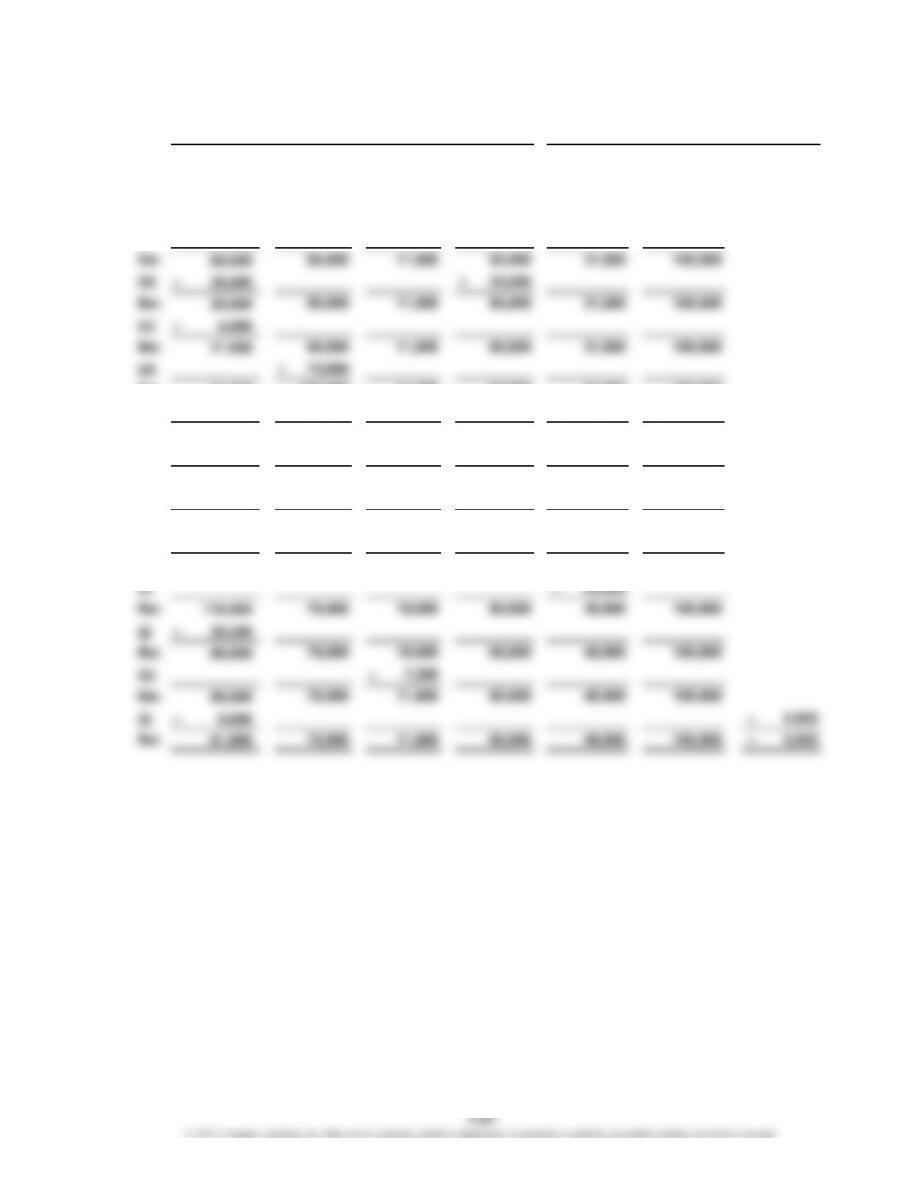
Bal. 39,000 80,000 11,000 50,000 31,500 148,500
(a) + 21,000 + 21,000
Bal. 21,000 152,000 11,000 85,000 31,500 169,500
(e)
–
20,000 – 20,000
Bal. 1,000 152,000 11,000 85,000 11,500 169,500
(f) + 8,000 +8,000
Bal. 1,000 152,000 19,000 85,000 19,500 169,500
(g) + 38,000
Bal. 39,000 152,000 19,000 85,000 19,500 169,500
(h) + 77,000 – 77,000
Bal. 116,000 75,000 19,000 85,000 19,500 169,500
–
–
Owner’s Equity
Accts.
PayableCash
Assets
Accts.
Rec.
Liabilities
Supplies Land
Beverly
Zahn,
Capital
Beverly
Zahn,
Drawing
–
–

CHAPTER 1 Introduction to Accounting and Business
Prob. 1-5B (Continued)
+–––
Supplies
Exp. ––– –
Bal.
(a)
Bal.
(b)
(f)
Bal. 72,000 –4,000
(g) + 38,000
Bal. 110,000 –4,000
(h)
Bal. 110,000 –4,000
(i) – 29,450
Bal. 110,000 –29,450 –4,000
(j) – 24,000 –2,100 –1,800 –1,300
Owner’s Equity (Continued)
Utilities
Exp.
Dry
Cleaning
Revenue
Dry
Cleaning
Exp.
Wages
Exp.
Rent
Exp.
Truck
Exp.
Misc.
Exp.
CHAPTER 1 Introduction to Accounting and Business
Prob. 1-5B (Continued)
3.
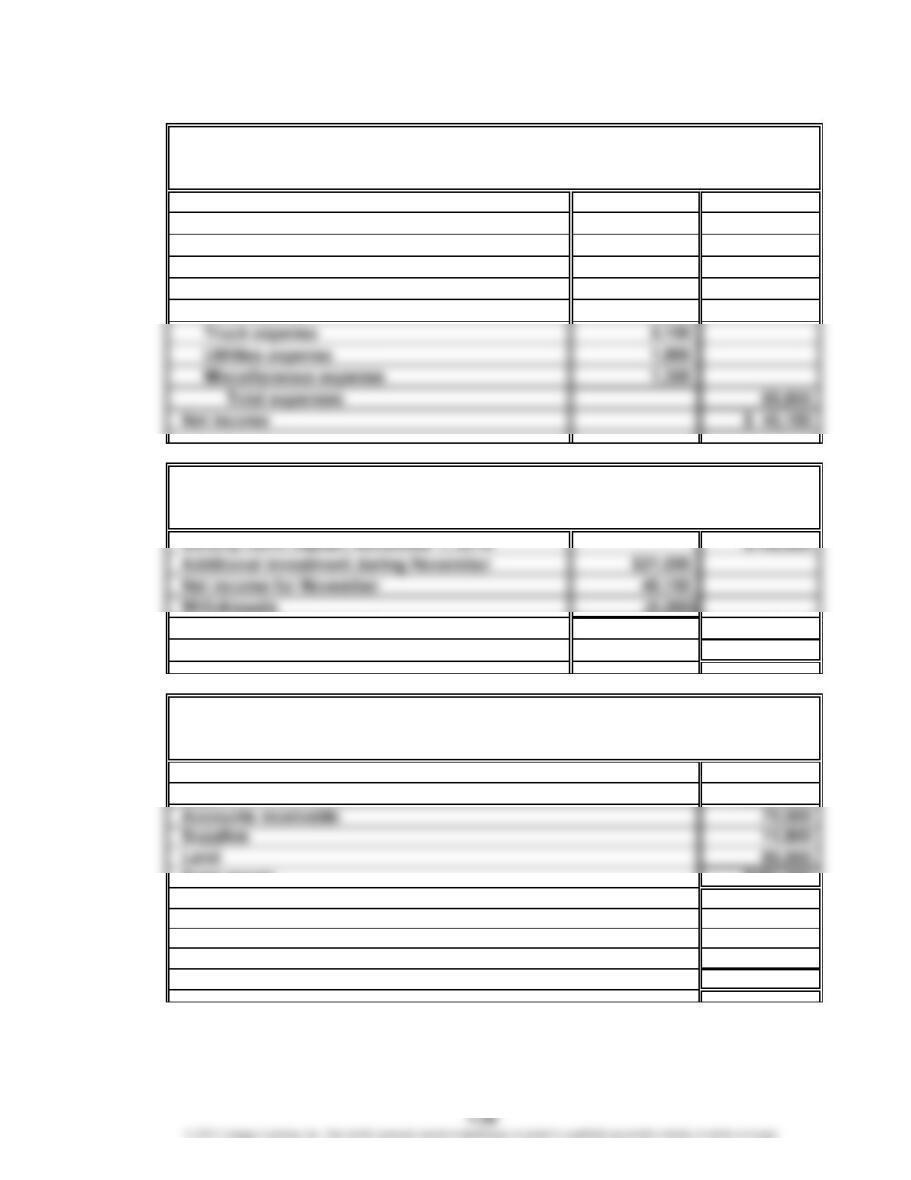
Dry cleaning revenue $110,000
Expenses:
Dry cleaning expense $29,450
Wages expense 24,000
Supplies expense 7,200
Rent expense 4,000
Withdrawals (5,000)
Increase in owner’s equity 56,150
Beverly Zahn, capital, November 30, 20Y6 $204,650
Cash $ 81,800
Total assets $253,600
Accounts payable $ 48,950
Beverly Zahn, capital 204,650
Total liabilities and owner’s equity $253,600
Assets
Liabilities
Owner’s Equit
y
Bev’s Dry Cleaners
Income Statement
For the Month Ended November 30, 20Y6
Bev’s Dry Cleaners
Statement of Owner’s Equity
For the Month Ended November 30, 20Y6
Bev’s Dry Cleaners
Balance Sheet
November 30, 20Y6
CHAPTER 1 Introduction to Accounting and Business
Prob. 1-5B (Concluded)
4. (Optional)
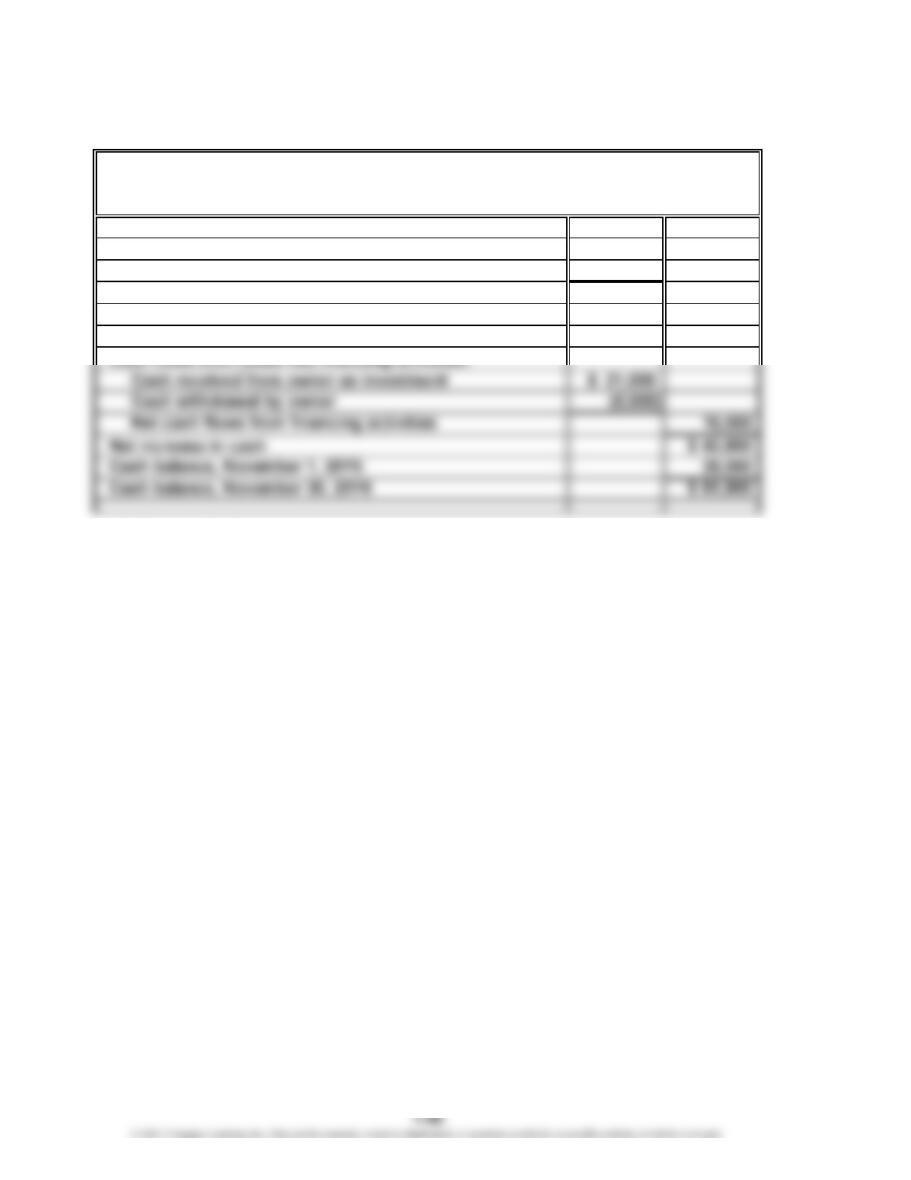
Cash flows from (used for) operating activities:
Cash received from customers* $115,000
Cash paid for expenses and to creditors** (53,200)
Net cash flows from operating activities $ 61,800
Cash flows from (used for) investing activities:
Cash paid for purchase of land (35,000)
*$38,000 + $77,000; these amounts are taken from the Cash column of the spreadsheet
in Part 2.
** $4,000 + $20,000 + $29,200; these amounts are taken from the Cash column of the
spreadsheet in Part 2.
Bev’s Dry Cleaners
Statement of Cash Flows
For the Month Ended Novemer 30, 20Y6
CHAPTER 1 Introduction to Accounting and Business
Prob. 1-6B
a. Wages expense, $203,200 ($288,000 – $48,000 – $17,600 – $14,400 – $4,800)
b. Net income, $112,000 ($400,000 – $288,000)
f. Withdrawals, $64,000; from statement of cash flows
g. Increase in owner’s equity, $208,000 ($160,000 + $112,000 – $64,000)
h. LuAnn Martin, capital, May 31, 20Y3, $208,000
i. Land, $120,000; from statement of cash flows
l. Total liabilities and owner’s equity, $256,000 ($48,000 + $208,000)
m. Cash received from customers, $400,000; this is the same as fees earned
since there are no accounts receivable.
n. Net cash flows from operating activities, $147,200 ($400,000 – $252,800)

CHAPTER 1 Introduction to Accounting and Business
1. = +
++=+–+
June 1 + 4,000 + 4,000
June 2 + 3,500 + 3,500
Bal. 7,500 4,000 3,500
Bal. 6,200 350 350 4,000 3,500
June 8 – 675
Bal. 5,525 350 350 4,000 3,500
Bal. 5,375 350 250 4,000 3,800
June 22 + 1,000 + 1,000
Bal. 5,375 1,000 350 250 4,000 4,800
June 25 + 500 + 500
Bal. 5,875 1,000 350 250 4,000 5,300
June 29 – 240
Bal. 5,635 1,000 350 250 4,000 5,300
June 30 + 900 + 900
Bal. 6,535 1,000 350 250 4,000 6,200
June 30 – 400
Bal. 6,135 1,000 350 250 4,000 6,200
CONTINUING PROBLEM
Peyton
Smith,
Drawing
Owner’s Equity
Accts.
PayableCash
Assets
Accts.
Rec.
Liabilities
Supplies
Peyton
Smith,
Capital
Fees
Earned

CHAPTER 1 Introduction to Accounting and Business
Continuing Problem (Continued)
– – –– ––––
June 1
June 2
Bal. – 800 – 500
June 8 – 675
Bal. – 800 – 675 – 500
June 12 – 350
Bal. – 350 – 800 – 675 – 500
June 13
Bal. – 350 – 800 – 675 – 500
June 30
Bal. – 590 – 800 – 675 – 500
June 30 – 400
Bal. – 590 – 800 – 675 – 500 – 400
June 30 – 300
Bal. – 590 – 800 – 675 – 500 – 400 – 300
Misc.
Exp.
Owner’s Equity (Continued)
Supplies
Exp.
Wages
Exp.
Music
Exp.
Office
Rent
Exp.
Equip.
Rent
Exp.
Adver-
tising
Exp.
Utilities
Exp.
CHAPTER 1 Introduction to Accounting and Business
Continuing Problem (Concluded)
2.
Fees earned: $6,200
Expenses:
Music expense $1,590
Supplies expense 180
Miscellaneous expense 415
Total expenses 4,860
Net income $1,340
3.
Peyton Smith, capital, June 1, 20Y9 $0
4.
Accounts payable $ 250
Peyton Smith, capital 4,840
Total liabilities and owner’s equity $5,090
Assets
Liabilities
Owner’s Equity
PS Music
Income Statement
For the Month Ended June 30, 20Y9
PS Music
Statement of Owner’s Equity
For the Month Ended June 30, 20Y9
PS Music
Balance Sheet
June 30, 20Y9
CHAPTER 1 Introduction to Accounting and Business
CP 1-1
1. The car repair is a personal expense and is Marco’s personal responsibility. By
2. The partnership’s net income will be reduced by the $2,000 Marco has taken.
This will reduce the amount of net income available to Marco’s partners.
CP 1-2
1. Acceptable professional conduct requires that Colleen Fernandez supply First
Federal Bank with all the relevant financial statements necessary for the bank
to make an informed decision. Therefore, Colleen should provide the complete
2. a. Owners are generally willing to provide bankers with information about the
operating and financial condition of the business, such as the following:
● Operating Information:
● Description of business operations
● Results of past operations
● Preliminary results of current operations
● Plans for future operations
● Financial Condition:
● List of assets and liabilities (balance sheet)
● Estimated current values of assets
CASES & PROJECTS
CHAPTER 1 Introduction to Accounting and Business
CP 1-2 (Concluded)
●Personal Financial Information. Owners may have little choice here
because banks often require owners of small businesses to pledge their
personal assets as security for a business loan. Personal financial
b. Bankers typically want as much information as possible about the ability
of the business and the owner to repay the loan with interest. Examples of
such information are described above.
c. Both bankers and business owners share the common interest of the
CP 1-3
A sample solution based on Nike Inc.’s Form 10-K for the fiscal year ended May 31,
2018, is as follows:
1. Nike, Inc.
2. Beaverton, Oregon
3. Mark G. Parker
4. Manufacturing
report or 10-K, we listed it as part of the answer.
CHAPTER 1 Introduction to Accounting and Business
CP 1-4
Example Memo
To: My Teacher
From: Ima Student
Date: January 1, 20XX
Re: Causes of Accounting Fraud
Business and accounting fraud typically result from either a failure of individual
character or a culture of greed within an organization. Managers and accountants
CP 1-5
The difference in the two bank balances, $55,000 ($80,000 – $25,000), may not be
pure profit from an accounting perspective. To determine the accounting profit for
to be paid for wages or other operating expenses, additional investments that Dr.
Cousins may have made in the business during the period, or withdrawals during
the period that Dr. Cousins might have taken for personal reasons unrelated to the
business.
Some businesses that have few, if any, receivables or payables may use a “cash”
basis of accounting. The cash basis of accounting ignores receivables and payables
CHAPTER 1 Introduction to Accounting and Business
CP 1-6
1.
=+
+ =+ – + ––––
(a) + 950 + 950
(b) – 300 + 300
Bal. 650 300 950
(f) + 600 + 600
Bal. 2,625 300 150 950 2,350 – 525
(g) – 800 – 800
Bal. 1,825 300 150 950 2,350 – 800 – 525
(h) – 290 – 290
Bal. 1,535 300 150 950 2,350 – 800 – 525 – 290
Owner’s Equity
Supplies
Accts.
Payable
Liabilities
Misc.
Exp.Cash
Lisa
Duncan,
Drawing
Supplies
Expense
Assets
Lisa
Duncan,
Capital
Fees
Earned
Rent
Expense
Salaries
Expense
CHAPTER 1 Introduction to Accounting and Business
CP 1-6 (Continued)
2.
Fees earned: $3,650
Expenses:
Salaries expense $800
3.
Increase in owner’s equity 2,465
Lisa Duncan, capital, September 30, 20Y7 $2,465
4.
Cash $2,435
Supplies 180
Total assets $2,615
Accounts payable $ 150
For the Month Ended September 30, 20Y7
Serve-N-Volley
Serve-N-Volley
Income Statement
For the Month Ended September 30, 20Y7
Serve-N-Volley
Statement of Owner’s Equity
Assets
Liabilities
Owner’s Equit
y
Balance Sheet
September 30, 20Y7
CHAPTER 1 Introduction to Accounting and Business
CP 1-6 (Concluded)
5. a. Serve-N-Volley would provide Lisa with $715 more income per month than
working as a waitress. This amount is computed as follows:
b. Other factors that Lisa should consider before discussing a long-term
arrangement with the Phoenix Tennis Club include the following:
Lisa should consider whether the results of operations for September are
indicative of what to expect each month. For example, Lisa should consider
whether club members will continue to request lessons or use the ball
machine during the fall months when interest in tennis may slacken. Lisa
should evaluate whether the additional income of $715 per month from
Serve-N-Volley is worth the risk being taken and the effort being expended.
Lisa should also consider how much her investment in Serve-N-Volley
could have earned if invested elsewhere. For example, if the initial
investment of $950 had been invested to earn a rate of return of 6%
per year, it would have earned $4.75 in September, or $57 for the year.
CP 1-7
Note to Instructors: The purpose of this activity is to familiarize students with the
certification requirements and their online availability. You might use this as an
opportunity to discuss the advantages and disadvantages of careers in public
accounting (CPA), management accounting (CMA), and internal auditing (CIA).
The following websites provide students with useful information (such as starting
salaries) on careers in accounting:
CP 1-8
First Second Third
Year Year Year
Net cash flows from (used for)
operating activities negative positive positive
Net cash flows from (used for)
Start-up companies normally experience negative net cash flows from operating
activities; however, Amazon.com was able to generate positive net cash flows
from operations by its second year. Start-up companies normally have negative