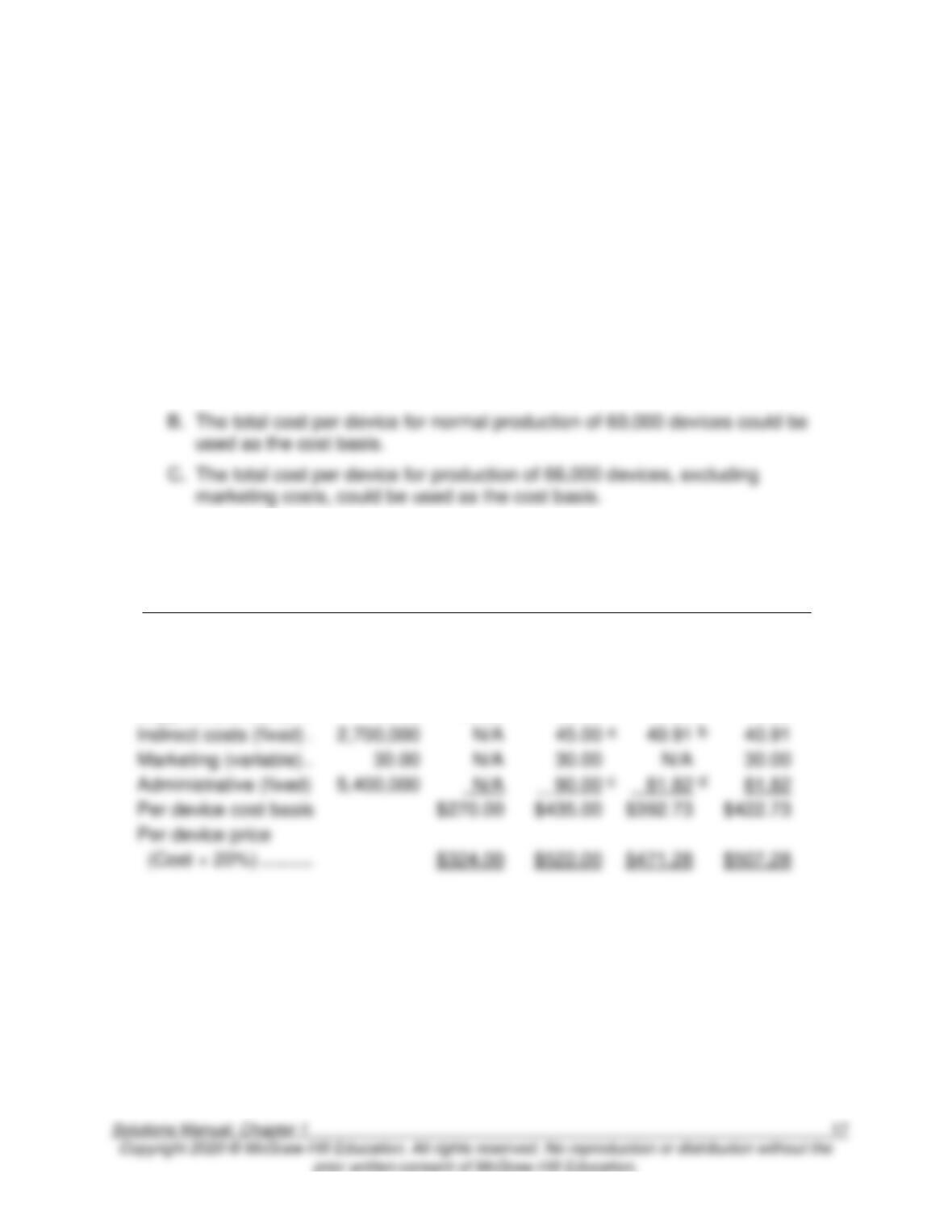
1-39. (20 Min.) Cost Data for Managerial Purposes: Imperial Devices.
This problem demonstrates the ambiguity of cost-based contracting and, indeed, the
measurement of “cost.” This problem can stimulate a lively discussion in class.
Recommended prices may range from the $324 suggested by the state government to
the $522 charged by Imperial Devices. The key is to negotiate the cost-based price prior
to the signing of the contract. Considerations that affect the base costs are reflected in
the following options:
Options:
A. Only the differential production costs could be considered as the cost basis.
D. The total cost per device for production of 66,000 devices, including
marketing costs, could be used as the cost basis.
Costs
Unit Cost Options
(One Unit = One Device)
A
B
C
D
Materials (variable) …
$75.00
$75.00
$75.00
$75.00
$75.00
Labor (variable) ……..
150.00
150.00
150.00
150.00
150.00
Supplies (variable) ….
45.00
45.00
45.00
45.00
45.00
Indirect costs (fixed) .
Marketing (variable) ..
Administrative (fixed)
81.82
Per device cost basis
a $45.00 = $2,700,000 ÷ 60,000 units.
b $40.91 = $2,700,000 ÷ 66,000 units.
c $90.00 = $5,400,000 ÷ 60,000 units.
d $81.82 = $5,400,000 ÷ 66,000 units.
We believe the most justifiable options exclude marketing costs and reflect the potential
production level of 66,000 devices. These are Options A and C. (As stockholders in
Imperial Devices, we would prefer Option C.) Also, depending on the resolution of the
term “cost,” we may want to consider whether the 20 percent markup in the next
contract is sufficient.
1-40. (20 Min.) Cost Data for Managerial Purposes: Marco and Jenna.
a. Answers will vary. The $0.13 that Marco proposes would be the incremental costs of
the trip. The $0.56 rate used by the local agency almost certainly includes
depreciation on the car, some of which is likely to occur regardless of the miles
driven.
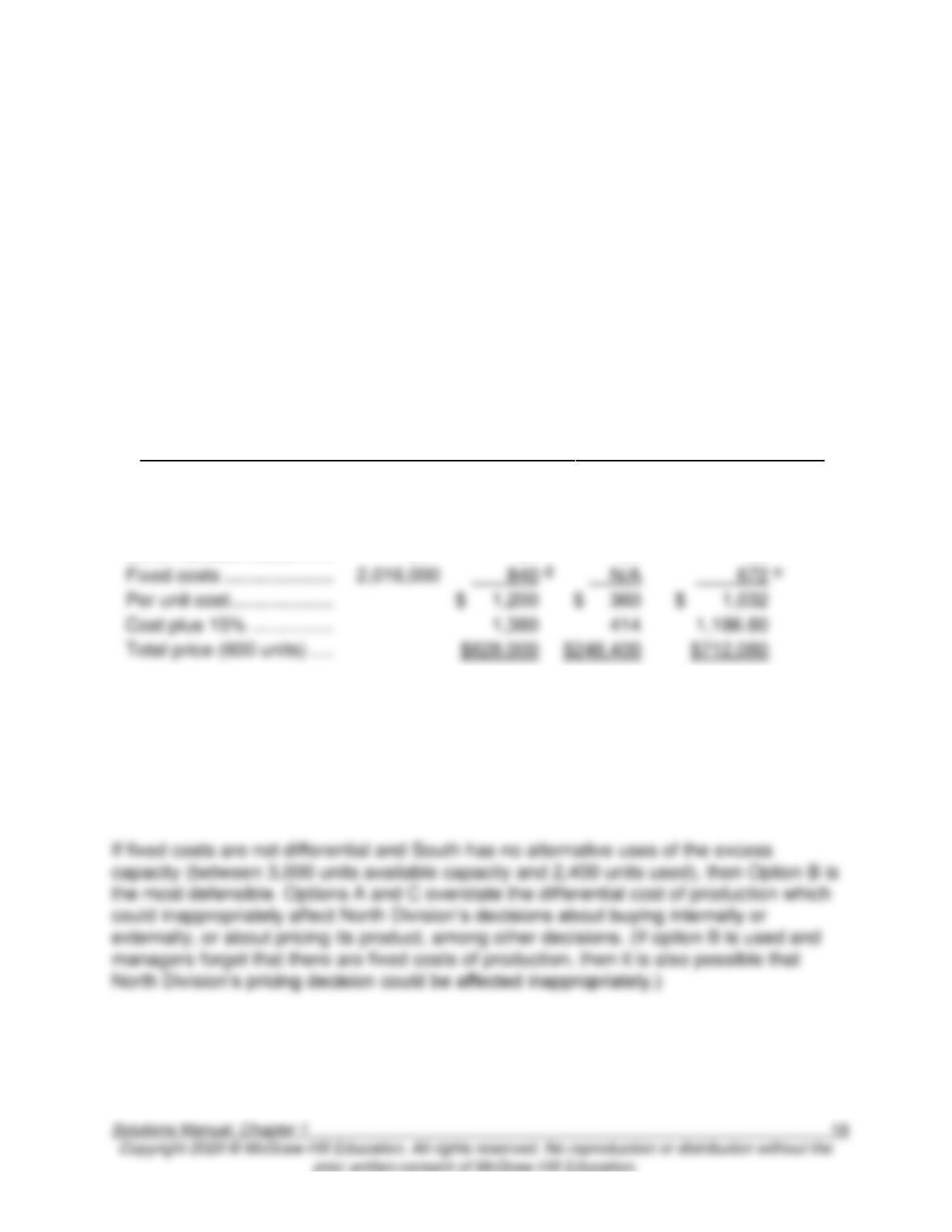
1-41. (20 Min.) Cost Data for Managerial Purposes: T-Comm.
This problem demonstrates the ambiguity in measuring “costs.”
South Division’s controller included the “per unit” fixed costs, which were calculated for
allocation purposes under normal production volume, when he or she calculated the per
unit cost of the additional production. The controller charged North Division on that
basis, ignoring the differential costs as a basis for interdivision sales.
Possible options available are as follows:
A. Use the full per unit cost for normal production of 2,400 units.
B. Use only differential costs as the cost basis.
C. Use differential costs plus a share of fixed costs, based on actual production
volume (with North’s order) of 3,000 units.
Costs
Unit Cost Options:
A
B
C
Direct materials (variable)
$ 200 a
$ 200
$ 200
$ 200
Direct Labor (variable) ….
96 b
96
96
96
Other variable costs ……..
64 c
64
64
64
Fixed costs …………………
840
d
e
Per unit cost ………………..
Cost plus 15% …………….
a $200 = $480,000 ÷ 2,400 units.
b $96 = $230,400 ÷ 2,400 units.
c $64 = $153,600 ÷ 2,400 units.
d $840 = $2,016,000 ÷ 2,400 units.
e $672 = $2,016,000 ÷ 3,000 units.
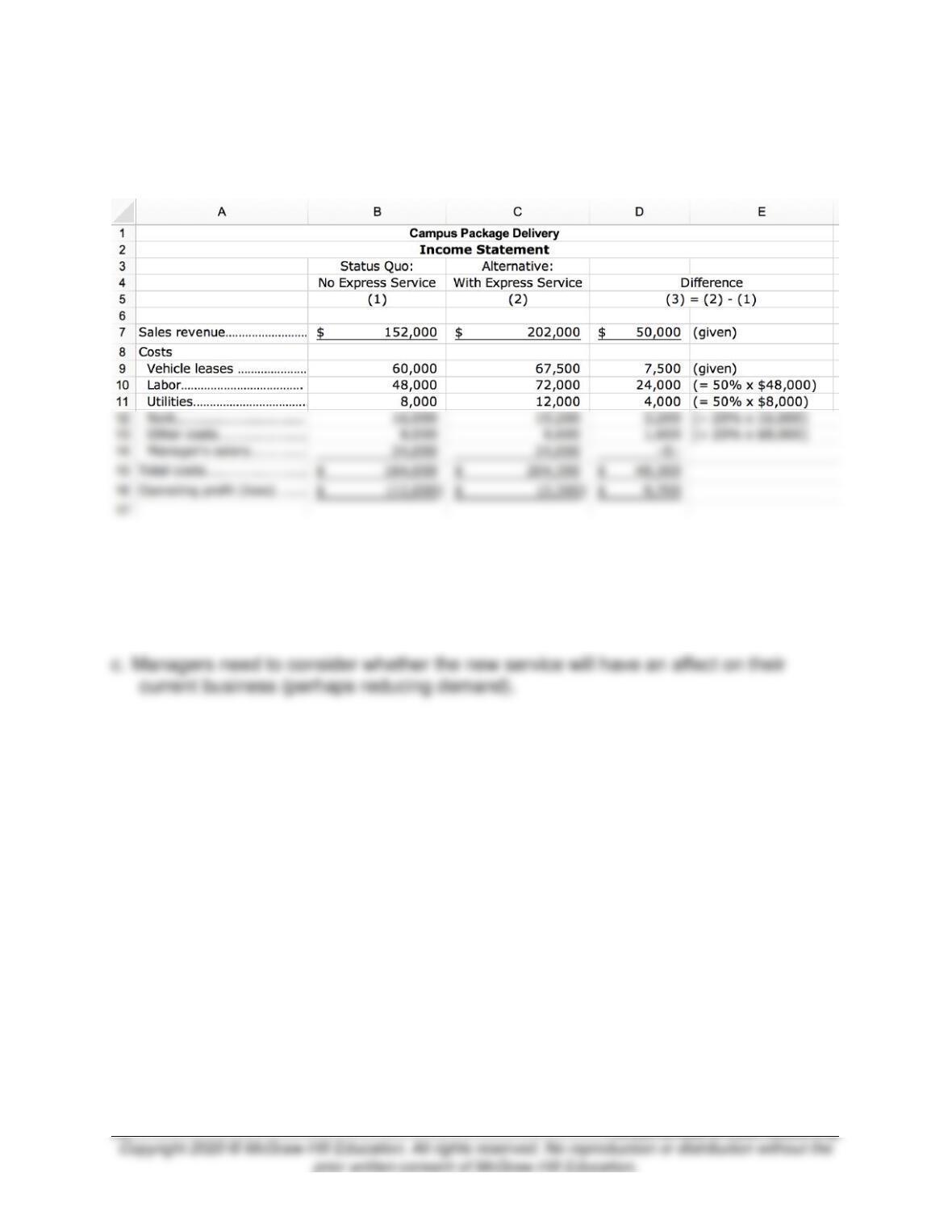
1-42. (20 Min.) Cost Data for Managerial Purposes: Campus Package Delivery.
a.
b. The decision to expand and offer the express service results in differential profits of
$9,700, so it is profitable to expand. Note that only differential costs and revenues
figured in the decision. The manager’s salary did not change, so it did not affect the
decision.
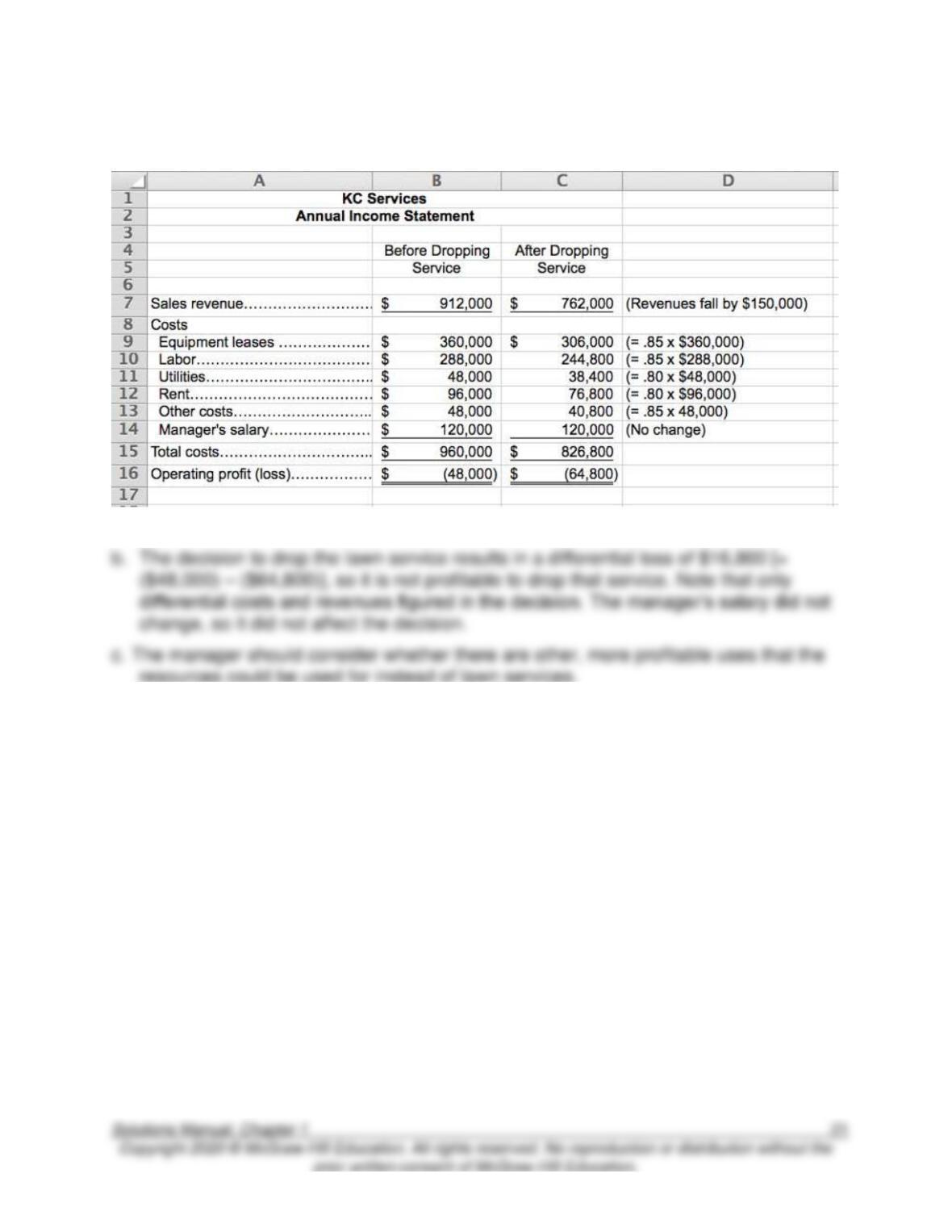
1-43. (20 Min.) Cost Data for Managerial Purposes: KC Services.
a.
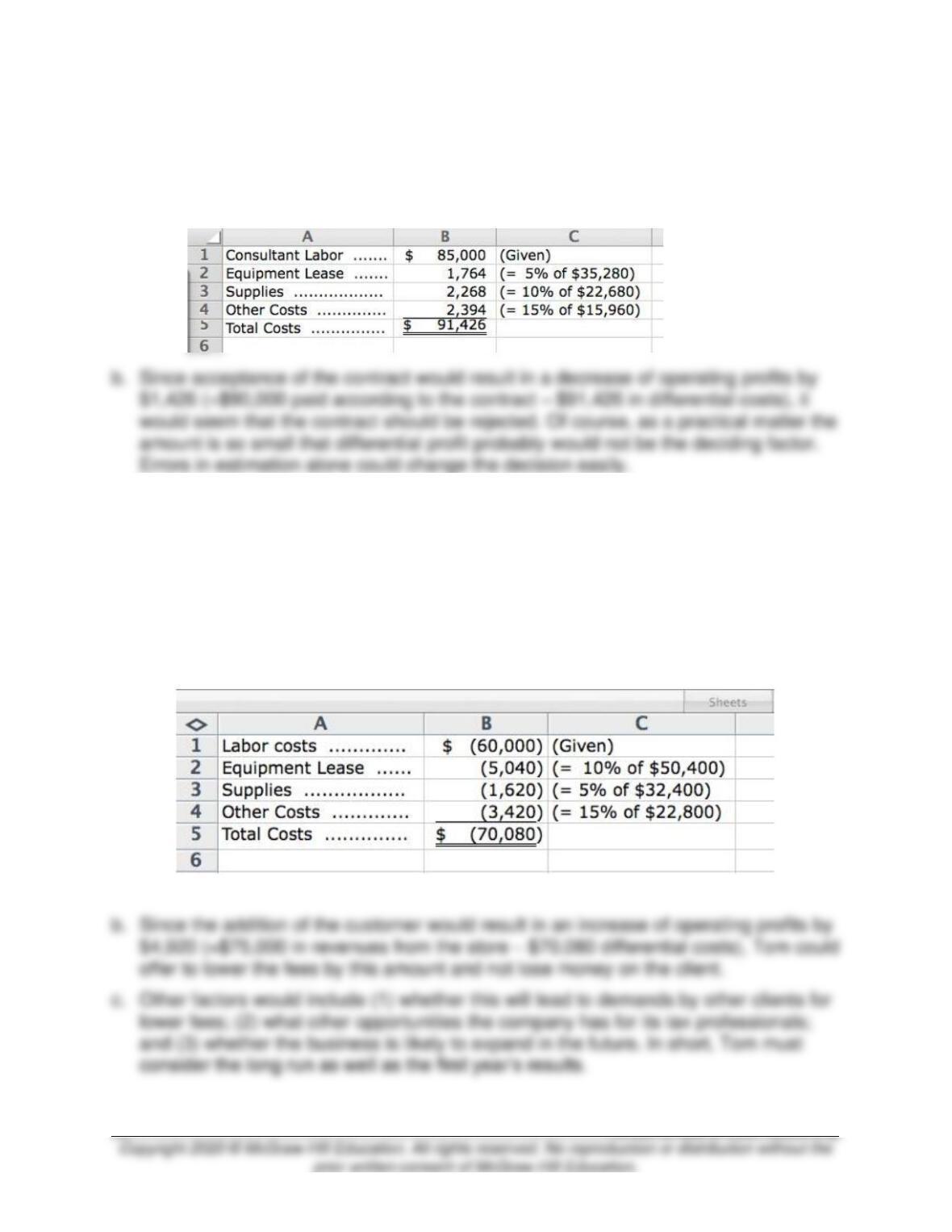
1-44. (20 Min.) Cost Data for Managerial Purposes: B-You
a. The following differential costs would be incurred:
c. Other factors would include (1) whether this will enable the company to get into a
new, profitable line of business; (2) what other opportunities the company has for
expanding; and (3) whether the contract will provide for more revenues in the future.
In short, the company must consider the long run as well as the first year’s results.
1-45. (20 Min.) Cost Data for Managerial Purposes: Tom’s Tax Services.
a. The following differential costs would be incurred:
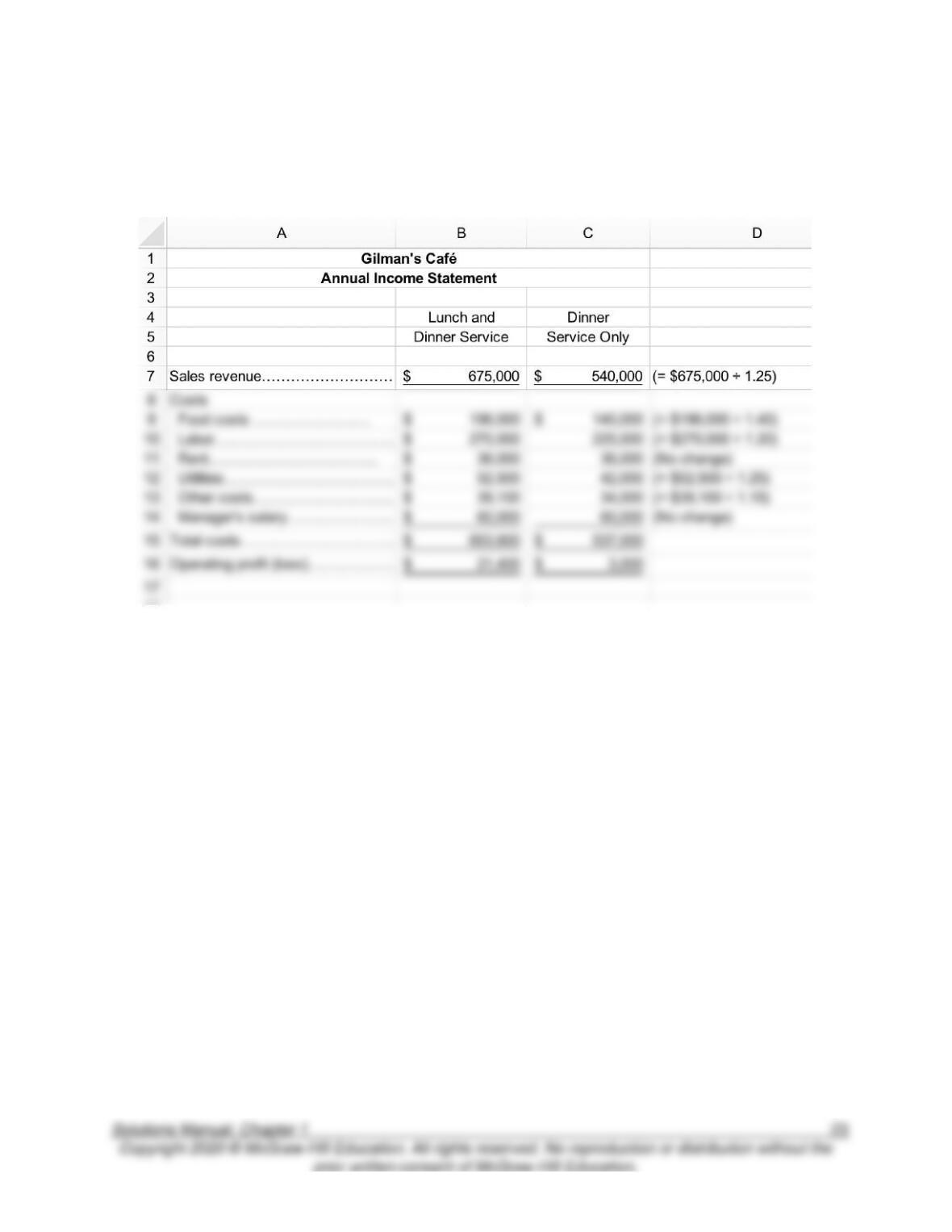
1-46. (30 Min.) Cost Data for Managerial Purposes: Gilman’s Café.
a. The following is the income for dinner service only:
Adding the lunch service would increase profit from $3,000 to $21,400 based on
Sarah’s estimates. Based on financial projections she should add the lunch service.
b. Other factors to consider include (1) whether this will lead to customers switching
from dinner to lunch (assuming this was not part of Sarah’s estimates); (2) what
other restaurants might do (one serving lunch might start offering dinner, for
example); and (3) whether the longer opening hours might cause the restaurant to
lose some of its appeal.
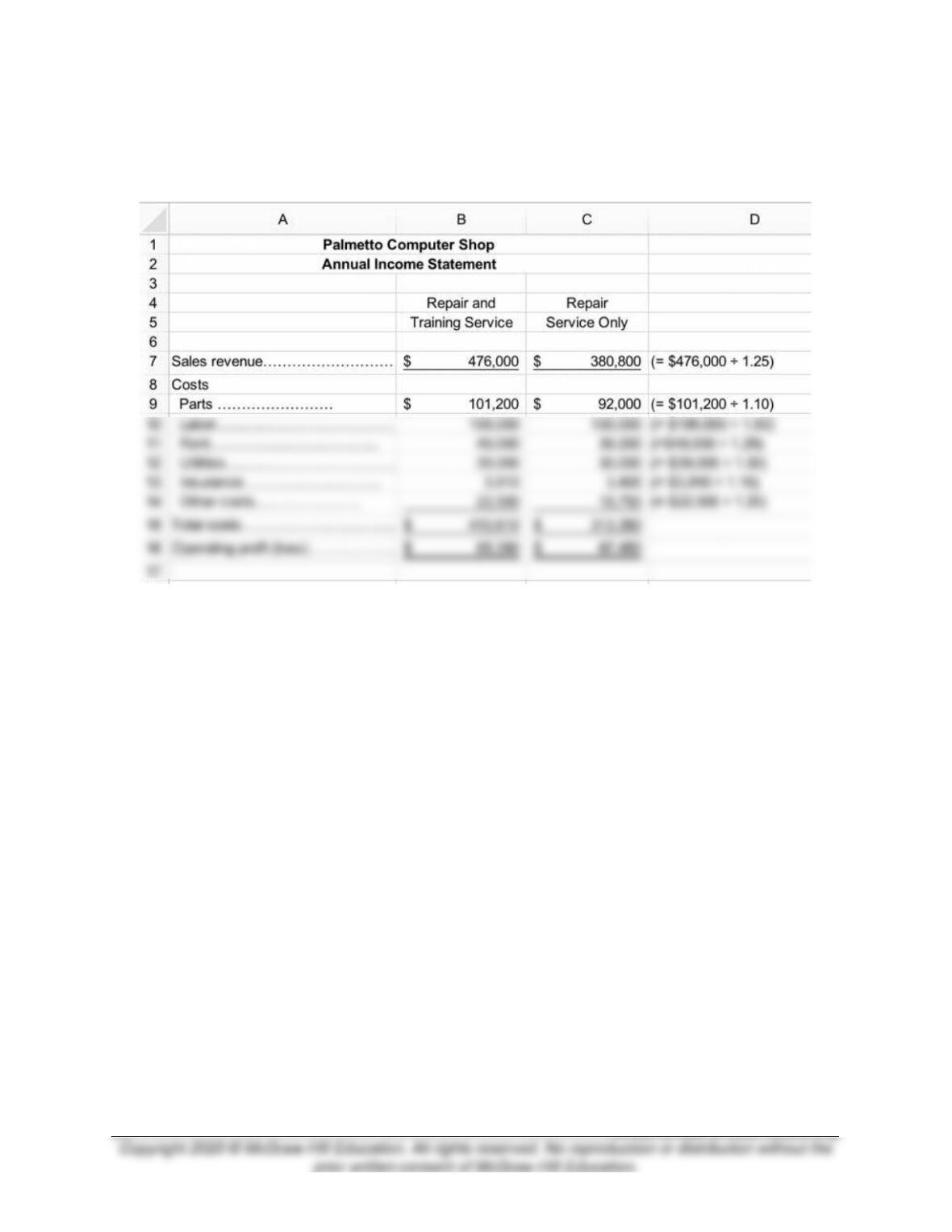
1-47. (30 Min.) Cost Data for Managerial Purposes: Palmetto Computer Shop.
a. The following is the income for repair service only:
Adding the training service would decrease profit from $67,450 to $65,390 based on
Jeff’s estimates. Based on financial projections he should not add the training
service.
b. Other factors to consider include (1) whether training will lead to customers using
Jeff’s repair services (assuming this was not part of Jeff’s estimates); (2) what Jeff
could make by teaching at the local college; and (3) whether the difference in the
estimates is really significant enough to base the decision based on financial
estimates.
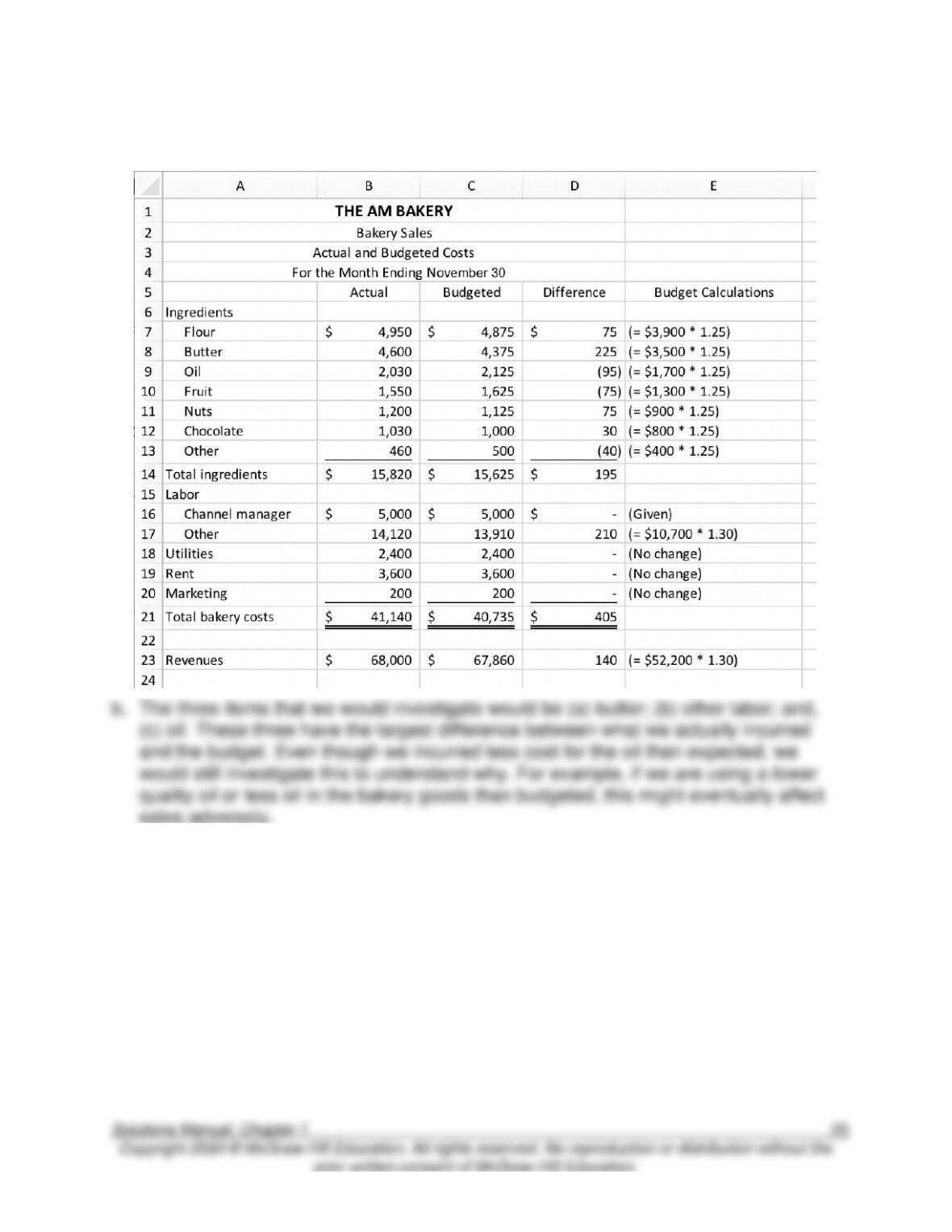
1-48. (20 Min.) Cost Data for Managerial Purposes––Budgeting
a.
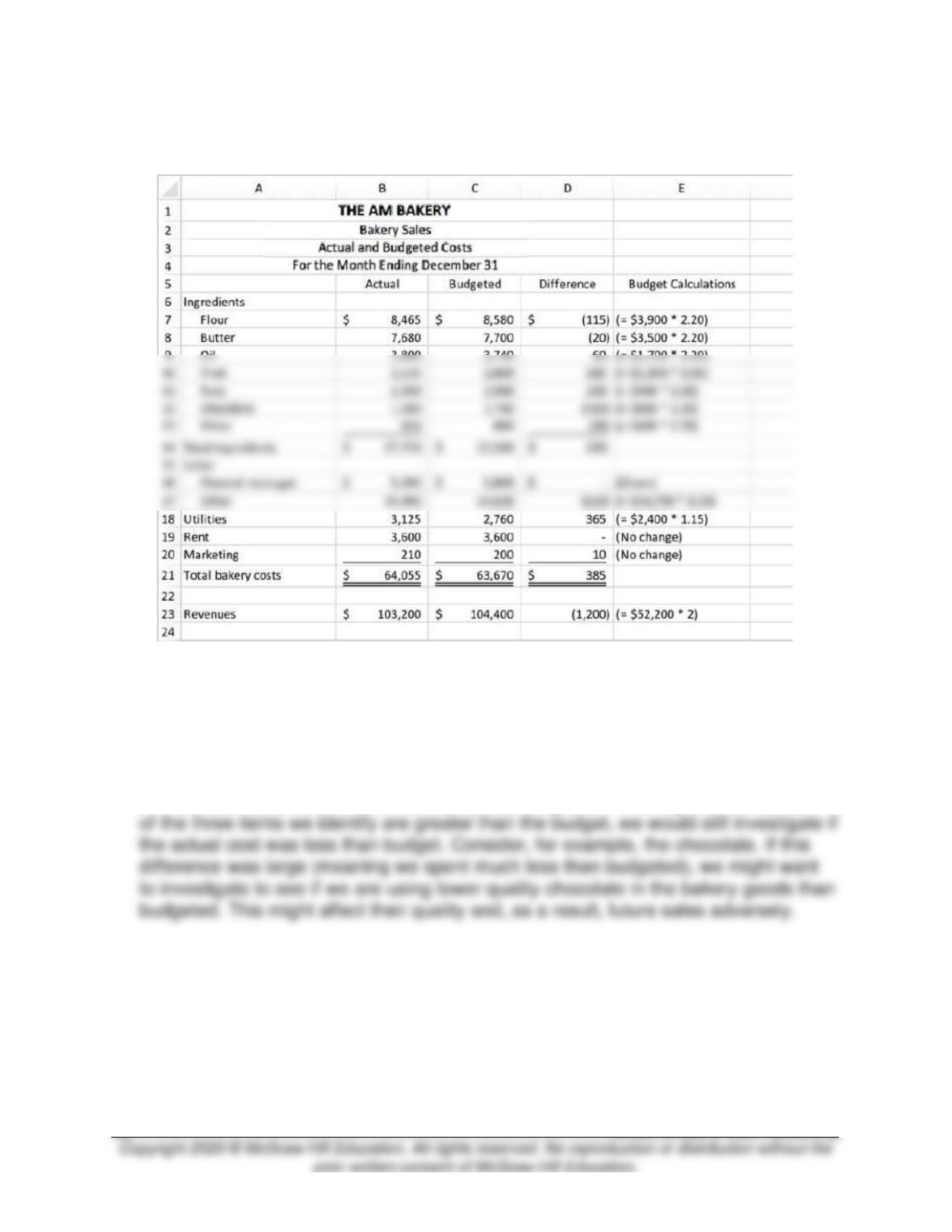
1-49. (20 Min.) Cost Data for Managerial Purposes––Budgeting
a.
b. The three items that we would investigate would be (a) utilities; (b) fruit; and, (c)
nuts. These three have the largest difference between what we actually incurred and
the budget. For example, we would like to understand why our utility costs are much
more than expected. Perhaps there has been an increase in rates and we can
expect higher costs in the future. Alternatively, perhaps some of our heating systems
are inefficient and we can save money by replacing them. Although the actual cost
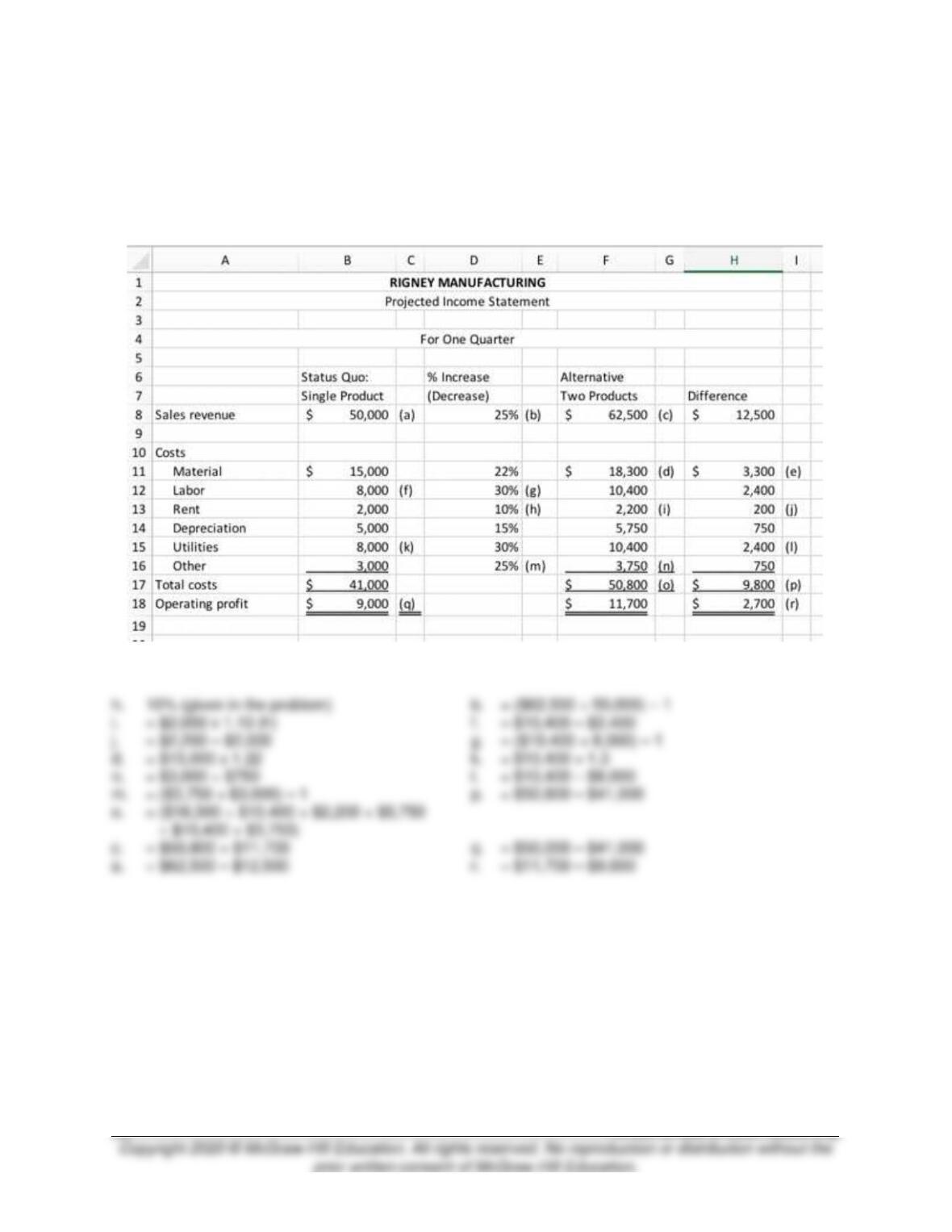
1-51. (40 Min.) Cost Data for Managerial Purposes––Finding Unknowns: Rigney
Manufacturing.
Note: This is more difficult than Problem 1-50 because you cannot use the
lettering to determine the order in which to solve for the individual cells.
The following is one approach to the solution. There are many paths that will lead to the same solution.
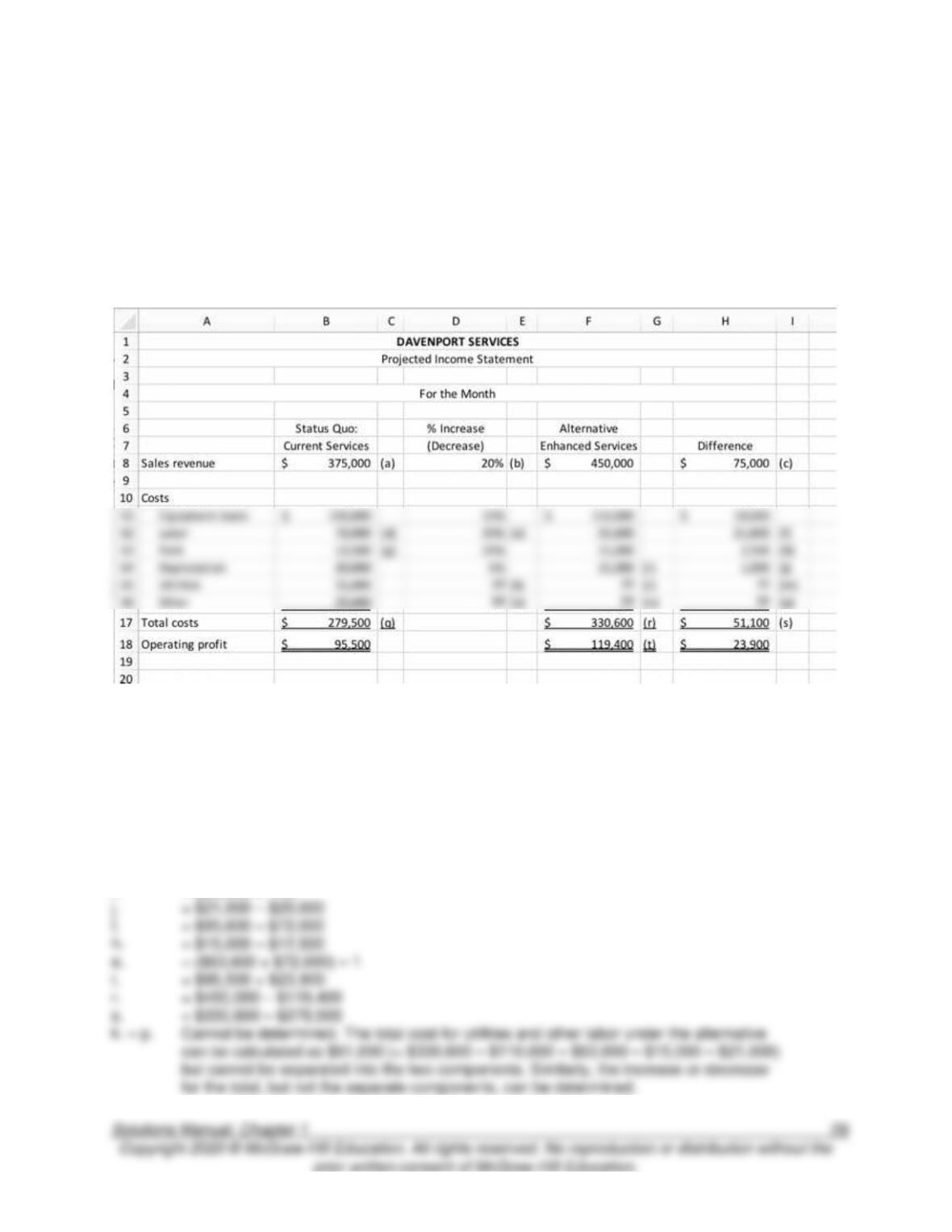
1-52. (40 Min.) Cost Data for Managerial Purposes––Finding Unknowns:
Davenport Services.
Note: This is more difficult than Problem 1-50 because you cannot use the
lettering to determine the order in which to solve for the individual cells. In
addition, it is not possible to determine all of the cells.
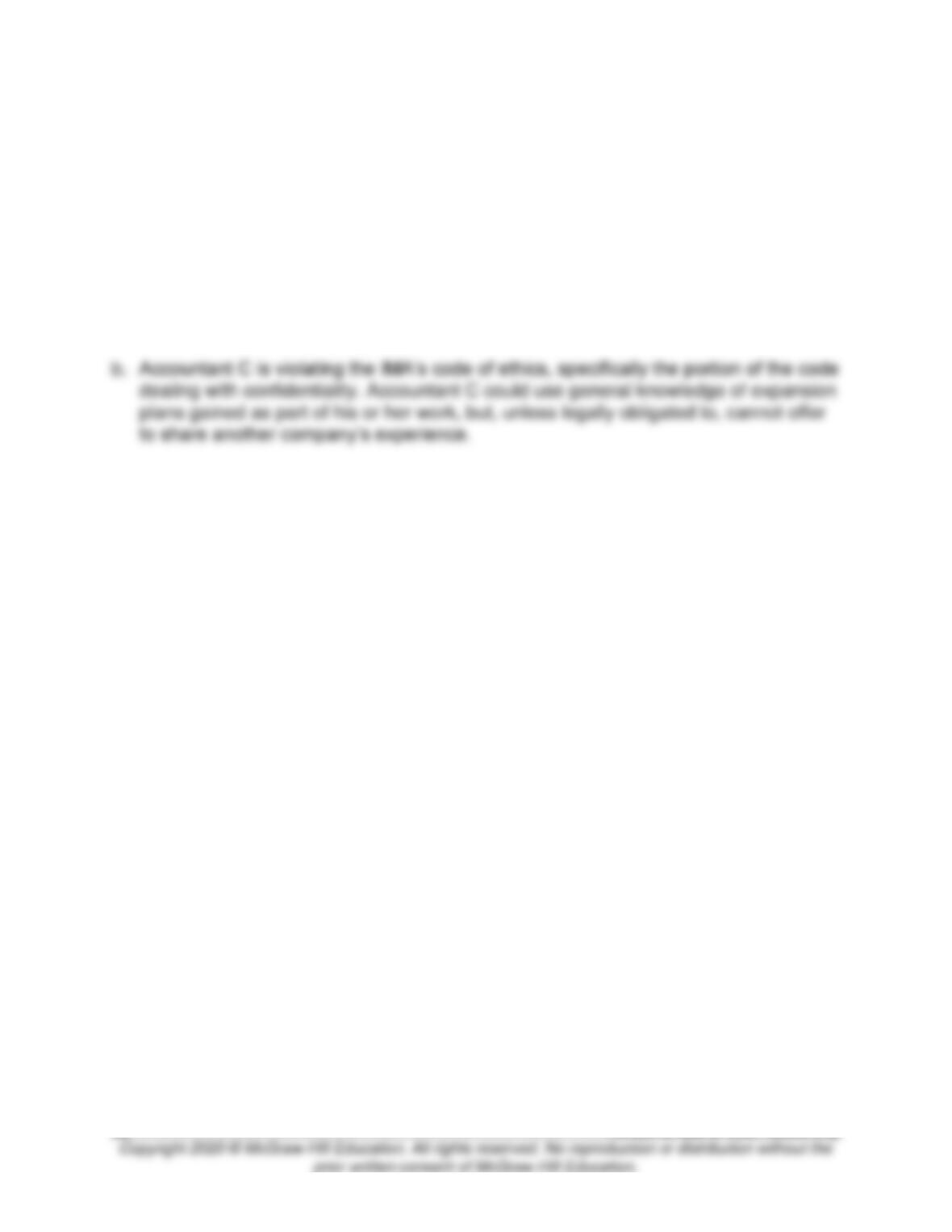
The following is one approach to the solution. There are many paths that will lead to the same solution.
f.
= 21,600 (given in the problem)
d.
= $93,600 – $21,600
g.
= $15,000 ÷ 1.20
q.
= $100,000 + $72,000 + $12,500 + $20,000
+ $55,000 + $20,000
a.
= $279,500 + $95,500
b.
= ($450,000 ÷ $375,000) – 1
c.
= $450,000 – $375,000
= $20,000 x 1.05
j.
= $21,000 – $20,000
f.
= $93,600 – $72,000
h.
= $15,000 – $12,500
e.
= ($93,600 ÷ $72,000) – 1
t.
= $95,500 + $23,900
= $450,000 – $119,400
s.
= $330,600 – $279,500
Solutions to Integrative Cases
1-53. (20 Min.) Identifying Unethical Action – Appendix
a. We recommend that Accountant B be retained to help Quince Products with their
expansion plans. Accountant B has experience with small companies and growth.
Although Accountant A has experience in the local area, the experience is with not–
for-profit firms and, therefore, might not be particularly applicable. We would not
retain Accountant C because he or she is willing to share information from another
company’s experience. Therefore, he or she might be willing to divulge our
information to another competitor.
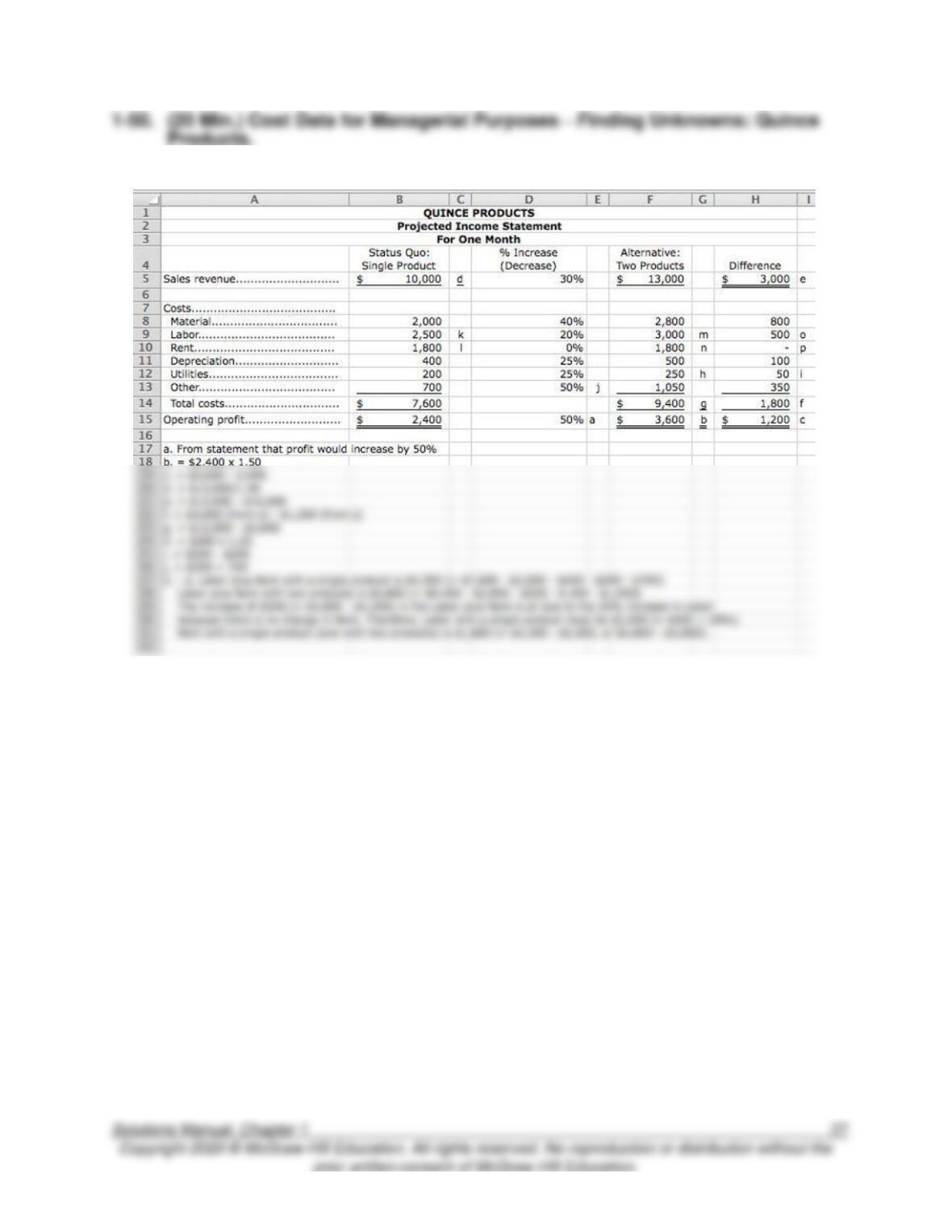
1-54. (20 Min.) Cost Data for Managerial Purposes––Finding Unknowns
1-55. (20 Min.) Identifying Unethical Actions (Appendix)
Yes. This action would violate both the Integrity and Credibility Principles.
1-56. (20 Min.) Responsibility for Unethical Action
a. We can understand, but not justify, what Charles did. He was under considerable
pressure in both his professional and personal life and he probably felt that he had
no choice. The problem is that his behavior was unethical and illegal.
b. People in this situation should contact a personal attorney (not the company
attorney) for advice. The next step would normally be to contact the most trustworthy
member of the board of directors. If the board failed to take action, Charles could
have used the IMA confidential call-in number or contacted the Securities and
Exchange Commission.