• Cost Accounting in Customer Service
o Total quality management (TQM) is a management method by which the organization
seeks to excel on all dimensions, with the customer ultimately defining quality.
o Cost of quality (COQ) is a system that identifies the costs associated with producing
low-quality items, including rework, returns, and lost sales.
• Enterprise Resource Planning
• Creating Value in the Organization
o All these tools are meant to add value to the organization.
KEY FINANCIAL PLAYERS IN THE ORGANIZATION
LO 1-5 Understand ethical issues faced by accountants and ways to deal with
ethical problems that you face in your career.
CHOICES: ETHICAL ISSUES FOR ACCOUNTANTS
• What Makes Ethics So Important?
o Accounting information is used to evaluate the performance of managers.
o Professional organizations such as the Institute of Management Accountants (IMA),
Institute of Internal Auditors (IIA) and the American Institute of Certified Public
Accountants (AICPA) have developed codes of ethics to help their members maintain the
highest levels of ethical conducts and resolve ethical dilemmas.
▪ Many businesses use these codes as a public statement of their commitment to certain
business practices with respect to their customers and as a guide for their employees.
▪ The IMA code of conduct appears in the Appendix to this chapter.
• Ethics
o The IMA code of ethics discusses the steps cost accountants should take when faced with
an ethical conflict.
• The Sarbanes-Oxley Act of 2002 and Ethics
o Congress passed the Sarbanes-Oxley Act of 2002 to address some of the more serious
problems of corporate governance.
▪ Provisions in Title III and IV of the Act deals with corporate responsibility and
enhanced financial disclosure, respectively.
▪ Section 404 of Title IV requires managers to attest to the adequacy of their internal
controls.
o The Sarbanes-Oxley Act of 2002 has important implications for managers who design
cost information systems.
COST ACCOUNTING AND OTHER BUSINESS DISCIPLINES
• The boundary between what is cost accounting and what belongs in another discipline is
often blurred.
APPENDIX: INSTITUTE OF MANAGEMENT ACCOUNTANTS CODE OF ETHICS
• Standards
▪ The IMA guidelines suggest you answer the following questions when faced with an
ethical dilemma:
• Will my actions be fair and just to all parties affected?
• Would I be pleased to have my closest friends learn of my actions?
▪ Resolving Ethical Issues
Matching
A.
Benchmarking
G.
Enterprise resource planning
B.
Cost accounting
H.
Just-in-time method
C.
Cost-benefit analysis
I.
Outsourcing
D.
Cost driver
J.
Responsibility center
E.
Differential revenues
K.
Supply chain
F.
Distribution chain
L.
Value chain
_____ 1. The set of activities that transforms raw resources into the goods and services end
users purchase and consume, and includes the treatment or disposal of any waste
generated by the end users.
_____ 5. A specific unit of an organization assigned to a manager who is held accountable for
its operations and resources.
_____ 6. The continuous process of measuring a company’s own products, services, and
activities against best practices either inside or outside the organization.
_____ 9. One or more of the firm’s activities will be performed by another firm or individual in
the supply or distribution chain for improved efficiency and cost savings.
_____ 10. Revenues that change in response to a particular course of action.
_____ 11. The process of comparing benefits (often measured in savings or increased profits)
with costs associated with a proposed change within an organization.
_____ 12. The set of firms and individuals that sells goods and services to the firm.
Matching Answers
2. B
4. F
6. A
8. G
10. E
12. K
Multiple Choice Questions
1. Cost accounting:
a. provides information to managers for decision making.
b. information is not comparable across organizations.
c. is not based on GAAP.
d. All of the above.
2. A cost accounting system:
a. adds value to the organization.
b. is part of Enterprise Resource Planning (ERP) systems.
c. is beyond any ethical issues.
d. Both a and b.
3. Which of the following positions/functions is not under the supervision of the Chief
Financial Officer (CFO)?
4. Which of the following statements is correct?
5. In cost-benefit analysis:
a. benefits are often measured in savings or increased profits.
b. proposed changes within the organizational structure are evaluated.
c. benefits should outweigh costs to be acceptable.
d. All of the above.
6. Cost drivers are:
a. factors that drive costs.
Use the following information to answer questions 7 and 8:
Company A’s quarterly sales revenue and operating costs are $12,000 and $9,500, respectively.
Operating costs include $1,500 of leasing charge for computers. A new product line will increase
sales revenue by 30 percent and costs (other than the leasing charge, which remains unchanged)
by 35 percent.
7. If Company A includes the new product line, then:
a. sales revenue will increase by $3,200.
8. The leasing charge:
a. is differential.
b. is relevant to the decision.
c. plays no role in the decision.
d. will not change in the future.
9. New trends in cost accounting include:
a. the just-in-time method.
10. Ethical conflicts in cost accounting:
a. are governed by the code of ethics of the professional organizations.
b. will not have implications for cost accountants’ decisions.
c. should be resolved to meet the demands of managers.
d. will never lead to resignation of cost accountants.
11. Financial statements for external users are characterized as:
a. user-specific.
b. managerial reports.
c. governed by GAAP.
d. not consistent with GAAP.
12. Which of the following statements is correct?
Multiple Choice Answers
2. d (LO1)
4. b (LO1)
6. d (LO2, LO3)
7. b (LO3)
9. d (LO4)
11. c (LO2)
Demonstration Problem
Jim is a florist who runs Bountiful Flower Shop as a sole owner. His typical monthly operating
results include the following: sales revenue $4,000, flower costs $800, supplies $300, labor costs
$600, utilities $250, rent $720, and other costs $350.
Required:
1. Should Jim expand his business to be associated with the national chain? Support your
answer.
2. If Jim can negotiate a different term with the national chain, what licensing fee makes him
indifferent between the two choices (i.e., the status quo of going solo vs. the alternative of
being associated with the national chain)?
Demonstration Problem – Solution
Part 1
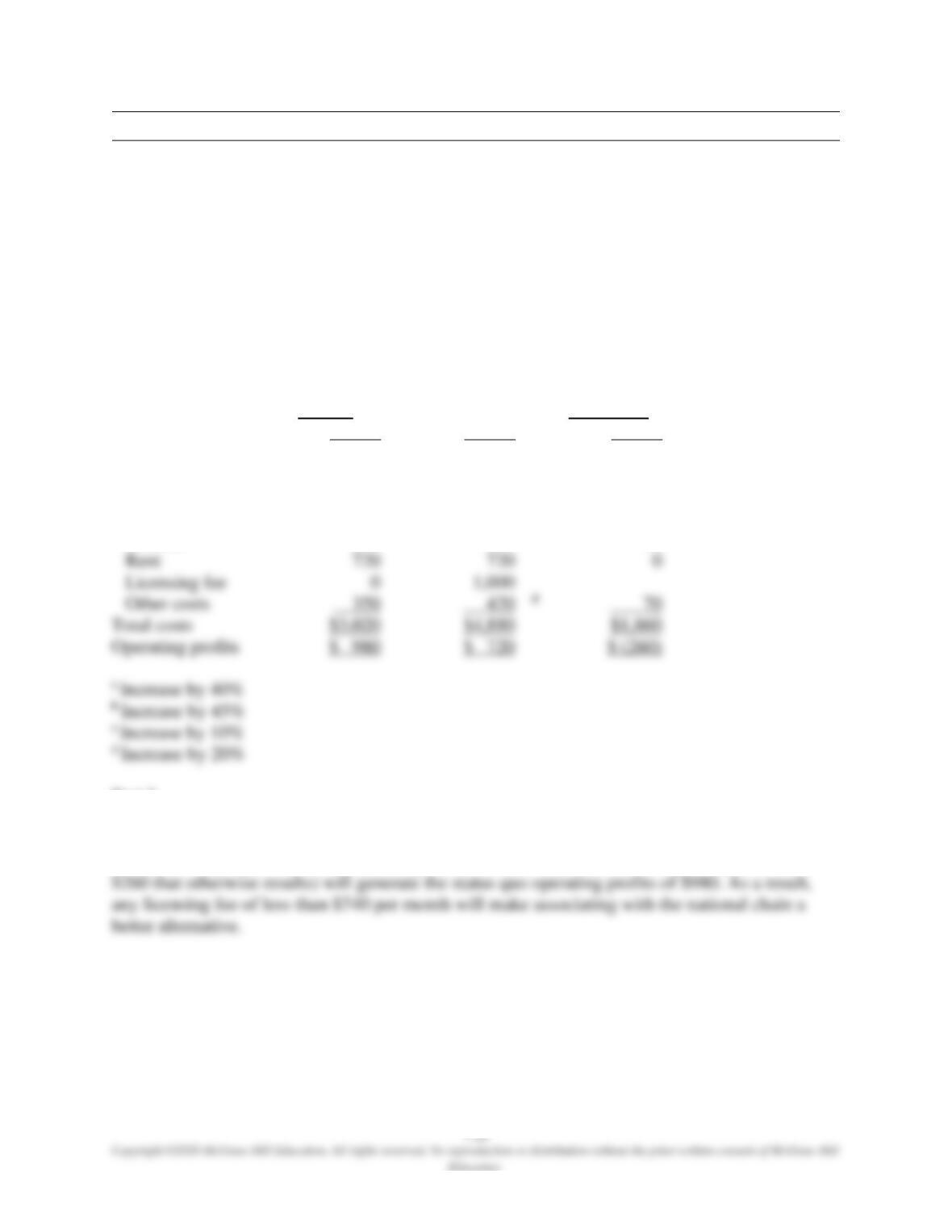
Jim should not expand his business because the projected results show that he will be worse off
by $260 per month. Rent remains the same under either option and is irrelevant to the decision.
Bountiful Flower Shop
Projected Income Statement
For One Month
Status Quo:
Run Business
“As Is”
Alternative:
Associate with
National Chain
Difference
Sales revenue
$4,000
$5,600
a
$1,600
Costs:
Flower
800
1,160
b
360
Supplies
300
435
b
135
Labor
600
870
b
270
Utilities
250
275
c
25
Rent
720
Licensing fee
Other costs
d
70
Total costs
$3,020
$1,860
Operating profits
$ 980
Part 2
Considering the loss of $260 if Jim associates with the national chain, a licensing fee of $740 per
month (or the proposed monthly licensing fee of $1,000 – the decrease in operating profits of