
Auditing: A Risk Based Approach to Conducting a Quality Audit, 10e
1-1
Solutions for Chapter 1
True/False Questions
1-1 T
1-2 T
1-3 F
1-4 F
Multiple Choice Questions
1-15 B
1-16 B
1-17 E
Review and Short Case Questions
1-29
The objective of external auditing is to provide opinions on the reliability of the financial
statements and, as part of an integrated audit, provide opinions on internal control effectiveness.
1-2
The value of the external auditing profession is affirmed when the public has confidence in its
objectivity and the accuracy of its opinions. The capital markets depend on accurate, reliable,
and objective (neutral) data that portray the economic nature of an entity’s business and in turn
1-30
The special function performed by the external auditing profession is the attestation to the
fairness of the financial statements of clients. The special function helps ensure the reliability
and integrity of the financial reporting system. The auditing profession exists to serve the users
1-31
Audit services are demanded because there is a:
• Potential bias in providing information.
• Remoteness between a user and the organization or trading partner.
1-32
The audit enhances the quality of financial statements because the user has the assurance that an
independent, qualified professional has examined the financial statements and has rendered an
opinion on their fairness. The independence and expertise of the auditor serve as a quality control
function to overcome the potential bias of management in presenting the financial statements in a
1-3
1-33
Independence means objectivity and freedom from bias. The auditor can favor neither the client
nor the third party in evaluating the fairness of the financial statements. The auditor must be
independent in fact and in appearance. Independence in fact means the auditor is unbiased and
1-34
a. An organization’s financial statements should reflect a true and fair view of the
organization’s financial results. The statements should not favor one user over another. However,
the interests of the various users can conflict. By having rules that encourage auditor
b.
Management
Review performance, make operational decisions, report results to
capital markets
Stockholders
Buy or sell stock
Bondholders
Buy or sell bonds
Financial Institutions
Evaluate loan decisions, considering interest rates, terms, and risk
Taxing Authorities
Determine taxable income and tax due
Regulatory Agencies
Develop regulations and monitor compliance
Labor Unions
Make collective bargaining decisions
Court System
Assess the financial position of a company in litigation
Vendors
Assess credit risk
Retired Employees
Protect employees from surprises concerning pensions and other post-
retirement benefits
1-35
1-4
a. Susan Birkert had a friend purchase $5,000 of stock in the company that she was
auditing. She lied to KPMG when responding to the firm’s yearly written requirements to
comply with the firm’s independence policies.
1-36
a. Management may want an independent audit because:
• An independent assessment of the fairness of presentation enhances the perceived
reliability of the financial report and assists the company in obtaining loans or new
capital because the investing and lending public will have confidence in the financial
figures.
b. Some of the points that might be discussed by management in determining the nature of
the audit firm to engage to conduct the audit:
1-5
• The reputation of the auditor in the community and potential impact of auditor reputation
in securing loans or capital.
• The ability of the auditor to assist the firm in expanding the scope of its operations
beyond the immediate geographic area.
• The industry-specific knowledge of the potential auditors.
c. Several users might be interested in McIver’s financial results, including: management
itself, existing or potential creditors, and potential takeover or merger distributorship partners.
1-37
Primary Parties Involved in Preparing
Audited Financial Statements
Role
Management
Maintains internal controls and prepares
reports
Internal Auditor
Provides internal assurance on internal
controls and reports
Audit Committee
Provides oversight of the reporting process
and other parties
External Auditor
Provides independent audit of internal
controls and financial statements
1-38
There exist various types of audit service providers, and they are each suited to auditing different
types of clients:
• Large, multi-national audit firms are best suited to auditing large multi-national
companies, both publicly traded and privately held.
1-6
1-7
1-39
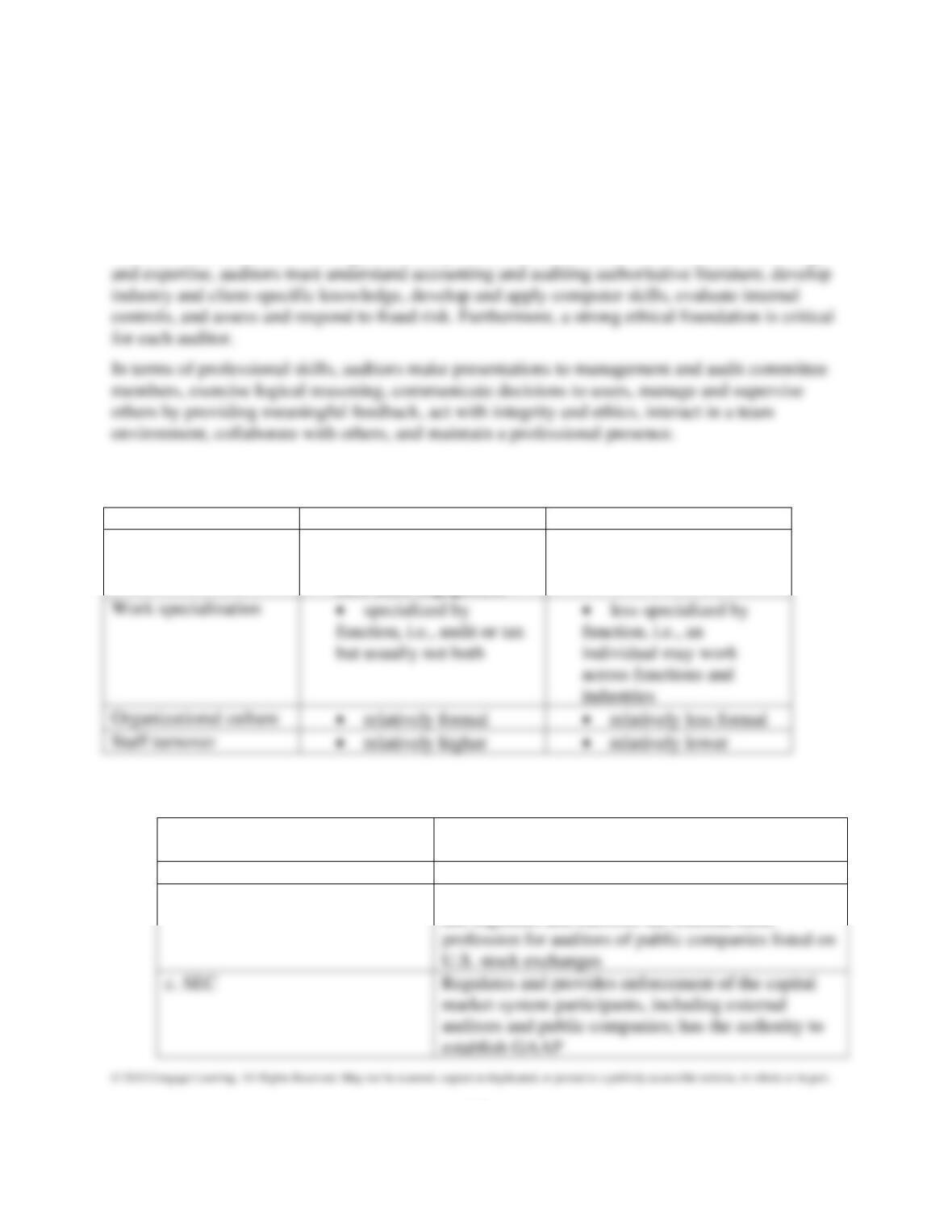
The requirements of those entering the auditing profession are demanding. Audits are performed
in teams where each auditor is expected to complete tasks requiring considerable technical
knowledge and expertise. Auditors also need well-developed skills in leadership, teamwork,
communication, decision making, and other professional areas. In terms of technical knowledge
1-40
Larger Audit Firms
Smaller Audit Firms
Working in a team
environment
• multiple teams that
typically disband after
each audit engagement
• teams that overlap
across engagements
1-41
Organization Affecting External
Auditing Profession
Nature of Effects
a. Congress
Passed Sarbanes-Oxley Act of 2002
b. PCAOB
Sets audit standards for auditors of public companies
and regulates and enforces the external audit
profession for auditors of public companies listed on
U.S. stock exchanges
c. SEC
Regulates and provides enforcement of the capital
market system participants, including external
auditors and public companies; has the authority to
establish GAAP
1-8
d. AICPA
Sets audit standards for auditors of privately held
companies and administers the CPA exam
e. Center for Audit Quality
Works to enhance investor confidence and trust in
the financial markets; is affiliated with the AICPA
f. IAASB
Sets audit standards for auditors of public companies
internationally.
g. COSO
Provides guidance on internal control, enterprise risk
management, and fraud deterrence.
1-42
PCAOB
AICPA
a)
Sets auditing standards for
audits of public companies
Does not set auditing
standards for the audits of
public firms anymore. It does
set standards for audits of
non-public companies.
b)
Does not set accounting
standards; this responsibility
is delegated to the FASB and
the SEC.
Does not set accounting
standards; this responsibility
is delegated to the FASB and
the SEC.
Performs inspections of all
firms that are registered with
it. Note that all firms that
Requires peer reviews of
firms enrolled in the AICPA
Peer Review Program to
1-43
a. On the “pro” side, having different standards makes audits more tailored to the nature of
the company (e.g., the nature of auditing for a large, public company may be very different from
auditing for a small, private company). On the “con” side, this dual structure can create various
1-9
b. Examples could include the following: (1) public companies might have auditing
standards that are more applicable to larger and more complex entities, (2) non-public companies
might have auditing standards that adjust for weaker internal controls (e.g., lack of segregation of
1-44
The requirement that no more than two of the PCAOB board members may be CPAs was put
into place to ensure that the Board is not unduly dominated by members of the external audit
1-45
Audit quality involves performing an audit in accordance with generally accepted auditing
standards (GAAS) to provide reasonable assurance that the audited financial statements and
related disclosures are presented in accordance with generally accepted accounting principles
(GAAP) and providing assurance that those financial statements are not materially misstated
1-46
a. Audit firm culture affects audit quality because when it is positive it:
– Creates an environment where achieving quality is valued, invested in and rewarded.
– Emphasizes the importance of ‘doing the right thing’ in the public interest and the effect
of doing so on the reputation of both the firm and individual auditors.
-Ensures partners and staff have sufficient time and resources to deal with difficult issues
1-10
-Ensures audit quality is monitored within firms and across international networks and
appropriate consequential action is taken.
Expert Skills and Qualities of the Audit Partner and Engagement team affect audit quality
because they:
–Affect whether partners and staff understand their clients’ business and adhere to the
principles underlying auditing and ethical standards.
-Affect the ability of partners and staff to exercise professional skepticism in their work
1-47
Independence is vitally important to the auditing profession. Audits exist to create confidence in
the public that financial statements are free from material misstatement. When auditors are not
independent, the public cannot necessarily trust that the statements are free from material
misstatement, because the public would believe that auditors could have incentives to allow
1-11
a. Auditor independence requirements help to avoid situations in which auditor
independence may be impaired, including situations in which the auditor has a relationship that:
• Creates a mutual or conflicting interest between the accountant and the audit client
b. Review programs include:
• external inspections/peer reviews, which include inspections by the PCAOB and peer
reviews by other audit firms facilitated by the AICPA
• engagement quality reviews, which involves having an audit partner not otherwise
c. Engagement letters state the scope of the work to be performed on the audit so that there
is no doubt on the part of the client, auditor, or court system as to the expectations agreed to by
the external auditor and the client.
1-49
The seven threats to independence are:
1. Self-review threat – occurs when the audit firm also provides non-audit work for the client,
such as preparing source documents used to generate the client’s financial statements.
Independence is threatened because it may appear that the auditor is reviewing his or her own
work.
1-12
3. Adverse interest threat – occurs when the auditor and the client are in opposition to one
another, such as when either party has initiated litigation against the other. Independence is
4. Familiarity threat – occurs when the auditor has some longstanding relationship with an
important person associated with the client. Examples include:
• The audit partner’s close relative is employed in a key position at the client.
• The audit partner has been assigned to the client for a long period of time and has
developed very close personal relationships with top management.
5. Undue influence threat – occurs when client management attempts to coerce or provide
excessive influence over the auditor. Examples include:
• Top management threatens to replace the auditor or the audit firm because of a
disagreement over an accounting issue.
• Top management pressures the auditor to reduce the amount of work they do on the audit
6. Financial self-interest threat – occurs when the auditor has a direct financial relationship with
the client, such as owning stock in the client company, owing money to the client company,
or when the audit client makes up the vast majority of the audit firm’s total revenue.