Chapter 01 – Financial Statements and Business Decisions
Chapter 01
Financial Statements and Business
Decisions
ANSWERS TO QUESTIONS
1. Accounting is a system that collects and processes (analyzes, measures, and
2. Financial accounting involves preparation of the four basic financial statements and
3. Financial reports are used by both internal and external groups and individuals. The
4. Investors purchase all or part of a business and hope to gain by receiving part of
5. In a society each organization can be defined as a separate accounting entity. An
accounting entity is the organization for which financial data are to be collected.
6. Name of Statement Alternative Title
(a) Income Statement (a) Statement of Earnings; Statement of
Chapter 01 – Financial Statements and Business Decisions
7. The heading of each of the four required financial statements should include the
following:
8. (a) The purpose of the income statement is to present information about the
revenues, expenses, and the net income of the entity for a specified period of
time.
9. The income statement and the statement of cash flows are dated “For the Year
Ended December 31, 2010,” because they report the inflows and outflows of
10. Assets are important to creditors and investors because assets provide a basis for
judging whether sufficient resources are available to operate the company. Assets
11. Net income is the excess of total revenues over total expenses. Net loss is the
excess of total expenses over total revenues.
12. The equation for the income statement is Revenues – Expenses = Net Income (or
Chapter 01 – Financial Statements and Business Decisions
1-3
13. The equation for the balance sheet (also known as the basic accounting equation)
is: Assets = Liabilities + Stockholders’ Equity. Assets are the probable (expected)
future economic benefits owned by the entity as a result of past transactions. They
14. The equation for the statement of cash flows is: Cash flows from operating activities
+ Cash flows from investing activities + Cash flows from financing activities =
Change in cash for the period. The net cash flows for the period represent the
15. The equation for the statement of retained earnings is: Beginning Retained
Earnings + Net Income – Dividends = Ending Retained Earnings. It begins with
16. Marketing managers and credit managers use customers’ financial statements to
decide whether to extend them credit for their purchases. Purchasing managers
17. The Securities and Exchange Commission (SEC) is the U.S. government agency
which determines the financial statements that public companies must provide to
Chapter 01 – Financial Statements and Business Decisions
1-4
18. Management is responsible for preparing the financial statements and other
information contained in the annual report and for the maintenance of a system of
internal accounting policies, procedures and controls. These measures are
19. A sole proprietorship is an unincorporated business owned by one individual. A
partnership is an unincorporated association of two or more individuals to carry on a
20. A CPA firm normally renders three services: auditing, management advisory
services, and tax services. Auditing involves examination of the records and

Chapter 01 – Financial Statements and Business Decisions
1-5
ANSWERS TO MULTIPLE CHOICE
Chapter 01 – Financial Statements and Business Decisions
1-6
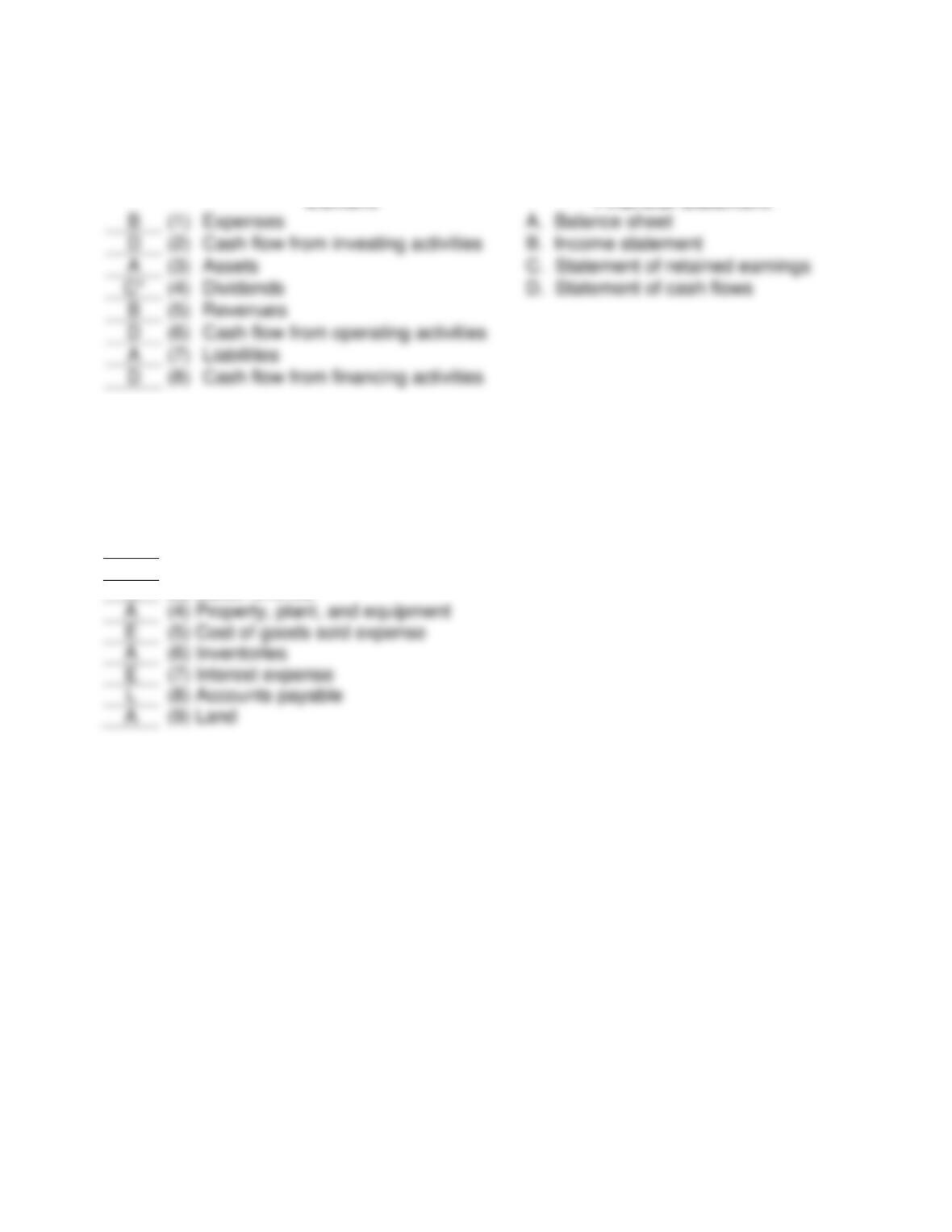
Authors’ Recommended Solution Time
(Time in minutes)
Mini-exercises
Exercises
Problems
Alternate
Problems
Cases and
Projects
No.
Time
No.
Time
No.
Time
No.
Time
No.
Time
1
5
1
12
1
45
1
45
1
20
2
5
2
12
2
45
2
45
2
30
10
25
11
30
12
15
13
12
14
30
3
5
3
12
3
45
3
45
3
30
4
20
4
45
4
60
5
25
5
30
6
20
6
20
7
15
7
8
25
9
25
Chapter 01 – Financial Statements and Business Decisions
1-7
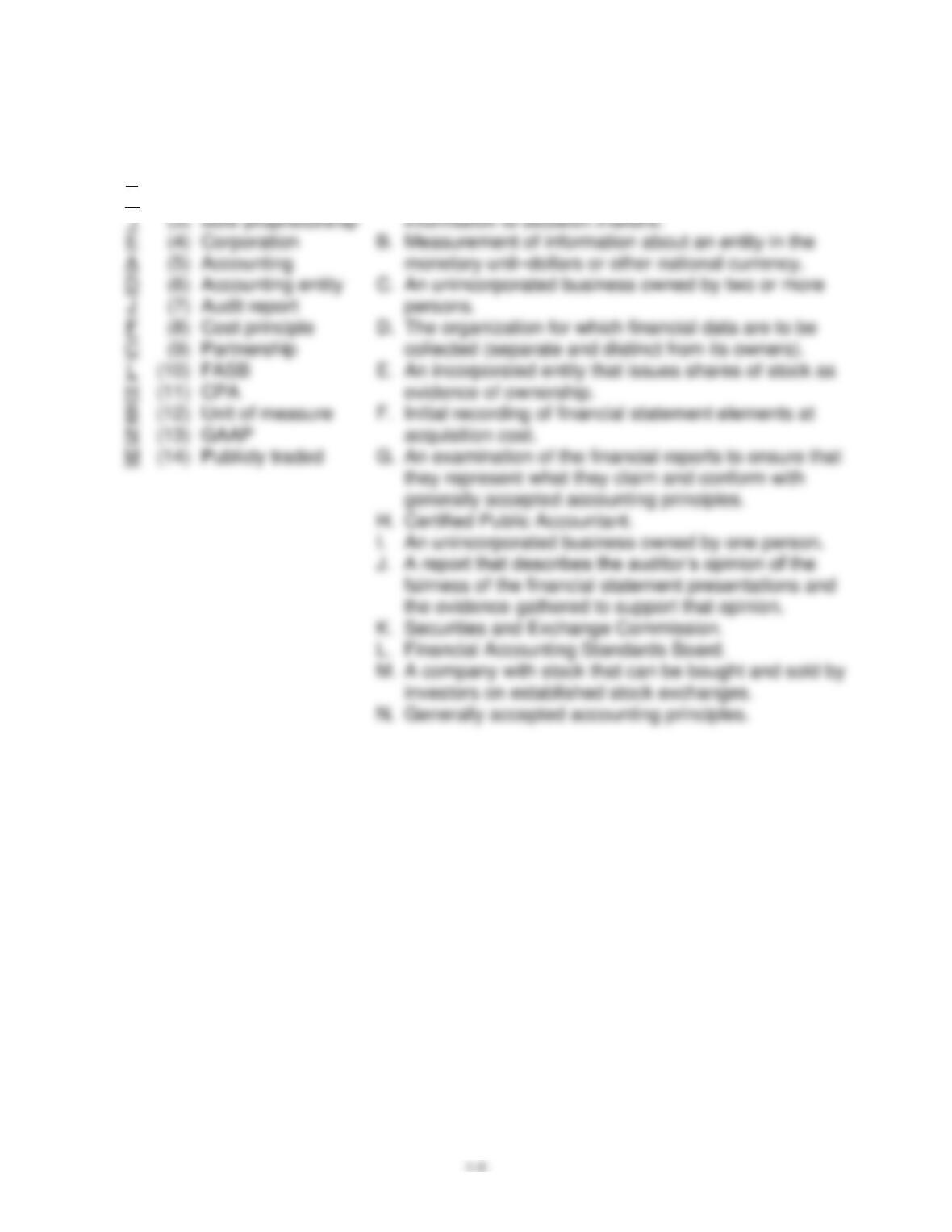
MINI-EXERCISES
M1–1.
Element
Financial Statement
*Dividends paid in cash are also subtracted in the Financing section of the Statement of
Cash Flows
M1–2.
SE
(1) Retained earnings
A
(2) Accounts receivable
R
(3) Sales revenue
A
(4) Property, plant, and equipment
E
(5) Cost of goods sold expense
A
(6) Inventories
E
(7) Interest expense
(8) Accounts payable
A
(9) Land
M1–3.
Abbreviation
Full Designation
(1)
CPA
Certified Public Accountant
(2)
GAAP
Generally Accepted Accounting Principles
(3)
AICPA
American Institute of Certified Public Accountants
(4)
SEC
Securities and Exchange Commission
(5)
FASB
Financial Accounting Standards Board
B
(1) Expenses
A. Balance sheet
D
(2) Cash flow from investing activities
B. Income statement
A
(3) Assets
C. Statement of retained earnings
(4) Dividends
D. Statement of cash flows
B
(5) Revenues
D
(6) Cash flow from operating activities
A
(7) Liabilities
D
(8) Cash flow from financing activities
Chapter 01 – Financial Statements and Business Decisions
EXERCISES
E1–1.
Term or Abbreviation Definition
K
G
(1)
(2)
SEC
Audit
A. A system that collects and processes financial
information about an organization and reports that
Chapter 01 – Financial Statements and Business Decisions
1-9
E1–2.
A
(1) Accounts receivable
A
(2) Cash and cash equivalents
E
(8) Marketing, administrative, and other operating expenses
E
(9) Income taxes
L
(10) Accounts payable
A
(11) Land
A
(12) Property, plant, and equipment
L
(13) Long-term debt
A
(14) Inventories
E
(15) Interest expense
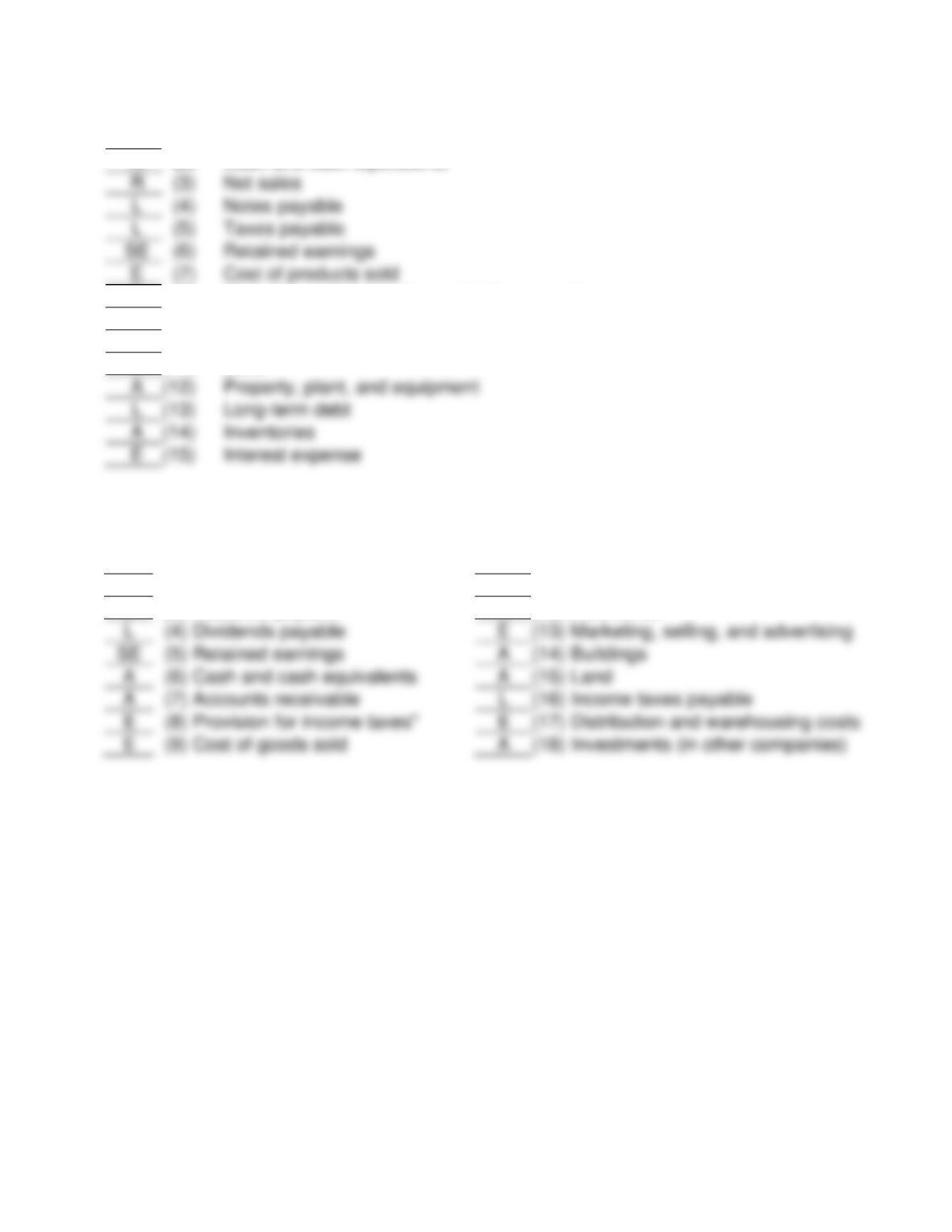
E1–3.
L
(1) Notes payable to banks
A
(10) Machinery and equipment
E
(2) General and administrative
R
(11) Net sales
L
(3) Accounts payable
A
(12) Inventories
L
(4) Dividends payable
E
(13) Marketing, selling, and advertising
(5) Retained earnings
A
(14) Buildings
A
(6) Cash and cash equivalents
A
(15) Land
A
(7) Accounts receivable
(16) Income taxes payable
E
(8) Provision for income taxes*
E
(17) Distribution and warehousing costs
E
(9) Cost of goods sold
A
(18) Investments (in other companies)
*Note that “Provision for income taxes” is a common synonym for “Income tax expense.”
R
(3) Net sales
L
(4) Notes payable
L
(5) Taxes payable
(6) Retained earnings
E
(7) Cost of products sold
Chapter 01 – Financial Statements and Business Decisions
E1–4.
Honda Motor Corporation
Balance Sheet
as of March 31, 2009
(in billions of Yen)
Assets
Cash and cash equivalents
¥ 690
Trade accounts, notes, and other receivables
854
Inventories
1,244
Investments
639
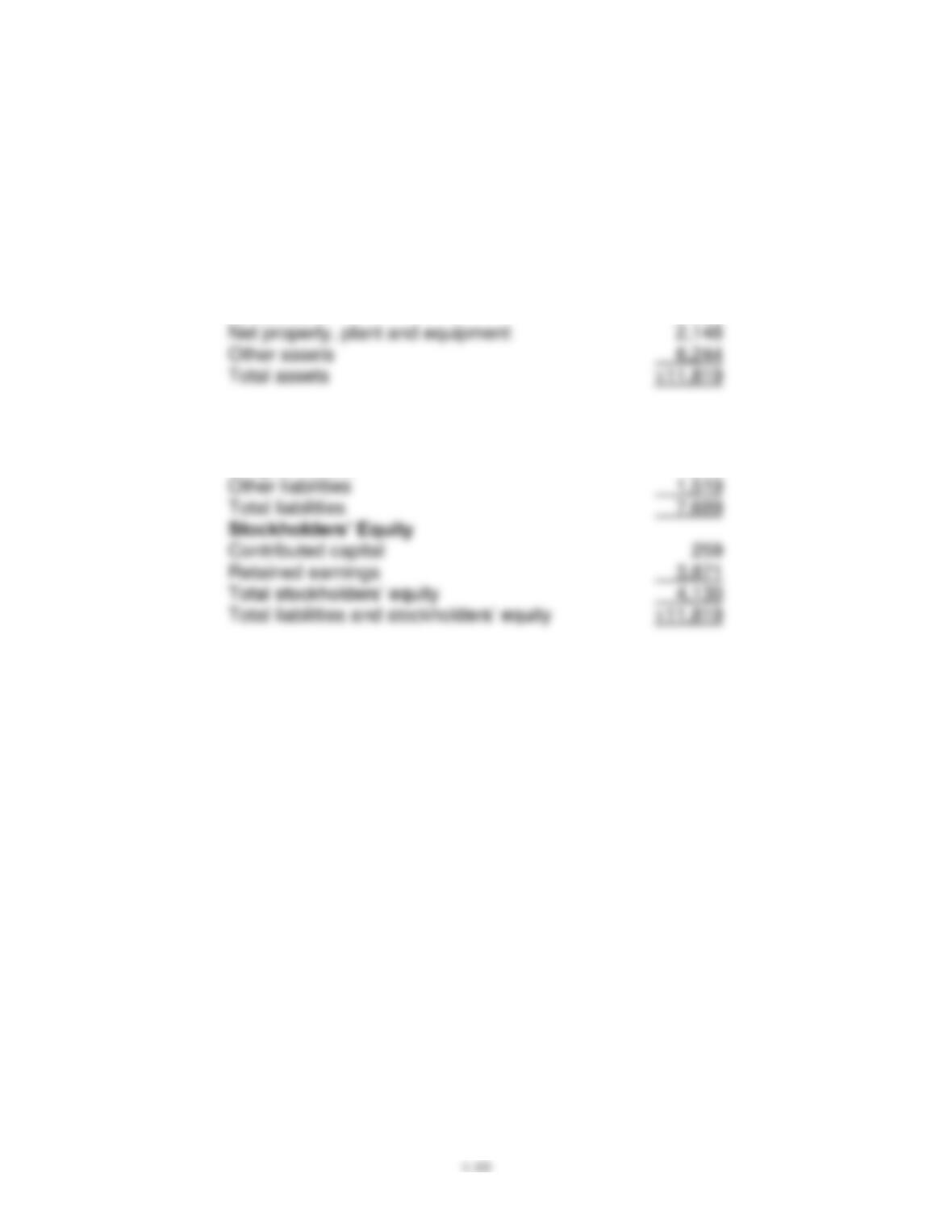
Net property, plant and equipment
Other assets
Total assets
¥11,819
Liabilities
Accounts payable and other current liabilities
¥ 4,237
Long-term debt
1,933
Other liabilities
Total liabilities
Contributed capital
259
Retained earnings
¥11,819
Chapter 01 – Financial Statements and Business Decisions
1-11
E1–5.
Req. 1
NEW WORLD BOOK STORE
Balance Sheet
At December 31, 2011
ASSETS
LIABILITIES
Cash
$68,350
Accounts payable
$12,000
Accounts receivable
39,000
Note payable
3,000
Store and office equipment
72,000
Interest payable
120
Total liabilities
15,120
STOCKHOLDERS’ EQUITY
Contributed capital
140,000
E1–6.
COLLEGE CONNECTION
Income Statement
For the Month of January 2011
Revenues:
Sales: Cash $110,000
On credit 3,000
Total sales revenue $113,000
Expenses:
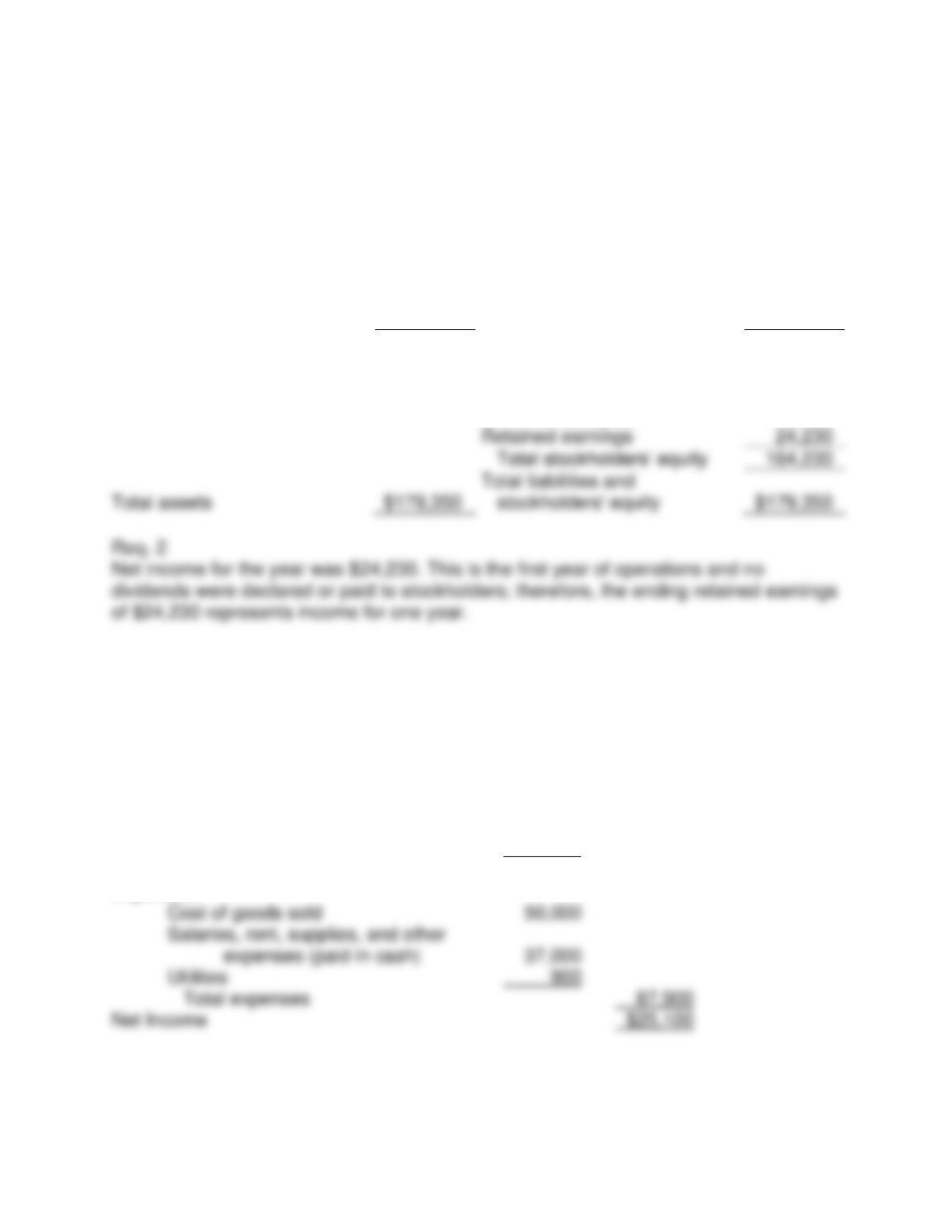
Retained earnings
Total assets
stockholders’ equity
Chapter 01 – Financial Statements and Business Decisions
E1–7.
WALGREEN CO.
Income Statement
For the Quarter ended May 31, 2009
(in millions)
Revenues:
Net sales
$16,210
Total revenues
$16,210
Expenses:
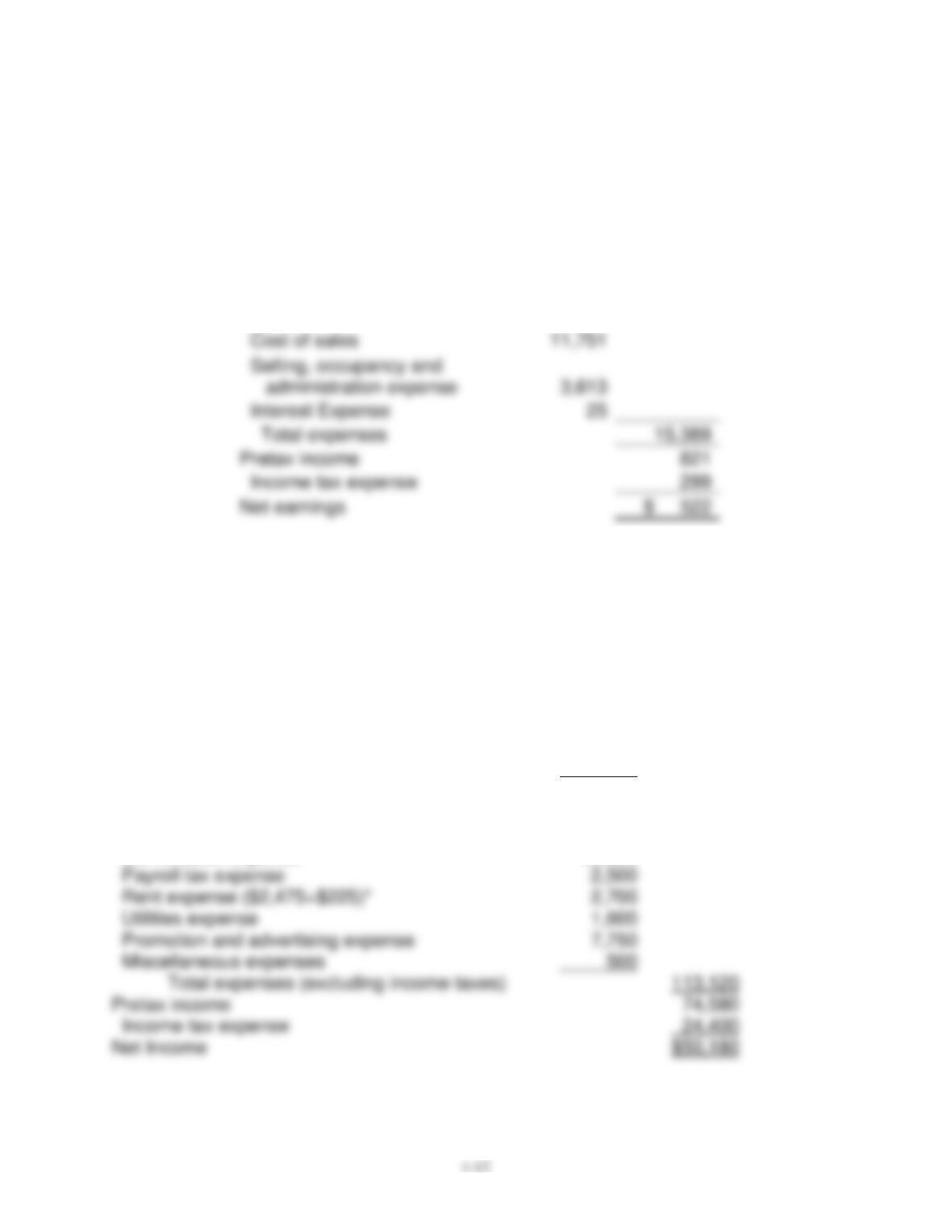
Cost of sales
Interest Expense
Total expenses
Pretax income
Income tax expense
Net earnings
*Note that “Provision for income taxes” is a common synonym for “Income tax
expense.”
E1–8.
NEIGHBORHOOD REALTY, INCORPORATED
Income Statement
For the Year Ended December 31, 2012
Revenues:
Commissions earned ($150,900+$16,800) $167,700
Rental service fees 20,000
Total revenues $187,700
Expenses:
Salaries expense 62,740
Commission expense 35,330
*$2,475 has been paid for 11 months ($225 per month) plus $225 owed for December.
Chapter 01 – Financial Statements and Business Decisions
1-13
E1–9.
Net Income (or Loss) = Revenues – Expenses
Assets = Liabilities + Stockholders’ Equity
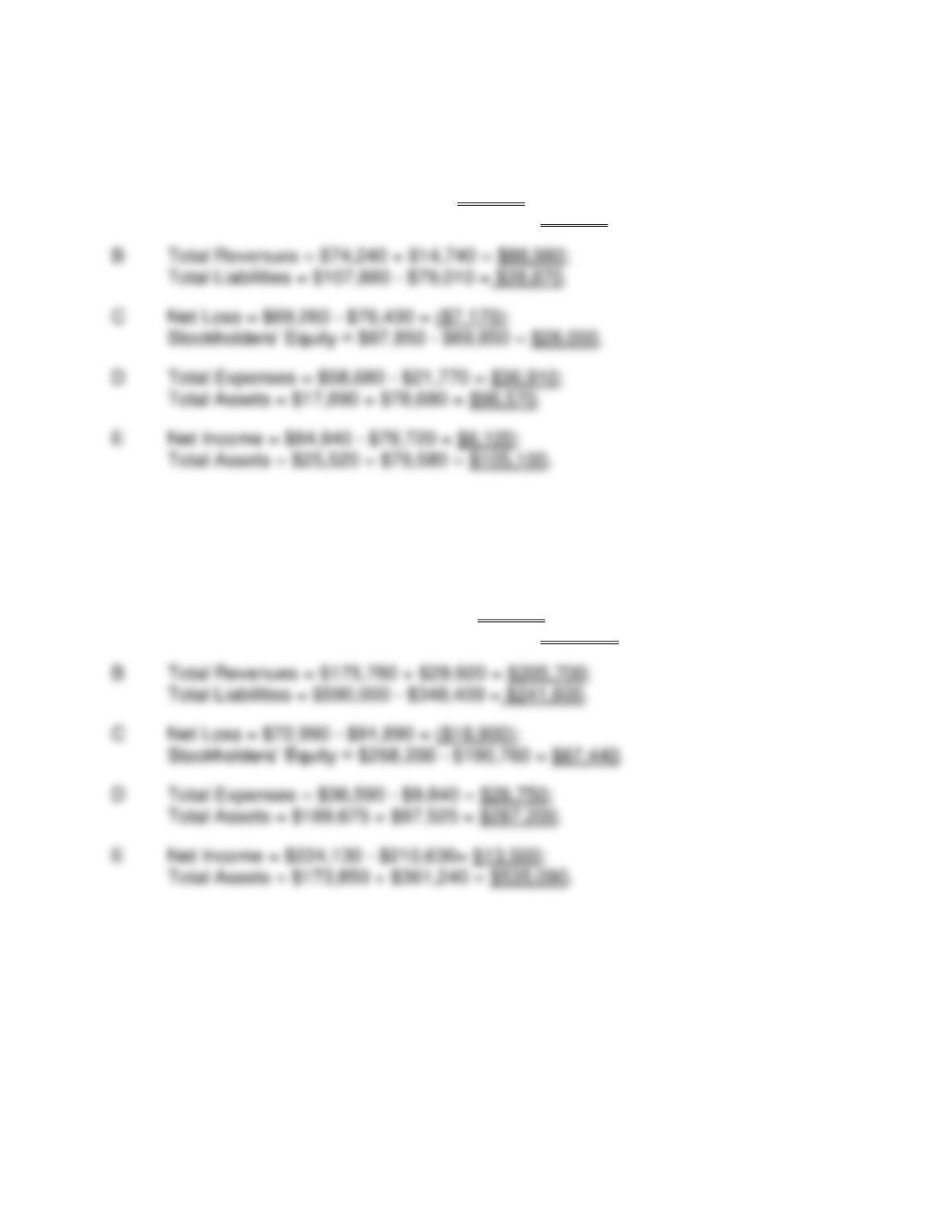
A Net Income = $91,700 – $76,940 = $14,760;
Stockholders’ Equity = $140,200 – $69,000 = $71,200.
E1–10.
Net Income (or Loss) = Revenues – Expenses
Assets = Liabilities + Stockholders’ Equity
A Net Income = $231,820 – $196,700 = $35,120;
Stockholders’ Equity = $294,300 – $75,000 = $219,300.
Chapter 01 – Financial Statements and Business Decisions
E1–11.
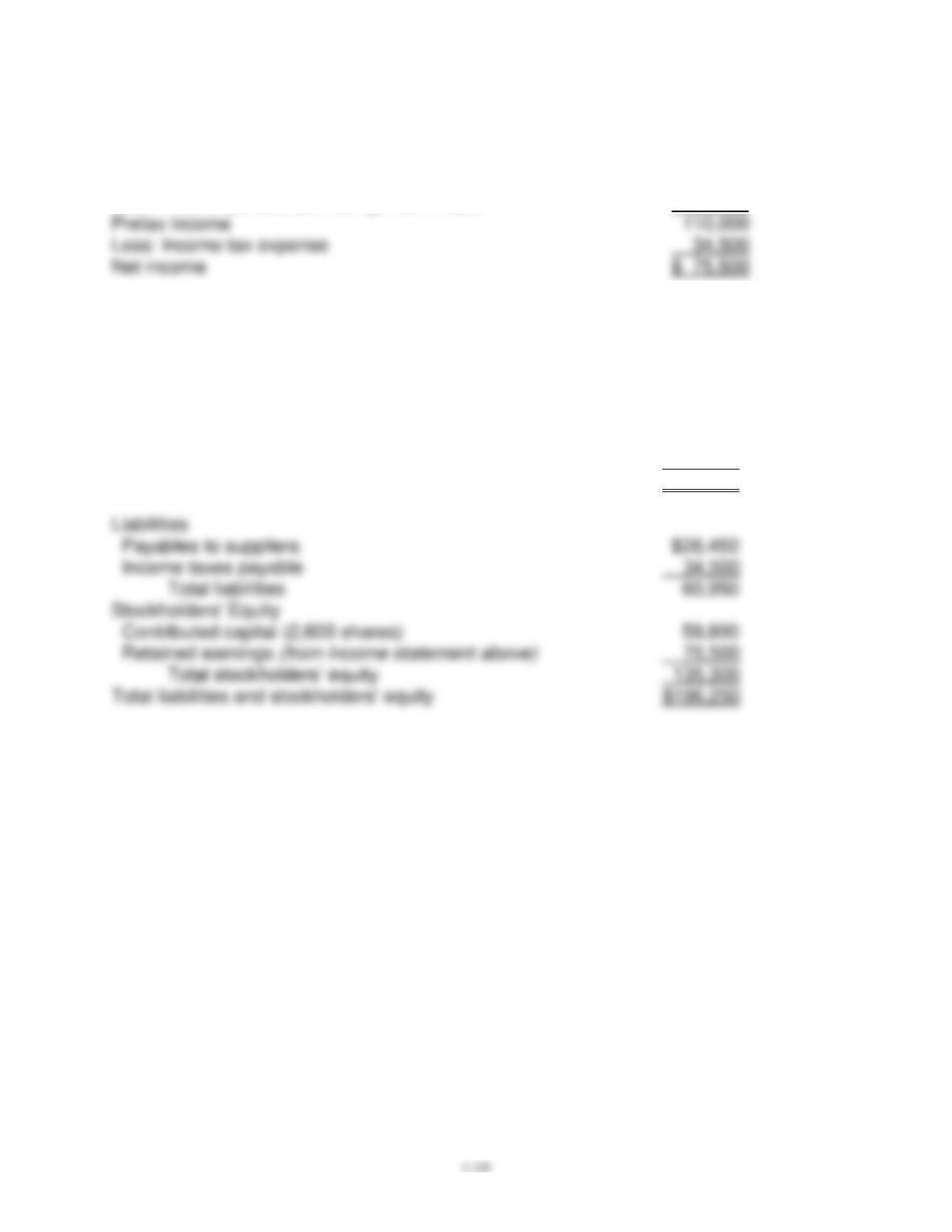
PAINTER CORPORATION
Income Statement
For the Month of January 2011
Total revenues $299,000
Less: Total expenses (excluding income tax) 189,000
PAINTER CORPORATION
Balance Sheet
At January 31, 2011
Assets
Cash $ 65,150
Receivables from customers 34,500
Merchandise inventory 96,600
Total assets $196,250
Chapter 01 – Financial Statements and Business Decisions
E1–12.
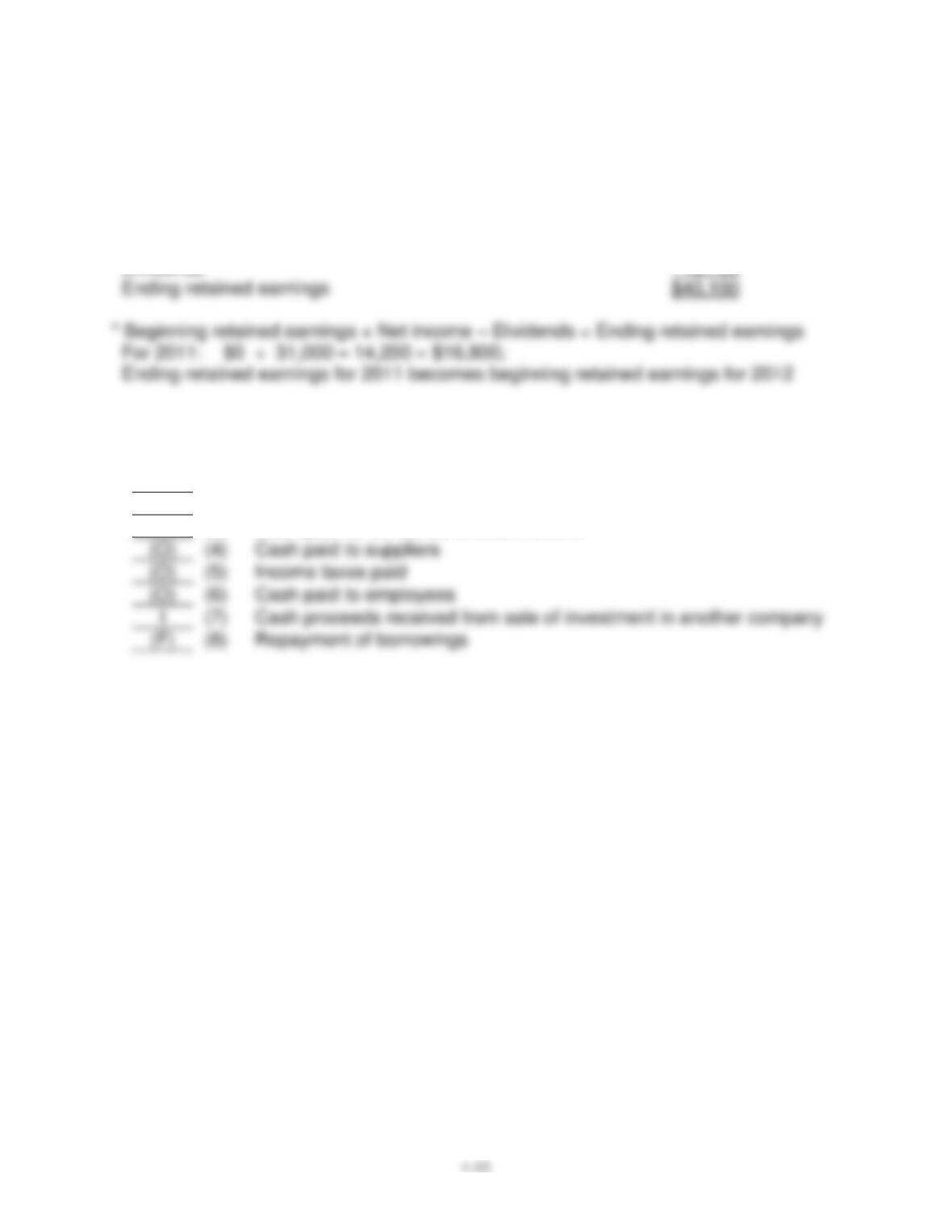
CLINT’S STONEWORK CORPORATION
Statement of Retained Earnings
For the Year Ended December 31, 2012
Beginning retained earnings* $16,800
Net income 42,000
Dividends 18,700
E1–13.
(I)
(1) Purchases of property, plant, and equipment
O
(2) Cash received from customers
(F)
(3) Cash paid for dividends to stockholders
(4) Cash paid to suppliers
(5) Income taxes paid
(6) Cash paid to employees
(7) Cash proceeds received from sale of investment in another company
(F)
(8) Repayment of borrowings