Wild, Shaw, Financial & Managerial Accounting, 8e Solutions Manual: Chapter 1
1
Chapter 1
Accounting in Business
QUESTIONS
1. The purpose of accounting is to provide decision makers with relevant and reliable
2. Technology reduces the time, effort, and cost of recordkeeping. There is still a
demand for people who can design accounting systems, supervise their operation,
3. External users and their uses of accounting information include: (a) lenders, to
measure the risk and return of loans; (b) shareholders, to assess whether to buy,
4. Business owners and managers use accounting information to help answer
questions such as: What resources does an organization own? What debts are
owed? How much income is earned? Are expenses reasonable for the level of
sales? Are customers’ accounts being promptly collected?
5. Service businesses include: Standard and Poor’s, Dun & Bradstreet, Merrill Lynch,
6. The internal role of accounting is to serve the organization’s internal operating
7. Accounting professionals offer many services including auditing, management
advice, tax planning, business valuation, and money management.
8. Marketing managers are likely interested in information such as sales volume,
Wild, Shaw, Financial & Managerial Accounting, 8e Solutions Manual: Chapter 1
2
9. Accounting is described as a service activity because it serves decision makers by
providing information to help them make better business decisions.
10. Some accounting-related professions include consultant, financial analyst,
underwriter, financial planner, appraiser, FBI investigator, market researcher, and
system designer.
13. The objectivity concept means that financial statement information is supported by
independent, unbiased evidence other than someone’s opinion or imagination.
15. The revenue recognition principle provides guidance for managers and auditors so
they know when to recognize revenue. If revenue is recognized too early, the
16. Business organizations can be organized as a sole proprietorship, partnership,
corporation, or LLC. These forms have implications for legal entity and liability,
business life, taxation, and number of owners as follows.
Proprietorship
Partnership
Corporation
LLC
Business entity
yes
yes
yes
yes
Unlimited life
yes
yes
One owner allowed
yes
yes
yes
17. (a) Assets are resources owned or controlled by a company that are expected to
yield future benefits. (b) Liabilities are creditors’ claims on assets that reflect
18. Equity is increased by investments (stock issuances) from the owner and by net
income (which is the excess of revenues over expenses). It is decreased by
dividends and by a net loss (which is the excess of expenses over revenues).
Wild, Shaw, Financial & Managerial Accounting, 8e Solutions Manual: Chapter 1
3
19. Accounting principles consist of (a) general and (b) specific principles. General
principles are the basic assumptions, concepts, and guidelines for preparing
20. Revenue (or sales) is the amount received from selling products and services.
21. Net income (also called income, profit, or earnings) equals revenues minus
22. The four basic financial statements are: income statement, statement of retained
earnings, balance sheet, and statement of cash flows.
26. The balance sheet describes a company’s financial position (types and amounts of
assets, liabilities, and equity) at a point in time.
27. The statement of cash flows reports on the cash inflows and outflows from a
company’s operating, investing, and financing activities.
28. Return on assets, also called return on investment, is a profitability measure that is
useful in evaluating management, analyzing and forecasting profits, and planning
29A. Return refers to income, and risk is the uncertainty about the return we expect to
make. The lower the risk of an investment, the lower the expected return. For
example, savings accounts pay a low return because of the low risk of a bank not
returning the principal with interest. Higher risk implies higher, but riskier, expected
returns.
Wild, Shaw, Financial & Managerial Accounting, 8e Solutions Manual: Chapter 1
31B. An organization’s financing activities (liabilities and equity) pay for investing
activities (assets). An organization cannot have more or less assets than its
32. The dollar amounts in Google’s financial statements are rounded to the nearest
33. The independent auditor for Apple is Ernst & Young, LLP. The auditor expressly
states that “our responsibility is to express an opinion on these financial statements
Wild, Shaw, Financial & Managerial Accounting, 8e Solutions Manual: Chapter 1
QUICK STUDIES
Quick Study 1-1 (10 minutes)
1.
f Technology
Quick Study 1-2 (10 minutes)
a.
E External user
g.
E External user
b.
E External user
h.
E External user
c.
E External user
I Internal user
d.
E External user
E External user
e.
I Internal user
k.
E External user
Quick Study 1-3 (10 minutes)
1. A. Opportunity
Quick Study 1-4 (5 minutes)
1. a. principle
6
Quick Study 1-5 (10 minutes)
Attribute Present
Proprietorship
Partnership
Corporation
LLC
1.
Business taxed
no
no
yes
no
2.
no
no
yes
3.
Legal entity
no
no
yes
Quick Study 1-6 (10 minutes)
1. D. Revenue recognition principle
Quick Study 1-7 (5 minutes)
Assets = Liabilities + Equity
Quick Study 1-8 (10 minutes)
1.
Assets = Liabilities + Equity
$75,000 (a) $35,000 $40,000
2.
Assets =
Liabilities
+ Common
Stock
– Dividends
+ Revenues
– Expenses
Wild, Shaw, Financial & Managerial Accounting, 8e Solutions Manual: Chapter 1
7
Quick Study 1-9 (10 minutes)
a. The accounts and their dollar amounts (in $ millions) for Google are:
(1)
Assets
=
$197,295
$152,502
Quick Study 1-10 (15 minutes)
Assets
=
Liabilities
+
Equity
Cash
+
Accounts
Recble.
=
Accounts
Payable
+
Common
Stock
–
Dividends
+
Revenues
–
Expenses
(a)
$5,500
=
$5,500
Consulting
(b)
+
$4,000
=
+
4,000
Commission
(c)
-1,400
=
–
Wild, Shaw, Financial & Managerial Accounting, 8e Solutions Manual: Chapter 1
8
Quick Study 1-11 (15 minutes)
Assets
=
Liabilities
+
Equity
Cash
+
Supplies
+
Equip.
+
Land
=
Accts.
Pay.
+
Common
Stock
–
Divi-
dends
+
Rev.
–
Exp.
(a)
$15,000
=
$15,000
(b)
–500
+
$500
=
+
=
+
(c)
+
$10,000
=
(d)
+
=
+$200
Quick Study 1-12 (10 minutes)
[Code: Income statement (I), Balance sheet (B), or Statement of cash flows (CF).]
a.
B Balance sheet
e.
B Balance sheet
c.
B Balance sheet
g.
I Income statement
d.
I Income statement
h.
B Balance sheet
Wild, Shaw, Financial & Managerial Accounting, 8e Solutions Manual: Chapter 1
9
Quick Study 1-13 (5 minutes)
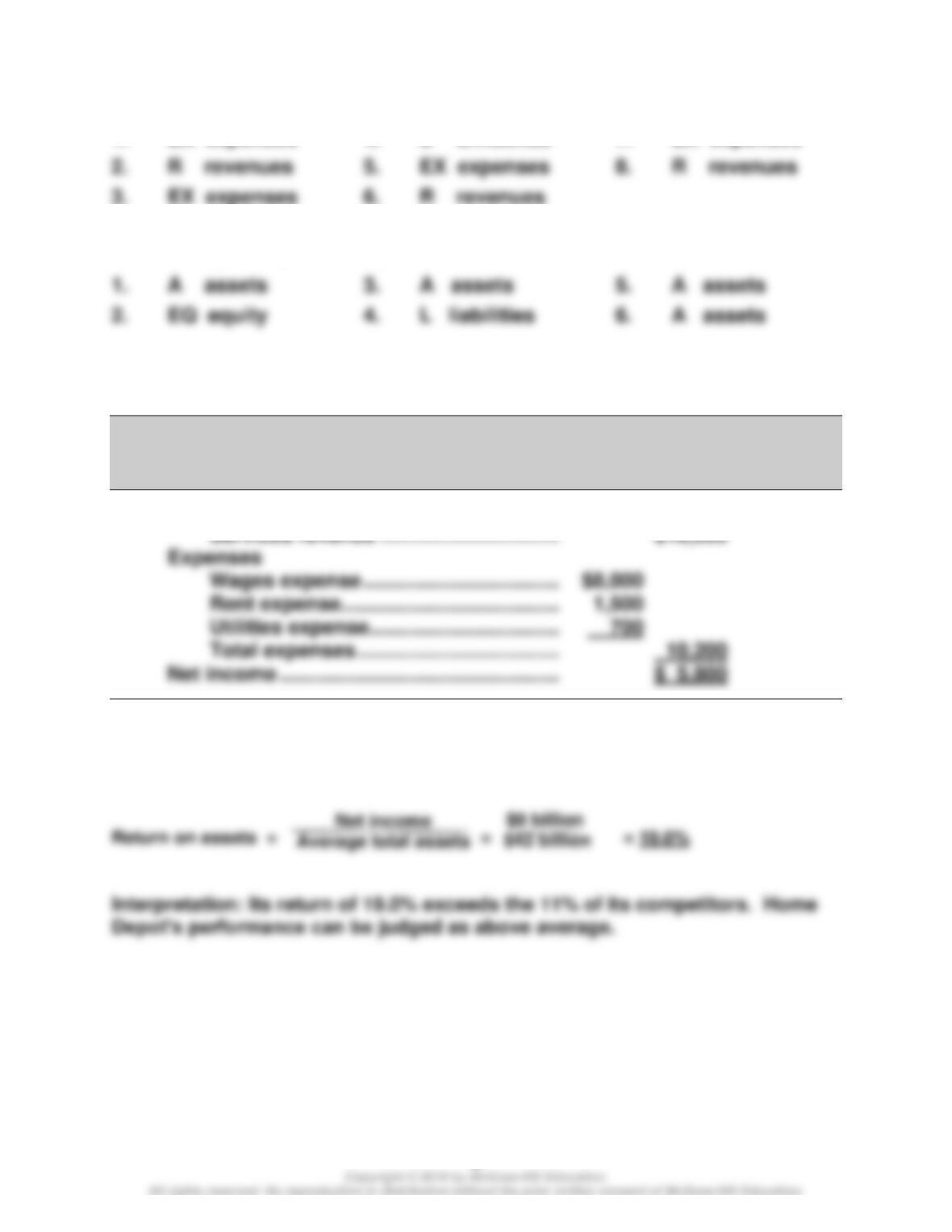
1. EX expenses 4. D dividends 7. EX expenses
Quick Study 1-14 (5 minutes)
Quick Study 1-15 (15 minutes)
HAWKIN
Income Statement
For Month Ended December 31
Revenues
Quick Study 1-16 (10 minutes)
Wild, Shaw, Financial & Managerial Accounting, 8e Solutions Manual: Chapter 1
10
Quick Study 1-17 (10 minutes)
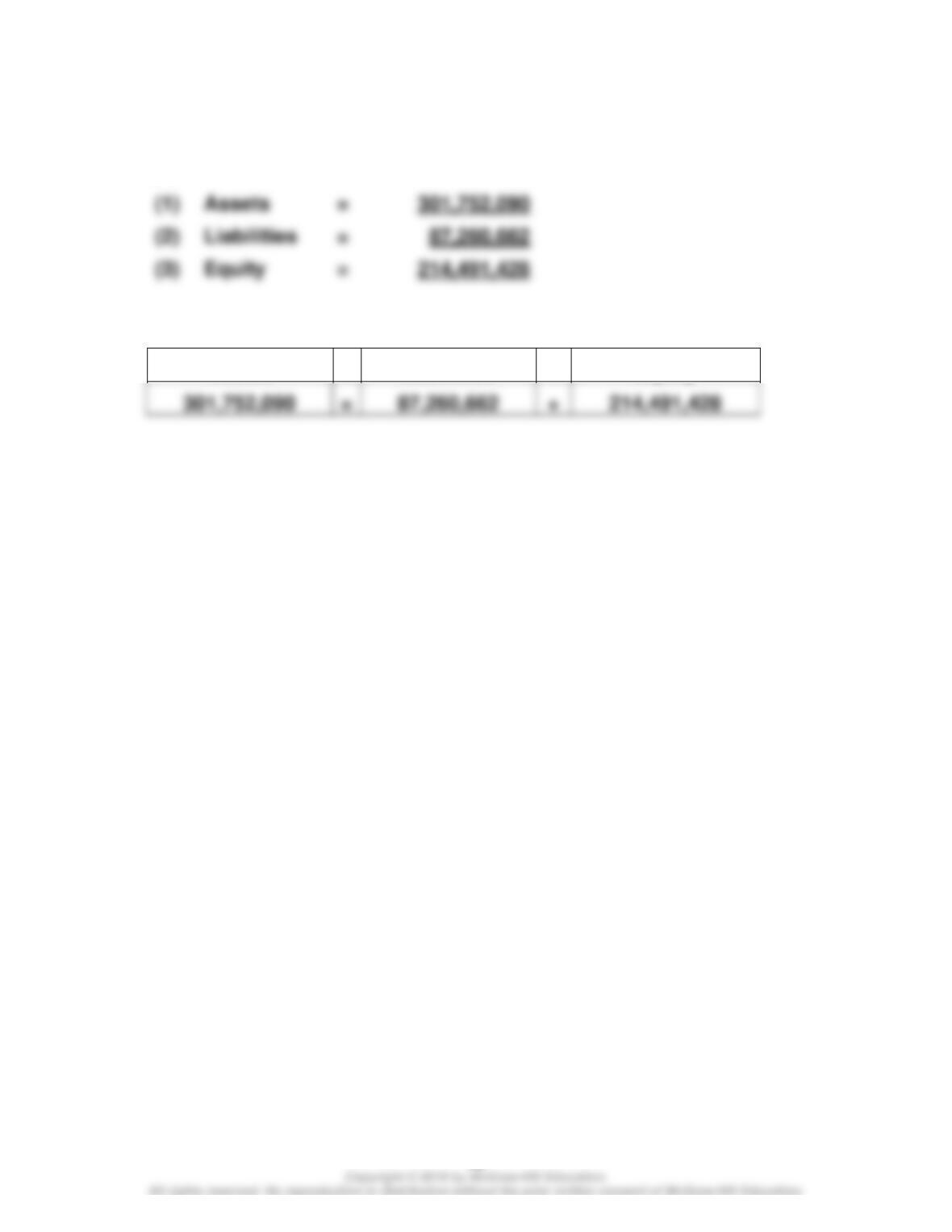
a. The accounts and their dollar amounts (in KRW millions) for Samsung
are:
b. Using Samsung’s amounts from (a) we verify (in KRW millions):
Assets
=
Liabilities
+
Equity
=
+
Wild, Shaw, Financial & Managerial Accounting, 8e Solutions Manual: Chapter 1
EXERCISES
Exercise 1-1 (10 minutes)
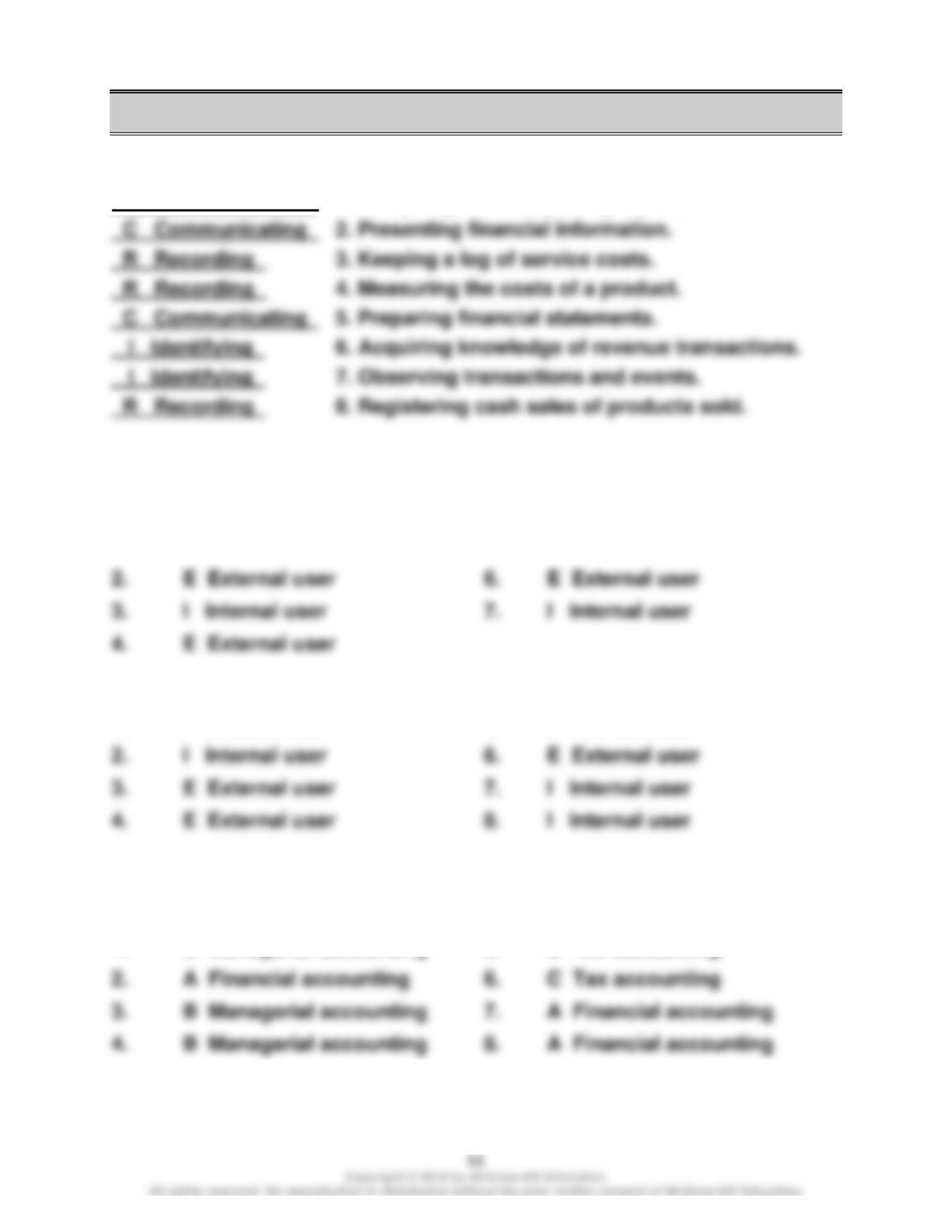
C Communicating 1. Analyzing and interpreting reports.
Exercise 1-2 (20 minutes)
Part A.
1.
I Internal user
5.
I Internal user
2.
6.
3.
I Internal user
7.
I Internal user
4.
Part B.
1.
I Internal user
5.
I Internal user
2.
I Internal user
6.
3.
7.
I Internal user
4.
8.
I Internal user
Exercise 1-3 (10 minutes)
1.
B Managerial accounting
5.
C Tax accounting
2.
6.
3.
B Managerial accounting
7.
A Financial accounting
Wild, Shaw, Financial & Managerial Accounting, 8e Solutions Manual: Chapter 1
Exercise 1-4 (10 minutes)
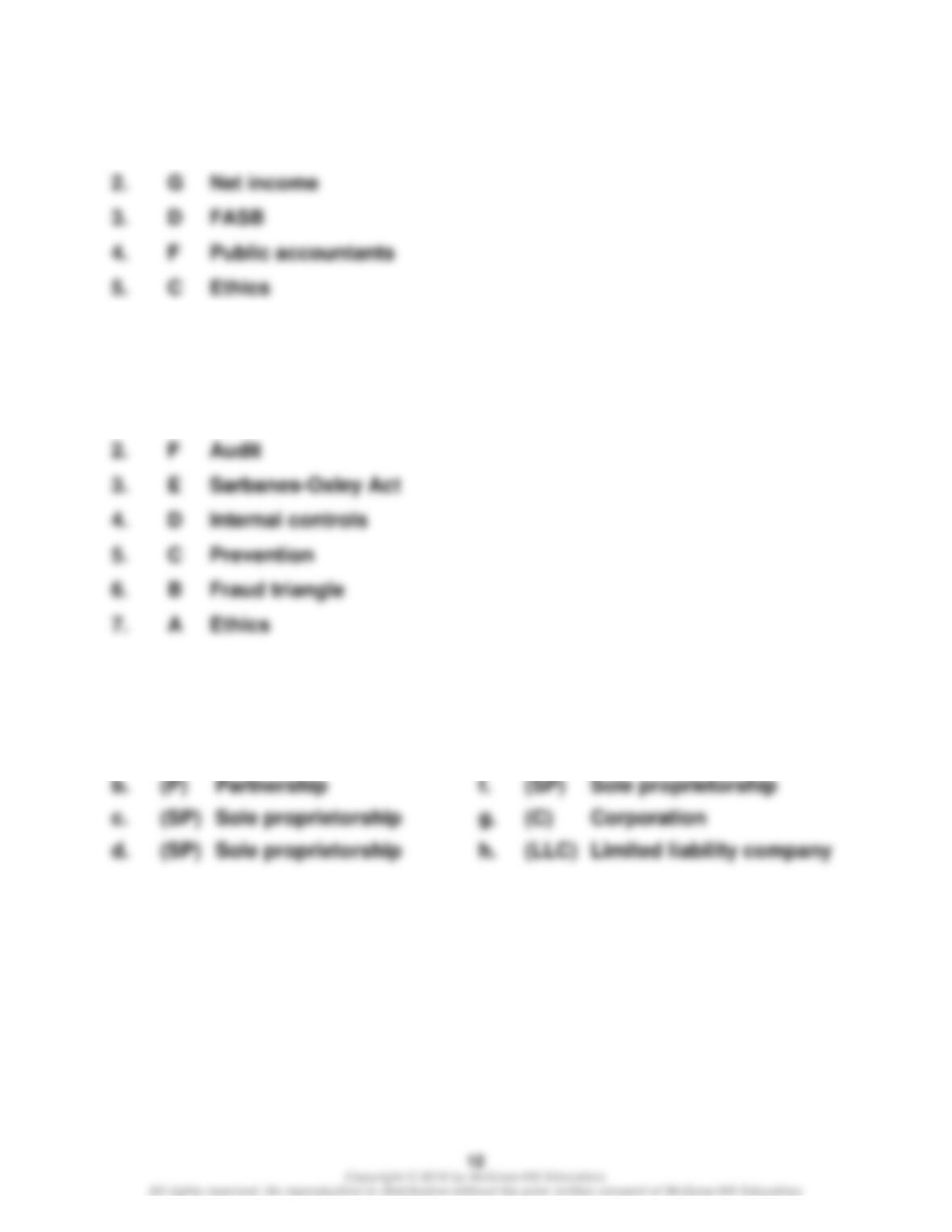
1. A Audit
Exercise 1-5 (20 minutes)
1. G Dodd-Frank Act
Exercise 1-6 (10 minutes)
a.
(C) Corporation
e.
(C) Corporation
c.
(SP) Sole proprietorship
(C) Corporation
Wild, Shaw, Financial & Managerial Accounting, 8e Solutions Manual: Chapter 1
13
Exercise 1-7 (10 minutes)
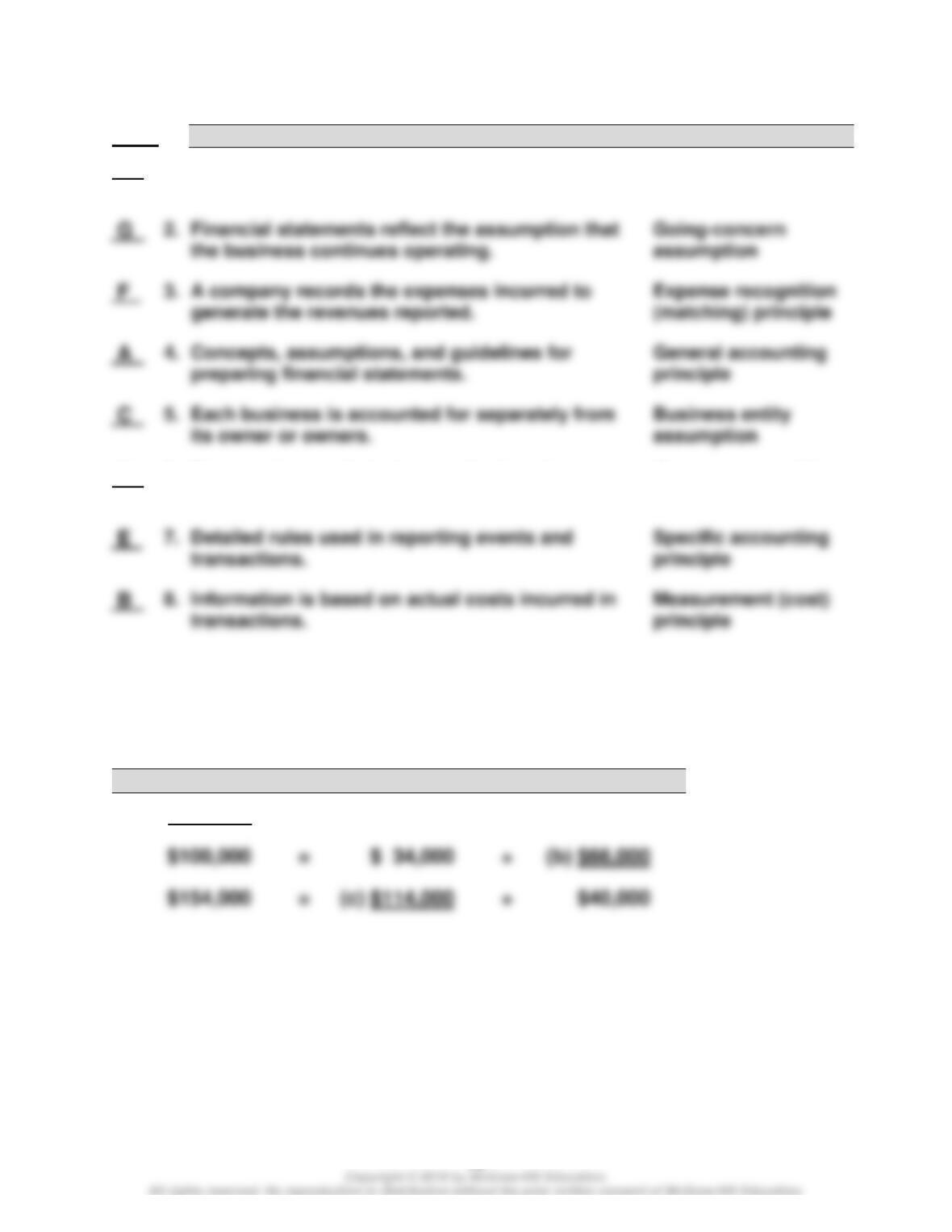
Code
Description
Principle/Assumption
H
1.
A company reports details behind financial
statements that would impact users’ decisions.
Full disclosure
principle
G
Financial statements reflect the assumption that
the business continues operating.
Going-concern
assumption
F
3.
A company records the expenses incurred to
generate the revenues reported.
Expense recognition
(matching) principle
C
5.
its owner or owners.
Business entity
assumption
D
6.
Revenue is recorded when products and
services are delivered.
Revenue recognition
principle
E
7.
Detailed rules used in reporting events and
transactions.
Specific accounting
principle
B
8.
Information is based on actual costs incurred in
transactions.
Measurement (cost)
principle
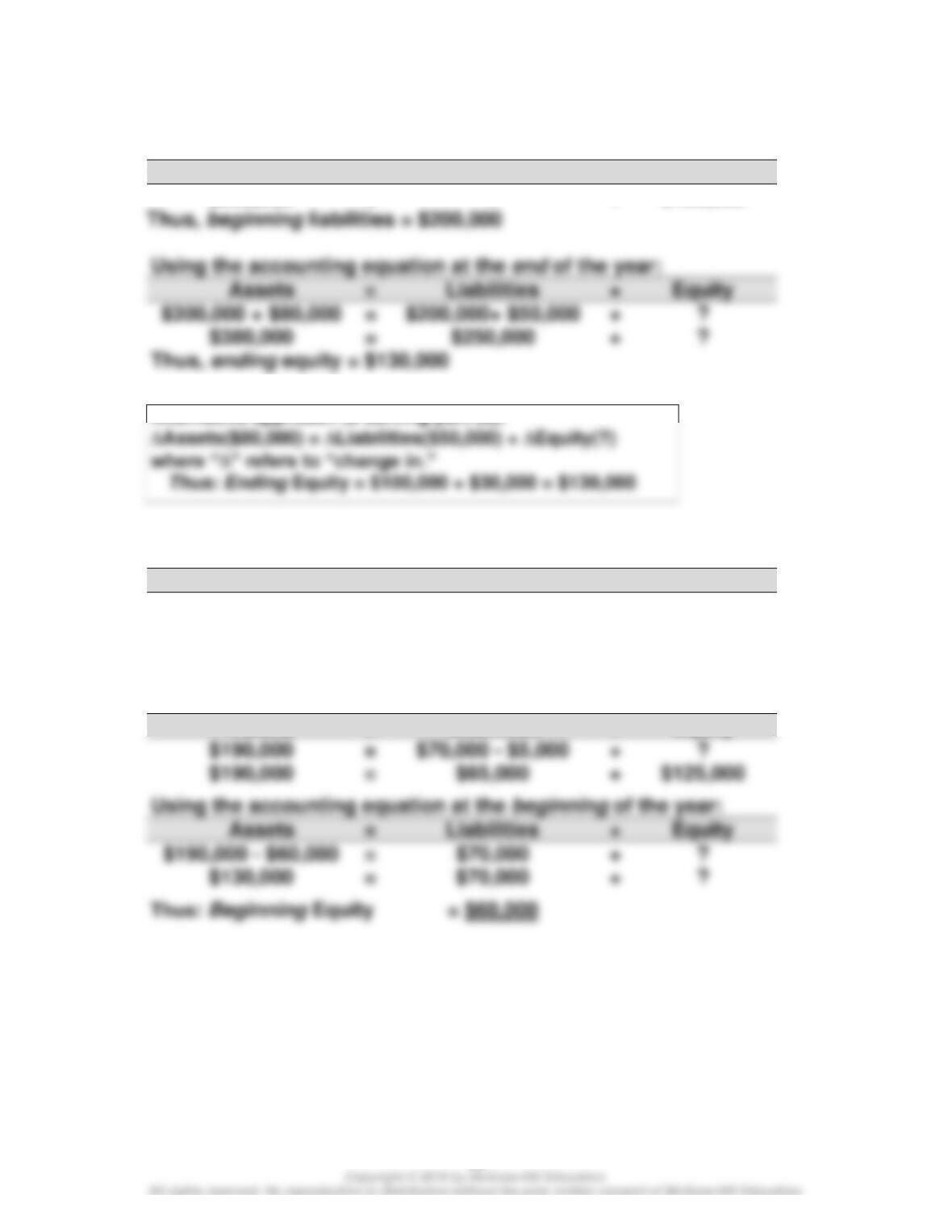
Exercise 1-8 (10 minutes)
Assets
=
Liabilities
+
Equity
(a) $ 65,000
=
$ 20,000
+
$45,000
=
+
$40,000
Wild, Shaw, Financial & Managerial Accounting, 8e Solutions Manual: Chapter 1
14
Exercise 1-9 (20 minutes)
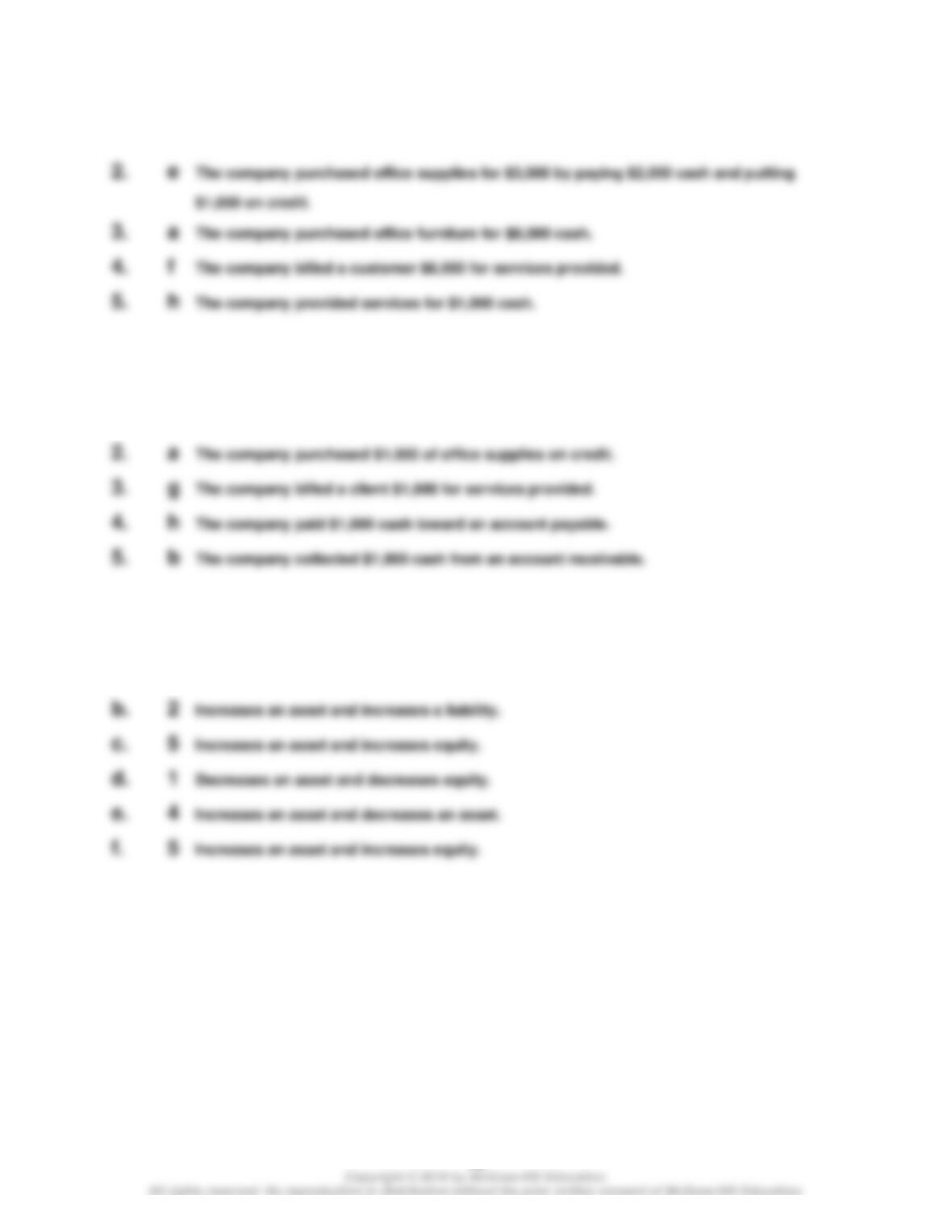
a. Using the accounting equation at the beginning of the year:
Assets
=
Liabilities
+
Equity
$300,000
=
?
+
$100,000
Assets
=
Liabilities
+
Equity
=
+
?
$380,000
=
+
?
Alternative approach to solving part (b):
b. Using the accounting equation:
Assets
=
Liabilities
+
Equity
$123,000
=
$47,000
+
?
Thus, equity = $76,000
c. Using the accounting equation at the end of the year:
Assets
=
Liabilities
+
Equity
$190,000
=
+
?
$190,000
=
$65,000
+
$125,000
Assets
=
Liabilities
+
Equity
=
$70,000
+
?
$130,000
=
$70,000
+
?
Wild, Shaw, Financial & Managerial Accounting, 8e Solutions Manual: Chapter 1
15
Exercise 1-10 (20 minutes)
1. d The owner invested $40,000 cash in the business in exchange for its common stock.
Exercise 1-11 (20 minutes)
1. f The company purchased land for $4,000 cash.
Exercise 1-12 (15 minutes)
a. 3 Decreases an asset and decreases a liability.

Wild, Shaw, Financial & Managerial Accounting, 8e Solutions Manual: Chapter 1
16
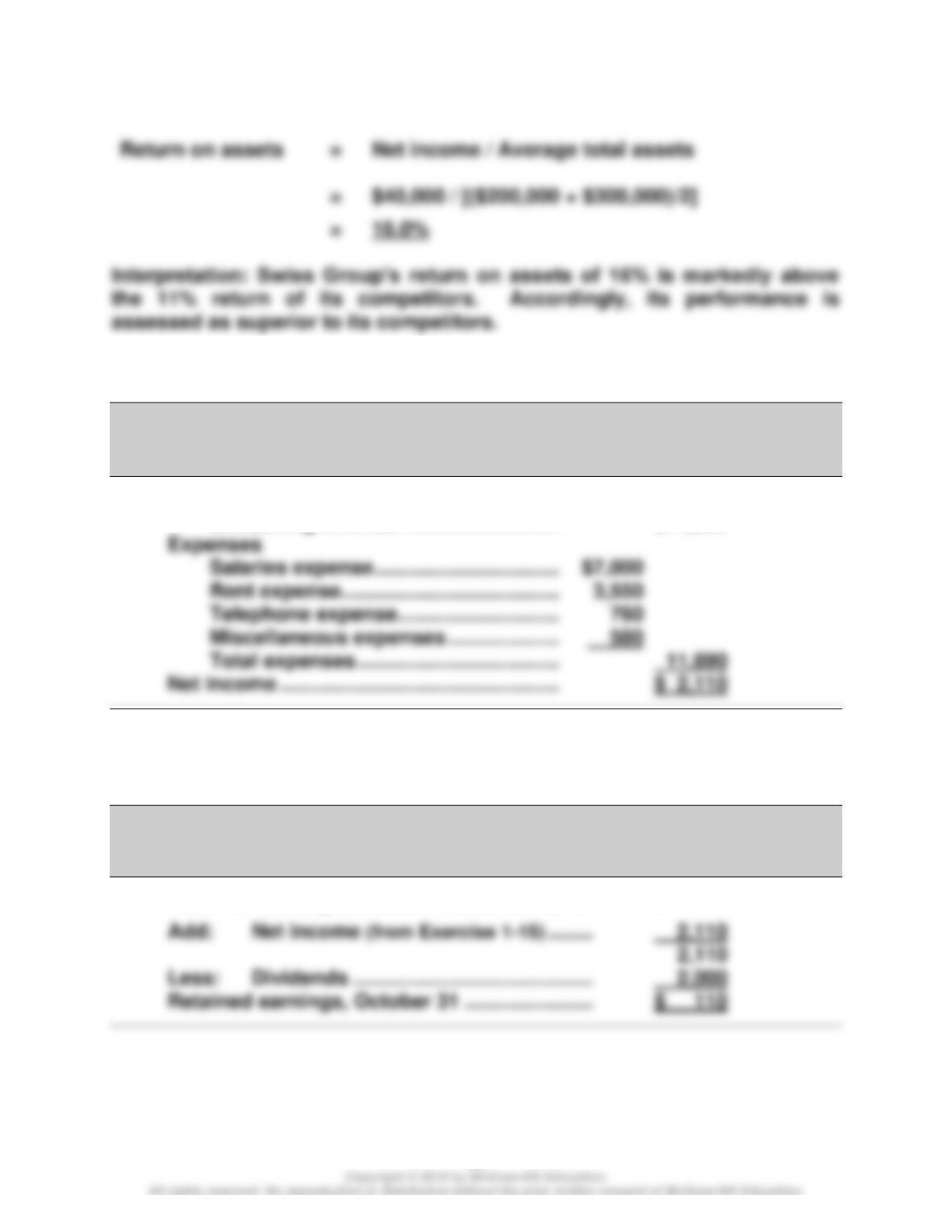
Exercise 1-13 (30 minutes)
Assets
=
Liabilities
+
Equity
Cash
+
Accounts
Receivable
+
Equip-
ment
=
Accounts
Payable
+
Common
Stock
–
Divi-
dends
+
Revenues
–
Expenses
a.
+$60,000
+
$15,000
=
+
$75,000
b.
– 1,500
______
______
–
$1,500
Bal.
58,500
+
+
15,000
=
+
75,000
–
1,500
c.
_______
+
10,000
______
_____
Bal.
58,500
+
+
25,000
=
10,000
+
75,000
–
1,500
d.
+ 2,500
______
_______
______
+
$2,500
_____
Bal.
61,000
+
+
25,000
=
10,000
+
75,000
+
2,500
–
1,500
e.
_______
+
______
_______
______
+
8,000
_____
Bal.
61,000
+
8,000
+
25,000
=
10,000
+
75,000
+
10,500
–
1,500
– 6,000
______
+
_______
______
_____
_____
Bal.
55,000
+
8,000
+
31,000
=
10,000
+
75,000
+
10,500
–
1,500
g.
– 3,000
______
______
_______
______
_____
–
3,000
Bal.
52,000
+
8,000
+
31,000
=
10,000
+
75,000
+
10,500
–
4,500
h.
+ 5,000
–
5,000
______
_______
______
_____
_____
Bal.
57,000
+
3,000
+
31,000
=
10,000
+
75,000
+
10,500
–
4,500
– 10,000
______
______
______
_____
_____
Bal.
47,000
+
3,000
+
31,000
=
0
+
75,000
+
10,500
–
4,500
______
______
_______
______
$1,000
_____
_____
Wild, Shaw, Financial & Managerial Accounting, 8e Solutions Manual: Chapter 1
17
Exercise 1-14 (10 minutes)
Exercise 1-15 (15 minutes)
ERNST CONSULTING
Income Statement
For Month Ended October 31
Revenues
Consulting revenue ………………………. $14,000
Exercise 1-16 (15 minutes)
ERNST CONSULTING
Statement of Retained Earnings
For Month Ended October 31
Retained earnings, October 1 ……………………. $ 0
Wild, Shaw, Financial & Managerial Accounting, 8e Solutions Manual: Chapter 1
18
Exercise 1-17 (15 minutes)
ERNST CONSULTING
Balance Sheet
October 31
Assets Liabilities
Cash …………………………. $11,360 Accounts payable …………….. $ 8,500
Exercise 1-18 (15 minutes)
ERNST CONSULTING
Statement of Cash Flows
For Month Ended October 31
Cash flows from operating activities
Cash received from customers …………………………………….. $ 0
Cash paid to employeesa ……………………………………………… (1,750)
Cash flows from financing activities
Cash investments from shareholders …………………………... 38,000
Cash dividends to shareholders …………………………………… (2,000)
Wild, Shaw, Financial & Managerial Accounting, 8e Solutions Manual: Chapter 1
19
Exercise 1-19 (10 minutes)
I 1. Cash purchase of equipment O 5. Cash paid on account payable
Exercise 1-20 (20 minutes)
Ford Motor Company
Income Statement
For Year Ended December 31
($ millions)
Revenues …………………………..……………………………….. $151,800
Exercise 1-21B (10 minutes)
a. Financing An owner contributes cash to the business in exchange for its common stock.
Assets
=
Liabilities
+
Equity
?
=
+
$40,000
?
=
$66,000
+
$40,000
Exercise 1-22 (15 minutes)
BMW GROUP
Income Statement
For Year Ended December 31
(Euros in millions)
Revenues …………………………..……………………………….. € 75,350
Exercise 1-23 (15 minutes)
a. Using the accounting equation on January 1:
Assets
=
Liabilities
+
Equity
?
=
$60,000
+
$40,000