P a g e | 59
proportions. By contrast to Valeant’s customers, Coca Cola customers choose to imbibe or not:
they are not forced to use company products by circumstances beyond their control. That is not
to say that they may not be ignorant of the health effects and may be addicted to sugar and
other health-pernicious ingredients, but consumers may be able to overcome those problems
Warren Buffett, through his investment company Berkshire Hathaway, owns 9% of Coca-Cola.
He says he loses no sleep over possible negative health effects of the products. In fact, he says
he “…checked the actuarial tables, and the lowest death rate is among six-year-olds. So [he]
decided to eat like a six-year-old.” In addition to loving coke, eating ice cream for breakfast and
potato sticks as snacks, the octogenarian also says, “If I eat 2700 calories a day, a quarter of that
is Coca-Cola. I drink at least five 12-ounce servings. I do it every day.” (Sellers 2015)
2. From a business standpoint, what is the most significant loss that could occur to each of Valeant and
Coca Cola as a result of their business models?
In the medium and longer term, reputation loss leading to profit loss, could be each company’s
biggest problem. With it, end users may choose product substitution, if they can.
P a g e | 60
3. Based on your assessment of the two business models, what would you do if you owned shares in
each company: Continue to hold? Sell? Something else? What was your reasoning for the action
chosen?
A) If you hold Valeant shares, you have already lost most of their value. If you believe that the
company has learned its ethics lesson, still has reasonable growth prospects, and may be
temporarily depressed by adverse publicity, then you might want to continue to hold. If not,
4. Review the incentive remuneration disclosures in Valeant’s Securities Exchange Commission (SEC)
Tayan, 2016). Were the incentive arrangements with Valeant’s CEO, Michael Pearson, appropriate?
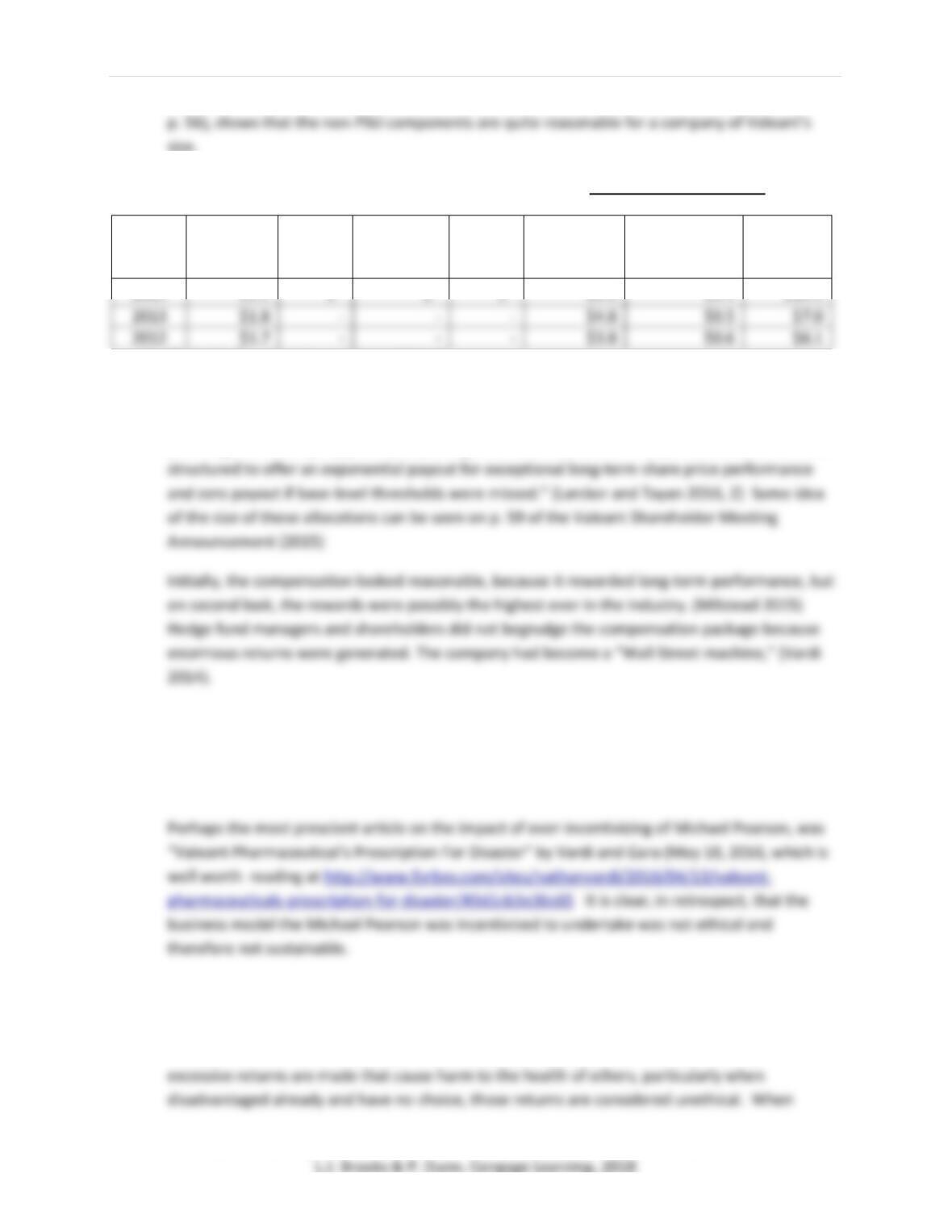
Pearson’s remuneration was dominated by performance stock unit (PSUs) awards that dwarfed
the salary, non-equity incentives, and other compensation received. The following table,
P a g e | 61
Business & Professional Ethics for Directors, Executives & Accountants, 8e
Chair and CEO Michael Pearson’s Compensation, 2012 to 2014 (No PSU Awards Included)
Year
Salary
(Millions)
Bonus
Stock
Awards
Option
Awards
Non-Equity
Incentive
Plan
All Other
Compensation
Total
2014
$1.9
$ –
$ –
$ –
$8.0
$0.4
$10.3
Modified table from (Larcker and Tayan 2016, 5)
However, Pearson’s remuneration was also based on performance stock (PSU) award
agreements signed in 2008, 2011, and 2015 that specified very large stock awards provided 3-
year targets for company profitability and growth were achieved: “The performance units were
How the returns were generated was not really sustainable, however: the company could not
remain a going—or growing concern with its business model for wealth, not health.
Executives—particularly Pearson, a major shareholder—were becoming very rich, but society
wasn’t becoming better off, so the compensation does not seem appropriate.
5. How much of a price increase for Isuprel and Nitropress would have been considered reasonable,
and would not have attracted negative attention?
Companies need to make reasonable returns on their capital to remain viable. But when
P a g e | 62
Business & Professional Ethics for Directors, Executives & Accountants, 8e
Useful Articles, Links, and Videos
Esterl, Mike, and Joann S. Lublin. (October 1, 2014). “Coke Scales Back Executive Equity Compensation,
Bowing To Pressure: Beverage Giant Looks to Pacify Investors, Including Buffett, Who Called Pay
Larcker, David F., and Brian Tayan (April 28, 2016). “CEO pay at Valeant: Does extreme compensation
create extreme risk?” Stanford Closer Look Series,
Milstead, David (July 30, 2015). “Valeant’s $3-billion man: CEO’s big bet pays off.” Globe and Mail,
(accessed October 25, 2016).
Petroff, Alanna (October 17, 2016). “Pepsi gets aggressive on cutting sugar.” CNN Money,
Petroff writes that “…two-thirds of [Pepsi’s] single serving drinks will have 100 or fewer calories
by 2025 as it cuts back on sugar. Currently [2016], less than 40% of its drinks have 100 calories
or fewer.” In addition, the company says it will reduce saturated fat and sodium in its snack
products.
Rockoff, Jonathan D., and Ed Silverman (April 26, 2015). “Pharmaceutical Companies Buy Rivals’ Drugs,
P a g e | 63
Business & Professional Ethics for Directors, Executives & Accountants, 8e
L.J. Brooks & P. Dunn, Cengage Learning, 2018
Sellers, Patricia (February 25, 2015). “Warren Buffett’s secret to staying young: ‘I eat like a six-year-old.'”
2016).
Valeant Pharmaceuticals international, Inc. (April 9, 2015). “Schedule 14A Information” (Notice of
Annual Meeting of Shareholders May 19, 2015), United States Securities and Exchange
Commission,
Vardi, Nathan (April 22, 2014). “Bill Ackman Outs Valeant CEO Mike Pearson As A Billionaire.” Forbes,
Business & Professional Ethics for Directors, Executives & Accountants, 8e
18. Betaseron (A) (Chapter 1, pages 59-60)
What this case has to offer
Betaseron A is a terrific case for breaking the ice with a class, and for getting them to start thinking
about business ethics problems in a real-life setting. Specifically, they will have to wrestle with:
• the role of a corporation – is it to make profit, how much, how
Teaching suggestions/Major ethical issues
I usually advise the students that the case is based on a real-life problem, and one that pharmaceutical
companies face continuously. I then write three headings on the board to facilitate keeping track of
suggestions and the discussion on the problems identified at the end of the case: pricing, distribution of
I then put forward that, if the company were to charge $50,000 for a 12-month dosage of Betaseron, the
limited supply would be enough to serve the market. I ask if this isn’t the right approach for the
company if its role is to maximize profit. A lively discussion ensues and usually turns into a discussion of
how much profit is enough. We then turn to the issues of enhancing supply, and of fair, cheap
distribution. Opinions differ and we cover such issues as: should the company care; legal realities
The author, Ann Buchholtz, who is now at the University of Georgia, has an excellent teaching note on
the A and B cases:
P a g e | 65
THE BETASERON® DECISION (B)
Dr. Ann Buchholtz, University of Georgia
On August 20, 1993, Berlex announced its distribution and price plan for Betaseron® and
sent a letter to all U.S. neurologists detailing its pricing and distribution.
• Persons who have either commercial medical insurance or an annual family
income of more than $50,000 would pay $1000 per month. However, to
encourage strict compliance to the treatment regimen, Berlex would give
patients two months of the drug free of charge after ten consecutive months of
To minimize out–of-pocket expenses, Berlex developed the Betaseron® Card which
would identify patients to pre-chosen pharmacies and provide information about their
payment program and price. Qualified patients would receive interest-free deferred
payment for up to 55 days. This was intended to enable most patients to pay their bills
after they received reimbursement. The card was provided through a financial
Initial access to the drug was determined by a lottery, designed to provide equal access
to the initially limited supply. Physicians who wished to obtain Betaseron® for their
patients enrolled them in the program during an open registration period from August
23 to September 15, 1993. At the conclusion of the registration period, patients were
assigned a randomly generated number. Patients who registered for the drug after the
close of registration were put at the end of the list on a first-come, first-served basis.
Business & Professional Ethics for Directors, Executives & Accountants, 8e
19. Magnetic Toys Can Hurt (Chapter 1, pages 60-61)
What this case has to offer
This case offers an opportunity to discuss a poorly handled hazardous products case, consider the rights
Teaching suggestions
The discussion might begin by asking the class whether Mega Brands acted properly or not, and why.
They should raise the following:
• Lack of co-operation with the U.S. Consumer Products Safety Commission (CPSC):
o Delays in providing info
Discussion of Ethical Issues
1. If you were an executive of Mega Brands, what concerns would you express to the CEO about the
Magnetix Toy issues noted above?
• The rights of the victims and their families, our employees (some of whom will leave) who
will see their reputations tarnished by association, our distribution channel partners and
System flaws
• no recording, analysis and risk assessment of complaints
P a g e | 67
Business & Professional Ethics for Directors, Executives & Accountants, 8e
Practice flaws
• denial of responsibility
2. If the CEO didn’t pay any attention, what would you do?
• Report the matter to the company’s Board through the Governance and/or Audit
3. Should the CPSC have more powers to deal with such hazards and companies? If so, what would
they be? If not, why not?
• Yes, because companies now seem to be able to ignore sound requests from authorities.
Useful Articles, Links, and Videos
Consumer Reports (April 14, 2009). “Mega Brands fined $1.1 million for failing to report Magnetix
Morgenson, Gretchen (July 15, 2007) “Toy Magnets Attract Sales, and Suits.” New York Times,

P a g e | 68
Business & Professional Ethics for Directors, Executives & Accountants, 8e
“In the News: Magnetix” (2007, 2009). Chicago Tribune, (Feature Article Collections on Mega Brands)
P a g e | 69
Business & Professional Ethics for Directors, Executives & Accountants, 8e
20. Bausch & Lomb’s Hazardous Contact Lens Cleaner (Chapter 1, pages 61-62)
What this case has to offer
Most companies do not react effectively and quickly enough to an ethical crisis, particularly over a
hazardous product discovery, so the case offers the opportunity to engage students to illustrate the:
• dangers of ignoring or minimizing the potential problems, and the motivations for doing so,
Teaching suggestions
To get the class discussion started, I ask the class to vote on whether the role of modern corporations
ought to be to maximize profit, or to serve the interests of all its stakeholders including shareholders.
The case will lead them to see that the second objective may (and we hope will) lead to the first, but
before they realize that divide the class into two groups for discussion purposes – one to take the role of
the CEO, Ron Zarrella who has acted in what he thinks is the best interest of the shareholders, and the
other to take the role of the victims and their families.
P a g e | 70
Business & Professional Ethics for Directors, Executives & Accountants, 8e
The class should be asked if there was anything that should have been done more quickly that happened
in real life that could/should have been done earlier to assist in the CEOs decision. This will lead to a list
such as:
• press for early information on anomalous information (Hong Kong issue and Renu’s 5 times
higher infection than competitors).
• implement an online complaint system to enable early warnings to be received, and follow-up
on complaints when they are reported.
Discussion of ethical issues
1. What lessons should be taken from B & L’s Renu experience?
2. What should Zarrella have done and when?
See above
Useful Articles, Links, and Videos
Smith, Aaron (April 27, 2006). “Bausch sold ReNu in US knowing problems in Asia.” CNNMoney,
Pettypiece, Shannon (April 14, 2006). “Bausch & Lomb Ads Apologize to Consumers on Cleaner.”

P a g e | 71
Business & Professional Ethics for Directors, Executives & Accountants, 8e
Dobbin, Ben (March 15, 2010). “New CEO, Chairman appointed at Bausch & Lomb.” Associated Press,
Walsh Juliann and Duncan Moore (April 12, 2006) “Bausch & Lomb Isn’t Recalling Contact Lens Cleaner.”
Bloomberg
P a g e | 72
Business & Professional Ethics for Directors, Executives & Accountants, 8e
Accounting & Auditing Cases
21. Where Were the Accountants? (Chapter 1, pages 62-63)
What this case has to offer
This case was designed to raise questions about two major scandals (the S&L crisis and BCCI) and one
Teaching suggestions and discussion
This case is a good one to assign students to do some research in advance on the S&L crisis and on the
BCCI scandal. For the former I would refer them to Management Accounting, February 1993, and for
I then ask why didn‘t accountants recognize the potential of the problem earlier and speak out. The
answer revolves around self-interest, and lack of understanding of the potential downside. For instance,
accountants should have known and probably did know about the financial uncertainty of the S&L’s but
hoped that the fortunes would turn around and all would be well. It was not in the short-term self-
interests of accountants involved as auditors or as management personnel to blow the whistle too
loudly. Jobs and/or clients would have been lost. The motivation for non-disclosure of the BCCI fraud is
probably similar, although it was finally brought to light by a report of the firm’s auditors in Great
P a g e | 73
Business & Professional Ethics for Directors, Executives & Accountants, 8e
Useful Articles, Links and Videos
Beaty, Jonathan and Gwynne, S.C. (July 29, 1991). “B.C.C.I.: The Dirtiest Bank of All.” Time,
Epstein, Marc J., (February, 1993), “Accountants and the S&L crisis”, Management Accounting, see
Roohani, Saeed, Knight, Lee, and Knight, Ray (January 1, 1994). “S&L Crisis: A learning experience for
accountants.” Journal of Bank Cost & Management Accounting 7 (3),
The Senate Committee on Foreign Relations heard testimony into the Bank of Credit and Commerce
International scandal and its effects on U.S. financial and security interests. Additional testimony
See also: “BCCI Investigation Day 2 Part I” C-Span US Senate Aug. 2, 1991 http://www.c-
P a g e | 74
Business & Professional Ethics for Directors, Executives & Accountants, 8e
22. To Resign or Serve? (Chapter 1, pages 63–64)
What this case has to offer
This case combines the facts of two real-life situations. It offers the opportunity to:
1. Work with the stakeholder concept,
2. Reason through two business arrangements to produce the best accounting disclosure of the
Due to placement of this case in Chapter 1, the discussion of ethical issues and ethical decision
frameworks will not be as well developed as it would be if the case were used after the material in
Chapter 4 were dealt with.
Teaching suggestions
Just for fun, I take a vote of the class at the outset to see how many students think that resignation was
appropriate, and how many would be prepared to take on the audit after the incumbent had resigned.
I believe that the business arrangement put forward in the case need to be understood before the ethics
Based on this understanding, the students can specify who are the stakeholders involved and what their
interests are, including:
• Current shareholders – accurate portrayal of reality as a basis for decisions, but higher rather
than lower profits
P a g e | 75
Business & Professional Ethics for Directors, Executives & Accountants, 8e
The conflicts in interest which show up in this listing should be underscored with the students because
they are at the root of most ethical problems, and they provide a framework for deciding how to best
disclose the transactions flowing from the two business arrangements.
Discussion of important issues
Renegotiation of overdue loans to call them current
For this to be substantive rather than just form, the collectability of the loans has to be improved and
Use of insurance against non-collectability
This approach is not new, but the familiarity of the insurer to the nature of risk involved, and the
Persuasion vs. qualification vs. Resignation
Customarily, as in the case, an auditor who believes statements should be changed or unfair
presentation will result calls for a meeting with the management and/or the Audit Committee of the
Courtesy to among auditors/Protection of shareholders and auditor’s interests
P a g e | 76
Business & Professional Ethics for Directors, Executives & Accountants, 8e
Codes of conduct for auditors usually provide that incoming auditors contact out-going auditors to
advise them of their appointment and to ask whether they had any problems with the client to advise