Alternate Exercises and Problems 9–1
Chapter 9 Inventories: Additional Issues
EXERCISES
Exercise 9-1
Requirement 1
(1)
(2)
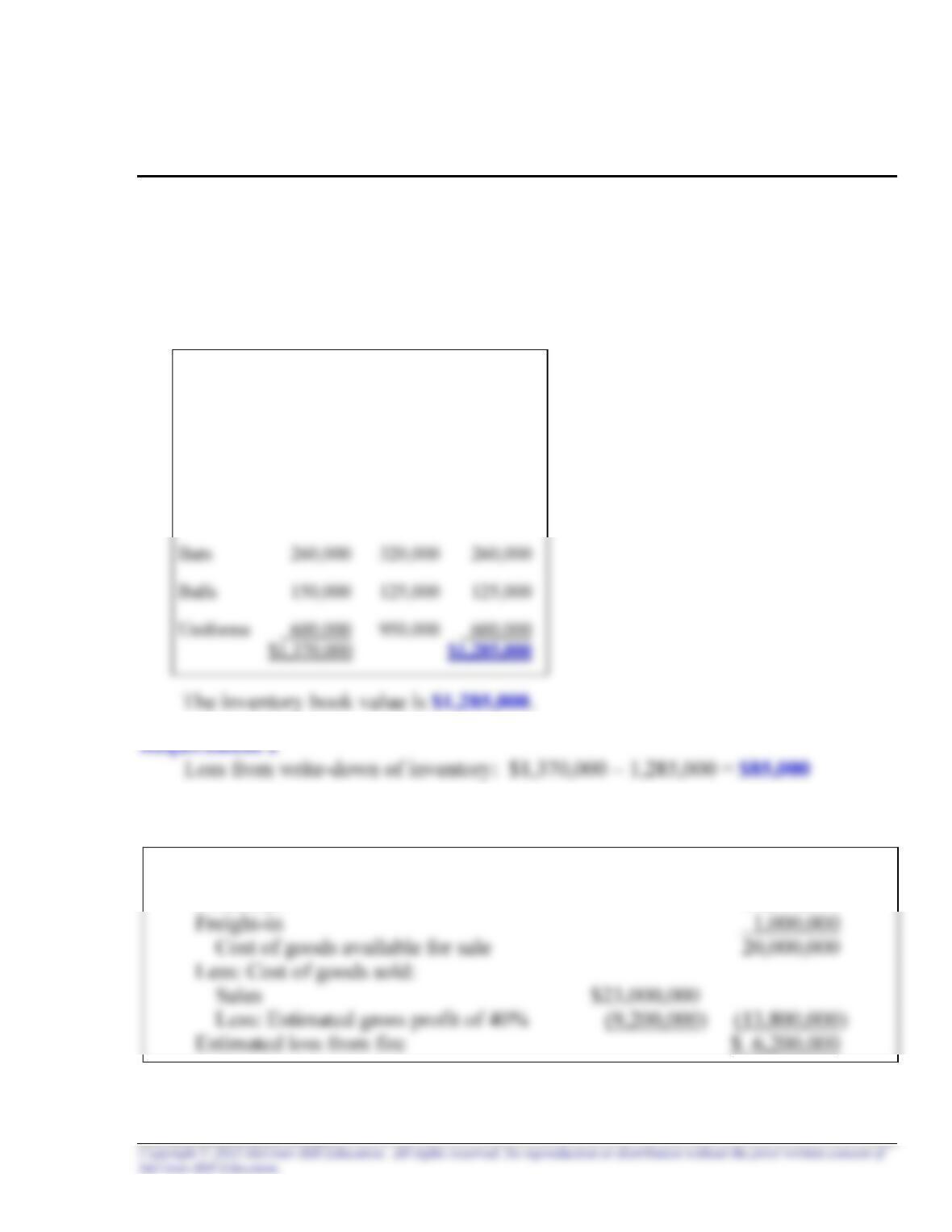
Product
Cost
NRV
Inventory
Value
[Lower of
(1) or (2)]
Gloves
$360,000
$300,000
$300,000
Bats
Balls
Uniforms
600,000
600,000
$1,370,000
Exercise 9-2
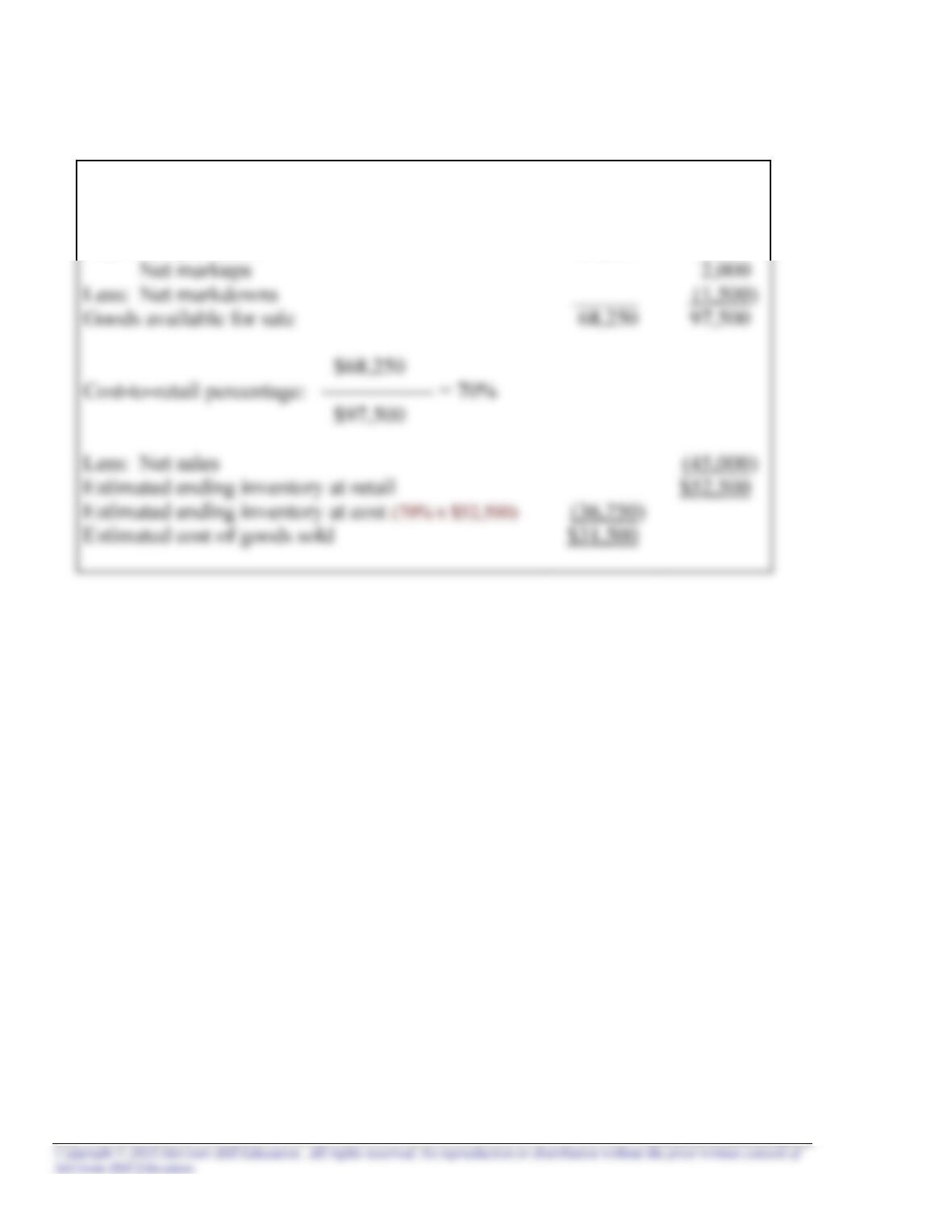
Merchandise inventory, January 1, 2016 $ 4,500,000
Purchases 14,500,000
9–2 Intermediate Accounting, 8/e
Exercise 9-3
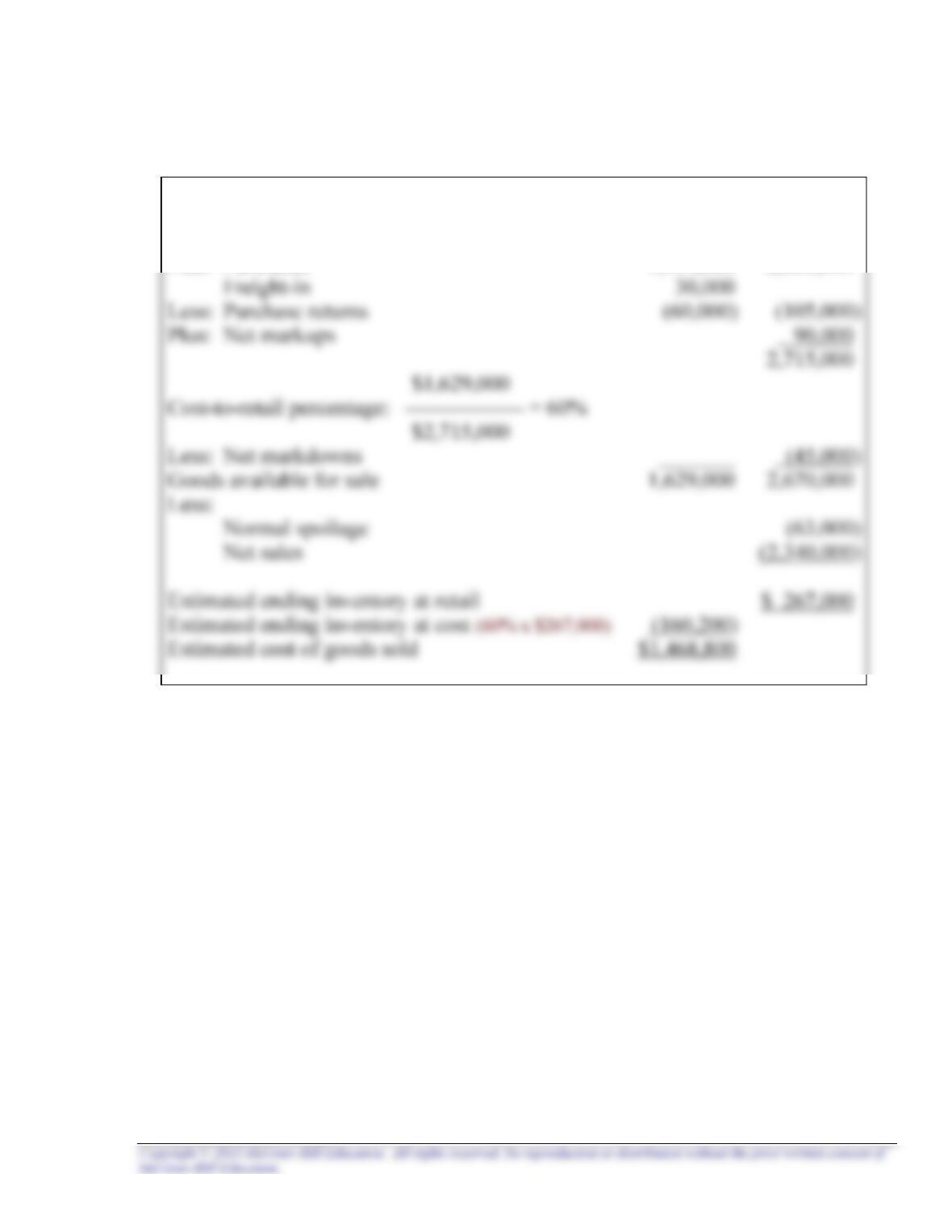
Cost
Retail
Beginning inventory
$40,000
$60,000
Plus: Net purchases
28,250
37,000
Net markups
Less: Net markdowns
Goods available for sale
Less: Net sales
Estimated ending inventory at retail
$52,500
Estimated ending inventory at cost (70% x $52,500)
Estimated cost of goods sold
Alternate Exercises and Problems 9–3
Exercise 9-4
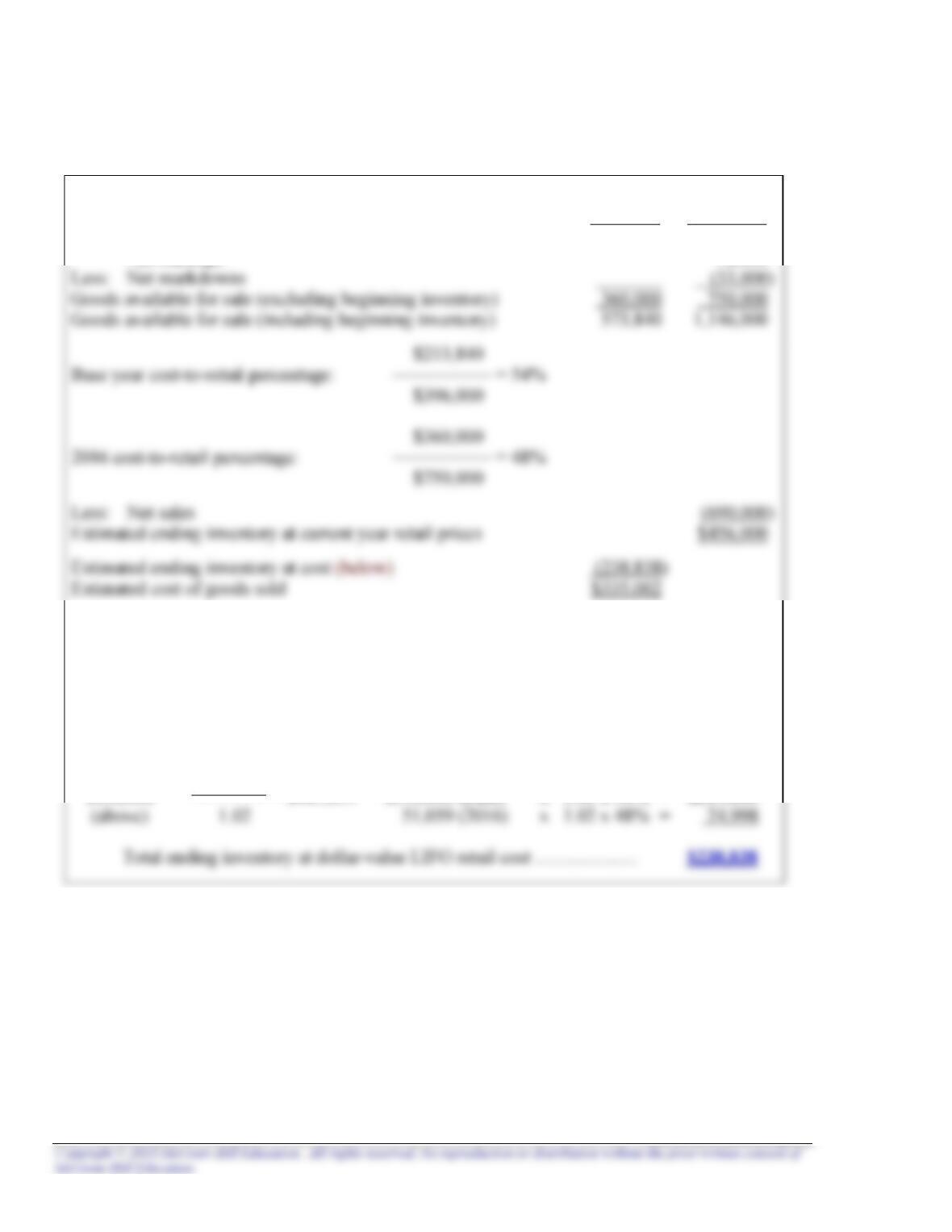
Cost
Retail
Beginning inventory
$ 180,000
$ 300,000
Plus: Purchases
1,479,000
2,430,000
Freight-in
Less: Purchase returns
Plus: Net markups
Less: Net markdowns
Goods available for sale
Less:
Normal spoilage
Net sales
Estimated ending inventory at retail
$ 267,000
Estimated ending inventory at cost (60% x $267,000)
Estimated cost of goods sold
$1,468,800
9–4 Intermediate Accounting, 8/e
Exercise 9-5
Cost
Retail
Beginning inventory
$213,840
$ 396,000
Plus: Net purchases
360,000
765,000
Net markups
18,000
Less: Net markdowns
Goods available for sale (excluding beginning inventory)
750,000
Goods available for sale (including beginning inventory)
573,840
Less: Net sales
Estimated ending inventory at current year retail prices
$456,000
Estimated ending inventory at cost (below)
Estimated cost of goods sold
$335,002
Total ending inventory at dollar-value LIFO retail cost …………………. $238,838
___________________________________________________________________________
Step 1 Step 2 Step 3
Ending Ending Inventory Inventory
Inventory Inventory Layers Layers
at Year-end at Base Year at Base Year Converted to
Retail Prices Retail Prices Retail Prices Cost
$456,000
$456,000 = $447,059 $396,000 (base) x 1.00 x 54% = $213,840
Alternate Exercises and Problems 9–5
Exercise 9-6
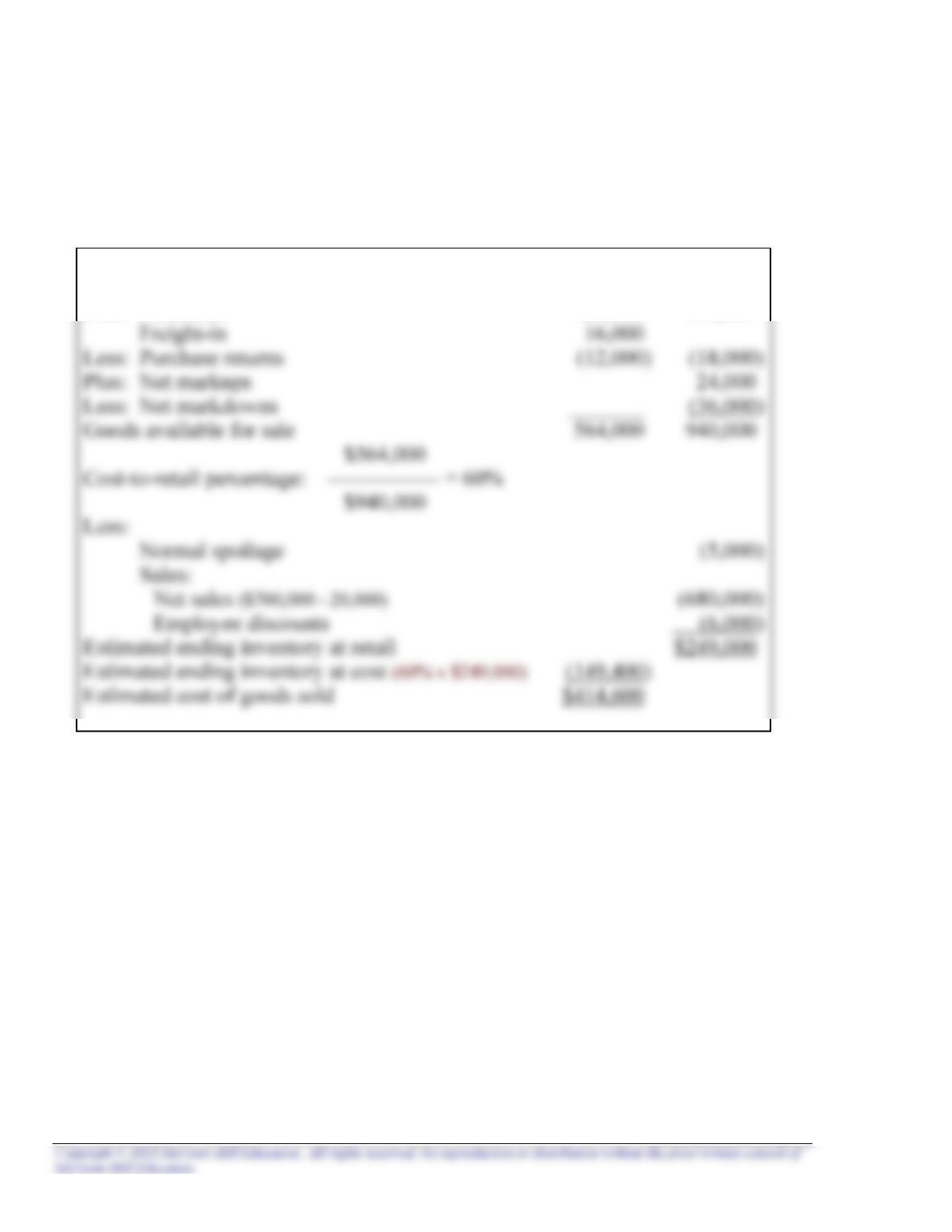
1. To increase inventory by $1.6 million and increase retained earnings to what it
would have been if 2015 cost of goods sold had been calculated correctly.
Analysis:
2015 2016
Beginning inventory Beginning inventory U
Purchases Purchases
Revenues
Less: Cost of goods sold O U = Understated
2. The 2015 financial statements that were incorrect as a result of the error would be
retrospectively restated to reflect the correct cost of goods sold, (income tax
3. Because retained earnings is one of the accounts incorrect, the correction to that
4. Also, a disclosure note should describe the nature of the error and the impact of
9–6 Intermediate Accounting, 8/e
PROBLEMS
Problem 9-1
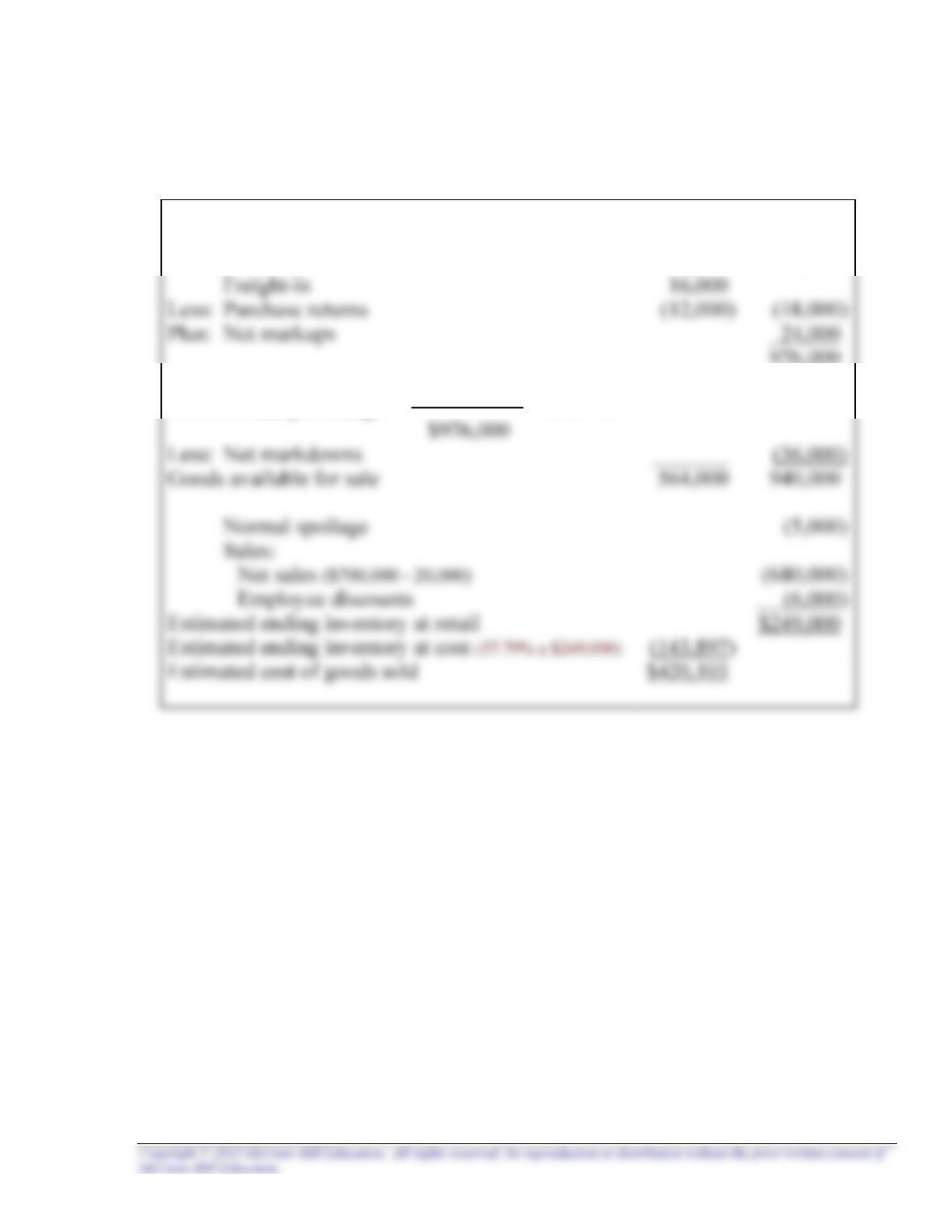
1. Average cost
Cost
Retail
Beginning inventory
$140,000
$280,000
Plus: Purchases
420,000
690,000
Less: Purchase returns
Less: Net markdowns
Goods available for sale
564,000
940,000
Less:
Normal spoilage
Net sales ($700,000 – 20,000)
Employee discounts
Estimated ending inventory at retail
$249,000
Estimated ending inventory at cost (60% x $249,000)
Alternate Exercises and Problems 9–7
Problem 9-1 (concluded)
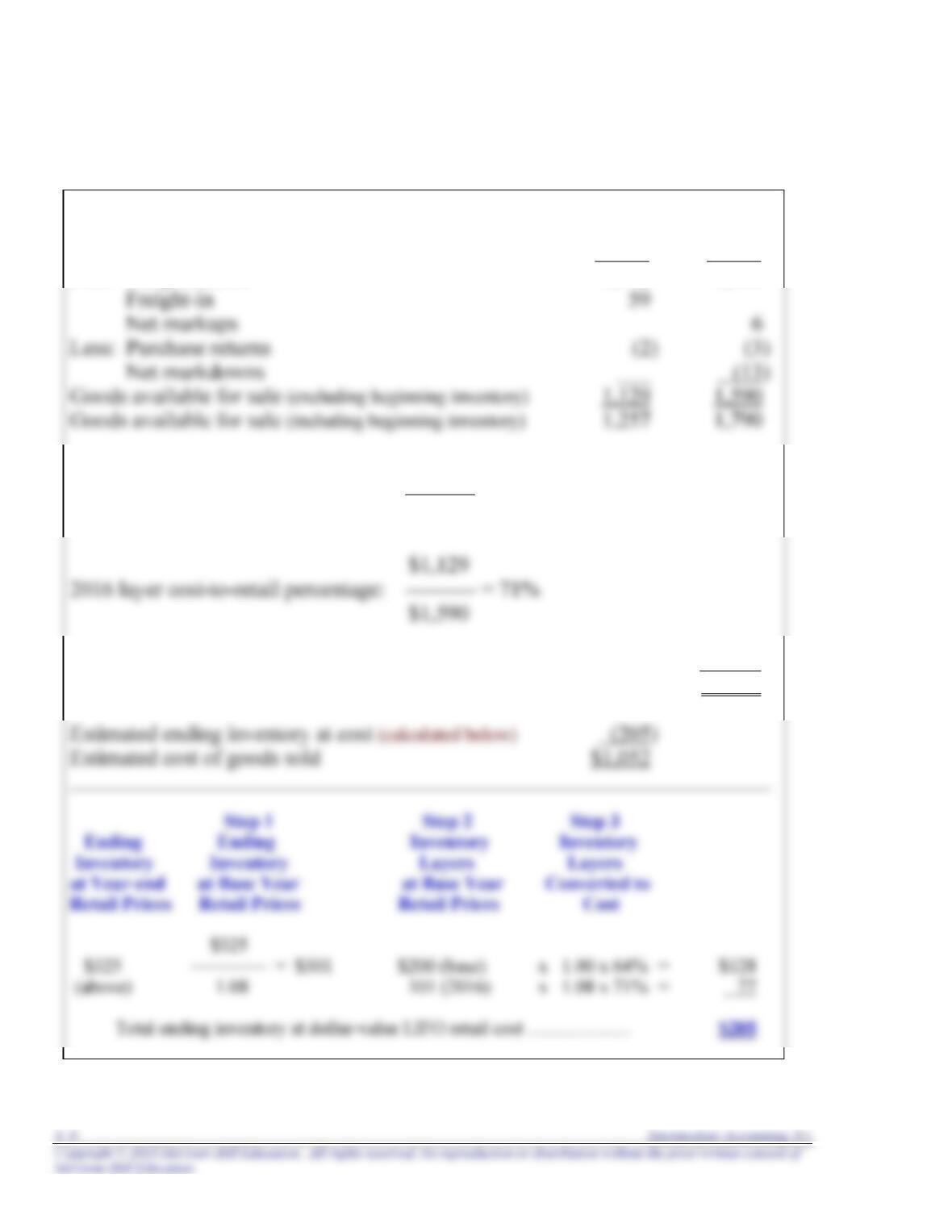
2. Conventional (average, LCM)
Cost
Retail
Beginning inventory
$140,000
$280,000
Plus: Purchases
420,000
690,000
Freight-in
Less: Purchase returns
976,000
Goods available for sale
564,000
940,000
Normal spoilage
Sales:
Employee discounts
Estimated ending inventory at retail
$249,000
Estimated ending inventory at cost (57.79% x $249,000)
Estimated cost of goods sold
$420,103
$564,000
Cost-to-retail percentage: = 57.79%
Problem 9-2
($ in 000s)
Cost
Retail
Beginning inventory
$ 128
$ 200
Plus: Net purchases
1,072
1,600
Freight-in
Net markups
6
Less: Purchase returns
(3)
Net markdowns
Goods available for sale (excluding beginning inventory)
1,129
1,590
Goods available for sale (including beginning inventory)
1,257
1,790
$128
Base layer cost-to-retail percentage: = 64%
$200
2016 layer cost-to-retail percentage: = 71%
Less: Net sales
(1,465)
Estimated ending inventory at current year retail prices
$ 325
Estimated ending inventory at cost (calculated below)
Estimated cost of goods sold