Appendix III – Inventory Management
III-1
APPENDIX III
INVENTORY MANAGEMENT
Learning Objectives
1. Calculate the economic order quantity (EOQ) using the EOQ decision model.
Appendix III – Inventory Management
III-2
Appendix Overview
I. Economic Order Quantity
A. Tabular approach
B. Equation approach
II. Just-in-Time Inventory Management
A. JIT implications for EOQ
Appendix III – Inventory Management
III-3
Key Lecture Concepts
I. Economic Order Quantity
• The economic order quantity (EOQ) formula is useful in determining the
size of inventory orders, or production runs in a manufacturing setting,
that will minimize the total cost of an inventory policy (i.e., ordering costs,
holding costs, and shortage costs).
• Inventory decisions often focus on balancing three categories of costs:
ordering, holding, and shortage.
➢ Holding costs consist of security costs, insurance, storage, spoilage,
• The lead time is useful in deciding when to order. Lead time, or the time
that elapses between order placement and order arrival, is based on
average usage and how long it takes to receive an order from a supplier.
• The EOQ recognizes the need to carry inventory and strives for cost
minimization by using a constant order quantity.
II. Just-in-Time Inventory Management
• In contrast to the EOQ system, a just-in-time philosophy also strives to
reduce costs but holds that all inventories are wasteful.
➢ With JIT, orders will vary in size and are dependent on near-term
production requirements.
Appendix III – Inventory Management
III-4
Teaching Overview
Normally, I spend only a very small amount of class time on this topic, focusing mostly
on the various types of inventory costs and the differences between the EOQ and JIT
Links to the Text
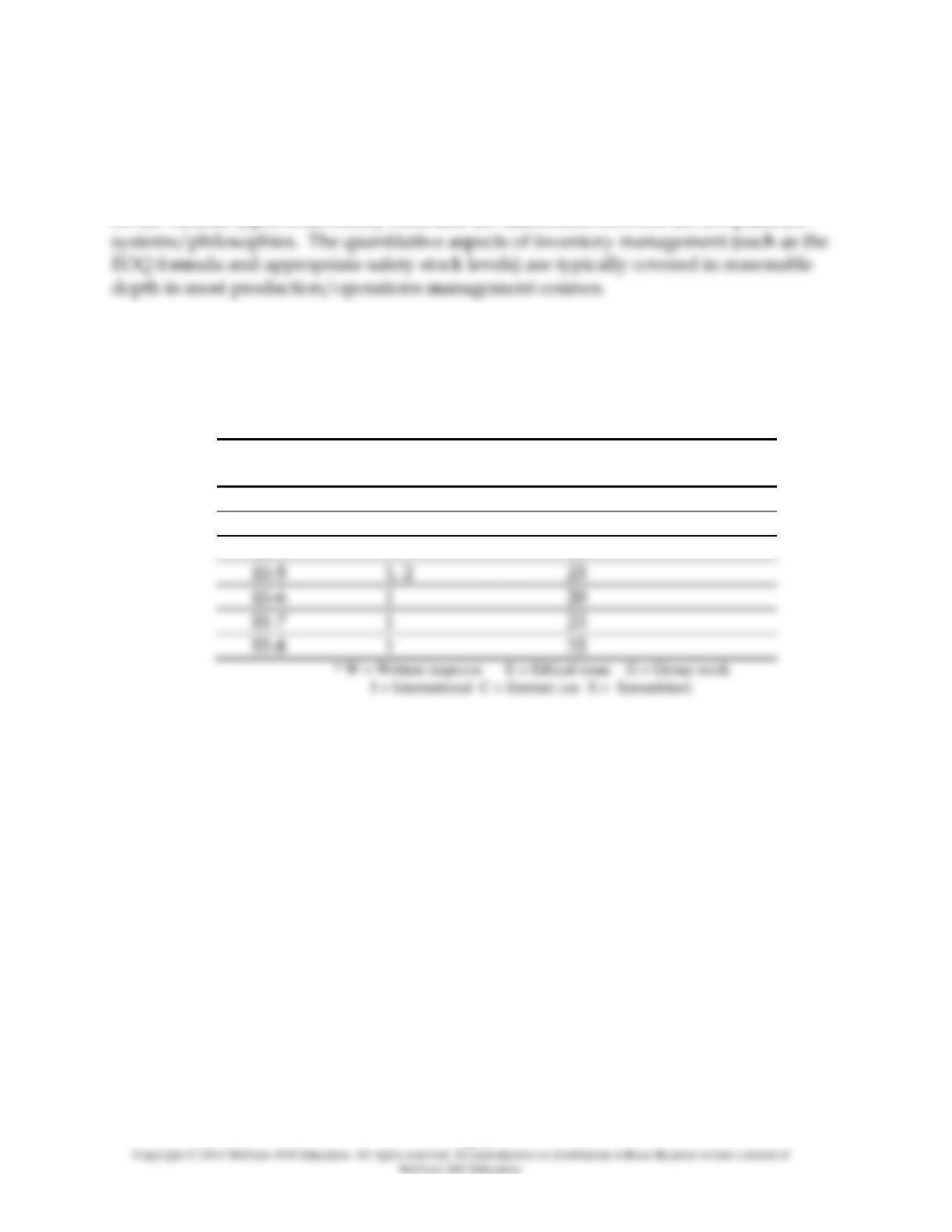
Homework Grid
Item No.
Learning
Objectives
Completion
Time (min.)
Special
Features*
Exercises:
III-3
1
15
III-4
1
10
III-5
1, 2
25
III-6
1
20
III-7
1
25
III-8
1
35