APPENDIX E
Reporting and Analyzing Investments
Learning Objectives
1. Identify the reasons corporations invest in stocks and debt securities.
2. Explain the accounting for debt investments.
3. Explain the accounting for stock investments.
4. Describe the purpose and usefulness of consolidated financial statements.
5. Indicate how debt and stock investments are reported in the financial statements.
6. Distinguish between short-term and long-term investments.
Summary of Questions by Learning Objectives and Bloom’s Taxonomy
Item LO BT Item LO BT Item LO BT Item LO BT Item LO BT
Questions
1. 1 K 5. 3 K 9. 3 C 13. 5 C 17. 5 K
Brief Exercises
1. 2 AP 3. 3 AP 5. 6 AN 7. 6 AN 8. 6 AP
Exercises
1. 2 AP 3. 3 AP 5. 3 AP 7. 5, 6 AN 8. 5, 6 AN
Problems: Set A
1. 2, 5,
2. 2, 3,
3. 3, 5,
4. 3 AN 6. 6 AP
ASSIGNMENT CHARACTERISTICS TABLE
Problem
Number
Description
Difficulty
Level
Time
Allotted (min.)
PE-1 Journalize debt investment transactions. Moderate 30–40
PE-2 Journalize investment transactions, prepare adjusting
entry, and show financial statement presentation.
Moderate 30–40
ANSWERS TO QUESTIONS
1. Companies invest because (1) they have excess cash for a short period of time, or (2) they want
to generate investment income or (3) they have strategic reasons such as controlling a competitor
or supplier or entering a new industry.
2. (a) The cost of an investment in bonds consists of the market price of the bonds plus any
brokerage fees.
3. (a) Losses and gains on the sale of debt investments are computed by comparing the cost of
the securities to the net proceeds from the sale.
4. Townsend Company is incorrect. The gain is the difference between the net proceeds, exclusive
of interest, and the cost of the bonds. The correct gain is $4,000 [($45,000 – $1,000) – $40,000].
7. (a) Whenever the investor’s influence on the operating and financial affairs of the investee is
significant, the equity method should be used. The major factor in determining significant
8. Since Upson Corporation uses the equity method, the income reported by Holland Packing
($80,000) should be multiplied by Upson’s ownership interest (30%) and the result ($24,000)
9. Significant influence over an investee may result from representation on the board of directors,
participation in policy-making processes, or material intercompany transactions. An investment
Questions Appendix E (Continued)
10. Under the cost method, an investment is originally recorded and reported at cost. Dividends are
recorded as revenue. In subsequent periods, it is adjusted to fair value and an unrealized holding
gain or loss is recognized and included in income (trading security) or as separate component of
11. Consolidated financial statements present the assets and liabilities controlled by the parent com-
pany and the total revenues and expenses of the affiliated companies. Consolidated financial state-
12. The valuation and reporting of investments is as follows:
Category Valuation and Reporting
Trading At fair value with changes reported in net income
13. Diana should report the data as follows:
(1) Under current assets in the balance sheet:
Short-term investments, at fair value ……………………………………………….. $70,000
14. Diana should report as follows:
(1) Under investments in the balance sheet:
Investments in stock of less than 20% owned companies, at fair value … $70,000
15. The entry is:
Fair Value Adjustment—Available-for-Sale ………………………………. 8,000
16. The entry is:
Fair Value Adjustment—Trading ……………………………………………… 8,000
Questions Appendix E (Continued)
18. Reporting Unrealized Gains (Losses)—Equity in the stockholders’ equity section serves two
important purposes: (1) it reduces the volatility of net income due to fluctuations in fair value, and
SOLUTIONS TO BRIEF EXERCISES
BRIEF EXERCISE E-1
Jan. 1 Debt Investments …………………………………… 40,800
Cash ……………………………………………….. 40,800
BRIEF EXERCISE E-2
Aug. 1 Stock Investments …………………………………. 35,600
Cash ……………………………………………….. 35,600
BRIEF EXERCISE E-3
Dec. 31 Stock Investments …………………………………. 37,500
Revenue from Stock Investments
BRIEF EXERCISE E-4
Dec. 31 Unrealized Loss—Income ………………………. 2,400
BRIEF EXERCISE E-5
Balance Sheet
Current assets
Short-term investments, at fair value …………………………. $59,600
BRIEF EXERCISE E-6
Dec. 31 Unrealized Gain or Loss—Equity ………………. 3,000
BRIEF EXERCISE E-7
Balance Sheet
Investments
Investments in stock of less than 20% owned
BRIEF EXERCISE E-8
Investments
Bond sinking fund ………………………………………………………. $150,000
Investments in stock of less than 20% owned
SOLUTIONS TO EXERCISES
EXERCISE E-1
(a) Jan. 1 Debt Investments ………………………………. 90,000
Cash ………………………………………….. 90,000
(b) Dec. 31 Interest Receivable ……………………………. 3,000
EXERCISE E-2
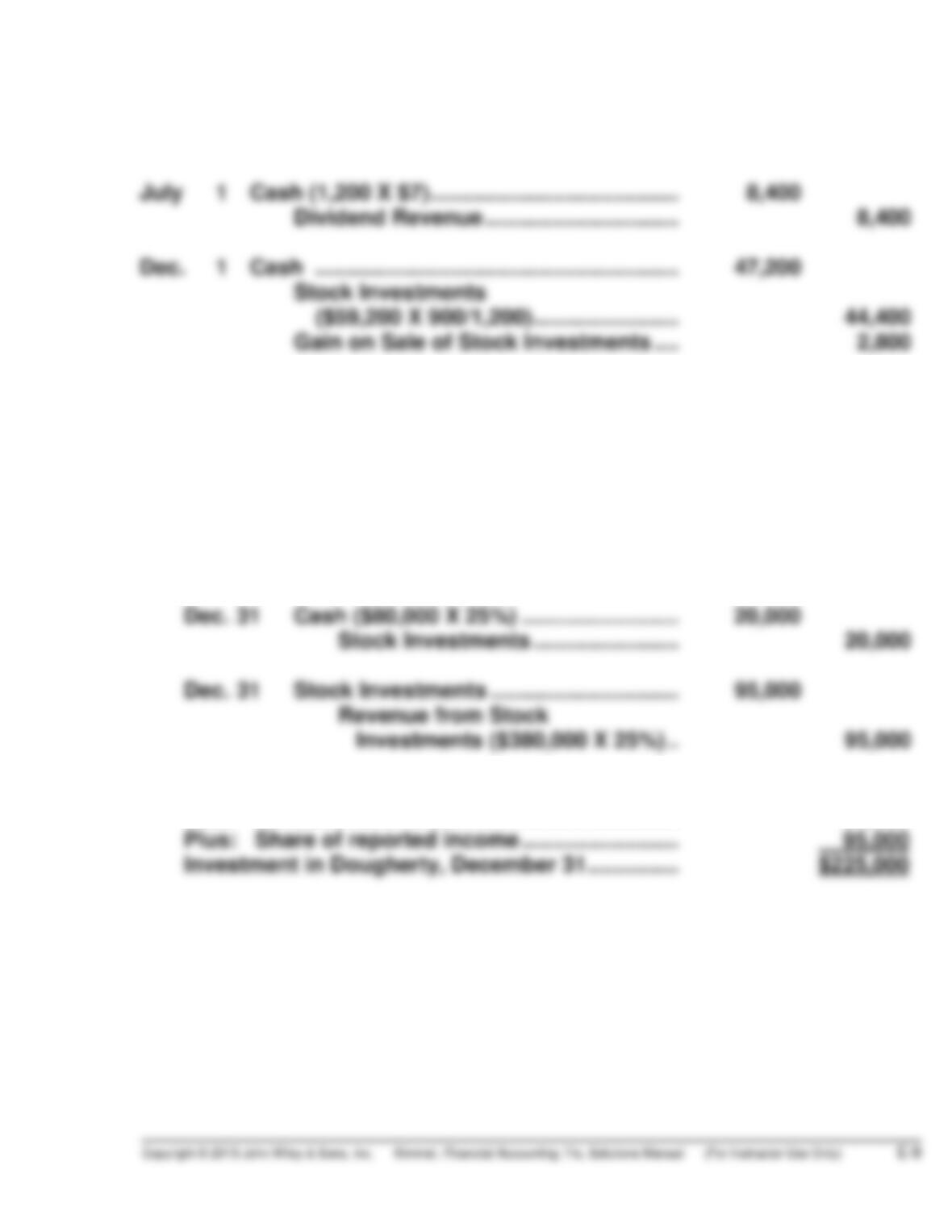
(a) Feb. 1 Stock Investments …………………………….. 8,400
Cash ………………………………………….. 8,400
July 1 Cash (1,200 X $2) ………………………………. 2,400
(b) Dividend revenue and the gain on sale of stock investments are reported
under other revenues and gains in the income statement.
EXERCISE E-3
Jan. 1 Stock Investments ………………………………… 59,200
Cash …………………………………………….. 59,200
Dec. 31 Cash (300 X $7) …………………………………….. 2,100
Dividend Revenue ………………………….. 2,100
EXERCISE E-4
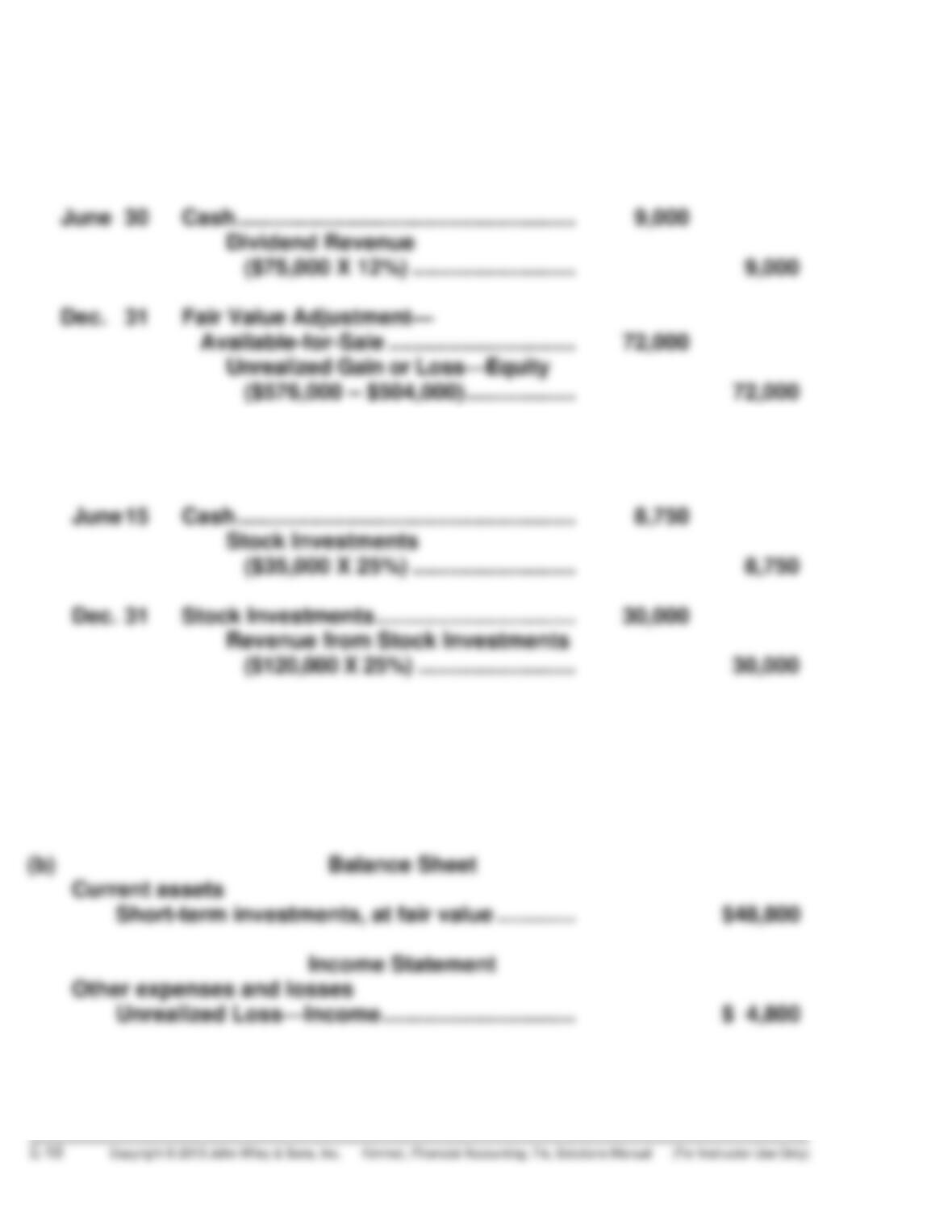
(a) Jan. 1 Stock Investments …………………………. 150,000
Cash ……………………………………….. 150,000
(b) Investment in Dougherty, January 1 ……………….. $150,000
Less: Dividend received ………………………………… 20,000
EXERCISE E-5
2014
1. Mar. 18 Stock Investments …………………………… 504,000
Cash (300,000 X 12% X $14) ………. 504,000
2. Jan. 1 Stock Investments …………………………… 82,500
Cash (30,000 X 25% X $11) ………… 82,500
EXERCISE E-6
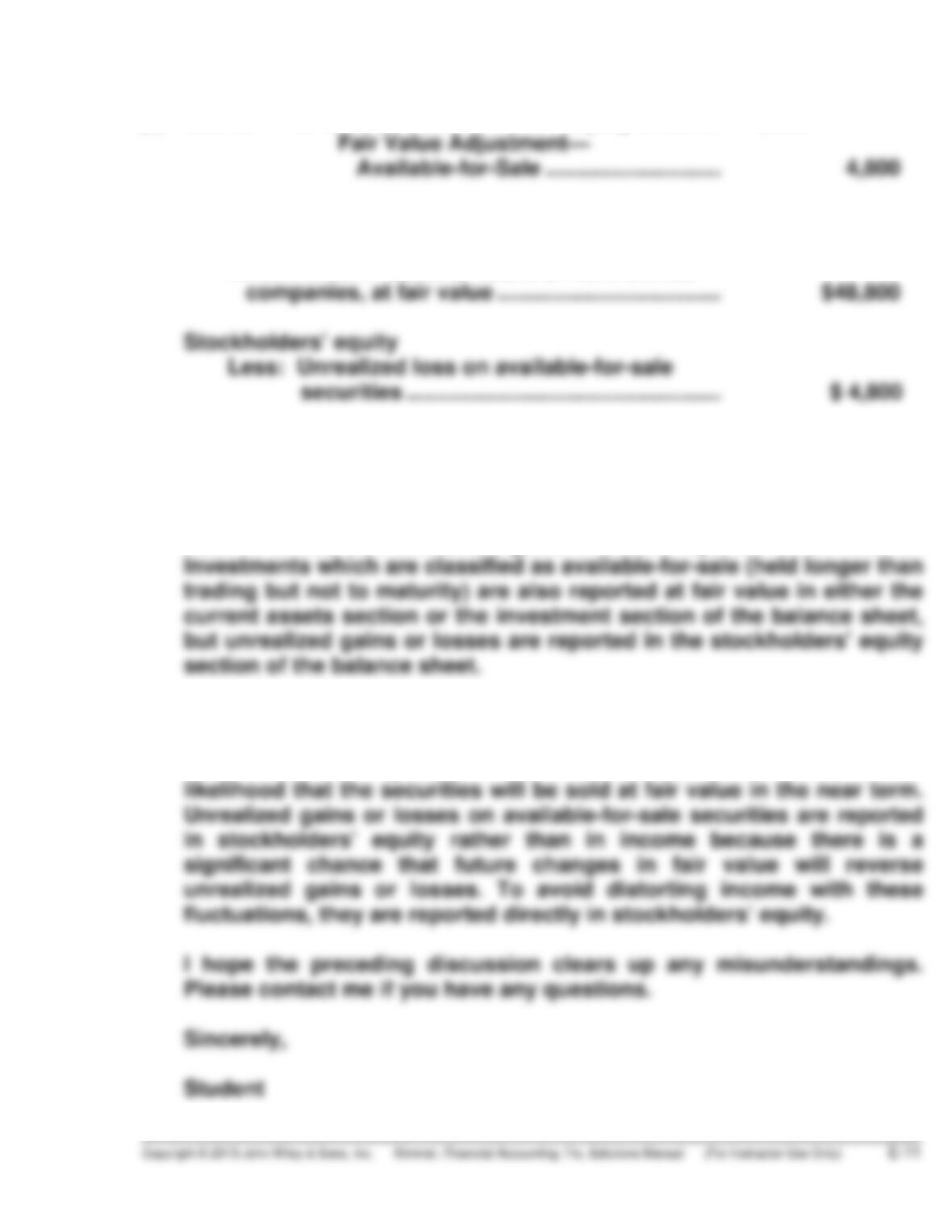
(a) Dec. 31 Unrealized Loss—Income ………………… 4,800
Fair Value Adjustment—Trading … 4,800
EXERCISE E-7
(a) Dec. 31 Unrealized Gain or Loss—Equity ………….. 4,800
(b) Balance Sheet
Investments
Investments in stock of less than 20% owned
(c) Dear Ms. Parks:
Investments which are classified as trading (held for sale in the near
term) are reported at fair value in the current asset section of the
balance sheet, with unrealized gains or losses reported in net income.
Fair value is used as a reporting basis because it represents the cash
realizable value of the securities. Unrealized gains or losses on trading
investments are reported in the income statement because of the
EXERCISE E-8
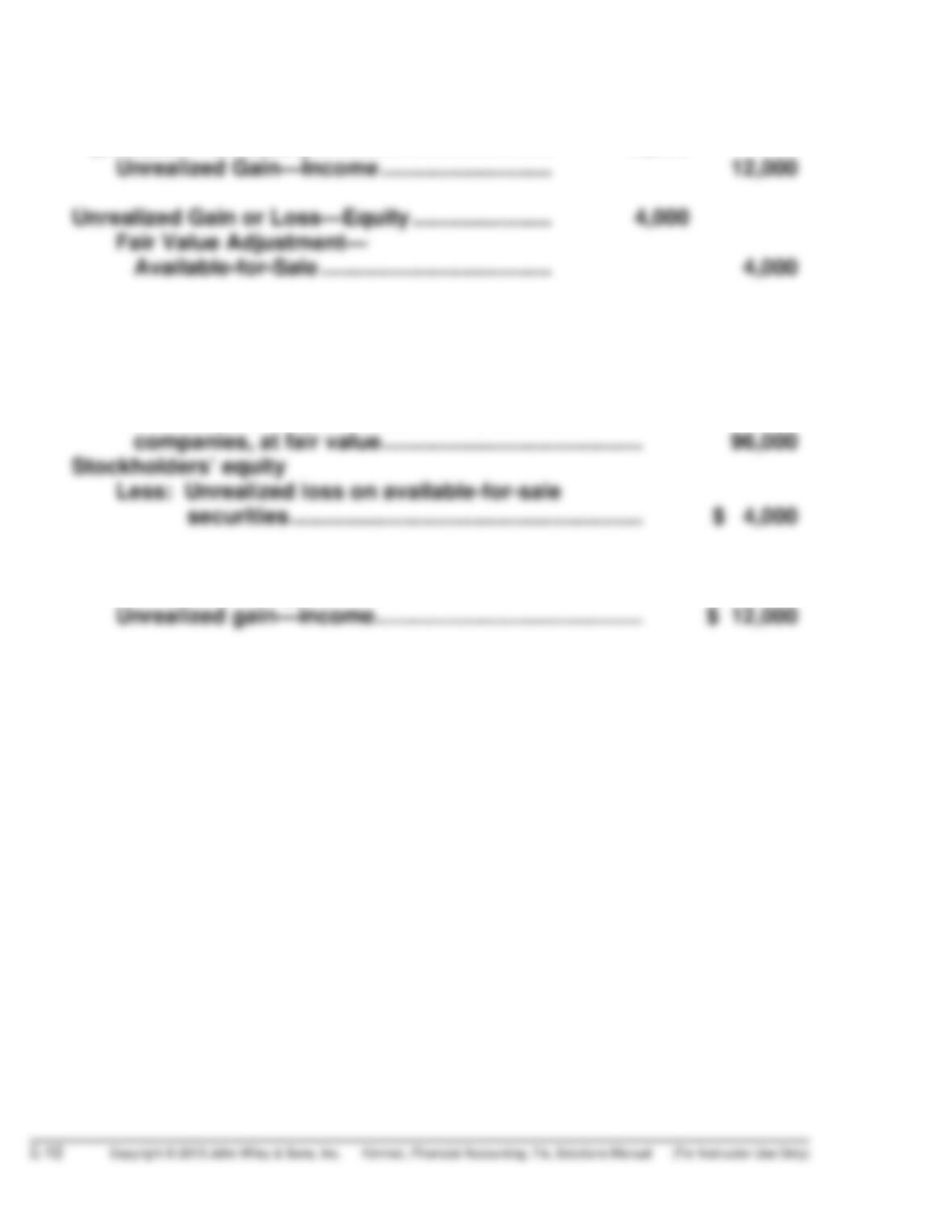
(a) Fair Value Adjustment—Trading
($122,000 – $110,000) ………………………………… 12,000
(b) Balance Sheet
Current assets
Short-term investments, at fair value …………………… $122,000
Investments
Investments in stock of less than 20% owned
Income Statement
Other revenues and gains