
D-1
APPENDIX D
TIME VALUE OF MONEY
LEARNING OBJECTIVES
1. Distinguish between simple and compound interest.
2. Solve for future value of a single amount..
3. Solve for future value of an annuity.
4. Identify the variables fundamental to solving present value problems.
5. Solve for present value of a single amount.
6. Solve for present value of an annuity.
7. Compute the present value of notes and bonds.
8. Use a financial calculator to solve time value of money problems.
D-2
Chapter Outline
Learning Objective 1 – Distinguish Between Simple and Compound Interest
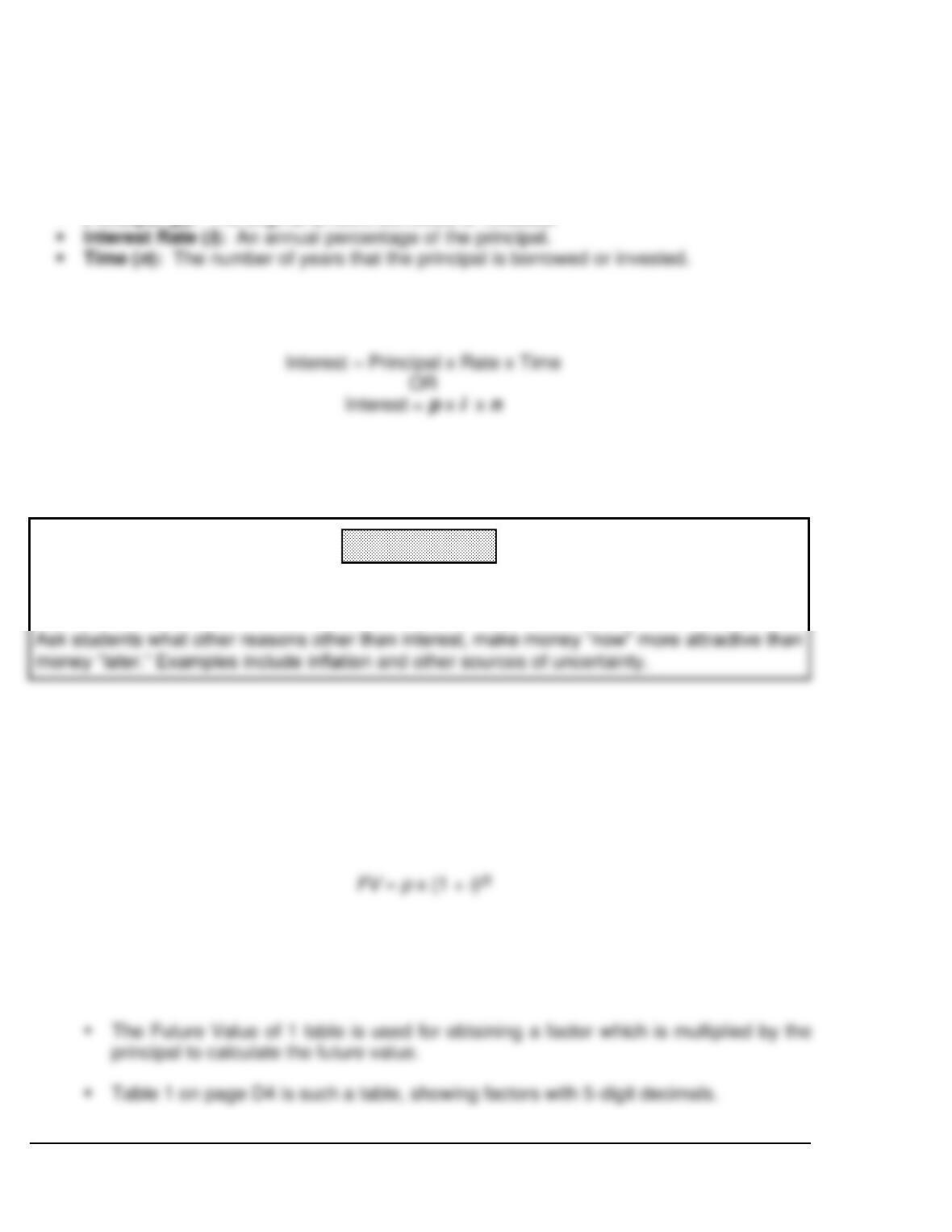
Nature of Interest—Interest is payment for the use of another person’s money. The
amount of interest involved in any financing transaction is based on three elements:
▪ Principal (p): The original amount borrowed or invested.
o Simple interest is computed on the principal amount only. Simple interest is usually
expressed as:
o Compound interest is computed on principal and on any interest earned that has not
been paid or withdrawn. It is the return on (or growth of) the principal for two or more
time periods.
TEACHING TIP
Ask students if they earn simple interest or compound interest on their savings accounts.
Ask them how often their interest is compounded.
Learning Objective 2 – Solve for Future Value of a Single Amount
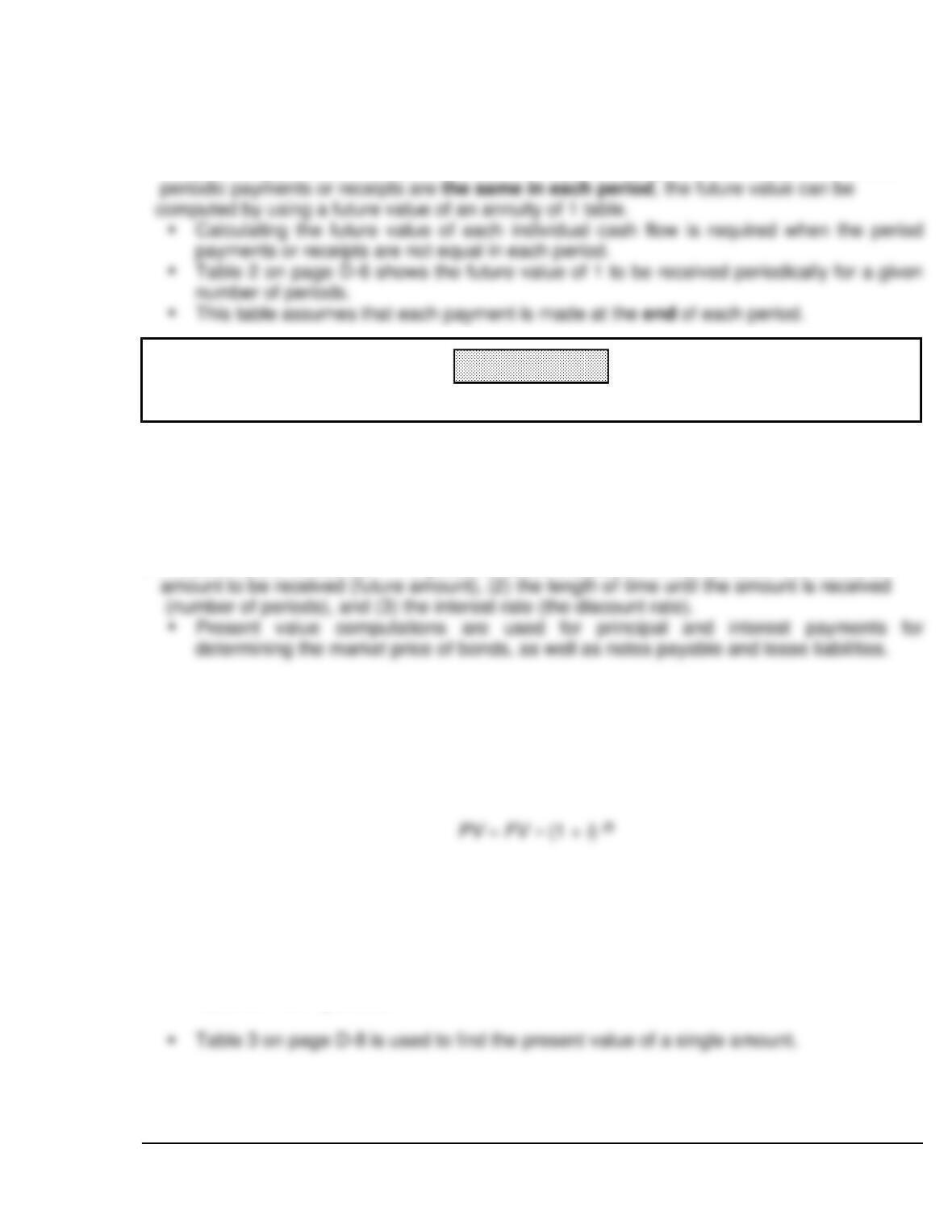
Future Value of a Single Amount—The future value of a single amount is the value at a
future date of a given amount invested, assuming compound interest. Future value is
usually expressed as:
FV = future value of a single amount
p = principal (or present value)
i = interest rate for one period
n = number of periods
D-3
Learning Objective 3 – Solve for Future Value of an Annuity
Future Value of an Annuity—The future value of an annuity is the sum of all the
payments (receipts) plus the accumulated compound interest on them. In computing the
future value of an annuity, it is necessary to know the (1) interest rate, (2) the number of
compounding periods, and (3) the amount of the periodic payments or receipts. When the
TEACHING TIP
Use the demonstration problem in the text to show students how to use Table 2.
Learning Objective 4 – Identify the Variables Fundamental to Solving Present
Value Problems.
Present Value Variables—The present value is based on three variables: (1) the dollar
Learning Objective 5 – Solve for Present Value of a Single Amount
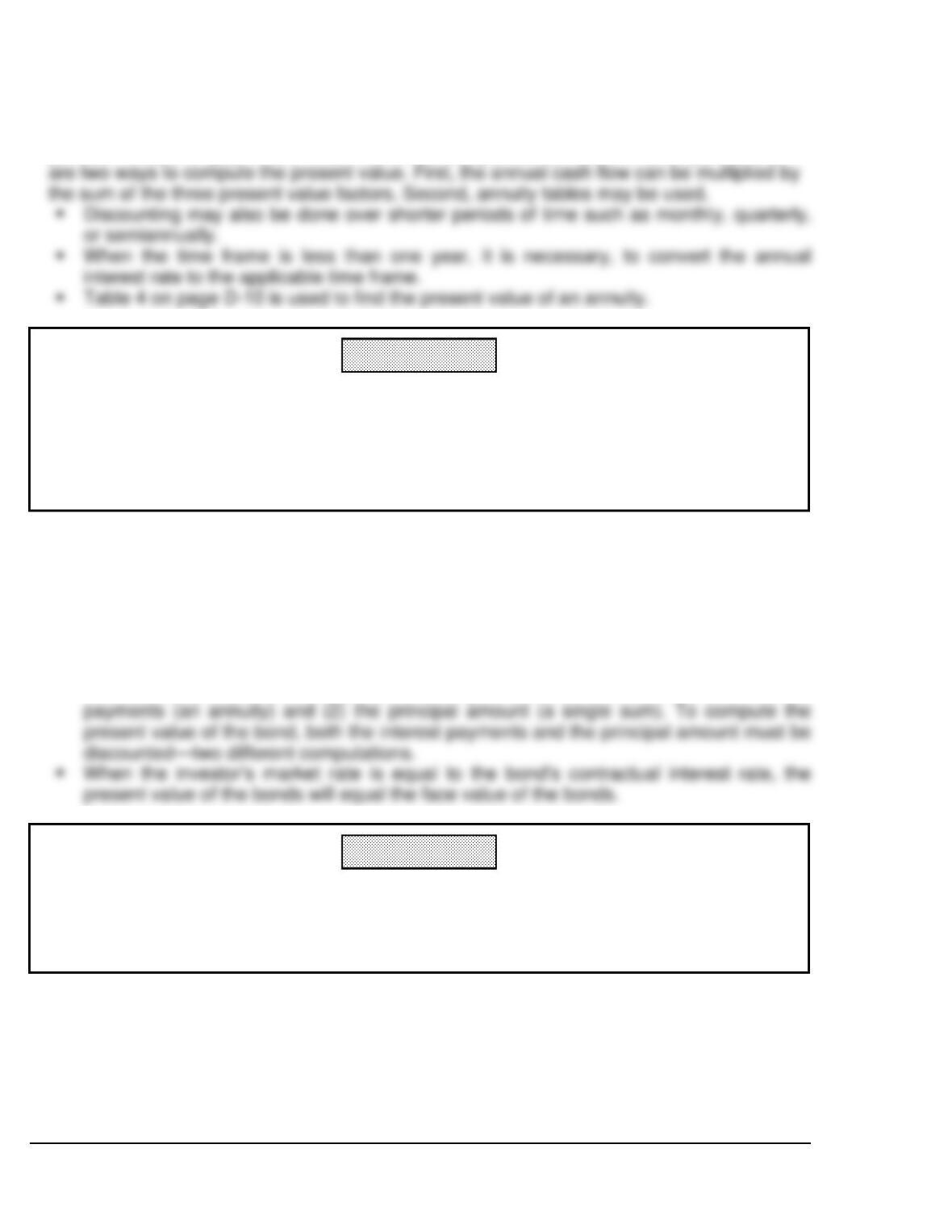
Present Value of a Single Amount—If the future amount to be received in n periods is
discounted at interest rate i, then the computation of a single amount to be invested is
calculated as:
PV = present value
FV = future value
i = interest rate
n = number of periods
▪ The present value of 1 may also be determined through tables that show the present
value of 1 for n periods.
D-4
Learning Objective 6 – Solve for Present Value of an Annuity
Present Value of an Annuity–—In computing the present value of an annuity, it is necessary
to know (1) the discount rate, (2) the number of discount periods, and (3) the amount of the
periodic receipts or payments. When the future receipts are the same in each period, there
TEACHING TIP
Ask students to give examples of annuities. Examples may include:
1. Auto loan payments
2. Mortgage payments
3. Student loan payments
4. Insurance premiums
Learning Objective 7 – Compute the Present Value of Notes and Bonds
Computing the Present Value of a Long-Term Note or Bond—The present value (or
market price) of a long-term note or bond is a function of three variables: (1) the payment
amounts, (2) the length of time until the amounts are paid, and (3) the discount rate.
▪ The first variable (dollars to be paid) is made up of two elements: (1) a series of interest
TEACHING TIP
Use a typical state lottery as another example of time value of money. The cash value in
most state lotteries is typically half the face value. Ask students what they would pick: the
cash value or annual payments. Use this topic to emphasize the importance of the interest
rate associated with the annual payment option.
D-5
Learning Objective 8 – Use a Financial Calculator To Solve Time Value of Money
Problems.
Using Financial Calculators—Once an understanding of the basic time value of money
concepts is gained, many professionals use financial calculators to solve the computations.
▪ The most common keys used for solving time value of money problems with a
financial calculator include:
o N = number of periods
o I = interest rate per period (some calculators use I/YR or i)
o PV = present value (occurs at the beginning of the first period)
o PMT = payment (all payments are equal, and none are skipped)
o FV = future value (occurs at the end of the last period)
▪ Most problems give three of four variables and require solving for the remaining
variable. The fifth key (the key not used) is given a value of zero to ensure that this
variable is not used in the computation.
▪ Financial calculators are particularly useful where interest rates and compounding
periods are not presented in tables.
TEACHING TIP
Emphasis to the students that it is important to read the owner’s manual, since financial
calculators differ.
▪ However, there are several general steps when solving time value of money
problems:
1. Clear the calculator.
2. Input the known value.