John J. Wild, Financial Accounting: Information for Decisions, 8th Edition
D-1
APPENDIX D
REPORTING AND ANALYZING PARTNERSHIPS
Related Assignment Materials
Student Learning Objectives
Questions
Quick
Studies*
Exercises*
Problems*
Beyond the
Numbers
Conceptual objectives:
organizations.
Analytical objectives:
Al. Compute partner return on
equity and use it to evaluate
partnership performance.
D-8
D-12
Procedural objectives:
P1. Prepare entries for partnership
formation.
D-3, D-6
D-5
loss among partners.
withdrawal of partners.
P2. Allocate and record income and
6, 7
D-3, D-4
D-4,
D-1, D-2,
D-3, D-5,

John J. Wild, Financial Accounting: Information for Decisions, 8th Edition
D-2
Additional Information on Related Assignment Material
Connect
Available on the instructor’s course-specific website) repeats all numerical Quick Studies, all Exercises and
Problems Set A. Connect also provides algorithmic versions for Quick Study, Exercises and Problems. It allows
instructors to monitor, promote, and assess student learning. It can be used in practice, homework, or exam mode.
Connect Insight
The Serial Problem for Success Systems continues in this chapter.
General Ledger
Assignable within Connect, General Ledger (GL) problems offer students the ability to see how transactions post
from the general journal all the way through the financial statements. Critical thinking and analysis components are
added to each GL problem to ensure understanding of the entire process. GL problems are auto-graded and provide
instant feedback to the student.
Excel Simulations
John J. Wild, Financial Accounting: Information for Decisions, 8th Edition
D-3
Chapter Outline
Notes
I. Partnership Form of Organization—An unincorporated association
of two or more people to pursue a business for profit as co-owners.
A. Characteristics of Partnerships
1. Voluntary association.
2. Partnership contract (called articles of co-partnership)—
should be in writing but may be expressed orally.
5. Mutual agency—each partner is an agent of the partnership
and can enter into and bind it to any contract within the
normal scope of its business.
6. Unlimited liability—each general partner is responsible for
payment of all the debts of the partnership if the other partners
are unable to pay a share.
B. Organizations with Partnership Characteristics
1. Limited Partnership (LP or Ltd.) has two classes of partners,
general (at least one) and limited. The general partners assume
unlimited liability for the debts of the partnership. The limited
partners assume no personal liability beyond their invested
amounts and cannot take active role in managing the
company.
2. Limited Liability Partnership (LLP) is designed to protect
B. Choosing a Business Form
Factors to be considered include: taxes, liability risk, tax and fiscal
year-end, ownership structure, estate planning, business risks, and
earnings and property distributions.
John J. Wild, Financial Accounting: Information for Decisions, 8th Edition
D-4
Chapter Outline
Notes
II. Basic Partnership Accounting—Same as accounting for a
proprietorship except for transactions directly affecting partners’
equity. Use separate capital and withdrawal accounts for each partner.
Allocates net income or loss to partners according to the partnership
agreement.
A. Organizing a Partnership
Each partner’s investment is recorded at an agreed upon value,
of contribution.
B. Dividing Income and Loss
1. Any agreed upon method of dividing income or loss is
allowed. If there is no agreement, the net income or loss is
divided equally.
2. Common methods of dividing partnership earnings use:
a. Stated ratio.
b. Allocation on capital balances.
3. Salaries to partners and interest on partners’ investments are
not partnership expenses; they are allocations of net income.
4. Partners may agree to salary and interest allowances to reward
unequal contributions of services or capital.
C. Partnership Financial Statements
Similar to a proprietorship except:
2. The balance sheet generally lists a separate capital account for
each partner.
John J. Wild, Financial Accounting: Information for Decisions, 8th Edition
D-5
Chapter Outline
Notes
III. Admission and Withdrawal of Partners
A. Admission of a Partner—two means:
1. Purchase of partnership interest.
a. The purchase is a personal transaction between one or
2. Investing assets in a partnership.
a. The transaction is between the new partner and the
partnership. Invested assets become partnership property.
income and loss sharing agreement.
B. Withdrawal of a Partner—two means:
1. Withdrawing partner sells his or her interest to another person
who pays cash or other assets to the withdrawing partner.
2. Cash or other assets of the partnership can be distributed to the
withdrawing partner in settlement of his or her interest.
b. When the withdrawing partner’s equity differs from assets
income and loss sharing agreement.
a. Withdrawing partner may accept assets equal to, less than,
or greater than his/her equity.
C. Death of a Partner
1. Dissolves a partnership.
2. Deceased partner’s estate is entitled to receive his or her
equity. Contract usually calls for closing of the books and
determining current value of assets and liabilities to update
equity.

John J. Wild, Financial Accounting: Information for Decisions, 8th Edition
D-6
Chapter Outline
Notes
IV. Liquidation of a Partnership
A. Involves four basic steps:
3. Pay or settle liabilities.
1. Noncash assets are sold for cash and a gain or loss on
liquidation is recorded.
B. Allocating gains or losses on liquidation may result in:
1. No capital deficiencies—all partners’ have a zero or credit
balance in their capital accounts the totals or which are
equivalent to final distribution of cash.
2. Capital deficiencies—when at least one partner has a debit
balance in his/her capital account.
V. Global View—Compares U.S. GAAP to IFRS
A. Both systems include broad and similar guidance for partnership
accounting.
B. Different legal and tax systems can impact partnership
agreements.
VI. Decision Analysis—Partner Return on Equity
John J. Wild, Financial Accounting: Information for Decisions, 8th Edition
D-7
ALTERNATE DEMONSTRATION PROBLEM
APPENDIX D
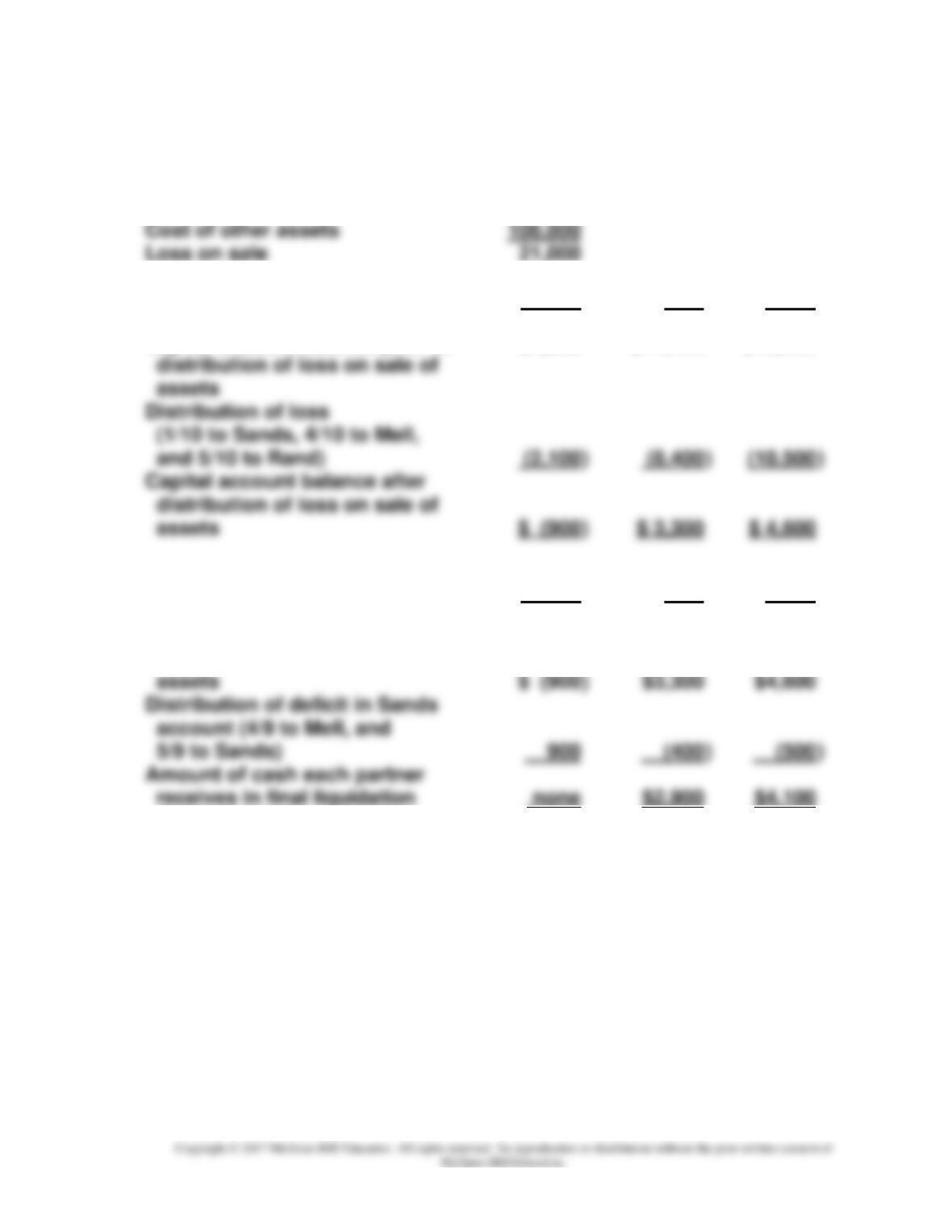
Sand, Mell, and Rand are partners who share incomes and losses in a 1:4:5
ratio. After lengthy disagreements among the partners and several
unprofitable periods, the partners decided to liquidate the partnership.
Determine the following:
John J. Wild, Financial Accounting: Information for Decisions, 8th Edition
D-8
SOLUTION: ALTERNATE DEMONSTRATION PROBLEM
APPENDIX D
1.
Proceeds from sale
$85,000
106,000
2.
Sands
Mell
Rand
)
)
)
)
Capital account balance prior to
$1,200
$11,700
$15,100
3.
Sands
Mell
Rand
)
$4,600
account (4/9 to Mell, and
)
)
$4,100
Capital account balance after
distribution of loss on sale of