
John J. Wild, Financial Accounting: Information for Decisions, 8th Edition
C-1
APPENDIX C
INVESTMENTS AND
INTERNATIONAL OPERATIONS
Related Assignment Materials
Student Learning Objectives
Questions
Quick
Studies*
Exercises*
Problems*
Beyond the
Numbers
Conceptual objectives:
C1. Distinguish between debt and
equity securities and between
short-term investments and
long-term investments.
1, 2, 5
C-1, C-2
C-1, C-11
C-5, C-6
C2. Describe how to report equity
securities with controlling
influence.
16, 17, 18
C-12, C-13
C-13
C-5,
GL C-2
C-6
C3. Explain foreign exchange rates
and record transactions listed in
a foreign currency. (Appendix
C-A)
12, 13, 14,
15
C-16, C-17
C-15, C-16
C-6
C-1, C-7,
C-8
Analytical objectives:
A1. Compute and analyze the
components of return on total
assets.
C-14, C-15
C-14
C-1, C-2,
C-9
Procedural objectives:
P1. Account for trading securities.
C-3, C-4,
C-5, C-16,
C-18
C-2, C-3,
C-6, C-8
C-1, SP C
C-6
P2. Account for held-to–maturity
securities.
5, 9
C-6
C-4, C-6,
C-3, C-6
securities.
15
C-9, C-10
C-7, C-8,
C-4, C-5,
significant influence.
John J. Wild, Financial Accounting: Information for Decisions, 8th Edition
C-2
Additional Information on Related Assignment Material
Connect
Available on the instructor’s course-specific website) repeats all numerical Quick Studies, all Exercises and
Problems Set A. Connect also provides algorithmic versions for Quick Study, Exercises and Problems. It allows
instructors to monitor, promote, and assess student learning. It can be used in practice, homework, or exam mode.
Connect Insight
The first and only analytics tool of its kind, Connect Insight is a series of visual data displays that are each framed
The Serial Problem for Success Systems continues in this chapter.
General Ledger
Assignable within Connect, General Ledger (GL) problems offer students the ability to see how transactions post
from the general journal all the way through the financial statements. Critical thinking and analysis components are
added to each GL problem to ensure understanding of the entire process. GL problems are auto-graded and provide
instant feedback to the student.
Excel Simulations
Synopsis of Chapter Revisions
• New three-step process for fair value adjustment.
John J. Wild, Financial Accounting: Information for Decisions, 8th Edition
C-3
Chapter Outline
Notes
I. Basics of Investments
A. Motivation for Investments—three reasons:
3. Strategic reasons. Examples: investments in competitors,
suppliers or customers.
1. Companies transfer excess cash to investments to produce
higher income.
B. Short-Term Investments
1. Cash equivalents are investments that are both readily
converted to known amounts of cash and mature within three
months.
2. Short-term investments (temporary investments or marketable
securities) -current assets that must meet these 2 requirements:
C. Long-Term Investments
1. Are not readily convertible to cash and not intended to be
converted to cash in short-term.
operations.
D. Investments in securities can include both debt and equity
securities.
1. Debt securities reflect a creditor relationship.
2. Equity securities reflect an owner relationship.
E. Classification and Reporting of Investments—accounting for
investments in securities depends on three factors:
2. Holding intention—either short term or long term.
3. Percentage of ownership.
1. Security type—either debt or equity.
E. Classifications of investments and reporting approach:
1. Trading securities (always short-term)—reported at fair value.
John J. Wild, Financial Accounting: Information for Decisions, 8th Edition
C-4
Chapter Outline
Notes
F. Accounting Basics for Investments
1. Debt Securities
a. Acquisition is recorded at cost (including any fees).
2. Equity Securities.
a. Acquisition is recorded at cost (including any fees).
reported on income statement.
loss is recorded.
II. Reporting of Noninfluential Investments—most must be reported at
fair value. Exact reporting depends on classification. The accounting
for each classification is as follows:
A. Trading Securities (debt and equity –less than 20% of voting
stock)—intended to be actively managed and traded for profit.
1. Entire portfolio is reported at fair value.
2. Fair value adjustment from cost results in unrealized gain (or
B. Held-to–Maturity Securities (HTM)—Debt securities a company
intends and is able to hold until maturity.
1. Classify as long-term investment when maturity date extends
beyond one year or the operating cycle, whichever is longer.
John J. Wild, Financial Accounting: Information for Decisions, 8th Edition
C-5
Chapter Outline
Notes
2. Entire portfolio is reported at fair value.
C. Available-for-Sale Securities (AFS)—debt and equity (less than
20% of voting stock) securities that are not intended to be held to
maturity. Intent is to sell them in future.
1. Long vs. short-term classification depends on when they are
intended to be sold.
III. Reporting of Influential Investments
A. Investment in Securities with Significant Influence.—Implies
investor can exert significant influence over the investee.
1. An investor who owns more than 20% (but not more than
50%) is presumed to have a significant influence over the
investee.
2. Equity method is used. Under this method the investor
a. records its share of the investee’s earnings as increase to
its investment and on its income statement.
b. reduces investment by share of losses and also reports
them on the income statement.
B. Investment in Securities with Controlling Influence—Investor is
able to exert a controlling influence over the investee (generally
owns more than 50% of a company’s voting stock).
1. The equity method with consolidation (subject for advanced
course) is used.
2. The controlling investor is called the parent company and the
C. Summary of Accounting for Investments in Securities
See Exhibit C.8.
John J. Wild, Financial Accounting: Information for Decisions, 8th Edition
C-6
Chapter Outline
Notes
D. Comprehensive Income—is defined as all changes in equity for a
period except those due to owner investments and dividends.
2. Can be reported in financial statements in one of two ways
1. Includes: Unrealized gains and losses on AFS securities,
foreign currency adjustments and certain pension adjustments.
IV. Global View—Compares U.S. GAAP to IFRS
A. Accounting for Noninfluential Securities—both systems are
broadly similar. Differences in terminology exist.
similar. Differences in terminology exist.
V. Decision Analysis—Components of Return on Total Assets
A. Assesses financial performance and can be separated into two
components:
B. Calculated as:
1. Profit margin (net income divided by net sales) reflects the
percentage of net income in each dollar of net sales.
VI. Investments in International Operations—Appendix C-A
A. Exchange Rates Between Currencies
1. Price of one currency stated in terms of another currency is
called a foreign exchange rate.
B. Sales and Purchases Listed in a Foreign Currency
1. Companies making sales (or purchases) for which they receive
(or pay) foreign currency must translate the transaction
amounts into domestic currency. The transaction is recorded

John J. Wild, Financial Accounting: Information for Decisions, 8th Edition
C-7
Alternate Demonstration Problem
Appendix C
2017
Jan
1
Investor Corporation purchased 8,000 shares (20%) of Investee
Company’s outstanding stock at a cost of $150,000.
May
31
Investee Company declared and paid a cash dividend of $1.50 per
share.
Dec
31
Investee Company announced that its net income for the year was
$100,000.
2018
Oct
1
Investee Company declared and paid a cash dividend of $1.00 per
share.
Dec
31
Investee Company announced that its net income for the year was
$80,000.
2019
Jan
1
Investor Corporation sold all of its shares of Investee Company
for $178,000 cash.
Required:
1. Prepare journal entries on Investor Corporation’s books using the
equity method, which assumes that Investor has significant influence
over Investee Company.
2. Prepare journal entries on Investor Corporation’s books using the cost
method, which assumes that even though Investor owns 20% of
Investee’s stock, Investor does not have significant influence over
Investee (for example, another corporation owns 70% of Investee
Company’s stock).
John J. Wild, Financial Accounting: Information for Decisions, 8th Edition
C-8
Solution: Alternate Demonstration Problem
Appendix C
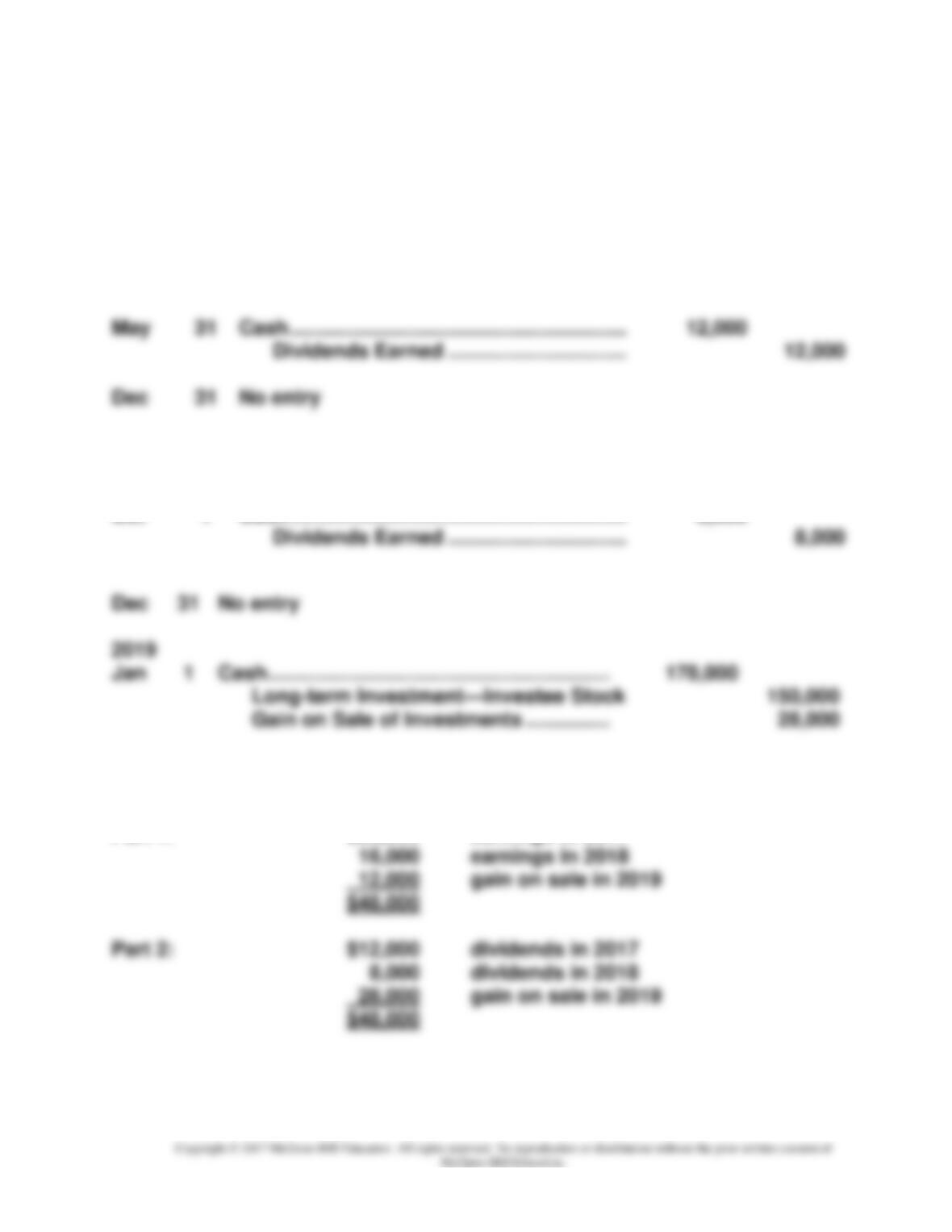
Part 1
2017
Jan
1
Long-Term Investment—Investee Stock ..
150,000
Cash ………………………………………………
150,000
May
Cash ……………………………………………………
Long-Term Investment—Investee Stock
Dec
Long-Term Investment—Investee Stock ..
2018
Oct
1
Cash ……………………………………………………
8,000
Long-Term Investment—Investee Stock
8,000
Dec
Long-Term Investment—Investee Stock ..
2019
Jan
1
Cash ……………………………………………………
178,000
Long-Term Investment—Investee Stock
166,000
Gain on Sale of Investments …………..
John J. Wild, Financial Accounting: Information for Decisions, 8th Edition
C-9
Solution: Alternate Demonstration Problem
Appendix C
Part 2
2017
Jan
1
Long-Term Investment—Investee Stock ..
150,000
Cash ………………………………………………
150,000
May
Cash ……………………………………………………
Dividends Earned …………………………..
Dec
2018
Oct
1
Cash ……………………………………………………
8,000
Dividends Earned …………………………..
8,000
Dec
2019
Jan
Cash …………………………………………………….
Long-term Investment—Investee Stock
150,000
Gain on Sale of Investments ……………
Note that the total income statement effect is the same under both
methods:
Part 1:
$20,000
earnings in 2017
earnings in 2018
Part 2:
$12,000
$48,000