Appendix C
Time Value of Money
REVIEW QUESTIONS
Question C-1 (LO C-1)
Interest is the cost of borrowing money. Simple interest is interest we earn on the initial investment
only. Compound interest is the interest we earn on the initial investment plus previous interest. We
use compound interest in calculating the time value of money.
Question C-2 (LO C-2)
To compute a future value, you need to know three amounts: (1) initial investment, (2) the interest
rate per period and (3) the number of periods.
Question C-3 (LO C-2)
BRIEF EXERCISES
Brief Exercise C-1 (LO C-1)
Oprah should choose the second option, the investment on which interest is
compounded semiannually. The more frequent the rate of compounding, the more
interest we earn on previous interest, resulting in a higher future value.
Brief Exercise C-2 (LO C-2)
Initial
investment
Annual
rate
Interest
compounded
Period
invested
Future
Value
$15,000
9%
Annually
6 years
$25,156.50a
Brief Exercise C-3 (LO C-2)
Initial
investment
Annual
rate
Interest
compounded
Period
invested
Future
Value
$27,000
7%
Annually
2 years
$30,912.30a
Brief Exercise C-4 (LO C-2)
Initial
investment
Annual
rate
Interest
compounded
Period
invested
Future
Value
1.
$8,000
10%
Annually
7 years
$15,589.74a
2.
4 years
3.
3 years
Brief Exercise C-5 (LO C-2)
Future
value
Annual
Rate
Interest
compounded
Period
invested
Present
Value
$6,000
8%
Annually
5 years
$4,083.50a
Brief Exercise C-6 (LO C-2)
Future
value
Annual
Rate
Interest
compounded
Period
invested
Present
Value
$55,000
6%
Annually
3 years
Brief Exercise C-7 (LO C-2)
Future
value
Annual
Rate
Interest
compounded
Period
invested
Present
value
1.
$10,000
6%
Annually
5 years
$7,472.58a
Brief Exercise C-8 (LO C-3)
Annuity
payment
Annual
Rate
Interest
compounded
Period
invested
Future value
of annuity
$4,000
8%
Annually
7 years
$35,691.21a
Brief Exercise C-9 (LO C-3)
Annuity
payment
Annual
Rate
Interest
compounded
Period
invested
Future value
of annuity
$3,000
10%
Semiannually
5 years
$37,733.68a
Brief Exercise C-10 (LO C-3)
Annuity
payment
Annual
Rate
Interest
compounded
Period
invested
Future value
of annuity
1.
$3,000
7%
Annually
Six years
$ 21,459.87a
2.
6,000
Semiannually
Brief Exercise C-11 (LO C-3)
Annuity
Payment
Annual
Rate
Interest
compounded
Period
invested
Present value
of annuity
$8,000
6%
Annually
Four years
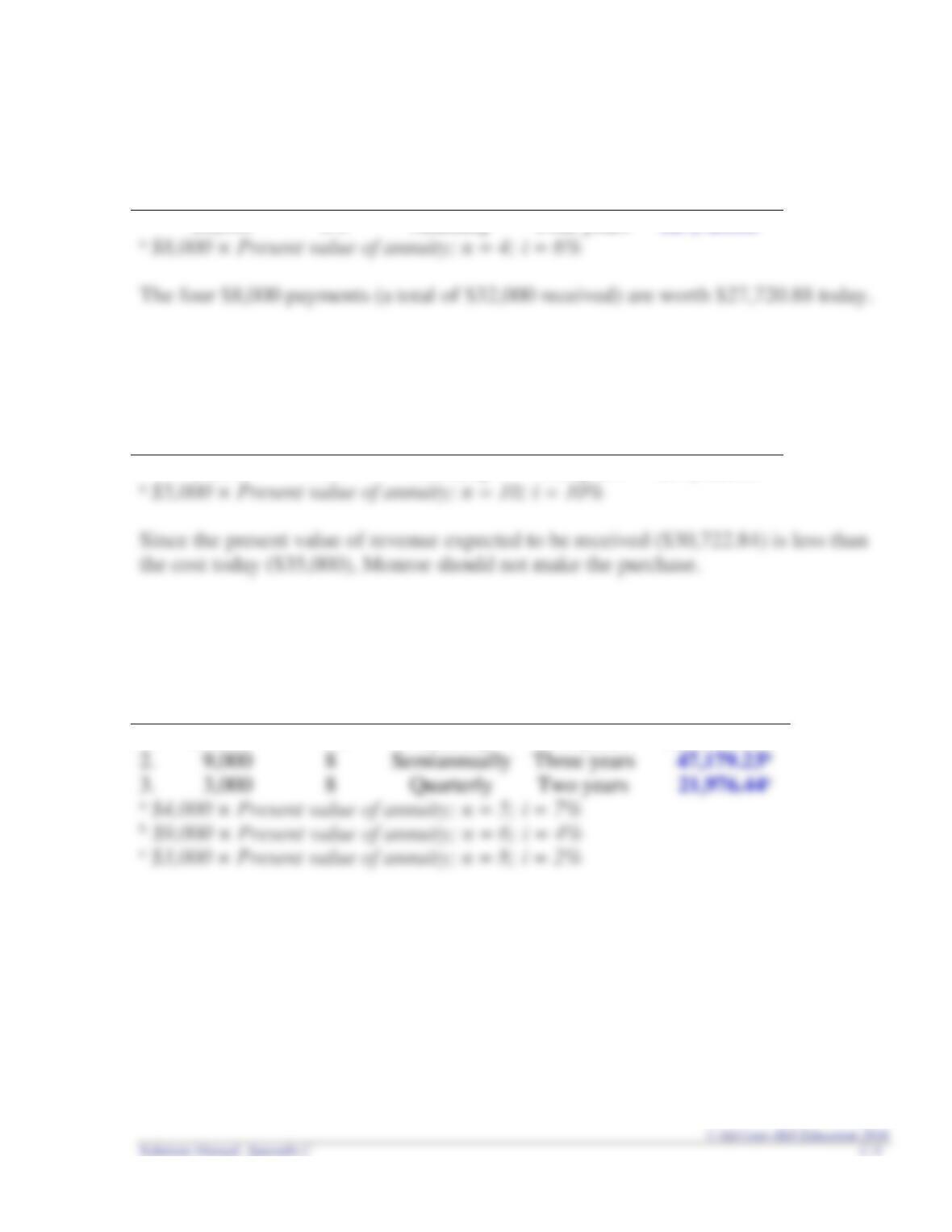
$27,720.88a
Brief Exercise C-12 (LO C-3)
Annuity
Payment
Annual
Rate
Interest
compounded
Period
invested
Present value
of annuity
$5,000
10%
Annually
Ten years
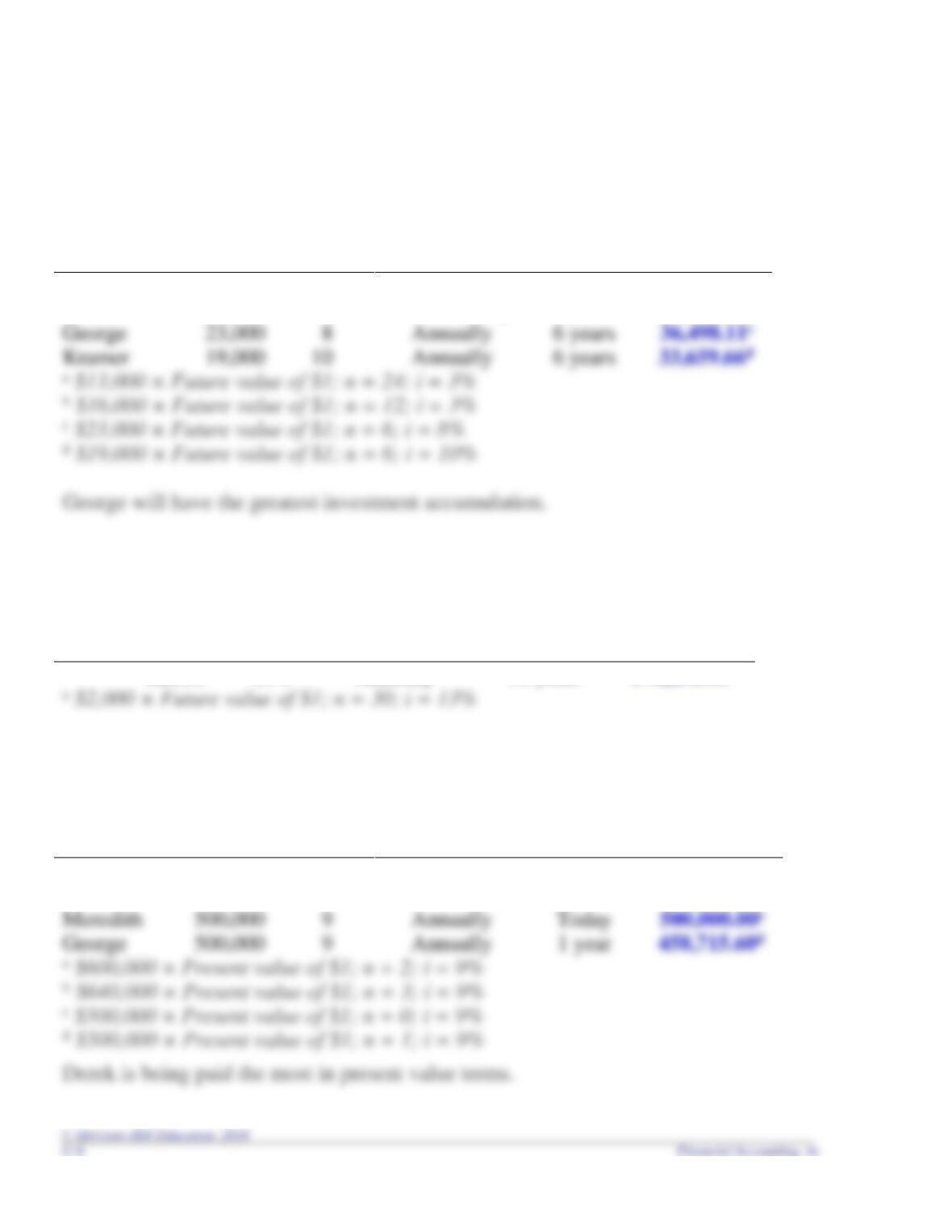
$30,722.84a
Brief Exercise C-13 (LO C-3)
Annuity
Payment
Annual
rate
Interest
compounded
Period
invested
Present value
of annuity
1.
$4,000
7%
Annually
Five years
$16,400.79a
2.
Semiannually
Three years
EXERCISES
Exercise C-1 (LO C-2)
Investment
amount
Interest
rate
Compounding
Period
invested
Future
Value
Jerry
$13,000
12%
Quarterly
6 years
$26,426.32a
Elaine
16,000
6
Semiannually
6 years
22,812.17b
Kramer
19,000
Annually
6 years
33,659.66d
Exercise C-2 (LO C-2)
Initial
investment
Annual
rate
Interest
compounded
Period
invested
Future
Value
$2,000
13%
Annually
30 years
$78,231.80a
Exercise C-3 (LO C-2)
Contract
amount
Discount
rate
Compounding
Period
invested
Present
Value
Derek
$600,000
9%
Annually
2 years
$505,008.00a
Isabel
640,000
9
Annually
3 years
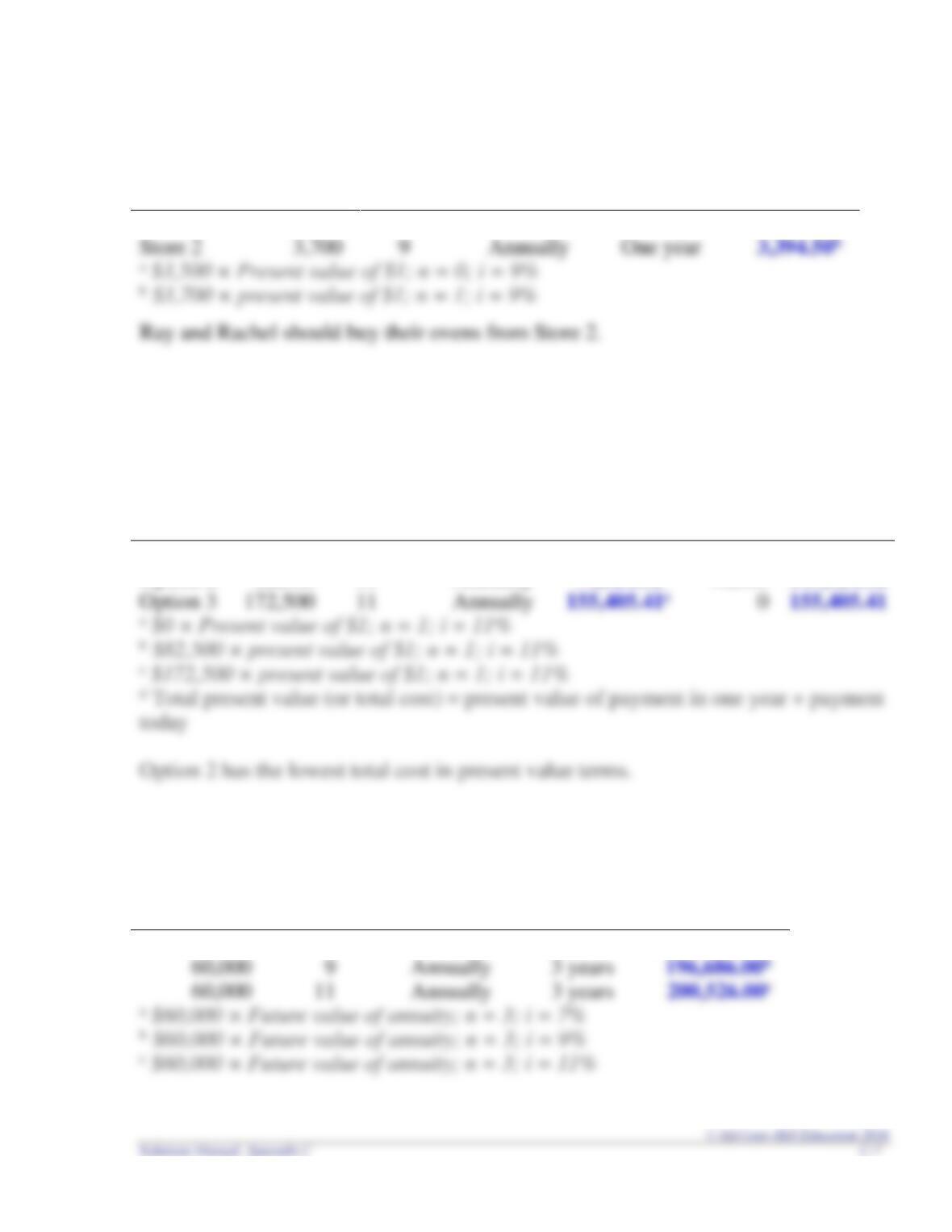
494,197.43b
Meredith
500,000
9
Annually
Exercise C-4 (LO C-2)
Purchase
amount
Discount
rate
Compounding
Period
due
Present
Value
Store 1
$3,500
9%
Annually
Today
$3,500.00a
Store 2
Annually
One year
Exercise C-5 (LO C-2)
Payment
in one
year
Discount
rate
Compounding
Present
value of
payment in
one year
Payment
today
Total
present
value (or
total cost)d
Option 1
$ 0
11%
Annually
$ 0a
$150,000
$150,000.00
Option 2
82,500
11
Annually
74,324.32b
75,000
149,324.32
Option 3
11
Annually
155,405.41
Exercise C-6 (LO C-3)
Annuity
payment
Annual
Rate
Interest
compounded
Period
invested
Future value
of annuity
$60,000
7%
Annually
3 years
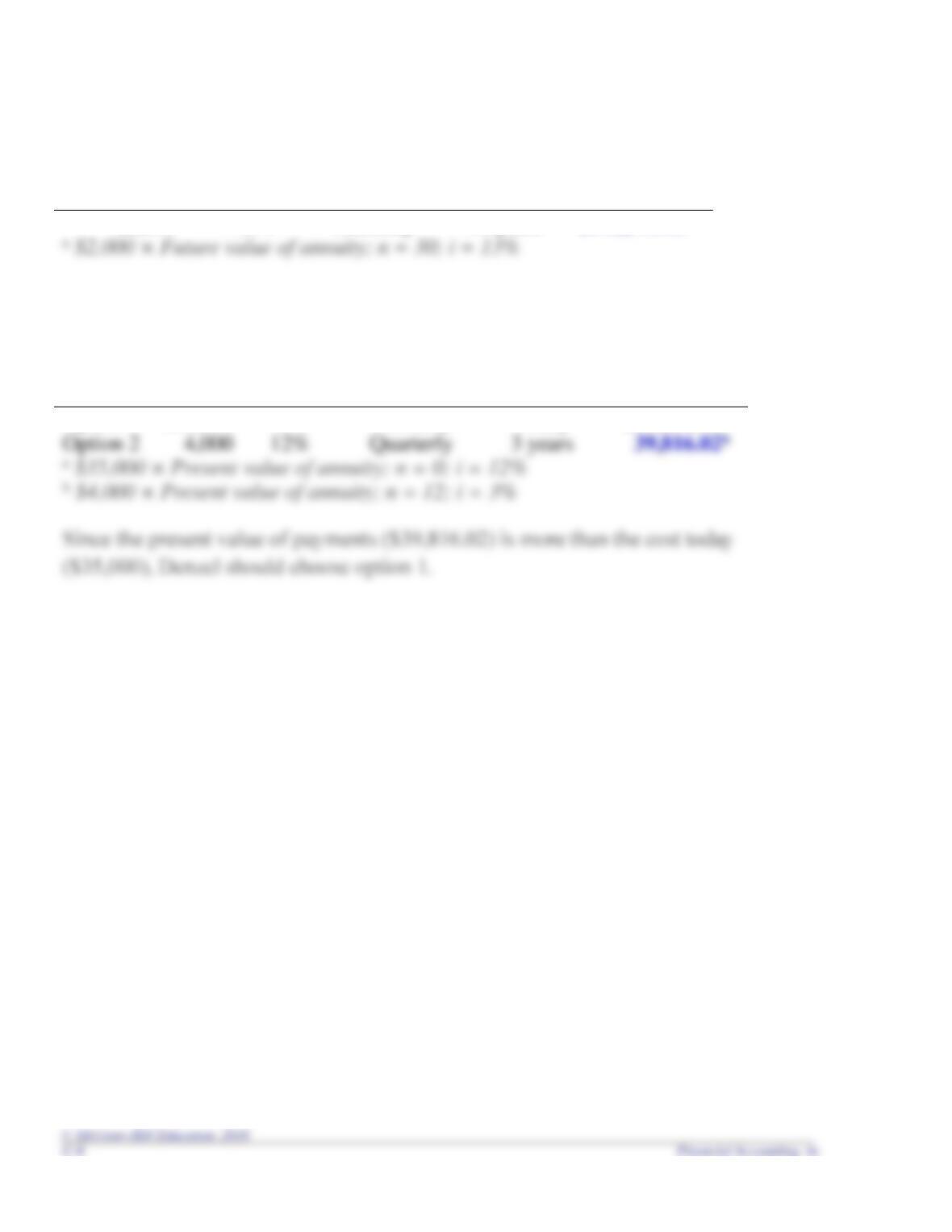
$192,894.00a
Annually
3 years
11
Annually
3 years
Exercise C-7 (LO C-3)
Annuity
payment
Annual
Rate
Interest
compounded
Period
invested
Future value
of annuity
$2,000
13%
Annually
30 years
$586,398.43a
Exercise C-8 (LO C-3)
Annuity
payment
Annual
Rate
Interest
compounded
Period
invested
Present value
of annuity
Option 1
$35,000
12%
Annually
Today
$35,000.00a
Option 2
12%
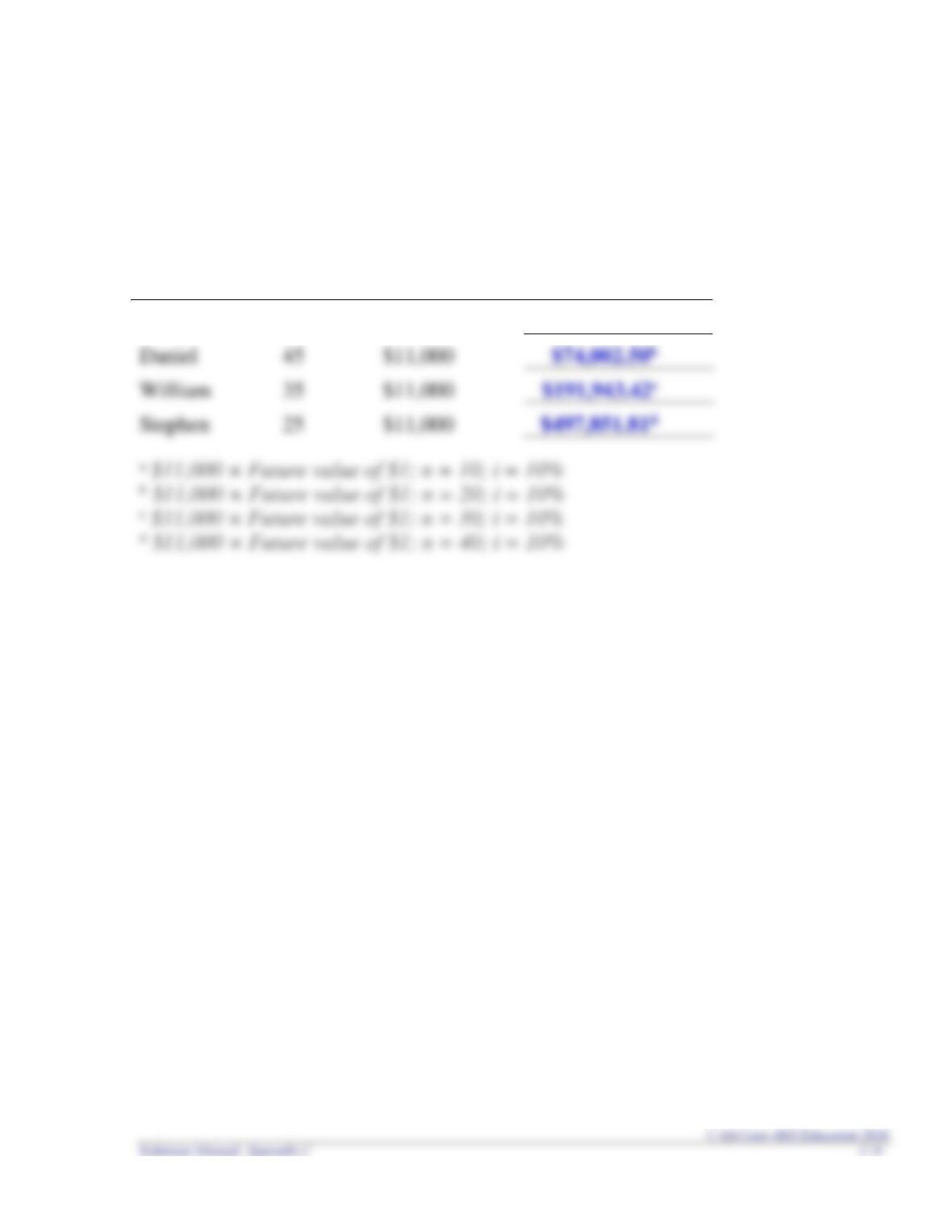
PROBLEMS: SET A
Problem C-1A (LO C-2)
Person
Age
Initial
investment
Accumulated
investment by
retirement
(age 65)
Alec
55
$11,000
$28,531.17a
Daniel
45
$11,000
William
35
$11,000
Stephen
$11,000
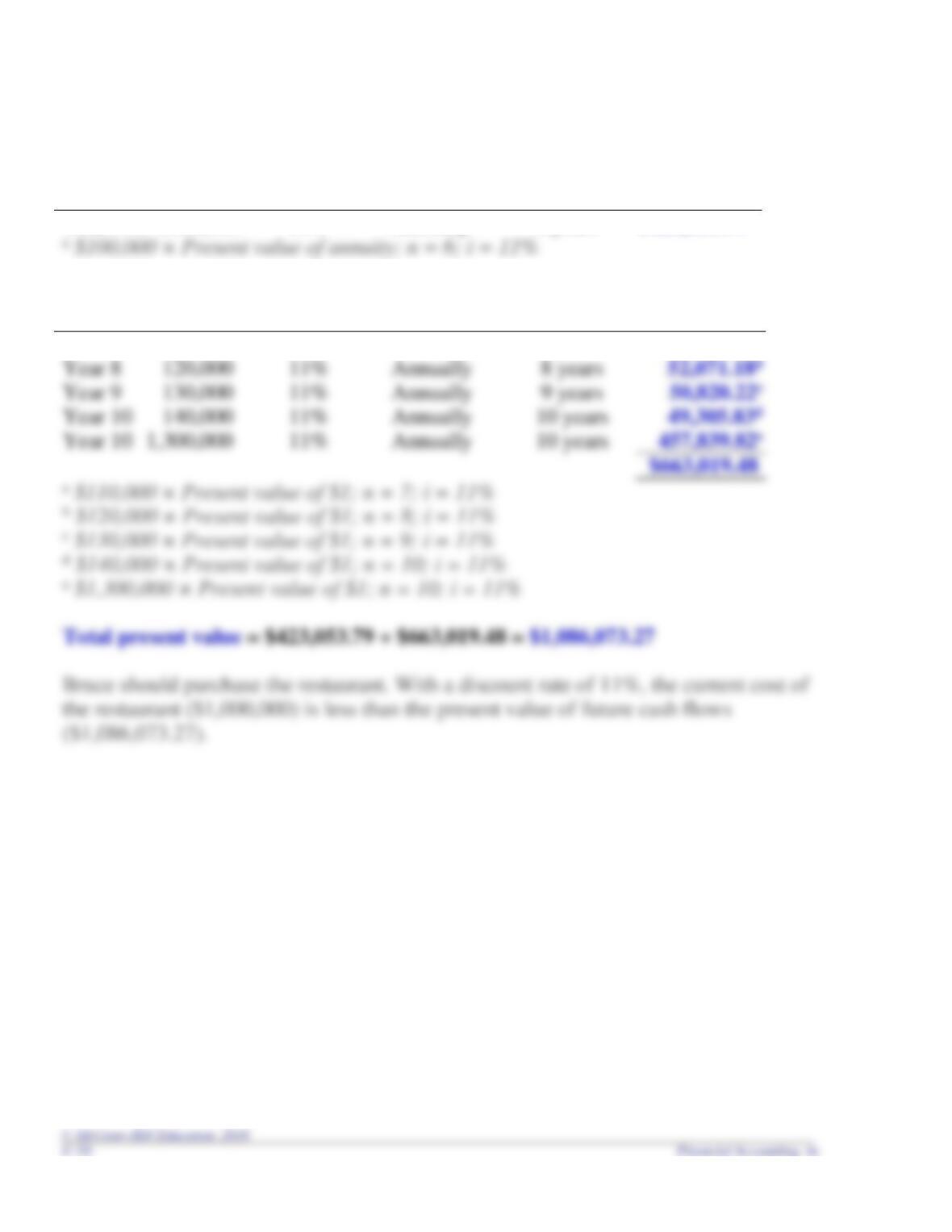
Problem C-2A (LO C-2, C-3)
Annuity
payment
Discount
Rate
Interest
compounded
Period
invested
Present value
of annuity
Years 1-6
$100,000
11%
Annually
6 years
$423,053.79a
Future
value
Discount
rate
Interest
compounded
Period
invested
Present
Value
Year 7
$110,000
11%
Annually
7 years
$ 52,982.43a
Year 8
11%
Annually
8 years
Year 9
11%
Annually
9 years
Year 10
11%
Annually
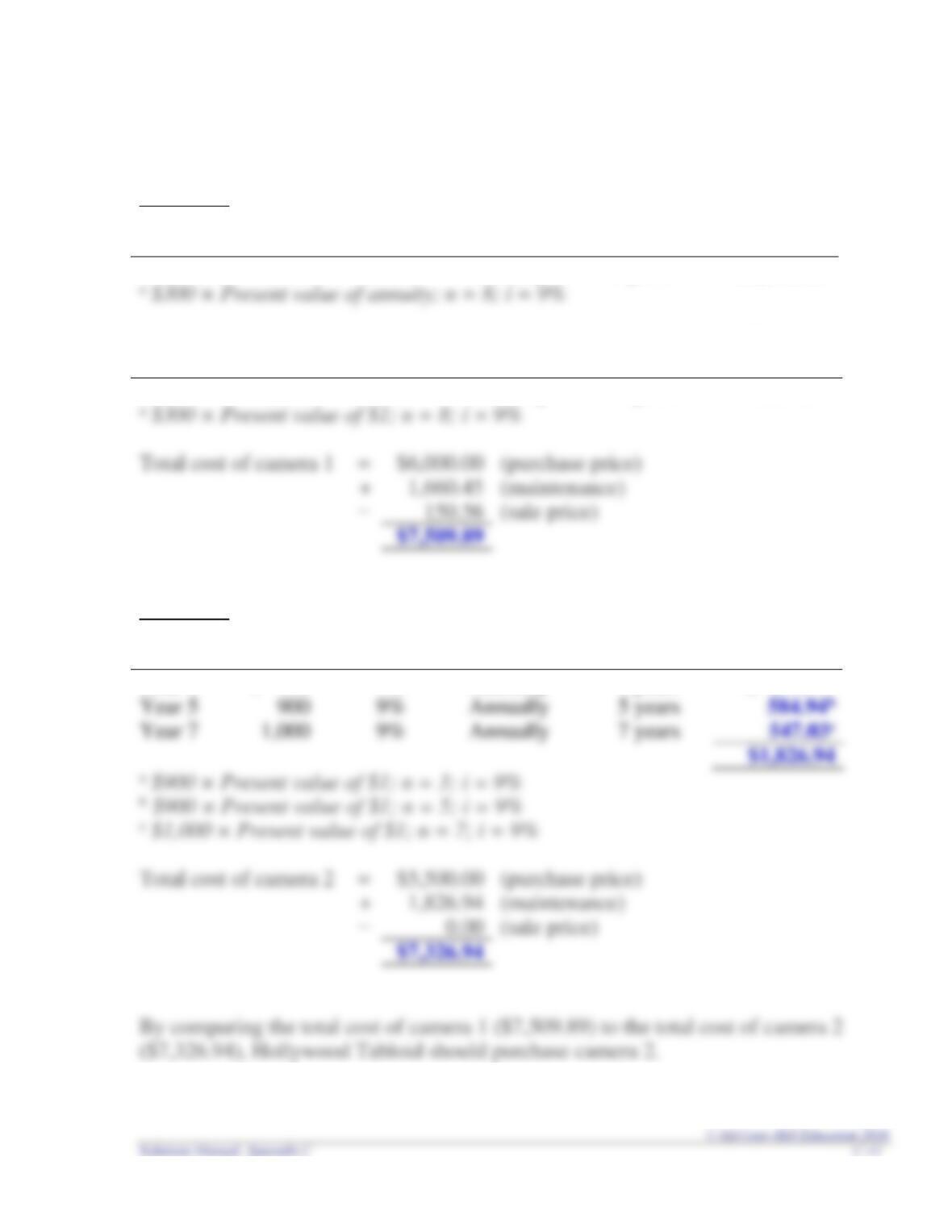
Problem C-3A (LO C-2, C-3)
Camera 1:
Annuity
payment
Discount
Rate
Interest
compounded
Period
invested
Present value
of annuity
Years 1-8
$300
9%
Annually
8 years
$1,660.45a
Future
value
Discount
rate
Interest
compounded
Period
invested
Present
Value
Year 8
$300
9%
Annually
8 years
$150.56a
+
Camera 2:
Future
payment
Discount
rate
Interest
compounded
Period
invested
Present
Value
Year 3
$ 900
9%
Annually
3 years
$ 694.97a
Year 5
9%
Annually
5 years
Year 7
9%
Annually
7 years
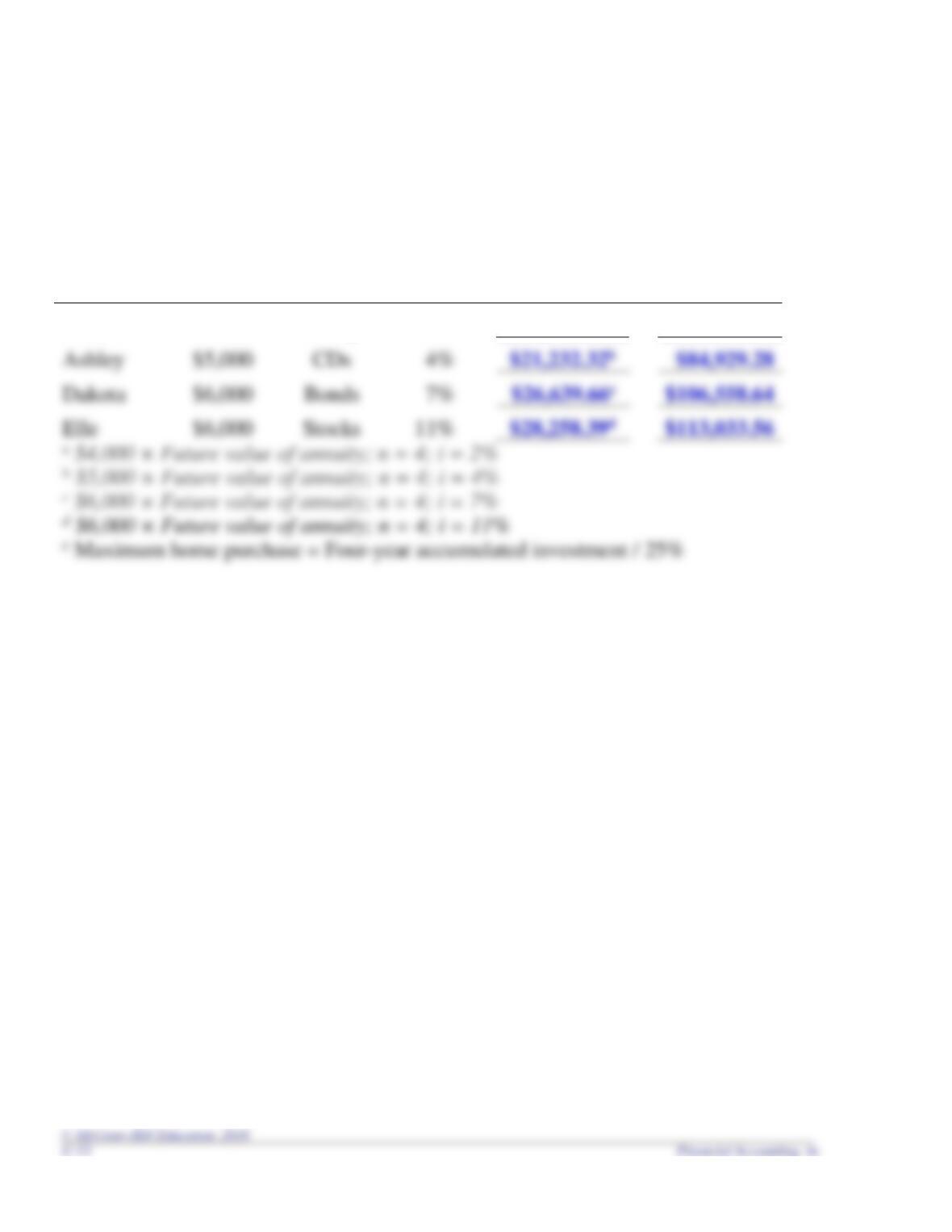
PROBLEMS: SET B
Problem C-1B (LO C-3)
Requirements 1 and 2
Person
Annuity
Payment
Type of
account
Expected
Annual
Return
Four-year
accumulated
investment
Maximum
home
purchasee
Mary Kate
$4,000
Savings
2%
$16,486.43a
$65,945.72
Elle
$6,000
Stocks
Problem C-2B (LO C-2, C-3)
Annuity
payment
Discount
Rate
Interest
compounded
Period
invested
Present value
of annuity
9%
Future
value
Discount
rate
Interest
compounded
Period
invested
Present
Value
Year 20
$600,000
9%
Annually
20 years
$107,058.53a
Problem C-3B (LO C-2, C-3)
Option 1:
Present value = $1,600,000
Option 2:
Annuity
payment
Discount
Rate
Interest
compounded
Period
invested
Present value
of annuity
Years 1-10
$150,000
8%
Annually
10 years
$1,006,512.21a
Option 3:
Annuity
payment
Discount
Rate
Interest
compounded
Period
invested
Present value
of annuity
Years 1-10
$250,000
10 years
Option 4:
Future
payment
Discount
rate
Interest
compounded
Period
invested
Present
Value
8%