Appendix A – Reporting and Interpreting Investments in Other Corporations
App A – 1
APPENDIX A
REPORTING AND INTERPRETING
INVESTMENTS IN OTHER CORPORATIONS
Learning Objectives and Related Assignment Materials
Learning Objectives
Mini-
Exercises
Exercises
Problems
Alternate
Problems
Cases and
Projects
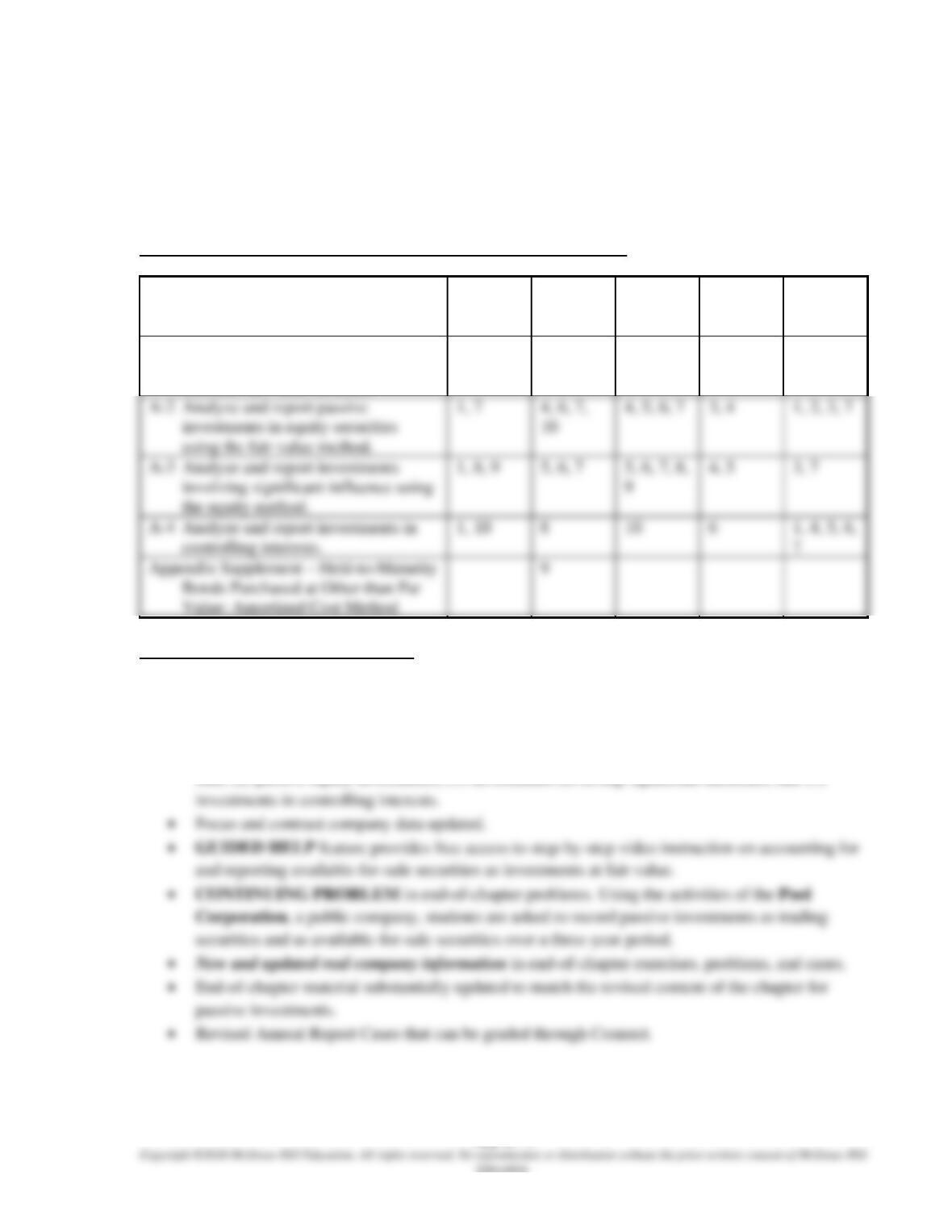
A-1 Analyze and report investments in
debt securities using the amortized
cost and fair value methods.
1, 2, 3, 4,
5, 6
1, 2, 3,
11
1, 2, 3, 4
1, 2, 3
1, 2, 7
Synopsis of Chapter Revisions
Focus Company: The Walt Disney Company
• New focus company, The Walt Disney Company, a recognizable global company that builds
and expands its brands through investing in other companies. Accounting and reporting are
discussed and illustrated for (1) debt securities held to maturity, actively traded, and available for
sale; (2) passive equity investments; (3) investments involving significant influence; and (4)
Appendix A – Reporting and Interpreting Investments in Other Corporations
PowerPoint Slides
Learning Objectives
PowerPoint® Slides
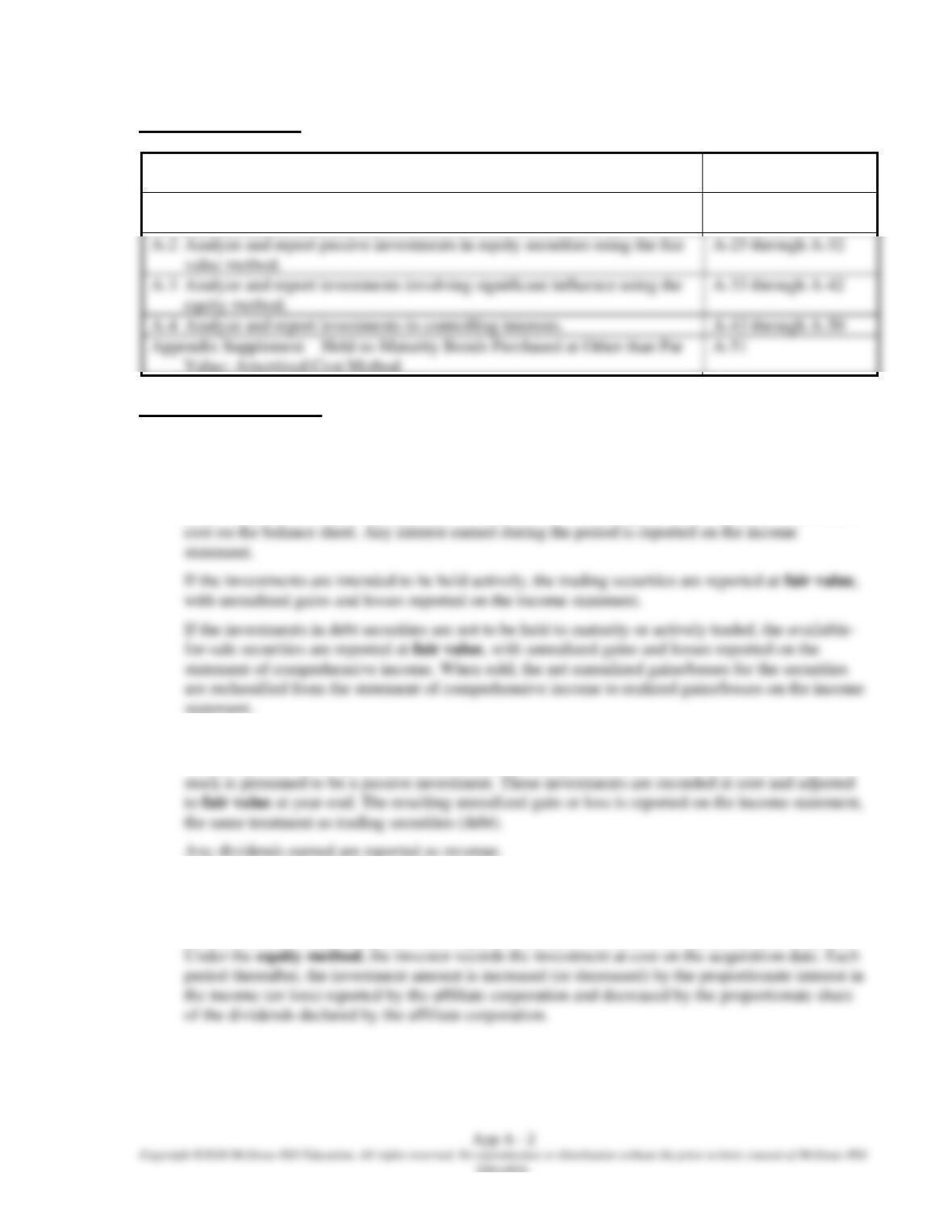
A-1 Analyze and report investments in debt securities using the amortized cost
and fair value methods.
A-10 through A-24
A-2 Analyze and report passive investments in equity securities using the fair
value method.
A-25 through A-32
A-3 Analyze and report investments involving significant influence using the
equity method.
A-33 through A-42
Appendix Supplement – Held-to–Maturity Bonds Purchased at Other than Par
A-51
Chapter Take-Aways
A-1 Analyze and report investments in debt securities using the amortized cost and fair value
methods.
When management intends to hold an investment in a debt security (such as a bond or note) until it
matures, the held-to–maturity security is recorded at cost when acquired and reported at amortized
A-2 Analyze and report passive investments in equity securities using the fair value method.
Acquiring less than 20 percent of the outstanding voting shares of another company’s common
A-3 Analyze and report investments involving significant influence using the equity method.
If between 20 and 50 percent of the outstanding voting shares are owned, significant influence over
the affiliate firm’s operating and financing policies is presumed, and the equity method is applied.

Appendix A – Reporting and Interpreting Investments in Other Corporations
App A – 3
Chapter Take-Aways, continued
A-4 Analyze and report investments in controlling interests.
Mergers occur when one company purchases all of the net assets of another and the target company
ceases to exist as a separate legal entity. Mergers and ownership of a controlling interest of another
Finding Financial Information
Balance Sheet
Current Assets
Investments (trading securities (debt) and
equity securities if intended to be current)
Noncurrent Assets
Investments (available-for-sale debt
Stockholders’ Equity
Other comprehensive income (for unrealized
gains/losses in available-for-sale debt
securities)
Statement of Comprehensive Income
Income Statement
Under “Other Items”:
Dividend and interest revenue
Gains or losses on sale of investments
Net unrealized gains/losses (on trading
securities or passive equity investments)
Statement of Cash Flows
Operating Activities:
Net income adjusted for:
Gains/losses on sale of investments
Net unrealized gains/losses (from trading
securities and passive equity securities)
Notes
In Various Notes
Accounting policies for investments
Appendix A – Reporting and Interpreting Investments in Other Corporations
Chapter Outline
Teaching Notes
LO A-1 – Analyze and report investments in debt securities using the amortized cost and fair value
methods.
I. Types of Investments and Accounting Methods
Illustrated in Exhibit A.2
A. Passive Investments in Debt and Equity Securities
1. Passive investments are made to earn a return on funds
that may be needed for future
2. Category includes:
a. Investments in debt (bonds and notes); always
considered passive investments
i. If the company intends to hold the securities until
b. Investments in equity securities (stock)
classified as current or noncurrent investments in
i. Presumed passive if the investing company owns
less than 20% of the outstanding voting shares of
B. Investments in Stock for Significant Influence
1. Significant influence is the ability to have an important
impact on the operating, investing, and financing policies
of another company
b. Other factors may also indicate that significant
a. Presumed if the investing company owns from 20% to
2. Equity method is used to measure and report investments
in stock for significant influence
Appendix A – Reporting and Interpreting Investments in Other Corporations
C. Investments in Stock for Control
of voting stock
are applied to combine the companies
1. Control is the ability to determine the operating and
financing policies of another company through ownership
II. Passive Investment in Debt Securities
A. Purchasing Debt Securities
including transfer fees and broker commissions, is
debited to Investments
2. On October 1, 2017, Disney paid the par value of
Dr Investments (+A)
150,000
1. A debt security (bond or note) may be acquired at the
maturity amount (par), for less than the maturity amount
(at a discount), or for more (at a premium). The total cost,
B. Earning Interest Revenue
Cr Interest Revenue (+R, +SE)
1. No premium or discount needs to be amortized because
bonds were purchased at par. Disney records the receipt
of $4,500 in interest revenue every March 31 and
2. At the end of each fiscal year, measuring and reporting
investments in debt securities depend on management’s
purpose. Will the debt instruments be:
a. Held to their maturity dates (classified as either
C. If Held to Maturity
1. Debt securities are considered held-to-maturity
investments when management has the intent and ability
to hold them until maturity
Only purchases at par are covered
here; purchases of bonds at
amounts at other than par are
Appendix A – Reporting and Interpreting Investments in Other Corporations
App A – 6
amortized cost
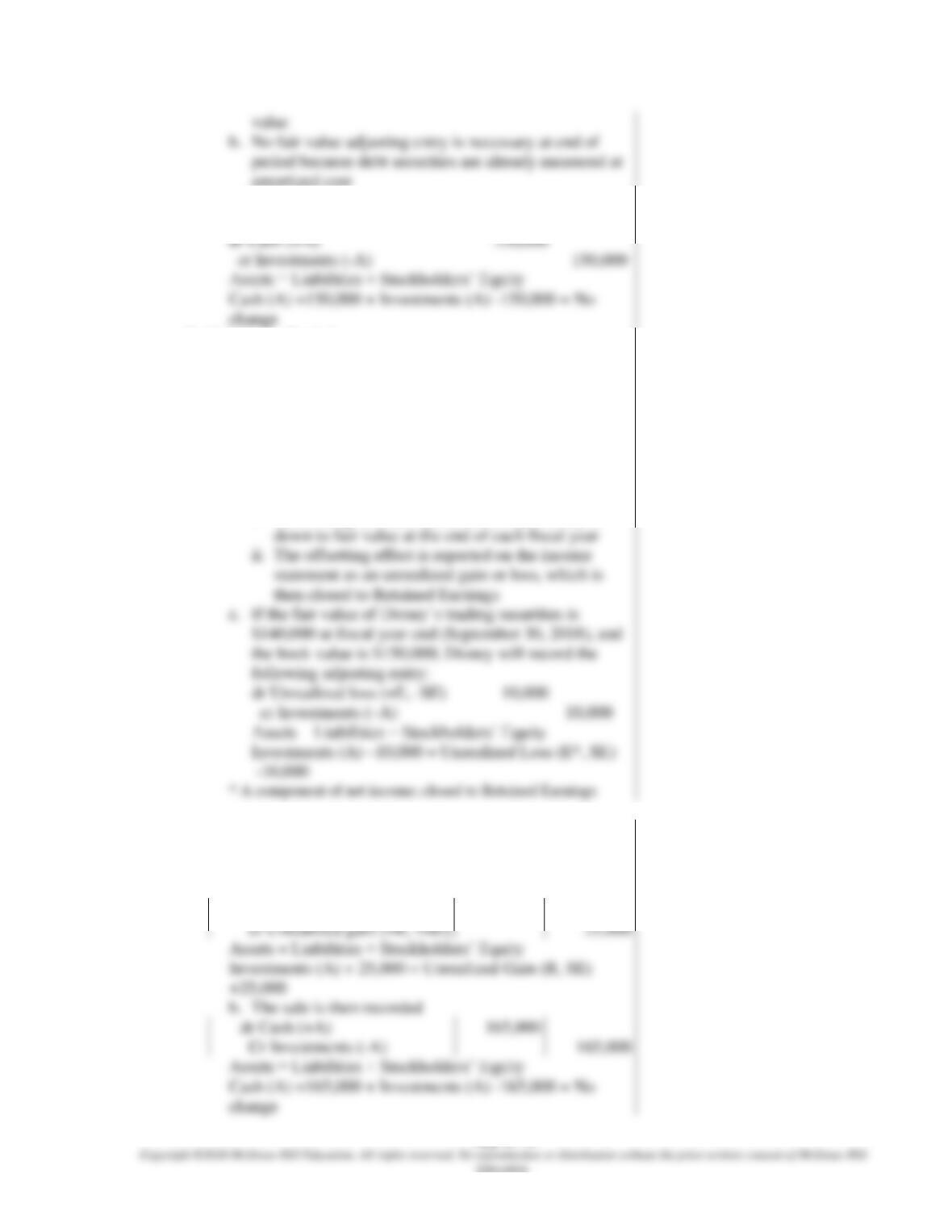
2. When Disney’s bonds investment matures on 9/30/22, the
journal entry to record the receipt of principal would be:
dr Cash (+A)
D. If Actively Traded
1. Investments in debt instruments that are held primarily
for the purpose of active trading in the near future are
accounted for as trading securities
a. Objective is to generate profits on short-term changes
in the price of the securities.
b. Trading securities with readily determinable market
values are recorded by applying the fair value method
and are reported as current assets
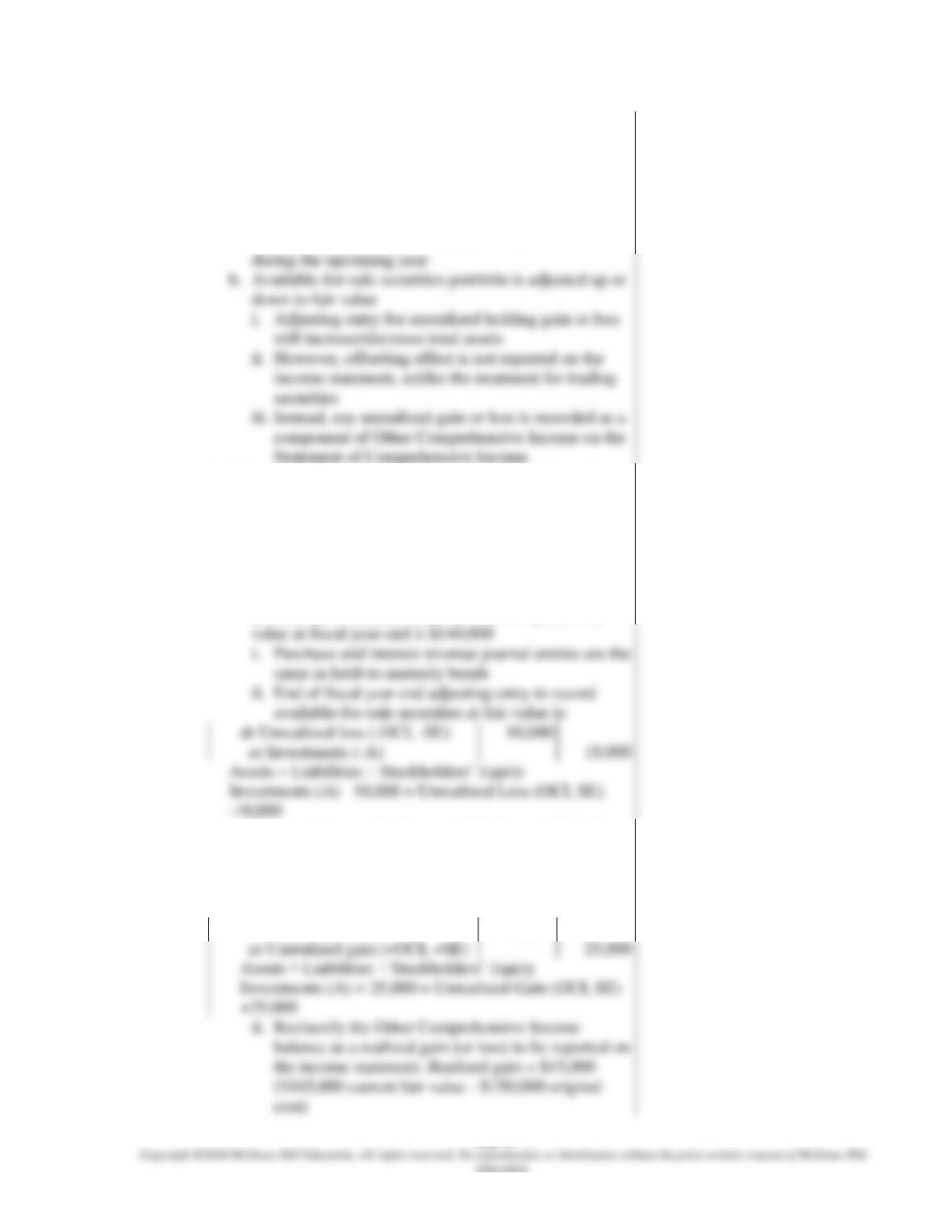
Investments (A) –10,000 = Unrealized Loss (E*, SE)
i. The trading securities portfolio is adjusted up or
2. When the securities are sold on 9/30/19, there are two
journal entries:
a. The trading securities are first adjusted to their fair
value of $165,000 on 9/30/19
dr Investments (+A)
25,000
Assets = Liabilities + Stockholders’ Equity
Cr Investments (-A)
Cash (A) +165,000 + Investments (A) -165,000 = No
Appendix A – Reporting and Interpreting Investments in Other Corporations
App A – 7
E. If Not Held to Maturity or Actively Traded
1. Debt investments not held to maturity or traded actively
are considered available-for-sale securities.
2. Available-for-sale securities with readily determinable
market values are reported at fair value
will increase/decrease total assets
a. Classified as current or noncurrent assets depending on
whether management intends to sell the securities
3. When a sale takes place, the investment portfolio is first
adjusted to fair value on the sale date. Then the
accumulated net unrealized gain or loss is reclassified out
of Other Comprehensive Income and reported on the
current period’s income statement as a realized gain or
loss.
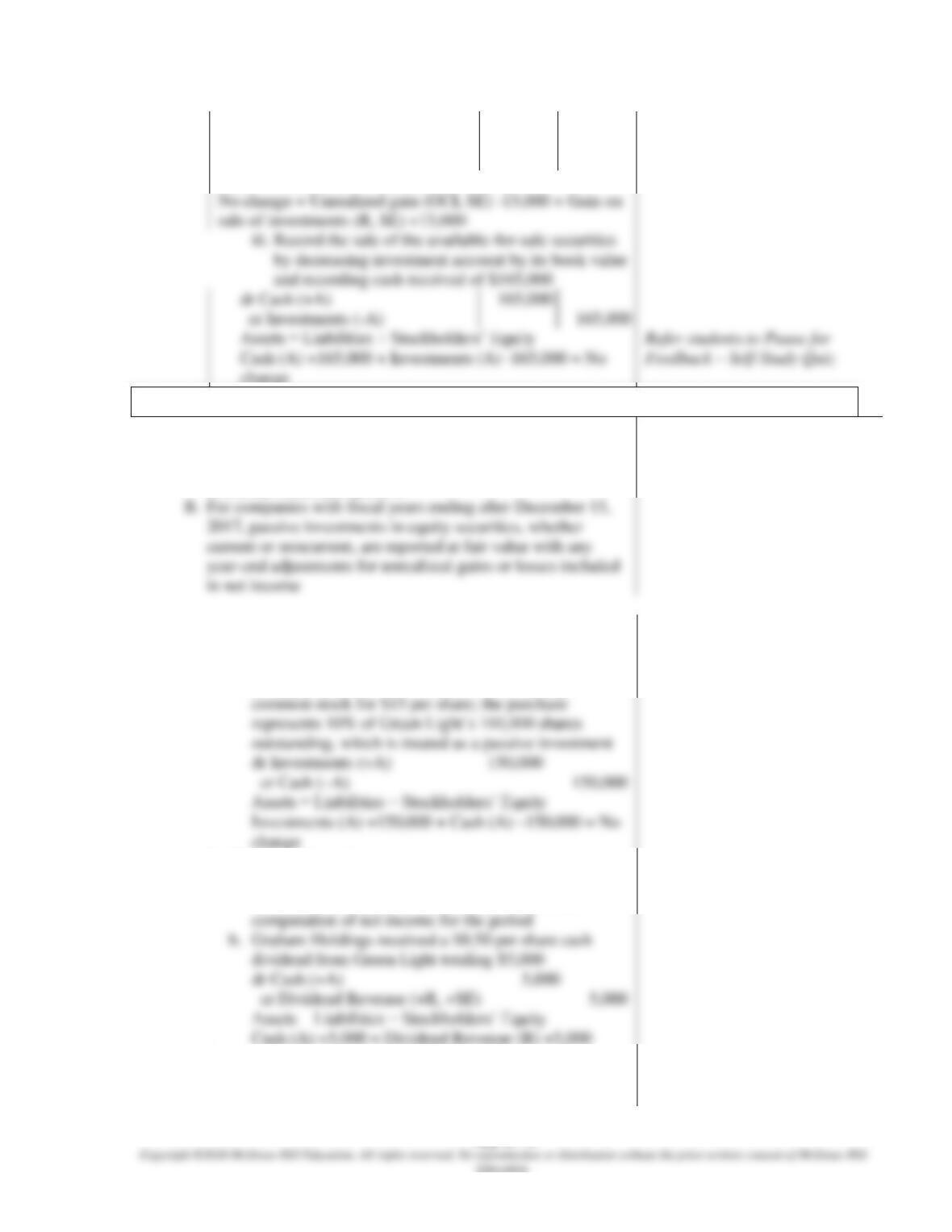
dr Unrealized loss (-OCI, –SE)
10,000
cr Investments (-A)
10,000
a. Assume Disney purchases $150,000 in bonds at par
and intends to hold the securities for two years. Fair
b. Three entries need to be recorded when available-for-
sale debt securities are sold:
i. Adjust the investment account to fair value
($165,000) as of the date of sale (9/30/19); book
value is $140,000
dr Investments (+A)
25,000
cost)
Appendix A – Reporting and Interpreting Investments in Other Corporations
App A – 8
dr Unrealized gain (-OCI, –SE)
15,000
cr Gain on sale of investments
(+R, +SE)
15,000
dr Cash (+A)
cr Investments (-A)
Assets = Liabilities + Stockholders’ Equity
change
LO A-2 – Analyze and report passive investments in equity securities using the fair value method.
III. Passive Investments: The Fair Value Method
A. When a company purchases and owns less than 20% of the
outstanding voting stock of another company, the investment
is usually considered passive
C. Purchasing Equity Securities
1. Purchase of Securities
a. Recorded initially at cost
dr Investments (+A)
cr Cash (–A)
b. Disney purchased 10,000 shares of Green Light’s
2. Dividends Earned
dr Cash (+A)
cr Dividend Revenue (+R, +SE)
a. Dividends earned are reported as investment income
on the income statement and are included in the
3. Applying the Fair Value Method
a. At end of accounting period, passive investments are
reported on the balance sheet at fair value (as current
Appendix A – Reporting and Interpreting Investments in Other Corporations
App A – 9
or noncurrent assets, depending on management’s
intent)
value at the end of the period
c. The unrealized gain or loss is reported on the income
statement
iii. Only when the security is sold are any realized
b. Reporting the investment at fair value requires
adjusting the Investments account up or down to fair
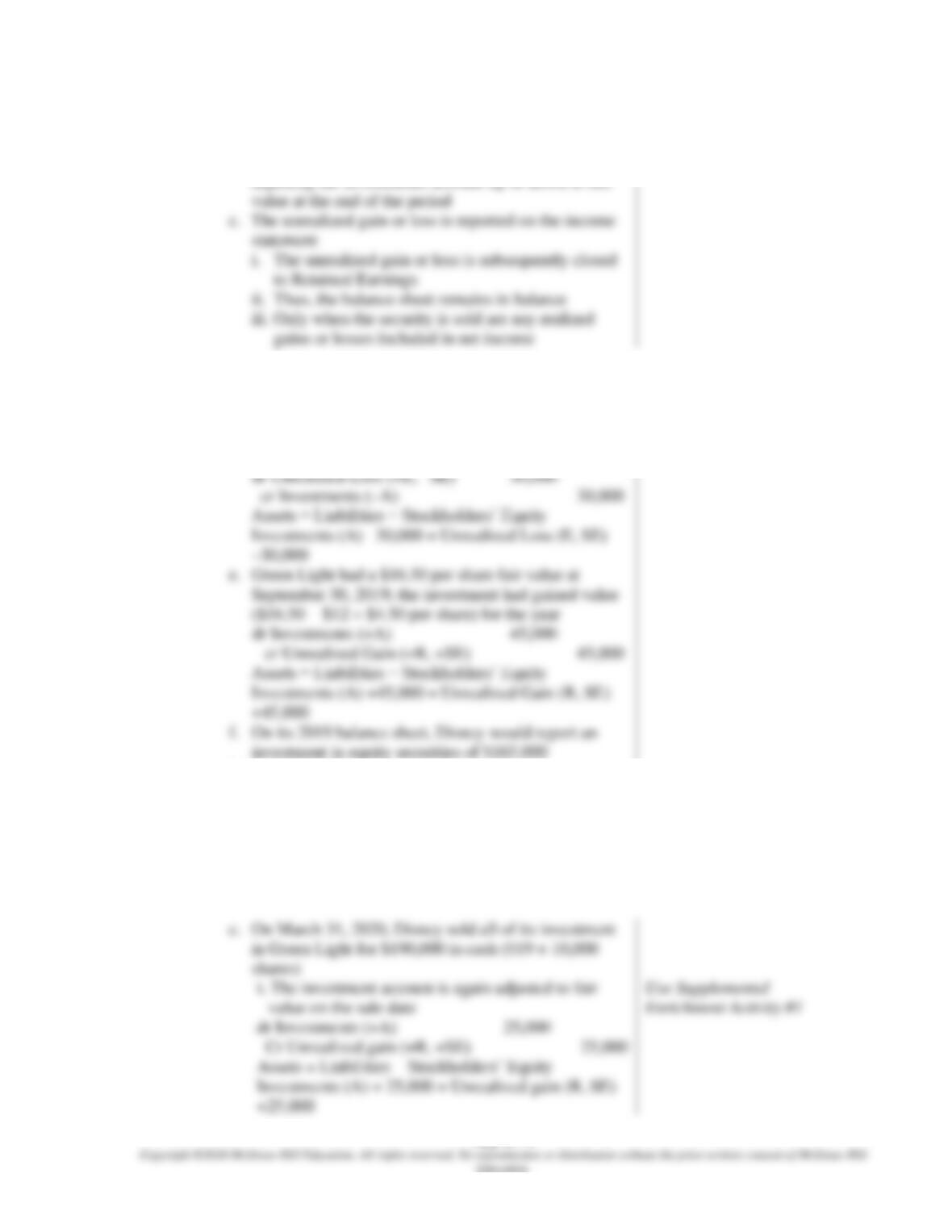
d. Green Light had a $12 per share fair value at
September 30, 2018 ($120,000); the investment
originally cost $15 per share. Therefore, the lost value
is ($15 − $12 = $3 per share × 10,000 shares) =
$30,000 for the year
dr Unrealized Loss (+E, –SE)
4. Sale of Securities
a. The investment account is again adjusted to its fair
value on the sale date
b. The sale is then recorded with the investments account
decreased by its book value (equal to fair value after
the adjustment above) and the cash account increased
by the amount received
in Green Light for $190,000 in cash ($19 × 10,000
Appendix A – Reporting and Interpreting Investments in Other Corporations
LO A-3 – Analyze and report investments involving significant influence using the equity method.
IV. Investments for Significant Influence: Equity Method
A. Recording Investments Under the Equity Method
1. An investor may want to exert influence (presumed by
owning 20% to 50% of the outstanding voting stock)
without becoming the controlling shareholder (presumed
when owning more than 50% of the voting stock) for the
following reasons:
a. A retailer may want to influence a manufacturer to be
additional managerial support
2. Equity method––used when an investor can exert
significant influence over an affiliate; the method permits
recording the investor’s share of the affiliate’s income
investments in stock held for the purpose of influencing
long term
3. Investments in affiliates or associated companies––
4. Under the equity method, the investor’s 20% to 50%
ownership of a company presumes significant influence
over the affiliate’s process of earning income
a. As a consequence, the investor reports its portion of
the affiliate’s net income as its income and increases
Appendix A – Reporting and Interpreting Investments in Other Corporations
5. Summary:
Investments in Affiliates (A)
Beginning balance
Purchases
Sales
[No effect on income]
Ending balance
6. Purchase of Stock
dr Investments (+A)
cr Cash (–A)
On September 30, 2017, the end of its fiscal year, Disney
had no long-term investments in companies over which it
–400,000 = No change
7. Earnings of Affiliates
During fiscal year 2018, Green Light reported a net
income of $500,000 for the year; Disney’s percentage
share of Green Light’s income was $200,000 (40% ×
dr Investments (+A)