Mass Communication: Living in a Media World, 6th edition
Ralph Hanson
161
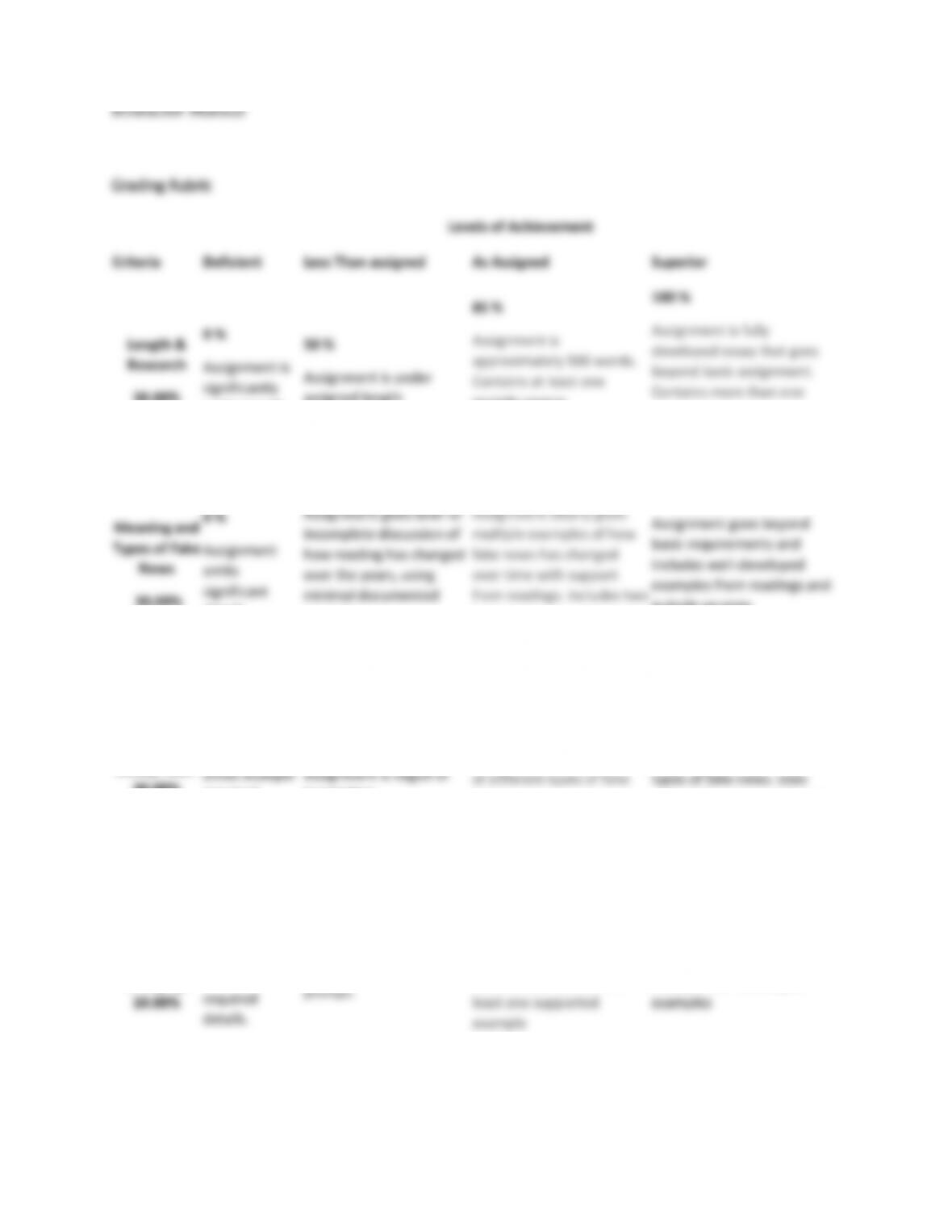
30.00%
significantly
under length
assigned length
outside source.
Contains more than one
outside source
100 %
50 %
85 %
100 %
Chapter 14―Media Ethics
Summary and Learning Objectives
Media ethics are a complex topic because they deal with an institution that must do things that
ordinary people in ordinary circumstances would not do. Media ethics draw on a range of philosophical
principles, including basic Judeo–Christian values, Aristotle’s ideas about virtue and balanced behaviors
(the golden mean), Kant’s categorical imperative, Mill’s principle of utility, Rawls’s veil of ignorance, and
the Hutchins Commission’s social–responsibility ethics. One way contemporary journalists can resolve
their ethical problems is by using the Bok model for ethical decision making.
Reporters face a range of ethical issues on a regular basis. Those issues include the following:
• Truthfulness—Journalists need to make a commitment to tell the truth. This includes not giving false
or made–up reports and telling truthful stories that are not intended to deceive the audience. This
may require reporters to provide not only the facts, but also the context surrounding them.
Truthfulness requires a commitment not only from the journalist, but also from the organization he
or she works for.
• Conflicts of interest—The interests of a corporation that owns a news organization may sometimes
be at odds with the nature of the news being reported. Journalists need to be careful not only to
portray their parent company in an accurate light, but also to give no special favors to companies
connected to the organization’s parent company.
• Sensationalism—News organizations sometimes emphasize news that is interesting, but
unimportant. This happens when reporters put more effort into attracting and pleasing an audience
than into reporting on the critical issues of the day. This can occur because of the increased pace of
the news business brought about by cable television, the Internet, and the parent company’s desire
for profits.
• Authenticity and appropriateness of photographs—Photos can be among the most controversial
media materials, both because of their disturbing content and because they can be altered with
digital editing tools.
Journalists and their employers can apply a variety of methods for enforcing and implementing
ethical behavior. These include employing an ombudsman, requiring a commitment to ethical behavior
on the part of all employees, and adhering to a code of ethics.
The advertising industry became concerned with protecting its image during World War II.
Among the major ethical issues in advertising are the following:
• Truthfulness—How important is it that claims such as “Tastes great” or “It’s the best” are
demonstrably true?
• Taste—Is it appropriate for ads to attract attention by shocking audiences?
• Media control—Do advertisers have a right to control the editorial material that surrounds their
advertisements?
In the public relations industry, practitioners need to work at balancing their clients’ interests
against those of the public at large. This can become problematic when a client is attempting to
influence the public to support an issue, such as going to war.
In online media, there is an ongoing problem of women who attempt to work in traditionally
male areas getting harassed and receiving rape and death threats.
After studying this chapter, you should be able to
1. define five major ethical principles affecting journalism;
3. explain the kinds of difficulties journalists and media writers have encountered in attempting to
be truthful;
5. explain how journalists can get into trouble trying to report on rapidly breaking stories;
7. discuss the ethical conflict in public relations between serving the client and serving the public.
Review Questions
1. How does Richard Drew defend the taking and publishing of disturbing photos from the
September 11 terrorist attacks on the United States?
2. How can two competing ethical principles lead us to making different ethical decisions?
3. Do reporters have an obligation to stay to report on protests and violence when police are telling
them to leave the area? Why or why not? What factors might affect how you answer the
question?
4. Should advertisers be able to shape the content of media they advertise in? Should they be able
to veto ad placement next to certain types of content? Why or why not?
5. What was the #gamergate hashtag supposedly about, and how was it actually used?
2001. Respond to each of the three steps: Consult your conscience, seek alternatives, and hold an
imagined ethical dialogue with everyone involved. What did you decide to do? Explain why you made
develop arguments from each of the major parties in the case. A search on Richard Drew’s name at the
Poynter.org website will turn up several good resources for this assignment.
Media Literacy Exercise―The news ombudsman
What is a news ombudsman? What does he or she do? Read a column by the Washington Post’s
current ombudsman at the paper’s website:
• http://washingtonpost.com/wp–dyn/opinion/columns/ombudsman/
Give an example of how the Post’s ombudsman solved a reader’s or source’s problem.
NOTES: The Washington Post’s ombudsman has a reputation for being one of the most active, involved,
and critical in the business. The best thing about this assignment is that it gets students looking at an
issue that is currently in the news rather than one that is drawn from the past.
The Post’s ombudsman also writes a blog located at
• http://voices.washingtonpost.com/ombudsman–blog/
Suggested Readings
• John C. Stauber and Sheldon Rampton, Toxic Sludge is Good for You: Lies, Damn Lies and the Public
Relations Industry (Monroe, ME: Common Courage Press, 1995): Stauber and Rampton take a highly
critical view of the public relations industry. If you take into account that the authors themselves are
engaging in the very techniques they are criticizing, this is a fascinating look at one side of public
relations ethics.
• Sissela Bok, Lying: Moral Choice in Public and Private Life (New York: Pantheon Books, 1978): Bok
has written a comprehensive look at the ethics surrounding lying and what it means to tell the truth.
• Robert M. Baird, William E. Loges, and Stuart E. Rosenbaum (Eds.), The Media and Morality,
(Amherst, NY: Prometheus, Books, 1999): A wide–ranging anthology that looks at media ethics from
a variety of points of view.
• All of the Chapter 14 links posted to my RalphEHanson.com blog at
http://www.ralphehanson.com/category/chapter–14/
Lecture Builders
9/11 and the Falling Man photo
The only chapter opening vignette in the book that still remains from the first edition of Mass
Communication: Living in a Media World is the story of Richard Drew’s disturbing “falling man” photo.
The story told in the vignette has changed over the years as our understanding of the meaning and what
is depicted in the photo has changed. One article that has had a huge influence on how we understand
that photo is Tom Junod’s 2003 Esquire article “The Falling Man.” As of this writing Esquire had the
article available here:
• http://www.esquire.com/news–politics/a48031/the–falling–man–tom–junod/
More on Photos from 9/11
• http://time.com/4453467/911–september–11–falling–man–photo/
NOTES: JOURNALISM AND PATRIOTISM: Journalist and press critic Bill Kovach, in a speech given to the
Organization of News Ombudsmen, asks the question, “Are you an American first, or are you a
journalist?” It’s a question that he doesn’t really like. In reply, he says, “I believe it is vital to the interest
of the journalist and the public alike that we engage in an urgent, forceful, and consistent campaign to
educate the public with the knowledge that in a democratic society the journalist is, in fact, exercising
the highest form of citizenship by monitoring events in the community and making the public aware of
them and their import, by skeptically examining the behavior of people and institutions of power, by
encouraging and informing forums for public debate.”
Sissela Bok
Read about ethicist Sissela Bok’s moral analysis of lying in private and public life:
• http://infed.org/mobi/sissela–bok–on–lying–and–moral–choice–in–private–and–public–life–an–
amplification/
NOTES: I first discovered Bok and her model through Philip Patterson’s and Lee Wilkins’ excellent book
on media ethics, Media Ethics: Issues and Cases. Bok’s model is one that students have a fairly easy time
following, and it is simpler to explain than the more complex Potter Box (which I do cover in my majors–
only ethics class).
VIDEO HINT: Bill Moyers has a good interview with Bok on the video World of Ideas II: Great Thinkers:
Sissela Bok; WNET New York and WTTW Chicago.
Who Gets Fired for Fabrication?
In addition to the scandal surrounding Stephen Glass’s many fabrications, that same year
brought questions about the truthfulness of the work of two popular Boston Globe columnists, a white
man and an African–American woman. Both writers faced allegations of having fabricated characters in
their columns.
Patricia Smith resigned from the Boston Globe after being asked to do so by the editor. The
winner of numerous writing awards during her eight years at the Globe, Smith admitted she had simply
made up names and quotes in some of her columns. In her farewell column, she apologized to her
readers:
“From time to time in my metro column, to create the desired impact or slam home a
salient point, I attributed quotes to people who didn’t exist. I could give them names,
even occupations, but I couldn’t give them what they needed most—a heartbeat. As
anyone who’s ever touched a newspaper knows, that’s one of the cardinal sins of
journalism: Thou shall not fabricate. No exceptions. No excuses.”
That same summer, another Boston Globe writer came under fire. Mike Barnicle, a long–time
columnist for the paper and one of its best–known writers, came under suspicion for a number of
reasons. In one case, jokes that had appeared in George Carlin’s book Brain Droppings also showed up,
unattributed, in Barnicle’s column. Barnicle denied that he had read Carlin’s book, yet it was soon
pointed out that he had reviewed the book for a local television station. He was left in the
uncomfortable position of having to either admit that he had lied about not reading the book or confess
that he had given a rave review to a book he hadn’t read.
Barnicle was originally given a lengthy suspension from the paper rather than being fired, largely
because he was popular with readers. But then a second fabrication was discovered. Several years
earlier, Barnicle had written a touching column about two boys—one black, one white—who shared a
hospital room while they were being treated. When the black child died, Barnicle wrote, the white
parents gave the black parents $10,000. In preparing to reprint the article, Reader’s Digest fact checkers
investigated the story but found no one at any Boston hospital who could remember such a case taking
place. After this became public knowledge, Barnicle resigned from the Globe. (Barnicle later moved to
hosting radio commentary on WTKK in Boston; being a regular guest on MSNBC’s Morning Joe program;
and writing for a number of different publications, including the Boston Herald, Time magazine, and
Huffington Post. Since leaving newspaper journalism, Smith has been a successful poetry writer and
performer.)
In addition to the shame of dealing with two ethical lapses in one summer, the Globe also had to
confront charges that it had been harsh with Smith, a black woman, while giving Barnicle, a white man, a
second chance. Brill’s Content, a media criticism magazine, even suggested that problems with Smith’s
columns had been ignored for several years because confronting them would have forced editors to
address similar charges that had been leveled against Barnicle.
Jayson Blair
You can read more about the Jayson Blair case at American Journalism Review:
• http://www.ajr.org/Article.asp?id=3020
NOTES: The Jayson Blair case received an enormous amount of attention when it broke because he was
working at the New York Times and because editors had apparently ignored a number of warning signs
that there were problems with his reporting. His case has been compared to that of Janet Cooke,
discussed in the Washington Post section of Chapter 6: Newspapers, and Stephen Glass, discussed later
in this chapter. The most important lesson to be learned from this case is looking at how the New York
Times responded to it. With the Glass case, the interesting issue was how the fact–checking process
failed. For the Smith and Barnicle cases, the issue comes down to preserving the paper’s investment in a
popular writer. But students should understand that the real ethical issues with these cases concern the
media’s response to the problems. There are no ethical dilemmas when it comes to what these
reporters did. Their behavior was flat–out wrong.
When Is Deception by Reporters Acceptable?
There’s been quite a fuss made recently about a journalist from an alternative news publication.
This alt–journalist called a conservative politician on the phone and pretended to be someone the
politician would feel comfortable talking to. The alt–journalist then took the material from his ill–gained
interview and used it to embarrass the politician. Once the interview was published, the Society of
Professional Journalists issued a statement about how unethical the deception was. Meanwhile, the rest
of the news media talked on and on about the deception, and the original prankster got a big laugh over
all the attention he gained by flouting journalistic convention.
You would be excused if you thought I was talking about how radical journalist Ian Murphy,
editor of the Buffalo Beast, impersonated billionaire conservative political activist David Koch in order to
get an embarrassing interview with Republican Wisconsin governor Scott Walker during the 2011 lead–
up to the recall campaign against the governor. And you would be right.134
But this could also describe a similar situation that took place more than 20 years ago.
In the spring of 1990, Arizona governor Jan Brewer, then a state senator, proposed a bill that
would require the labeling of record albums that portrayed sexual content in a violent context, violence,
Satanism, murder, morbid violence, or the use of illegal drugs. It would also have made it a crime to sell
these offensive albums to minors.
David Koen, music reviewer for the Phoenix–area alternative newspaper New Times, taped a
series of interviews with the senator while pretending to be a columnist from the Mesa Tribune, a local
conservative daily newspaper.
Using Senator Brewer’s recorded comments from the taped interviews, Koen constructed a rap
tape based on the group W.A.S.P.’s song “F*** Like a Beast.” He then played this tape over a sound
system at noon at the state capitol. For several weeks, stories about the conflict continued to surface
across Arizona and national media. The fuss finally died down when Brewer withdrew her bill from
consideration.135
SECRET 4 – Journalists occasionally “go undercover” in order to collect news about people who
are breaking the law or abusing the public trust; sometimes they even win awards for the stories that
come out of this impersonation. (Think back to Chapter 13 and the story about Food Lion v. ABC.) Much
less often they go undercover in order to create a satirical story to draw attention to a particular issue.
The punkings of Governors Brewer and Walker and the subsequent media agitation over them
serve as a great reminder of Secret Four—Nothing’s new: Everything that happened in the past will
happen again.
Who are the sources?
134 Jim Romenesko, “SPJ Scolds Buffalo Beast for Call to Wisconsin Governor,” Poynter, February 23, 2011,
www.poynter.org/latest–news/mediawire/120621/spj–scolds–buffalo–beast–for–call–to–wisconsin–governor/; Peter
Wallsten, “The Blogger Behind the Scott Walker Prank Call,” Washington Post, February 23, 2011,
voices.washingtonpost.com/44/2011/02/the–blogger–behind–the–scott–w.html; Ezra Klein, “What a Prank Call
Proves About Wisconsin,” Washington Post, February 23, 2011, voices.washingtonpost.com/ezra–
klein/2011/02/what_a_prank_call_proves_about.html.
135 Ralph E. Hanson, “F*** Like a Beast: Arizona Governor Jan Brewer’s First Brush With National News,” Living
in a Media World, April 28, 2010, ralphehanson.com/blog/archive_10_01.html#042810_brewer.
Who are Ian Murphy and David Koen? Where do they work? How do the papers they work for
differ from more mainstream newspapers?
What did they do?
How did Murphy and Koen report their stories? Who did they claim to be? How did their sources
and the public react to what Murphy and Koen did?
How does what they did compare to the ABC Food Lion reporters?
Go back to Chapter 13, page 340, to read about the case of ABC producers lying about their
work history to get jobs working in a Food Lion store. How did the actions of Murphy and Koen differ
from those of the ABC producers investigating Food Lion? How did their motivations for being deceptive
about their identities differ?
How do you and your friends feel about deception by reporters?
Photo Manipulation
For more on the ethics of manipulating digital images, read the linked article by John Long on
the National Press Photographers Association website:
www.nppa.org/professional_development/self–
training_resources/eadp_report/digital_manipulation.html
NOTES: This is a growing issue as digital photo editing becomes the industry standard. It is impossible for
photo editors to say that they will do no digital manipulation, because every photo is cropped and
adjusted digitally. So, the question then becomes how much is acceptable and under what
circumstances. Here are a couple of case studies you may find interesting:
• A Los Angeles Times photographer was fired for digitally combining two photos he took during
the 2003 war in Iraq: www.poynter.org/content/content_view.asp?id=28082
• Sports Illustrated digitally altered a dramatic sports photo in order to make it fit on the cover:
www.poynter.org/content/content_view.asp?id=15422
• A Toledo Blade photographer resigned after he had digitally altered a page–one photo:
www.nppa.org/news_and_events/news/2007/04/toledo03.html
• A pair of Reuters photographs of columns of smoke rising over Beirut were found to have been
edited to show more smoke: www.nppa.org/news_and_events/news/2006/08/reuters.html
There is a great archive of controversial digitally (and conventionally) altered photos assembled by
Hany Farid, a computer science professor at Dartmouth. The archive is located at
• http://www.cs.dartmouth.edu/farid/research/digitaltampering/
SHOULD NEWS OUTLETS SHOW PHOTOS OF TERRORISTS?
Another fascinating piece from Time magazine’s Light Box feature. Fred Ritchin, Dean of the School
at the International Center of Photography, looks at the questions of what our news media ought to do
with photos of terrorists. On the one hand, their photos are emphatically news. On the other hand, in
many cases what these terrorists want is attention for themselves – and when the news media run their
photos, they are giving the terrorists what they want. An in–depth and thoughtful analysis.
• http://time.com/4438929/terror–attack–photos/
Don Imus and Race
When CBS Radio and cable news channel MSNBC fired long–time host Don Imus for calling the
Rutgers women’s basketball team a group of “nappy–headed hos” on the air, it appeared to be an issue
of what the public would tolerate from a “shock jock” radio host. But the networks were also under
pressure from advertisers who no longer wanted to be associated with Imus’s show. Advertisers, such as
office supply store chain Staples, Bigelow Tea, and consumer products giant Procter & Gamble pulled
their ads. The networks also faced considerable pressure from civil rights activists, including Al Sharpton
and Jesse Jackson, as well as from the networks’ own employees.136
Controversy surrounding Imus’s show was nothing new.
Back in 1993, Imus said on his show, “Isn’t the Times wonderful. It lets the cleaning lady cover
the White House.” The “cleaning lady” he was referring to was Gwen Ifill, an African–American woman
who was the New York Times White House correspondent.
He made offensive and racist jokes about former secretary of defense William Cohen having an
African–American wife, and he described Washington Post media reporter Howard Kurtz as a “boner–
nosed . . . beanie–wearing Jewboy.” (It should be noted that Kurtz was a frequent guest on the more
serious portion of Imus’s show.)
But there was another side to Imus and his show. Along with the segments of rude talk and
bigoted commentary, Imus was also known for extended conversations with a wide range of important
newsmakers and journalists. His guests—including Tom Brokaw, Rudy Giuliani, Senator John Kerry,
Senator John McCain, and, yes, Howard Kurtz—were allowed to talk about serious issues at length
instead of just in sound bites. He also runs a camp for children with cancer and has been an advocate for
autism research.
CBS had kept the show on the air for years despite the occasional bouts of controversy because
it was profitable—making $20 million a year just for his primary station, WFAN–AM in New York. But in
the end the network calculated that the cost of carrying the show was greater than the cost of dropping
it.
In December 2007, approximately eight months after he was fired from WFAN, Imus
136 Paul Farhi and Paul Ahrens, “Advertisers Pull Out of Imus Show,” Washington Post, April 11, 2007, A01; Gwen
Ifill, “Trash Talk Radio,” New York Times, April 10, 2007, A21; Timothy Noah, “The Wit and Wisdom of Don
Imus; A Guide for Washington’s Power Crowd,” April 10, 2007, www.slate.com/id/2163872; Farhi and Ahrens,
“Advertisers Pull Out of Imus Show”; Paul Farhi, “Don Imus Is Fired by CBS Radio,” Washington Post, April
13, 2007, A01.
was back on the air, this time at New York’s WABC. And in 2009, cable news channel Fox
Business News started running Imus’s show on television again. Unlike many media figures who
get caught saying something they wish they hadn’t, Imus was fairly straightforward in talking
about his return to the airwaves. He told trade magazine Radio Ink:
I think what happened is about what should have happened. . . . You don’t get to decide, nor
should you, how the news media is going to treat a remark you make. You don’t get to decide if
they will put it in context, and you can’t whine and complain if you pick up the New York Times
and an essay rates what you said as a racist tirade. Every time I would get pissed off, I’d remind
myself that if I hadn’t said what I said, I wouldn’t have to deal with it, the women at Rutgers
would have to deal with it. I always remembered that it began with that remark.
Disability and Humor
There’s a heartwarming story that circulated on the Internet in the spring of 2012 about
President Obama giving a speech on energy policy at Prince George’s Community College in MaryLand.
Stephone–a deaf man–had front–row seating for the event. He got to shake the president’s hand after
the speech and signed to him, “I am proud of you.” To Stephon’s surprise, the president signed back at
him, “Thank you.”137
Stephon then posted a YouTube video in which he told the story of what happened in American Sign
Language (ASL). The video then spread to several social media sites, along with a transcription for those
of us who don’t sign.
I first discovered the story through a link on Twitter that took me to the Washington, D.C.–centric
blog Distriction. The story and video were posted there under the rather clever headline “Sign of the
Times.”
Then Alex, a former student of mine, mentioned on Facebook that the story had also been
posted on the Huffington Post site under the considerably less clever headline, “Deaf Student
‘Speechless’ After Obama Responds to Him in Sign Language.”
Alex, who is not deaf, found the headline to be “at least mildly offensive,” and he asked me
what I thought of it. I read the story and found the following quote from Stephon: “Oh my gosh! I was
like wow! He understood me after I said I was proud of him. It was so amazing…. I was just speechless.”
So, my analysis was that the headline was fine. It accurately portrayed what was in the story.
But as I read through the other comments on Facebook, I began wondering if the “speechless” pun was
in bad taste, referring as it did to someone who communicated primarily (I assumed) through signing.
I did a quick search on the Web, and while I did find criticism of the headline, none of it came
from people who identified themselves as being deaf. The only thing I knew for sure to be offensive to
the deaf community is when audio or video stories about deafness don’t include transcripts or subtitles.
137 H. Hoover, “Sign of the Times,” March 20, 2012, distriction.com/2012/03/sign–of–the–times/; Huffington Post,
“Deaf Student ‘Speechless’ After Obama Responds to Him in Sign Language,” March 21, 2012,
www.huffingtonpost.com/2012/03/21/deaf–student–obama–sign–language_n_1369118.html; Ralph E. Hanson,
“Should Streaming Video About Gallaudet College Be Captioned?” October 18, 2006,
ralphehanson.com/blog/archive_06_10.html#101806_questions;
Matt Daigle, personal communication, March 22, 2012.
But to really answer the question, I thought I would turn to deaf artist Matt Daigle, who, along
with his wife Kay, produces the witty and enlightening Web comic That Deaf Guy. Now I don’t presume
that Matt can speak for the entire deaf community, but he can give us the point of view of someone
who takes a humorous look at the issues deaf people and their families face. Here’s what he had to say
about the story in a series of e–mails:
I looked over the article and I was not personally offended by the title.
Myself as well as many of my deaf friends are aware that the term
speechless means in ASL SHOCKED ASTOUNDED. We know that the
English language uses figurative language in the form of idioms and
metaphors and such, so we see those terms and just automatically
translate them into meaning—like anyone else.
It is the same concept with the word “hear.” Deaf people often sign NEVER HEARD
meaning no one told me or I didn’t know about that. Within that context the word
“hear” has the meaning of KNOW. We don’t really think of the literal sense of that word
just the meaning.
On a related note, Matt had this to say about media portrayal of deaf people in general:
The media does misrepresent deaf people often, that is true. We pretty much can agree
that the most hated word used in the media concerning deaf people is “Hearing
Impaired.”
Now I say that and yet I know some (very very few) deaf people who preferred to be called
Hearing Impaired.
You can see the videos mentioned here:
• http://www.ralphehanson.com/2012/03/22/link–ch–14–when–is-a-headline–offensive/
Adbusters
Adbusters is a nonprofit organization devoted to fighting consumer culture. Their web site
contains wide–ranging critiques of advertising:
http://adbusters.org
NOTES: This site is interesting and a lot of fun, but it’s worth remembering that the writers there are
using many of the same persuasive techniques that the advertisers they are criticizing and parodying
use.
Media Activities
CLASSROOM DISCUSSION—Reporting and Truthfulness
In your textbook, we discuss the issues of reporters and truthfulness in a variety of contexts.
Here are some links that go with these readings:
• Pulitzer Prize winning story coauthored by Jose Antonio Vargas on the Virginia Tech massacre
• Profile of Facebook founder Mark Zuckerberg for the New Yorker by Vargas
• Vargas outing himself as an undocumented immigrant in a first–person article for the New York
Times Magazine
In it, he tells the story of how he came to the United States as a 12–year–old boy to live with his
grandparents in Silicon Valley. He did not know that he had entered the country on forged
papers until he took his supposed green card to the DMV at age 16 to get his drivers permit, and
was told that his card was fake and that he should not come back again.
• In an interview with Vargas on MSNBC’s Rachel Maddow Show, Vargas explains he was
supposed to work in shadow economy jobs until he could find an American citizen to marry and
get a permanent residency permit that way. Only one problem: When Vargas was in high school,
he came out publicly as being gay. So, while he was out of the closet as a gay male, he remained
secretive about his immigration status.
• The story of Vargas and his outing of himself has caused a fair amount of controversy in
journalistic circles because Vargas has been lying about his immigration status for his entire
adult life. (This link is to an audio story that also has a transcript. Listen if you can.) And lying is
rather looked down on by journalists. Phil Bronstein, who had hired Vargas to write for the
Chronicle, writes that he felt duped by Vargas, especially since Vargas wrote about the
experiences of undocumented workers without mentioning that he was one himself.
• Read about the punking of Wisconsin’s Governor Scott Walker and then Arizona Senator Jan
Brewer by alternative journalists. It contains links to the original source materials for your media
literacy box.
• James O’Keefe and Political Activism Through Deception
All of this leaves us with this central ethical conflict: A journalist lying about his or her identity is
always troubling for any reason. But if Vargas had not lied about who he was, he could not have been a
reporter. (If you go to my blog, you will see some strong thoughts on the deception Vargas practiced
from UNO journalism professor Chris Allen.) This is, at its core, the definition of an ethical problem.
Because ethics are all about what you do when no answer seems right, when all answers are
problematic, when telling the whole truth stands in the way of telling any truth.
So, after you have read this material, and Chapters 13 and 14, here are your discussion
questions:
• Was Vargas wrong to work as a journalist while concealing his immigration status? Could he
have spoken out if he had revealed his status? What would we lose if we didn’t have Vargas
working as a reporter? What would we gain? Does the fact that he lied about his immigration
status invalidate the work he did? What would you have done if you found yourself in his
situation?
• Was it appropriate for Murphy and Koen to lie about who they were to create their satirical
stories? Would it have been OK if they had been creating serious stories? How did the actions of
Murphy and Koen differ from those of the ABC producers investigating Food Lion?
• Do journalists ever have the right to lie or be deceptive in their work? Support with examples
from your readings or real–life. (You are welcome to use examples other than those I provided.) I
don’t want pretend examples. Why or why not? When would it be acceptable?