Mass Communication: Living in a Media World, 6th edition
Ralph Hanson
141
Mass Communication: Living in a Media World, 6th edition
Ralph Hanson
142

Mass Communication: Living in a Media World, 6th edition
Ralph Hanson
143
Mass Communication: Living in a Media World, 6th edition
Ralph Hanson
144
Mass Communication: Living in a Media World, 6th edition
Ralph Hanson
145
Mass Communication: Living in a Media World, 6th edition
Ralph Hanson
146
25.00%
length
research.
one outside source.
multiple outside sources.
0 %
50 %
100 %
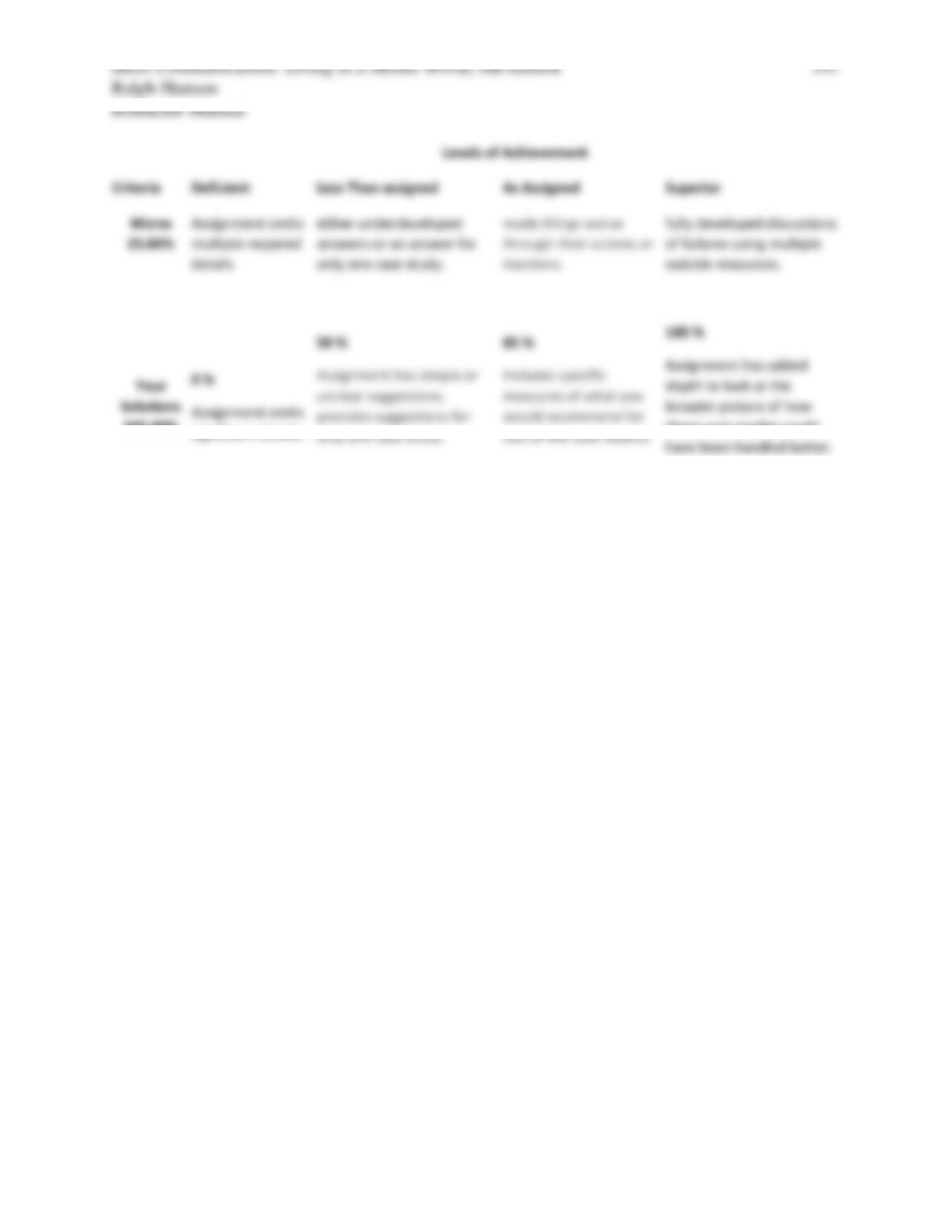
Levels of Achievement
Criteria
Deficient
Less Than assigned
As Assigned
Superior
Worse
25.00%
Assignment omits
multiple required
details
either underdeveloped
answers or an answer for
only one case study.
made things worse
through their actions or
inactions.
fully developed discussions
of failures using multiple
outside resources.
100 %
Chapter 13―Media Law
Summary and Learning Objectives
The First Amendment to the U.S. Constitution says that
“Congress shall make no law respecting an establishment of religion, or prohibiting the
free exercise thereof; or abridging the freedom of speech, or of the press; or the right of
the people peaceably to assemble, and to petition the Government for a redress of
grievances.”
This statement is at the core of all media law in the United States. The purpose of the
amendment is to protect the free and open discussion necessary to a democratic society. Although the
First Amendment guarantees the right of free speech, Congress has passed several laws that limit this
freedom. These include the Alien and Sedition Acts of 1798; the Espionage Act of 1917; the Smith Act of
1940; the USA PATRIOT Act of 2001; and laws controlling libel, invasion of privacy, publication of military
secrets, and obscenity.
The rights of individuals are protected from actions of the media through libel law, invasion of
privacy law, and guarantees of a fair trial. Libel is a statement that unjustifiably exposes someone to
ridicule or contempt. For a statement to be libelous, it must include defamation, identification, and
publication. In general, the media are allowed to publish defamatory material that is true, privileged, or
a statement of opinion. New York Times Co. v. Sullivan established that public officials seeking to win a
libel suit must show that the media acted with actual malice in publishing a false defamatory statement.
There are four basic forms of invasion of privacy: intrusion, embarrassment, false light, and
misappropriation. In some cases, journalists can defend themselves against charges of invasion of
privacy by showing that the story in question was newsworthy. There is often a conflict between an
individual’s right to a fair trial and the press’s right to cover that trial. The Supreme Court has generally
ruled that the judge, not the press, is responsible for guaranteeing the defendant a fair trial. The Court
has also ruled that protection of the right to a fair trial should require as few limits on the freedom of
the press as possible. This can be done by imposing gag orders, sequestering the jury, postponing or
changing the venue of a trial, or ordering a new trial.
Since 1977, courts in the United States have been experimenting with allowing cameras in the
courtroom. Proponents of such a policy argue that televising trials allows the public to better
understand how the justice system works. Opponents argue that cameras are intrusive and turn trials
into media circuses.
Although the press is subject to the same laws as society as a whole, it is protected from
censorship in most cases. The government is allowed to prevent publication of certain information only
if the material is obscene or gives away military secrets during time of war. There have been only three
major cases involving prior restraint: Near v. Minnesota, the Pentagon Papers case, and the Progressive
H-bomb story. High school newspapers published as a classroom activity are not afforded the same level
of protection, however. The courts have ruled that obscenity is not protected by the First Amendment,
and they have established that the standard for obscenity will be set using state law and local
community standards.
The broadcast media traditionally have been regulated much more heavily than the print media
because they make use of the public airwaves. They are regulated both for technical reasons and to
ensure that they serve the public interest. Major legislation controlling the broadcast media was passed
in 1927, 1934, and 1996. Standards for regulating the Internet are still evolving, but they appear to be
more similar to print regulations than to broadcast ones.
After studying this chapter, you will be able to
1. describe the development of a free press in the United States;
3. explain the three elements that must be present for libel to occur and the four major defenses
against libel;
5. discuss the issue of whether the press can be legally required to behave ethically using three
Supreme Court case examples; and
1. Why did Apple not want to comply with the FBI’s order to hack into a terrorist’s iPhone?
2. How has the USA PATRIOT Act changed the freedoms for Americans since 9/11? How did the
USA FREEDOM Act change the Patriot Act?
3. Why did the U.S. Supreme Court rule that public officials needed to meet a higher standard to
win a libel suit than ordinary people do?
4. According to the U.S. Supreme Court, why do student publications have fewer First Amendment
rights than do publications created by adults? What have states done in response to this?
5. Is there still a need to enforce the equal time provision on broadcast television? Why or why
not? What has happened in the last ten years that might tend to change your opinion on the
topic?
For this assignment, start by reading about the Phelps family in the Visual Media Literacy box on
page 321 of your textbook. Then read the links and view the video at this blog post about the Snyder v.
Phelps court decision:
• Snyder v. Phelps Readings and Video
In a short essay (500 words minimum), you are to answer the following questions:
• Who are the Phelps family and the Westboro Baptist Church?
• Who is Albert Snyder, and why did he sue the Phelps family?
• What grounds would the court have had for ruling in favor of Snyder? What grounds did the
court have for ruling in favor of Phelps?
• Do you agree or disagree with how the court ruled in the Phelps case? Why or why not?
• What would the consequences be for free speech if the court had ruled against Phelps?
• What can communities do (if anything) about the Westboro protests?
• Do you think people have a right to protest at or near funerals?
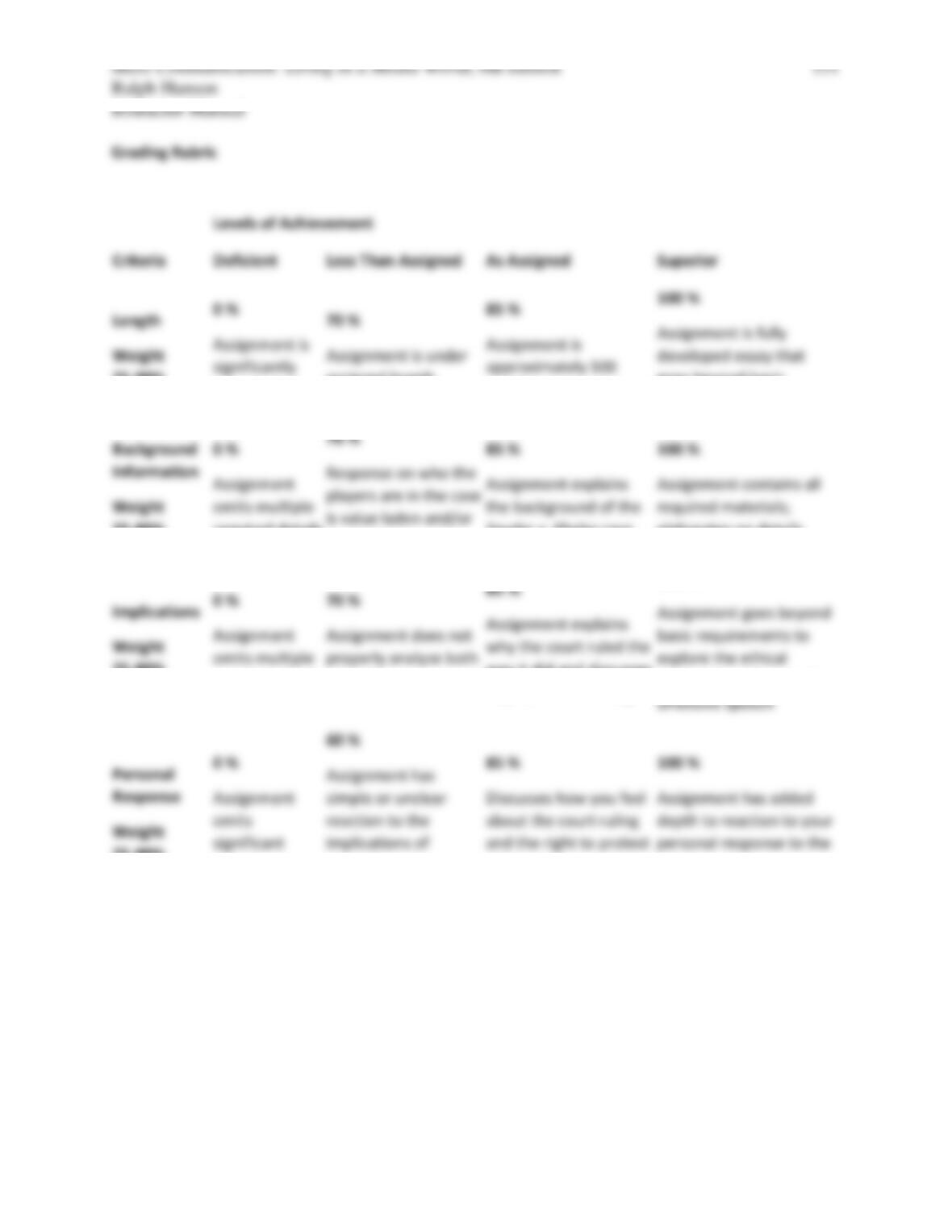
Grading Rubric
Levels of Achievement
Criteria
Deficient
Less Than Assigned
As Assigned
Superior
25.00%
under length
assigned length
words
100 %
goes beyond basic
assignment
25.00%
required details
70 %
is value laden and/or
incomplete
Snyder v. Phelps
case
elaborates on details
25.00%
required details
sides of case
85 %
way it did and discusses
implications of ruling
100 %
implications of protecting
offe
nsive speech
25.00%
details
60 %
protecting unpopular
speech
at funerals
case
Media Literacy Exercise―Current issues in media law
The Freedom Forum is a nonprofit foundation established by the Gannett newspaper chain that
is devoted to protecting free speech and free press rights. They have a website devoted to current issues
related to the First Amendment:
Mass Communication: Living in a Media World, 6th edition
Ralph Hanson
152
Mass Communication: Living in a Media World, 6th edition
Ralph Hanson
153
Mass Communication: Living in a Media World, 6th edition
Ralph Hanson
154
Mass Communication: Living in a Media World, 6th edition
Ralph Hanson
155
Mass Communication: Living in a Media World, 6th edition
Ralph Hanson
156
1901)
It is rumored that a performance in the trial courtroom had persuaded the jury of the rightness
of the defendant’s cause.
Falwell v. Flynt
In 1983, the Reverend Jerry Falwell was in Washington, DC, for a news conference when a
reporter rushed up to him carrying the November 1983 issue of Hustler magazine and asked, “Reverend
Falwell, have you seen this?” The reporter was referring to a crude parody of a Campari ad that
several newspaper owners, press associations, and the Association of American Editorial Cartoonists.
Also supporting Flynt was HBO, which was looking to protect the stand–up comics featured on the cable
network.
On February 24, 1988, in an 8–0 vote, the Supreme Court overturned the lower court’s verdict,
ruling that the courts could not protect a public figure from emotional distress, even from “speech that
is patently offensive and intended to inflict emotional injury.”
The Court ruled that given a choice between protecting a public figure from emotional distress
and protecting free speech rights, it would support free speech.
Chief Justice William Rehnquist acknowledged that the ad was “doubtless gross and repugnant
in the eyes of most,” but said that political cartoons often go beyond the limits of good manners and
taste. He saw no way to distinguish between proper and improper satire or between fair and unfair
comment and criticism. The Court ruled that the only way a public figure or official could win a decision
for intentional infliction of emotional distress would be if false statements had been made with
knowledge that the “statement was false or reckless disregard as to whether it was true.”
This was the central point of the Flynt decision—that even something mean–spirited and cruel is
still legitimate opinion and commentary, as long as it is a statement of opinion and not a statement of
fact. Flynt explained the significance of the decision from the publisher’s point of view in an interview:
Had those decisions been allowed to stand, it would have meant that you would no longer
need to prove libel to collect damages. All you would have to do is prove intentional
infliction of emotional distress. Well, you know, any political cartoonist or editorial writer
wants to inflict emotional distress. That’s their business.
In a strange ending to this case, Falwell, who passed away on May 15, 2007, and Flynt
developed a relatively civil relationship in recent years, appearing in debates and on television
together. On one occasion, Falwell even accepted an airplane ride home from Flynt following a
joint speaking engagement.
The conflict between Larry Flynt and Jerry Falwell highlights the central conflicts in American
media law:
• How do you protect both the rights of individuals and those of the press?
• Is the press protected even when it is “gross and repugnant in the eyes of most?”
• When can the media be punished for stepping over the line?
• Do individuals have a right to control how a sometimes hostile press portrays them?
When the movie The People versus Larry Flynt was released, Flynt and the Reverend Jerry Falwell
appeared together on CNN’s Larry King Live. Here’s a transcript of that broadcast:
http://www.cnn.com/SHOWBIZ/9701/11/falwell.v.flynt/lkl.00.html
NOTES: The Falwell–Flynt case illustrates how troubling the First Amendment can be at times. Clearly
Flynt’s ad parody was a mean–spirited attack on Falwell and his mother. On the other hand, many
editorial cartoons that express “legitimate” opinions are also mean–spirited.
SLIDE HINTS: Take a look at Daryl Cagle’s Professional Cartoonists Index (mentioned elsewhere in this
instructor’s manual). The site is full of political opinion that, while funny, is not nice. If you made Flynt’s
attack on Falwell illegal, how many of these cartoons would end up being suppressed?
Access the site at http://www.cagle.com/
Oyez
Oyez is a Supreme Court website located at Northwestern University. Oyez is the word the
Marshal of the Court cries to call the court to order.
http://www.oyez.org/
NOTES: This site has audio of the oral arguments of many major Supreme Court cases. Using the search
function, you can find virtually every case mentioned in this chapter.
You can hear the oral arguments for Morse v. Frederick (Bong Hits 4 Jesus) at
https://www.oyez.org/cases/2006/06–278
FCC
Find out the latest on broadcast regulation from the Federal Communication Commission’s web
site:
http://www.fcc.gov/
NOTES: This is a good place to look for up–to–the–minute information about recent FCC rulings. News
reports of FCC actions are often incomplete, and it can be useful as the instructor to be able to look at
the original documents. There is more material on the FCC in Chapter 9: Television.
Media Activities
Free Speech and Students—The Hazelwood Decision
For a more complete analysis of Hazelwood School District v. Kuhlmeier Supreme Court decision,
visit this guide located at the Student Press Law Center’s website:
http://cdn.spl.s3.amazonaws.com/pdf/HazelwoodGuide.pdf
NOTES: When the Hazelwood was decided in 1988, high school students didn’t have any reasonable
alternative for publishing a newspaper if the school’s official paper was shut down or censored. While
students could certainly publish an “underground” paper, distributing it in school could be problematic.
But with the advent of the Web, anyone who wants to can publish a small–scale alternative “newspaper”
at very little cost. And aslong as it is not produced using school resources, there is little school systems
can do about it. Student journalists working on their own websites are still bound by privacy and libel
law, however, which they may or may not have a good understanding of.
The Hazelwood Decision’s 25th Anniversary
• http://www.ralphehanson.com/2013/01/14/the–hazelwood–decisions–25th–
anniversary/
Twenty–five years ago, the United States Supreme Court ruled that a high school principal in
Hazelwood, Missouri, had the right to censor articles in the student newspaper about pregnancy and
divorce. The court, in its ruling, wrote:
The First Amendment rights of students in the public schools are not automatically co–
extensive with the rights of adults in other settings. . . . A school need not tolerate
student speech that is inconsistent with its “basic educational mission,” even though the
government could not censor similar speech outside the school.
The court essentially ruled that a high school student newspaper was a classroom exercise and
not an instrument for free speech. The ruling went on to say that administrators could censor any
content that is “reasonably related to legitimate pedagogical concerns.” Or, as one first amendment
attorney said at the time, “He can censor the paper because he wants to teach those kids a lesson.”
Geoff Campbell, who now teaches journalism and advertising at the University of Texas at
Arlington, was a high school journalist in Missouri in the early 1980s, and he writes for the Fort
Worth Star–Telegram that he had to continually battle with the school district’s superintendent over any
article that had a whiff of controversy in it. He writes:
It was a stressful time. Teachers said things like, “You have constitutional rights. But
what about responsibility, decency and good taste?”
We could have made people happy by confining ourselves to stories about AV Club bake
sales, but that wouldn’t have made students more celibate or less pregnant.
Unfortunately, discussion about those very real issues got hijacked by a censorship
debate.
Katelynn McCollough, writing for the Iowa State Daily (my old college paper!), notes that the
state of Iowa passed the “Student Exercise of Free Speech” law the year following the Hazelwood
decision that gave Iowa high school students back their basic rights to free expression. The law did have
some minor restrictions in it, but basically it said that Iowa believed that its students could handle their
constitutional rights and responsibilities.
Questions: What do school districts gain by allowing students full free–speech rights? What do they
lose? What do students learn about the constitution when they are censored by school administrators?
Classroom Debate: Celebrity Privacy
Movie, television, and music stars all benefit from positive publicity, but they don’t like it when
details about their private lives get printed or broadcast. Should celebrities have a right to be left alone
by the press, or is living in a fishbowl the cost of fame?
NOTES: This can be a fun issue to debate. What many students don’t realize is that celebrities often
have cordial “backstage” relationships with the tabloids where they supply the tabs with photo
opportunities or stories. But there are also the times when they would simply like to be left alone.
Classroom Debate: Telling The Truth
When journalists go undercover to report on a story, they often have to lie about who they are.
Is it ever OK for journalists to lie to the people they are writing about? Why or why not?
NOTES: This is a problematic issue for journalists. If they lie to get a story, how will they convince the
public that they are telling the truth when they give a report of what they found out while lying? These
issues can also be discussed in Chapter 14: Media Ethics. That provides a nice contrast between what is
legal to do and what is right to do. The Cohen case established that journalists are obliged to keep their
promises. In the Food Lion case, the journalists technically lost, but they were only fined $2.
NOTES: CENSORING NEWS PHOTOS ON FACEBOOK
In the fall of 2016, Facebook was briefly censoring Nick Ut’s iconic Vietnam War photo of nine–
year–old Kim Phuc running down a street naked after her village had been bombed with a napalm attack.
Facebook placed a large black box over Ms. Phuc’s body, apparently considering it to be potential child
pornography.
The photo is famous for potentially turning many people against the war.
Here’s a link to Time magazine’s discussion of the photo:
• http://time.com/4485344/napalm–girl–war–photo–facebook/
Homework – Crisis Management
During the middle of April this last spring, several companies and organizations had a week of crazy
public relations problems.
To prepare for this week’s assignment, I want you to read the following blog post. Read the links to
articles along with the tweets.
• Pepsi, United, and Sean Spicer in a race to see who can be worst at PR
In an essay that runs at least 500 words:
• Pick two of the examples and explain what each did to create a PR problem for their
organization.
• How did they make things worse through their actions?
• If you were brought in now to be in charge of PR for one of the companies, what would you do
to help solve their problems?
• Support your arguments with information from your textbook and outside sources.