Mass Communication: Living in a Media World, 6th edition
Ralph Hanson
101
25.00%
details
details
explains significance
of it
Movie
Analysis
Weight
25.00%
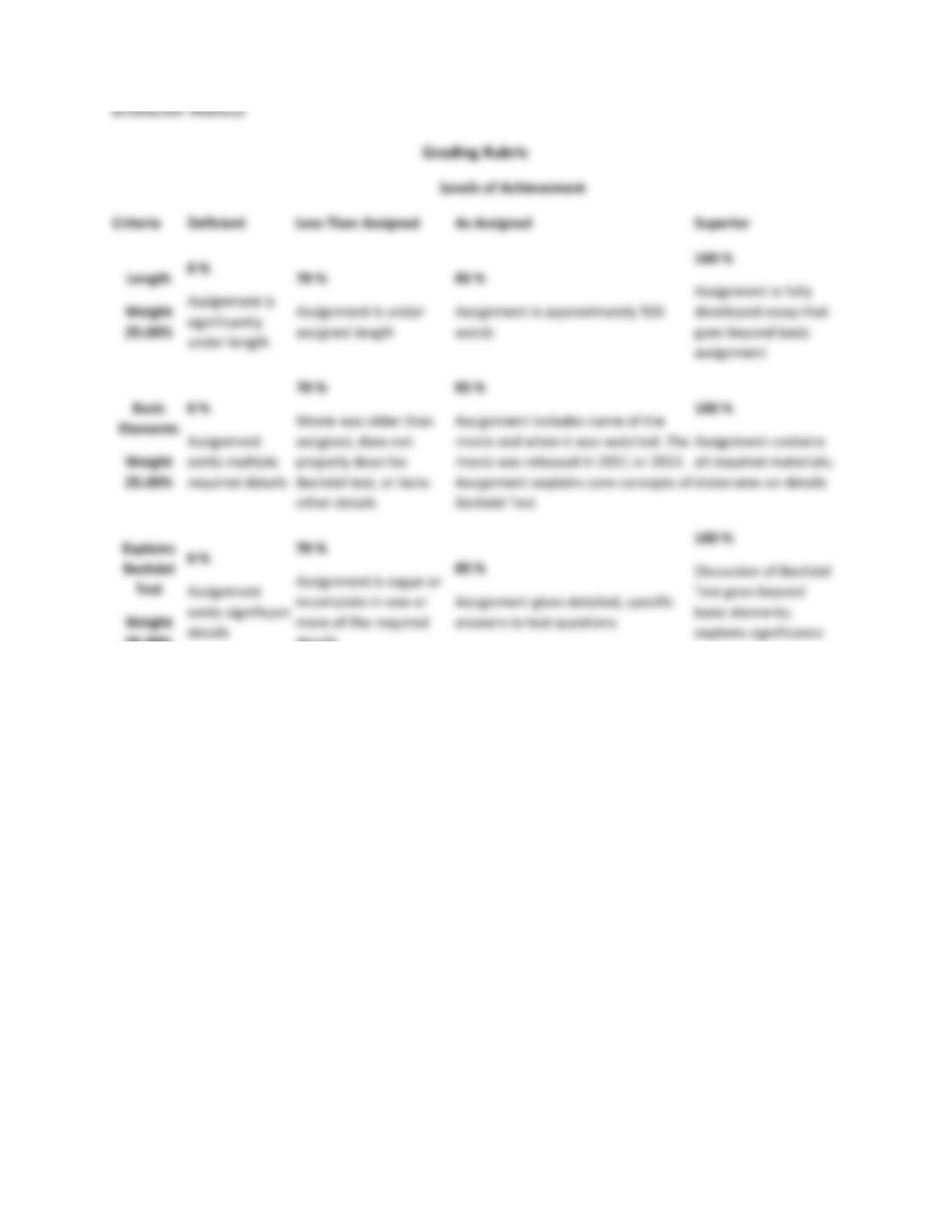
0 %
Assignment
omits significant
details
60 %
Assignment has simple
or unclear reaction to
results
85 %
Assignment has a clear reaction to
what was learned from conducting
the analysis
100 %
Assignment has added
depth to reaction to
what the test tells the
viewer
Suggested Readings
• Leonard Maltin (Ed.), Leonard Maltin’s Movie & Video Guide (current edition): This is the
definitive annual capsule review book that has been published for more than twenty years.
• Gerald Mast (Ed.), The Movies in Our Midst: Documents in the Cultural History of Film in America
(Chicago, IL: The University of Chicago Press, 1982): This anthology tells the history of the
movies through documents published from the cinema’s earliest days.
• Pauline Kael, For Keeps: 30 Years at the Movies (New York: Plume Penguin, 1996): Reviews from
the New Yorker’s long–time film critic.
• All of the Chapter 8 links posted to my RalphEHanson.com blog at
Mass Communication: Living in a Media World, 6th edition
Ralph Hanson
102
Mass Communication: Living in a Media World, 6th edition
Ralph Hanson
103
Mass Communication: Living in a Media World, 6th edition
Ralph Hanson
104
Mass Communication: Living in a Media World, 6th edition
Ralph Hanson
105
Mass Communication: Living in a Media World, 6th edition
Ralph Hanson
106
and-3-d/
Box Office mojo
Get the latest on current movie box office, as well as the top moneymakers of all time at Box
Office Mojo: http://boxofficemojo.com/
NOTES: Box Office Mojo is the source for up–to–date movie statistics. Along with the most recent box
figures, it also has estimated budgets and marketing costs for many films. This lets you illustrate the
point made in the text that a high box office total does not necessarily make a movie profitable. Through
Box Office Mojo, you can see, for example, that Bill Murray’s art house movie Lost In Translation
103 Brad Bird’s Tweets were sent out from @BradBirdA113 in early October 2013. They are curated at “Director
Brad Bird Tweets on Gravity,” October 11, 2013, www.ralphehanson.com/2013/10/11/director–brad–bird–tweets–
on–gravity/.
Mass Communication: Living in a Media World, 6th edition
Ralph Hanson
107
Mass Communication: Living in a Media World, 6th edition
Ralph Hanson
108
Mass Communication: Living in a Media World, 6th edition
Ralph Hanson
109
Mass Communication: Living in a Media World, 6th edition
Ralph Hanson
110
1. discuss the development of television from its invention to HDTV today;
3. discuss the issue of racial and ethnic diversity on television;
5. discuss the problem of broadcast decency, using examples; and
1. How does Univision news anchor Jorge Ramos’s approach to news differ from the traditional
American approach of news anchors like Walter Cronkite?
2. How did Ted Turner transform cable television?
3. What does media journalist Ken Auletta mean by “an earthquake in slow motion”? How is that
earthquake still going on today?
4. How did Janet Jackson’s 2004 Super Bowl appearance transform our standards for decency on
broadcast television?
5. How have technological changes transformed how we think of “watching television”?
Media Literacy Exercises
Media Literacy Exercise―The Nielsen Ratings
The television industry is obsessed with ratings, but how do we really know who is Number
One? The Nielsen ratings are the bible of the industry. How does the Nielsen Media Research Company
measure audiences? How many homes are sampled? What is the difference between a people meter
and a diary? To answer these questions, visit Nielsen Media Research at www.nielsenmedia.com.

Suggested Readings
• Ken Auletta, Three Blind Mice: How the TV Networks Lost Their Way (New York: Random House,
1991), and Ken Auletta, The Highwaymen (San Diego: Harcourt Brace, 1998): Through these two
books, journalist Ken Auletta looks at the huge transformations that took place in television during
the 1980s and 1990s.
• Erik Barnouw, Tube of Plenty: The Evolution of American Television, 2nd revised edition (New York:
Oxford University Press, 1990): An interesting look at the changing role of television in American life.
• Joshua Meyrowitz, No Sense of Place (New York: Oxford University Press, 1985): An examination of
how television through its very existence changes the world we live in.
• All of the Chapter 9 links posted to my RalphEHanson.com blog at
http://www.ralphehanson.com/category/chapter–9/
Lecture Builders
NOTES: ROOTS MINI SERIES―ERIK BARNOUW: In 1977, ABC–TV created a new form of television for an
American audience and demonstrated the power of television to shape a nations agenda for discussion.
On eight consecutive nights, January 23 through 30, the miniseries Roots aired. It told the story of
African–American writer Alex Haley’s family, starting with Kunte Kinte, an African taken into slavery,
through the years the family spent in the United States, up to the Emancipation.
Each night that the show aired, it gained in audience, and the final episode of the series had the highest
ratings of any program up until that time. This was followed by Holocaust on NBC, which dealt with a
single Jewish family experiencing Hitler’s Final Solution. Television historian Erik Barnouw, in his book
Tube of Plenty, says that the two programs changed the landscape of television because they
demonstrated that there could be a market for serious, disturbing programs shown over an extended
period of time.
They also came at a pivotal time for television history, when network television was beginning a long
decline in audience size and profitability as it moved into the cable era, where there would rarely be a
single mass audience, but rather a disconnected series of separate audiences.
VIDEO HINT: Showing a clip or two from the Best of the Ernie Kovacs series can serve as an illustration of
how comedy adapted to the new medium in the 1950s. I typically use the oscilloscope gags, the “Gorilla
Swan Lake,” or the “Nairobi Trio.”
You find several examples of Ernie Kovacs’s work and the influence he has had at
http://ralphehanson.com/blog/archive_kovacs.html
Mass Communication: Living in a Media World, 6th edition
Ralph Hanson
113
Mass Communication: Living in a Media World, 6th edition
Ralph Hanson
114
Mass Communication: Living in a Media World, 6th edition
Ralph Hanson
115
Mass Communication: Living in a Media World, 6th edition
Ralph Hanson
116
Mass Communication: Living in a Media World, 6th edition
Ralph Hanson
117
1. explain how Internet technology developed;

2. identify the three levels of communication on the Internet;
4. describe five characteristics of social media;
6. describe the four elements of the hacker ethic and how they apply to the contemporary
Internet; and
1. Why is Yik Yak not as anonymous as users think it is?
2. How was our first nationwide interactive computing network built?
3. How does interacting online differ when you do it through an app rather than through the
World Wide Web?
4. How are social media and mobile media connected to each other? How are social media
changed when we use them with mobile devices?
5. If you were asked to defend video games as a medium of mass communication, how would you
do that?
6. What does your author mean when he writes “Everything is data”? What kind of transformation
is taking place in the legacy media industry as more media are transmitted digitally?
Media Literacy Exercises
Media Literacy Exercise—Social Media & Privacy
Start by reading the Test Your Media Literacy: How Much Privacy Do You Have with Your Social Media
Accounts? Then read these links:
• A Minnesota middle–school girl says she was forced to reveal her Facebook password to police
and school officials.
• Government agencies and colleges are asking for applicants’ Facebook passwords.
• What can you do when an employer asks for your password?
see about you.
• Take a look at what you have on your Twitter account and any other social media accounts.
• Google yourself to check out what is publicly available about you on the Web.
Now, in an essay of 500–700 words, I want you answer the following questions:
• If an employer, your parents, the police, a reporter, or a potential date were to look you up
online, what would they learn about you? Would letting them “friend” you change what they
would find?
• Do you think that it’s an invasion of your privacy to have someone investigate you online
without your permission? Why or why not?
• What would you look for if you were investigating someone online?
• How would you feel about being asked to let an employer, coach, teacher or another parallel
adult into your accounts? Why do you feel that way?
• Can anything you put online be considered private? Why or why not?
• What have you done to protect the image your project online?
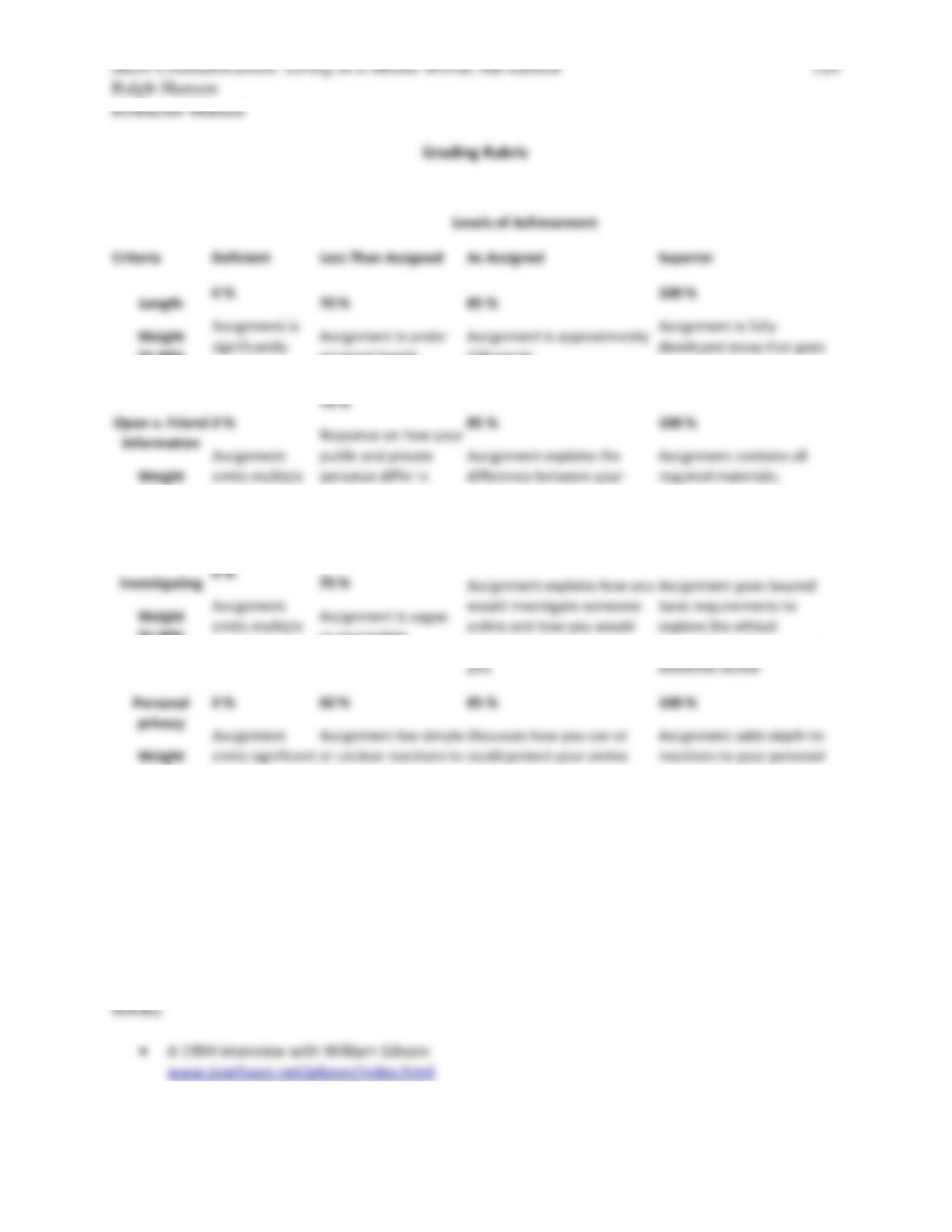
Grading Rubric
Levels of Achievement
Criteria
Deficient
Less Than Assigned
As Assigned
Superior
25.00%
0 %
significantly
under length
assigned length
500 words
100 %
developed essay that goes
beyond basic assignment
25.00%
required details
70 %
generic without
analysis
public and private persona
elaborates on details
25.00%
required details
or incomplete
85 %
feel about it being done to
100 %
implications of investigating
0 %
60 %
85 %
100 %
25.00%
details
privacy implications
privacy
response to privacy
Media Literacy Exercise― Hacker culture
We hear a lot of talk about all the wonderful things that Internet communication is going to do for
us as a society. But it can also have dysfunctional or antisocial aspects as well. Read the links below.
Based on your readings, who and what do you think hackers are? What do these people do with their
computers that is different from what mainstream users do? (Use examples from your readings.) Do you
think that are a genuine counterculture? Why or why not? Give your answer in an essay (400–500