Mass Communication: Living in a Media World, 6th edition
Ralph Hanson
61
Mass Communication: Living in a Media World, 6th edition
Ralph Hanson
62
Mass Communication: Living in a Media World, 6th edition
Ralph Hanson
63
1. Is there any harm in magazines featuring extremely thin (in the case of women) or very
muscular (in the case of men) models in their photos and advertisements?
2. Do you think the images in fashion magazines contribute to the problem of eating disorders
or steroid or supplement abuse? Why?
3. What about the opposite? Should magazines feature “realistically sized” models? Does this
help or harm things? Why?
4. Should magazines Photoshop models to make them look thinner?
NOTES: Traditionally, the concern about unrealistic body image has been connected with thinness,
eating disorders, and young women. But more recently the debate has extended to the muscular,
“ripped” image of young men. There have been charges made that the unrealistic image presented in
magazines and on television has led young men to use or abuse dietary supplements and steroids in
their effort to achieve “the look.”
Censorship and Teen Magazines
Sometimes the truth can get magazines into as much trouble as faked letters or digitally altered
photos. In 1998, a New York school district removed Seventeen, Teen, and YM from the middle school
library in response to complaints by parents that the magazines contained inappropriate sexual
material.54 The superintendent said that he took the magazines out of the middle school library—but
not the high school library—because the sex and health columns were not appropriate for children ages
10 to 14.55 According to the New York Times, the complaints focused on material about “having sex,
using at–home pregnancy tests, taking the birth–control pill, vaginal discomfort, using a condom,
masturbation, tampons, stretch marks, and worries about various body fluids and HIV.”56
Such incidents are rare, however. What is more common is for school districts to control the
contents of student–produced publications. Such was the case in Grand Ledge, Michigan, where school
officials removed information about Planned Parenthood and changed information about the state’s
abortion law from a story about teen pregnancy scheduled to run in the high school magazine The
Comets’ Tale.57
Race, Beauty, and Magazine Covers
Trisha Goddard is a black British talk show host who’s been described as a cross between Jerry
Springer and Oprah Winfrey. American audiences may know her from the horror–comedy film
Shaun of the Dead. She’s also the mother of two girls. In a commentary in London’s Daily Mail,
she writes that she was startled in the summer of 2006 to see a black face (of R&B singer
Jamelia) staring back at her from the cover of the British edition of Cosmopolitan magazine. “It
took me a moment to realize why a simple photo of this beautiful girl had pulled me up short,”
she writes. “Then I realized it was because I’m so unused to seeing a non–white face on the
cover of a mainstream magazine.”58
The implication of rarely seeing a woman of color on the cover of a magazine hit home
to Goddard when her 12–year–old daughter Madison said that she thought she looked ugly.
54 Joan E. Bertin, “Do Teenage Girl Magazines Belong on Middle School Library Shelves?” Newsday, March 1,
1998.
55 Jessica Kowal, “Ban Furor Spreads,” Newsday, February 26, 1998.
56 John T. McQuiston, “Magazines Found Too Adult for School,” New York Times, February 13, 1998.
57 Associated Press, “Student Magazine Alleges Censorship over Abortion Stories,” May 4, 2006,
www.firstamendmentcenter.org//news.aspx?id=16853&SearchString=magazine_censor.
What did Madison think a pretty girl looked like? “Well, she’s got a little upturned nose, and
blonde or light brown hair, and blue eyes.” Goddard quickly realized that her daughter was
describing a white girl.
Were editors being racist in using primarily white models on magazine covers? Goddard
says no. Instead, she writes that magazine editors pick as cover models personalities who are
well liked by readers. When the editors find black women who are popular with readers, the
magazines sell well. The problem, according to the editor of British Cosmo, is that there are only
a few black women who resonate with readers.
You can read more about Goddard here:
http://ralphehanson.com/blog/archive_09_02.html#021809_magazines
Classroom Debate On Truth One: Consumer Magazines
Do popular consumer magazines pander too much to advertisers? Do you have trouble telling
the difference between advertisements and articles? Or doesn’t it matter as long as the advertising is
interesting?
NOTES: This issue comes up repeatedly through the chapter, and is addressed again in Chapter 14:
Media Ethics.
Chapter 6―Newspapers & the News
Summary and Learning Objectives
The first newspapers were published in Europe in the 17th century. Numerous papers were
published in the American colonies, but they faced extensive censorship from the British government.
Newspapers printed before the 19th century tended to be partisan publications that were supported
through high subscription fees and political subsidies. This changed with the rise of the penny press in
the 1830s. The penny papers were mass produced on steam–powered printing presses and contained
news of interest to ordinary people. The papers cost one or two cents and were supported by
advertisers who wanted to reach the papers’ large numbers of readers.
The late 19th and early 20th centuries were characterized by the yellow journalism of the New
York newspapers published by Joseph Pulitzer and William Randolph Hearst. The two publishers tried to
attract circulation and attention by running comic strips, advice columns, and sensational stories about
sex, crime, and scandal. This was also the time when newspapers started running extensive headlines
and illustrations.
The major classes of newspapers today include:
• national papers that attempt to cover issues of interest to the entire country, such as USA Today
and the Wall Street Journal;
• metropolitan papers that cover a particular city, such as the New York Times and the
Washington Post;
• community papers that serve a particular town or suburb and provide news that readers cannot
get elsewhere; and
• alternative newspapers that serve specialized populations rather than a broad general audience.
These can serve ethnic populations within a community, groups such as gays and lesbians, or
even young people who are not interested in traditional newspapers.
Evolving technology has brought changes to the newspaper business. The rise of television news
resulted in a decline in the number of afternoon newspapers, and changes in news consumption
patterns have drawn audiences and advertisers away from both newspapers and broadcast television
news. Digital media have given newspapers new opportunities to update the news rapidly and fresh
ways to deliver the news. Whatever the method of delivery, reporters struggle with the issue of
objectivity, especially when the story is close to home and when they are risking their lives to report the
news.
After studying this chapter, you will be able to
1. discuss the development of the colonial and early American press;
3. describe the four major types of newspapers today, with examples;
5. discuss the risks that reporters take to cover the news.
6. Explain how the Internet and mobile technology have changed the news and newspaper
Review Questions
1. Why does Michigan Radio reporter Steve Carmody regret that it took him as long as it did to
start covering the Flint water crisis? What was the function of the press in this crisis?
2. How was the penny press responsible for creating our modern version of the newspaper?
3. What makes journalists calling out sources for lying so difficult?
4. How does the news media experience differ between people who are politically liberal and
politically conservative?
5. What did New York Times publisher Adolph Ochs mean when he said in 2007, “I really don’t
know whether we’ll be printing the Times in five years, and you know what? I don’t care either .
. .”?
Media Literacy Exercises
Media Literacy Exercise―Gans’s basic journalistic values
Pick up a copy of a major newspaper (USA Today, New York Times, Wall Street Journal) or the
nearest urban newspaper (Omaha World Herald or Denver Post) and look at the front page. Mark each
example of Gans’s basic journalistic values that you can identify. Then, in your journal:
• Give the name and date of your paper.
• List every story by headline on the front page.
• List the basic journalistic values from Gans for each story, and provide examples of how you see
them. Not all stories will fit perfectly, but review them and give your best argument for why you
think its fits into one category versus another. Be specific. HINT: You should have something to
say about each story on your front page.
Then, in a brief essay (400–500 words), explain which values you found and the evidence for them.
Did you see any other values that you would want to add to the list? What were they?
NOTES: This is one of my favorite exercises for several reasons:
• It forces students to look at the nature of bias rather than parrot back what they have heard
media commentators saying.
• It forces them to get at the “how” of bias. That is, what forms does bias take? What do
journalists actually emphasize?
Media Literacy Exercise―Media Bias
Everyone seems to be convinced that the media are biased. But no one seems to agree about how
the media are biased. Go back to your textbook and reread Pages 43 to 46 (including Test Your Media
Literacy) on media bias. Then read the following two articles from the Washington Post:
• Two Views of the Same News Find Opposite Biases, by Shankar Vedantam, 7/24/2006
• Science: Behavior and Evolution, online chat transcript with Shankar Vedantam, 7/24/2006
Note: This transcript covers a couple of different articles by Vedantam. You only need to
concern yourself with the material that deals with perception of bias.
Based on what you have read; you are to write an essay (500–700 words) that answers the following
questions:
• How do people who have a point of view about a topic react to studies that are supposedly
neutral (or unbiased)? How do neutral observers react to the same material? How do people
react to stories that have an explicit point of view?
• How did the researchers reach their conclusions? How did they conduct their research?
• How would you categorize this research as message-, medium–, ownership–, or audience based?
Why?
• When you are consuming news, do you ever see news that you think is biased in favor of your
point of view? Or do you usually see it as being biased against your point of view? Answer with
examples.
100 %
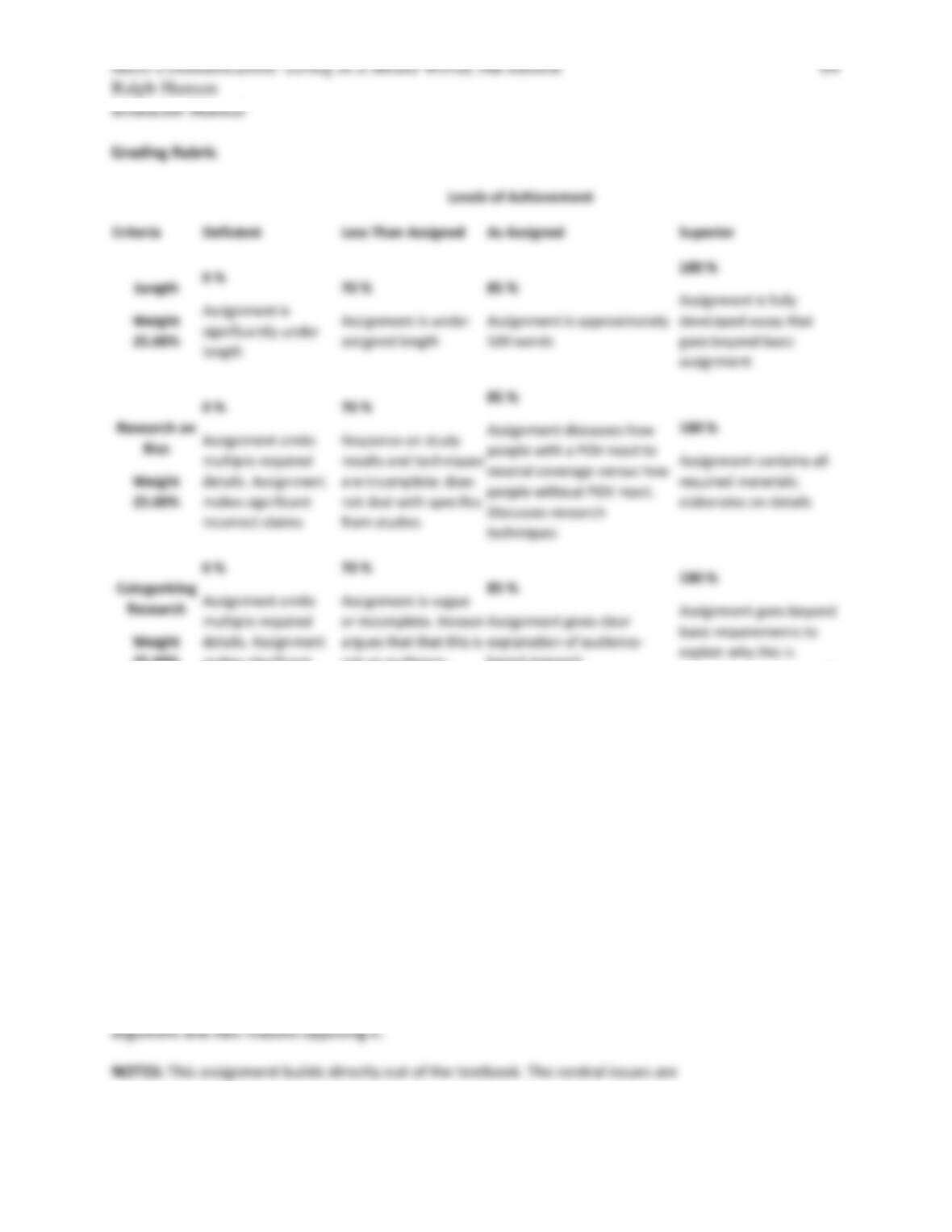
Grading Rubric
Levels of Achievement
Criteria
Deficient
Less Than Assigned
As Assigned
Superior
Length
Weight
25.00%
0 %
Assignment is
significantly under
length
70 %
Assignment is under
assigned length
85 %
Assignment is approximately
500 words
100 %
Assignment is fully
developed essay that
goes beyond basic
assignment
Research on
Bias
Weight
25.00%
0 %
Assignment omits
multiple required
details. Assignment
makes significant
incorrect claims
70 %
Response on study
results and techniques
are incomplete; does
not deal with specifics
from studies
85 %
Assignment discusses how
people with a POV react to
neutral coverage versus how
people without POV react.
Discusses research
techniques
100 %
Assignment contains all
required materials;
elaborates on details
Assignment goes beyond
0 %
70 %
100 %
• Urban afternoon papers having been closing at a steady pace over the last several decades; and
urban papers are suffering overall.
• National newspapers, such as the Wall Street Journal and USA Today are holding onto paid
circulation and readership.
• Most cities that had multiple competing newspapers now have both the morning and the
afternoon papers published by the same company. Relatively few cities have true competing
papers.
• More people still subscribe to newspapers than watch network television news.
• Suburban and community papers are suffering from the recession, but are not seeing as much
trouble as the urban papers.
Media Literacy Exercise―Nellie Bly and the tabloids today
How would 19th–century reporter Nellie Bly fit into the world of tabloid journalism today? Explain.
NOTES: For a more complete look at journalist Nellie Bly, take a look at
www.pbs.org/wgbh/amex/world
This link takes you to the Around the World in 72 Days website that accompanies the PBS
documentary of the same name. From what was written in the book and is apparent from the website,
Nellie Bly would have neatly fit within any of the current tabloid newspapers. Look at the sort of lively
and sensational stories that Bly used to write and compare them in style to what papers like the New
York Daily News or the Chicago Sun–Times print.
MEDIA LITERACY EXERCISE – BIAS
Bias in the News
No matter what the news media do, they are likely to be charged with being biased. How do
critics know this bias exists? They just have to look at the news. It’s perfectly obvious, “they” say. But a
pair of research studies found that if you examine a news story about a partisan issue, readers or
viewers from both sides will claim that it is biased against their point of view. The studies showed that as
long as the story tried to present a nuanced view that presented multiple sides of an issue—that is, what
journalists would call an unbiased view—partisans on either side of the issue viewed the story as
hopelessly biased. On the other hand, if the story had a strong point of view—that is, it was biased—
people tended to perceive it as less biased.59
Who are the sources?
Who conducted the two studies written about in the story? Where do they work? What are
59 Shankar Vedantam, “Two Views of the Same News Find Opposite Biases,” Washington Post, July 24, 2006, A02.
their fields of study?
What are they saying?
How do partisans react to stories that are supposedly neutral (or unbiased)? How do neutral
observers react? How do members of the two groups react to stories that have an explicit point of view?
How would you categorize this research in terms of being message–, medium–, ownership–, or audience–
based? Can you categorize the type of theory base the researchers were using?
What evidence exists?
How did the two researchers reach their conclusions? How did they conduct their research?
What do you and your classmates think about media bias?
What stories do you or your classmates see as biased? Do you ever think that stories are biased
in your favor? How do you feel when a story is trying to be balanced by presenting information you
disagree with? In light of these studies, how do you think the news media should respond to charges of
being biased? Do you prefer neutral–style reporting or news with an explicit point of view? Why?
http://www.washingtonpost.com/wp–dyn/content/article/2006/07/23/AR2006072300512.html
Suggested Readings
• Daniel Pearl, At Home in the World: Collected Writings from the Wall Street Journal (New York:
Wall Street Journal, 2002): A collection of the best of murdered reporter Danny Pearl’s work.
• Ben Bradlee, A Good Life: Newspapering and other Adventures (New York: Simon & Schuster,
1995): This autobiography of the former editor of the Washington Post gives insight into
Watergate, the Janet Cooke scandal, and the growth of one of the country’s great newspapers.
• Michael Schudson, Discovering the News (New York: Basic Books, 1978): Schudson clearly
explains the varied roles that newspapers have played in the United States from the colonial
period through the 20th century.
• Brooke Kroeger, Nellie Bly: Daredevil, Reporter, Feminist (New York: Times Books, 1994): Kroger
provides a fascinating look at the lives and times of stunt reporter Nellie Bly.
• All of the Chapter 6 links posted to my RalphEHanson.com blog
http://www.ralphehanson.com/category/chapter–6/
Mass Communication: Living in a Media World, 6th edition
Ralph Hanson
72
Mass Communication: Living in a Media World, 6th edition
Ralph Hanson
73
Mass Communication: Living in a Media World, 6th edition
Ralph Hanson
74
Mass Communication: Living in a Media World, 6th edition
Ralph Hanson
75
Mass Communication: Living in a Media World, 6th edition
Ralph Hanson
76
Mass Communication: Living in a Media World, 6th edition
Ralph Hanson
77
Mass Communication: Living in a Media World, 6th edition
Ralph Hanson
78
Mass Communication: Living in a Media World, 6th edition
Ralph Hanson
79
Mass Communication: Living in a Media World, 6th edition
Ralph Hanson
80