Mass Communication: Living in a Media World, 6th edition
Ralph Hanson
21
Mass Communication: Living in a Media World, 6th edition
Ralph Hanson
22

Mass Communication: Living in a Media World, 6th edition
Ralph Hanson
23
Mass Communication: Living in a Media World, 6th edition
Ralph Hanson
24
1. discuss the history and development of our understanding of media effects;
3. name four types of effects the mass media can have;
5. explain how the mean world syndrome addresses the effects of consuming large amounts of
1. How did the existence of electronic documents allow Edward Snowden to steal and release
so many secret government records? Could he have done the same thing with paper
documents?
2. What are the major problems with the direct effects model—the original theory of media
effects?
3. What are the four major types of media effects? Give an example of each.
4. Compare and contrast how the direct effects model would explain the effects of media
violence compared with the cultivation theory.
5. What kind of questions can you best answer using critical theory? What kind of questions is
it weakest at answering?
Media Literacy Exercises
Media Literacy Exercise―C–SPAN versus commercial networks
Watch C–SPAN’s Washington Journal morning interview program for half an hour. It can be
viewed on your local cable service or on the Internet at www.c–span.org/. Then watch half an hour of a
morning news show on a commercial broadcast or cable news channel.
In a brief essay, describe three ways in which Washington Journal differs from the morning news
show you watched on the commercial network. Which type of program do you prefer? Why?
• Marshall McLuhan, Understanding Media: The Extensions of Man (New York: McGraw–Hill, 1964):
The original work on how the media shape how we perceive the world.
• Joshua Meyrowitz, No Sense of Place (New York: Oxford University Press, 1985): An examination of
how television through its very existence changes the world we live in.
• Arthur Asa Berger, Media Analysis Techniques, 3rd ed. (Thousand Oaks, CA: Sage 2005): An excellent
and readable summary of different approaches to studying the mass media.
• Dennis McQuail, McQuail’s Mass Communication Theory, 5th ed. (London: Sage, 2005): This is a
huge, comprehensive look at mass communication theory and was one of my primary references for
this chapter. This title is one for you, not for your students, most likely.
• All of the Chapter 2 links posted to my RalphEHanson.com blog
http://www.ralphehanson.com/category/chapter–2/page/5/
Lecture Builders
Philip de Vellis’s Vote Different ad
The opening of the YouTube video is instantly familiar—Apple’s iconic “1984” Super Bowl
commercial featuring dark Orwellian imagery created by famed director Ridley Scott streams out. But
what’s going on here? Instead of television screens filled with Big Brother spouting ideology at the
colorless marching drones, it’s Hillary Clinton’s face and voice from her presidential campaign
announcement video. At the close of the video comes the text, “On January 14th, the Democratic
primary will begin. And you’ll see why 2008 won’t be like ‘1984.’” The one–minute clip then ends with a
letter O stylized to resemble the rainbow Apple logo, above the Web address of rival Democratic
presidential hopeful Barack Obama.
The mash–up video appeared to come from Obama’s campaign, though of course it didn’t. But
it’s a fascinating look at how user–created video sites such as YouTube changed the nature of the 2008
presidential campaign. You had a zero–cost distribution network through which individual people
enthralled by the video distributed it virally through blogs and e–mails. Messages were going out that no
candidate financed or approved.
Once posted, the video became one of the hottest user–created videos on the Web. Over an 18–
day period, the clip was viewed more than 2.5 million times, and over the course of the 2008 campaign
it was viewed more than 4 million times.
There was endless speculation about who created it and, just as important, why. The user name
of the video poster was “ParkRidge47,” a subtle poke at Senator Clinton, who was born in 1947 and was
raised in the Park Ridge, Illinois, area.19
The response to the video was fascinating. Obama, appearing on the Larry King Live show,
denied having anything to do with the video, but he spoke admiringly about it:
19 Michah L. Sifry, “Parkridge47: Not an R, and Not Bill Hillsman,” Personal Democracy Forum, March 21, 2007,
www.techpresident.com/node/173.
[W]e knew nothing about it. I just saw it for the first time. And, you know, one of the
things about the Internet is that people generate all kinds of stuff. In some ways, it’s—
it’s the democratization of the campaign process. . . . But it’s not something that we
had anything to do with or were aware of and, given what it looks like, frankly we
don’t have the technical capacity to create something like that. It’s pretty
extraordinary.20
The accusations and rumors about the identity of the creator were all over the place. Of course,
some fingered the Obama campaign, while others accused Republican activist groups similar to Swift
Boat Veterans for Truth (who helped sink John Kerry’s presidential campaign in 2004). Eventually the
liberal–leaning website the Huffington Post tracked the video back to Phil de Vellis, who had been an
Internet consultant for an Ohio Democratic Senate candidate and also worked for a Democratic Internet
consulting firm.21 In his own post on Huffington’s blog, de Vellis acknowledged creating the video:
I made the “Vote Different” ad because I wanted to express my feelings about the
Democratic primary, and because I wanted to show that an individual citizen can
affect the process. There are thousands of other people who could have made
this ad, and I guarantee that more ads like it—by people of all political
persuasions—will follow. This shows that the future of American politics rests in
the hands of ordinary citizens…This ad was not the first citizen ad, and it will not
be the last. The game has changed.22
The amazing thing was how easy it was for de Vellis to produce the ad. He told Vanity Fair’s
James Wolcott, “I made the ad on a Sunday afternoon in my apartment using my personal equipment (a
Mac and some software), uploaded it to YouTube, and sent links around to blogs.”23 Prior to becoming a
full–time political consultant, de Vellis was a freelance video editor and graphics designer in Los Angeles.
He has a bachelor’s degree in history from the University of California, Los Angeles. After de Vellis was
outed as the creator of “Vote Different,” he was terminated by his employer, Blue State Digital, but he
was soon hired to be the vice president of new media for Murphy Putnam Media.
De Vellis was correct when he said that the political advertising game had changed. During the
general election campaign, the best video supporting Obama came not from the campaign but rather
from Will.i.am of the Black Eyed Peas. The video “Yes We Can” features speeches by Obama overlaid by
a wide range of popular performers singing and speaking. Like “Vote Different,” it was created as a
personal project by a skilled media professional with no connection to the campaign. Numerous
advertising journalists, including Ad Age’s Bob Garfield and Business Week’s David Kiley, called “Yes We
Can” the best marketing message of 2008.24
Clay Johnson, the head of Blue State Digital, in an interview conducted before de Vellis was
revealed as the video’s creator, spoke to the challenges of user–created video. “The real trouble . . . is
that as people get more sophisticated in producing these videos, you’re going to see a very large blur in
20 Larry King, interview with Barack Obama, CNN Larry King Live, March 19, 2007,
transcripts.cnn.com/TRANSCRIPTS/0703/19/lkl.01.html.
21 Arianna Huffington, “Who Created ‘Hillary 1984’? Mystery Solved,” Huffington Post, March 21, 2007,
www.huffingtonpost.com/arianna–huffington/who–created–hillary–1984_b_43978.html.
22 Phil de Vellis, “I Made the ‘Vote Different’ Ad,” Huffington Post, March 21, 2007,
www.huffingtonpost.com/phil–de–vellis–aka–parkridge/i–made–the–vote–differen_b_43989.html.
23 James Wolcott, “The YouTube Election,” Vanity Fair, June 2007.
24 Bob Garfield, “Ads Garfield Loved,” Advertising Age, December 15, 2008, adage.com/article?article_id=133200;
David Kiley; “Best Message Creation of 2008: The Winner Is Will I.Am,” Business Week, December 31, 2008,
www.businessweek.com/the_thread/brandnewday/archives/2008/12/best_message_cr.html.
what’s official and what’s not.”25
In this simple statement, Johnson is putting forward Truth Two—There are no mainstream
media; Truth Three—Everything from the margin moves to the center, and, by implication, Truth Five—
New media are always scary. The “Vote Different” and “Yes We Can” videos show how new tools, such
as YouTube videos, are becoming a growing part of the political process. What makes user–produced
videos so scary to those in the business of politics is that the videos can’t be controlled. They aren’t yet
regulated—at least as of this writing—by the Federal Election Commission; they can be produced by
anyone with talent and a halfway–decent computer; and they can reach a worldwide audience almost
instantly at little cost to the producer.
Here are links to the two videos mentioned here:
• http://ralphehanson.com/blog/archive_07_03.html#032207_1984
• http://www.youtube.com/watch?v=jjXyqcx–mYY
Material on political influence
Our understanding of the media and the campaign process has evolved over the past hundred
years. In the early decades of the twentieth century, scholars and critics worried that voters might be
manipulated and controlled by campaign messages sent through the media, especially those that might
be sent subliminally. This understanding changed in the 1940s and 1950s as scholars came to suspect
that media effects might in fact be selective and indirect. Currently, it is believed that an interactional
relationship exists among politicians, the press, and the public in which each influences the others.
How Do Political Campaigns Affect Voters?
If, as The People’s Choice study indicates, campaigns do not have strong direct effects on voters,
what are candidates trying to accomplish with their campaigns? They may be trying to directly persuade
voters with the content of the messages, but more likely they are trying to shape the campaign in
subtler ways. These are interactional models that say that the interaction among voters, the media, and
the campaigns that are triggered by the ads are more important than any direct persuasion of voters.
Here are two examples:
The resonance model says that the candidate’s success depends in part on how well his or her
basic message resonates with voters’ preexisting political feelings. Thus, the candidate who does the
best job of sending out messages that connect with target voters is the one most likely to win. The
communication goal for the campaign is not so much to get people to change their minds as it is to get
voters to believe that they share viewpoints with the candidate.26 The resonance model was clearly
used in the 2008 campaign in ads by both Democratic candidate Barack Obama and Republican
candidate John McCain. Obama got strong resonance out of a commercial that claimed McCain was out
25 Sarah Lai Stirland, “Fears of a YouTube Swiftboat,” Wired News, March 23, 2007,
www.wired.com/news/politics/0,73069–0.html?tw=rss.politics.
26 Dan Balz and Anne E. Kornblut, “Obama Joins Race with Goals Set High,” Washington Post, February 11, 2007.
of touch with ordinary people because he didn’t know how many houses he owned. McCain got a similar
resonance by charging Obama with being more of a celebrity than a serious politician.
The competitive model looks at the campaign not in isolation, but as a competition between
two or more candidates for the hearts and minds of voters. Hence the success of a campaign message,
such as a speech that criticizes the candidate’s opponent, depends as much on the opponent’s reaction
as it does on the message itself. Voter response can also depend on how the media react to the
message. If the message attracts media attention, it may be played repeatedly on news broadcasts, as
well as on political talk shows.27 During the 2008 Democratic presidential primary, candidate Hillary
Clinton leveled charges against Obama that he had lifted political rhetoric from Massachusetts governor
Deval Patrick. Similar charges that Sen. Joe Biden had lifted a speech from the British Labor Party leader
helped sink his campaign for the presidency back in 1988.28
But Obama did not suffer the same sort of damage that Biden did. Why not? First, Obama and
Governor Patrick are friends, they share the same political adviser, and they have long shared a similar
message. Second, Patrick did not object to the use of his words. Finally, Obama did not react particularly
defensively to the charges of plagiarism. So, according to the competitive model, the public’s direct
reaction to the charges didn’t matter as much as how the public reacted to Obama’s reaction to the
charges.
MEDIA THEORY NOTES: McLUHAN: Marshall McLuhan was famous for his quote “The medium
is the message.” Now it is absurd to argue that there is no importance in the actual message. Rhetorical
theorist Kenneth Burke says to imagine you are given a warning that you have an enemy coming to kill
you. You will want to know who the enemy is and why he hates you. You want to know more than just
what channel was used to transmit the message. But McLuhan was not really trying to say that the
message itself was unimportant. Instead he meant that media have effects beyond the messages they
transmit.
McLuhan argues that the changing nature of our communication technology changes how we
use our senses to perceive the world. When we lived in an era where all of our media were printed, we
used rational, linear arguments because we were accustomed to the linear nature of print. Now that we
live in a video age, we pay more attention to our feelings and to what McLuhan considered to be more
expressive communication.
McLuhan died in 1980, not long before MTV first went on the air, but he would have loved the
implications of the music video channel. For music videos are media with very little content. There is a
stream of music and images that individually might make sense, but more often have little to do with
one another. MTV, McLuhan might have argued, is almost pure medium―a series of beautiful,
27 Stephen Ansolabehere, Shanto Iyengar, and Adam Simon, “Shifting Perspectives on the Effects of Campaign
Communication,” in Do the Media Govern? Politicians, Voters, and Reporters in America, ed. Shanto Iyengar
and Richard Reeves (Thousand Oaks, Calif.: Sage Publications, 1997).
28 Howard Kurtz, “Media Notes: Big Day or Non–Event?” Washington Post, February 19, 2008, www.washington
post.com/wp–dyn/content/article/2008/02/19 /AR2008021900844.html?referrer= emailarticle.
interesting, or shocking images and sounds that push to the limits the technological capabilities of cable
television. The message of MTV might be that life is a series of brief images that capture our imagination
because they are flashy, interesting, sexy, or violent.
MEDIA THEORY NOTES: MACARTHUR DAY PARADE: One of the most visionary of the early TV
studies was conducted by Kurt and Gladys Lang in the late 1950s. They wanted to know how people
perceived an event differently when they viewed it on television rather than when they experienced it in
person. To find out, they positioned 31 observers around Chicago to study how people responded to the
parade honoring General Douglas MacArthur and then compared their feelings to those who viewed the
parade on television.
People who saw the parade in person had expected to see mobs and wild crowds; they also
expected to be entertained. But at the parade itself there was relatively little discussion of the political
controversies surrounding General MacArthur, people behaved relatively well, and folks complained
that the parade would have been better on television.
Those who watched the parade on television and listened to the commentary saw an image of
the public wildly supporting MacArthur. Television delivered the excitement that people expected
through the entire day. People along the parade route waited and waited with nothing going on; they
then saw MacArthur for a few moments as he went past. People watching the parade on television saw
MacArthur continuously. What is more, they had commentators telling them the event was exciting.
The Langs concluded that television gave a very different picture of the parade than being there
in person. They found that
• television technology shapes the views people receive of the world.
• the commentary from an announcer helps shape the views of television audience members.
• the event itself was staged primarily for television coverage rather than the in–person audience.
• the goal of the broadcast was to give the audience something interesting to look at rather than an
accurate portrayal of reality.
Social learning Batman example
Think about a small boy who watches Batman defeat evil bad guys (EBGs) by physically fighting
with them. Fighting with the EBGs proves to be a successful strategy and generally earns the superhero
praise and the keys to Gotham City. Thus, while watching the animated show may not lead directly to
the child engaging in violence, it could teach him that fighting is an effective way of solving problems
and leads to social approval. He may then try out the practice by fighting with his sister, at which point
he discovers it does not lead to social approval from his parents, and he stops the behavior. Or he might
try it out by fighting with his friends and discover that it leads to his receiving respect. From this
simplistic example, we can see how social learning theory can be applied to analyzing media. The
content of the media can provide a large–scale source of content from which social learning can take
place.29 If the behavior being modeled is successful in achieving the person’s goals, it may continue to be
used. Think of the Batman–watching child who gains respect among his friends by fighting. If the
behavior is unsuccessful in achieving results, the person may try other strategies. Think of the Batman–
watching child who earns parental disapproval by fighting with his sister. He may instead sharpen his
verbal or negotiating skills to gain the upper hand in conflicts with his sister.
NOTES: WHO IS THE AUDIENCE: A good bit of the media content exists for relatively small
audiences. For example, the Sunday morning shows on the various cable and broadcast networks, such
as Fox News Sunday, Meet the Press, and Face the Nation, are heavily watched by print journalists, who
may write stories for Monday’s paper based on what was said on the Sunday pundit shows. The
influence of these programs comes not from how many people watch them, but rather who watches
them.
NOTES: HOW DOES TELEVISION CHANGE POLITICAL NEWS: Joshua Meyrowitz, in his book No
Sense of Place, says that when we see too much of our leaders, we tend to lower them to our level. For
leaders to appear heroic they need to keep people at a certain distance, which is hard when the media
are constantly viewing them. The coming of the television camera to presidential press conferences
made the meetings between the press and reporters public. No longer can the president banter with the
press or give them directions without the world watching in. President Teddy Roosevelt, for example,
used to be interviewed while being shaved. And although this would be a fairly intimate situation, it was
not being staged for the press. The readers of the newspaper articles would not hear about him sitting
in the barber’s chair. They would simply read about the information he gave out. But television gives all
sorts of details that are left out of other media. Meyrowitz says, “Print, for example, conveys words but
no intonations or facial gestures; radio sends intonations along with the words, but provides no visual
information; television transmits the full audio/visual spectrum of verbal, vocal, and gestural.” Also,
because our messages can go out instantly, we expect instant response. President Franklin D. Roosevelt
spoke to the country the day after Pearl Harbor, but President George W. Bush appeared on television
the evening of September 11, 2001, following the terrorist attacks on New York and Washington, D.C.,
and he received some criticism for delaying his appearance for that long.
VIDEO HINTS: When I used to teach this course in a large lecture setting, I would generally have
C-SPAN playing on the video system as students came to class. Today, in addition to the basic C–SPAN
networks, you also have access to anything that has ever aired on C–SPAN through the C–SPAN video
archives mentioned previously.
To highlight the difference between C–SPAN and the commercial networks, show a clip of
Washington Journal followed by a clip from The O’Reilly Factor from Fox News or Countdown from
MSNBC. It can also be interesting for students to see an excerpt of BBC news. This can be taped from
BBC America if you have access to that channel, or streamed from the BBC website.
29 DeFleur and Ball–Rokeach, Theories of Mass Communication.
Media Activities
When Words Matter
The words we use matter intensely. Sometimes they tell others a lot about who we are. Sometimes
when we use the wrong words we hurt people we hadn’t intended to. And sometimes we don’t have
any idea what the actual words are as illustrated in this link:
• http://www.ralphehanson.com/2014/11/21/when–words–matter/
Questions: Consider, for example, the language people use to refer to immigrants who enter the United
States without the permission to do so. How does using different words change how we feel about or
perceive people?
Chapter 3―Media Business
Summary and Learning Objectives
The American media industry, the largest in the world, is run by private business with only minor
government control. Started in the 1640s, it was among the first industries in the American colonies.
However, media business did not become big until the 1830s, when high levels of literacy and the
development of the steam–powered printing press allowed for the mass production of newspapers,
books, and magazines. The growth of the electronic media in the second half of the 20th century helped
create a national media culture, as the same content became available simultaneously throughout the
country.
For many years, six large media conglomerates dominated the American and much of the global
media. They owned the major television networks, broadcast stations, cable channels and providers,
newspapers, magazines, record labels, movie studios, and Internet services. These companies tend to be
vertically integrated—producing, promoting, and delivering content to the consuming audience. But
there are a number of new players in the media business who are also significant. They provide cable
television and Internet services, online search and content, and integrated media content and hardware.
Among the biggest media companies operating in the United States are Time Warner, Disney, News
Corporation, 21st Century Fox, Viacom/CBS, Bertelsmann, Comcast/NBCUniversal, Google, and Apple.
Widespread access to the Internet has brought about the rise of smaller–scale new media
companies that specialize in providing a wide range of media content that appeals to relatively small
numbers of consumers. When combined, these niche markets, known as the long tail of media, can rival
the size of the markets for blockbuster media content.
While the media industry is dominated by a limited number of companies, these companies
have to please a wide range of groups in order to operate successfully. Those groups include the
companies’ owners, advertisers, government, special interest groups, news sources, and audience
members.
After studying this chapter, you will be able to
2. summarize how control of the media industry has changed from the 1950s to the present
day;
4. explain why Apple, Google, and other tech companies may also be considered leading media
companies;
6. identify six groups that influence how the media behave and what content they present.
1. How do musicians Doug and Telisha Williams measure their success as professional
musicians? How does their approach differ from fans who say, “I hope you make it”?
2. How is media ownership different in the United States than in much of the rest of
the world?
3. What do the “legacy conglomerates” have in common as media companies?
4. How do the new Big Media companies differ from the older legacy companies?
5. How do long–tail media differ from short–head media?
6. Compare and contrast the power wielded by at least three of the groups who your
book suggests control the media in the United States.
Media Literacy Exercises
Media Literacy Exercise―Media ownership
Your local cable company may offer more than 100 channels, but how many different
companies own the channels you are viewing? For this assignment you are to list the cable channels that
appear on your local system, from channel 14 to channel 33 (the first 20 nonbroadcast channels). Now
list who owns each of these channels. You will likely be able to find much of the information you need at
the Columbia Journalism Review’s website:
www.cjr.org/resources/
Another good source of information on media ownership is available at the Pew Research
Center’s Project Excellence in Journalism website:
http://www.stateofthemedia.org/2010/media–ownership/dashboard.php
You may also need to go the websites of various channels or to your university library. How
many different companies control those twenty channels?
• Students should earn a C for the assignment if they simply list the channel numbers and a single
owner for each channel.
• Students may earn a D or F if they simply attach the name of station to the channel number.
Media Literacy Exercise―Synergy
Pick a popular current movie. What studio produced it? What major media corporation owns
the studio that produced it? Next, identify as many cross–promotion partnerships as you can. For
example, how many magazines owned by the same corporation are featuring articles about the movie?
What books have been published that tie in with the show or movie? Is there a soundtrack CD (or even a
series of CDs)? What products are being sold with the movie’s image on it? (These can range from
games to posters to clothing.) Try checking the movie or show’s website and the parent company’s site.
What nonmedia products include the movie or show in their promotions? (These could include food,
beverage, and even car companies.) You can find helpful information for this exercise at the Internet
Movie Data Base at
http://imdb.com
NOTES: This assignment is going to be very much a matter of degree. Commercial blockbuster
movies are going to have enormous levels of product tie–ins, while more serious movies will have far
fewer. Even the movie The Hours, which featured Virginia Woolf as a character, had a tie–in promotion
with several of Woolf’s books. You might consider asking your students to compare the number of tie–
ins each movie has with the size of its budget. This assignment can be done as a paper for a grade or as a
basis for a class discussion in a smaller enrollment section.
You can find a good estimate of many movies’ budgets at
http://www.boxofficemojo.com
A second useful site is
http://www.the–numbers.com/
As always, feel free to use whatever grading scheme works best for you. I use a rubric–based
system, where I assume that most students will complete the assignment in a competent manner and
should earn a grade of B.
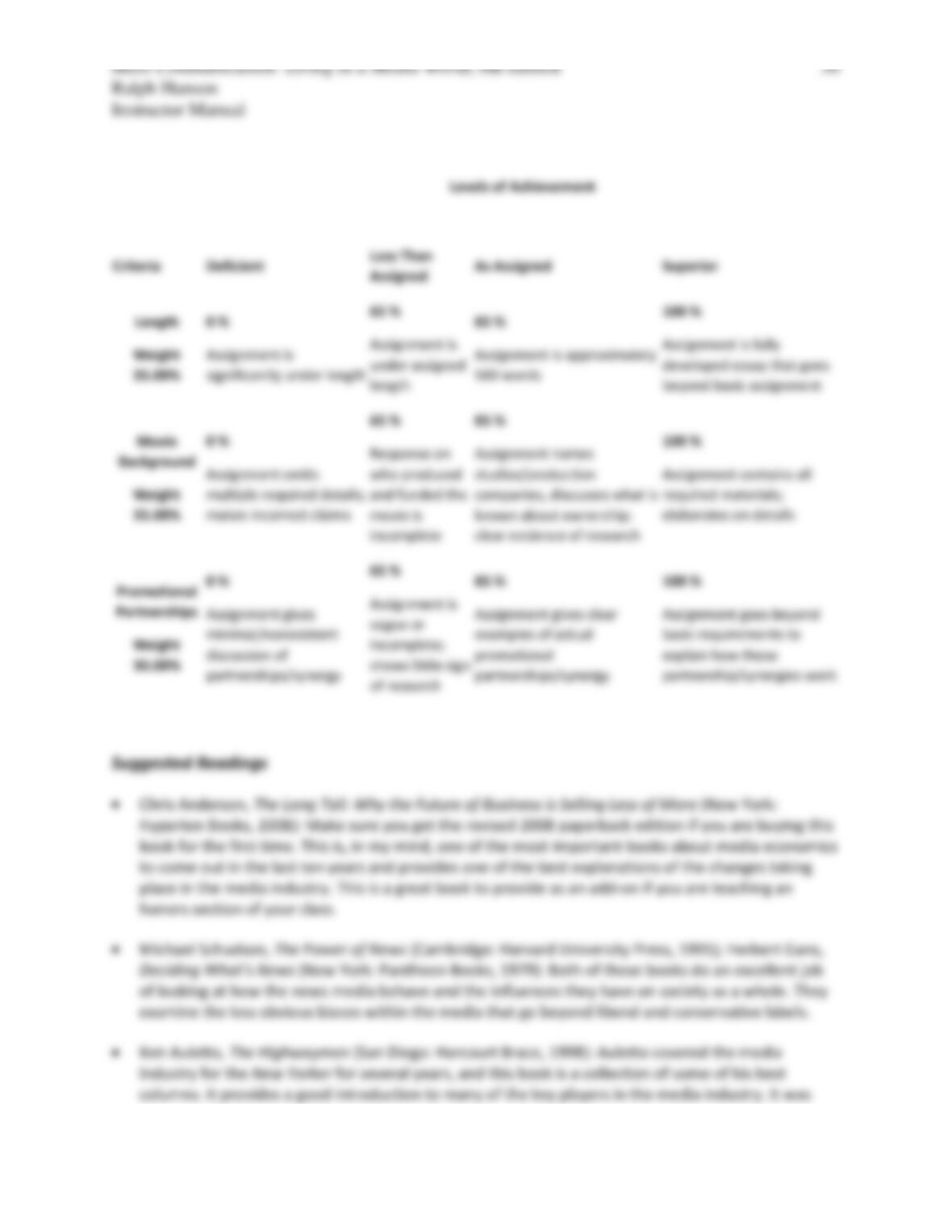
Levels of Achievement
Criteria
Deficient
Less Than
Assigned As Assigned Superior
Length
Weight
35.00%
0 %
Assignment is
significantly under length
65 %
Assignment is
under assigned
length
85 %
Assignment is approximately
500 words
100 %
Assignment is fully
developed essay that goes
beyond basic assignment
Movie
Background
Weight
35.00%
0 %
Assignment omits
multiple required details;
makes incorrect claims
65 %
Response on
who produced
and funded the
movie is
incomplete
85 %
Assignment names
studios/production
companies, discusses what is
known about ownership;
clear evidence of research
100 %
Assignment contains all
required materials;
elaborates on details
Promotional
Partnerships
Weight
30.00%
0 %
Assignment gives
mini
mal/nonexistent
discussion of
partnerships/synergy
65 %
Assignment is
vague or
incomplete;
shows little sign
of research
85 %
Assignment gives clear
examples of actual
promotional
partnerships/synergy
100 %
Assignment goes beyond
basic requirements to
explain how these
partnership/synergies work
Suggested Readings
• Chris Anderson, The Long Tail: Why the Future of Business is Selling Less of More (New York:
Hyperion Books, 2008): Make sure you get the revised 2008 paperback edition if you are buying this
book for the first time. This is, in my mind, one of the most important books about media economics
to come out in the last ten years and provides one of the best explanations of the changes taking
place in the media industry. This is a great book to provide as an add–on if you are teaching an
honors section of your class.
• Michael Schudson, The Power of News (Cambridge: Harvard University Press, 1995); Herbert Gans,
Deciding What’s News (New York: Pantheon Books, 1979): Both of these books do an excellent job
of looking at how the news media behave and the influences they have on society as a whole. They
examine the less obvious biases within the media that go beyond liberal and conservative labels.
• Ken Auletta, The Highwaymen (San Diego: Harcourt Brace, 1998): Auletta covered the media
industry for the New Yorker for several years, and this book is a collection of some of his best
columns. It provides a good introduction to many of the key players in the media industry. It was
followed by Backstory: Inside the Business of News (New York: Penguin, 2004), which contains more
recent columns. Auletta also wrote a great book about Google that was a key source for this
chapter: Googled: The End of the World as We Know It (New York: Penguin Press, 2009).
You can find several good interviews with Auletta at the C–SPAN video archives. Just search for Ken
Auletta at http://www.c–spanvideo.org/
• Ben H. Bagdikian, The New Media Monopoly (Boston: Beacon Press, 2004): The authoritative book
on consolidation within the media industry.
• Walter Isaacson, Steve Jobs (New York: Simon & Schuster, 2011): The definitive (and authorized)
biography of Jobs.
• All of the Chapter 3 links posted to my RalphEHanson.com blog at
http://www.ralphehanson.com/category/chapter–3/
Lecture Builders
SPIKE LEE AND KICKSTARTER
Famed African–American Filmmaker Spike Lee has a long record of producing independently
minded films from his seminal movie Do the Right Thing to his biopic on Malcolm X, though he’s also
known for more commercial fare, like his thriller Inside Man starring Denzel Washington, Clive Owen,
and Jodie Foster.
But during 2013 and 2014, he made an extremely low–budget, truly independent film for a little
more than $1.25 million financed by more than 5,000 backers from the crowd–funding website
Kickstarter.30 Da Sweet Blood of Jesus, a movie Lee describes as a “bloody, funny, sexy movie” about
people who are “addicted to blood” who are not vampires, was shot in 16 days in Brooklyn and Martha’s
Vineyard with a cast of unknowns.31 Forrest Wickman, a movie reviewer for the website Slate, describes
the movie as “veering wildly between pulpy exploitation . . .and art–house filmmaking,” and notes that it
is unlike anything that would ever get conventional funding.32
30 Henry Barnes, “Spike Lee Raises $1.25m on Kickstarter for ‘Bloody, Funny, Sexy’ Film,” The Guardian, August
19, 2013.
31 Ramin Setoodeh, “Spike Lee on ‘Da Sweet Blood of Jesus’ and Hollywood’s Diversity Problem,” Variety, June
23, 2104, variety.com/2014/film/news/spike–lee–da–sweet–blood–of–jesus–hollywood–diversity–problem–
1201243416/.
32 Forrest Wickman, “Spike Lee’s Kickstarter Movie Is a Surprise Remake. Will Supporters Get What They Paid
For?” Slate, June 24, 2014,
www.slate.com/blogs/browbeat/2014/06/24/spike_lee_s_kickstarter_movie_da_sweet_blood_of_jesus_is_a_stealth_
remake.html?wpisrc=burger_bar.
To get funding though Kickstarter, filmmakers (like everyone else seeking Kickstarter funding)
put together a video pitch along with written details about their qualifications and the film they intend
to make. Potential contributors pledge to fund projects they find interesting, but they only get charged if
the project reaches the financial goal the creator set. If the project doesn’t reach its funding goal, no
money is exchanged.33 Assuming the project does reach its goal and gets funded, the people who
pledge do not get an investment in the movie as they might with conventional movie financing. Instead,
they get the satisfaction of supporting the project and very often some kind of reward, such as a copy of
the film or book produced by the project (though in the case of Spike Lee’s film, the reward at the
$10,000 level was getting to sit courtside with Lee at a Knicks NBA game).
At the time it was funded in August 2013, Da Sweet Blood of Jesus was the third largest movie
project to be funded through Kickstarter (raising approximately $1.4 million), following behind a movie
version of the cult TV series Veronica Mars ($5.7 million) and a Zach Braff film that raised $3.1 million.34
Lee, along with Braff (a popular actor and the director of the film Garden State), has received criticism
for funding his project through Kickstarter when he had other options available to him, with the
presumption that the funding that went to him could have gone to other, more needy filmmakers.35 The
founders of Kickstarter, however, responded through their blog to defend the celebrity filmmakers:
Almost five million people have backed a project on Kickstarter, and more
than a million have backed two or more projects. These repeat backers are responsible
for 59% of the total money pledged to Kickstarter projects—a whopping $444 million.
On average, 2,130 people a day have become new repeat backers this year. This is
huge! Future creators will benefit from more and more people using Kickstarter.36
In his Kickstarter proposal, Lee says that using nontraditional funding to finance his films is
nothing new to him:
I’m an Indie Filmmaker and I will always be an Indie Filmmaker. Indie
Filmmakers are always in search of financing because their work, their vision
sometimes does not coincide with Studio Pictures. But I do put my own money in my
films. I self–financed RED HOOK SUMMER. My fee for MALCOLM X was put back into
the budget. The truth is I’ve been doing KICKSTARTER before there was KICKSTARTER,
there was no Internet. Social Media was writing letters, making phone calls, beating
the bushes. I’m now using TECHNOLOGY with what I’ve been doing.37
33 David Carr, “At Sundance, Kickstarter Resembled a Movie Studio, but Without the Egos,” Media Decoder (New
York Times), January 30, 2012, mediadecoder.blogs.nytimes.com/2012/01/30/at–sundance–kickstarter–resembled–a-
movie–studio–but–without–the–egos/?_php=true&_type=blogs&_r=0.
34 Barnes, “Spike Lee Raises $1.25m on Kickstarter.”
35 Aaron Couch, “Kickstarter Defends Spike Lee’s Campaign: ‘This Isn’t Charity,’” HollywoodReporter.com,
August 19, 2013, www.hollywoodreporter.com/news/kickstarter–defends–spike–lees–campaign–609233.
36 Perry Chen, Yancey Strickler, and Charles Adler, “The Truth about Spike Lee and Kickstarter,” Kickstarter Blog,
www.kickstarter.com/blog/the–truth–about–spike–lee–and–kickstarter–0.
37 Spike Lee, “The Newest Hottest Spike Lee Joint,” Kickstarter.com, August 2013,
Kickstarter began in April 2009 and as of May 2014 had funded more than 60,000 projects. (Full
disclosure: Your author has helped fund several music and Web comic projects through Kickstarter.) Of
the more than 14,000 film and video projects that have been funded as of the summer of 2014, 70 have
been screened at Sundance, and more than 100 have been screened at the SXSW festival in Austin,
Texas.38
Beyond being a new source of funding for filmmakers, Kickstarter represents a new way of the
movie industry looking at the Internet and the people who inhabit it. As New York Times media blogger
David Carr points out, the legacy movie industry, represented through the Motion Picture Association of
America and the National Association of Theatre Owners, sees the online world as a scary place where
movie pirates reside, while independent filmmakers view it as an exciting source of support to make
movies Hollywood isn’t interested in making. And this makes Kickstarter an example of both Secret
Five—New media are always scary—and Secret Two—There are no mainstream media.
SLIDE HINTS: Good images for your slides can be found from the annual reports on each of the
major media companies’ websites. Here are links to many of the major media company corporate sites:
• http://www.ralphehanson.com/2012/01/24/link–ch-2-who–are–the–owners/
Making Money with American Idol
American Idol, produced by a division of Bertelsmann and airing on Fox Broadcasting, might be
the most profitable multimedia property of all time, with a total value of $2.5 billion. That’s more than
the gross domestic product of the European nation Moldova, according to news site MSNBC.39 Mike
Brunker, who leads a special projects reporting team for the news channel and website, writes that
American Idol draws that astronomical amount of revenue from a wide range of sources:
• Advertising—For 2007, American Idol was expected to bring in approximately $500 million a
year in advertising revenue from traditional commercials. Idol was charging $620,000 per 30–
second spot for the 2007 season.
• Product Placement—During the 2006 season, Idol had 4,086 paid product placements
during the show. This involves a sponsor paying to have its product featured during the
show itself rather than during a commercial slot, when viewers can tune out. The
Amazing Race was a distant second in the number of product placements, with only
2,790.
www.kickstarter.com/projects/spikelee/the–newest–hottest–spike–lee–joint?ref=live.
2014.
39 Mike Brunker, “‘Idol’ Empire Conquers New Multimedia Worlds; Hit Show’s Creators Find New Ways to
Squeeze Out Financial High Notes,” January 15, 2007, www.msnbc.msn.com/id/16580677.
Mass Communication: Living in a Media World, 6th edition
Ralph Hanson
40