A-57
chapter
1 2 3 4 5
6 7 8 9 10
11 12 13 14 15
16 17 18
The Business of Banking
1. Suppose Melvin’s Bank starts with the balance sheet in Table 9.4A and the income
statement in Table 9.2. Show how the balance sheet and income statement change
in each of the following scenarios. Also calculate the new ROA, ROE, and rate-
sensitivity gap.
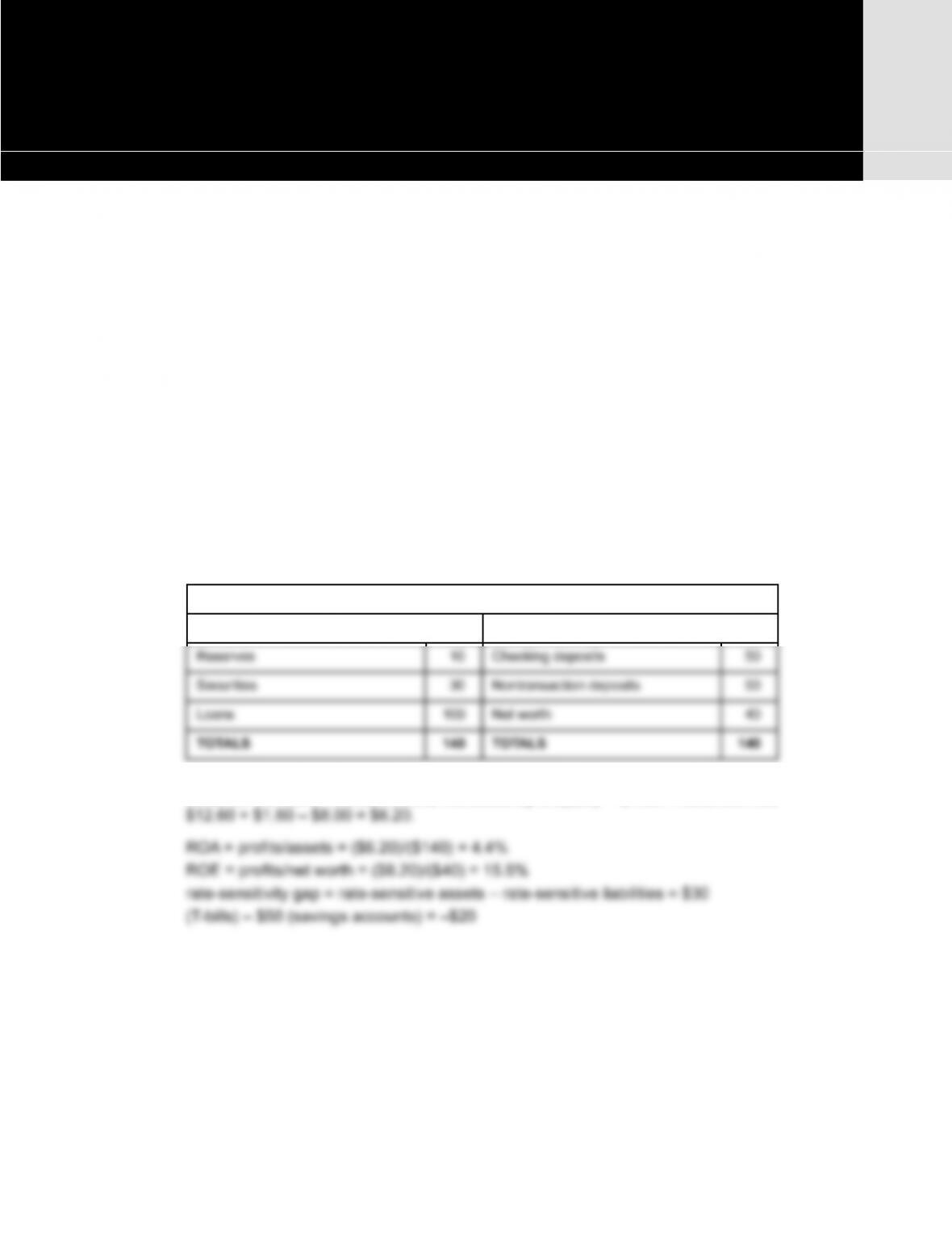
a. The bank issues $20 of new stock and uses the proceeds to make loans.
ANSWER:
The income statement is affected because the additional loans generate interest in-
come for the bank. Interest income increases by 8%($20) = $1.60. Profits are now
BALANCE SHEET
Assets Liabilities and Net Worth
A-58 CHAPTER 9 The Business of Banking
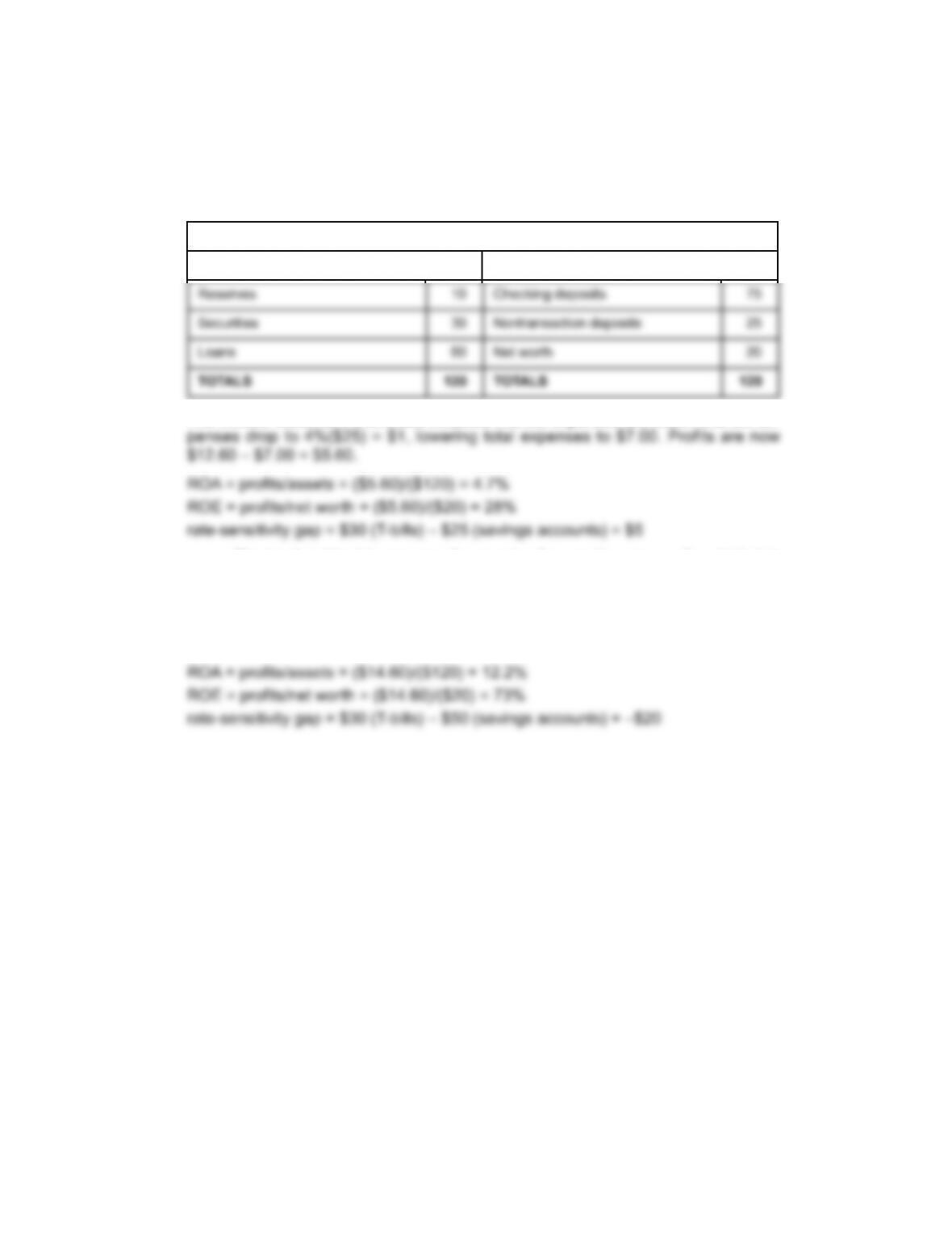
b. Britt moves $25 from his savings account to his checking account.
ANSWER:
The income statement is affected because interest expenses are lower. Interest ex-
c. The bank is hired to manage the assets of a wealthy person, for which it is
paid $10 a year.
ANSWER: Asset management is an off-balance-sheet activity (OBS). The balance
sheet is not affected, but the income statement is. Noninterest income increases by
$10. Profits are now $22.60 – $8.00 = $14.60.
BALANCE SHEET
Assets Liabilities and Net Worth
CHAPTER 9 The Business of Banking A-59
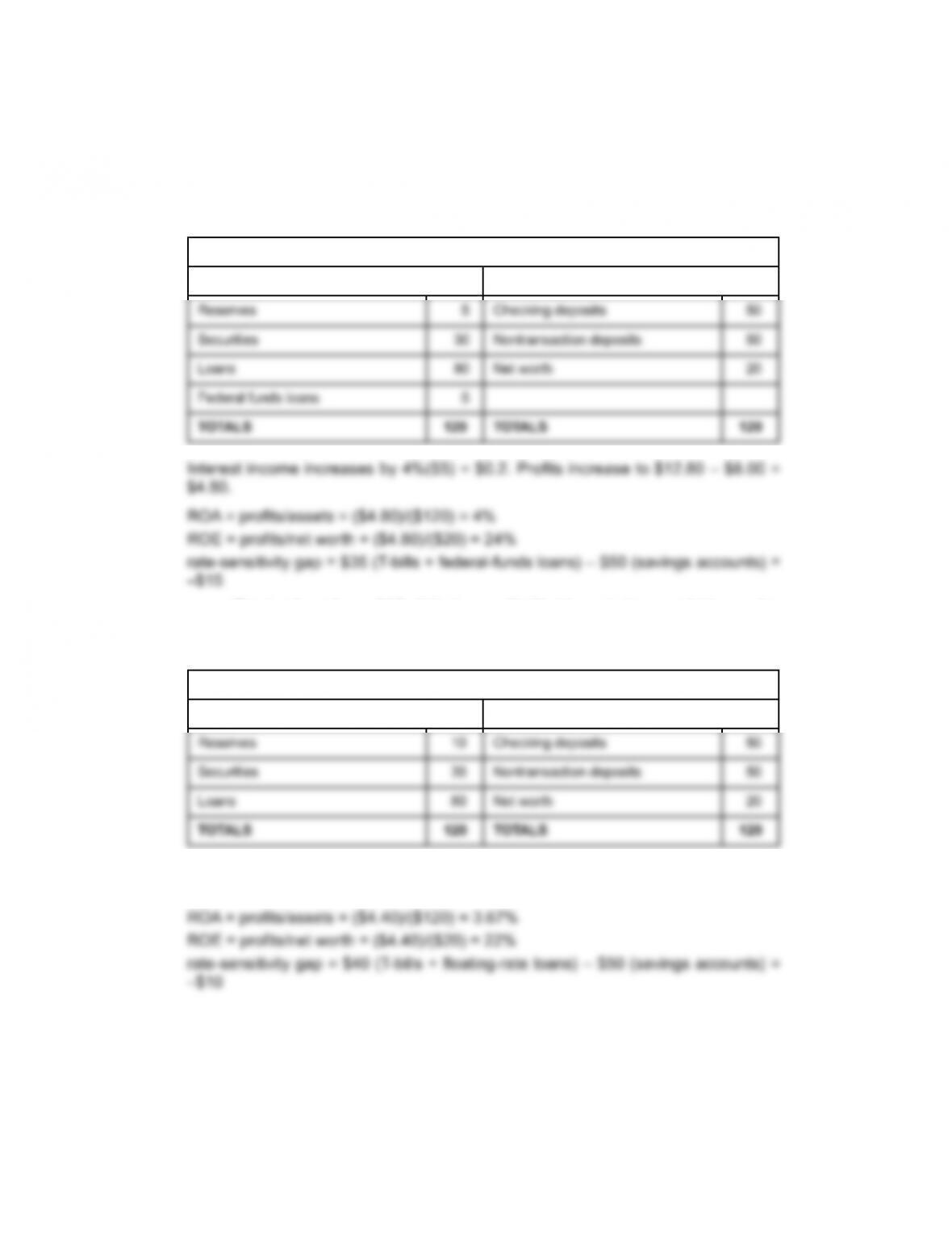
d. The bank lends $5 of reserves to another bank in the federal funds market. (As-
sume the federal-funds rate is the same as the Treasury-bill rate.)
ANSWER:
e. The bank replaces $10 of its loans with floating-rate loans, which pay the
Treasury-bill rate plus 2 percent.
ANSWER:
The balance sheet does not change, but the interest income changes. Interest in-
come on loans is 8%($70) + 6%($10) = $6.20. Profits drop to $12.40 – $8.00 = $4.40.
BALANCE SHEET
Assets Liabilities and Net Worth
BALANCE SHEET
Assets Liabilities and Net Worth
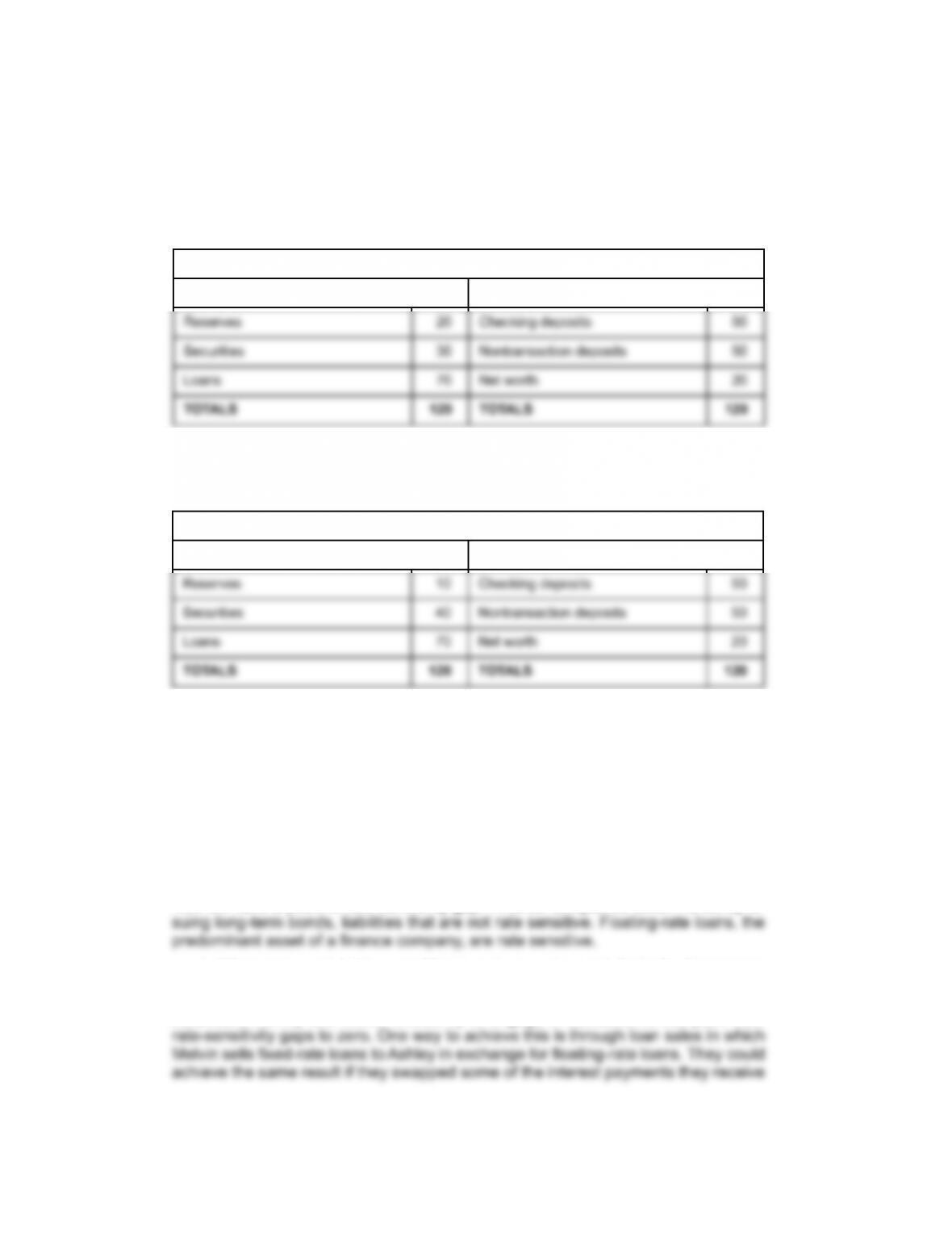
2. Suppose again that Melvin’s Bank starts with the balance sheet in Table 9.4A. Then
the bank sells $10 of loans for $10 of cash.
a. What is the immediate effect on the balance sheet?
ANSWER:
b. After the loan sale, what additional transactions is the bank likely to make?
What will the balance sheet look like after these transactions?
ANSWER:
The bank may use the cash from the loan sale to purchase T-bills in order to earn
some interest income. This transaction will reduce the bank’s exposure to credit risk
and helps to reduce the rate-sensitivity gap, making profits less sensitive to interest-
rate changes.
3. Suppose Ashley’s Finance Company raises most of its funds by issuing long-term
bonds. It uses these funds for floating-rate loans.
a. How does the company’s rate-sensitivity gap differ from those of most banks?
ANSWER: While banks tend to have a negative rate-sensitivity gap, finance compa-
nies will have a positive rate-sensitivity gap. Finance companies obtain funds by is-
b. What deal could Ashley and Melvin make to reduce risk for both of their insti-
tutions?
ANSWER: Ashley and Melvin should try to engage in transactions that push their
A-60 CHAPTER 9 The Business of Banking
BALANCE SHEET
Assets Liabilities and Net Worth
BALANCE SHEET
Assets Liabilities and Net Worth
Ashley and Melvin could also enter a futures contract that generates gains for Melvin
4. Canada does not have an institution like Fannie Mae that securitizes mortgages.
How do you think this fact affects the types of mortgages offered by Canadian banks?
(Hint: Think about interest-rate risk.)
ANSWER: The process of securitization facilitates loan sales and therefore helps
banks in managing their negative rate-sensitivity gap. Loan sales are one method
5. Robert Shiller of Yale University has suggested a variation on ARMs in which mort-
gage interest rates are tied to inflation, not to short-term interest rates. Discuss the
pros and cons of this idea for banks and for borrowers.
ANSWER: Recall from Chapter 4 that the nominal interest rate iequals the real
interest rate rplus inflation
π
. The Fisher equation (4.1), i= r+
π
, indicates that
short-term interest rates ican vary because of changes in rand/or because of
6. Suppose the Federal Reserve raises short-term interest rates, an action that is
likely to reduce aggregate output temporarily. Describe the various effects on the
profits of commercial banks.
ANSWER: In this case, banks’ exposure to (1) interest-rate risk, (2) credit risk, and
(3) economic risk has to be considered. (1) Higher short-term interest rates will reduce
CHAPTER 9 The Business of Banking A-61
7. How does each of the following developments affect banks’ desired equity ratios?
Explain.
a. An increase in OBS activities.
ANSWER: Assume that the banks have achieved the desired equity ratio ER = capital/
assets before the increase in OBS (off-balance sheet) activities. While the OBS ac-
b. A shift from C&I lending to real estate lending.
ANSWER: Real estate loans earn a higher interest rate than C&I (commercial and in-
c. A shift from fixed-rate to floating-rate loans.
ANSWER: A shift from fixed-rate to floating-rate loans will decrease the interest-rate
d. An increase in securitization.
ANSWER: An increase in securitization makes it easier to manage credit risk
through loan sales. If a bank is better able to decrease the likelihood of loan defaults,
8. As noted in Section 9.4, the Credit CARD Act of 2009 has made it more difficult for
people under 21 to obtain credit cards. Do you think this policy helps or hurts young
adults? Explain your view.
ANSWER: The Credit Card Accountability, Responsibility, and Disclosure Act of 2009
allows issuance of credit cards to people under 21 when one of the three conditions
below is met: (1) a parent, guardian, or other responsible individual agrees to co-sign
for the debt; (2) the applicant provides proof he or she can independently repay the
A-62 CHAPTER 9 The Business of Banking
ONLINE AND DATA QUESTIONS
www.worthpublishers.com/ball2
9. Examine a recent annual report for the bank where you have a checking account.
(The bank’s Web site is likely to have a link to its annual report.) Also examine the up-
dated Table 9.1 and Figure 9.1 at the text Web site.
a. How does your bank’s composition of assets and liabilities differ from aver-
ages for U.S. commercial banks? What explains these differences?
b. In recent years, how has your bank’s return on equity differed from the U.S. av-
erage? What factors might explain the above- or below-average performance?
10. Do some research on adjustable rate mortgages. One source is Freddie Mac’s
Annual ARM Survey (the text Web site links to Freddie Mac’s site, which contains
the survey). Since 2009, when ARMs were 3 percent of prime mortgages, has this
percentage remained low or risen? What explains the answer?
ANSWER: As stated in Freddie Mac’s Annual (ARM) Survey, the reason for the small
percentage of ARMs (adjustable rate mortgages) for prime mortgages in 2009 is at-
11. Do some research on the Consumer Financial Protection Bureau, established in
2010 (the text Web site links to the Bureau’s site). What regulations on credit cards
has the Bureau created? Is it considering additional regulations on credit cards? How
do existing and proposed regulations affect the fees and interest you pay if you are
late paying a credit card bill, transfer a balance between cards, or take a cash ad-
vance?
ANSWER: Establishing the Consumer Financial Protection Bureau by law in July
2010 required the President of the United States to nominate a director who would
CHAPTER 9 The Business of Banking A-63