A-21
chapter
1 2 3 4 5
6 7 8 9 10
11 12 13 14 15
16 17 18
What Determines
Interest Rates?
1. Using the loanable funds theory, show in a graph how each of the following events
affects the supply and demand for loans and the equilibrium real interest rate:
a. A war leads the government to increase spending on the military. (Assume
taxes do not change.)
ANSWER: With constant tax revenue and increased government spending, public
saving decreases. This decrease is represented by a leftward shift in the supply of
b. Wars in other countries lead to higher government spending in those countries.
ANSWER: As the real interest rate is pushed up in other countries (see answer to part
[a]), domestic savers have an incentive to lend their funds abroad. This will cause
c. Someone invents a new kind of computer that makes firms more productive.
Many firms want to buy the computer. Higher productivity also increases people’s
confidence in the economy, so consumers see less need to save.
ANSWER: The technological advance in the form of a new kind of computer in-
creases firms’ demand for loanable funds. Graphically this can be shown as a right-
ward shift in the demand for loanable funds. At the same time, private saving
A-22 CHAPTER 4 What Determines Interest Rates?
d. The same things happen as in part (c). In addition, increased confidence in
the economy raises net capital inflows.
ANSWER: The increase in capital inflows counteracts the decrease in private do-
2. Suppose the real interest rate rises. Using the loanable funds theory, discuss
whether this event is likely to reflect good economic news or is a sign of trouble.
ANSWER: A rise in the real interest rate can be caused by (1) a rightward shift in the
demand for loanable funds or (2) a leftward shift in the supply of loanable funds.
Whether this increase in the real interest rate is good news depends on the events
3. Comment on this statement: “People care about real interest rates, not nominal
rates. Therefore, money demand should depend on the difference between the real
rates on money and bonds, not the nominal rate on bonds.”
ANSWER: Note that the real interest rate on a bond is r. The real return on money
is –π. Money earns a negative real return when the inflation rate πis positive. With
increasing prices for goods and services, a given amount of money loses purchas-
ing power at the rate of inflation over time. If at the beginning of the year a hamburger,
4. Suppose that discount brokers make bonds more liquid. It becomes quick and in-
expensive to sell bonds. In the liquidity preference theory, how does this develop-
ment affect money demand and the interest rate?
ANSWER: If it becomes easier to sell bonds and turn bonds into money, then peo-
CHAPTER 4 What Determines Interest Rates? A-23
5. Suppose again that discount brokers make bonds more liquid. What should the
central bank do if it doesn’t want the interest rate to change? Explain your answer.
ANSWER: In order to prevent the drop in the nominal interest rate, the central bank
should decrease the supply of money. This decrease counteracts the drop in money
6. Suppose it is 2020 and the 1-year interest rate is 4 percent. The expected 1-year
rates in the following four years (2021 to 2024) are 4 percent, 5 percent, 6 percent,
and 6 percent.
a. Assume the expectations theory of the term structure, with no term premiums.
Compute the interest rates in 2020 on bonds with maturities of 1, 2, 3, 4, and 5
years. Draw a yield curve.
ANSWER:
1-year rate in 2020: 4%
Drawing the yield curve will show a flat yield curve for the first two years. After year
2, the yield curve is upward sloping.
b. Redo part (a) with term premiums. Assume the term premium for an n-year
bond, τn, is (n/2)%. For example, the premium for a 4-year bond is (4/2)% = 2%.
ANSWER:
1-year rate in 2020: 4% + (1/2)% = 4.5%
Drawing the yield curve will show an upward-sloping yield curve throughout. Adding
term premiums results in a steeper yield curve.
7. Suppose it is 2020, the 1-year interest rate is 8 percent, and the 10-year rate is 6
percent.
a. Draw a graph showing a likely path of the 1-year rate from 2020 through 2029.
ANSWER: Based on both, the pure expectations theory and the expectations theory
with term premiums, the 10-year rate can only be lower than the 1-year rate if the 1-
b. Why might people expect such a path for the 1-year rate?
ANSWER: Recall that nominal interest rates consist of the sum of the real interest
rate and the expected inflation rate. Therefore, such a path of falling 1-year rates may
8. Using the expectations theory without term premiums, derive a formula giving the
4-year interest rate in 2020 as a function of 2-year rates in 2020 and the future.
ANSWER: 4-year rate 2020 = (2-year rate 2020 + 2-year rate 2022)/2.The same
9. Suppose that some event has no effect on expected interest rates but raises un-
certainty about rates. What happens to the yield curve? Explain.
ANSWER: In order to discuss the impact of such an event on the yield curve, it is use-
ful to apply the expectations theory with a term premium. The term premium is the
10. Suppose a Treasury bond costs $100 and promises a payment of $105 in 1 year.
A bond from the Acme Corporation costs $100 and promises $107 in a year. Assume
that Acme pays the $107 with probability p. With probability 1 – p, Acme defaults and
pays nothing. What are likely values of p? Explain.
ANSWER: In order for people to buy Acme bonds, the bonds have to have an ex-
pected return of at least 5 percent. The expected return of an Acme bond can be cal-
culated as:
A-24 CHAPTER 4 What Determines Interest Rates?
ONLINE AND DATA QUESTIONS
www.worthpublishers.com/ball2
11. From the text Web site, link to the site of the Federal Reserve Bank of St. Louis;
also, see the “Guide to St. Louis Fed Data.” Get data on the inflation rate and the in-
terest rate on 90-day Treasury bills. Compute the average T-bill rate and average in-
flation for each decade from the 1960s to the 2000s. Graph the relationship between
the two variables across decades, and explain your results.
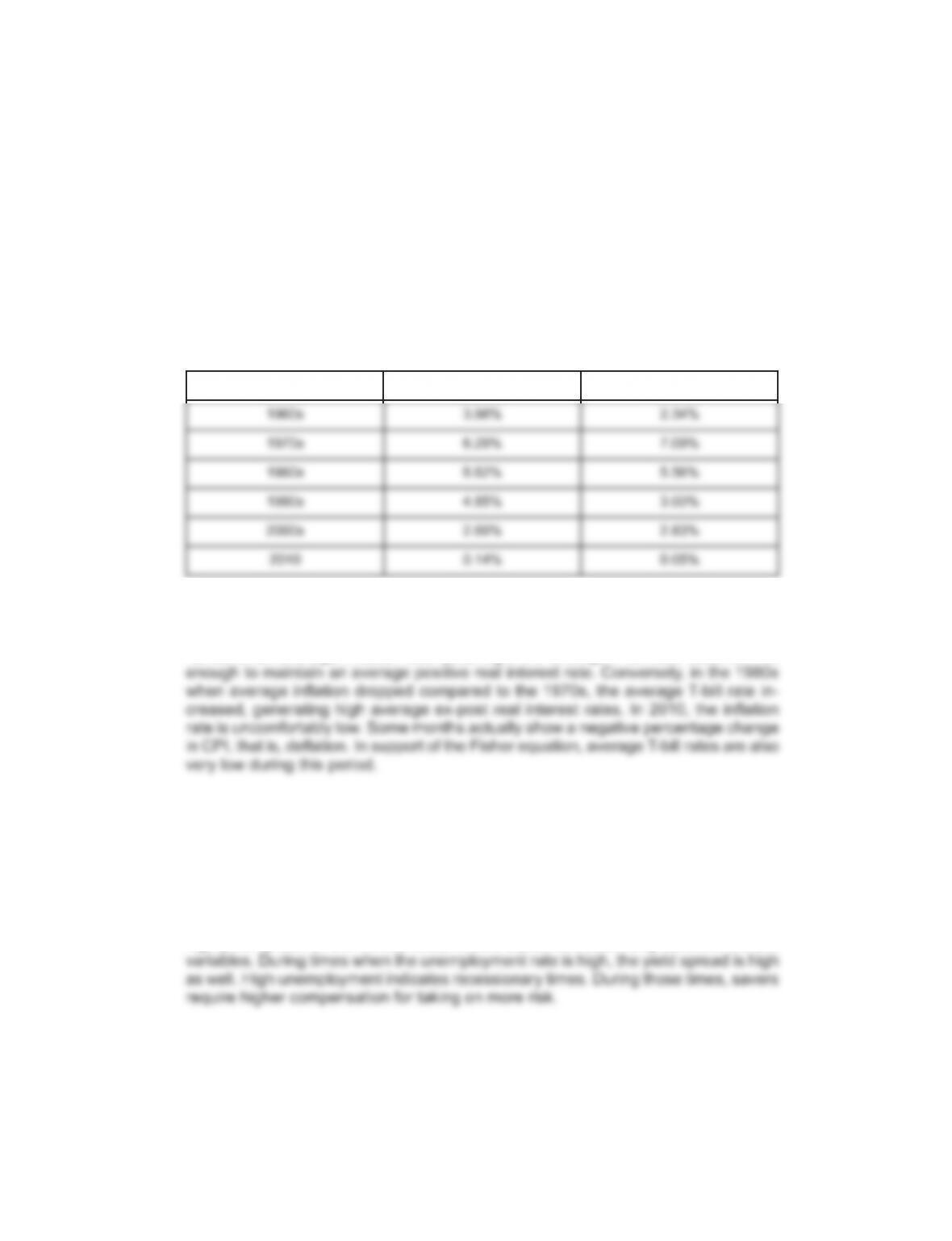
ANSWER:
Using the Fisher equation (i= r + πe), the data for each decade shows that the aver-
age 90-day Treasury bill rate varies directly with the inflation rate. But the data also
seem to support some version of adaptive inflation expectations. For example, in the
1970s when average inflation was quite high, the average T-bill rate rose, but not
12. From the text Web site, link to the St. Louis Fed site for data on the high-yield
spread and on the unemployment rate.
a. Graph unemployment on the horizontal axis and the spread on the vertical
axis, with a point for each year from 1970 to the present. What do you learn from
this graph?
ANSWER: A graph showing the unemployment rate on the horizontal axis and the
high yield spread on the vertical axis, reveals a positive relationship between the two
Decade Average T-bill rate Average inflation rate
CHAPTER 4 What Determines Interest Rates? A-25
A-26 CHAPTER 4 What Determines Interest Rates?
b. Graph the recent behavior of unemployment and the high-yield spread with
time on the horizontal axis. Plot the two variables for every month from January
2007 to the present. What do you learn from this graph that you didn’t learn from
the graph in part (a)?
ANSWER: Recent behavior of the two variables shows that unemployment remains
13. Link through the text Web site to the “Ratings” page of the Standard & Poor’s
Web site. Find a country or corporation whose debt rating has recently changed and
explain why S&P made the change.
ANSWER: S&P rates debt of countries and corporations from AAA (lowest risk of de-
fault) to D (highest risk of default). A downgrade by S&P, for example, from A to B,
means that the country or corporation is deemed to be more likely to default on its