Asset Prices and
Interest Rates
1. Suppose you win the lottery. You have a choice between receiving $100,000 a
year for 20 years or an immediate payment of $1,200,000.
a. Which should you choose if the interest rate is 3 percent? If it is 6 percent?
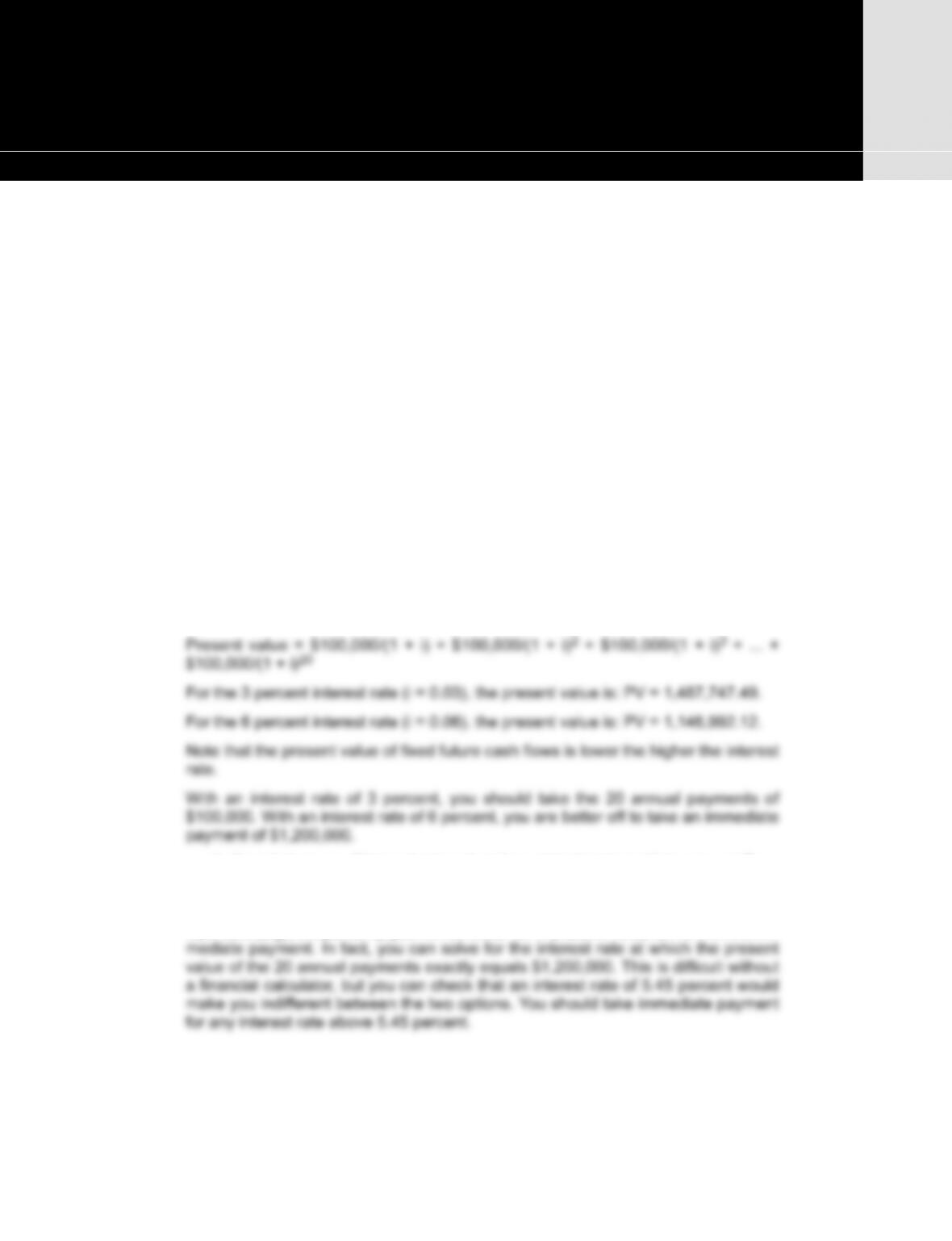
ANSWER: For both interest rates you need to figure out the present value of the 20
annual payments of $100,000. Assuming that each annual payment is received at
the end of the year (so that the first payment is received after one year), the equa-
tion for the discounted present value of the 20 annual payments reads:
b. For what range of interest rates should you take the immediate payment?
ANSWER: From your answer in part (a), it is clear that you should take immediate
payment for any interest rate above 6 percent. Even with an interest rate just below
6 percent (e.g., 5.8 percent), you will be better off in present-value terms with the im-
CHAPTER 3 Asset Prices and Interest Rates
A-13
A-13
chapter
1 2 3 4 5
6 7 8 9 10
11 12 13 14 15
2. Suppose a bond has a maturity of 3 years, annual coupon payments of $5, and a
face value of $100.
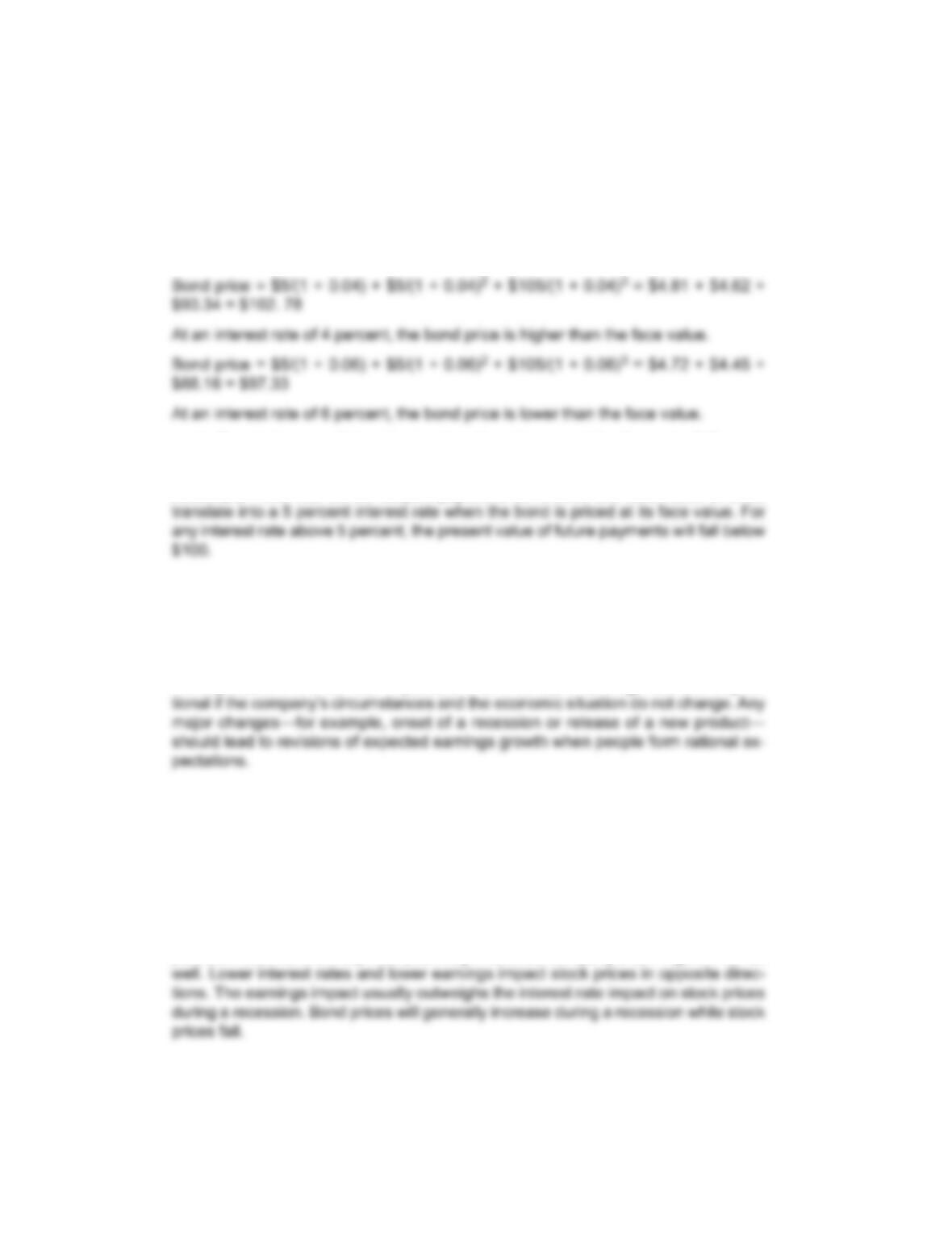
a. If the interest rate is 4 percent, is the price of the bond higher or lower than the
face value? What if the interest rate is 6 percent?
ANSWER:
b. For what range of interest rates does the price exceed the face value? Can you
explain the answer?
ANSWER: Note that the $5 coupon payments on a bond with face value of $100
3. Suppose that people expect a company’s earnings to grow in the future at the
same rate they have grown in the past. Does this behavior satisfy the assumption of
rational expectations? Explain.
ANSWER: Rational expectations rely on the best possible forecast at the time that
the expectations are formed. Expectations of a constant earnings rate are only ra-
4. Describe how each of the following events affects stock and bond prices.
ANSWER: Stocks have variable future streams of income, whereas bonds have fixed
streams of income. The present value of both financial assets is influenced by the in-
terest rate.
a. The economy enters a recession.
ANSWER: Often during recessions, interest rates tend to decrease. This would im-
pact both stock and bond prices positively. However, company’s earnings will fall as
A-14 CHAPTER 3 Asset Prices and Interest Rates
b. A genius invents a new technology that makes factories more productive.
ANSWER: Future expected earnings of the companies will increase, likely increas-
c. The Federal Reserve raises its target for interest rates.
d. People learn that major news about the economy will be announced in a few
days, but they don’t know whether it is good news or bad news.
ANSWER: This event increases uncertainty and can be thought of as increasing the
5. Consider two stocks. For each, the expected dividend next year is $100 and the
expected growth rate of dividends is 3 percent. The risk premium is 3 percent for one
stock and 8 percent for the other. The economy’s safe interest rate is 5 percent.
a. What does the difference in risk premiums tell us about the dividends from
each stock?
ANSWER: The risk premium captures the expectation of how volatile dividends of a
b. Use the Gordon growth model to compute the price of each stock. Why is one
price higher than the other?
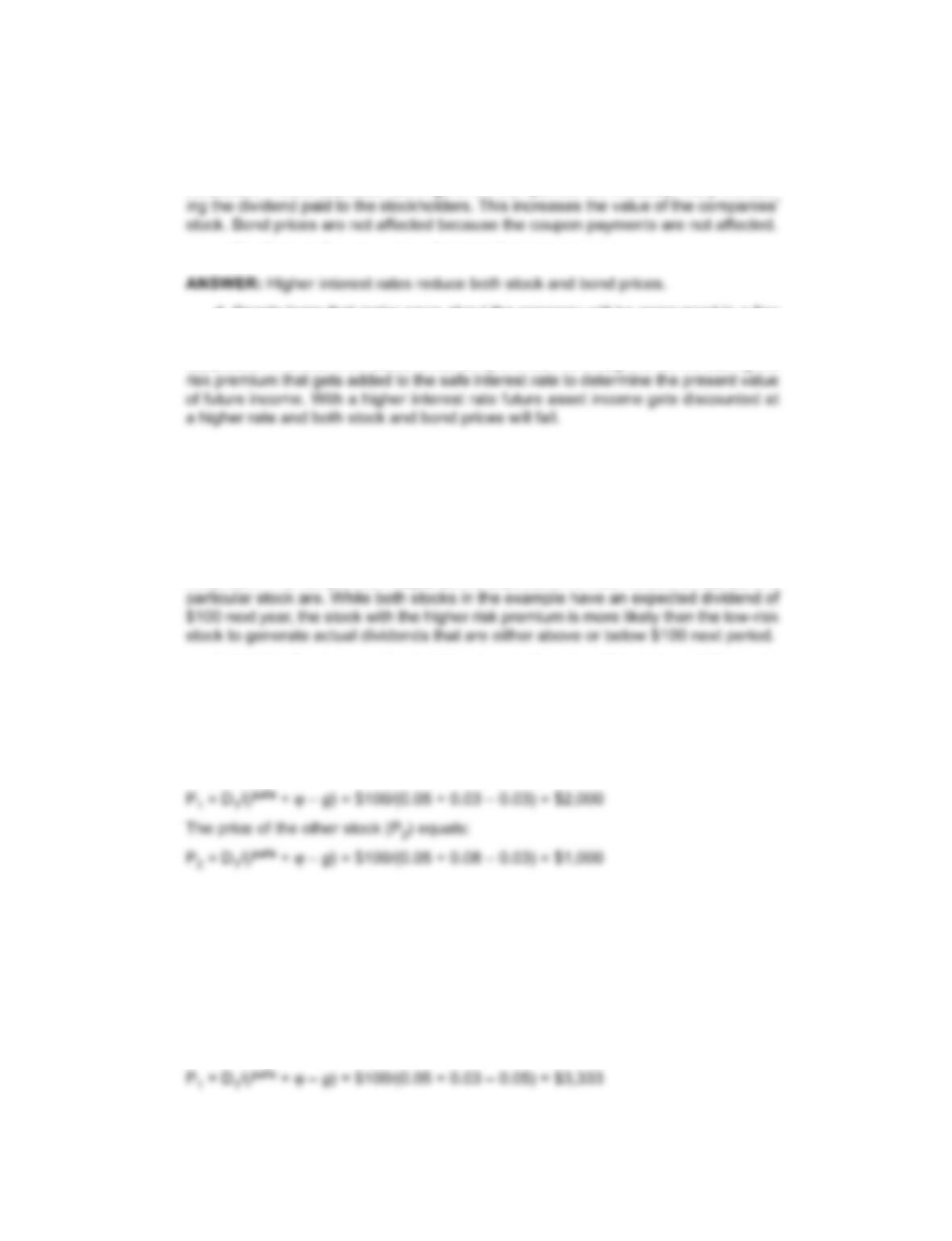
ANSWER: The Gordon growth model states that the price of a stock = D1/(i – g)
where D1is the dividend next year, i= isafe + ϕ, the risk-adjusted interest rate, and g
is the dividend growth rate. The two stocks only differ with respect to their risk pre-
mium ϕ. Therefore the price of one stock (P1) equals:
Other things constant, the higher the risk premium for a stock, the lower the price of
the stock is predicted to be according to the Gordon growth model.
c. Suppose the expected growth rate of dividends rises to 5 percent for both
stocks. Compute the new price of each. Which stock’s price changes by a larger
percentage? Explain your answer.
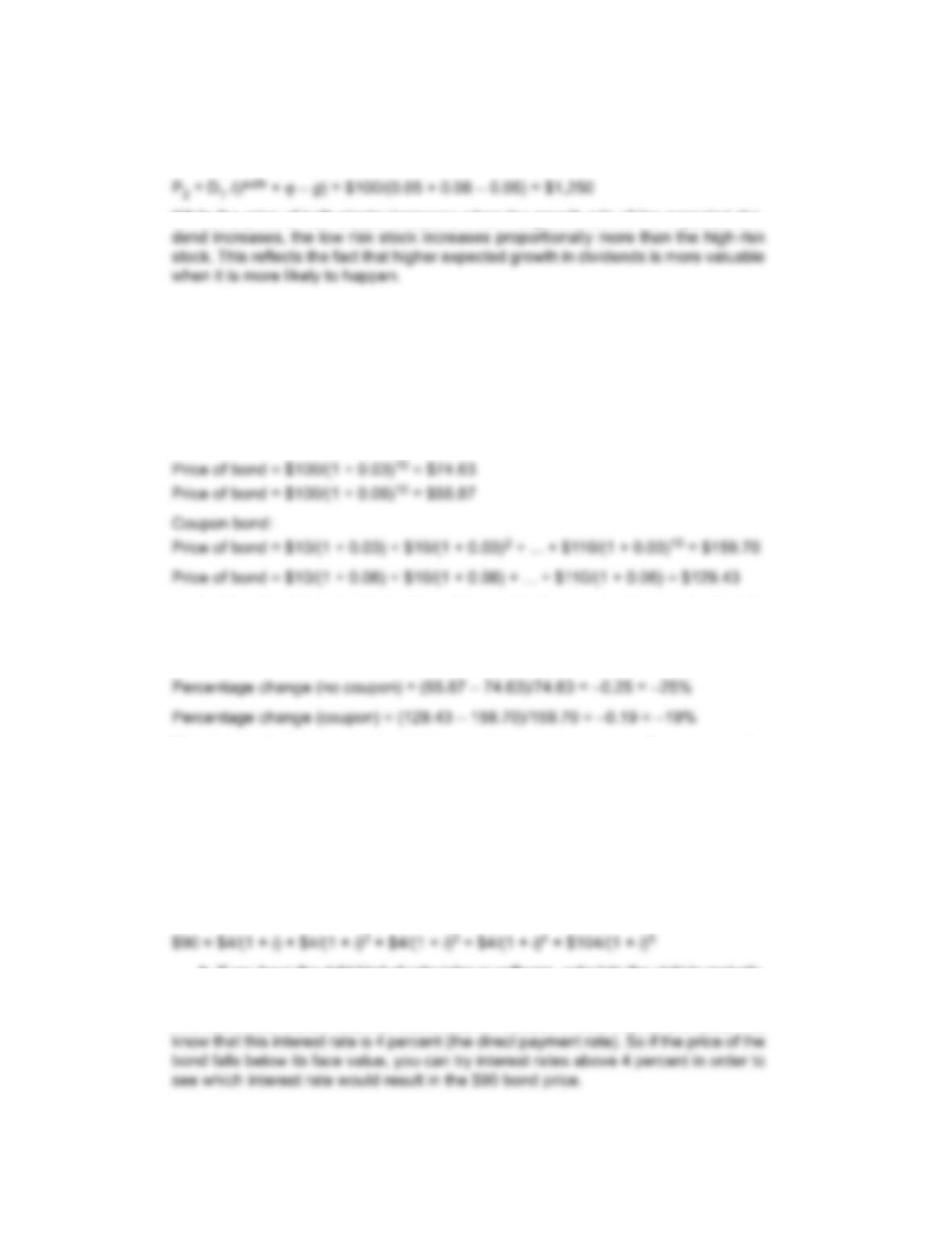
ANSWER:
The price of one stock (P1) at the higher dividend growth rate equals:
CHAPTER 3 Asset Prices and Interest Rates A-15
A-16 CHAPTER 3 Asset Prices and Interest Rates
The price for the other stock (P2) equals:
While the price of both stocks increases when the growth rate of the expected divi-
6. Consider two bonds. Each has a face value of $100 and matures in 10 years. One
has no coupon payment, and the other pays $10 per year.
a. Calculate the price of each bond if the interest rate is 3 percent and if the in-
terest rate is 6 percent.
ANSWER:
No coupon bond:
b. When the interest rate rises from 3 percent to 6 percent, which bond price falls
by a larger percentage? Explain why.
ANSWER:
The drop in the no-coupon bond is larger in percentage terms. On average, the
coupon bond does not get discounted as heavily as the no-coupon bond when inter-
est rates increase.
7. Suppose a bond has a face value of $100, annual coupon payments of $4, a ma-
turity of 5 years, and a price of $90.
a. Write an equation that defines the yield to maturity on this bond.
ANSWER:
b. If you have the right kind of calculator or software, calculate the yield to maturity.
ANSWER: The yield to maturity is i= 6.04%. If you do not have such a calculator,
think about the interest rate that would result in a present value of $100 (not $90). You
CHAPTER 3 Asset Prices and Interest Rates A-17
8. Suppose the price of the bond in Problem 7 falls from $90 to $85 over a year. Cal-
culate the bond’s rate of return over the year.
a. To calculate the rate of return, you have to take into account the direct payment
received over the course of the year as well as the change in the price of the
bond. Here, you incur a capital loss over the course of the year because the bond
price fell.
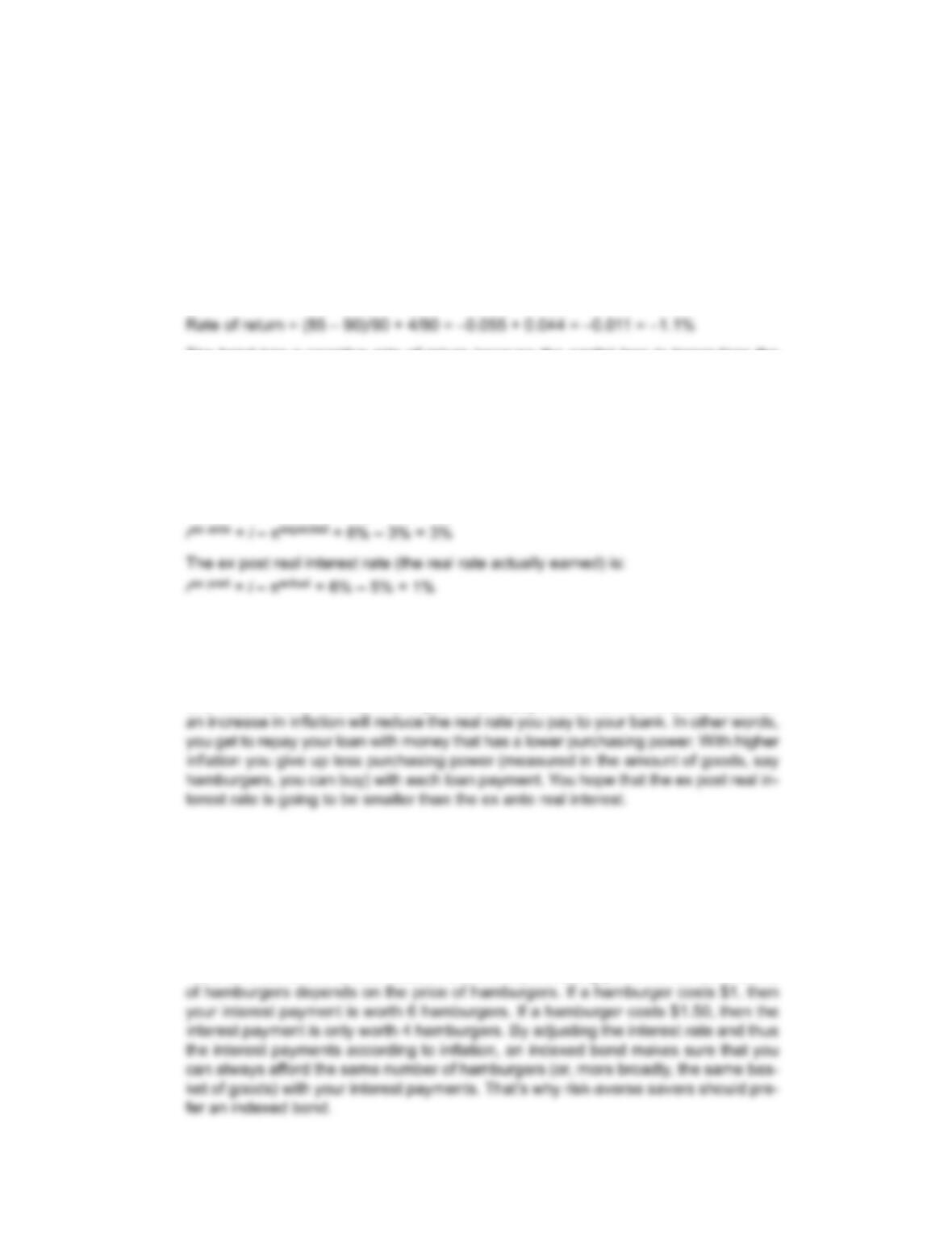
ANSWER:
The bond has a negative rate of return because the capital loss is larger than the
gain from the direct payment.
9. Suppose the yield to maturity on a 1-year bond is 6 percent. Everyone expects in-
flation over the year to be 3 percent, but it turns out to be 5 percent. What is the nom-
inal interest rate on the bond, the ex ante real rate, and the ex post real rate:
ANSWER: In this case, i= 6%, representing the nominal interest rate. The real in-
terest rate is calculated by deducting the inflation rate. The ex ante real rate is:
10. “I just bought my first house. Economists are predicting low inflation in the future,
but I sure hope they’re wrong!” Why might it make sense for someone to say this?
ANSWER: This statement makes sense if you bought your house by borrowing funds
at a fixed nominal interest rate. If you have to pay a fixed nominal interest rate, then
11. “Buying an inflation-indexed bond is risky. If I buy a conventional bond, I know
what interest rate I will receive. With an indexed bond, the rate can rise or fall de-
pending on inflation. Risk-averse savers should prefer conventional bonds.” Discuss.
ANSWER: If you buy a conventional bond, you know the nominal interest rate and
payments you will receive. You do not know what these interest payments are able
to buy in terms of goods and services. For example, if you receive a $6 coupon pay-
ment on a bond with a face value of $100, the purchasing power of the $6 in terms
ONLINE AND DATA QUESTIONS
www.worthpublishers.com/ball2
12. The text Web site contains data from the Bernanke–Kuttner paper on the Fed
and the stock market (see p. 63). The data cover 68 days from 1995 through 2002
when the Fed either changed interest rates or decided not to change them. For each
of these days, the data include the change in a short-term interest rate and the per-
centage change in stock prices. The data also include the interest-rate change that
participants in financial markets expected before the Fed acted. (The expected
change is measured using data from futures markets, which we discuss in Chapter
Five.)
a. Make a graph with the change in the interest rate on the horizontal axis and the
percentage change in stock prices on the vertical axis. Plot a point for each day
in the data set.
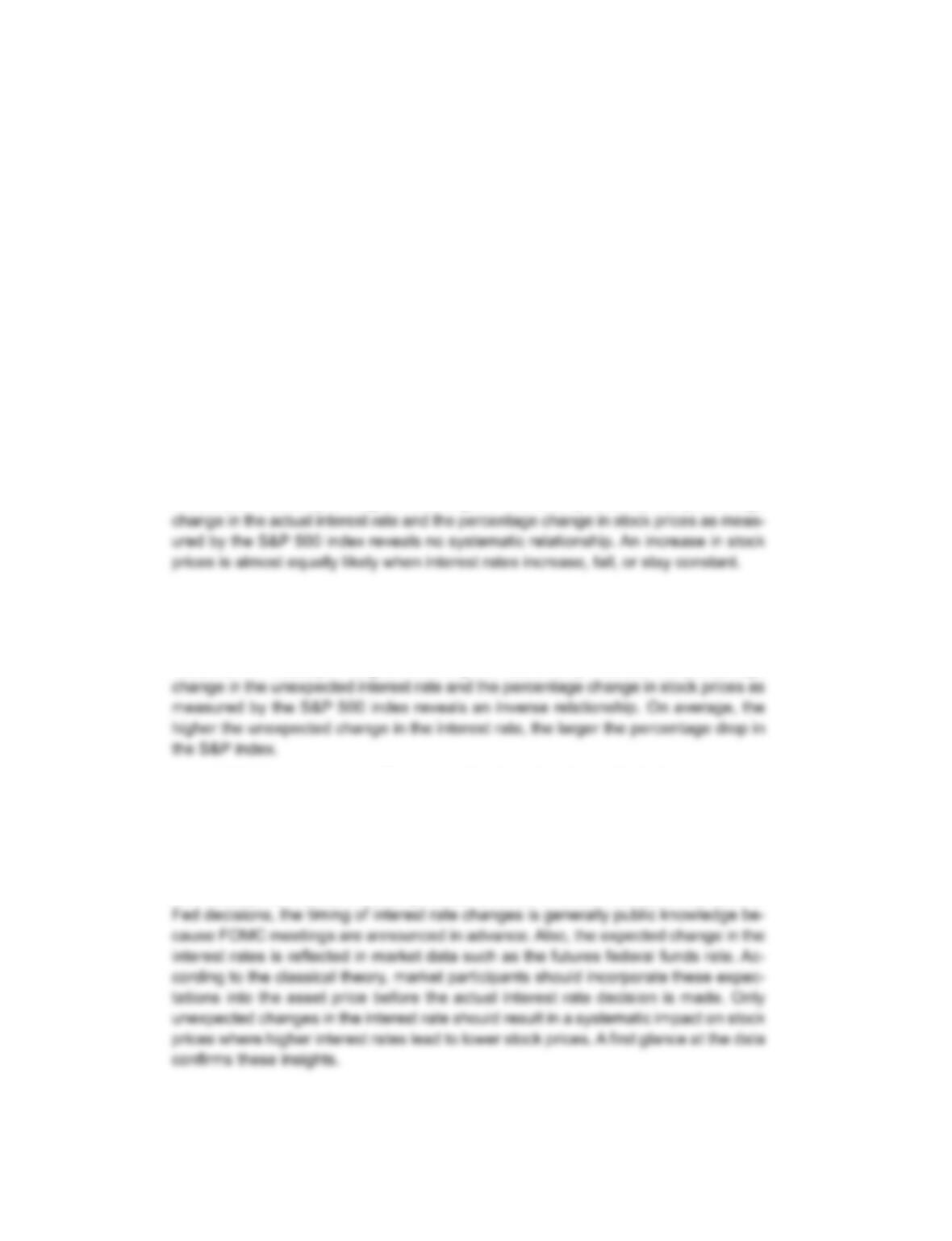
ANSWER: A scatterplot diagram showing the relationship between the percentage
b. Now compute the unexpected change in the interest rate—the actual change
minus the expected change. Redo the graph in part (a) with this variable on the
horizontal axis.
ANSWER: A scatterplot diagram showing the relationship between the percentage
c. Which has a stronger effect on stock prices, the change in the interest rate or
the unexpected change? Explain your finding.
ANSWER: The impact of an unexpected change in the interest rate on stock prices
is larger than the impact of actual changes in the interest rate. This evidence supports
the classical theory of asset prices, which maintains that expectations are rational so
that asset prices reflect the best possible forecast of asset income. In the case of
A-18 CHAPTER 3 Asset Prices and Interest Rates
13. The text Web site links to www.bloomberg.com, which provides daily data on the
Dow Jones stock index. Find a day within the last year when the index rose or fell by
at least 2 percent. Consult news reports for that day and discuss why stock prices
might have changed. Was the change consistent with the classical theory of asset
prices?
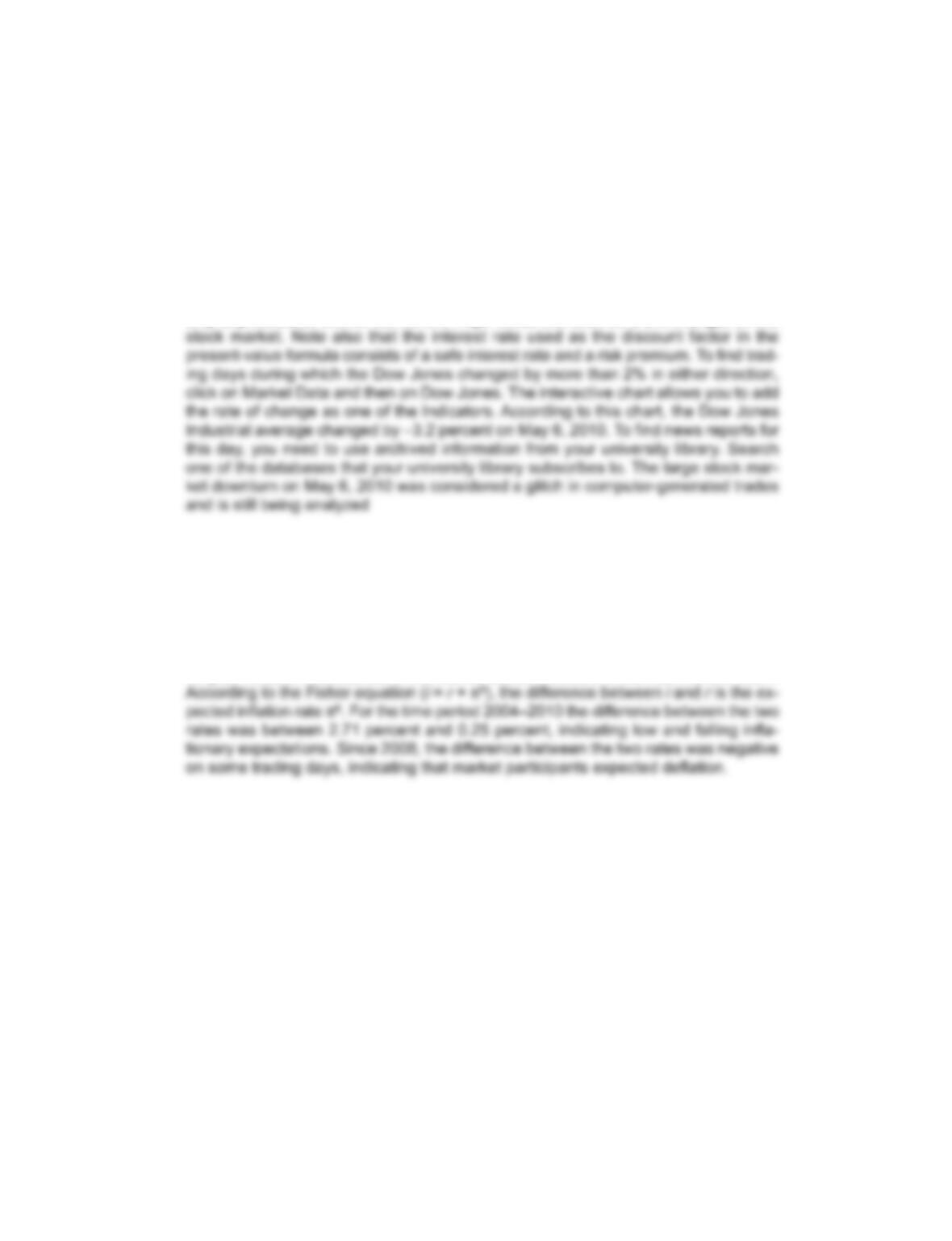
ANSWER: According to the classical theory, asset prices are determined by the pres-
ent value of expected asset income. Expectations are the best possible forecast of
future asset income. This means that expectations do not have to be correct, but that
only unpredictable events will have a major influence, such as a 2% change, on the
14. The text Web site contains data on interest rates for Treasury bonds. For the most
recent data, compare the rates on 10-year conventional bonds and 10-year inflation-
indexed bonds. What do these rates tell us about expectations of future inflation?
ANSWER: Comparing the rates on 10-year conventional bonds and 10-year
inflation-indexed bonds gives us a measure of expected inflation. The yield on the 10-
year conventional bond is a measure for the nominal interest rate i. The yield on the
10-year inflation-indexed bond is a market-based measure of the real interest rate r.
CHAPTER 3 Asset Prices and Interest Rates A-19