A-119
chapter
1 2 3 4 5
6 7 8 9 10
11 12 13 14 15
16 17 18
CHAPTER 18 Financial Crises A-119
Financial Crises
1. Many economists argue that the rescue of a financial institution should protect the
institution’s creditors from losses but not protect its owners: they should lose their
equity. Supporters of this idea say it reduces the moral hazard created by bailouts.
a. Explain how this approach reduces moral hazard compared to a bailout that
protects both creditors and equity holders.
ANSWER: A full bailout of both creditors and equity holders (owners) of a particular
financial institution sends the message to other financial institutions that losses will
be limited since taxpayers will bear the full loss of the rescue. This will change the
cost-benefit analysis of all financial institutions when they engage in loans for risky
b. Does this approach eliminate the moral hazard problem completely? Explain.
ANSWER: While the moral hazard problem is reduced because the owners’ equity is
at risk, the moral hazard problem is not completely eliminated. Any time a financial in-
2. What could U.S. policymakers have done to prevent the Great Depression or at
least to reduce its severity? Specifically:
a. What government or Fed policies might have prevented the stock market crash
and bank panics that started the financial crisis? (Hint: Think of policies that exist
today.)
A-120 CHAPTER 18 Financial Crises
ANSWER: It is hard to think of a policy that could have completely prevented the
stock market crash. Maybe some restrictions on bank lending, for example, by limit-
A policy that would have been effective in preventing the bank panics is deposit in-
b. Once the crisis began, what could policymakers have done to dampen the ef-
fects on the financial system and economy? Explain.
ANSWER: Once the stock market crash started, the Federal Reserve could have
served as the lender of last resort to banks. This would have encouraged banks to
maintain bank lending and might have prevented the “fire sale” of stocks that people
engaged in to raise funds. The fire sale of stocks was triggered when banks called in
Even with some bank failures, the Federal Reserve could have done a better job of
maintaining money supply, even though the Federal Reserve Bank of New York ex-
panded its lending dramatically in the aftermath of the Crash of 1929. Since the
3. Some Congress members think the government should not risk taxpayer money
to rescue financial firms whose highly paid executives have behaved irresponsibly. In-
stead, the government should aid middle- and low-income people hurt by the finan-
cial crisis, such as homeowners facing foreclosure. Discuss the arguments for this
position and against it.
ANSWER: Policy decisions involving government rescue of financial institutions hinge
on the fear that the failure of a financial institution will trigger a wide-spread crisis with
dire consequences for production, income, and jobs. Financial rescue policies that
CHAPTER 18 Financial Crises A-121
4. In 2010, Senator Blanche Lincoln (D-Arkansas) proposed that commercial banks
be forbidden to trade derivative securities. Discuss the arguments for and against
this proposal.
ANSWER: As described in Chapter 5 ( Section 5.6), derivatives can take on many
forms and can be traded in such a way as to reduce risk (hedging) or can be traded
in such a way as to increase risk-taking of a commercial bank (speculation). One of
the objectives of regulatory reform after the financial crisis has been to curb exces-
5. Of the proposed financial reforms discussed in Section 18.4, which would have
significantly dampened the financial crisis of 2007–2009 if they had been in place
before the crisis? Could any of the reforms have prevented the crisis entirely? Explain.
ANSWER: Regulatory reform aimed at reducing excessive risk-taking and greater
transparency could have dampened the financial crisis of 2007–2009. For example,
requiring all financial institutions to keep some of the financial assets sold, should
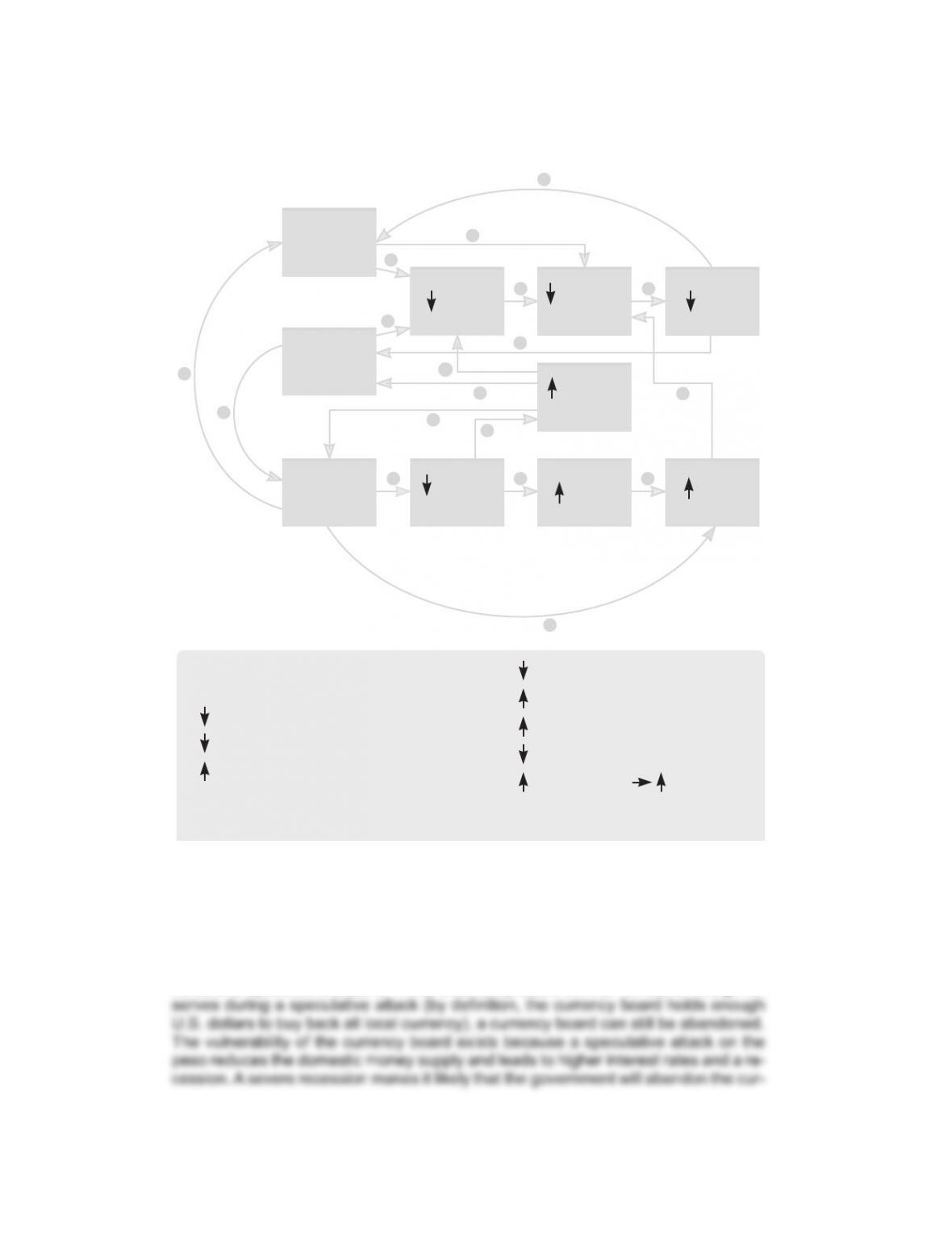
6. Draw an expanded version of Figure 18.1 (the outline of a typical financial crisis on
page 554) for emerging economy crises. Your chart should include capital flight and
show how this phenomenon and its consequences interact with the other elements
common to a financial crisis.
ANSWER:
7. In the late 1990s, some economists advised Argentina to dollarize, that is, to elim-
inate the peso and use the U.S. dollar as its currency. Discuss how dollarization might
have changed the course of events in 2001–2002.
ANSWER: Dollarization—complete elimination of the local currency in Argentina—
would have prevented speculative attacks on the peso during the crisis in 2001–2002.
Even though Argentina had a currency board at that time, its currency was still vul-
nerable to speculative attacks. While a currency board cannot run out of foreign re-
A-122 CHAPTER 18 Financial Crises
Aggregate
expenditure
Lending Output
Banking
problems
Capital
flight
Debts in
local currency
Asset-price
crashes
G
1
456
7
8
11
9
10
2
3
C
B
A
F
E
D
Interest
rates
Exchange
rate Inflation
1: Foreign banks cut off loans to domestic banks.
2: Sales of domestic assets reduce their prices.
3: Supply of loans.
4: Demand for currency.
5: Import prices.
6: Central bank tightens to contain inflation.
(See Figure 18.1 for descriptions of channels A–G.)
7: Spending.
8: Burden of debt fixed in dollars.
9: Debts of banks.
10: Net worth of borrowers.
11: Government debt fears of default.
On the other hand, even with dollarization Argentina would not have avoided the re-
cession in the late 1990’s. Argentina still would have had a basic fiscal problem.
Budget deficits were rising due to actions in Argentina’s provinces, increasing gov-
ONLINE AND DATA QUESTIONS
www.worthpublishers.com/ball2
8. Explain what has happened to Greece’s financial system and economy since the
fall of 2010. Has its crisis worsened or eased? Has the crisis affected other Euro-
pean or non-European economies? Have events followed the typical pattern of fi-
nancial crises described in this chapter?
ANSWER: The Greek financial crisis was largely triggered by rising government debt.
As financial investors grew reluctant to buy Greek government bonds, yields on those
bonds increased. With the increased interest burden on its debt, the Greek govern-
ment reacted by reducing spending and raising taxes. Predictably, these measures
9. In 2010, the Dodd-Frank Act authorized the Federal Reserve, Financial Services
Oversight Council, and Office of Credit Ratings to issue new financial regulations, in-
cluding stronger capital requirements and restrictions on risk-taking by investment
banks. What major regulations have been issued since Dodd-Frank was enacted?
ANSWER: As described in the Harvard Law School Forum on Corporate Governance
and Financial Regulation (http://blogs.law.harvard.edu/corpgov/2010/11/20/the-fi-
CHAPTER 18 Financial Crises A-123
A-124 CHAPTER 18 Financial Crises