A-87
chapter
1 2 3 4 5
6 7 8 9 10
11 12 13 14 15
16 17 18
Economic Fluctuations,
Monetary Policy, and the
Financial System
1. Suppose the federal funds rate is 3 percent. Bond traders expect it to remain at that
level for 3 months and then rise to 3.5 percent for 9 months. However, the FOMC
raises the rate to 3.5 percent immediately. After this action, traders expect the funds
rate to stay at 3.5 percent for a year. How does the FOMC’s action affect the 3-month
interest rate, the 6-month rate, and the 1-year rate?
ANSWER:
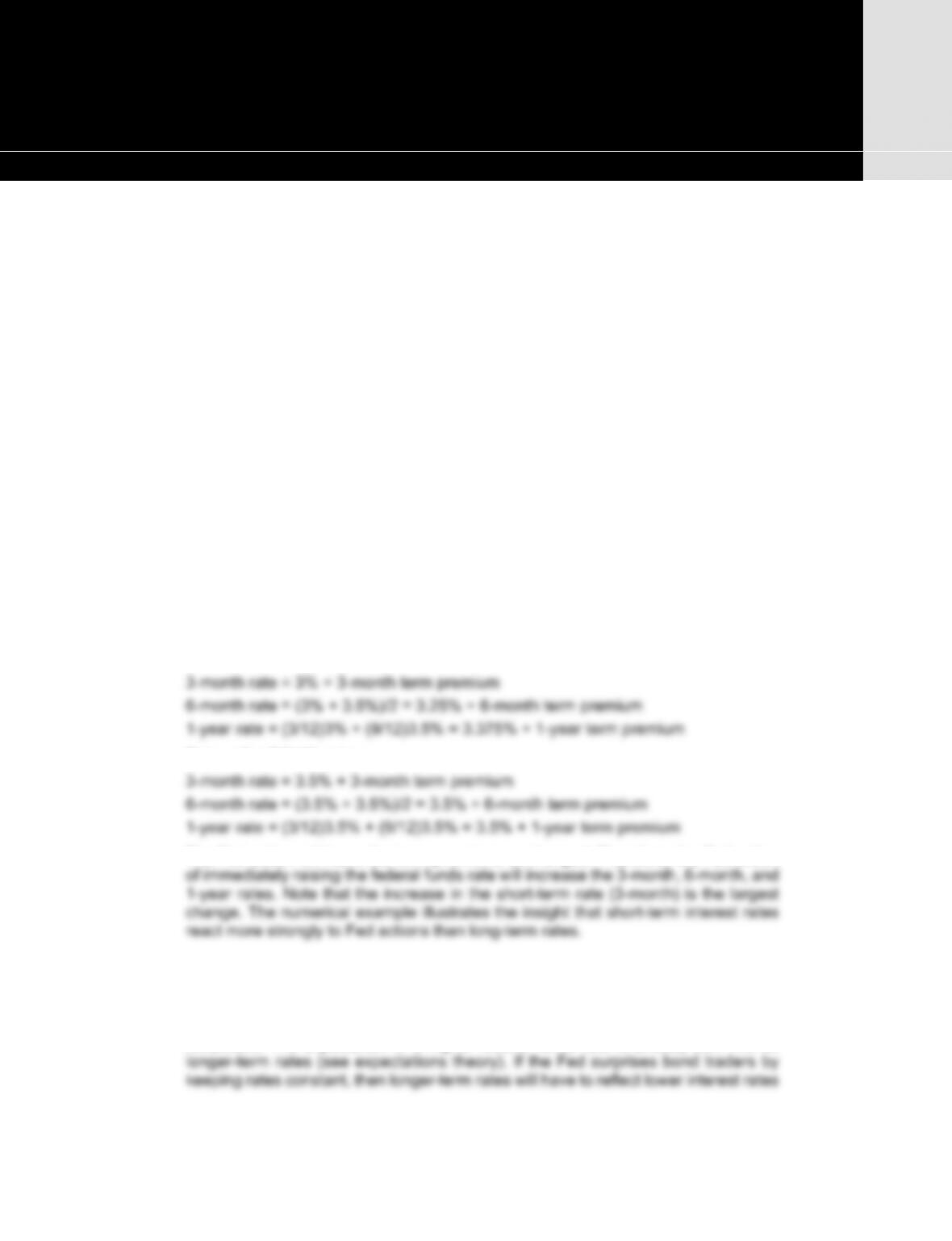
Rates without FOMC action:
Rates after FOMC action:
The Fed action will leave the term premiums unchanged. Therefore, the Fed action
2. Suppose that bond traders expect an increase in the federal funds rate, but the
FOMC surprises them by keeping it constant. What happens to longer-term rates?
Explain.
ANSWER: The expectation of a higher federal funds rate is already built into all
A-88 CHAPTER 13 Economic Fluctuations, Monetary Policy, and the Financial System
3. Describe all the ways that a rise in stock prices affects aggregate expenditure. Do
the same for a rise in housing prices. Do stock prices have some effects that hous-
ing prices don’t, or vice-versa?
ANSWER: Aggregate expenditures are composed of four components, consumption
(C), investment (I), government purchases (G), and net exports (NX). A rise in stock
prices affects C, I, and NX. Consumption increases because of the wealth effect.
A rise in housing prices will affect Cand I. Just like increases in stock prices, an in-
crease in housing prices creates a wealth effect that leads to more spending on goods
and services by households. Households will also be able to use their homes as col-
4. The riskiness of banks’ assets fluctuates over time. For example, default risk on
loans rises and falls.
a. How are banks likely to adjust their equity ratios (their ratios of capital to as-
sets) when the riskiness of assets changes? Explain. (Hint: See Section 9.6.)
ANSWER: When assets become more risky, it is more likely that banks will have to
write off assets. This can result in insolvency unless banks have a sufficiently large
b. How do the adjustments in part (a) affect the sizes of booms and recessions?
Explain.
ANSWER: A boom is characterized by a positive output gap, and a recession is char-
acterized by a negative output gap. During a recession, workers are laid off, firms go
out of business, and households and firms have a harder time servicing bank loans.
CHAPTER 13 Economic Fluctuations, Monetary Policy, and the Financial System A-89
5. Economists have found that recent earnings have larger effects on investment for
small firms than for large firms. What might explain this fact?
ANSWER: Small firms face more severe asymmetric information problems than large
firms. Since small firms are less well known to lenders, it is harder for them to bor-
6. Figure 13.12 shows what happens if the AE curve shifts out temporarily and the
central bank raises the real interest rate. Now suppose the same shock occurs but
the central bank keeps the interest rate constant. Assuming lags in the AE and Phillips
curves, show over time what happens to output and inflation. Discuss the pros and
cons of raising the interest rate in response to the shock.
ANSWER: Let’s explore the impact on output first. A positive expenditure shock shifts
the AE curve to the right in 2020. Since the real interest rate does not change at all,
this shift in the AE curve to the right will cause an increase in output in 2020. In 2020,
7. Consider the expenditure shock in Figure 13.12: the AE curve shifts to the right in
2020 and returns to its initial position in 2021. Suppose the central bank anticipates
the shock: in 2019, it knows what will happen in the following two years. Assuming
lags in the AE and Phillips curves, can the central bank keep output and inflation con-
stant? If it can, explain how; if it can’t, explain why not.
ANSWER: In the absence of supply shocks (as assumed here), the inflation rate will
only change if output deviates from potential output. So if the central bank succeeds
in keeping output at potential, the inflation rate will be constant as well. Since aggre-
8. Consider the AE/PC model with time lags. Suppose the economy starts in 2019
with output at potential and constant inflation. In 2020, an adverse supply shock oc-
curs, shifting the Phillips curve up.
a. Show the paths of output and inflation over time if the central bank keeps the
real interest rate constant.
ANSWER: An adverse supply shock does not shift the AE curve. With constant real
interest rates, aggregate expenditures are unchanged after the supply shock. Output
is constant and remains at potential, but the inflation rate will permanently rise in re-
b. Can the central bank prevent inflation from rising temporarily as a result of the
supply shock? Can it prevent inflation from rising permanently? Explain.
ANSWER: Let’s assume that the Fed did not anticipate the supply shock and that the
supply shock occurs in 2020 only. In 2021, the PC shifts back to its original position.
Given those assumptions, the Fed cannot prevent inflation from rising temporarily in
c. Suppose policymakers want to return inflation to its 2019 level as quickly as
possible and then keep inflation constant. What path should policymakers choose
for the real interest rate? What are the resulting paths of output and inflation?
ANSWER: Policymakers should increase the real interest rate in 2020, immediately
after the supply shock was observed. In 2021, policymakers should reduce the real
ONLINE AND DATA QUESTIONS
www.worthpublishers.com/ball2
9. From the text Web site, get Bernanke and Kuttner’s data on expected and unex-
pected changes in the federal funds rate by the FOMC. (You may have used these
data to solve Problem 3.12.) Choose one day when the expected change in the funds
rate was large and the unexpected change was small, and one day when the oppo-
site was true. Then link to the site of the Federal Reserve Bank of St. Louis, which
A-90 CHAPTER 13 Economic Fluctuations, Monetary Policy, and the Financial System
has daily data on the interest rate on 1-year Treasury bonds. For each of the days you
selected from the Bernanke-Kuttner data, compare the change in the 1-year interest
rate from the day before the FOMC’s action to the day after the action. If you can, ex-
plain why the change in the 1-year rate was larger in one case than in the other
ANSWER: A day for which the expected change in the federal funds rate was large
and the unexpected change small is 2/1/1995. For that day markets expected the
funds rate to change by 0.45 percent. The unexpected change accounted for only
0.05 percent. On February 1, 1995, the 1-year Treasury bond rate (reported as the
1-year percent Treasury bill rate from the secondary market) changed from 6.41 per-
10. Link from the text Web site to the online Economic Report of the President and
get annual data on real GDP and real investment. Calculate the growth rates of the
two variables for each year since 1960. (A variable’s growth rate in a given year is the
percentage change from the previous year.) Which is more volatile, GDP or invest-
ment? What might explain the difference in volatility?
ANSWER: The growth rate for the investment component of GDP is much more
volatile than the growth rate of GDP itself. During each recession when overall GDP
falls, investment falls by a much larger percentage. In times of falling output, firms
have the option of completely stopping any new investment projects since there is no
CHAPTER 13 Economic Fluctuations, Monetary Policy, and the Financial System A-91