A-71
chapter
1 2 3 4 5
6 7 8 9 10
11 12 13 14 15
16 17 18
The Money Supply
and Interest Rates
1. Continue the story of The Friendly Bank (Section 11.2) for a few more days. Show
the bank’s balance sheet, the monetary base, and the money supply for Friday and
the following Monday, Tuesday, and Wednesday. Continue to assume the currency–
deposit ratio and reserve–deposit ratio are 0.25.
ANSWER:
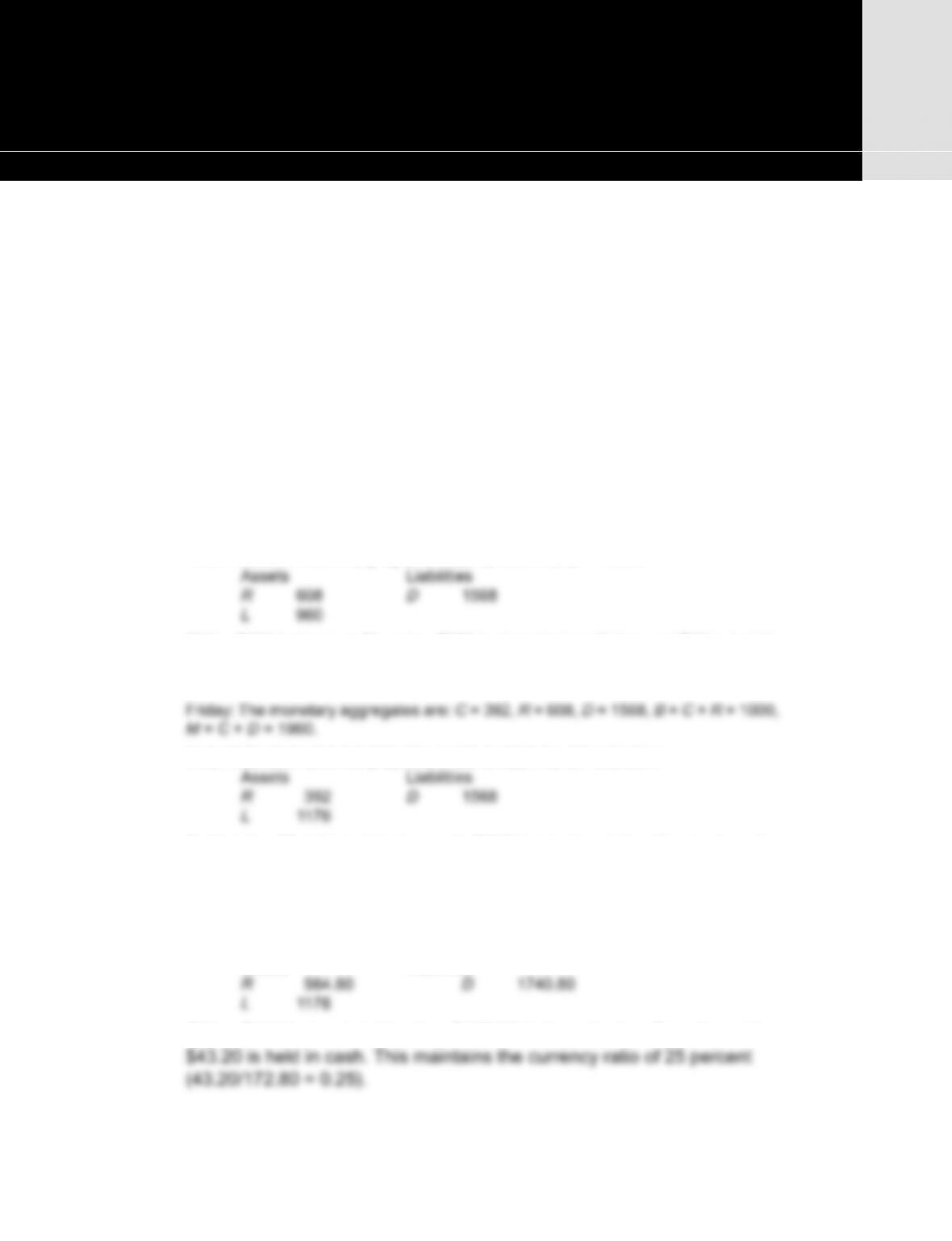
THE FRIENDLY BANK’S (FB) BALANCE SHEET AS OF FRIDAY
Of the $360 lent out on Thursday, $288 is deposited on Friday and $72 is held in
cash. The $288 deposit represents 80 percent of the loan amount and maintains the
currency ratio of 25 percent (72/288 = 0.25).
THE FRIENDLY BANK’S (FB) BALANCE SHEET AS OF MONDAY
On Monday, FB reduces the reserves to $392 in order to maintain the reserve ratio
of 25 percent. The bank loans out $216.
Monday: The monetary aggregates are: C= 608, R= 392, D= 1568, B= C+ R=
1000, M= C+ D= 2176.
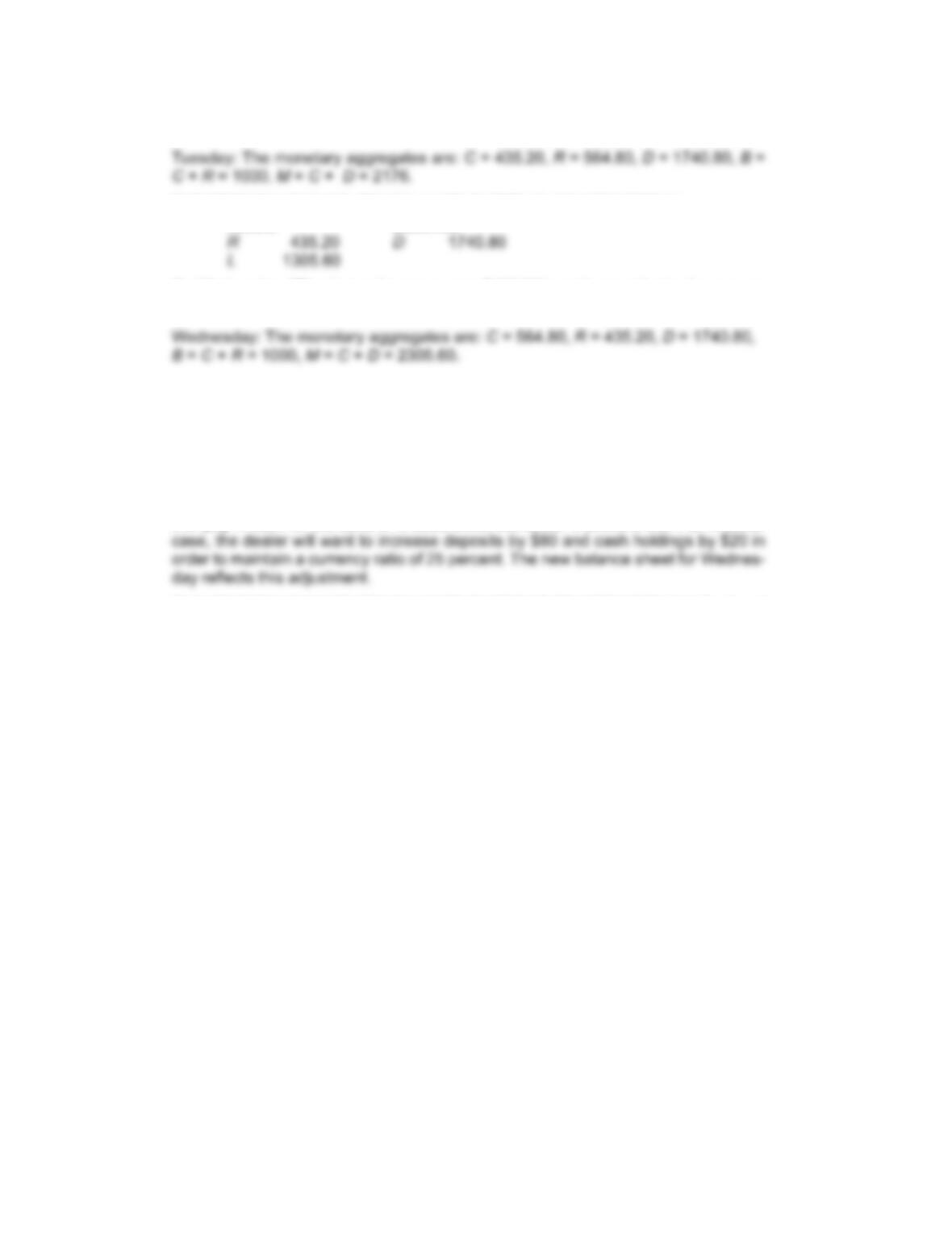
THE FRIENDLY BANK’S (FB) BALANCE SHEET AS OF TUESDAY
Assets Liabilities
Of the $216 lent out on Monday, $172.80 is deposited on Tuesday and
A-72 CHAPTER 11 The Money Supply and Interest Rates
THE FRIENDLY BANK’S (FB) BALANCE SHEET AS OF WEDNESDAY
Assets Liabilities
On Wednesday, FB reduces the reserves to $435.20 in order to maintain the reserve
ratio of 25 percent. The bank loans out $129.60.
2. Start with the Wednesday balance sheet for The Friendly Bank on page 320. Sup-
pose that, at the end of Wednesday, the Fed buys $100 in government bonds from a
dealer with an account at the bank. Otherwise, everyone behaves the same way as
in the text. Show the bank’s balance sheet, the monetary base, and the money sup-
ply for Thursday and Friday.
ANSWER: When the Fed buys a $100 government bond from a dealer, it could ei-
ther pay in cash for the bond or it could credit the dealer’s account with FB. In either
THE FRIENDLY BANK’S (FB) BALANCE SHEET AS OF WEDNESDAY (after bond
purchase by the Fed)
Assets Liabilities
R760 D1360
L600
Wednesday: The monetary aggregates are: C= 340, R= 760, D= 1360, B= C+ R
= 1100, M= 1700.
Note that the Fed action immediately increases the monetary base and money sup-
ply by $100.
THE FRIENDLY BANK’S (FB) BALANCE SHEET AS OF THURSDAY
Assets Liabilities
R340 D1360
L1020
On Thursday, FB reduces the reserves to $340 in order to maintain the reserve ratio
of 25 percent. The bank loans out $420.
Thursday: The monetary aggregates are: C= 760, R= 340, D= 1360, B= C+ R=
1100, M= 2120.
THE FRIENDLY BANK’S (FB) BALANCE SHEET AS OF FRIDAY
Assets Liabilities
R676 D1696
L1020
Of the $420 lent out on Thursday, $336 is deposited on Friday and $84 is held in
cash. This maintains the currency ratio of 25 percent (84/336 = 0.25).
CHAPTER 11 The Money Supply and Interest Rates A-73
Friday: The monetary aggregates are: C= 424, R= 676, D= 1696, B= C+ R=
1100, M= 2120.
The Fed action increases money creation.
3. Let’s change the story of The Friendly Bank by introducing savings deposits. As-
sume that when people put money into the bank, half of it goes to checking de-
posits (D) and half to savings deposits (S). The ratio of currency to total deposits,
C/(D+ S), is 0.25. The ratio of reserves to checking deposits, R/D, is 0.25.
a. Notice that reserves are a fraction of checking deposits and don’t depend on
savings deposits. Why might this be a reasonable assumption?
ANSWER: Banks hold reserves in order to be able to service withdrawals. With-
b. Redo the story of The Friendly Bank, showing the bank’s balance sheet and
the monetary aggregates for the first four days the bank is in business.
ANSWER:
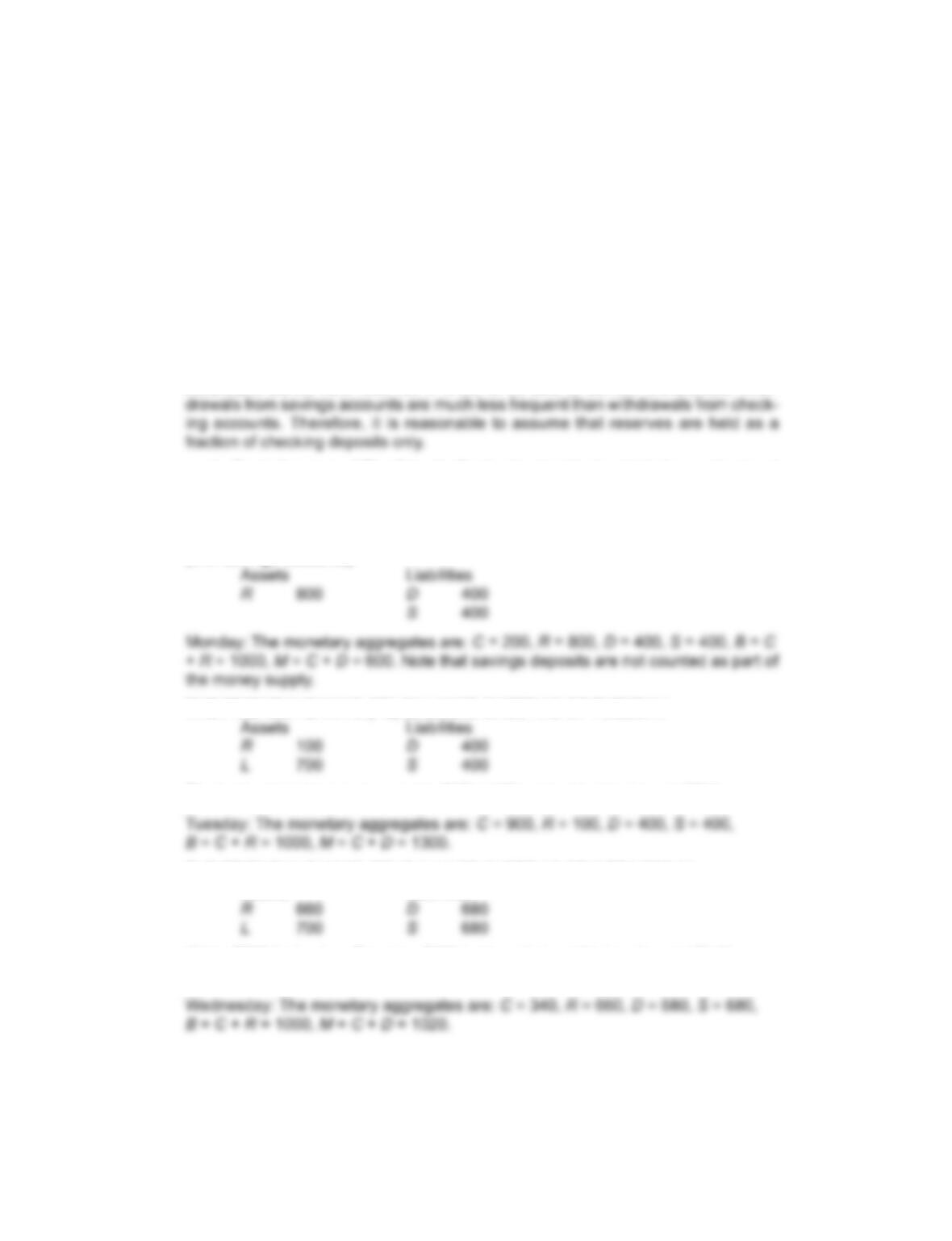
THE FRIENDLY BANK’S (FB) BALANCE SHEET AS OF MONDAY
(with savings accounts)
THE FRIENDLY BANK’S (FB) BALANCE SHEET AS OF TUESDAY
The bank maintains a reserve ratio (R/D) of 25 percent by loaning out $700.
THE FRIENDLY BANK’S (FB) BALANCE SHEET AS OF WEDNESDAY
Assets Liabilities
Of the $700 lent out on Tuesday, $560 is deposited on Wednesday and $140 is
held in cash. $560 is split evenly between checking (D) and savings (S) deposits.
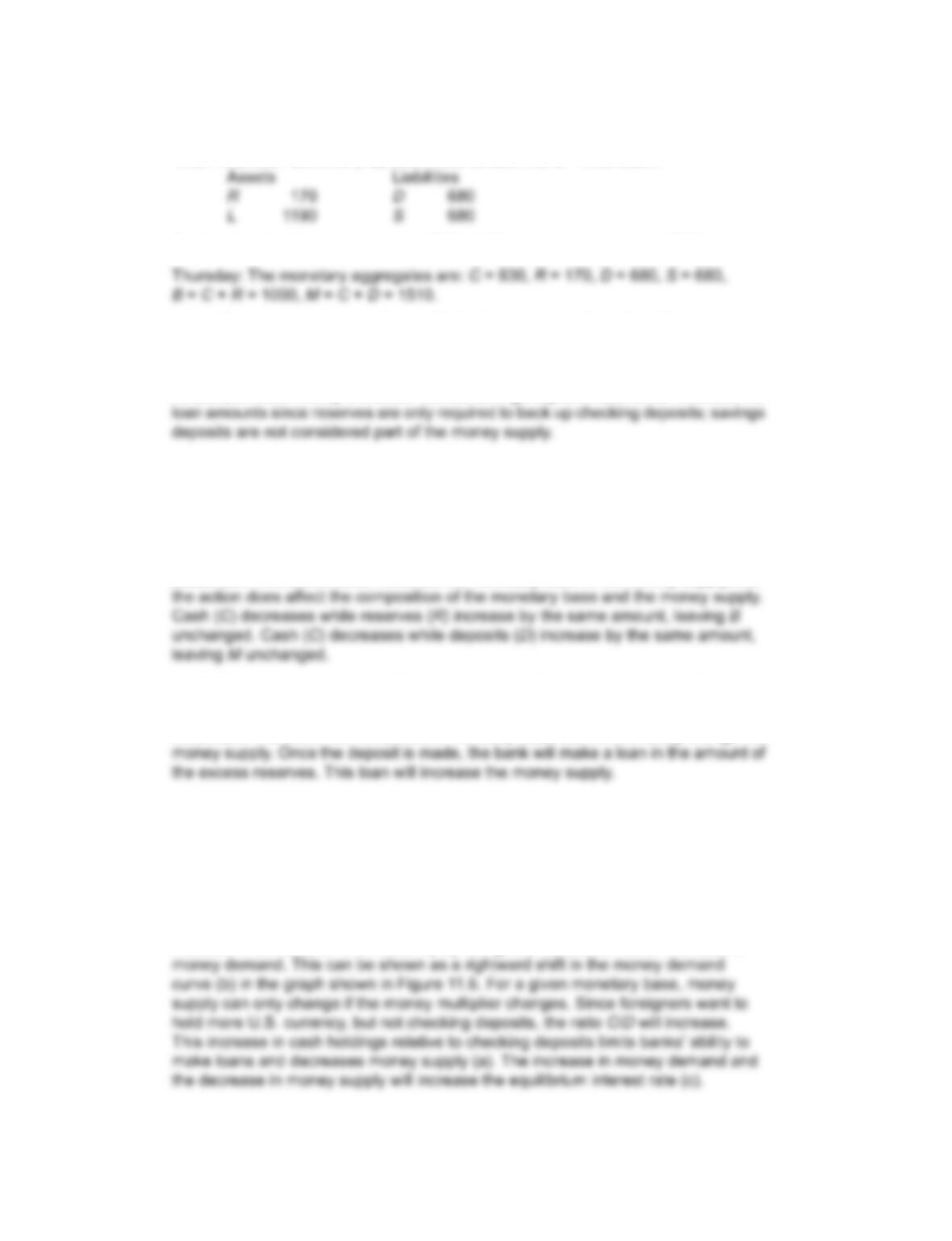
THE FRIENDLY BANK’S (FB) BALANCE SHEET AS OF THURSDAY
The bank maintains a reserve ratio (R/D) of 25 percent by loaning out $490.
c. Compare your answer for part (b) to the corresponding calculations on pages
320–322, where we ignore savings deposits. In which case is the most money
created? What explains this result?
ANSWER: More money is created without savings deposits. Banks can increase the
4. Suppose someone keeps $100 in cash under her pillow. One day, she takes it out
and deposits it in a checking account.
a. Does this action directly affect the monetary base or the money supply? Explain
why or why not.
ANSWER: This action does not affect the monetary base or the money supply, but
b. Does the action eventually lead to a change in the monetary base or the money
supply? Explain why or why not.
ANSWER: The action will not affect the monetary base, but will eventually change the
5. Suppose that foreigners start holding more U.S. currency. For a given interest rate,
Americans don’t change their holdings of either currency or checking deposits. As-
sume the Fed keeps the monetary base constant. Describe what happens to (a) the
money supply, (b) the money-demand curve, and (c) the equilibrium interest rate. Ex-
plain your answers.
ANSWER: The liquidity preference theory is helpful in answering this question. An
increase in demand for U.S. currency by foreigners translates into an increase in
A-74 CHAPTER 11 The Money Supply and Interest Rates
6. Redo Problem 5, but do not assume the monetary base is constant. Instead, an-
swer each part of the question assuming the Fed targets the money supply. Then an-
swer each part assuming the Fed targets the interest rate. What happens to the
monetary base in each of these cases?
ANSWER: (I) The Fed targets the money supply: The increase in demand for U.S.
currency will still shift the money demand curve to the right. This change will not
concern the Fed if it targets money supply. However, the increase in the currency–
7. How did the Federal Reserve’s actions over 2008–2009 in response to the finan-
cial crisis (see the case study in Section 11.4) affect its balance sheet diagrammed
in Section 11.2)?
ANSWER The Federal Reserve balance sheet shows the monetary base, normally
consisting of government bonds and discount loans to banks on the asset side.
During the financial crisis the Fed instituted a number of additional policy tools
8. Suppose the discount rate is below the federal funds rate, and banks can borrow
as much as they want from the Fed. How could a bank earn easy profits? Would the
federal funds rate stay above the discount rate? Explain.
ANSWER: With unlimited lending from the Fed at rates that are lower than market
rates (the federal funds rate), banks could borrow from the Fed and loan out funds
CHAPTER 11 The Money Supply and Interest Rates A-75
9. Milton Friedman believed the Fed should control the money supply precisely. In the
1960s, he proposed that the required reserve ratio be raised to 100 percent. How
would this policy improve control of the money supply? What are the drawbacks to
the policy?
ANSWER: The formula for money supply from Section 11.4 is helpful in answering
this question. With a reserve ratio of 100 percent, the ratio R/D= 1. Plugging this
information into the money multiplier generates a money multiplier of m= 1. Thus,
10. In the text, we ignored traveler’s checks in deriving the money multiplier. Sup-
pose we are more careful and include traveler’s checks in the money supply. Let T
be the level of traveler’s checks, so T/Dis the ratio of traveler’s checks to checking
deposits. Derive the money multiplier in terms of C/D, R/D, and T/D.
ANSWER: M= C+ D+ Tand B= C+ R.
M/B= (C+ D+ T)/(C+ R)
11. Suppose the Fed wants to reduce the money supply by $100. Should it buy or sell
government bonds? How much should it buy or sell?
ANSWER: The Fed needs to decrease the monetary base in order to reduce the
money supply. The monetary base shrinks if the Fed sells government bonds in the
12. Assume the monetary base is $100, the currency–deposit ratio is 0.5, and the
reserve–deposit ratio is 0.1.
a. Calculate the money multiplier and the money supply.
The money multiplier m= (1+C/D)/[(C/D) + (R/D)]. For C/D = 0.5 and R/D = 0.1, the
money multiplier m= 1.5/0.6 = 2.5. The money supply M = m× B = 2.5 × $100 =
$250.
b. Suppose the currency–deposit ratio rises to 1.0. If the Fed holds the monetary
base constant, what happens to the money multiplier and the money supply?
A-76 CHAPTER 11 The Money Supply and Interest Rates
ANSWER: The money multiplier m= (1+C/D)/[(C/D) + (R/D)]. When the currency–
deposit ratio increases, both the numerator and the denominator of the expression
c. Suppose the Fed wants to keep the money supply constant at the level found
in part (a). How must it adjust the monetary base when the currency–deposit ratio
rises?
ANSWER: When C/Drises, then the money multiplier decreases. Banks receive
fewer deposits and therefore make fewer loans. With a lower money multiplier, the
money supply decreases. In order to keep the money supply constant, the Fed
13. The Fed bought an unusually large quantity of Treasury bonds at the end of De-
cember 1999. What explains this behavior? (Hint: Search online for “Y2K.”)
ANSWER: At the end of December 1999, many people feared that the beginning of
the year 2000 would wreak havoc with computers. In particular, people were not
sure if ATM machines would still operate properly on January 1, 2000 (many old
14. Which is more stable from day to day, the discount rate or the federal funds rate?
Explain.
ANSWER: Since the discount rate is set by the Fed, the rate is typically fixed from
day to day. The federal funds rate is a market interest rate, determined by demand
and supply in the market for short-term, overnight loans among banks. Therefore,
CHAPTER 11 The Money Supply and Interest Rates A-77