A-65
chapter
1 2 3 4 5
6 7 8 9 10
11 12 13 14 15
16 17 18
Bank Regulation
1. Suppose you are a depositor at Melvin’s Bank, which has the balance sheet shown
in Table 10.1A. Deposit insurance does not exist. You originally deposited your money
in Melvin’s Bank because its branch locations are more convenient than those of
other banks.
a. Suppose you know that Melvin’s other depositors plan to keep their money
there. Should you do the same or withdraw your money and deposit it elsewhere?
ANSWER: Melvin’s bank has a positive level of capital, or net worth. This means that
b. Suppose you know that other depositors plan to make large withdrawals from
Melvin’s Bank. What should you do?
ANSWER: When other depositors make large withdrawals, then Melvin’s bank will
run out of reserves and secondary reserves. The bank will then be forced to sell loans.
c. What do your answers to parts (a) and (b) tell you about the likelihood and
causes of bank runs?
ANSWER: Bank runs can happen even if a bank is solvent. The expectation of large
2. Suppose an economy has a high level of loans from one bank to another. How
might this fact affect the likelihood of a bank panic?
ANSWER: A bank panic triggers widespread withdrawals throughout the entire bank-
ing system. If depositors know that banks rely heavily on purchased funds (loans
A-66 CHAPTER 10 Bank Regulation
3. Some economists suggest that banks should be charged premiums for deposit in-
surance based on their levels of capital. Premiums should be higher if capital is lower.
What is the rationale for this proposal? Are there any drawbacks to the idea?
ANSWER: A high level of bank capital discourages bank owners (shareholders) from
engaging in taking on excessive risk. When a risky activity fails, shareholders stand
to lose more the higher the level of capital. High levels of capital help to reduce the
4. Suppose Walmart is allowed to open a bank that accepts deposits and makes
loans at its U.S. stores.
a. How might this affect existing banks, especially community banks? (See Sec-
tion 8.2 for a review of community banks.)
ANSWER: Currently, many community banks have branches within Walmart stores,
so-called in-store, independent banks. The immediate impact of a Walmart bank
would be to displace the independent community banks from their in-store locations.
b. In general, who might gain and who might lose if Walmart opens a bank?
ANSWER: If Walmart opened a bank in all of its stores, then any customer with an
account at the Walmart bank would have access to a bank with a nationwide branch-
ing system. This provides added convenience for some customers who would have
5. Consider an analogy (the type on the SATs): “A bank regulator is to a bank as a
bank is to a borrower.” In what ways is this analogy true? (See Section 7.5 for a re-
view of the bank–borrower relationship.)
ANSWER: Strictly speaking, the analogy is not true because while the bank is a di-
rect source of funds for the borrower, the bank regulator is not the direct source of
CHAPTER 10 Bank Regulation A-67
The general idea is to prevent excessive risk-taking with other people’s money. For
6. Suppose Melvin’s Bank can make a bet on derivatives that has a 2/3 probability of
earning $20 and a 1/3 probability of losing $40.
a. Assume Melvin’s has $20 in capital. What are the possible costs and benefits
of the bet for Melvin and the deposit insurance fund? Is Melvin likely to make the
bet?
ANSWER: If the bet is successful, then Melvin’s net worth increases by $20. If the
bet is lost, then Melvin’s loses $20 in net worth, the maximum amount he can lose in
b. How are the answers in part (a) different if Melvin’s Bank has $50 in capital?
What if it has $0 in capital?
ANSWER: If the bank has $50 in capital, then Melvin’s has a 2/3 chance of gaining
c. In light of these examples, discuss the benefits of (i) capital requirements, (ii)
bank supervision, and (iii) quick closure of insolvent banks.
ANSWER: The example above illustrates that Melvin’s is more likely to engage in
the risky bet the lower its capital. Thus, (i) capital requirements are an important reg-
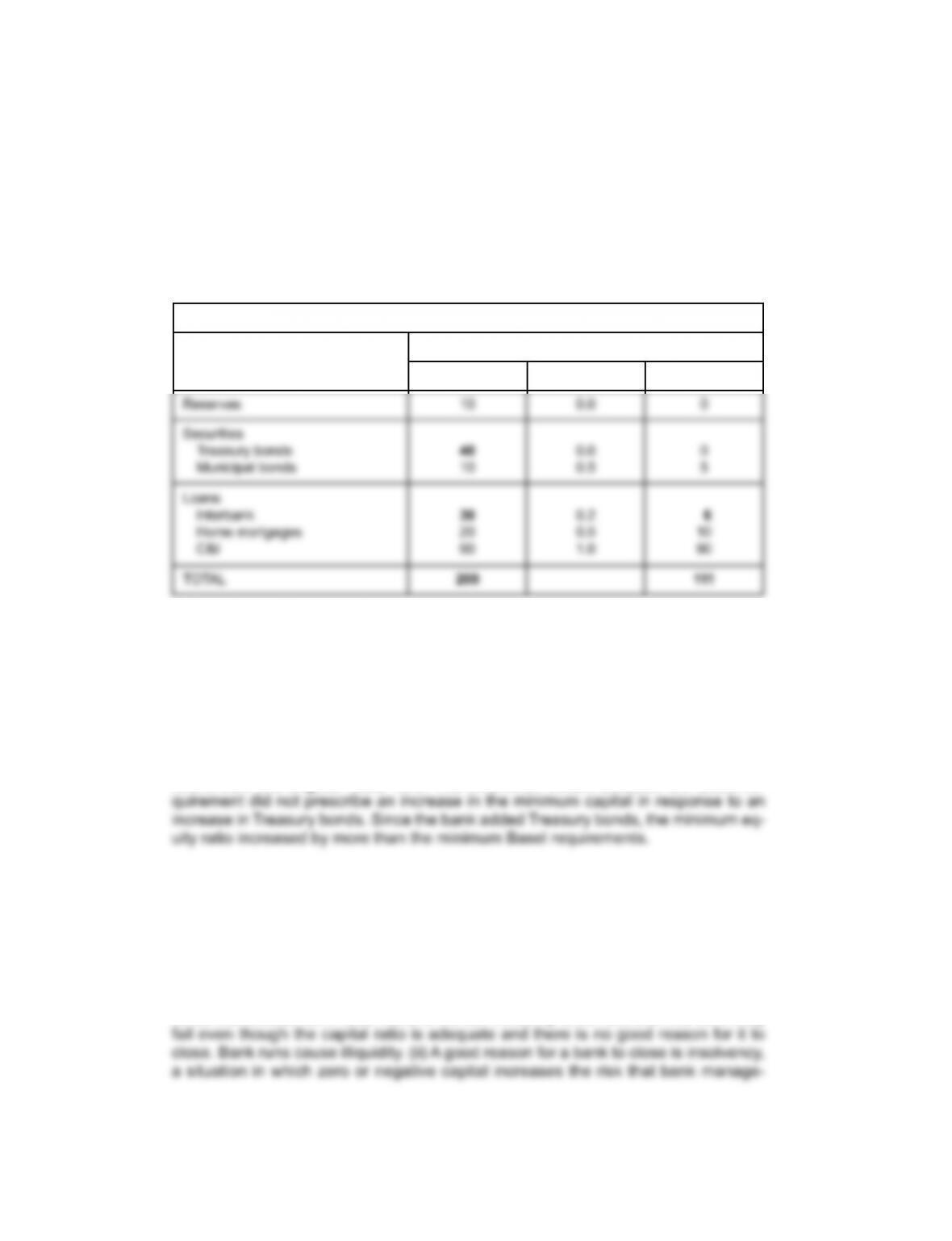
7. Let’s change the example of capital requirements in Table 10.3. Assume that
Melvin’s Bank holds $40 in Treasury bonds (rather than $10) and $30 in loans to
other banks (rather than $10). Otherwise, Melvin’s assets are the same as in the
table.
a. Calculate the level of capital that Melvin’s must hold to satisfy (i) the minimum
equity ratio and (ii) the risk-based Basel requirement.
ANSWER:
(i) Based on minimum equity ratio:
minimum capital = (0.05)(total assets) = (0.05)($200) = $10
(ii) Based on Basel requirement:
minimum capital = (0.08)(weighted assets) = (0.08)($111) = $8.88
b. Which of the two requirements is more stringent in this case? Is the answer dif-
ferent than it was for the original Table 10.3? If so, why?
ANSWER: In the case above, the minimum equity ratio is more stringent. This is dif-
ferent from the original Table 10.3. The difference occurs because the Basel re-
8. Consider two possibilities: (i) a bank is forced to close even though there is no
good reason for it to close; (ii) a bank remains open even though there are good rea-
sons for it to close.
a. Explain why (i) and (ii) are possible, and what regulations affect the likelihood
of these outcomes.
ANSWER: (i) If a bank faces a run in which depositors withdraw large amounts of
funds that exceed bank reserves and the bank’s ability to borrow, then the bank may
A-68 CHAPTER 10 Bank Regulation
Capital Requirements for Melvin’s Bank
Weighted
Assets Weights Assets
b. Can some combination of regulations make both (i) and (ii) unlikely?
ANSWER: Situation (i) can be avoided if deposit insurance exists. This makes situ-
ONLINE AND DATA QUESTIONS
www.worthpublishers.com/ball2
9. Link through the text Web site to the site of the Office of the Comptroller of the
Currency and look up “Enforcement Actions.” Find an example of a specific enforce-
ment action against a bank. Explain what the OCC did and what problem it was try-
ing to rectify.
ANSWER: The OCC website at www.occ.treas.gov/ defines various types of enforce-
ment actions. For example, in some cases banks are subject to Bank Civil Money
10. The text Web site has a link to a paper by Christine Blair, an economist at the
FDIC, called “The Mixing of Banking and Commerce.” Read this paper and briefly
summarize the arguments for and against the “mixing” in the title. Which side do you
agree with?
ANSWER: Recent efforts to “mix” banking and commerce were made by Walmart
and Home Depot, who wanted to start their own banks to handle customer payments
and to arrange consumer loans for their customers. Arguments that oppose this mix-
CHAPTER 10 Bank Regulation A-69