Chapter 9
Operating Activities
9-14
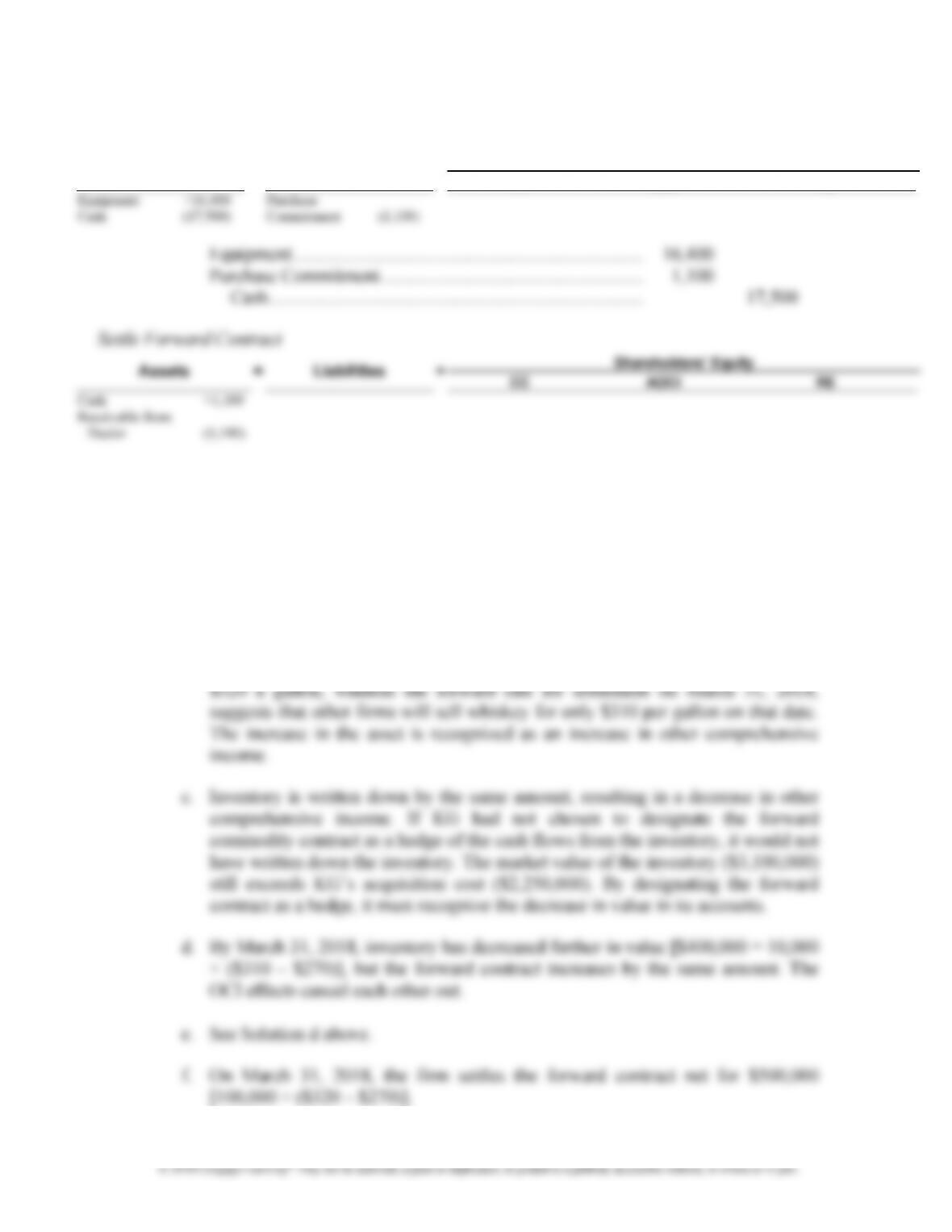
Acquisition of Equipment
Assets = Liabilities + Shareholders’ Equity
CC AOCI RE
Cash…………………………………………………………………………. 1,100
Receivable from Dealer ………………………………………….. 1,100
9.23 Accounting for Futures Commodity Price Contract as a Cash Flow Hedge.
a. KG does not make an entry on October 1, 2017, because the futures contract is a
mutually unexecuted contract and requires no initial investment.
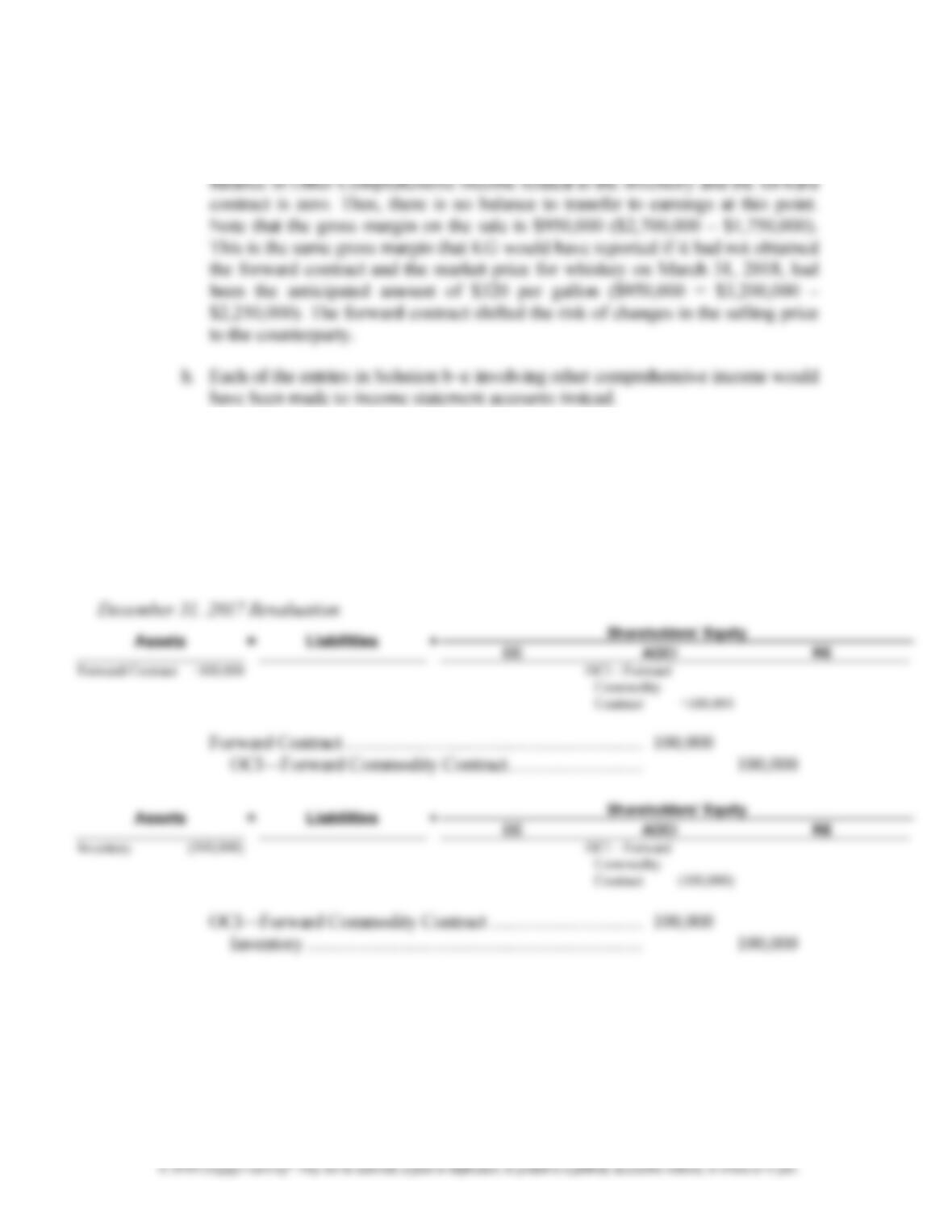
b. The value of the forward contract increases $100,000 [10,000 × ($320 – $310)].
The forward contract is an asset because the firm has the right to sell whiskey at
Chapter 9
Operating Activities
9-15
g. At sale, the firm recognizes 100,000 × $270 = $2,700,000 in sales revenue and
$10,000 × ($225 – $10 – $40) = $1,750,000 in cost of goods sold. The net
i. A justification for treating the forward commodity price contract as a fair value
hedge is that the firm wanted to protect the gross margin on the sale of $950,000
against commodity price changes. A justification for treating the contract as a
cash flow hedge is that the firm wanted to ensure that it received a net cash
inflow of $3,200,000 on the sale of the whiskey.
Accounting for Futures Contract as a Cash Flow Hedge
Chapter 9
Operating Activities
9-16
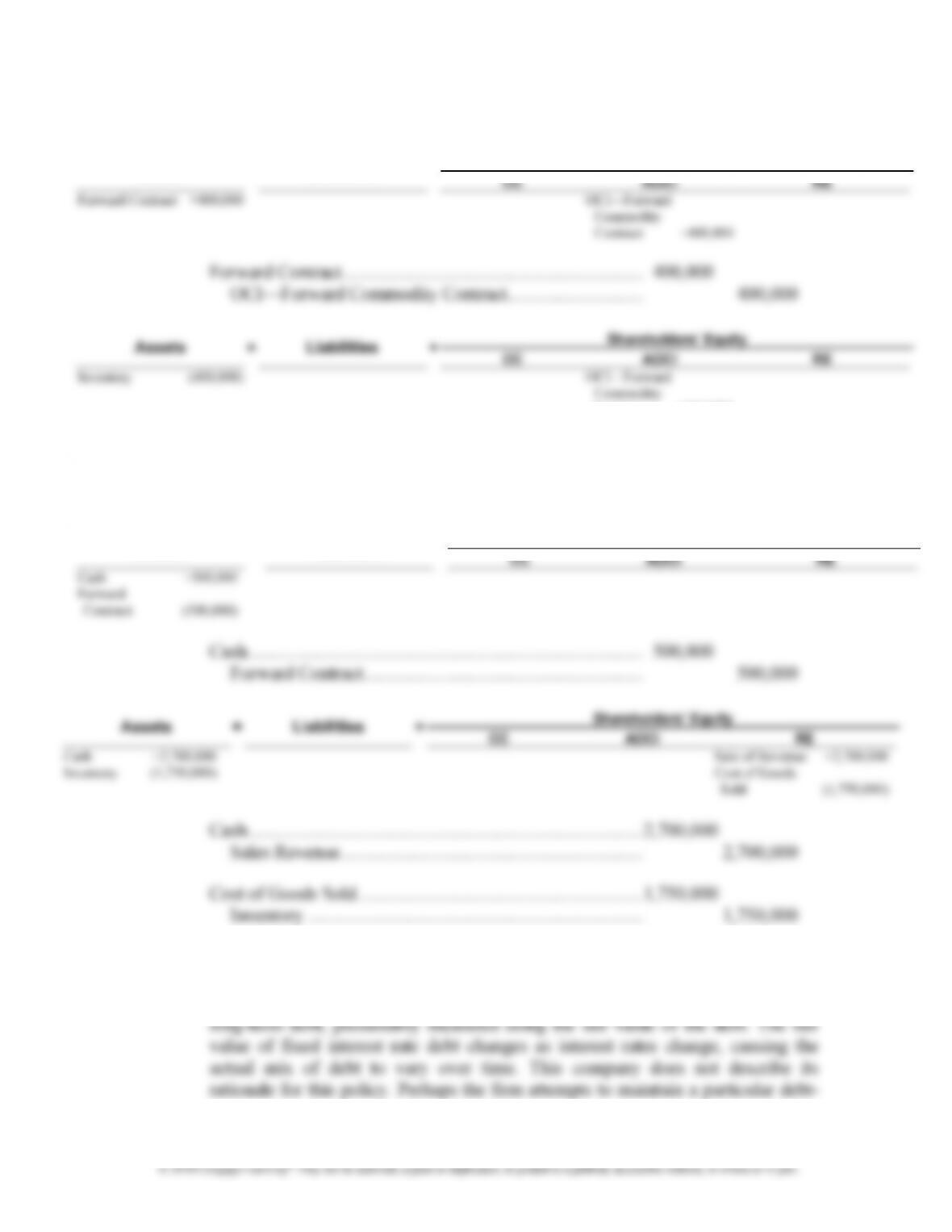
March 31, 2018 Revaluation
Assets = Liabilities + Shareholders’ Equity
Contract (400,000)
OCI—Forward Commodity Contract …………………………… 400,000
Inventory ……………………………………………………………… 400,000
Closing of Forward Contract and Sale of Inventory
Assets = Liabilities + Shareholders’ Equity
9.24 Interpreting Derivatives Disclosures.
a. This company attempts to maintain a particular mix of fixed and variable rate
Chapter 9
Operating Activities
9-17
© 2018 Cengage Learning®. May not be scanned, copied or duplicated, or posted to a publicly accessible website, in whole or in part.
to-equity ratio, measured using market values, to minimize its weighted-average
cost of capital. (Chapter 11 discusses the cost of capital.) Alternatively, the
targeted mix of fixed and variable rate debt may indicate the amount of interest
rate risk the firm is willing to incur. This company likely uses interest rate swaps
to convert some of its fixed-rate debt into variable-rate debt to reduce or
eliminate changes in fair values.
b. This company sells products in other countries through subsidiaries, affiliates,
the foreign entity, but then the company must pay the counterparty the excess to
bring the net cash flow equal to the contracted forward exchange rate.
c. Fair value hedges hedge changes in the fair value of existing assets or liabilities
or in the fair values of a firm commitment. This company uses interest rate
d. Firms must demonstrate initially that a particular derivative will effectively
hedge a particular risk if it is to be accounted for as a hedge instead of as a
speculative investment. This company discloses that none of its derivatives were
Chapter 9
Operating Activities
9-18
e. Foreign exchange contracts appear on the December 31, Year 4, balance sheet at a
carrying and fair value of $39 million. Accumulated Other Comprehensive
forward exchange rate at that time for the particular settlement date.
f. If the forward exchange contracts give rise to a net loss, the company must
anticipate a net gain on the forecasted amounts to be received from foreign
entities. An increase in the expected U.S. dollar equivalent amount to be received
suggests that, on average, the foreign currencies are increasing in value over time
ineffective portion. To determine the net ineffective portion, we need to net the
$76 million loss against the net gains the company anticipates from forecasted
remittances and then assess whether the hedges were highly effective. This
company does not disclose this amount, but does disclose that the amount
included in earnings because of ineffective cash flow hedges was not significant.
Chapter 9
Operating Activities
9-19
i. The company will transfer amounts from accumulated other comprehensive
income to earnings at the time of settlement for the forward exchange contract. If
9.25 Interpreting Income Tax Disclosures.
a. Coca-Cola generates large tax savings from operations in countries with an
income tax rate lower than the U.S. statutory tax rate of 35% in every year, with
Chapter 9
Operating Activities
9-20
c. Net deferred tax assets will not change in the year when net operating losses
originate. Gross deferred tax assets increase, but the increase in the valuation
deferred tax assets is that the firm does not recognize the tax benefits in
measuring income tax expense until the firm realizes those tax benefits. This
treatment differs from the usual treatment of deferred tax assets for which a
valuation allowance is not recognized. Income tax expense follows the book
income and expense amounts in the usual case. The deferred tax asset simply
Chapter 9
Operating Activities
9-21
Integrative Case 9.1: Walmart
a. Walmart’s retail sales revenues are recognized at a point in time (i.e., at delivery).
b. Walmart uses LIFO for domestic inventories and FIFO for foreign inventories
(recall that IFRS does not permit the use of LIFO).
c. Walmart uses a special form of these two methods that proxies for the lower-of-
cost-or-market method—the retail inventory method. This method is a technical
accounting measurement approach that was not discussed in the text.
given that this is a retail operation). The two largest working capital liabilities are
accounts payable of $38,487 million and accrued liabilities of $19,609 million.
g. Working capital liabilities are slightly larger than working capital assets, a net
negative investment in working capital. This is a good situation for Walmart’s
profitability because working capital investments rarely generate a return.
Chapter 9
Operating Activities
9-22
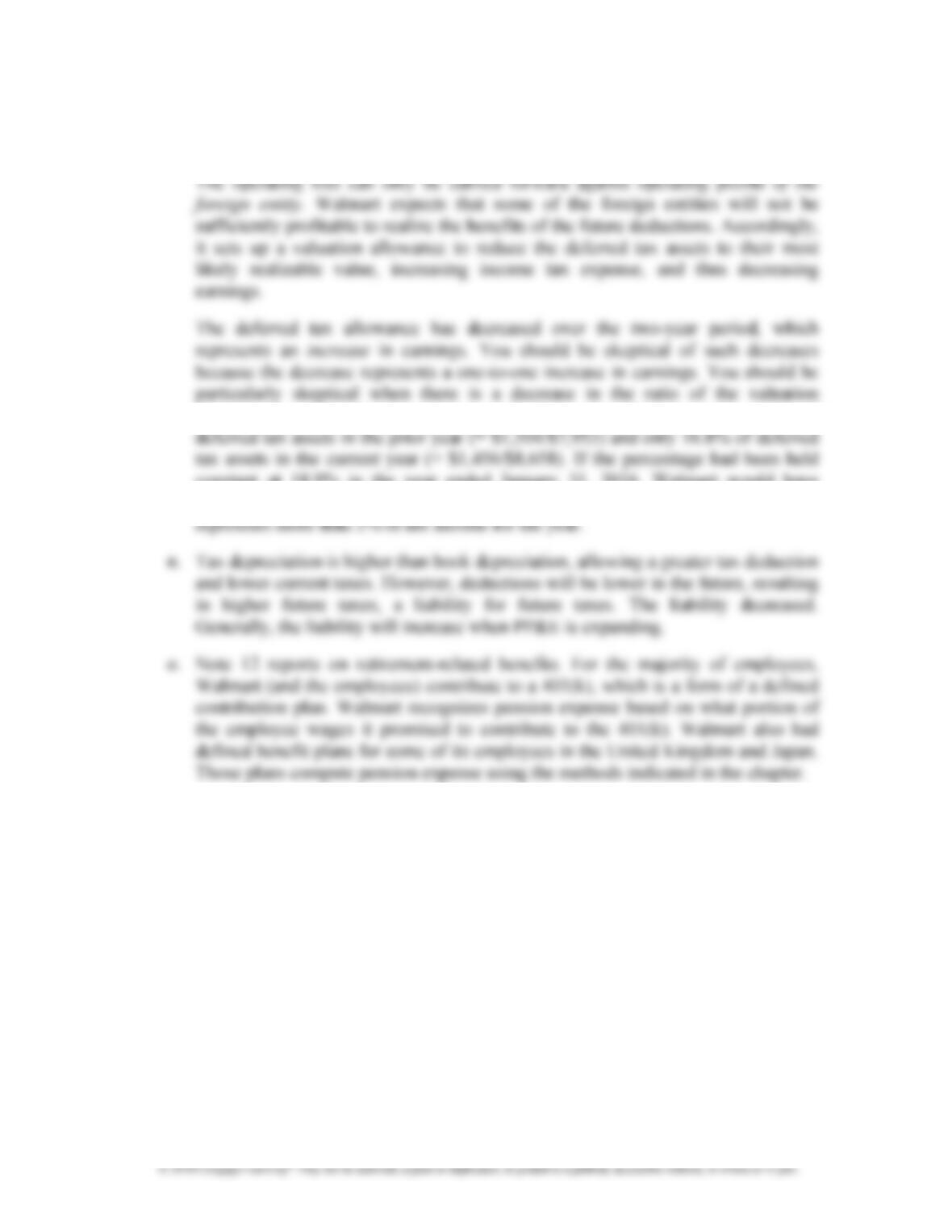
information necessary to calculate the average, or effective, tax rates for the three
years by source of income:
January 31 (amounts in millions) 2016 2015 2014
United States income:
j. Walmart’s foreign earnings are fluctuating as a percentage of total earnings. The
percentage for the year ending January 31, 2016, has fallen relative to 2015.
January 31 (amounts in millions) 2016 2015 2014
k. Because foreign tax rates are lower, repatriation will generally increase the
rate.
l. The two largest deferred tax assets are “loss and tax credit carryforwards” and
“accrued liabilities.” The former arose when Walmart generated an operating loss
m. Deferred tax assets reduce income tax expense and, thus, increase earnings. The
Chapter 9
Operating Activities
9-23
deductions. For a profitable company like Walmart, the valuation allowance is
likely due to one phenomenon—in prior periods, a foreign operation lost money.
allowance to deferred tax assets as well. Walmart’s allowance was 18.9% of
constant at 18.9% in the year ended January 31, 2016, Walmart would have
reported $181.8 million [= (18.9% – 16.8%) × $8,658] less in net income, which
Chapter 9
Operating Activities
9-24
Case 9.2: Coca-Cola Pensions
a. The memorandum should include the following points (all amounts in millions):
PBO increased $114 due to service cost. Service cost represents the present value of
the obligation to employees because of their working for one year. The service cost is
based on the plan benefit formula. (Solution b: Recognized as an increase in current
PBO decreased $13 due to plan amendments. The amendment reduced the pension
benefits earned by employees in past periods (called prior service cost). (Solution b:
Recognized as an increase in other comprehensive income; recycled as a reduction of
other comprehensive income and an increase in pension expense via the amortization
Chapter 9
Operating Activities
9-25
PBO increased by $11 due to special termination benefits. Occasionally an employee
group negotiates a special termination benefit when terminating plan coverage.
Plan assets increased $96 due to Coca-Cola’s contributions to the plan. (Solution b:
No effect on pension expense. Cash flow event.)
Plan assets decreased $118 due to foreign currency exchange rate changes. See the
separately if material.)
c. The justification for keeping some PBO and fair value of plan asset changes out of
current period net income is that they are not indicative of current operating perfor-
mance and thus are not predictive of future operating performance. For example, the
Chapter 9
Operating Activities
9-26
© 2018 Cengage Learning®. May not be scanned, copied or duplicated, or posted to a publicly accessible website, in whole or in part.
d. If the expected rate of increase in compensation levels was decreased by 1%, the
actuary will reduce the PBO (the present value of expected future benefits to em–
ployees), which are generally based on final pay. Current pension expense is lower
because service cost is lower. Future pension expense will be affected by both the lower
service cost and the amortization of the liability gain from the actuary reducing the
PBO; however, the amortization of the liability gain depends on whether accumulated
liability and asset gains in losses do not offset and become larger than the corridor.