6-18
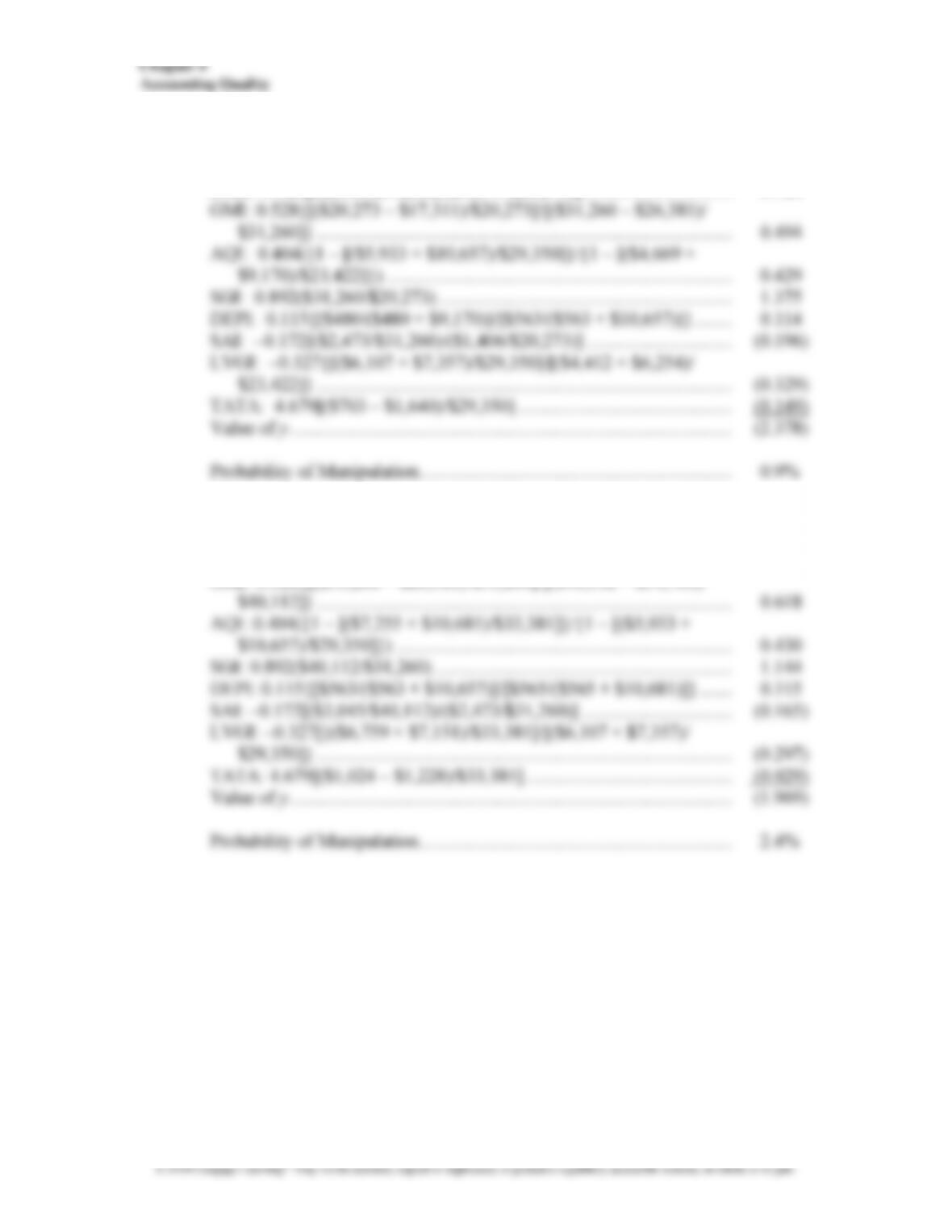
6.23 Applying and Interpreting the Earnings Manipulation Model.
a. 1998
Constant ……………………………………………………………………………………. (4.840)
DSRI: 0.920[($2,060/$31,260)/($1,697/$20,273)] ………………………….. 0.724
1999
Constant ……………………………………………………………………………………. (4.840)
DSRI: 0.920[($3,030/$40,112)/($2,060/$31,260)] ………………………….. 1.055
GMI: 0.528{[($31,260 – $26,381)/$31,260]/[($40,112 – $34,761)/
Chapter 6
Accounting Quality
6-19
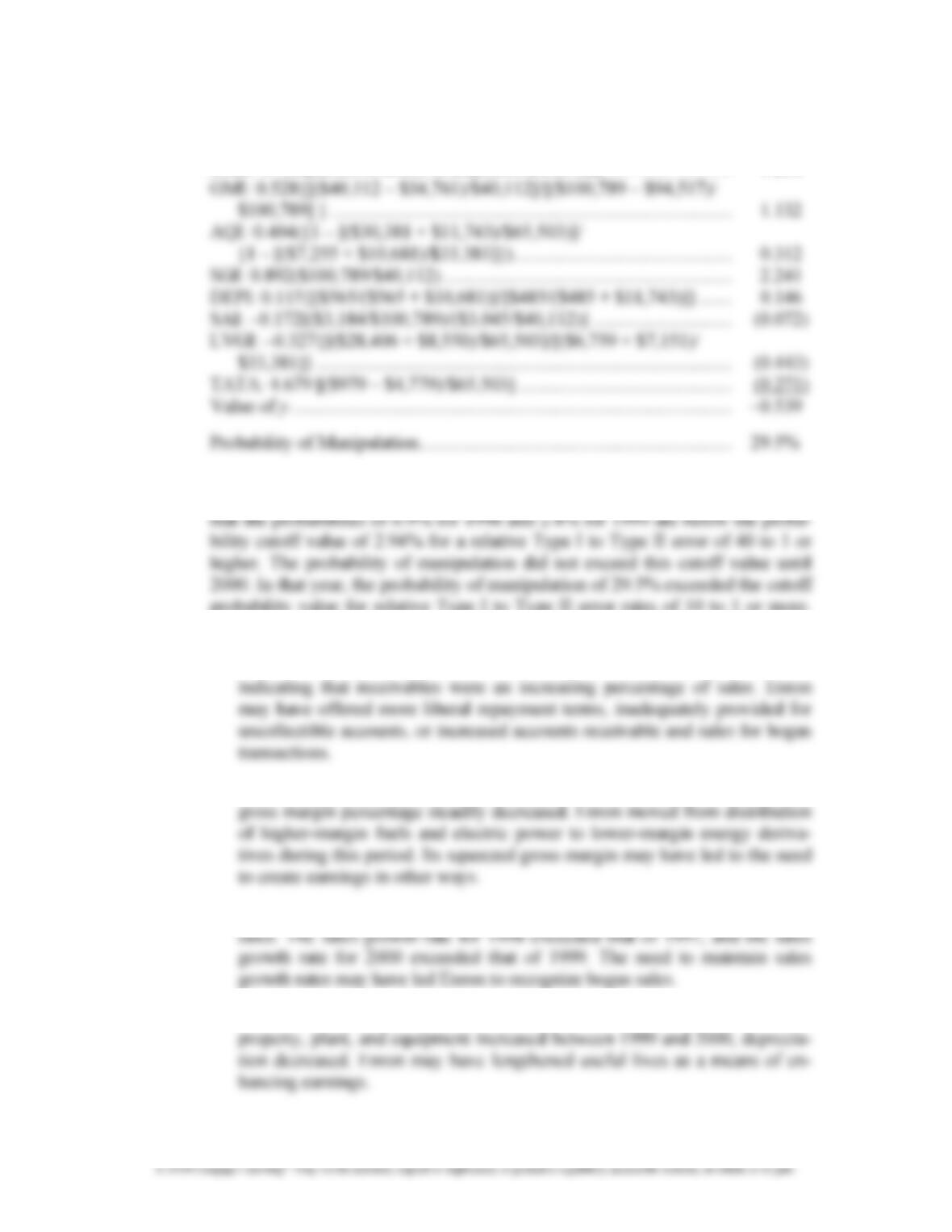
2000
Constant ……………………………………………………………………………………. (4.840)
DSRI: 0.920[($10,396/$100,789)/($3,030/$40,112)] ………………………. 1.256
b. The probability of manipulation increased over the three years. Note, however,
probability value for relative Type I to Type II error rates of 10 to 1 or more.
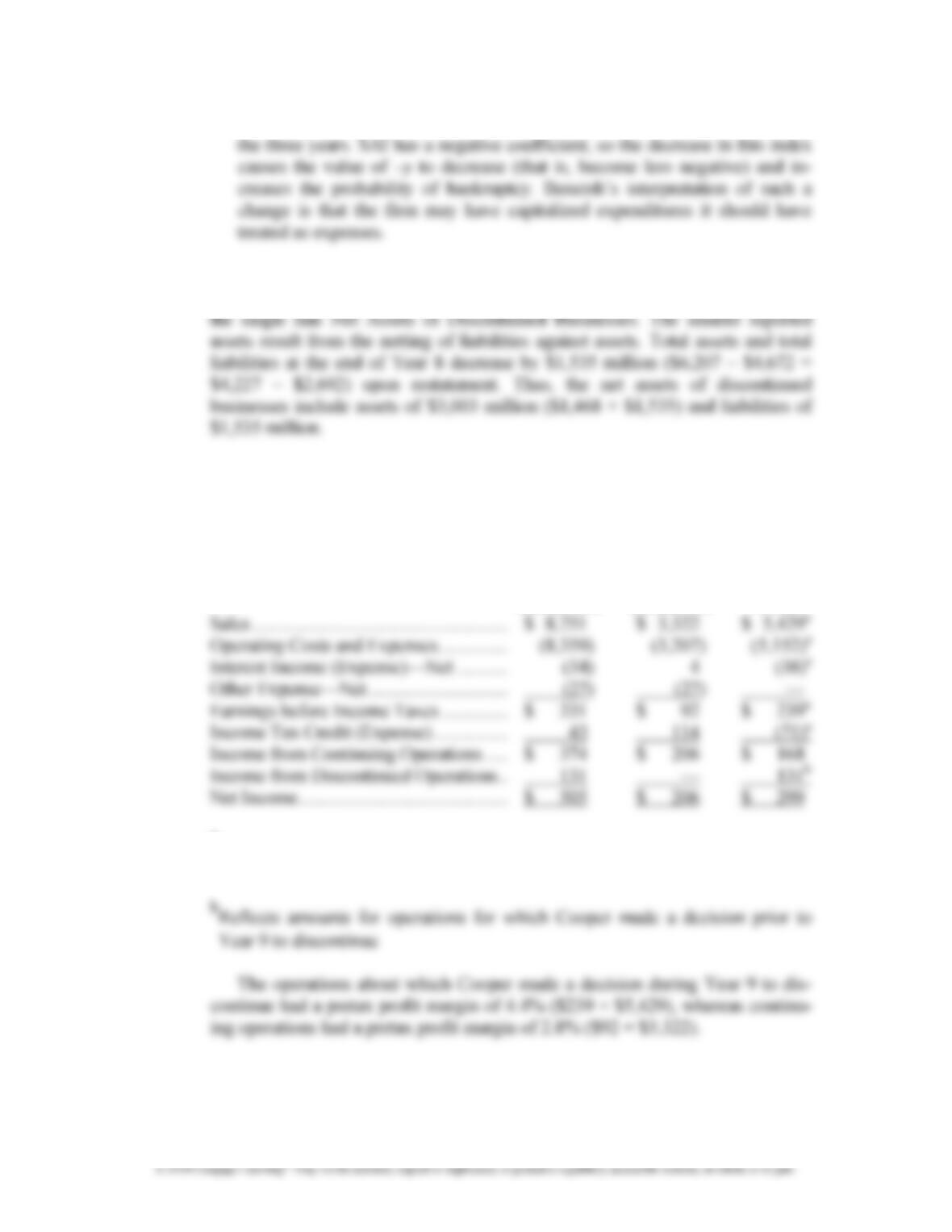
The most important contributing factors were as follows:
1. DSRI: The days receivables outstanding variable steadily increased,
2. GMI: The gross margin index steadily increased, which indicates that the
3. SGI: The sales growth index exceeded 1.0 each year, indicating growing
4. DEPI: The depreciation index increased between 1999 and 2000. Although
Chapter 6
Accounting Quality
6-20
5. SAI: The selling and administrative expense index decreased steadily during
6.24 Using Originally Reported versus Restated Data.
a. Cooper reclassified both the assets and liabilities of discontinued business into
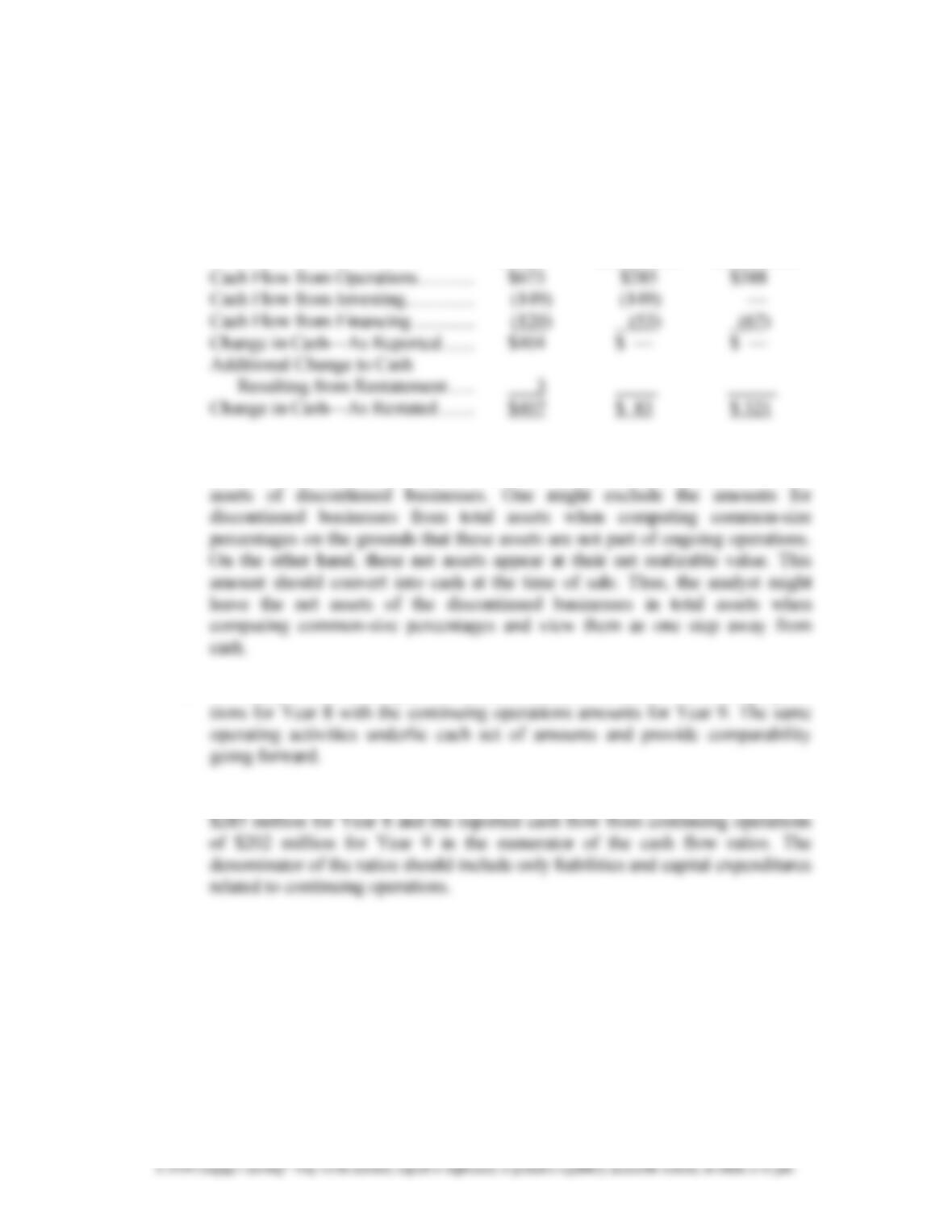
b. Cooper reclassified individual revenues and expenses of discontinued businesses
into the single line Earnings from Discontinued Operations. A comparison of the
originally reported and restated amounts portrays the following picture of
operating performance during Year 8:
Continuing Discontinued
Businesses Businesses Total
aReflects amounts for operations for which Cooper made a decision during Year
9 to discontinue
Chapter 6
Accounting Quality
6-21
c. Cooper nets investing and financing cash flows of discontinued operations
against cash flows from operations for the discontinued businesses and shows
the net cash flow of $324 million in the operating section. The following
analysis summarizes the cash flow pattern.
Continuing Discontinued
Total Businesses Businesses
d. The analyst should compare the restated amounts for Year 8 with the reported
amounts for Year 9. One issue the analyst must face is the treatment of the net
e. The analyst should compare the restated amounts related to continuing opera-
f. The analyst should use the restated cash flows from continuing operations of
Chapter 6
Accounting Quality
6-22
Integrative Case 6.1: Walmart
The accounting issues explored are those issues of most importance to Walmart’s
EDLP
“Everyday low prices” is a key success factor for Walmart. Achieving everyday low
prices requires Walmart to achieve everyday low costs by successfully managing its
For purposes of accounting analysis, we analyzed the key accounting issues related to
these critical risk and success factors. Students might organize their discussion in many
different ways. We have organized this solution as follows:
Our discussion is focused on accounting quality as it relates to the measurement of assets
ACCOUNTING FOR CAPACITY
A key value driver for Walmart is the existence and expansion of stores and the distribu-
tion network, including the ability to service online orders. Key accounting policies
follow (described in Note 1 to the Consolidated Financial Statements unless otherwise
noted):
• Walmart expenses any cost of start-up activities (e.g., “preopening costs” such as
Chapter 6
Accounting Quality
6-23
that type of expenditure. The stores have not begun operations and are not yet gener-
These accounting policies appear consistent with economic reality and are likely to result
in earnings measures that are indicative of current performance and that are persistent.
However, the following questions require further analysis:
Operating Leases. Walmart accounts for some of its leases as operating. Balance sheet
quality is impaired because, although these leases are noncancelable promises to pay cash
Credit analysis: Because of the significance of noncapitalization of operating leases for
assessments of solvency risk, it is likely that the analyst would want to effectively
capitalize the leases before performing credit analysis. Lease capitalization methods are
Chapter 6
Accounting Quality
6-24
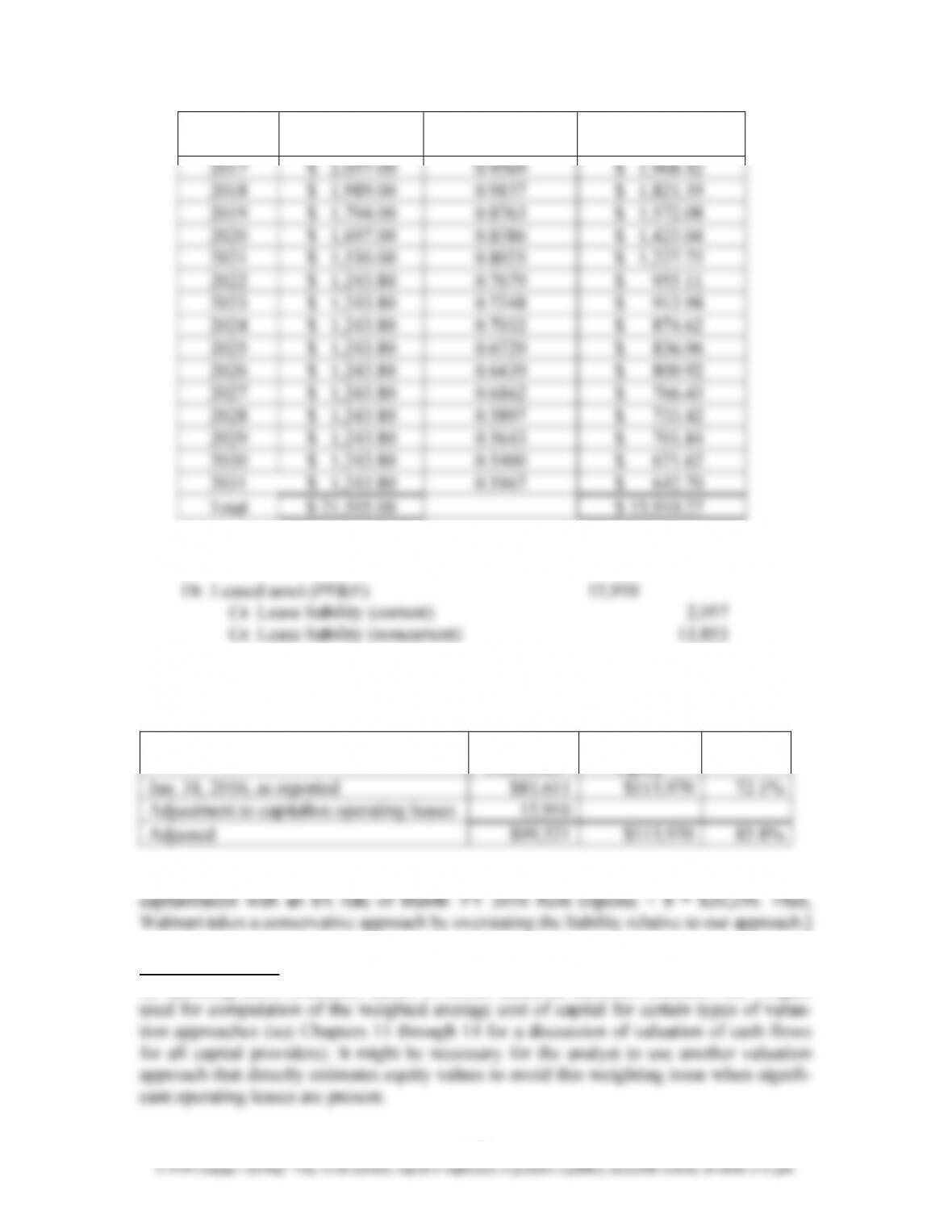
Fiscal
year Payment Discount factor
@ 4.5% Present value
The journal entry to effectively capitalize the operating leases is:
As an example of the effect on a solvency risk ratio, consider the total liabilities to
shareholders’ equity ratio:
Total
Liabilities
Shareholders’
equity
Ratio
[Note: Walmart calculates selected ratios in the MD&A. Walmart approximates the lease
Equity valuation: Although financial statement predictability is not likely to be affected
by operating lease treatment, failure to reflect financial liabilities misstates the weights
Chapter 6
Accounting Quality
6-25
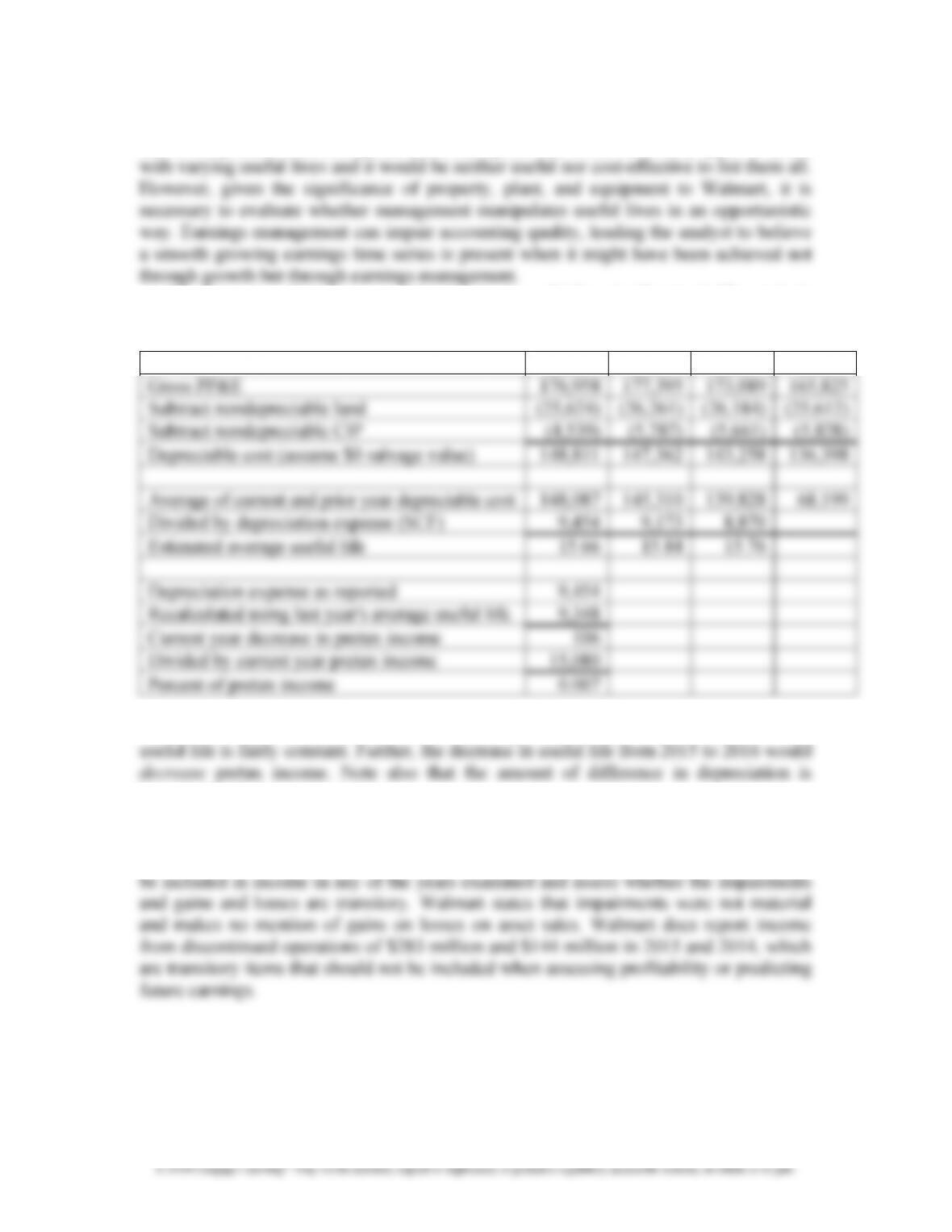
Manipulation of useful lives. Note 1 provides a list of useful lives used in depreciation
that is not precise. This is a typical disclosure given that firms have many types of assets
We discuss a technique to ascertain changes in useful lives in Chapter 8. The analysis
appears below if the instructor wishes to demonstrate it at this point:
2016 2015 2014 2013
It does not appear that Walmart is manipulating useful lives. The estimated average
immaterial relative to pretax income.
Impairments and asset sales. The analyst should look for any asset impairments record-
ed as parts of restructuring charges and any gains or losses on sales of PP&E that might
Chapter 6
Accounting Quality
6-26
ACCOUNTING FOR INVENTORY
Walmart uses a different inventory method for each of its three major segments: a special
type of LIFO designed to approximate lower-of-cost-or-market commonly used in the
REVENUE RECOGNITION
Based on the information in Note 1, Walmart’s revenue recognition policies appear to be
reasonable and in line with other companies. Revenue from product sales is generally
and recognizes that revenue over the normal holding periods of the shopping cards.
approach, which is a weakness in its disclosure quality.
INTERNATIONAL OPERATIONS
Walmart’s cash flows and financial position are at risk due to fluctuations in international
exchange rates. Accordingly, Walmart hedges some of these exposures through the use of

Chapter 6
Accounting Quality
6-27
SUMMARY
In summary, with the exception of operating leases, Walmart’s accounting quality is
Chapter 6
Accounting Quality
6-28
Case 6.2: Citi: A Very Bad Year
Principal transactions. Citi reports $22,188 million in losses from principal transactions
in 2008, down from a $12,086 million loss in 2007. Principal transactions represent
Realized (gains) and losses from sales of investments. These are similar to principal
transactions and should be included in profitability assessment and earnings prediction
Provision for loan losses. The provision for loan losses is a major operating item in the
income statements of lending institutions such as Citi. This accrual is similar to bad debt
Restructuring. Citi reports restructuring charges in operating income in 2008 ($1,766
million pretax) and in 2007 ($1,528 million pretax) related to asset impairments and
employee severance costs under two restructuring plans. (See Note 10.) These charges
Chapter 6
Accounting Quality
6-29
Other operating expenses (goodwill impairment). As noted in the accompanying press
release and in Note 19, Citi recorded approximately a $9.6 billion pretax ($8.7 billion
by $374 million and increase tax expense by $132 million ($374 million – $242 million).
Discontinued operations. Citi sold several operating units over the past three years that
qualified for discontinued operations treatment. In each year presented, Citi reports an
Chapter 6
Accounting Quality
6-30
Case 6.3: Arbortech: Apocalypse Now
I. Objectives
A. Analyze the effect of various accounting irregularities on the financial state-
ments.
B. Assess the credit worthiness of a high-growth firm that has experienced lapses
in its financial controls.
C. Apply bankruptcy prediction models and assess the likelihood of bankruptcy.
II. Responses to Case Questions
a. Year 5
Constant ………………………………………………………………………………. (4.840)
Year 6
Constant ……………………………………………………………………………………. (4.840)
Chapter 6
Accounting Quality
6-31
b. Signals of Accounting Irregularities: Beneish’s manipulation index shows a
high probability of manipulation for both fiscal Year 5 and Year 6. The rapid
c. Effect of Irregularities on the Financial Statements:
(1) Invalid Sales Transactions: The invalid sales transactions overstate sales,
cost of goods sold, income tax expense, and net income on the income
(2) Bill and Hold Transactions: The improper cutoff of sales at each year end
Chapter 6
Accounting Quality
6-32
© 2018 Cengage Learning®. May not be scanned, copied or duplicated, or posted to a publicly accessible website, in whole or in part.
June 30, Year 6. The balance sheet for each intervening period reports over-
stated accounts receivable, understated inventories, overstated income tax
payable, and overstated retained earnings. The amount of cash flow from
operations is correct for each year, although net income and changes in
accounts receivable, inventories, and other current liabilities will change.
(3) Inventory Counts: The firm likely overstated its ending inventories each
year in an effort to reduce cost of goods sold and inflate net income. Thus,
(4) Product Obsolescence: The failure to write down inventories for product
(5) Capitalization of Costs in Property, Plant, and Equipment: The improp-
er capitalization of various costs in property, plant, and equipment resulted
(6) Improper Classification of Prepaid License Fees: The classification of
the advance as a receivable instead of a prepaid cost to be amortized results
(7) Inadequate Provision of Uncollectibles on Advances to Investees: Bad
debt expense is understated and income tax expense and net income are
Chapter 6
Accounting Quality
6-33
(8) FASB Statement No. 115 requires firms to report marketable equity securi-
ties at market value and report increases and decreases in market values
d. The decision to extend credit to Arbortech must rest on two positive factors: (1)
the viability of its products with established customers and (2) the fact that the
seem appropriate.
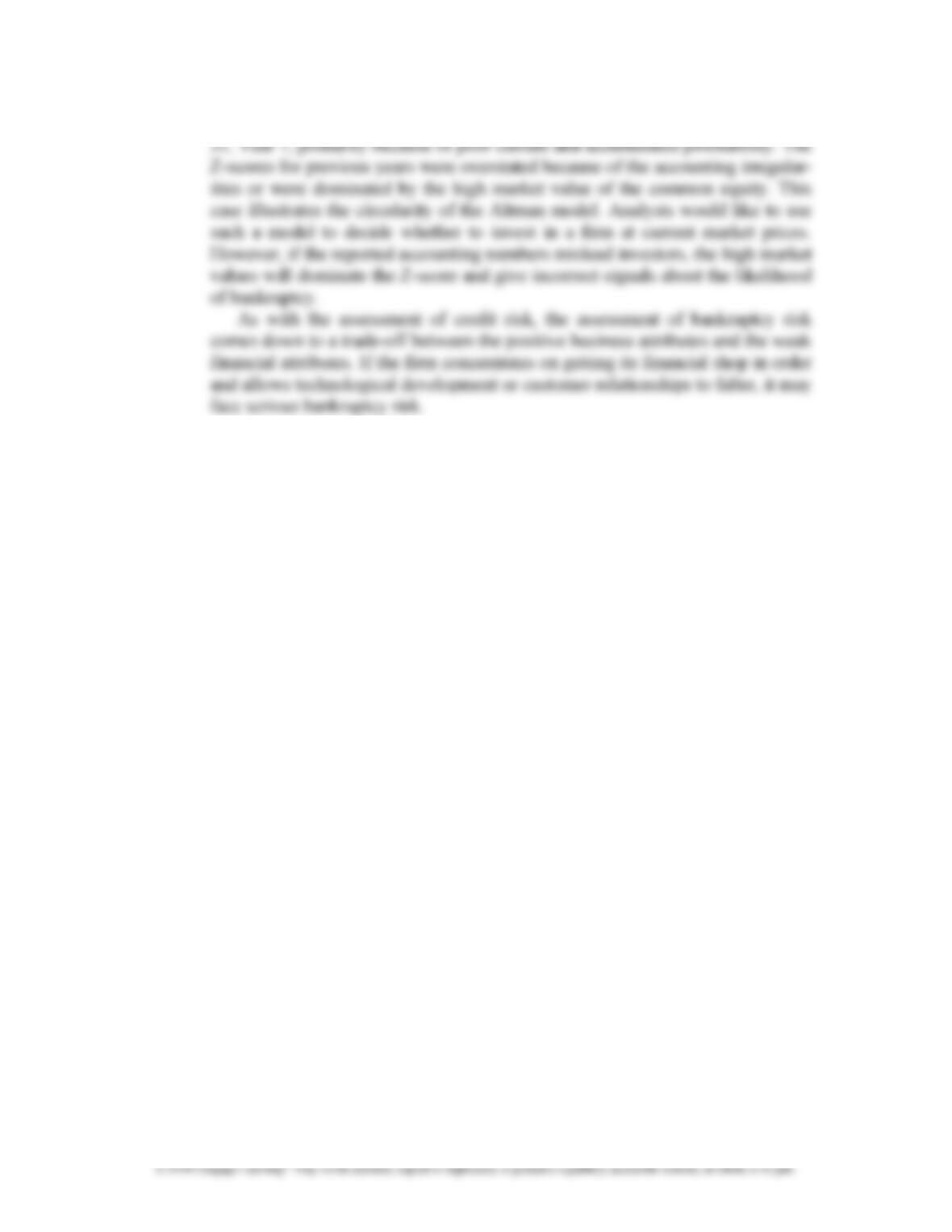
e. The calculation of Altman’s Z-score is as follows:
Chapter 6
Accounting Quality
6-34
f. The Altman’s Z-score indicates a high probability of bankruptcy as of March