6-1
CHAPTER 6
ACCOUNTING QUALITY
Solutions to Questions, Exercises, Problems, and Teaching Notes to Cases
6.1 Concept of Earnings Quality. Many examples answer this question. For example,
a firm that reports earnings dominated by a substantial one-time gain from the sale
6.2 Balance Sheet Quality and Earnings Quality. Balance sheet and earnings quality
are related by financial statement articulation. The income statement measures
changes in assets and liabilities from transactions with non-owners. Therefore, low-
Chapter 6
Accounting Quality
6-2
6.3 Concept of Earnings Management. Define earnings management. Healy and
Wahlen provide the following definition of earnings management:
Earnings management occurs when managers use judgment in financial
reporting and in structuring transactions to alter financial reports to either
6.4 Own Debt Profits. Gains from revaluation of debt are an example of achieving high
balance sheet quality at the expense of earnings quality. While a company’s credit
6.5 Incentives to Manage the Balance Sheet. To obtain lower cost debt financing, the
corporation would prefer to show a higher current ratio (lower liquidity risk) and a
Chapter 6
6-3
© 2018 Cengage Learning®. May not be scanned, copied or duplicated, or posted to a publicly accessible website, in whole or in part.
• the existence of transactions described in the chapter as “off-balance-sheet
financing,” especially the use of lease financing and the proper accounting for
transfers of assets to other parties.
6.6 Incentives to Manage Earnings Upward. Managers have numerous incentives to
manage earnings upward, including
• to increase compensation payments under compensation contracts based on
earnings or stock prices.
6.7 Incentives to Manage Earnings Downward. Managers may also have incentives
to manage earnings downward, including
• to discourage entry into the industry by potential competitors.
6.8 Criteria to Identify Nonrecurring Items. The presumption in using reported
financial statement data is that they accurately portray the economic effects of a
firm’s decisions and actions during the current period and are informative about the
Chapter 6
Accounting Quality
6-4
© 2018 Cengage Learning®. May not be scanned, copied or duplicated, or posted to a publicly accessible website, in whole or in part.
profitability and risk and valuing the firm. Accounting data is of highest quality
when two characteristics exist: (1) the data is a fair and complete representation of
the firm’s economic performance, position, and risk; and (2) the data provides
relevant information to forecast the firm’s expected future earnings and cash flows.
6.9 Restating Earnings for Litigation Loss. Pro forma earnings for 2004 are $1.03
million [–3.2 + (0.65 × 6.5)]. The calculation assumes a federal statutory tax rate of
6.10 Reporting Impairment and Restructuring Charges. The number of shares
outstanding for the fourth quarter of 2004 was 37,565,000 ($29.3 million/$0.78).
Net income excluding the impairment and restructuring charge for the fourth
34,615,000 ($4.5 million/$0.13). Net income excluding the impairment and restruc-
6.11 Concept of Peripheral Activity. Gains generated by investment firms in their
Chapter 6
Accounting Quality
6-5
6.12 Reporting Impairment Charges. Many examples exist as answers to this
question. Students can use the examples provided in the chapter as clues for
6.13 Effect of Alternative Accounting Standards on Financial Statement Analysis.
Cross-national analysis of firms entails a two-step approach: (1) achieve
comparability of the reporting methods and accounting principles employed by the
6.14 Accounting for Loss Contingencies. Contingent obligations may or may not give
1. Information available prior to the issuance of the financial statements indicates
2. The firm can estimate the amount of the loss with reasonable precision.
Chapter 6
Accounting Quality
6-6
6.15 Securitization of Receivables. The FASB requires that firms recognize transfers of
receivables as sales only if the transferor surrenders control of the receivables.
Firms surrender control only if all of the following conditions are met:
6.16 Achieving Off-Balance-Sheet Financing.
Transfer of Receivables with Recourse. To be considered a sale, the transferor
must have surrendered control of the receivables: (1) the assets transferred have
been isolated from the selling firm (Diviney Company); (2) the buying firm
Chapter 6
Accounting Quality
6-7
If the call option were not present in this case, the transaction would more
likely qualify as a sale. The one issue remaining is the likelihood of Diviney having
financial statements:
Product Financing Arrangement. Firms recognize product financing arrange-
ments as liabilities if (1) the arrangements require the sponsoring firm (Diviney) to
purchase the inventory at specified prices and (2) the payments made to the other
Throughput Contract. Financial reporting treats throughput contracts as executory
Chapter 6
Accounting Quality
6-8
collateralized loan (the economics of the arrangement) even though U.S. GAAP and
the auditor would permit treatment as an executory contract with footnote
disclosure.
Construction Partnership. The construction loan appears as a liability on the
books of Chemical, the joint venture entity. Because Diviney and Mission each own
50% of Chemical, U.S. GAAP requires that neither company consolidate
and therefore has value. Diviney would recognize this amount as a liability and
increase its account, investment in joint venture, in an equal amount. Note that the
half of the debt as a liability when assessing the risk and value of these firms.
Research and Development Partnership. Firms must recognize financing related
R&D as liabilities if (1) the sponsoring firm (Diviney) must repay the financing
Chapter 6
Accounting Quality
6-9
If Diviney did not guarantee the bank loan and had an option to purchase the
output of the R&D effort, it would not seem to bear the risk of failure, again except
failure of the R&D effort and should recognize a liability.
Hotel Financing. Diviney will recognize a liability for the hotel financing only to
the extent of the value of the credit enhancement that its guarantee of the debt
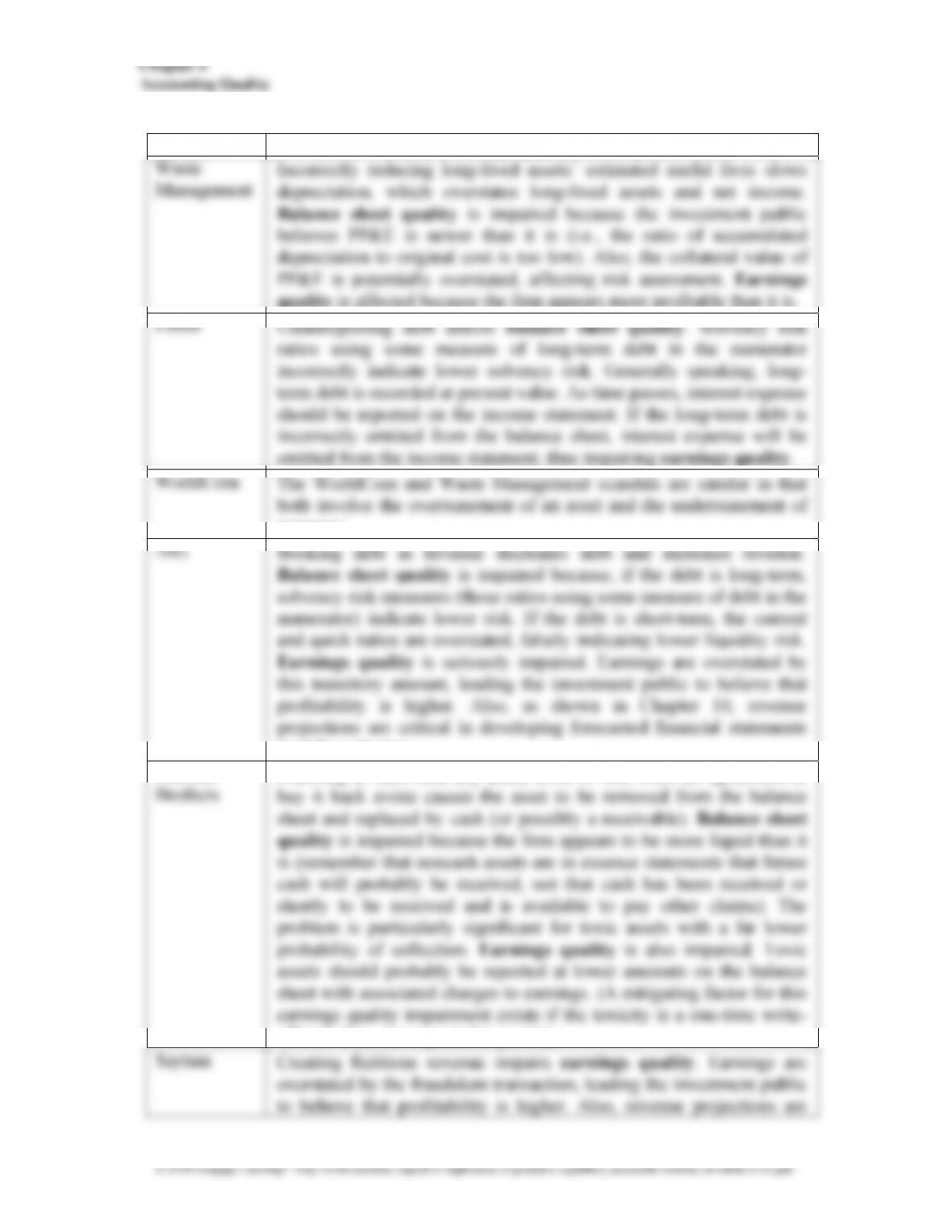
Summarizing Each Case
U.S. GAAP Economics
6-10
6.17 Accounting Scandals.
Scandal How balance sheet and earnings quality were impaired
quality is affected because the firm appears more profitable than it is.
expenses.
used for valuation.
Lehman
Claiming to have sold any asset, toxic or not, when an agreement to
off and, thus, not expected to persist).
Chapter 6
Accounting Quality
6-11
© 2018 Cengage Learning®. May not be scanned, copied or duplicated, or posted to a publicly accessible website, in whole or in part.
critical in developing forecasted financial statements used for
valuation. The false growth implied by the revenue inflation will
likely lead to upwardly biased revenue forecasts and valuation errors.
Balance sheet quality is also impaired. The current ratio is overstated
by the inflated accounts receivable, and liquidity risk appears to be
lower when it is not.
6.18 Adjusting for Unusual Income Statement and Classification Items.
a. (1) Gain on sale of a portion of the branded product line—The case for
(2) Extraordinary loss—The case for eliminating the loss is its nonrecurring
nature. The case against eliminating the loss is the immateriality of the
amount.
b. Year 10 Year 11 Year 12
c. Revenues should appear as the amount of cash the firm expects to receive from
customers. The incentives represent reductions in the selling price of products
Chapter 6
Accounting Quality
6-12
d. Year 10 Year 11 Year 12
Sales ……………………………………………. 100.0% 100.0% 100.0%
e. Sales ……………………………………………. 100.0% 100.0% 100.0%
Gain on Sale …………………………….. — — —
Cost of Goods Sold ……………………. (64.8) (66.7) (64.6)
f. The common-size income statement in Part d indicates that the net income to sales
Chapter 6
Accounting Quality
6-13
of revenues is a reduction in Henry’s effective tax rate. The effective tax rate after
effective tax rate from 26.4% in Year 11 to 34.8% ($445/$1,279) in Year 12.
6.19 Unusual Income Statement Items.
a. (1) Goodwill impairment. Goodwill impairment charges are generally con-
sidered transitory and should be eliminated when assessing current profita-
bility and future earnings. However, the analyst should consider whether
(2) Discontinued operations. Although discontinued operations appear in
(3) Loss (Gain) on sale of property, plant, and equipment and businesses
(net). Although losses and gains come from peripheral transactions, the
Chapter 6
Accounting Quality
6-14
b. Common-Size Income Statement (amounts in thousands)
2008 2007 2006
Total Revenues …………………………….. 100.0% 100.0% 100.0%
Cost of Revenues ………………………….. 79.5 71.4 72.1
Operating Earnings ……………………….. 6.8% 21.5% 20.8%
Other Income (Expense), Net …………. (0.1) (0.2) 0.9
(93.1% minus the 6.9% goodwill impairment) by 2008. Total operating
expenses were lower in each period due to the peripheral gains on sale of
Chapter 6
Accounting Quality
6-15
6.20 Implications of a Goodwill Impairment Charge for Future Cash Flow and
Profitability.
a. Companies examine annually whether goodwill is impaired by simulating what
the acquisition price would be if the segment were repurchased in the open
market at the balance sheet date. That is, what is the current fair value of the
b. If one assumes that the simulation process in the goodwill impairment test
yields accurate measures of the implied goodwill at a given balance sheet date,
then goodwill impairment measures the decline in the value of goodwill due to
6.21 Restructuring Charges at Intel.
a. Given the information in Intel’s Note 15, it appears that management has
Chapter 6
Accounting Quality
6-16
b. Asset impairments are recorded by an asset write-down rather than by accrual of
c. The accrued restructuring liability increases by “additional accruals,” which
represent new employee severance and benefit accruals that decrease net in-
come. “Adjustments” occur when additional information becomes available
d. Under U.S. GAAP, firms record a restructuring liability on the balance sheet
and the associated restructuring charge (an expense) on the income statement
6.22 Interpreting the Statement of Cash Flows.
a. The sales decline is a primary indicator of an operating problem. During a
period of decreased sales, accounts receivable and inventories usually decrease.
Chapter 6
Accounting Quality
6-17
the mix of businesses in which it was involved. Cash flow from operations was
insufficient to finance its investing needs. The firm engaged in short-term bor-
of shares that it issued to employees.
b. Net income turned negative during Year 6, primarily as a result of the provision
for restructuring and asset impairment. Assuming an income tax rate of 35%,
the restructuring and asset impairment charge reduced net income for Year 6 by
c. Net income increased significantly in Year 7, as one would expect from an