Chapter 5
Risk Analysis
5-16
© 2018 Cengage Learning®. May not be scanned, copied or duplicated, or posted to a publicly accessible website, in whole or in part.
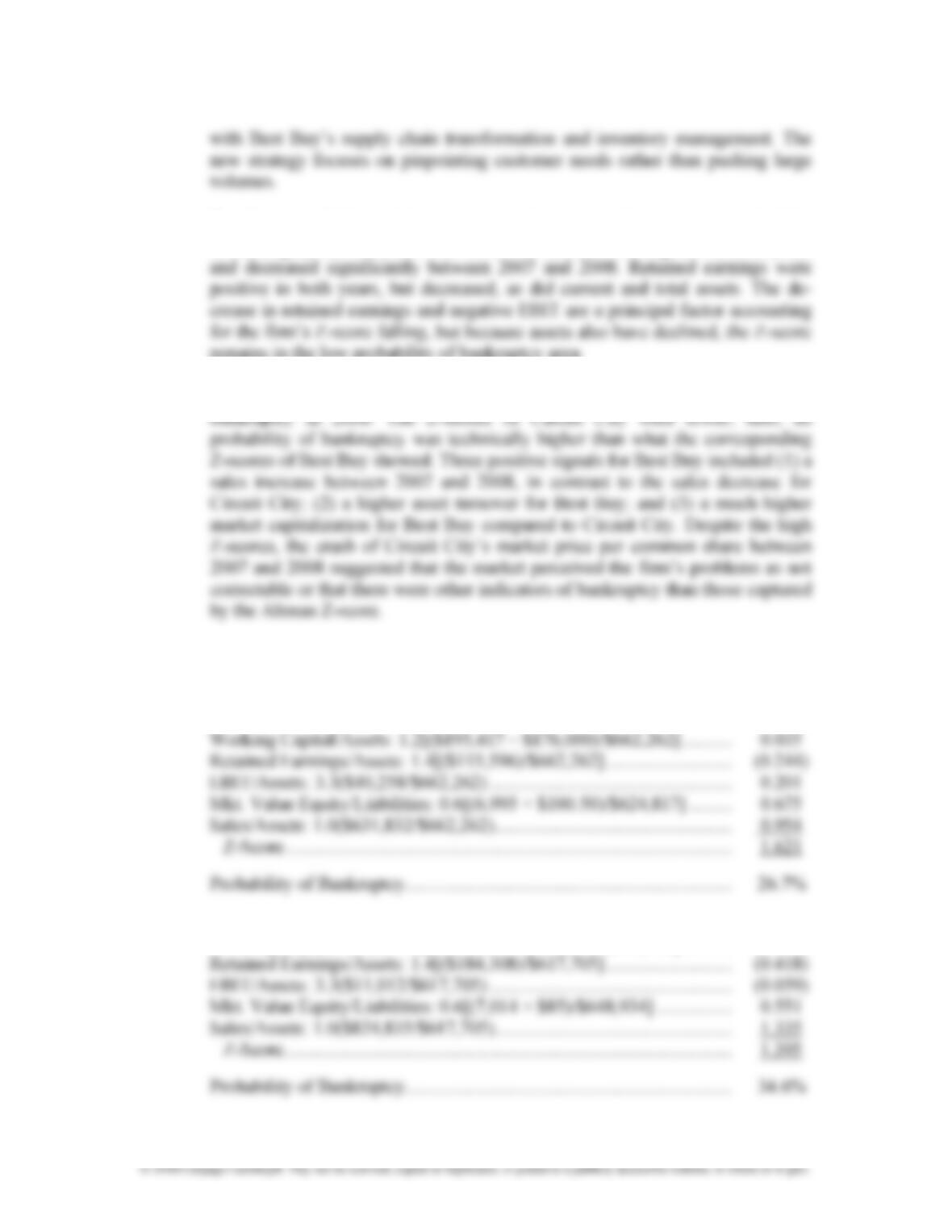
with Best Buy’s supply chain transformation and inventory management. The
new strategy focuses on pinpointing customer needs rather than pushing large
volumes.
c. The Z-scores of Circuit City also were in the range indicating a low probability
of bankruptcy in both years. The firm’s net income was negative in both years
remains in the low probability of bankruptcy area.
d. The Z-scores did not predict that Circuit City or Best Buy would file for
5.20 Applying and Interpreting Bankruptcy Prediction Models.
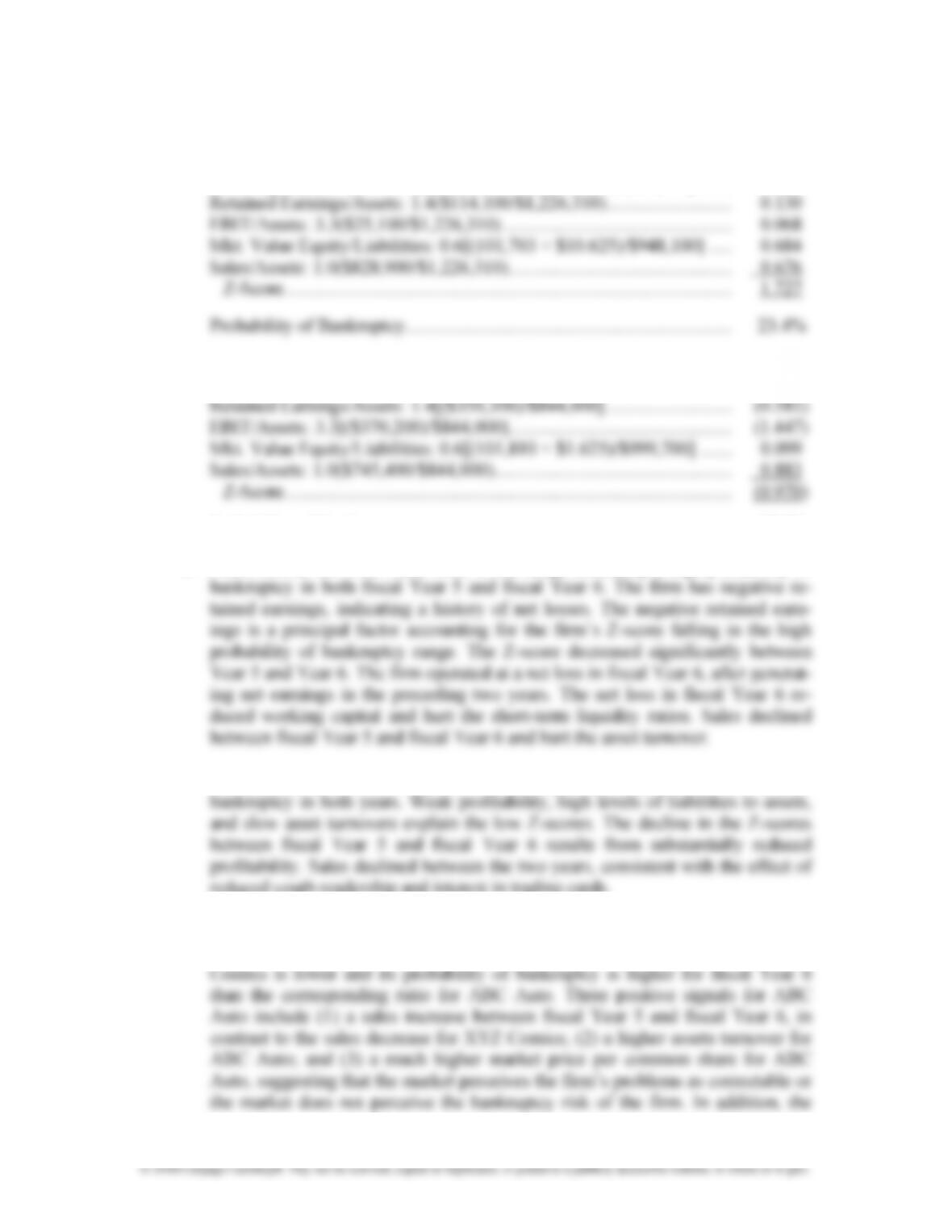
a. Altman’s Z-Score for ABC Auto
Year 5
Year 6
Working Capital/Assets: 1.2[($156,226 – $163,384)/$617,705] ……….. (0.014)
Chapter 5
Risk Analysis
5-17
Altman’s Z-Score for XYZ Comics
Year 5
Working Capital/Assets: 1.2[($490,600 – $318,100)/$1,226,310] …….. 0.169
Year 6
Working Capital/Assets: 1.2[($399,500 – $345,800)/$844,000] ……….. 0.076
Probability of Bankruptcy ……………………………………………………………. 97.6%
b. The Z-scores for ABC Auto were in the range indicating a high probability of
c. The Z-scores of XYZ Comics fall in the range indicating a high probability of
reduced youth readership and interest in trading cards.
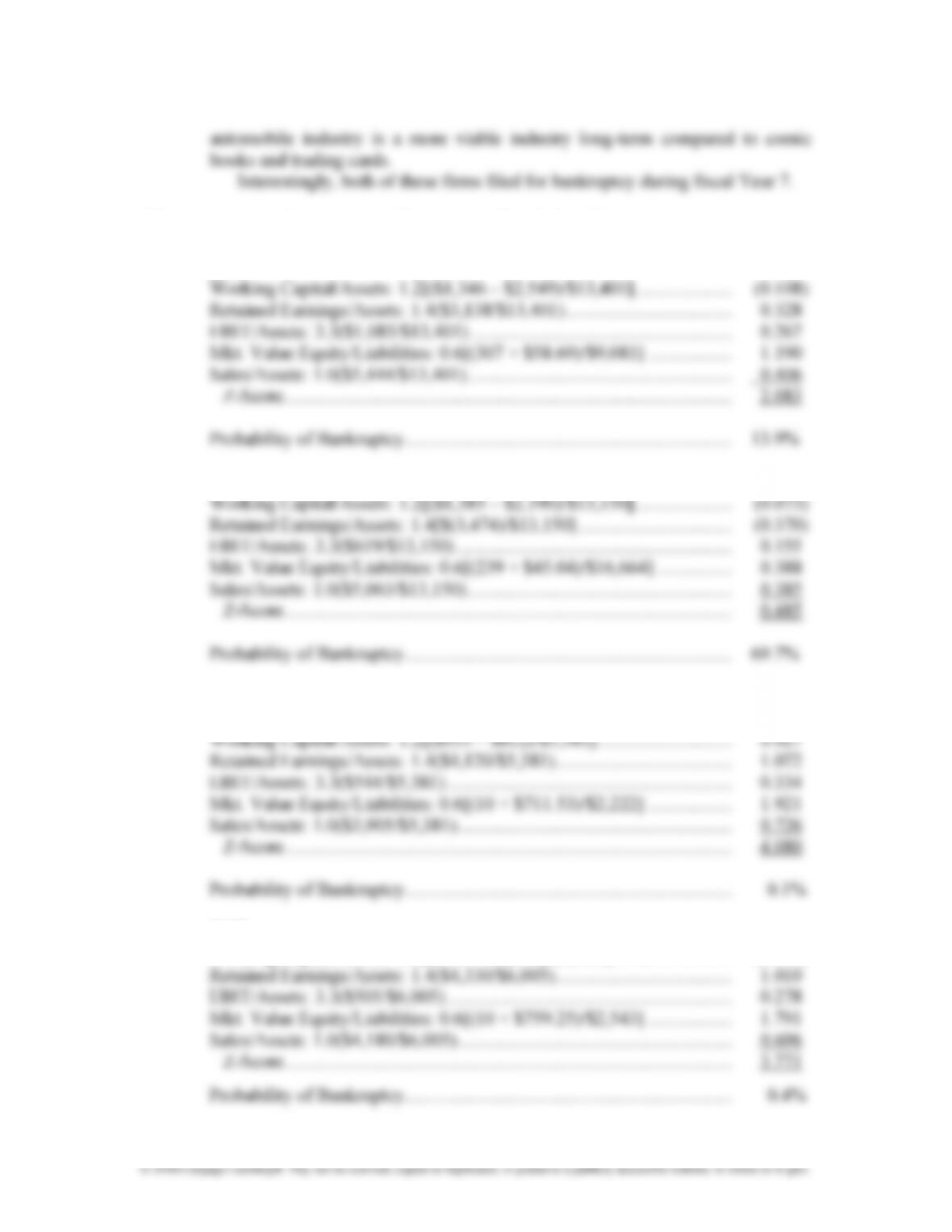
d. Application of the bankruptcy prediction model suggests that XYZ Comics is
more likely to file for bankruptcy during fiscal Year 7. The Z-score of XYZ
Chapter 5
Risk Analysis
5-18
© 2018 Cengage Learning®. May not be scanned, copied or duplicated, or posted to a publicly accessible website, in whole or in part.
automobile industry is a more viable industry long-term compared to comic
books and trading cards.
Interestingly, both of these firms filed for bankruptcy during fiscal Year 7.
5.21 Applying and Interpreting Bankruptcy Prediction Models.
a. Altman’s Z-Score for The Tribune Company
2006
2007
Altman’s Z-Score for The Washington Post Company
2006
2007
Working Capital/Assets: 1.2[($995 – $1,013)/$6,005] …………………….. (0.004)
Chapter 5
Risk Analysis
5-19
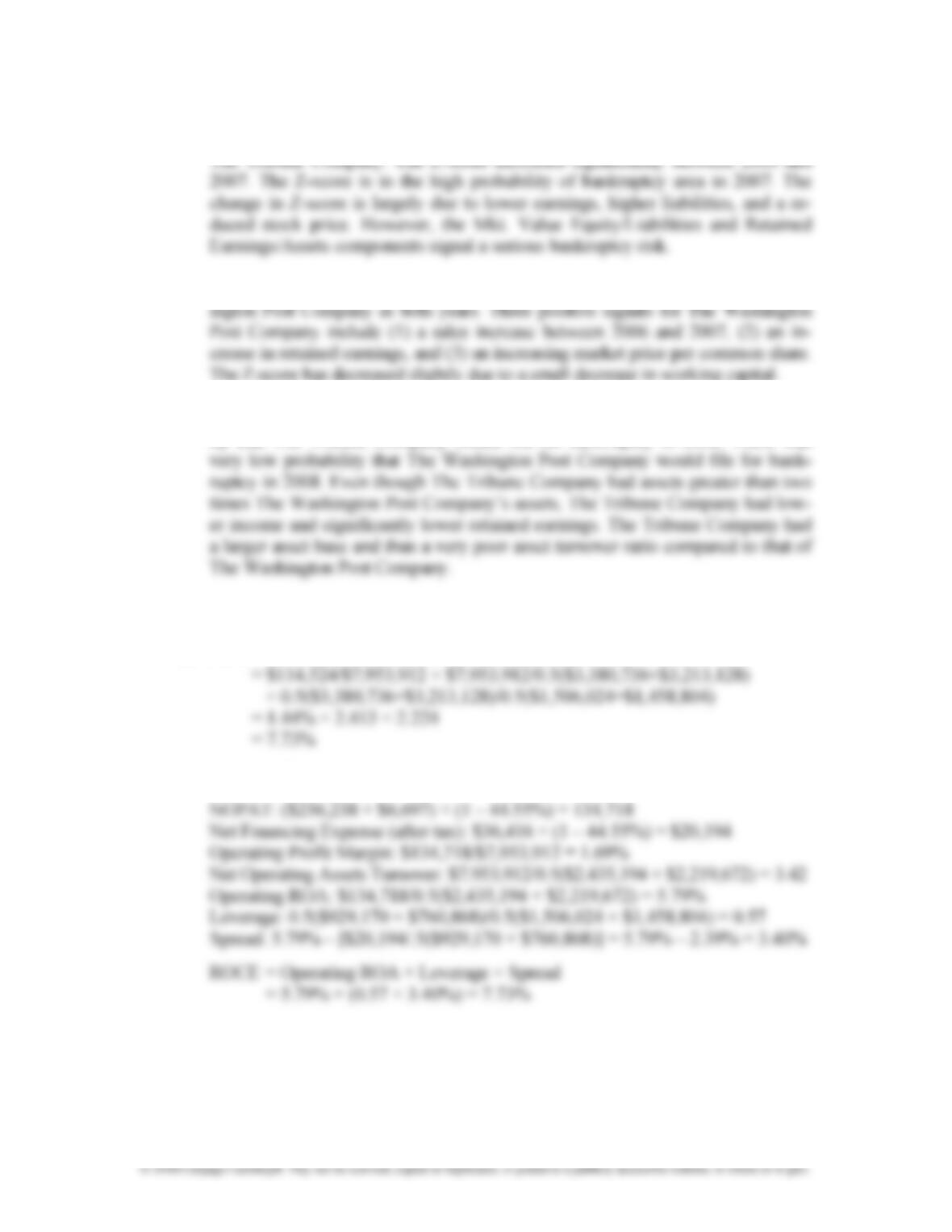
b. Altman’s Z-score model indicates an increasing probability of bankruptcy for
c. Altman’s Z-score model indicates a low probability of bankruptcy for The Wash-
d. Altman’s bankruptcy prediction model suggested that there was a high probabil-
ity that The Tribune Company would file for bankruptcy in 2008. There was
5.22 Reformulating Financial Statements, Preparing an Alternative Decomposition
of ROCE, and Assessing Financial Flexibility.
a. ROE = MARGIN × TURNOVER × LEVERAGE
b. Effective Tax Rate: $91,995/$206,519 = 44.55%
Chapter 5
Risk Analysis
5-20
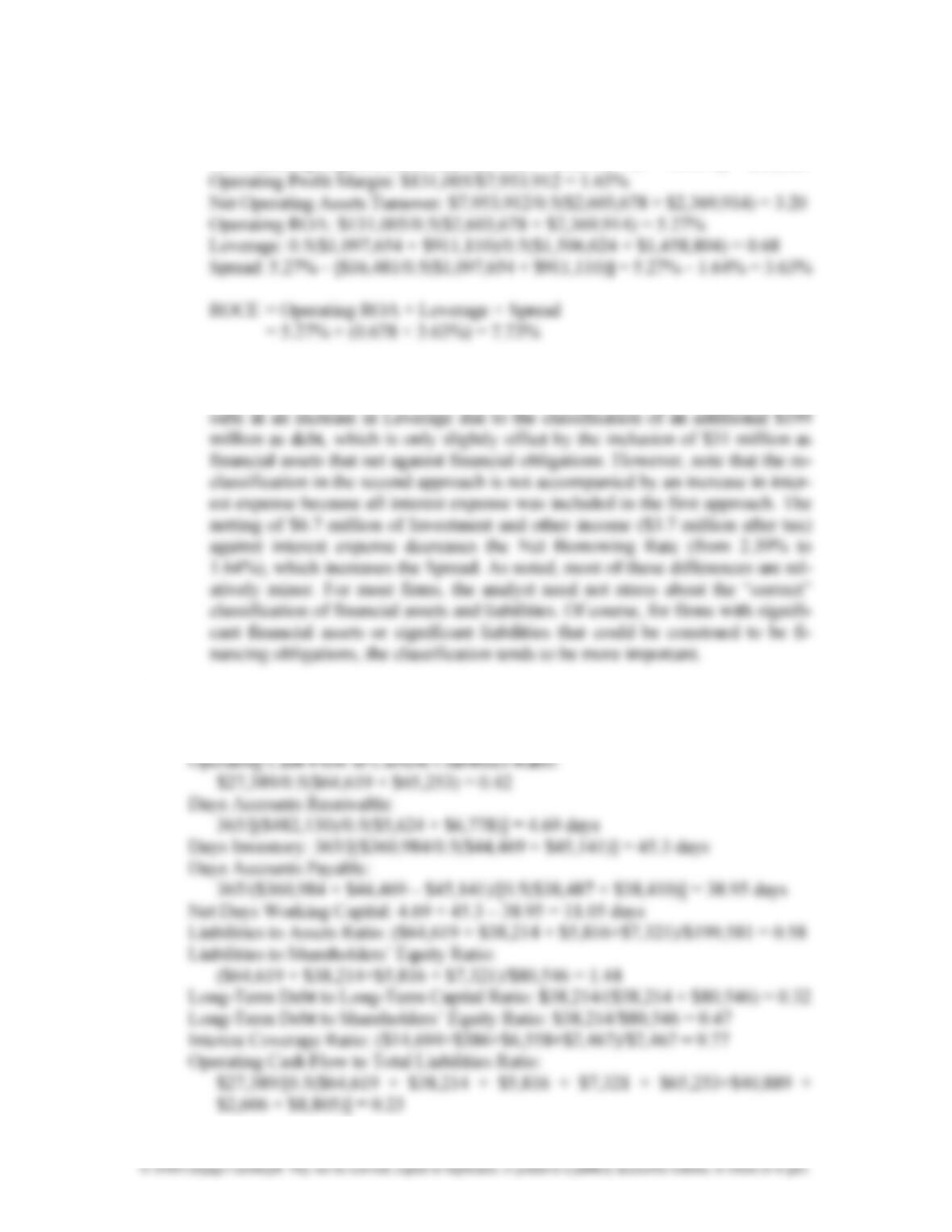
c. NOPAT: $236,238 × (1 – 44.55%) = 131,005
Net Financing Expense (after tax): ($36,416 – $6,697) × (1 – 44.55%) = $16,481
d. The inferences under either treatment are that the company has a relatively low
Operating ROA, modest Leverage, and small Spread. The second approach re-
Integrative Case 5.1: Walmart
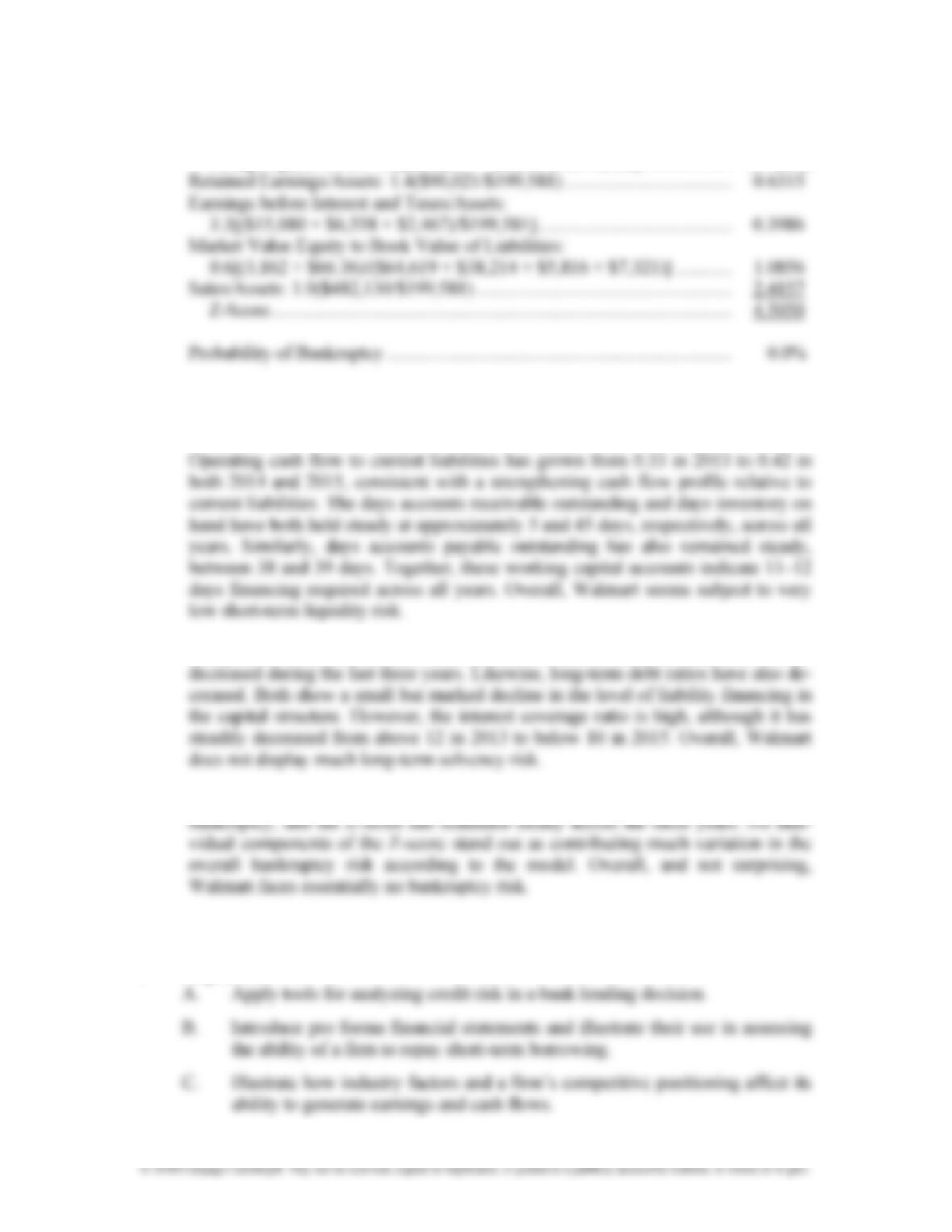
a. Current Ratio: $60,239/$64,619 = 0.93
Quick Ratio: ($8,705 + $5,624)/$64,619 = 0.22
Chapter 5
Risk Analysis
5-21
Altman’s Z-Score
Working Capital/Assets: 1.2[($60,239 – $64,619)/$199,581] ………………. (0.0263)
b. Short-Term Liquidity Risk: Walmart shows limited persistent changes in its
short-term liquidity. Its current ratio grew from 0.88 in 2013 to 0.97 in 2014, then
back to 0.90 in 2015. The quick ratio shows a similar pattern from 0.20 to 0.22.
Long-Term Solvency Risk: Walmart’s total liabilities and liabilities ratios have
Bankruptcy Risk: Altman’s Z-score model shows virtually no probability of
Case 5.2: Massachusetts Stove Company—Bank Lending Decision
I. Objectives
Chapter 5
Risk Analysis
5-22
II. Teaching Strategy
You may teach this case following at least two different approaches. One approach
is to ask students to list the positive and negative factors affecting the desirability of
appreciate their richness as a tool of analysis.
III. Case Discussion
We use the version of the “Cs” of credit analysis presented in the chapter.
A. Circumstances Leading to Need for the Loan: The case indicates that the
firm needs the loan to finance working capital related to a 25% projected
growth in sales, to repay suppliers, and to provide funds for expected nonre-
B. Credit: The firm has an ongoing relationship with its bank, having reduced
C. Cash Flows: The bank prefers that the company generate sufficient cash flows
Chapter 5
Risk Analysis
5-23
© 2018 Cengage Learning®. May not be scanned, copied or duplicated, or posted to a publicly accessible website, in whole or in part.
cash to repay the bank loan without adversely affecting operations and capital
expenditures. Students should question the assumed growth rate in sales of
25% each year. This growth rate exceeds the growth rate in sales for Year 10
and Year 11, although it is in line with the upward trend in sales growth of
those years. The sales growth assumes that other wood-stove companies will
not move aggressively into retail direct marketing and erode the position of
Massachusetts Stove Company. Barriers to entry include obtaining a customer
list and investing in the necessary communication technology. The projected
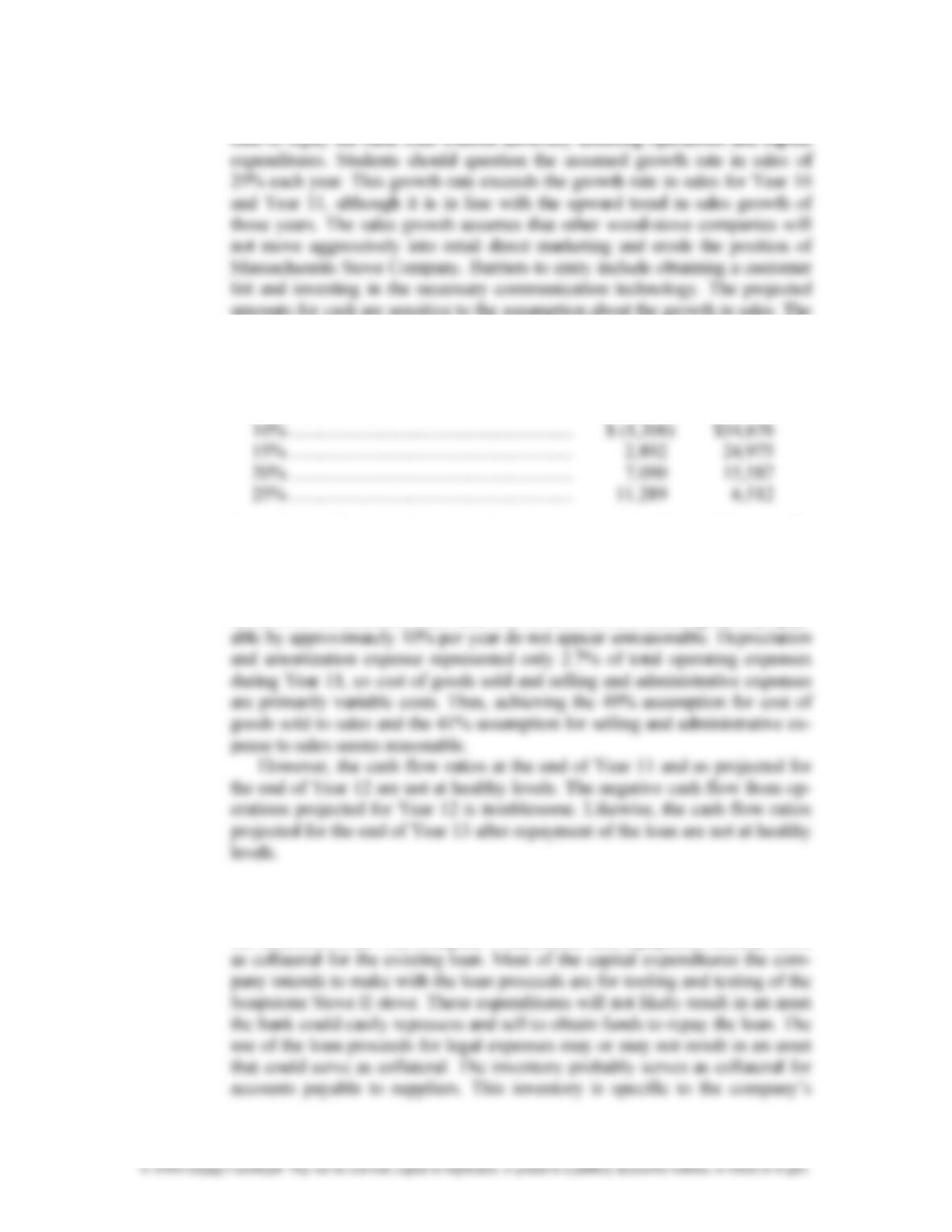
amounts for cash are sensitive to the assumption about the growth in sales. The
amounts of cash on the balance sheet on December 31, Year 12 and Year 13,
for different growth rates in sales are as follows:
December 31, December 31,
Growth Rate in Sales Year 12 Year 13
Regardless of the growth rate in sales, it appears that the firm will have suffi-
cient cash to repay the bank loan.
The company has reduced its days accounts receivable, inventory, and ac-
counts payable during the last three years. Thus, maintaining the current rates
of turnover for accounts receivable and inventories and reducing the days pay-
D. Collateral: If cash flows are not adequate to service the loan, the bank has
the right to sell the collateral. There does not appear to be much collateral for
the increased loan. The company’s machinery and equipment already serve
Chapter 5
Risk Analysis
5-24
stoves and probably is not easily salable. Given that the bank already requires
E. Capacity for Debt: One approach to assessing debt capacity is to examine
the proportion of debt in the capital structure. Because of the accumulated
deficit in retained earnings, liabilities exceed total assets. However, all of the
F. Contingencies: Two contingencies cloud the company’s future. First, a
favorable outcome to the lawsuit is likely but uncertain. Legal expenses
might exceed the $45,000 currently forecasted. If the court finds in favor of
the company, the company might have difficulty finding tenants for the other
40% of the building. If it does, it may incur costs to alter the space to suit the
Chapter 5
Risk Analysis
5-25
G. Character of Management: Character refers to both the integrity of man-
agement and its ability to adapt successfully to changing business conditions.
Are the managers committed to making a go of the firm? Do they possess the
H. Communication: The case does not provide information on how well the
I. Conditions: The case is silent on constraints the bank will place on the
company beyond the interest rate and the repayment date of the loan. The
bank might specify a lid on the amount of expenditures the company can
Case 5.3: Fly-by-Night International Group: Can This Company Be Saved?
I. Objectives
Chapter 5
Risk Analysis
5-26
II. Approach to Teaching the Case
A. Begin by placing the segment data in Note 3 to the financial statements on an
overhead transparency. Ask students to describe the likely rationale for
B. Next, raise the question as to why FBN likely discontinued its Transport and
Training segments. These operations were not very profitable in Year 10.
C. Finally, ask why FBN likely sold its Aircraft Sales and Leasing segment. FBN
derived a substantial portion of its operating profit from this segment in Year
10 and Year 11. One possible explanation is that FBN had only a limited
Chapter 5
Risk Analysis
5-27
III. Responses to Questions
A. Signals of Cash Flow Problems
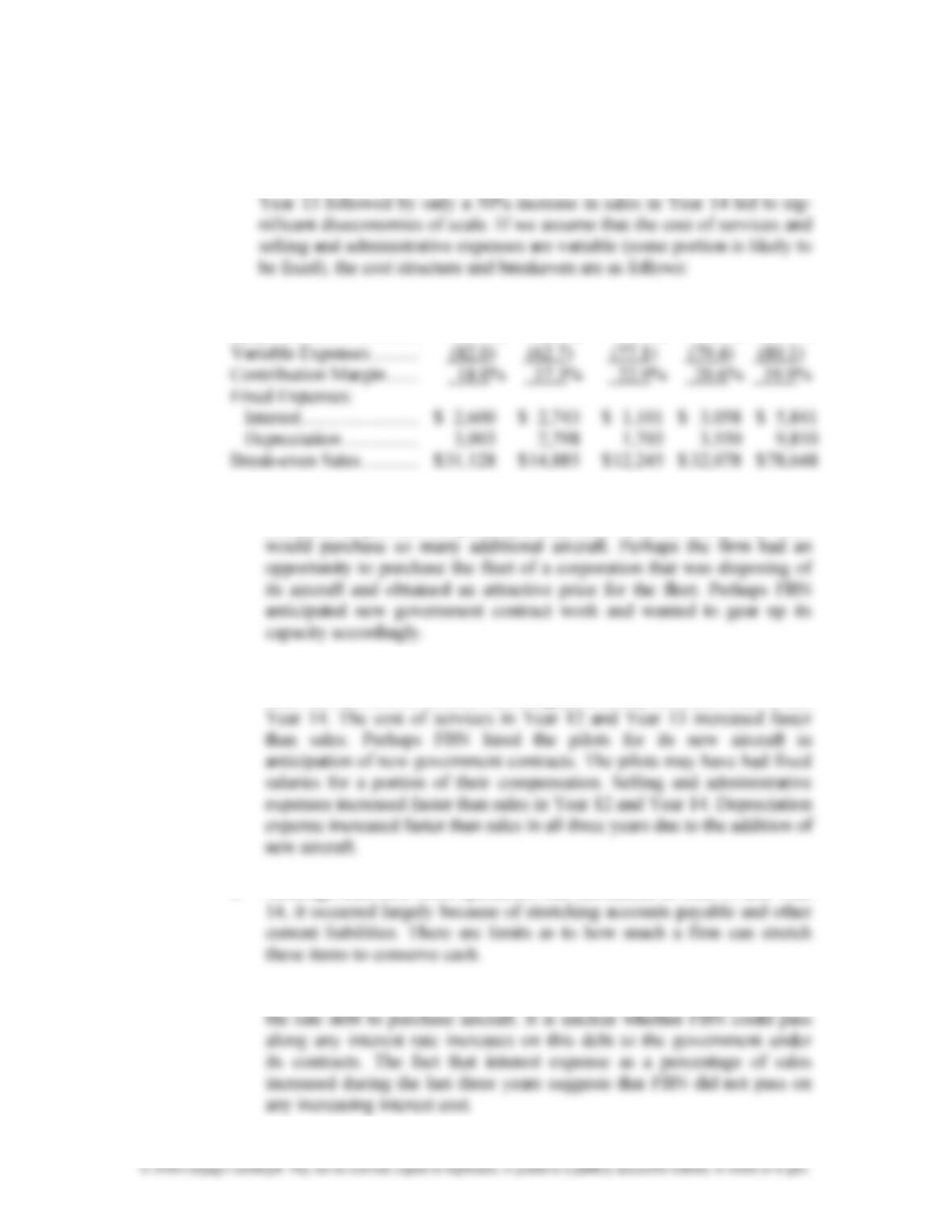
1. Significant increase in fixed assets (220%) and related debt (318%) in
Year 10 Year 11 Year 12 Year 13 Year 14
Sales …………………………. 100.0% 100.0% 100.0% 100.0% 100.0%
The increase in sales in Year 14, although impressive, was not
sufficient to provide for profit and cash flow. It is not clear why FBN
2. Excluding discontinued operations, the ROA, profit margin, assets
turnover, and ROCE indicate declining profitability between Year 12 and
3. Although cash flow from operations was substantial in Year 13 and Year
4. During Year 12 to Year 14, FBN assumed increasing amounts of varia-
Chapter 5
Risk Analysis
5-28
5. The transactions between Mather and FBN suggest a pattern whereby
Mather “shared” economic profits from various transactions between
FBN and himself personally. Several of these transactions occurred in
We begin by acknowledging that Mather should have obtained
approval for the sale from the board of Directors. We ask students to
assume that he had obtained such approval and then ask whether Mather
Chapter 5
Risk Analysis
5-29
B. Can FBN Avoid Bankruptcy in Year 15?
Positive Factors:
1. The board is now aware of its poor cost and accounting controls.
2. The board has fired Mather.
3. The company has government contracts in place extending through Year
16 and Year 17.
Negative Factors:
1. All assets are already collateralized. The company has zero unused debt
capacity.
IV. Epilogue
FBN is actually Flight International Group Inc., a Georgia corporation. The dates in
the case were changed. (Year 14 is actually 1989.) A venture capital group acquired
Chapter 5
Risk Analysis
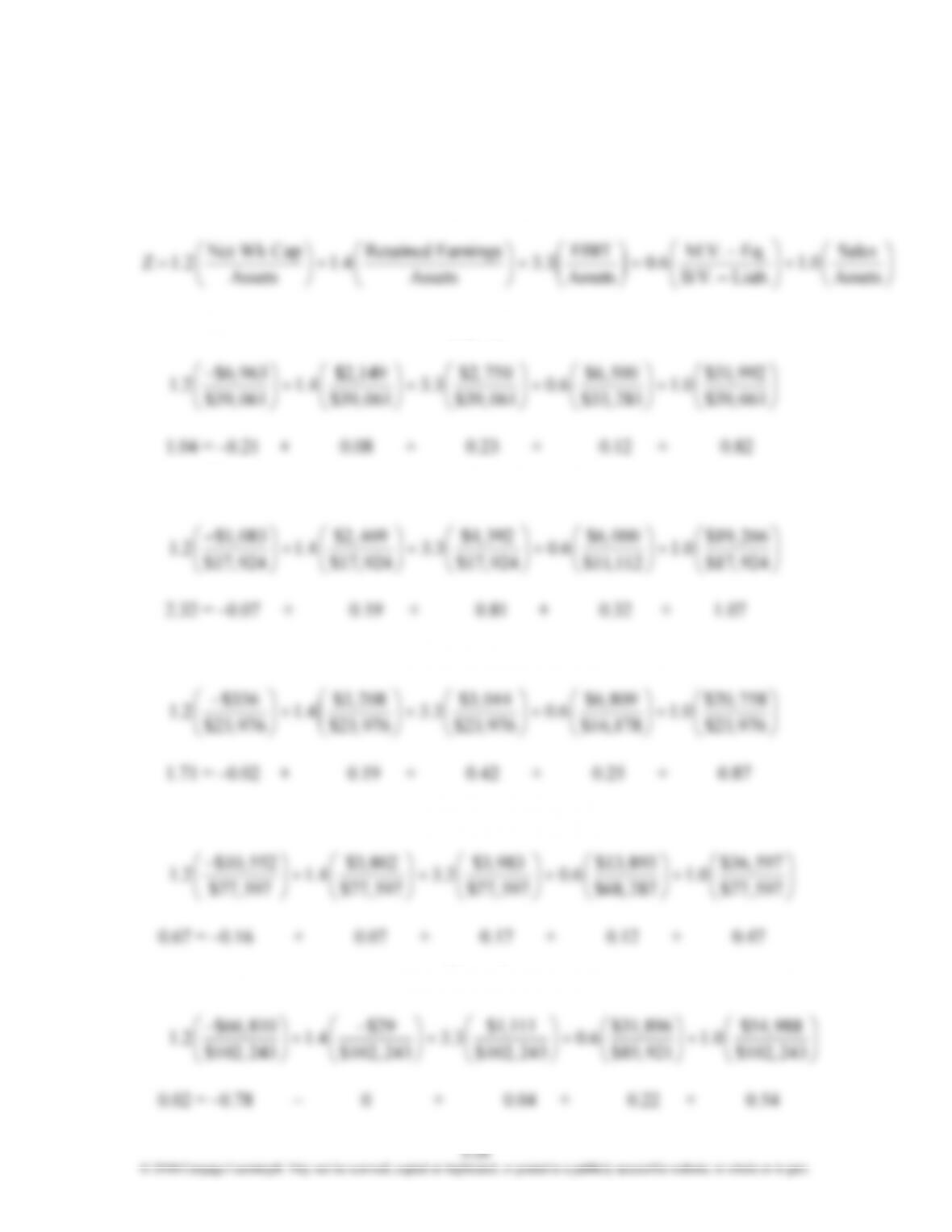
Exhibit 5.A
Z-Score Analysis for FBN
(Case 5.3)
Year 10
Year 11
Year 12
Year 13
Year 14