2-1
CHAPTER 2
ASSET AND LIABILITY VALUATION
AND INCOME RECOGNITION
Solutions to Questions, Exercises, and Problems, and Teaching Notes to Cases
2.1 Relevance versus Representational Faithfulness. Relevance describes accounting
information that is timely and has the capacity to affect a user’s decisions based on
valuations may or may not be subjective; the existence of subjectivity in an asset
2.2 Asset Valuation and Income Recognition. The important part of the question is
that it focuses on net income (as opposed to comprehensive income). Changes in the
valuation of assets generally result in an increase in shareholders’ equity (to
Chapter 2
Asset and Liability Valuation
and Income Recognition
2-2
© 2018 Cengage Learning®. May not be scanned, copied or duplicated, or posted to a publicly accessible website, in whole or in part.
shareholders’ equity). Such changes would be part of Approach 2 as shown in
Exhibit 2.3 and discussed in the text. In these situations, asset valuations do not
have to relate to the recognition of net income (although such asset valuations relate
to comprehensive income).
2.3 Trade-offs among Acceptable Accounting Alternatives. For the balance sheet,
FIFO results in inventory that was purchased most recently before the fiscal year (or
quarter) end remaining on the balance sheet. Relative to inventory purchases made
2.4 Income Flows versus Cash Flows. The analysis below demonstrates that the
income for the five years and the balance in retained earnings at the end of five
2.5 Measurement of Acquisition Cost. Acquisition cost is $240,500 ($250,000
Chapter 2
Asset and Liability Valuation
and Income Recognition
2-3
2.6 Measurement of a Monetary Asset.
Balance, January 1, 2016: $10 million × 9.81815 (Part a) ……………. $ 98,181,500
2.7 Measurement of a Nonmonetary Asset. American Airlines amortizes the $150
million over the five years of use. Accordingly, the acquisition cost of the landing
2.8 Fair Value Measurements.
a. The stocks are Level 1 assets, assuming they are for public companies for which
the prices of each share are available via closing quotes from one of the major
exchanges.
2.9 Computation of Income Tax Expense.
a. Taxes Currently Payable ……………………………………………………….. $ 50,000
Chapter 2
Asset and Liability Valuation
and Income Recognition
2-4
b. Taxes Currently Payable ……………………………………………………….. $ 50,000
2.10 Computation of Income Tax Expense.
a. Taxes Currently Payable ……………………………………………………….. $ 35,000
Less Increase in Deferred Tax Assets:
Beginning of Year: $24,600 – $6,400 = $ 18,200
2.11 Costs to Be Included in Historical Cost Valuation.
2.12 Effect of Valuation Method for Nonmonetary Asset on Balance Sheet and
Income Statement.
Chapter 2
Asset and Liability Valuation
and Income Recognition
2-5
2016
Assets = Liabilities +
Shareholders’ Equity
Contributed
Accumulated Other
Retained Earnings
2018
Assets = Liabilities +
Shareholders’ Equity
Contributed
Capital (CC)
Accumulated Other
Comprehensive
Income (AOCI)
Retained Earnings (RE)
2016
2017
2018
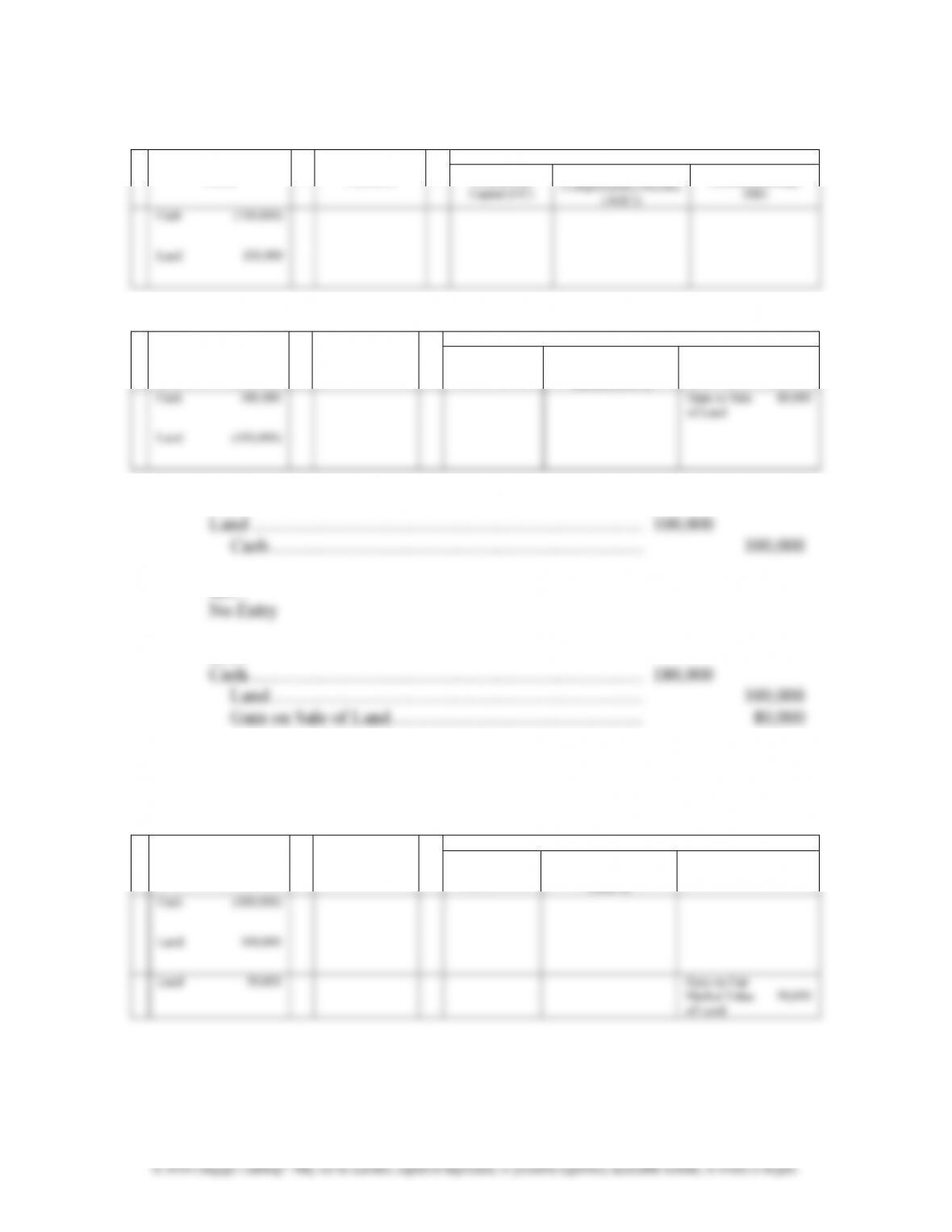
b. Valuation of the land at current market value and including market value
changes each year in net income:
2016
Assets = Liabilities +
Shareholders’ Equity
Contributed
Capital (CC)
Accumulated Other
Comprehensive Income
(AOCI)
Retained Earnings (RE)
Chapter 2
Asset and Liability Valuation
and Income Recognition
2-6
2017
Assets = Liabilities +
Shareholders’ Equity
Contributed
Capital (CC)
Accumulated Other
Comprehensive
Income (AOCI)
Retained Earnings (RE)
2018
Assets = Liabilities +
Shareholders’ Equity
Contributed
Capital (CC)
Accumulated Other
Comprehensive
Income (AOCI)
Retained Earnings (RE)
2016
The land would initially be recognized at acquisition cost of $100,000. At the
end of 2016, Walmart would remeasure the land at fair value and increase the
asset by $50,000, which would be reflected on the income statement as “Gain
on Fair Market Value of Land.”
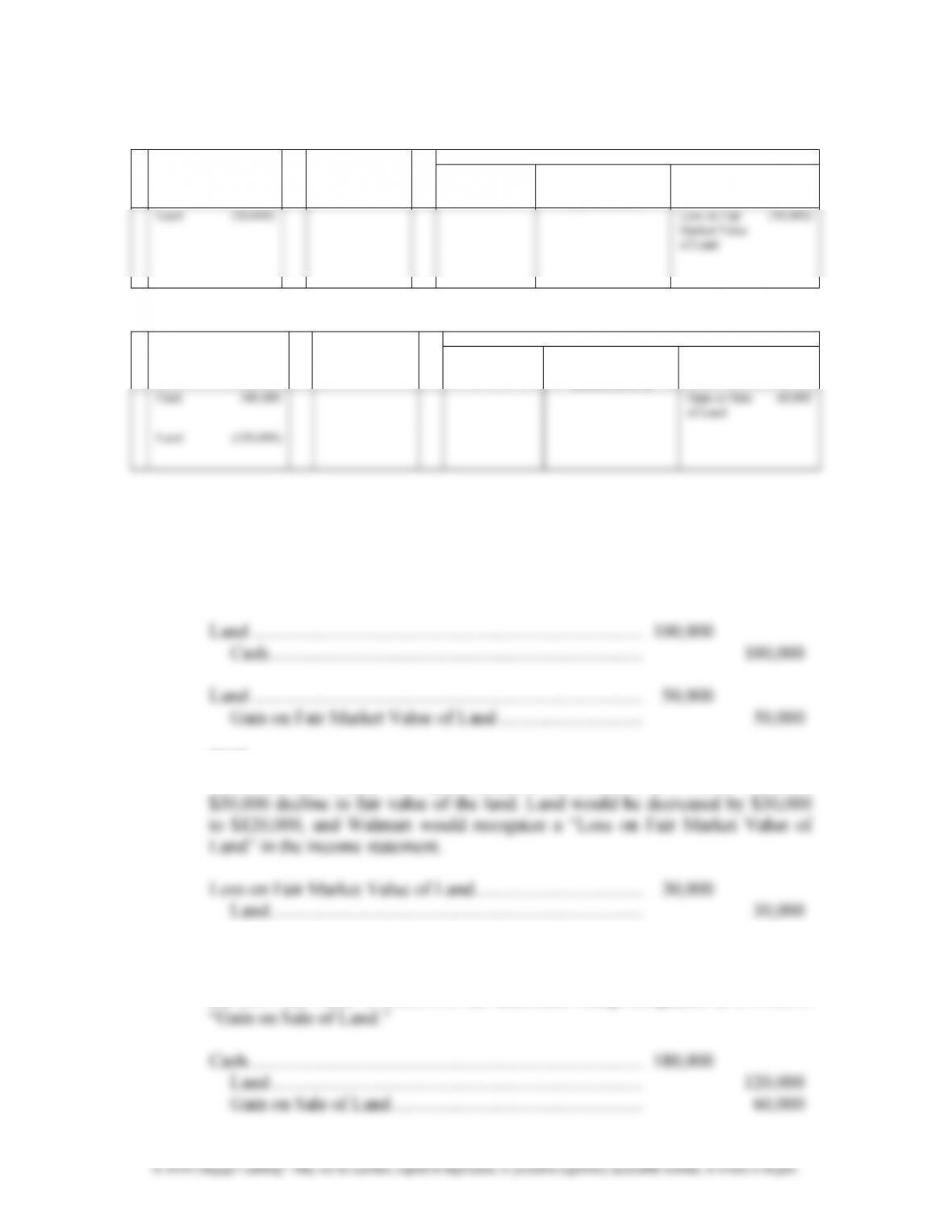
2017
Part of the end-of-year 2016 upward adjustment would be reversed to reflect the
2018
The firm would realize $180,000 of cash, derecognize the land—now valued at
the 2017 fair value of $120,000, the difference being recognized as a $60,000
Chapter 2
Asset and Liability Valuation
and Income Recognition
2-7
c. Valuation of the land at current market value but including unrealized gains and
losses in accumulated other comprehensive income until sale of land:
2016
Assets = Liabilities +
Shareholders’ Equity
Contributed
Capital (CC)
Accumulated Other
Comprehensive Income
(AOCI)
Retained Earnings (RE)
OCI 50,000
2017
Assets = Liabilities +
Shareholders’ Equity
Contributed
Capital (CC)
Accumulated Other
Comprehensive Income
(AOCI)
Retained Earnings (RE)
2018
Assets = Liabilities +
Shareholders’ Equity
Contributed
Capital (CC)
Accumulated Other
Comprehensive Income
(AOCI)
Retained Earnings (RE)
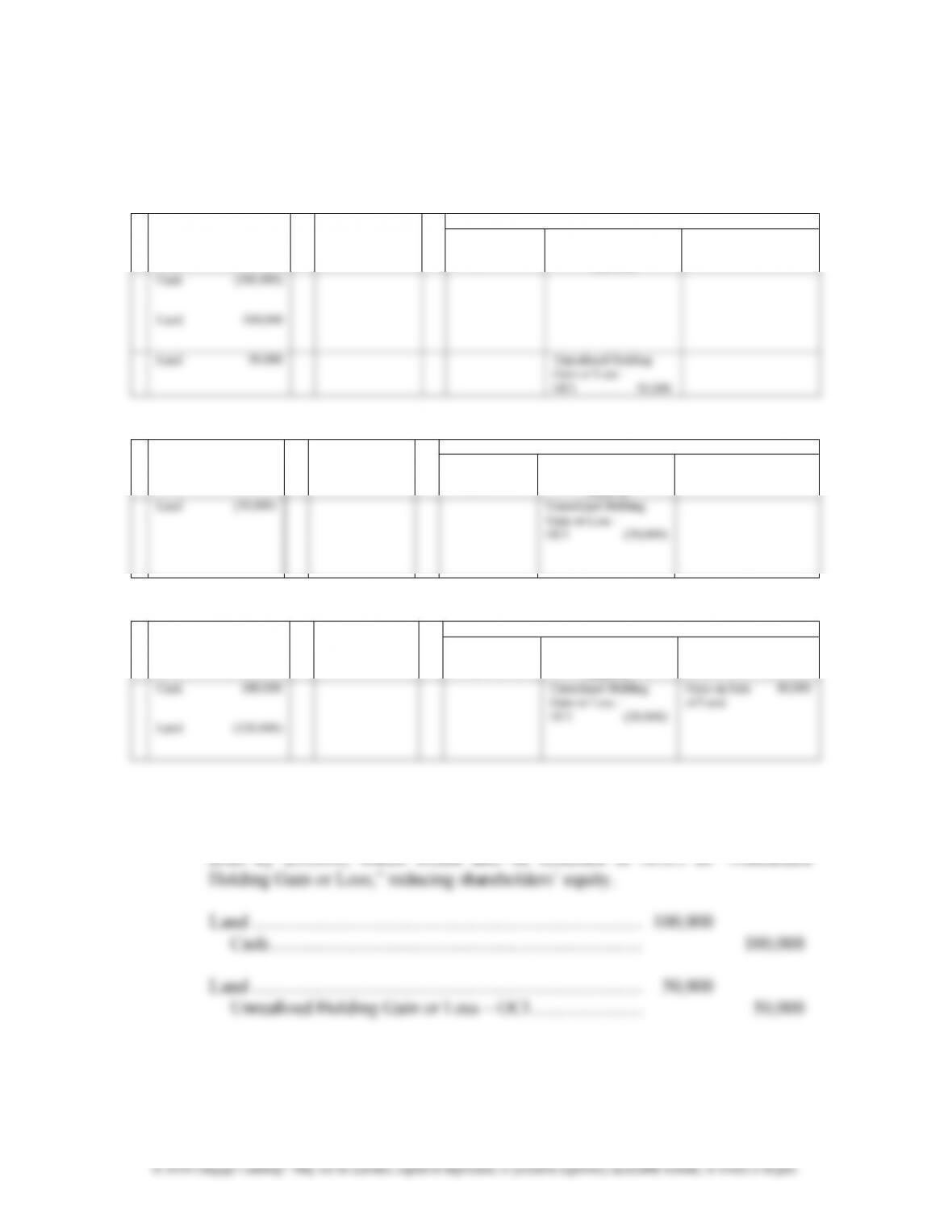
2016
The land would initially be recognized at acquisition cost of $100,000. At the
end of 2016, Walmart would remeasure the land at fair value and increase the
Chapter 2
Asset and Liability Valuation
and Income Recognition
2-8
2017
Part of the end-of-year 2016 upward adjustment would be reversed to reflect the
$30,000 decline in fair value of the land. Land would be decreased by $30,000
to $120,000, and the “Unrealized Holding Gain or Loss” sitting in AOCI in the
equity section would also be reduced by $30,000, from $50,000 to $20,000.
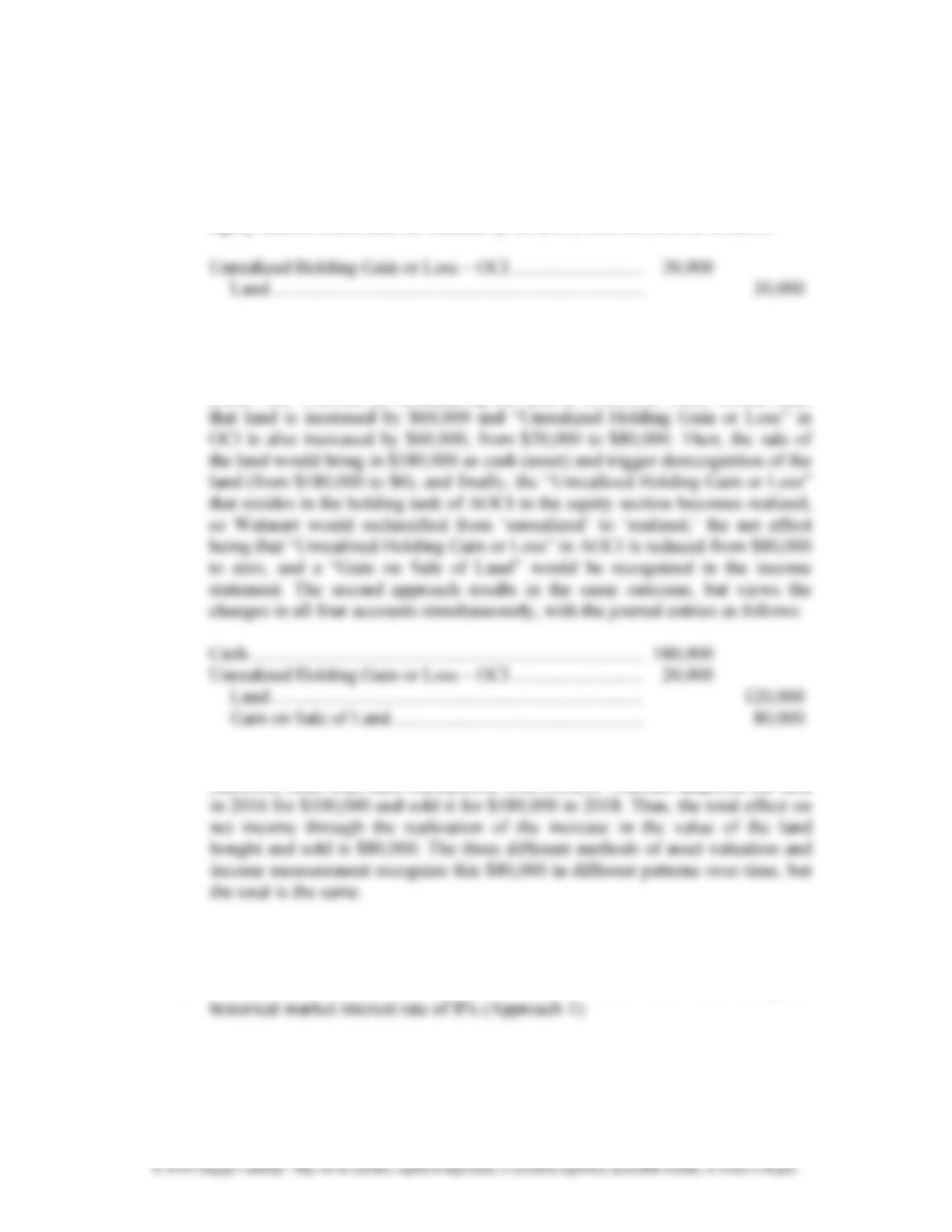
2018
The fair value of the land at the end of 2018 is $180,000 (as evidenced by the
price received upon sale). We can consider this effect in two ways. First, we
could view Walmart as remeasuring the land to $180,000, which would mean
d. Net income over sufficiently long time periods equals cash inflows minus cash
outflows, other than cash transactions with owners. Walmart acquired the land
2.13 Effect of Valuation Method for Monetary Asset on Balance Sheet and Income
Statement.
a. Valuation of the note at the present value of future cash flows using the
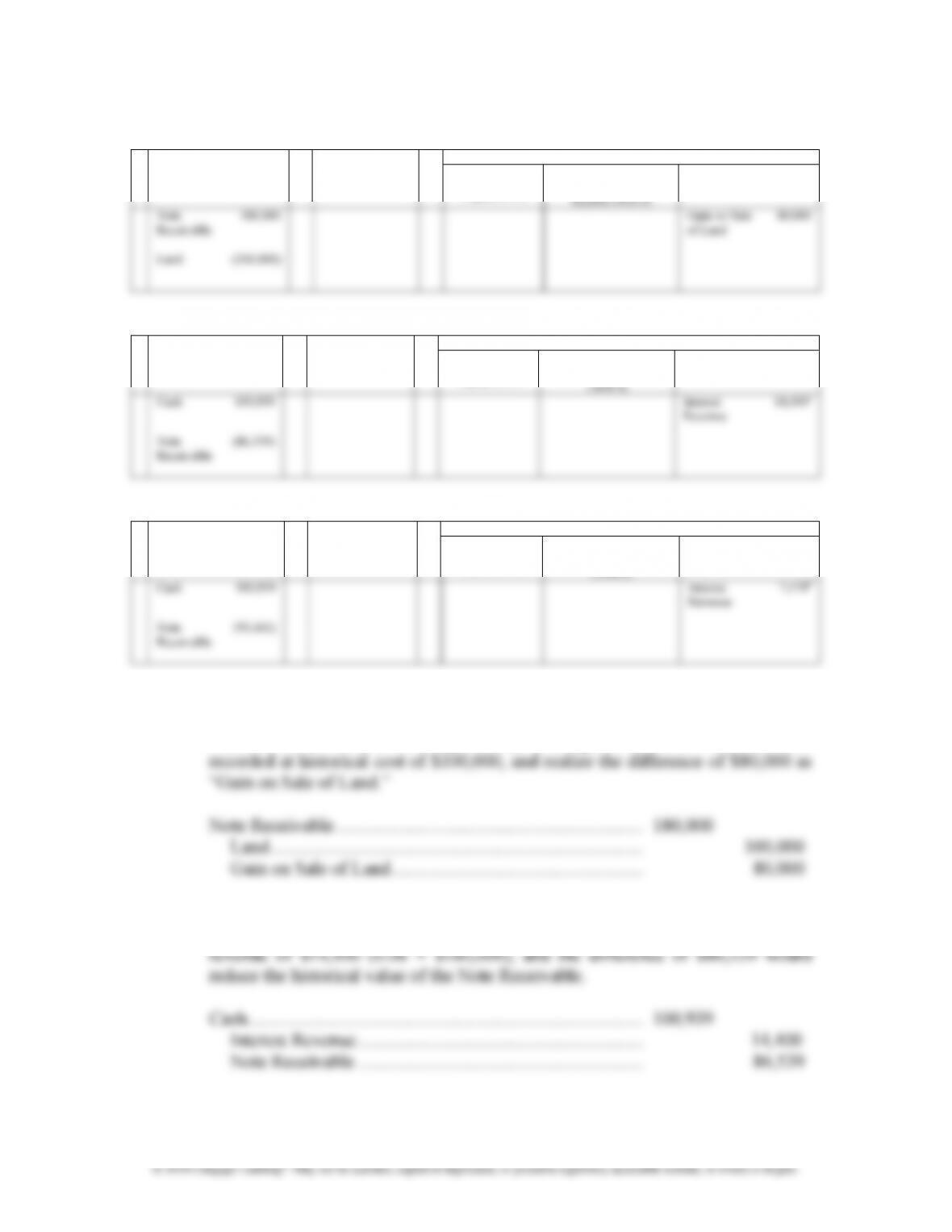
Chapter 2
Asset and Liability Valuation
and Income Recognition
2-9
2018
Assets = Liabilities +
Shareholders’ Equity
Contributed
Capital (CC)
Accumulated Other
Comprehensive
Retained Earnings (RE)
2019
Assets = Liabilities +
Shareholders’ Equity
Contributed
Capital (CC)
Accumulated Other
Comprehensive Income
Retained Earnings (RE)
2020
Assets = Liabilities +
Shareholders’ Equity
Contributed
Capital (CC)
Accumulated Other
Comprehensive Income
(AOCI)
Retained Earnings (RE)
b
Receivable
2018
Walmart would recognize an asset for the Note Receivable at its then present
value of $180,000 (the cash equivalent), derecognize the land which remains
2019
Walmart would receive the cash payment of $100,939, recognize interest
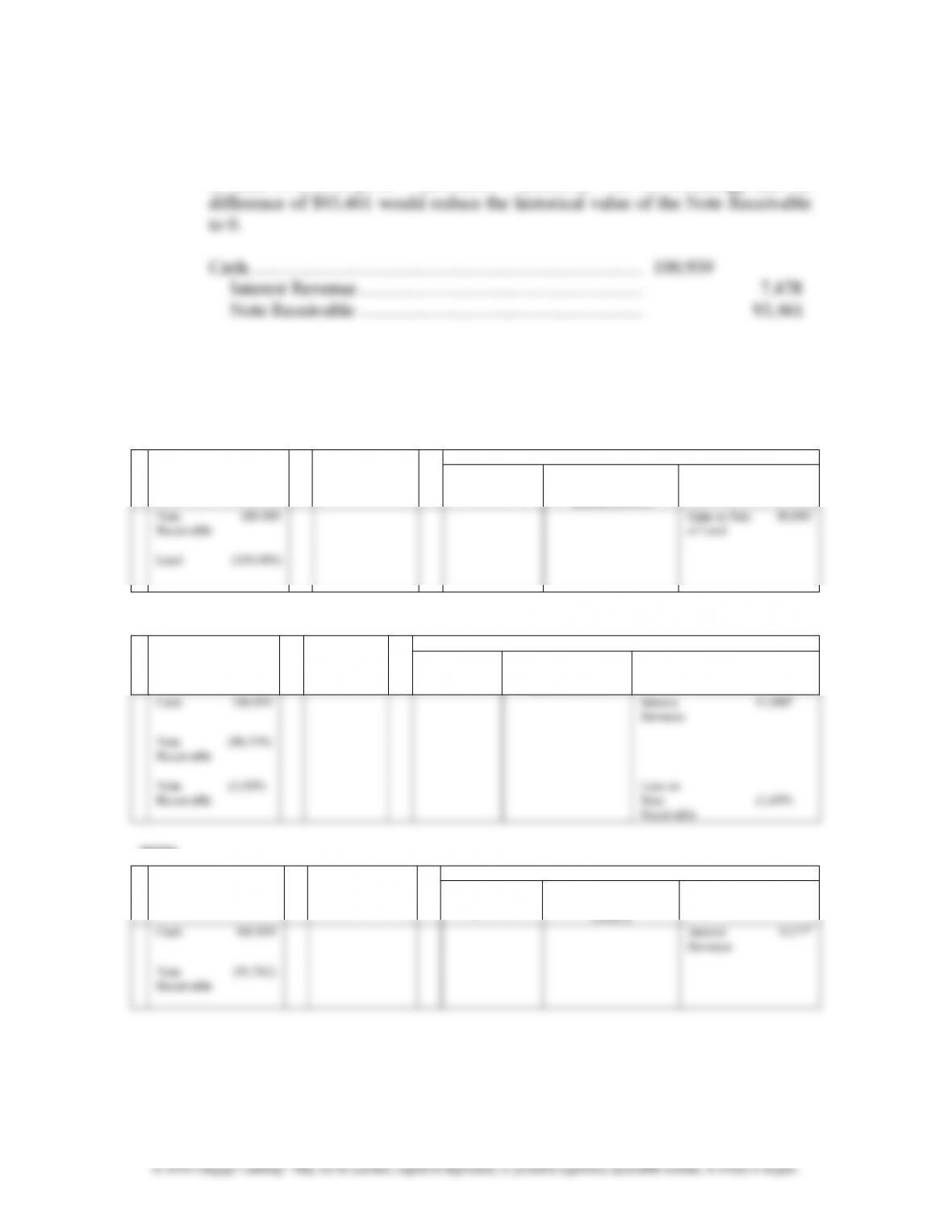
Chapter 2
Asset and Liability Valuation
and Income Recognition
2-10
2020
Walmart would receive the second cash payment of $100,939, recognize interest
revenue of $7,478 [0.08 × ($180,000 – $86,539), + $1 for rounding], and the
b. Valuation of the note at the present value of future cash flows, adjusting the
note to fair value upon changes in market interest rates and including unrealized
gains and losses in net income (Approach 2):
2018
Assets = Liabilities +
Shareholders’ Equity
Contributed
Capital (CC)
Accumulated Other
Comprehensive
Income (AOCI)
Retained Earnings (RE)
2019
Assets = Liabilities +
Shareholders’ Equity
Contributed
Capital (CC)
Accumulated Other
Comprehensive
Income (AOCI)
Retained Earnings (RE)
2020
Assets = Liabilities +
Shareholders’ Equity
Contributed
Capital (CC)
Accumulated Other
Comprehensive Income
Retained Earnings (RE)
Chapter 2
Asset and Liability Valuation
and Income Recognition
2-11
2018
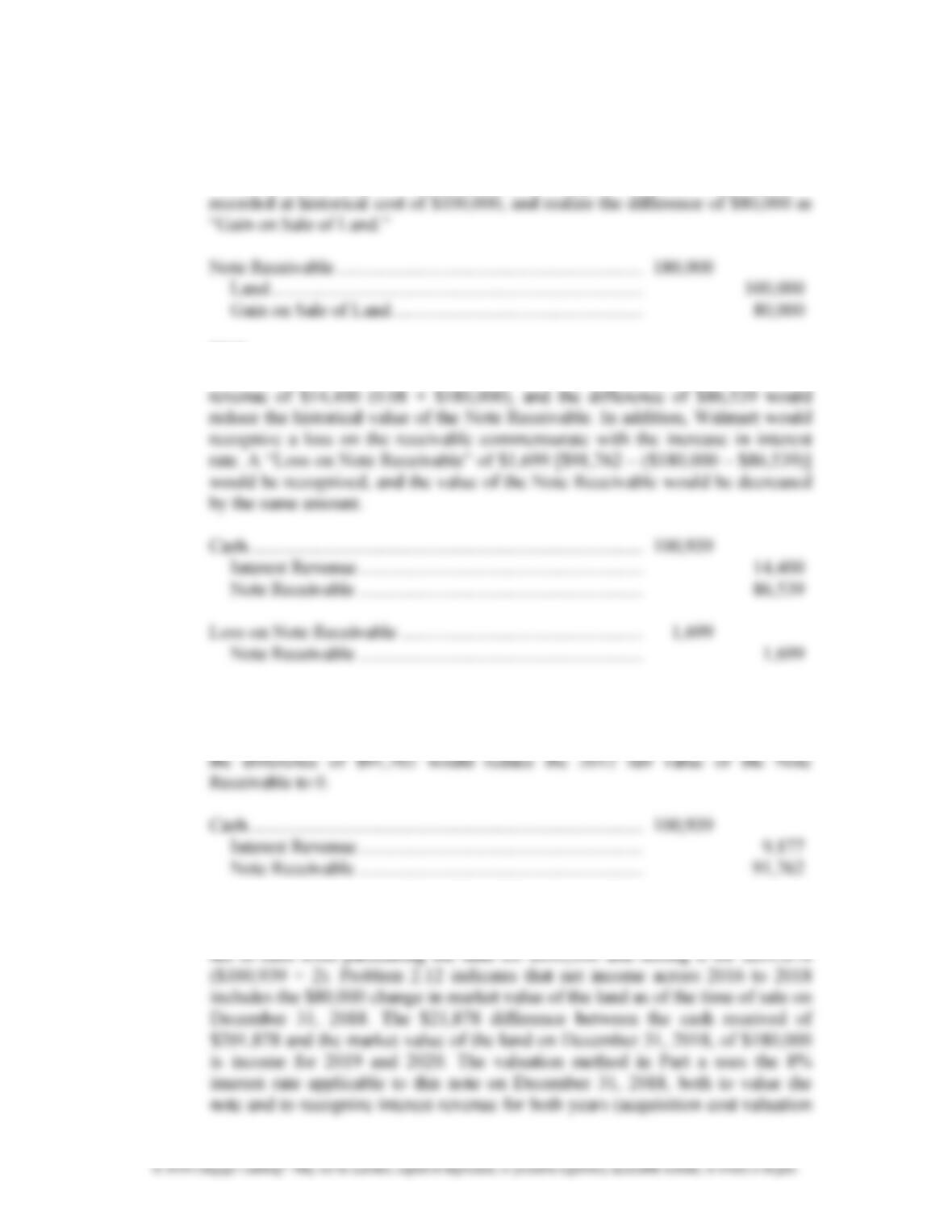
Walmart would recognize an asset for the Note Receivable at its then present
value of $180,000 (the cash equivalent), derecognize the land which remains
2019
Walmart would receive the cash payment of $100,939, recognize interest
2020
Walmart would receive the second cash payment of $100,939, recognize interest
revenue of $9,177 (0.10 × $91,762, plus an additional $1 due to rounding), and
c. Over sufficiently long time periods, net income equals cash inflows minus cash
outflows, other than cash transactions with owners. Walmart receives $101,878
Chapter 2
Asset and Liability Valuation
and Income Recognition
2-12
© 2018 Cengage Learning®. May not be scanned, copied or duplicated, or posted to a publicly accessible website, in whole or in part.
of the asset, Approach 1 for income recognition). The valuation method in Part b
uses the market interest rate for this note each year (8% for 2019 and 10% for
2020) to value the note and to recognize interest revenue and holding gains and
losses (fair value for the asset, Approach 2 for income recognition). These two
methods report the same total income but in a different pattern over time.
2.14 Effect of Valuation Method for Nonmonetary Asset on Balance Sheet and
Income Statement.
a. Assume for this part that SCCO accounts for the equipment using historical cost
adjusted for depreciation and impairment losses.
(1)
Assets = Liabilities +
Shareholders’ Equity
Contributed
Capital (CC)
Accumulated Other
Comprehensive Income
(AOCI)
Retained Earnings
(RE)
(2)
Assets = Liabilities +
Shareholders’ Equity
Contributed
Capital (CC)
Accumulated Other
Comprehensive
Retained Earnings (RE)
(3)
Assets = Liabilities +
Shareholders’ Equity
Contributed
Capital (CC)
Accumulated Other
Comprehensive
Retained Earnings (RE)
(4)
Assets = Liabilities +
Shareholders’ Equity
Contributed
Capital (CC)
Accumulated Other
Comprehensive
Income (AOCI)
Retained Earnings (RE)
Chapter 2
Asset and Liability Valuation
and Income Recognition
2-13
(5)
Assets = Liabilities +
Shareholders’ Equity
Contributed
Capital (CC)
Accumulated Other
Comprehensive
Income (AOCI)
Retained Earnings (RE)
(6)
Assets = Liabilities +
Shareholders’ Equity
Contributed
Capital (CC)
Accumulated Other
Comprehensive
Income (AOCI)
Retained Earnings (RE)
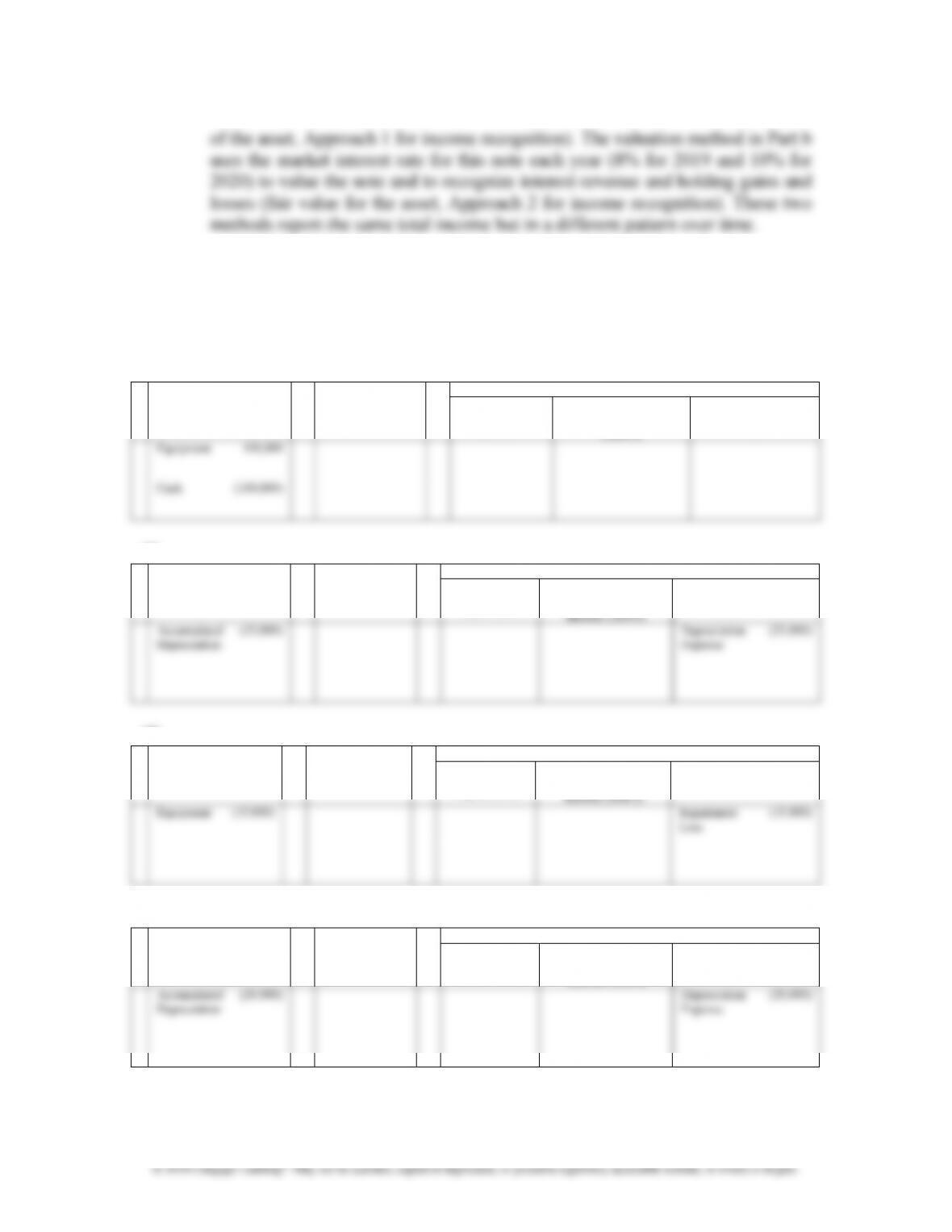
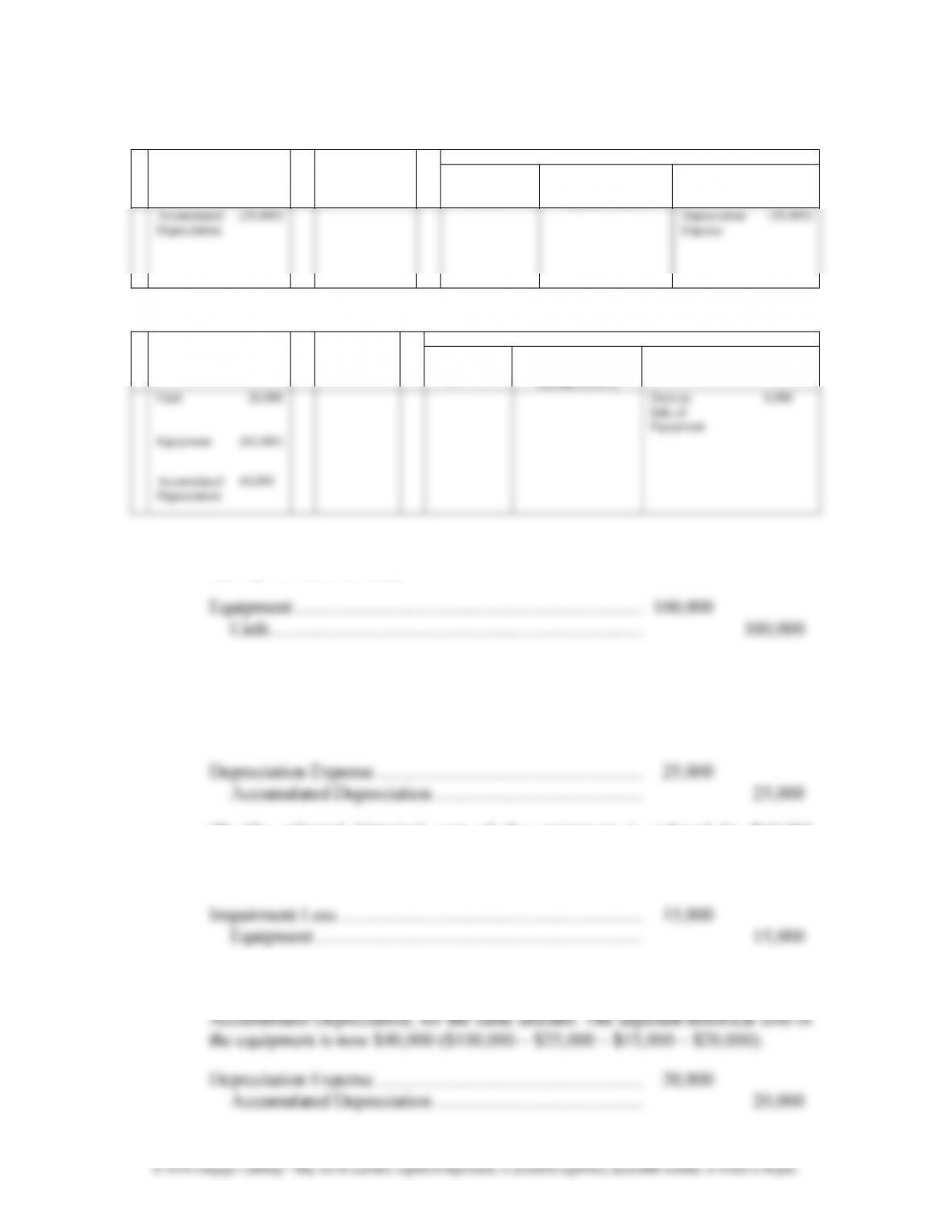
(1) SCCO records the equipment at historical cost of $100,000 (and reduces
cash by the same amount).
(2) SCCO records depreciation expense of $25,000 [($100,000 – $0)/4] and
adjusts the historical cost of the equipment by recognizing a contra-asset,
Accumulated Depreciation, for the same amount. The adjusted historical cost of
the equipment is now $75,000 ($100,000 – $25,000).
(3) The adjusted historical cost of the equipment is reduced by $15,000
($60,000 – $75,000), and an “Impairment Loss” of the same amount is
recognized on the income statement.
(4) SCCO records depreciation expense of $20,000 [($60,000 – $0)/3] and
adjusts the historical cost of the equipment by recognizing a contra-asset,
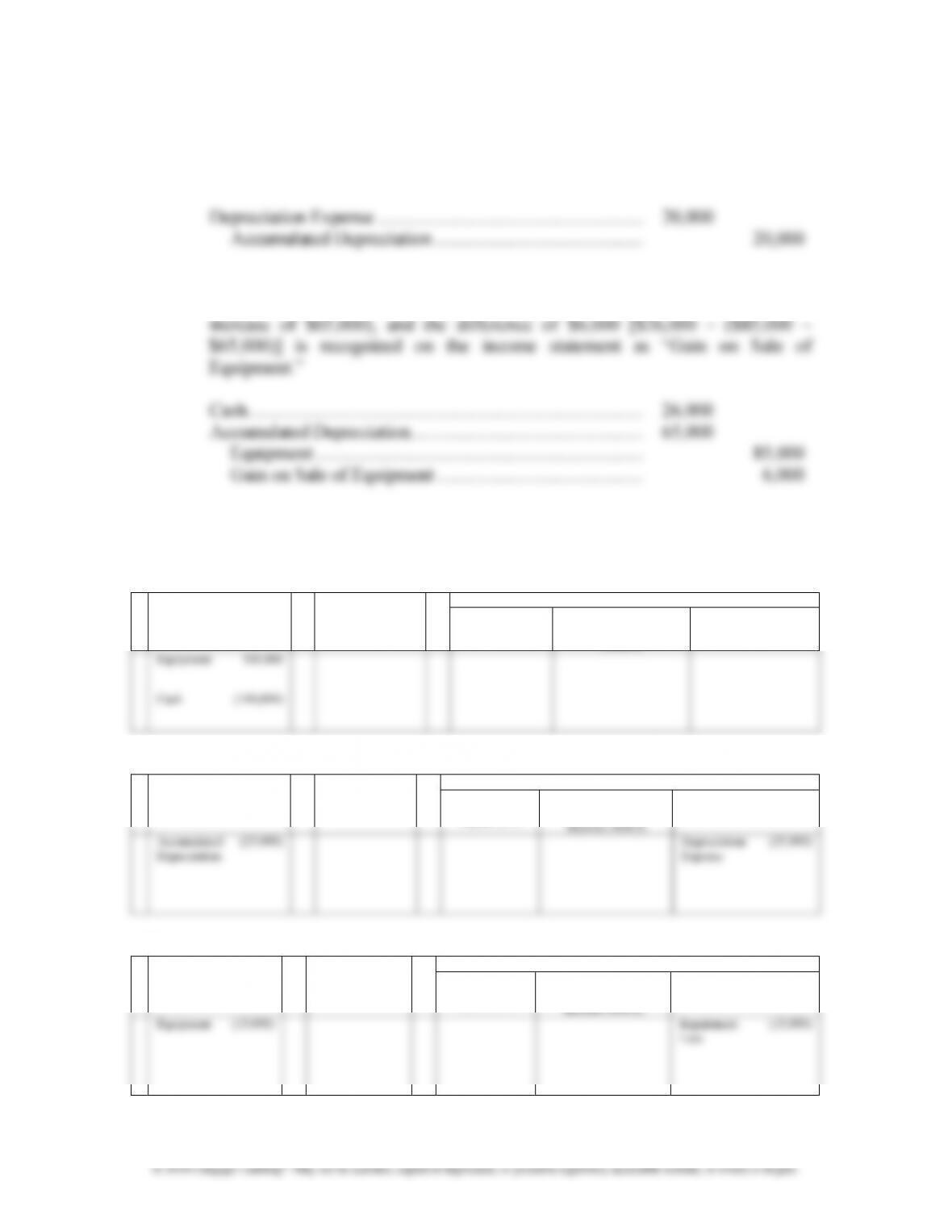
Chapter 2
Asset and Liability Valuation
and Income Recognition
2-14
(5) Same as (4). The adjusted historical cost of the equipment is now $20,000
(in these formulas $100,000 – $25,000 – $15,000 – $20,000 – $20,000).
(6) SCCO receives cash of $26,000 (asset increase), derecognizes both the
equipment (asset decrease of $85,000) and accumulated depreciation (asset
b. Assume that SCCO accounts for the equipment using current market values
adjusted for depreciation and impairment losses.
(1)
Assets = Liabilities +
Shareholders’ Equity
Contributed
Capital (CC)
Accumulated Other
Comprehensive Income
(AOCI)
Retained Earnings
(RE)
(2)
Assets = Liabilities +
Shareholders’ Equity
Contributed
Capital (CC)
Accumulated Other
Comprehensive
Retained Earnings (RE)
(3)
Assets = Liabilities +
Shareholders’ Equity
Contributed
Capital (CC)
Accumulated Other
Comprehensive
Income (AOCI)
Retained Earnings (RE)
Chapter 2
Asset and Liability Valuation
and Income Recognition
2-15
(4)
Assets = Liabilities +
Shareholders’ Equity
Contributed
Capital (CC)
Accumulated Other
Comprehensive
Income (AOCI)
Retained Earnings (RE)
(5)
Assets = Liabilities +
Shareholders’ Equity
Contributed
Capital (CC)
Accumulated Other
Comprehensive Income
(AOCI)
Retained Earnings (RE)
(6)
Assets = Liabilities +
Shareholders’ Equity
Contributed
Capital (CC)
Accumulated Other
Comprehensive
Income (AOCI)
Retained Earnings (RE)
(7)
Assets = Liabilities +
Shareholders’ Equity
Contributed
Capital (CC)
Accumulated Other
Comprehensive Income
(AOCI)
Retained Earnings (RE)
(8)
Assets = Liabilities +
Shareholders’ Equity
Contributed
Capital (CC)
Accumulated Other
Comprehensive
Income (AOCI)
Retained Earnings (RE)
Chapter 2
Asset and Liability Valuation
and Income Recognition
2-16
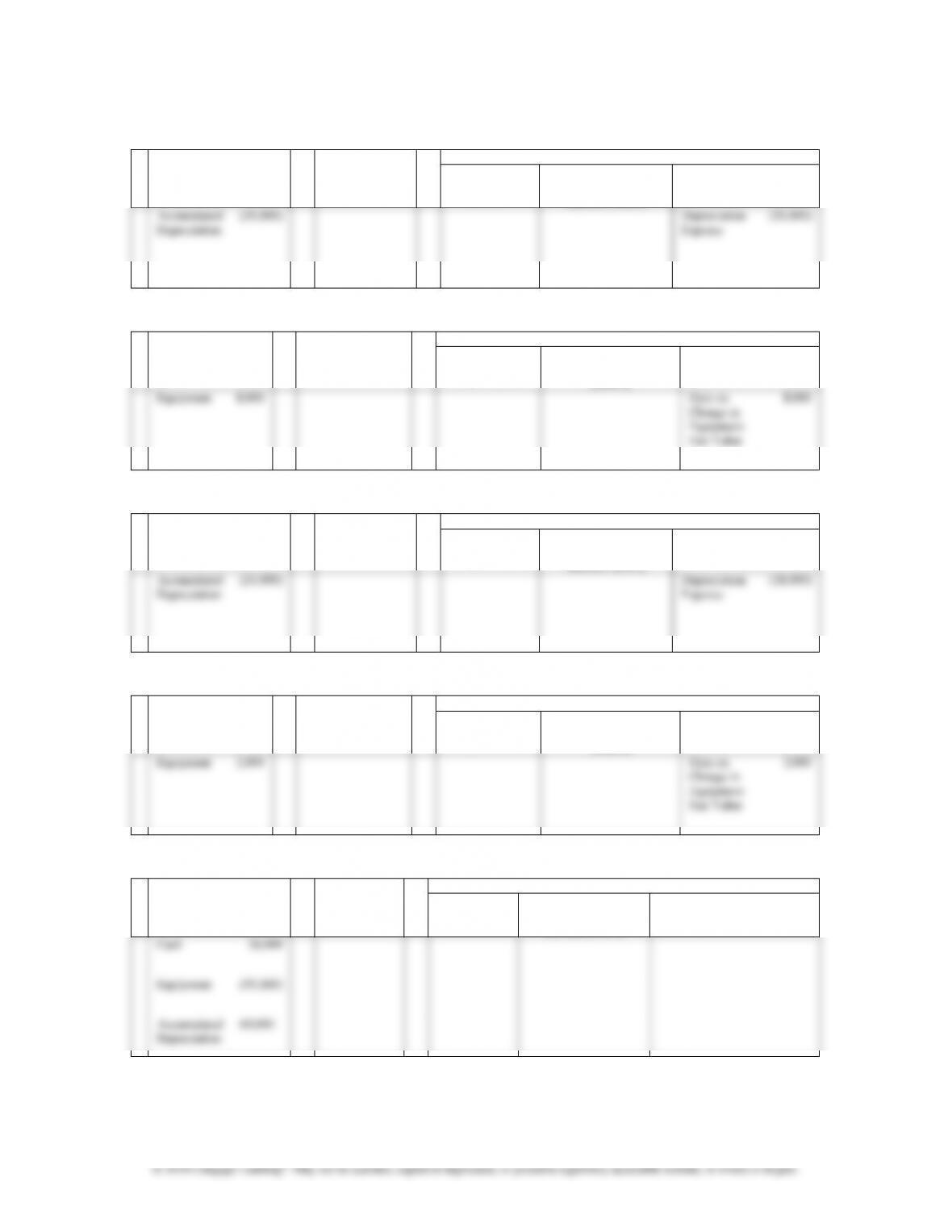
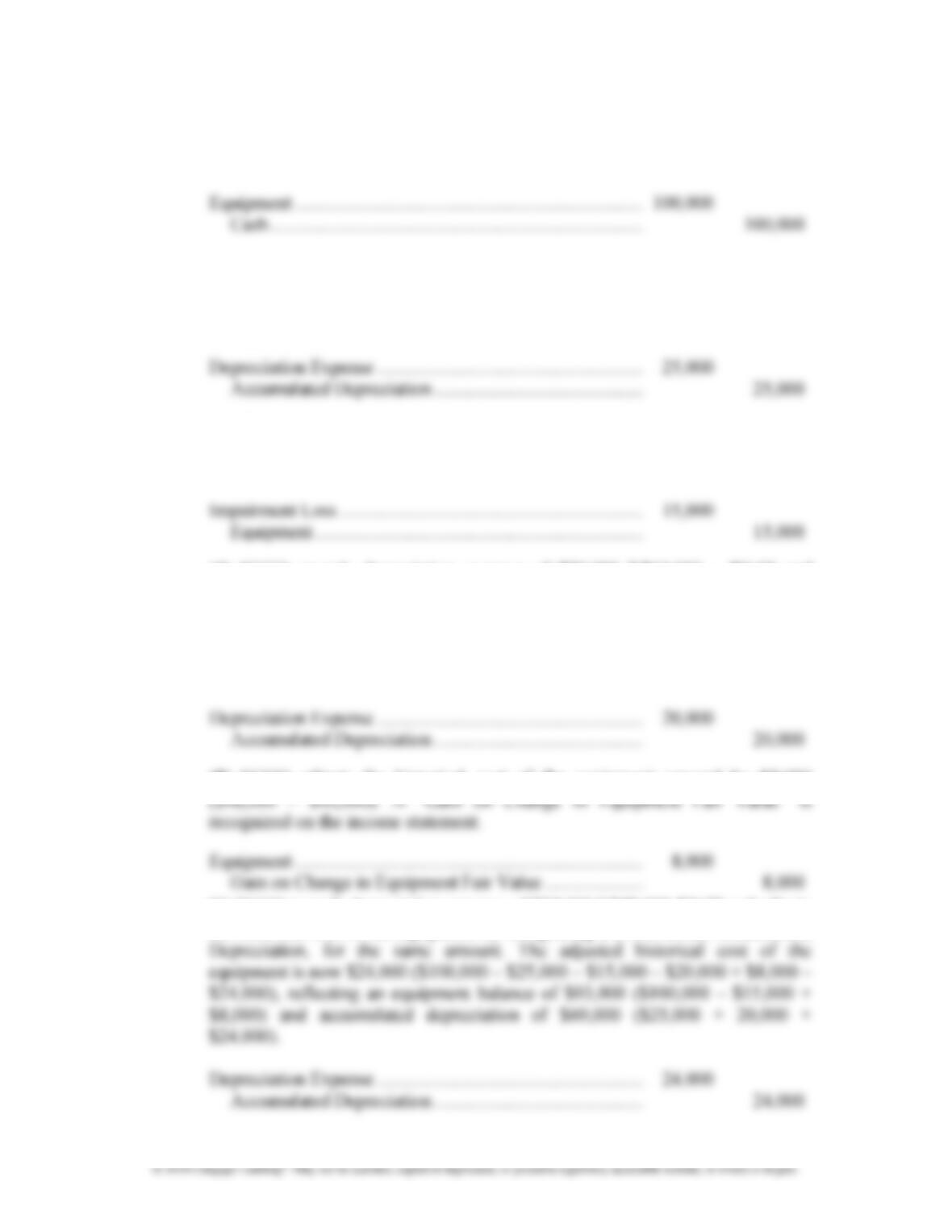
(1) SCCO records the equipment at historical cost of $100,000 (and reduces
cash by the same amount).
(2) SCCO records depreciation expense of $25,000 [($100,000 – $0)/4] and
adjusts the historical cost of the equipment by recognizing a contra-asset,
Accumulated Depreciation, for the same amount. The adjusted historical cost of
the equipment is now $75,000 ($100,000 – $25,000).
(3) The adjusted historical cost of the equipment is reduced by $15,000
($60,000 – $75,000), and an “Impairment Loss” of the same amount is
recognized on the income statement.
(4) SCCO records depreciation expense of $20,000 [($60,000 – $0)/3] and
adjusts the historical cost of the equipment by recognizing a contra-asset,
Accumulated Depreciation, for the same amount. The adjusted historical cost of
the equipment is now $40,000 ($100,000 – $25,000 – $15,000 – $20,000),
reflecting an equipment balance of $85,000 ($100,000 – $15,000) and
accumulated depreciation of $45,000 ($25,000 + 20,000).
(5) SCCO adjusts the historical cost of the equipment upward by $8,000
(6) SCCO records depreciation expense of $24,000 [($48,000-$0)/2] and adjusts
the historical cost of the equipment by recognizing a contra-asset, Accumulated
Chapter 2
Asset and Liability Valuation
and Income Recognition
2-17
(7) SCCO adjusts the historical cost of the equipment upward by $2,000
($26,000 – $24,000). A “Gain on Change in Equipment Fair Value” is
recognized on the income statement. The value of the equipment rises to
(8) SCCO receives cash of $26,000 (asset increase) and derecognizes both the
equipment (asset decrease of $95,000) and accumulated depreciation (asset
c. Total expenses over sufficiently long time periods equal cash outflows, other than
cash transactions with owners. The negative $74,000 total net cash outflow for the
2.15 Effect of Valuation Method for Monetary Asset on Balance Sheet and Income
Statement.
a. Assume that Alfa Romeo accounts for this note throughout the three years using
its initial present value.
(1)
Assets = Liabilities +
Shareholders’ Equity
Contributed
Capital (CC)
Accumulated Other
Comprehensive Income
(AOCI)
Retained Earnings
(RE)
2-18
(2)
Assets = Liabilities +
Shareholders’ Equity
Contributed
Capital (CC)
Accumulated Other
Comprehensive
Income (AOCI)
Retained Earnings (RE)
Automobile
Inventory
(30,000) Cost of
Goods
Sold
(30,000)
(3)
Assets = Liabilities +
Shareholders’ Equity
Contributed
Capital (CC)
Accumulated Other
Comprehensive
Retained Earnings (RE)
(4)
Assets = Liabilities +
Shareholders’ Equity
Contributed
Capital (CC)
Accumulated Other
Comprehensive
Income (AOCI)
Retained Earnings (RE)
(5)
Assets = Liabilities +
Shareholders’ Equity
Contributed
Capital (CC)
Accumulated Other
Comprehensive
Retained Earnings (RE)
(1) The cash costs of the automobile increases inventory (and decreases cash).