Chapter 12
Valuation: Cash-Flow-Based Approaches
12-34
Exhibit 12.H
Partial Projected Balance Sheets for Holmes Corporation
(amounts in thousands)
Balance Sheet Year 15 Year 16 Year 17 Year 18 Year 19 Year 20
Assets
Cash 3,857 12,494 18,424 24,650 31,187 38,051
Liabilities & S.E.
Accounts Payable 4,400 4,620 4,851 5,094 5,348 5,616
Add. Paid-In Capital 5,286 5,286 5,286 5,286 5,286 5,286
Retained Earnings 14,894 21,634 28,710 36,141 43,943 52,135
Total Shareholders’ Equity 29,394 36,134 43,210 50,641 58,443 66,635
Total Liab. & Sh. Eq. 45,513 53,059 60,981 69,300 78,035 87,207
Assumptions
Chapter 12
Valuation: Cash-Flow-Based Approaches
12-35
F. Next, project the operating and investing sections of the statement of cash flows
V. Establishing the Purchase Price
A. Present Value of Free Cash Flows Model
1. Continuing Value—Revenues are projected to grow at a compound annual
bid.
2. Cost of Capital—Question c. indicates the mix of financing and the interest
Chapter 12
Valuation: Cash-Flow-Based Approaches
12-36
Exhibit 12.I
Partial Projected Statements of Cash Flows for Holmes Corporation
(amounts in thousands)
Cash Flow Statement Year 15 Year 16 Year 17 Year 18 Year 19 Year 20
Operations:
Investing
Acquisition of Property, Plant, and
(1,172) (984) (1,033) (1,085) (1,139) (1,196)
Other Financing 0 0 0 0 0 0
Cash Flow from Financing (2,098) 0 0 0 0 0
Change in Cash 2,317 8,637 5,930 6,226 6,537 6,864
Cash, Beginning of Year 1,540 3,857 12,494 18,424 24,650 31,187
Cash, End of Year 3,857 12,494 18,424 24,650 31,187 38,051
12-37
3. The cost of equity capital is more problematic. The CAPM requires an
and 1.12, with a simple average of 0.96. However, adding considerable
financial leverage in the LBO requires a higher market equity beta. We need
LJG Industries:
Gelas:
0.93 = Unlevered Equity Beta[1 + (1 – 0.375)($8,869/$41,962)]
8.44%
Chapter 12
Valuation: Cash-Flow-Based Approaches
12-38
© 2018 Cengage Learning®. May not be scanned, copied or duplicated, or posted to a publicly accessible website, in whole or in part.
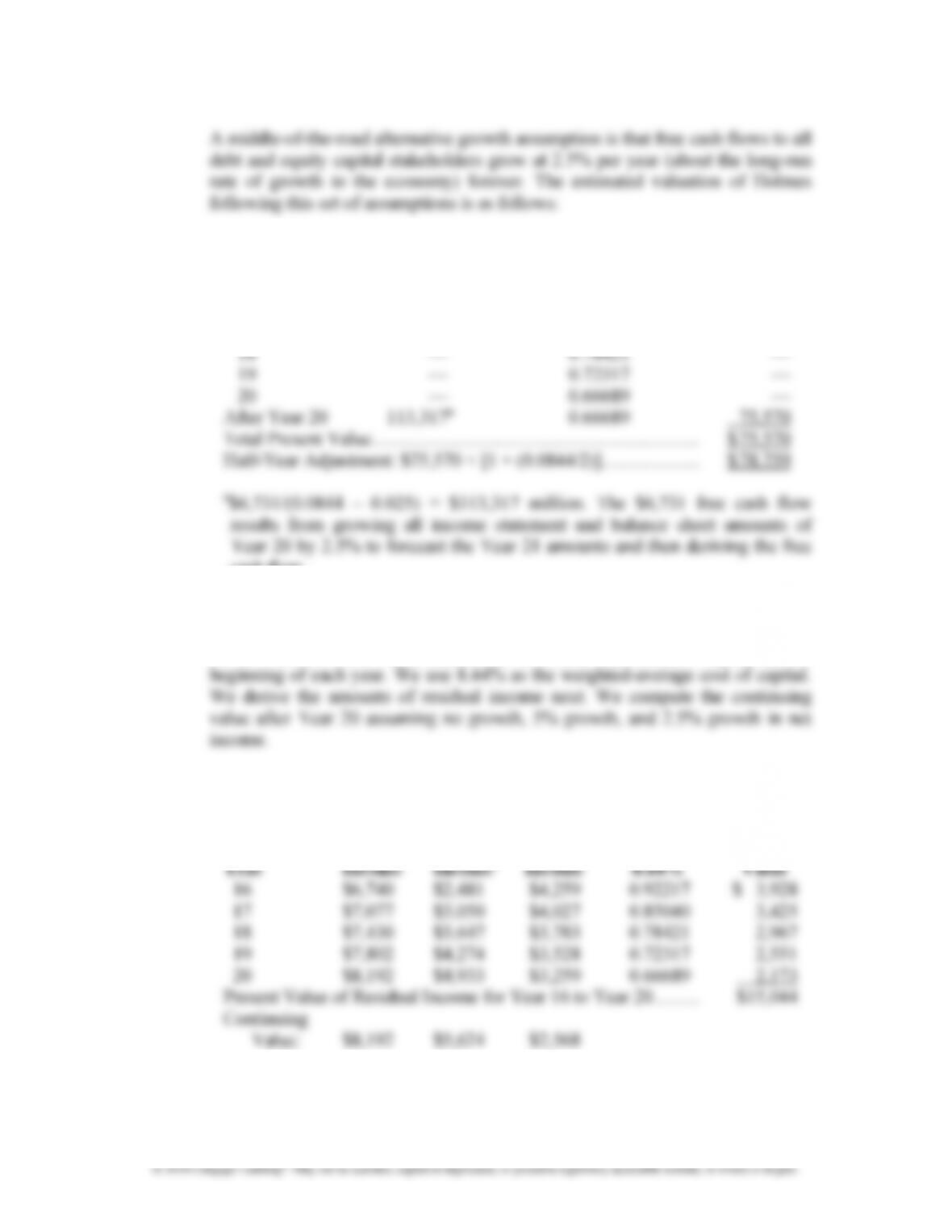
The valuation of Holmes assuming no growth in free cash flows to all debt
and equity capital stakeholders after Year 20 is as follows (keeping in mind
that this is quite a conservative forecast):
Free Cash Present Value Factor Present
Year Flowsa at 8.44% Values
from growing all income statement and balance sheet amounts of Year 20 by
20 — 0.66689 —
After Year 20 153,198a 0.66689 102,166
Total Present Value ……………………………………………………………. $102,166
Half-Year Adjustment: $102,166 × [1 + (0.0844/2)] ………………. $106,477
a$5,270/(0.0844 – 0.05) = $153,198 million. The $5,270 free cash flow results
Chapter 12
Valuation: Cash-Flow-Based Approaches
12-39
© 2018 Cengage Learning®. May not be scanned, copied or duplicated, or posted to a publicly accessible website, in whole or in part.
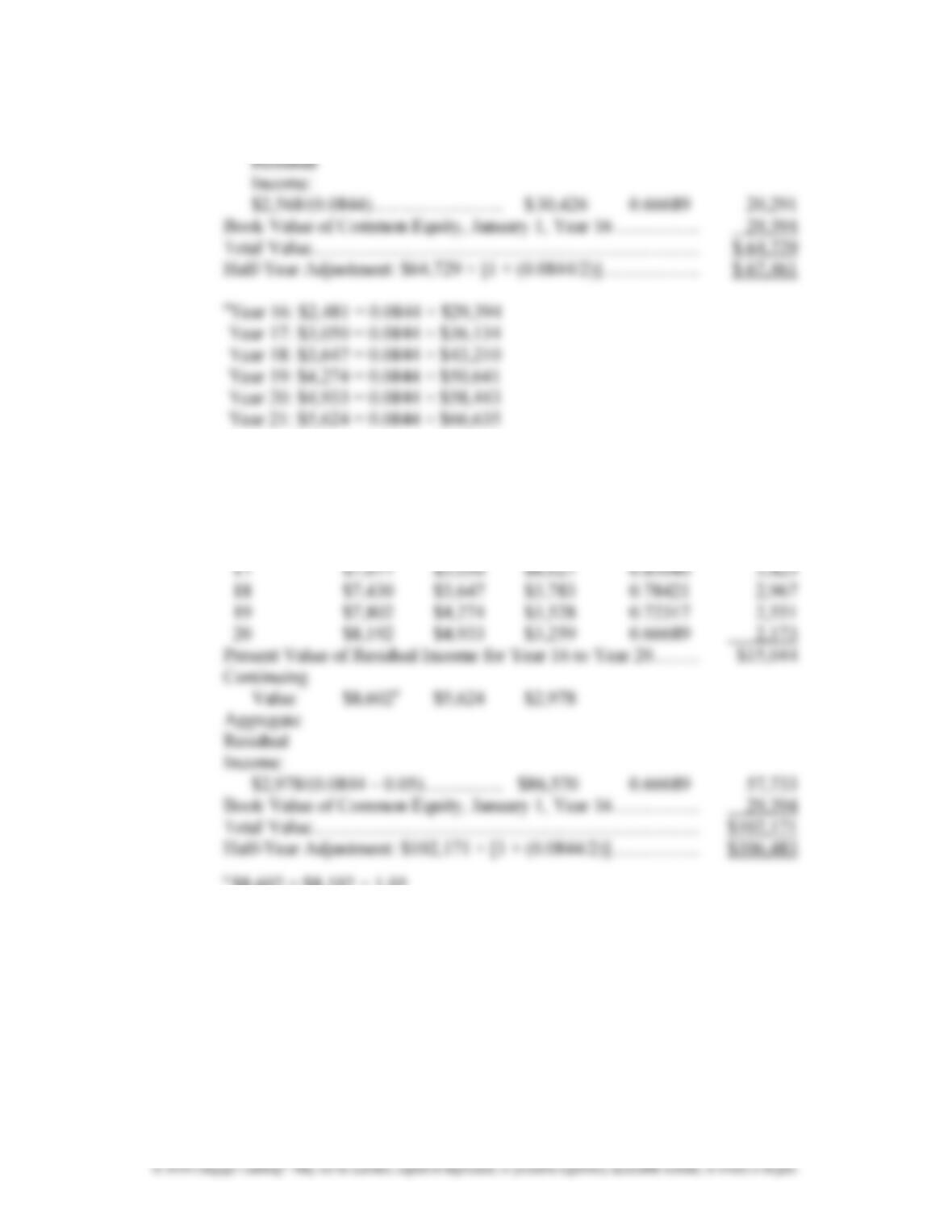
A middle-of-the-road alternative growth assumption is that free cash flows to all
debt and equity capital stakeholders grow at 2.5% per year (about the long-run
rate of growth in the economy) forever. The estimated valuation of Holmes
following this set of assumptions is as follows:
Free Cash Present Value Factor Present
Year Flow at 8.44% Values
16 — 0.92217 $ —
17 — 0.85040 —
cash flow.
B. Residual Income Model
The projected financial statements indicate the forecasted net income for Year
16 to Year 20 and the amounts for common shareholders’ equity at the
1. Valuation with no growth in earnings after Year 20
Present Value
Net Required Residual Factor at Present
Chapter 12
Valuation: Cash-Flow-Based Approaches
12-40
Aggregate
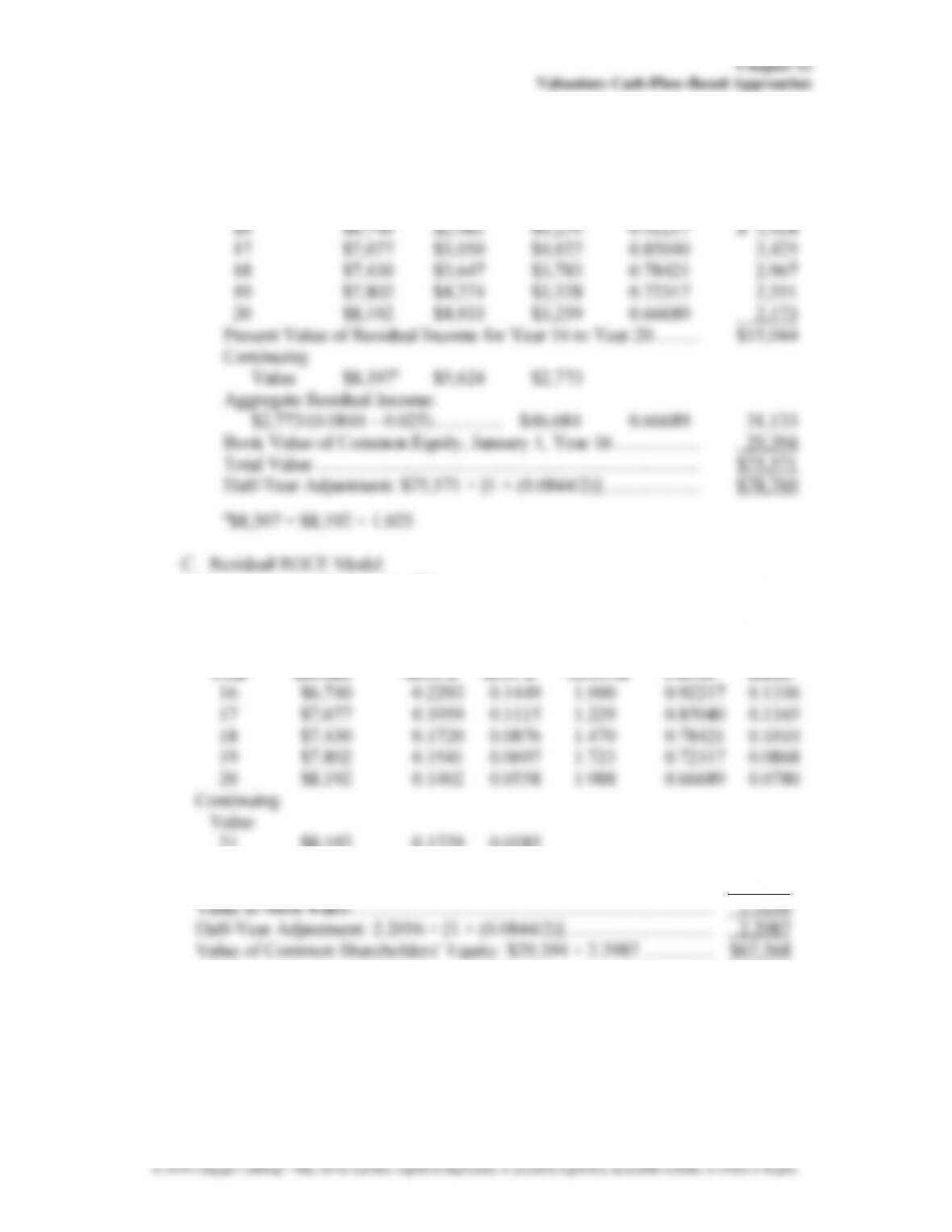
2. Valuation with 5% growth in earnings after Year 20
Present Value
Net Expected Residual Factor at Present
Year Income Income Income 8.44% Value
16 $6,740 $2,481 $4,259 0.92217 $ 3,928
12-41
3. Valuation with 2.5% growth in earnings after Year 20
Present Value
Net Expected Residual Factor at Present
Year Income Income Income 8.44% Value
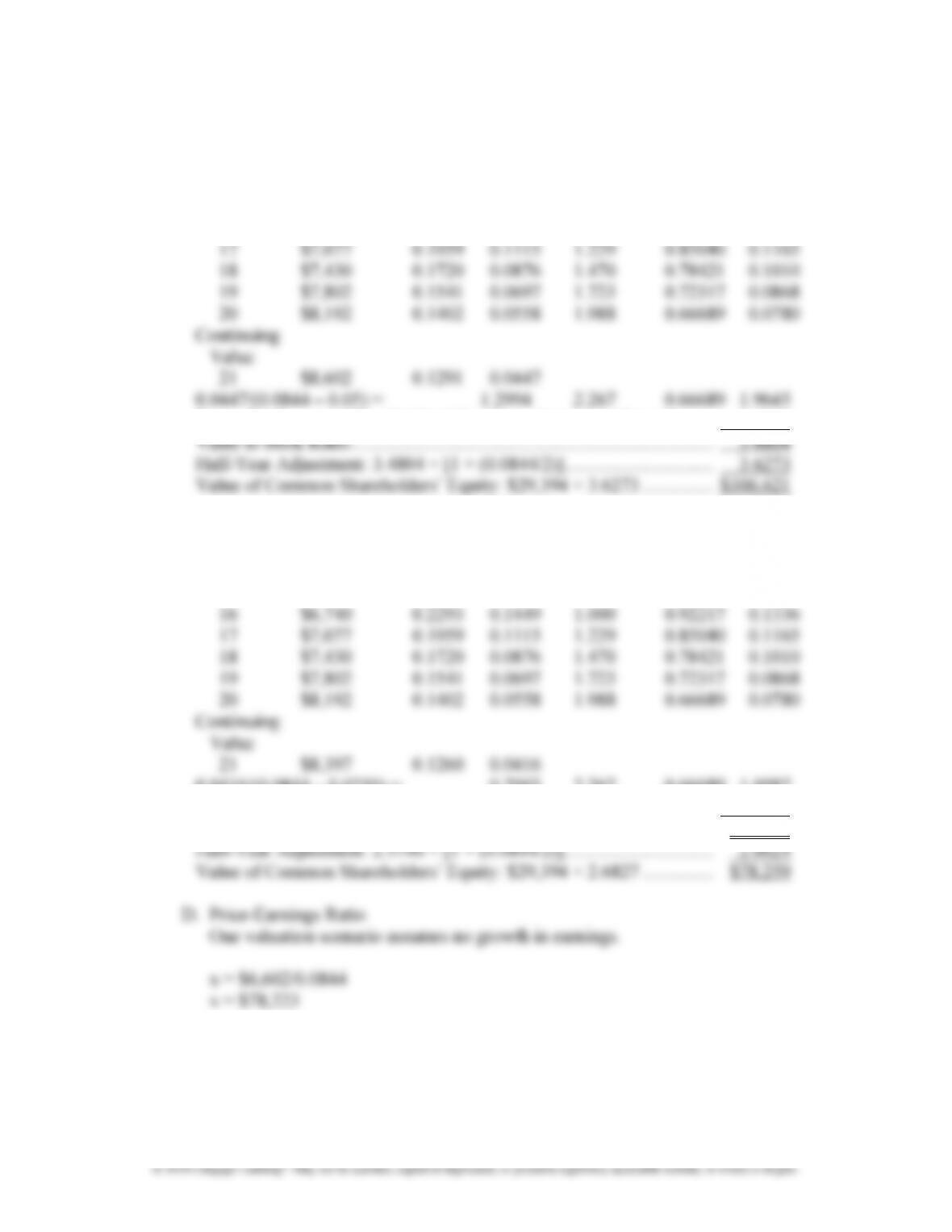
1. Zero growth after Year 20
Compre- Cum. Present Value/
hensive Implied Residual Share. Eq. Value Book
Year Income ROCE ROCE Growth Factor Ratio
21 $8,192 0.1229 0.0385
0.0385/(0.0844) = 0.4562 2.267 0.66689 0.6897
Factor for Common Shareholders’ Equity on January 1, Year 13 …….. 1.0000
Chapter 12
Valuation: Cash-Flow-Based Approaches
12-42
2. 5% growth after Year 20
Compre- Cum. Present Value/
hensive Implied Residual Share. Eq. Value Book
Year Income ROCE ROCE Growth Factor Ratio
16 $6,740 0.2293 0.1449 1.000 0.92217 0.1336
Factor for Common Shareholders’ Equity on January 1, Year 13 …….. 1.0000
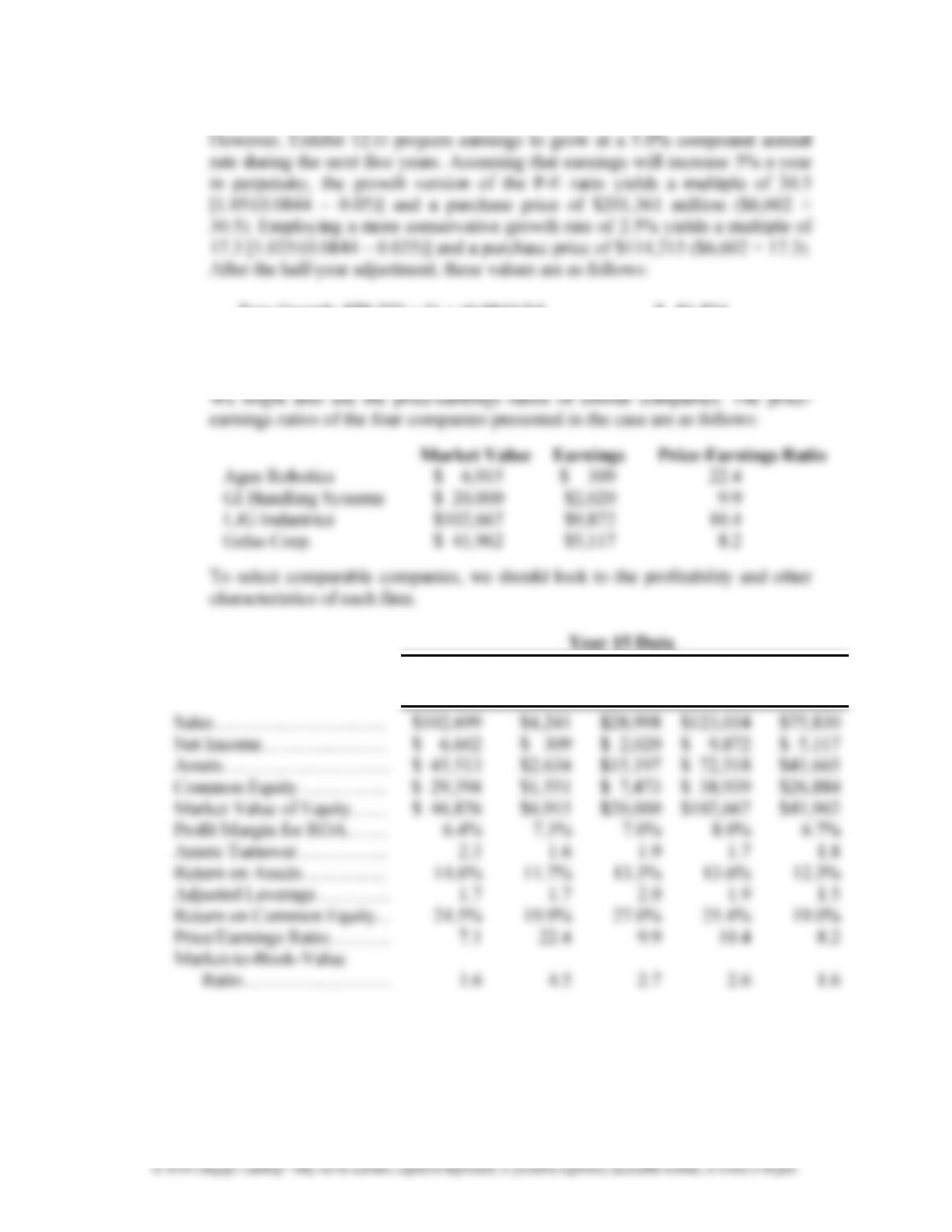
3. 2.5% growth after Year 20
Compre- Cum. Present Value/
hensive Implied Residual Share. Eq. Value Book
Year Income ROCE ROCE Growth Factor Ratio
0.0416/(0.0844 – 0.0250) = 0.7003 2.267 0.66689 1.0587
Factor for Common Shareholders’ Equity on January 1, Year 13 …….. 1.0000
Value to Book Ratio …………………………………………………………………… 2.5546
Chapter 12
Valuation: Cash-Flow-Based Approaches
12-43
Zero Growth: $78,223 × [1 + (0.0844/2)] ……………… $ 81,524
5% Growth: $201,361 × [1 + (0.0844/2)] ……………… $209,858
2.5% Growth: $114,215 × [1 + (0.0844/2)] …………… $119,035
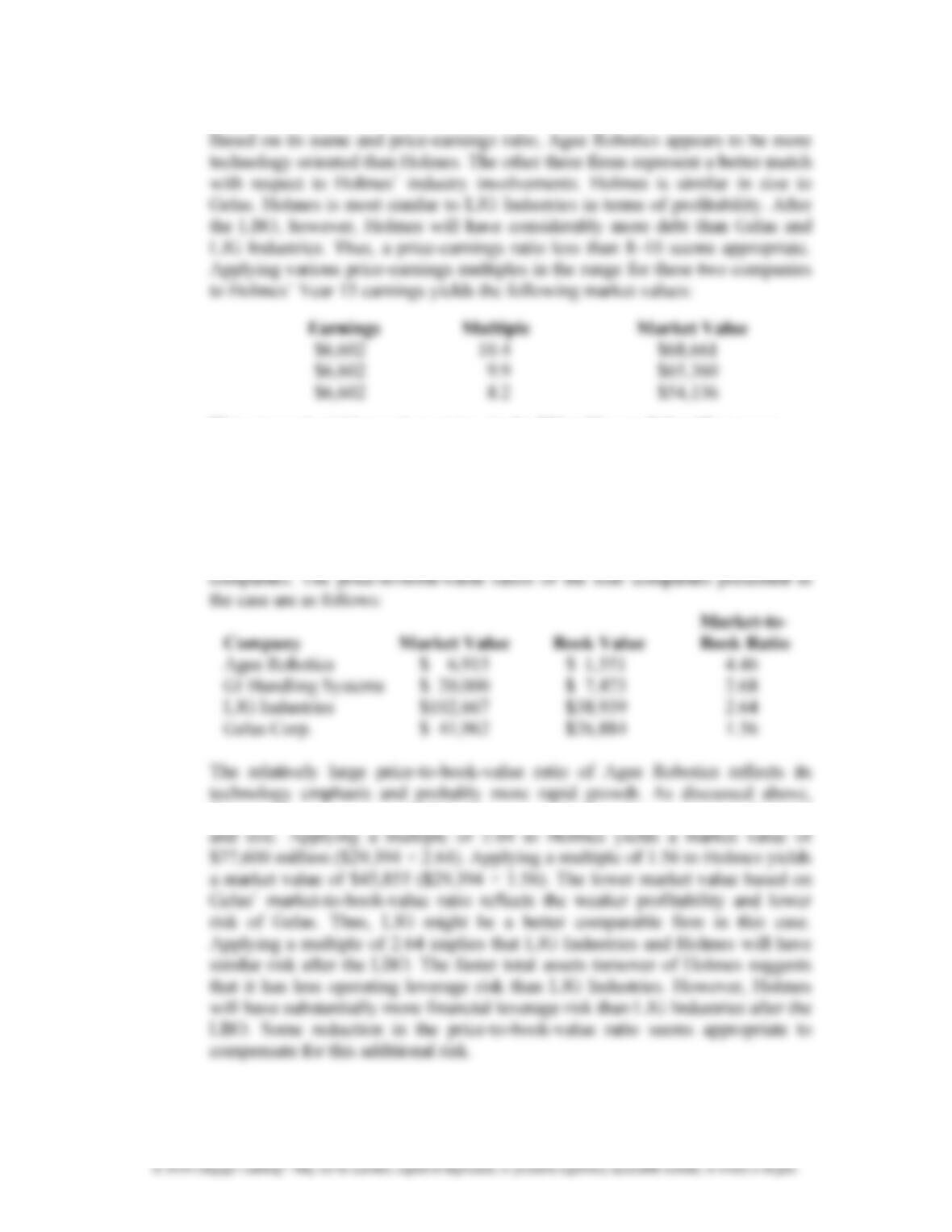
GI Hand.
Holmes Agee Systems LJG Ind. Gelas
Chapter 12
Valuation: Cash-Flow-Based Approaches
12-44
This approach yields purchase prices in the $54 million to $69 million range.
E. Price-to-Book-Value Ratio
The residual ROCE valuation model in Part C above gives the values based on
the theoretical value-to-book-value ratio.
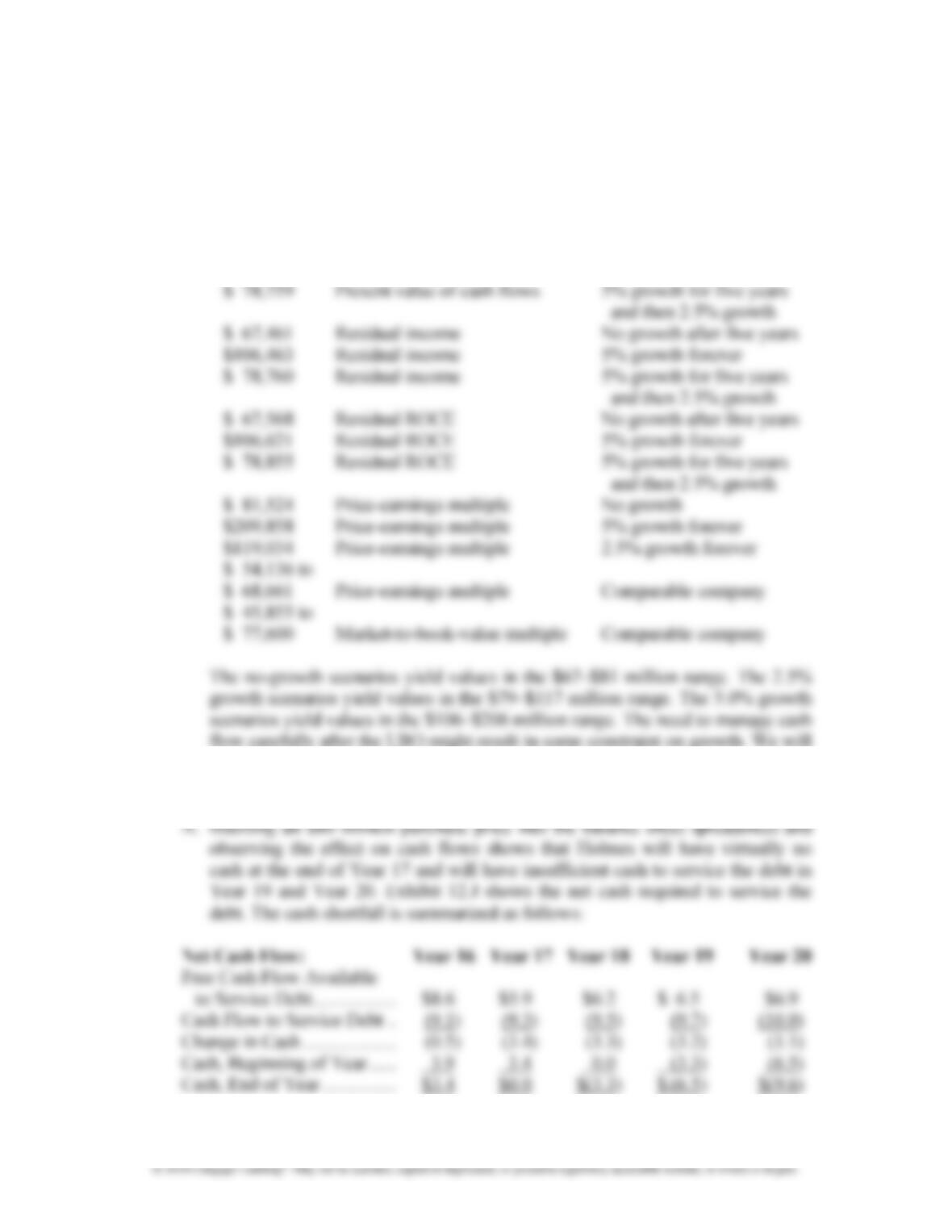
An alternative approach is to use the price-to-book-value ratios of comparable
Holmes is most similar to LJG Industries and Gelas with respect to profitability
Chapter 12
Valuation: Cash-Flow-Based Approaches
12-45
F. Summary of Valuations
Following are the valuations derived from various methods and sets of
assumptions (dollar amounts in millions):
Valuation Method Assumptions
$ 67,462 Present value of cash flows No growth after five years
$106,477 Present value of cash flows 5% growth forever
flow carefully after the LBO might result in some constraint on growth. We will
assume a purchase price of $80 million.
VI. Will the LBO Work at an $80 Million Purchase Price?
Chapter 12
Valuation: Cash-Flow-Based Approaches
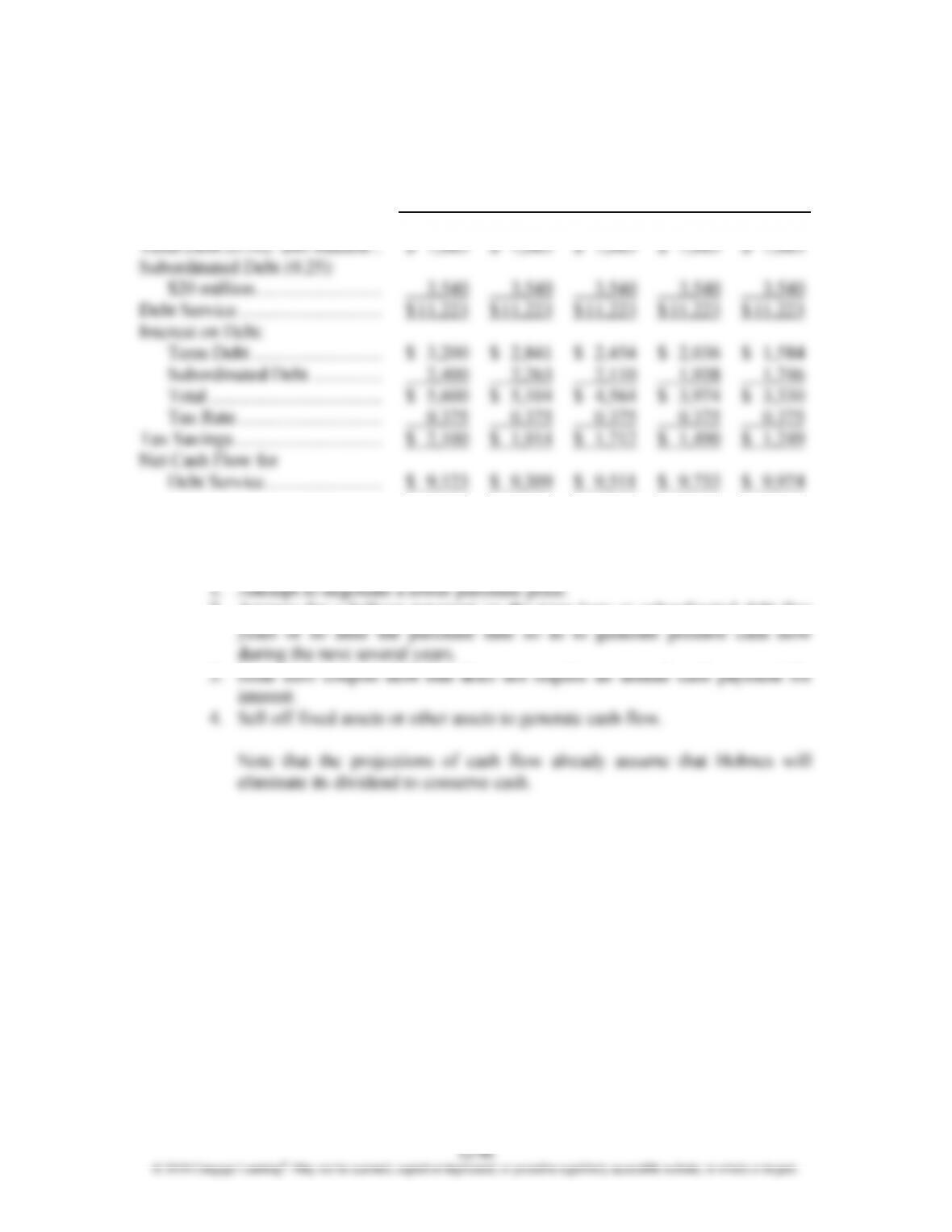
Exhibit 12.J
Debt Service Requirements to Finance $80 Million Purchase Price
Projected
Year 16 Year 17 Year 18 Year 19 Year 20
B. Among the alternatives the acquirer might pursue to deal with the cash flow
shortage are the following:
2. Arrange for a balloon payment on the term loan or subordinated debt five