Overview of Financial Reporting, Financial
© 2018 Cengage Learning®. May not be scanned, copied or duplicated, or posted to a publicly accessible website, in whole or in part.
Exhibit 1.C—(Problem 1.12)
Nippon
Toyota
Deutsche
Inter-
public
Roche
Marks &
BNP Steel Motor Telekom Accor Group Oracle E.ON Holding Spencer Carrefour Nestlé
1 2 3 4 5 6 7 8 9 10 11 12
BALANCE SHEET
Chapter 1
Overview of Financial Reporting, Financial
Statement Analysis, and Valuation
1-18
1.13 Value Chain Analysis and Financial Statement Relations. There are various
approaches to this problem. One approach begins with a particular company,
unique characteristic.
the highest profit margins (that is, net income divided by sales). This would suggest
that Firm (1) is neither Wyeth nor Amgen. Also, Firm (1) has the highest cost of
competition among generic firms should give Mylan a lower profit margin. This
reasoning would suggest that Johnson & Johnson is Firm (7) and Mylan is Firm (1).
Firm (7) also has higher selling and administrative expenses versus Firm (1),
consistent with Johnson & Johnson. The low profit margin of Mylan is the result of
Chapter 1
Overview of Financial Reporting, Financial
Statement Analysis, and Valuation
1-19
We are now left with Covance, Cardinal Health, and Walgreens as Firms (2),
(5), and (6). Covance will have very low inventories, whereas Cardinal Health
Covance. This firm will need property, plant, and equipment to conduct the testing
of new drugs. Of the remaining two firms, Cardinal Health and Walgreens,
Walgreens will likely have a higher proportion of assets in property, plant, and
© 2018 Cengage Learning®. May not be scanned, copied or duplicated, or posted to a publicly accessible website, in whole or in part.
Chapter 1
Overview of Financial Reporting, Financial
Statement Analysis, and Valuation
Exhibit 1.D—(Problem 1.13)
Mylan
Cardinal
Laboratories
Health
Amgen
Wyeth
Covance Walgreens J&J
INCOME STATEMENT
Operating Revenues 100.0% 100.0%
100.0% 100.0%
100.0% 100.0%
100.0%
Cost of sales (excluding depreciation) or operating expenses (59.7) (94.4) (15.3) (27.4) (62.5) (72.2)
(29.0)
Chapter 1
Overview of Financial Reporting, Financial
Statement Analysis, and Valuation
1-21
Integrative Case 1.1: Walmart
I. Objectives
A. Identify the economics characteristics of the retail industry and Walmart’s
strategy for competing in this industry as background for the integrative case
works well because it is a company that most students understand and find
interesting.
II. Teaching Strategy—We have taught this case with two approaches. If an
opportunity exists to distribute the case prior to the first class, we give students the
solutions to the questions involving the balance sheet, income statement, statement
you can choose to emphasize particular questions based on the amount of time
available and refer students to the solution for the remaining parts.
Note to Instructors:
Walmart is a good company to use for classroom discussion and demonstration of
the techniques throughout this book. Students generally relate easily and readily to
Walmart because they are familiar with Walmart’s retail stores. As a company and
Chapter 1
Overview of Financial Reporting, Financial
Statement Analysis, and Valuation
1-22
Industry and Strategy Analysis
a. Porter’s five forces applied to the retail industry:
1. Buyer Power: Buyer power for consumer goods from large retail chains is
Chapter 1
Overview of Financial Reporting, Financial
Statement Analysis, and Valuation
1-23
© 2018 Cengage Learning®. May not be scanned, copied or duplicated, or posted to a publicly accessible website, in whole or in part.
b. Walmart competes on the bases of price, a very large selection of consumer goods,
and convenient store locations. Walmart has a competitive advantage in its brand
name, as a recognized retailer of consumer goods at relatively low prices. Walmart
also has established a competitive advantage through its scale. Given its enormous
size, it has tremendous buying power over suppliers of consumer goods. Walmart
is further leveraging its brand name by selling consumer goods through large
chains of “big box” retail stores, Sam’s Club warehouse stores, and smaller scale
retail stores.
Balance Sheet
c. Cash includes cash on hand and in checking accounts. Cash equivalents include
amounts that a firm can easily convert into cash. Cash equivalents usually have a
maturity date of less than three months at the time of purchase so that changes in
Chapter 1
Overview of Financial Reporting, Financial
Statement Analysis, and Valuation
1-24
h. Walmart’s largest liability is long-term debt, which was likely used to finance
Income Statement
apparent on the balance sheet are cash and cash equivalents, which only amount
Chapter 1
Overview of Financial Reporting, Financial
Statement Analysis, and Valuation
1-25
Statement of Cash Flows
m. Firms use the accrual basis of accounting in measuring net income. Firms usually
recognize revenue at the time of sale of goods and services, not necessarily when
they receive cash from customers. Firms attempt to match expenses with the time
periods during which they consume economic resources, regardless of when they
expend cash. The accrual basis gives a better indication of a firm’s operating
performance than the cash basis because of the matching of inputs and outputs.
Chapter 1
Overview of Financial Reporting, Financial
Statement Analysis, and Valuation
1-26
Relations between Financial Statements
s. Explain the change in retained earnings.
Net income, dividends, and stock repurchases explain almost all of the change in
Interpreting Financial Statement Relations
t. A cautionary note with interpreting percentage changes is that large percentage
1-27
Case 1.2: Nike: Somewhere between a Swoosh and a Slam Dunk
I. Objectives
II. Teaching Strategy—We have taught this case with two approaches. If an
opportunity exists to distribute the case prior to the first class session, we give
Income Statement
a. For wholesale and retail customers, Nike apparently recognizes revenues from the
on either an average or specific-identification cost basis. For inventories in transit
supplies (e.g., thousands of pairs of a particular type of shoe), so using average
Chapter 1
Overview of Financial Reporting, Financial
Statement Analysis, and Valuation
1-28
c. Nike outsources its manufacturing. Thus, depreciation expense relates to buildings
current amount of income taxes payable was $943 million, which means that Nike
paid $80 million in tax that increased deferred tax assets or reduced deferred tax
2016 was greater than its income before taxes for financial reporting. Note 9,
revenues and expenses recognized during the year for financial reporting. The
basis for measuring income tax payable is the amount of revenues and expenses
Balance Sheet
f. The allowance for uncollectible accounts arises because, under accrual accounting,
Chapter 1
Overview of Financial Reporting, Financial
Statement Analysis, and Valuation
1-29
likely to collect 100% of the amount reported as sales revenue, it must recognize
balance sheet, but this is not the case for Nike because it outsources its
manufacturing of inventory.
h. The notes indicate that Nike uses the straight-line method for buildings and
leasehold improvements, and machinery and equipment. As with the inventory
cost-flow assumption, standard-setting bodies give firms freedom to select any
example, advertising, promotion, and quality control) to develop intangibles (for
Statement of Cash Flows
Chapter 1
Overview of Financial Reporting, Financial
Statement Analysis, and Valuation
1-30
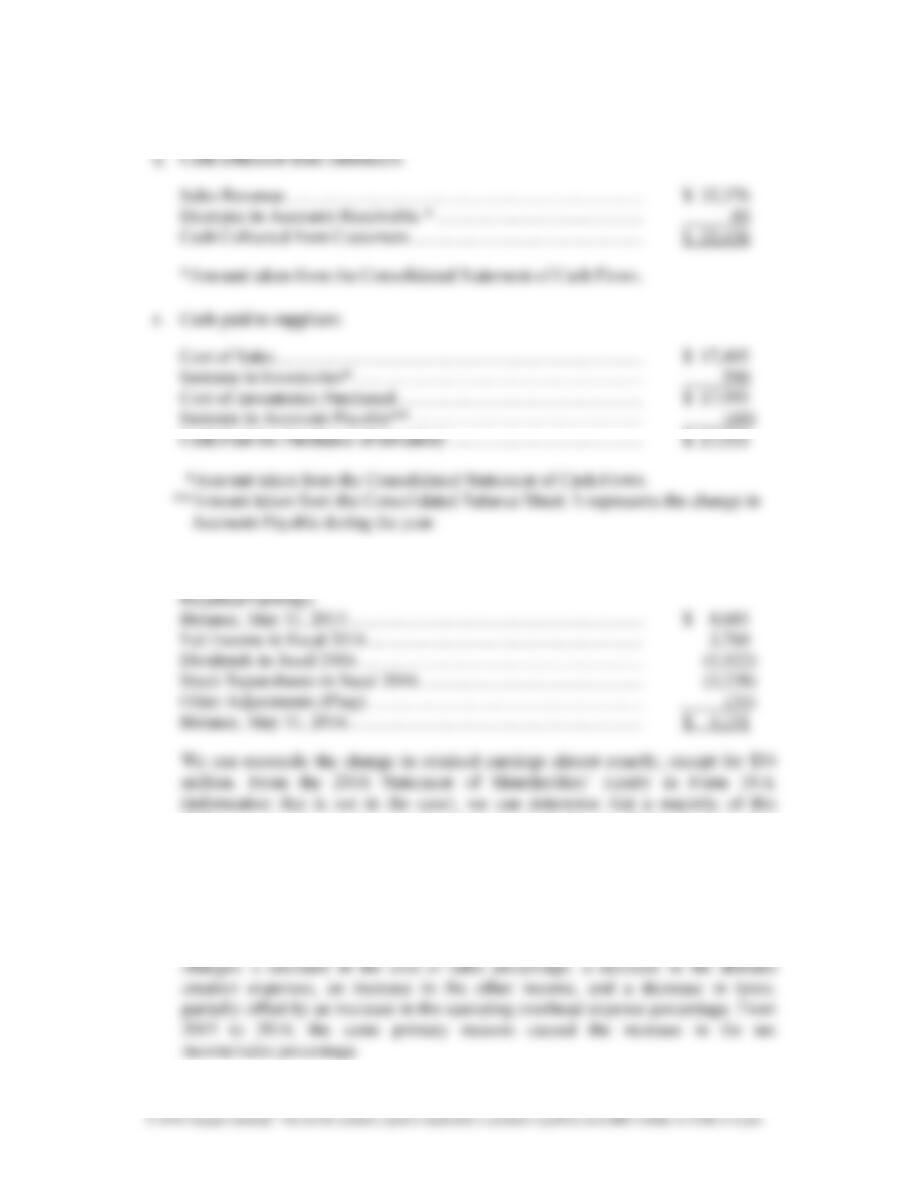
of resources generated and consumed in a particular period, apart from the cash
flows of the period. The operating activities section of the statement of cash flows
reports the amount of cash received from customers net of amounts paid to
suppliers of goods and services.
sold included in net income to cash payments to suppliers for inventory items.
Chapter 1
Overview of Financial Reporting, Financial
Statement Analysis, and Valuation
1-31
Relations between Financial Statement Items (amounts in millions):
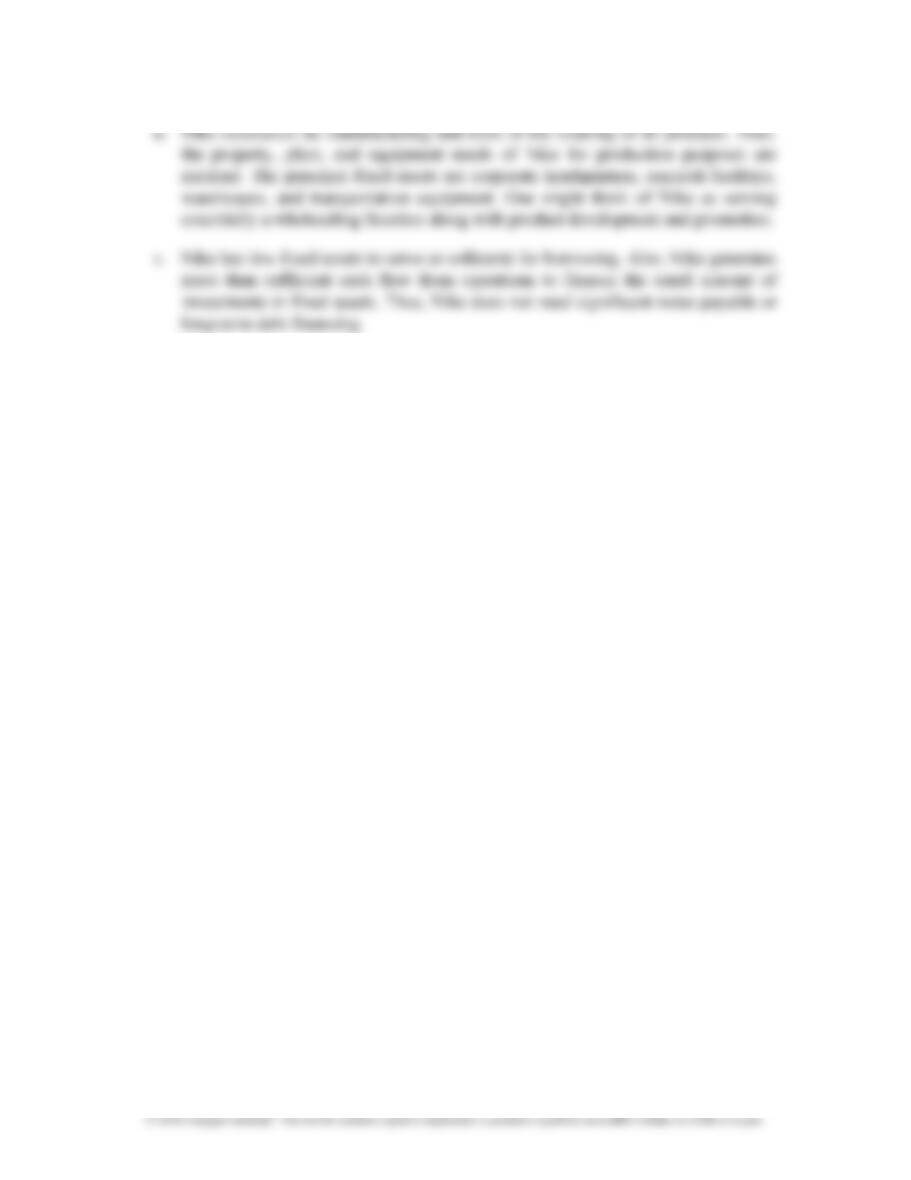
s. Reconcile the change in retained earnings:
difference arise because the amounts of dividends declared in 2016 are greater than
the amounts paid during 2016. This suggests there is some amount of dividends
payable on the balance sheet at the end of fiscal 2016.
Interpreting Financial Statement Relationships
t. The improved net income/sales percentage in 2015 reflects the net result of several
Chapter 1
Overview of Financial Reporting, Financial
Statement Analysis, and Valuation
1-32
© 2018 Cengage Learning®. May not be scanned, copied or duplicated, or posted to a publicly accessible website, in whole or in part.
u. Nike outsources its manufacturing and most of the retailing of its products. Thus,
the property, plant, and equipment needs of Nike for production purposes are
minimal. The principal fixed assets are corporate headquarters, research facilities,
warehouses, and transportation equipment. One might think of Nike as serving
essentially a wholesaling function along with product development and promotion.
v. Nike has few fixed assets to serve as collateral for borrowing. Also, Nike generates
more than sufficient cash flow from operations to finance the small amount of
investments in fixed assets. Thus, Nike does not need significant notes payable or
long-term debt financing.