Chapter 1: An Overview of Marketing
1
MULTIPLE CHOICE
1. Marketing is the activity, set of institutions, and processes for __________ offerings that have
value for customers, clients, partners, and society at large.
a. creating
b. communicating
c. delivering
d. exchanging
e. All of these
PTS: 1 OBJ: LO: 1-1 TOP: AACSB: Reflective Thinking
KEY: CB&E Model: Strategy MSC: BLOOMS: Level I Knowledge
2. Prior to the Responsible Marketing Policy, Coca-Cola used a __________ orientation for its
advertising.
a. production
b. sales
c. market
d. societal marketing
PTS: 1 OBJ: LO: 1-2 TOP: AACSB: Reflective Thinking
KEY: CB&E Model: Strategy MSC: BLOOMS: Level I Knowledge
3. If Coca-Cola decides to no longer use their iconic polar bears in holiday season advertising
and they ask employees to submit ideas for replacement mascots, this would be an example of
__________.
a. relationship marketing
b. empowerment
c. teamwork
d. co-creation
PTS: 1 OBJ: LO: 1-3 TOP: AACSB: Reflective Thinking
KEY: CB&E Model: Strategy MSC: BLOOMS: Level I Knowledge
© 2018 Cengage Learning. All Rights Reserved. May not be scanned, copied or duplicated, or posted to a publicly accessible website, in whole or in part.
Chapter 1: An Overview of Marketing
2
4. Customer relationship management (CRM) is a company-wide business strategy designed to
optimize __________ by focusing on highly defined and precise customer groups.
a. profitability
b. revenue
c. customer satisfaction
d. A and B
e. All of these
PTS: 1 OBJ: LO: 1-3 TOP: AACSB: Reflective Thinking
KEY: CB&E Model: Strategy MSC: BLOOMS: Level I Knowledge
5. Who at Coca-Cola needs to fully understand the company’s new Responsible Marketing
Policy?
a. the marketing team
b. the CEO and his advisors
c. the accounting and finance departments
d. everyone in the organization
PTS: 1 OBJ: LO: 1-4 TOP: AACSB: Reflective Thinking
KEY: CB&E Model: Strategy MSC: BLOOMS: Level I Knowledge
Great Ideas for Teaching Chapter 1
Rich Brown, Freed-Hardeman University
How Should Service Make You Feel, and Why Is That Important?
A problem in teaching people to be good service providers, or effective managers, is that many
people don’t know how intrinsically rewarding it is to truly be of service to another person.
Many students have experience in service-related jobs but not so many have worked in great
service environments. Most have experienced, accepted, and expected mediocre service in a
© 2018 Cengage Learning. All Rights Reserved. May not be scanned, copied or duplicated, or posted to a publicly accessible website, in whole or in part.
Chapter 1: An Overview of Marketing
3
This assignment has two parts. First, you must get the students to think of situations in which
You could ask the students to write about their experiences, but I have found the discussion
format to be extremely beneficial. Most students will have had positive experiences and most
Here is a list of questions to use while starting a discussion.
Whom did you help, and what exactly did you do for them?
Did they really need the help? Why?
What would their situation have been like if you had not helped them?
How has their situation changed because you helped them? Was the change in situation
worth the effort it took? Why?
How did they feel about you helping them, and how could you tell?
How did you feel about helping them in this situation, and how do you feel about it now?
Why?
Was this an unusual experience for you? Why?
Was what you did complicated or difficult?
Do you think service in general would be better if service providers could feel about their
jobs the way you felt after you helped in this situation? Why?
How could managers of customer service providers help their employees to realize the
intrinsic benefits that can result from really serving another person?
James S. Cleveland, Sage College of Albany
Discussion Board Topics to Encourage Participation
Discussion board questions provided to students to encourage them to engage in thinking and
© 2018 Cengage Learning. All Rights Reserved. May not be scanned, copied or duplicated, or posted to a publicly accessible website, in whole or in part.
Chapter 1: An Overview of Marketing
4
Discussion topics such as this one are abstract and often require that the instructor provide an
I have developed, therefore, a series of discussion board questions to use with experienced, adult
students. These questions are designed to encourage them to use their experiences as employees
Each question has three parts:
1. First, there is a sentence or two from the students’ textbooks introducing the topic. By
using the text author’s own words, students are enabled to locate relevant material in the
text more easily, the text content is reinforced, and confusion resulting from use of variant
terms or expressions is minimized.
2. Second, there is a reference to the text pages that the student should review before
proceeding. Since the goal of the exercise is for students to apply the course content to
their own experiences, reviewing the content first is important.
3. Third, there is a request for the student to think about or remember some specific situation
in their experience to which they can apply the text material and there is a question or
questions for them to address in their reply.
The following example is for Chapter 1 of MKTG11. The three parts have been separated here so
they are more readily visible.
1. Four competing philosophies strongly influence an organization’s marketing activities.
These philosophies are commonly referred to as production, sales, market, and societal
marketing orientations.
2. Review these four philosophies in section 1-2 of your text.
3. Then describe an experience you’ve had recently as a customer or an employee that
illustrates one of these philosophies.
Stephen Baglione, Saint Leo University
Relationship Marketing Made Easy
Before discussing the impact of packaging, I bring a bag of dirt to class and tell the students that
© 2018 Cengage Learning. All Rights Reserved. May not be scanned, copied or duplicated, or posted to a publicly accessible website, in whole or in part.
Chapter 1: An Overview of Marketing
5
it is a cake mix. It is a clear plastic bag that has a piece of paper taped to it that indicates the
brand name and basic information like nutritional value, the address and telephone number of the
Ira S. Kalb, University of Southern California
Effective Strategies Using a Universal Marketing Structure
The Universal Marketing Structure (UMS)™ is designed to teach students and clients to create
consistent and competent marketing. The system has worked, and student teams have been
consistently creating excellent marketing campaigns for organizations in the Los Angeles area.
Most recently, the students created an advertising campaign for the City of Los Angeles to attract
businesses and tourists to Los Angeles after a period of civil unrest. They received a Certificate
of Commendation for their efforts on this project.
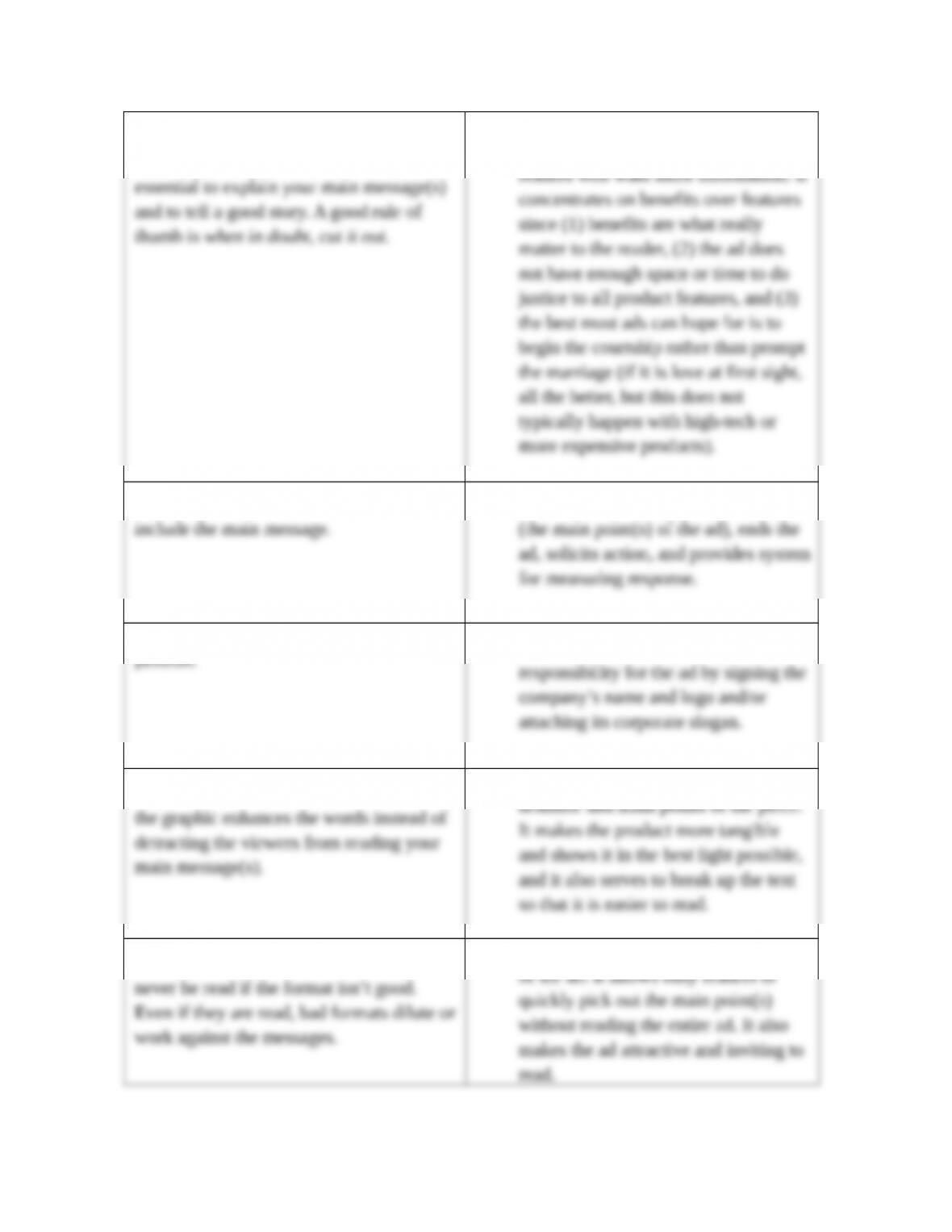
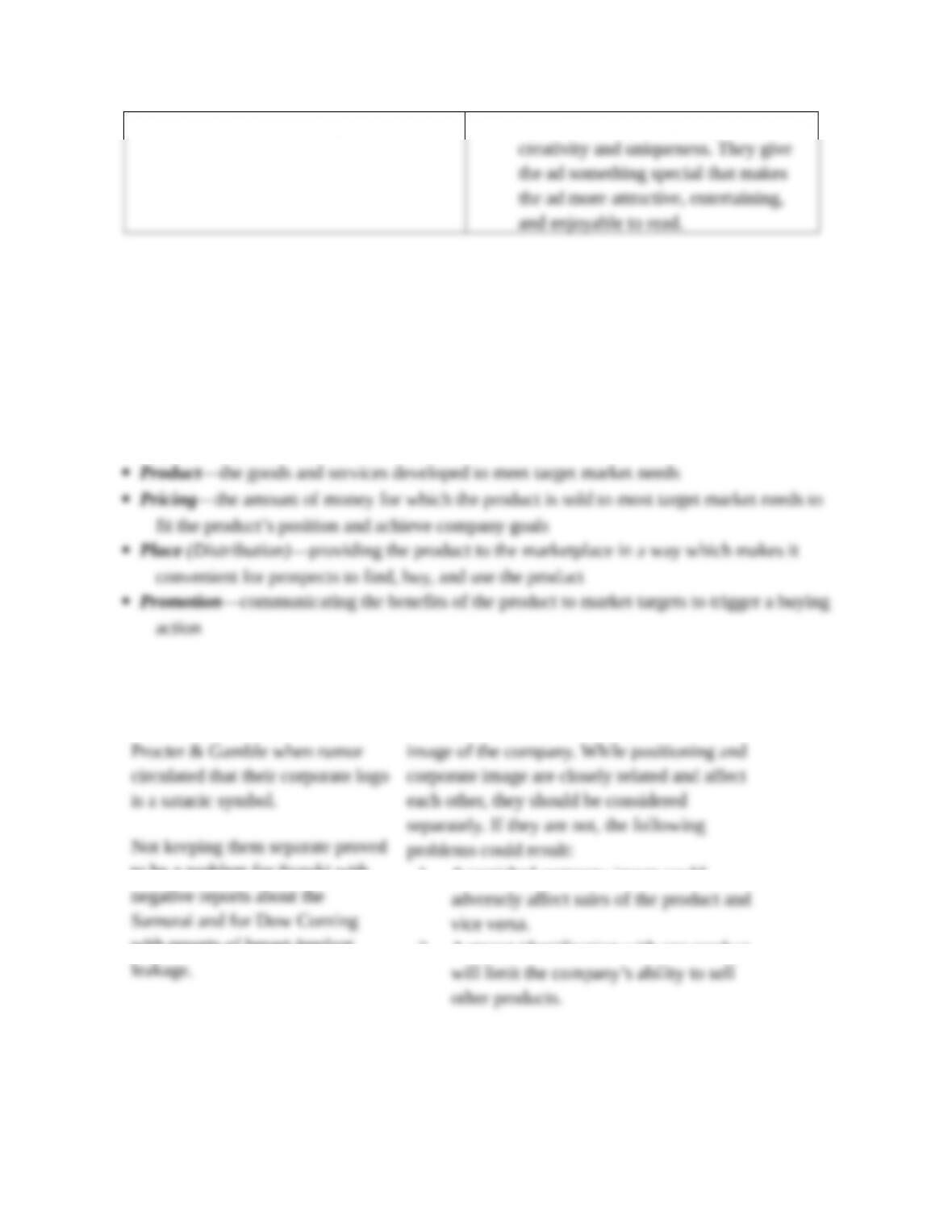
The Universal Marketing Structure™ is displayed in this table and on the following page.
Because five times as many people read
the headline compared to the rest of the
piece, the greatest effort and thought
should go into creating the headline.
The structure of a good ad (or any
marketing piece) follows the UMS™.
Headline—This part contains the main
message(s) of the piece or hooks the
reader into reading the main
© 2018 Cengage Learning. All Rights Reserved. May not be scanned, copied or duplicated, or posted to a publicly accessible website, in whole or in part.
Chapter 1: An Overview of Marketing
6
Body text should not be thought of as
filler. It should be limited to what is
Body Text—This part supports, clarifies,
and explains the headline for those
readers who want more information. It
The last point left with the reader should
Close—This part reinforces the headline
Similar to your signature on a letter or
petition. Signature—This part proudly takes
A picture is worth 1,000 words. Make sure
Photo/Graphic—This part reinforces the
headline and main points of the piece.
The best messages can be lost forever and
Format—This part facilitates the reading
of the ad. It allows busy readers to
© 2018 Cengage Learning. All Rights Reserved. May not be scanned, copied or duplicated, or posted to a publicly accessible website, in whole or in part.
Chapter 1: An Overview of Marketing
7
Intangibles—This part corresponds to
Marketing Principles
The following seven main principles are the building blocks of marketing: the Five Ps, Corporate
Image, and the Marketing Information System.
The Five Ps
Positioning—finding a unique image for the product (or a window) in the minds of prospects
(market targets)
Keeping corporate image and the
positioning of the product
separate proved important to
Corporate Image
Unlike positioning, which relates to the image
of the product, corporate image relates to the
1. A tarnished company image could
2. A strong identification with one product
to be a problem for Suzuki with
with reports of breast-implant
Marketing Information System (includes
Market Research)
© 2018 Cengage Learning. All Rights Reserved. May not be scanned, copied or duplicated, or posted to a publicly accessible website, in whole or in part.
Chapter 1: An Overview of Marketing
8
Market Intelligence—complaints,
Measure Performance—performance
Nancy Ryan McClure, University of Central Oklahoma
James L. Thomas, Jacksonville State University
Marketing in Action
Marketing majors and non-majors alike persist in thinking that marketing is selling. To overcome
The tour was designed to provide students with maximum exposure to some of the best in the
field of marketing. Each of the organizations involved developed extensive presentations within
their particular area of marketing specialization. The organizations that participated included the
This course was offered for two hours of either undergraduate or graduate credit (with
Fundamentals of Marketing as a prerequisite). The students stayed in the Dallas area in January
While there is nothing novel about field trips, the combination of organizations and the class
format permitted a more in-depth learning experience for the students than they could ever have
© 2018 Cengage Learning. All Rights Reserved. May not be scanned, copied or duplicated, or posted to a publicly accessible website, in whole or in part.
Chapter 1: An Overview of Marketing
9
had just reading a book. Unfortunately, the way most courses are designed, field trips are
It should be noted that the first time such a course is offered, a great deal of time and planning
must be devoted to the development of the course. The authors found that the process of simply
Rich Brown, Freed-Hardeman University
An Assignment That Ties the Principles of Marketing Course Together
The purpose of this assignment is to cause students to connect the different parts of the Principles
of Marketing course. The assignment is a three- to five-page paper. It begins with the
identification of a target market and ends with the student assuming the role of a marketing
consultant suggesting ways to improve the effectiveness of the marketing mix being used to
attract it. Feedback from students is overwhelmingly positive and indicates that completing the
assignment really helps them to “put it all together.” My written instructions to the students are
as follows:
1. Choose an organization that does marketing. Make it easy on yourself, and choose an
organization that you can observe the marketing efforts of and are familiar with. If you
2. After choosing an organization, your next step is to identify and describe the target market
© 2018 Cengage Learning. All Rights Reserved. May not be scanned, copied or duplicated, or posted to a publicly accessible website, in whole or in part.
Chapter 1: An Overview of Marketing
10
3. After discussing the target market, you should then discuss the marketing mix (the four Ps)
the firm is using to attract the chosen target market. You should describe each of the four
4. After discussing the firm’s marketing mix, you should assume the role of a marketing
consultant and make specific suggestions for improving the firm’s effectiveness. These
suggestions can be in the form of changes to any part of the current marketing mix to fix
the problems you identified. If you did not identify any problems, you should make
Sheri Carder, Lake City Community College
Lemonade from Lemons Marketing—Consumerism Exercise
As a consumer, you expect quality products and good service. But sometimes things go wrong. If
Consider yourself an active consumer. Choose a company or service with which you’ve recently
been disappointed. Write them a letter, using the following guidelines, to explain the problem
© 2018 Cengage Learning. All Rights Reserved. May not be scanned, copied or duplicated, or posted to a publicly accessible website, in whole or in part.
Chapter 1: An Overview of Marketing
11
We will make this a research project, measuring how responsive companies are to their
customers. Are companies really concerned with total quality? We will note the amount of time it
1. Describe the problem and what (if anything) you’ve already done to resolve it. List
pertinent information including the date and place of purchase, serial or model number, etc.
2. Send sales receipts, repair orders, warranties, etc. (copies, not originals) to make your case.
3. Don’t be angry or sarcastic. In fact, begin your letter with a compliment to the company,
e.g., “Colgate Palmolive products are central to any household. I have used your _____ for
five years and have been completely satisfied. That is why I was disappointed when the
_____ didn’t live up to the Colgate Palmolive standards I expected.”
© 2018 Cengage Learning. All Rights Reserved. May not be scanned, copied or duplicated, or posted to a publicly accessible website, in whole or in part.