POINT/COUNTER-POINT:
Should China Be Forced to Alter the Value of Its Currency?
POINT: U.S. politicians frequently suggest that China needs to increase the value of the Chinese yuan
against the U.S. dollar, even since China has allowed the yuan to float (within boundaries). The U.S.
politicians claim that the yuan is the cause of the large U.S. trade deficit with China. This issue is
periodically raised not only with currencies tied to the dollar, but also with currencies that have a floating
rate. Some critics argue that the exchange rate can be used as a form of trade protectionism. That is, a
country can discourage or prevent imports and encourage exports by keeping the value of its currency
artificially low.
COUNTER-POINT: China might counter that its large balance of trade surplus with the U.S. has been due
to the differences in prices between the two countries, and that it should not be blamed for the high U.S.
prices. It might argue that the U.S. trade deficit can be partially attributed to the very high prices in the
U.S., which are necessary to cover the excessive compensation for executives and other employees at U.S.
firms. The high prices in the U.S. encourage firms and consumers to purchase goods from China. Even if
China’s yuan is revalued upward, this does not necessarily mean that the U.S. firms and consumers will
purchase U.S. products. They may shift their purchases from China to purchase products in Indonesia or
other low–wage countries rather than buy more products from the U.S. Thus, the underlying dilemma is not
China, but any country that has lower costs of production than the U.S.
WHO IS CORRECT? Use the Internet to learn more about this issue. Which argument do you support?
Offer your own opinion on this issue.
ANSWER: The issue is important because it affects the potential degree of economic growth in the U.S.
Chapter Questions
1. Exchange Rate Systems. Compare and contrast the fixed, freely floating, and managed float exchange
rate systems. What are some advantages and disadvantages of a freely floating exchange rate system
versus a fixed exchange rate system?
ANSWER: Under a fixed exchange rate system, the governments attempted to maintain exchange
2. Intervention with Euros. Assume that Belgium, one of the European countries that uses the euro as its
currency, would prefer that its currency depreciate against the dollar. Can it apply central bank
intervention to achieve this objective? Explain.
© 2018 Cengage Learning. All Rights Reserved. May not be copied, scanned, or duplicated, in whole or in part, except for use as
permitted in a license distributed with a certain product or service or otherwise on a password-protected website for classroom use.
Government Influence on Exchange Rates 2
3. Direct Intervention. How can a central bank use direct intervention to change the value of a currency?
Explain why a central bank may desire to smooth exchange rate movements of its currency.
ANSWER: Central banks can use their currency reserves to buy up a specific currency in the foreign
4. Indirect Intervention. How can a central bank use indirect intervention to change the value of a
currency?
5. Intervention Effects. Assume there is concern that the United States may experience a recession. How
should the Federal Reserve influence the dollar to prevent a recession? How might U.S. exporters react
to this policy (favorably or unfavorably)? What about U.S. importing firms?
ANSWER: The Federal Reserve would normally consider a loose money policy to stimulate the
6. Currency Effects on Economy. What is the impact of a weak home currency on the home economy,
other things being equal? What is the impact of a strong home currency on the home economy, other
things being equal?
ANSWER: A weak home currency tends to increase a country’s exports and decrease its imports,
© 2018 Cengage Learning. All Rights Reserved. May not be copied, scanned, or duplicated, in whole or in part, except for use as
permitted in a license distributed with a certain product or service or otherwise on a password-protected website for classroom use.
Government Influence on Exchange Rates 3
7. Feedback Effects. Explain the potential feedback effects of a currency’s changing value on inflation.
ANSWER: A weak home currency can cause inflation since it tends to reduce foreign competition
8. Indirect Intervention. Why would the Fed’s indirect intervention have a stronger impact on some
currencies than others? Why would a central bank’s indirect intervention have a stronger impact than
its direct intervention?
ANSWER: Intervention may have a more pronounced impact when the market for a given currency is
9. Effects on Currencies Tied to the Dollar. The Hong Kong dollar’s value is tied to the U.S. dollar.
Explain how the following trade patterns would be affected by the appreciation of the Japanese yen
against the dollar: (a) Hong Kong exports to Japan and (b) Hong Kong exports to the United States.
ANSWER:
10. Intervention Effects on Bond Prices. U.S. bond prices are normally inversely related to U.S.
inflation. If the Fed planned to use intervention to weaken the dollar, how might bond prices be
affected?
© 2018 Cengage Learning. All Rights Reserved. May not be copied, scanned, or duplicated, in whole or in part, except for use as
permitted in a license distributed with a certain product or service or otherwise on a password-protected website for classroom use.
Government Influence on Exchange Rates 4
11. Direct Intervention in Europe. If most countries in Europe experience a recession, how might the
European Central Bank use direct intervention to stimulate economic growth?
12. Sterilized Intervention. Explain the difference between sterilized and nonsterilized intervention.
13. Effects of Indirect Intervention. Suppose that the government of Chile reduces one of its key interest
rates. The values of several other Latin American currencies are expected to change substantially
against the Chilean peso in response to the news.
a. Explain why other Latin American currencies could be affected by a cut in Chile’s interest rates.
b. How would the central banks of other Latin American countries be likely to adjust their interest
rates? How would the currencies of these countries respond to the central bank intervention?
c. How would a U.S. firm that exports products to Latin American countries be affected by the
central bank intervention? (Assume the exports are denominated in the corresponding Latin
American currency for each country.)
14. Freely Floating Exchange Rates. Should the governments of Asian countries allow their currencies to
float freely? What would be the advantages of letting their currencies float freely? What would be the
disadvantages?
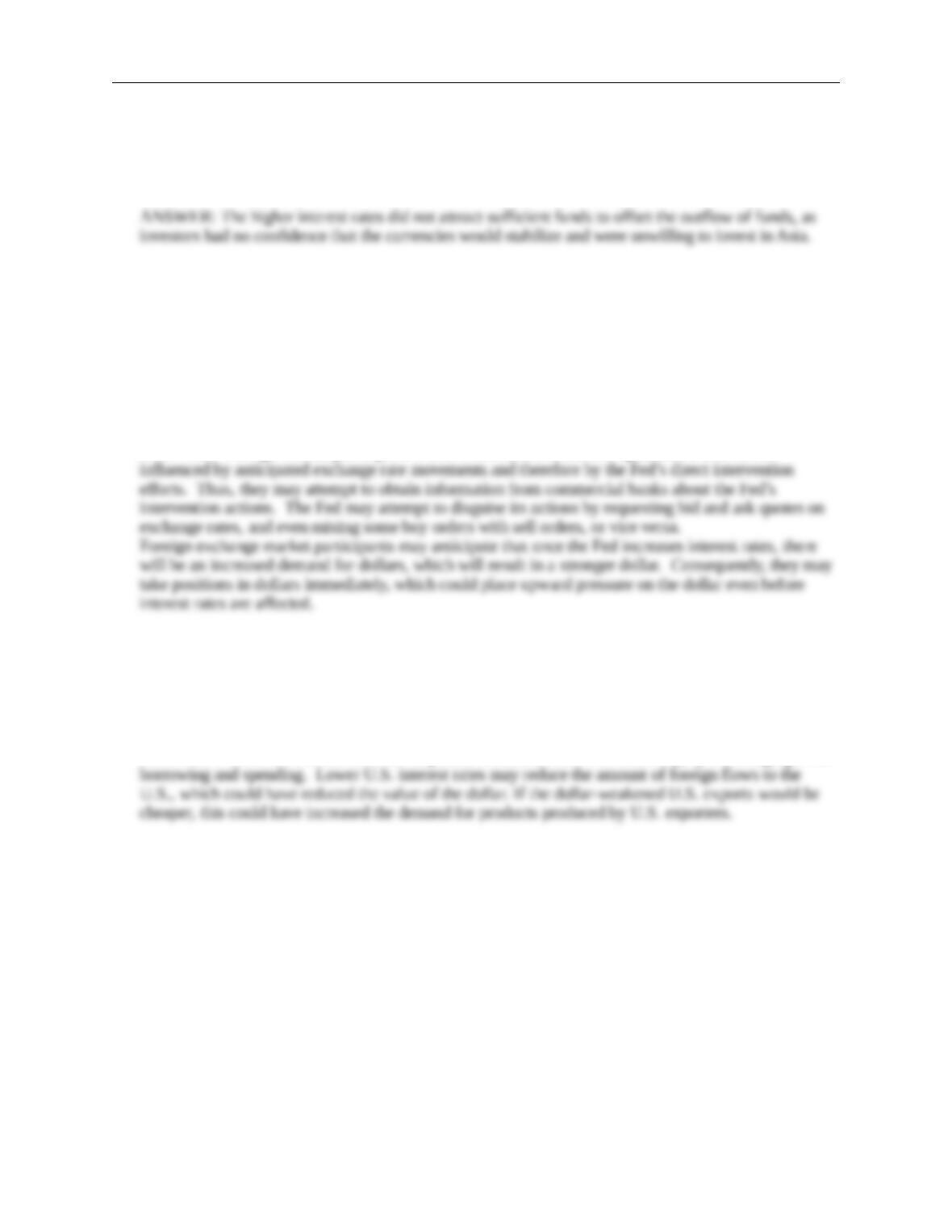
ANSWER: A freely floating currency may allow the exchange rate to adjust to market conditions,
© 2018 Cengage Learning. All Rights Reserved. May not be copied, scanned, or duplicated, in whole or in part, except for use as
permitted in a license distributed with a certain product or service or otherwise on a password-protected website for classroom use.
Government Influence on Exchange Rates 5
15. Indirect Intervention. During the Asian crisis (see Appendix 6 at the end of this chapter), some Asian
central banks raised their interest rates to prevent their currencies from weakening. Yet, the currencies
weakened anyway. Offer your opinion as to why the central banks’ efforts at indirect intervention did
not work.
Advanced Questions
16. Monitoring the Fed’s Intervention. Why do foreign market participants monitor the Fed’s direct
intervention efforts? How does the Fed attempt to hide its intervention actions? The media frequently
reports that “the dollar’s value strengthened against many currencies in response to the Federal
Reserve’s plan to increase interest rates.” Explain why the dollar’s value may change even before the
Federal Reserve affects interest rates.
ANSWER: Foreign market participants make investment and borrowing decisions that can be
17. Effects of September 11. Within a few days after the September 11, 2001 terrorist attack on the
U.S., the Federal Reserve reduced short-term interest rates in the U.S. to stimulate the U.S. economy.
How might this action have affected the foreign flow of funds into the U.S. and affected the value of the
dollar? How could such an effect on the dollar increase the probability that the U.S. economy would
strengthen?
ANSWER: The lower interest rates are expected to stimulate the U.S. economy, by encouraging more
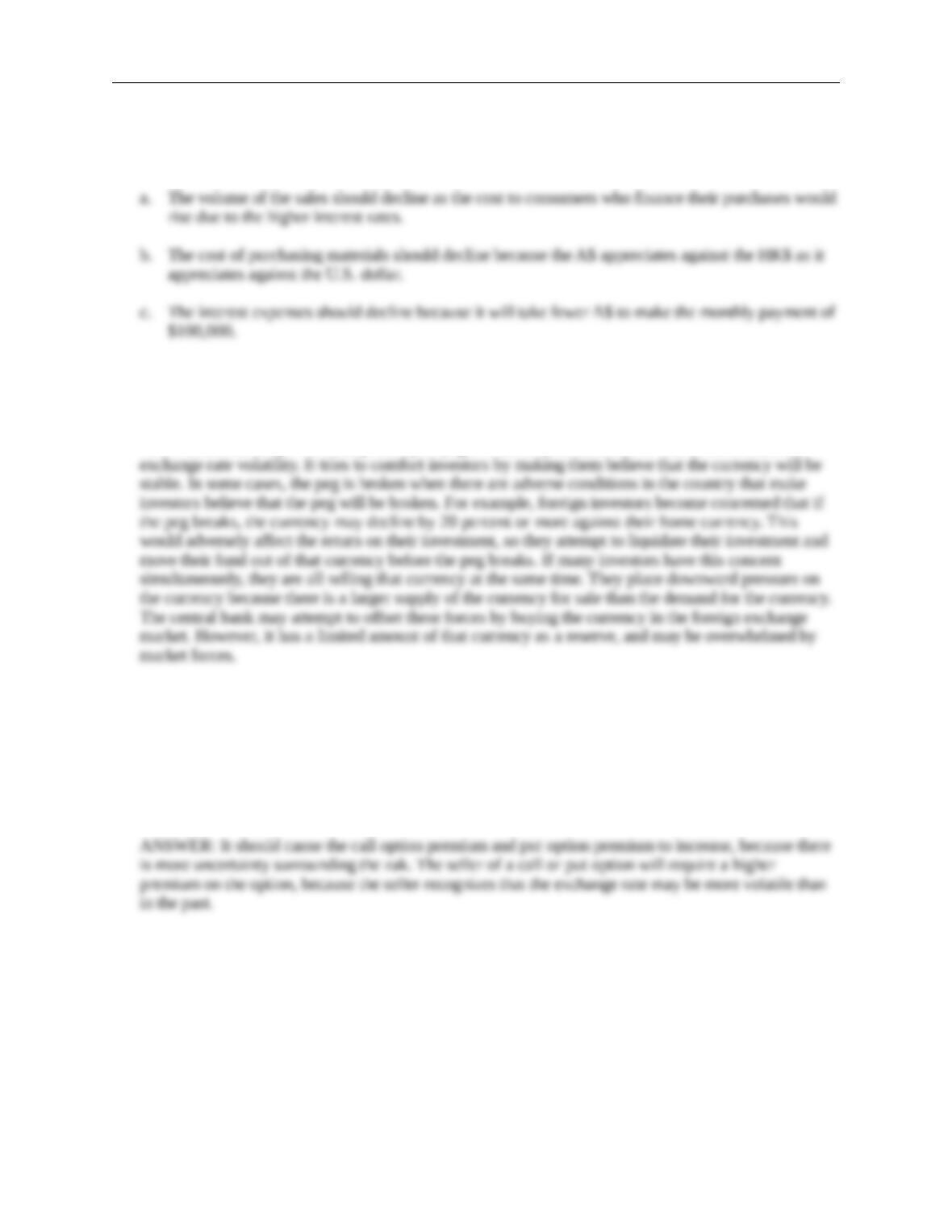
18. Intervention Effects on Corporate Performance. Assume you have a subsidiary in Australia. The
subsidiary sells mobile homes to local consumers in Australia, who buy the homes using mostly
borrowed funds from local banks. Your subsidiary purchases all of its materials from Hong Kong. The
Hong Kong dollar is tied to the U.S. dollar. Your subsidiary borrowed funds from the U.S. parent, and
must pay the parent $100,000 in interest each month. Australia has just raised its interest rate in order
to boost the value of its currency (Australian dollar, A$). The Australian dollar appreciates against the
dollar as a result. Explain whether these actions would increase, reduce, or have no effect on:
a. The volume of your subsidiary’s sales in Australia (measured in A$)
b. The cost to your subsidiary of purchasing materials (measured in A$)
c. The cost to your subsidiary of making the interest payments to the U.S. parent (measured in A$).
© 2018 Cengage Learning. All Rights Reserved. May not be copied, scanned, or duplicated, in whole or in part, except for use as
permitted in a license distributed with a certain product or service or otherwise on a password-protected website for classroom use.
Government Influence on Exchange Rates 6
Briefly explain each answer.
ANSWER:
19. Pegged Currencies. Why do you think a country suddenly decides to peg its currency to the dollar or
some other currency? When a currency is unable to maintain the peg, what do you think are the typical
forces that break the peg?
ANSWER: A country will usually attempt a peg to reduce speculative flows that occur because of
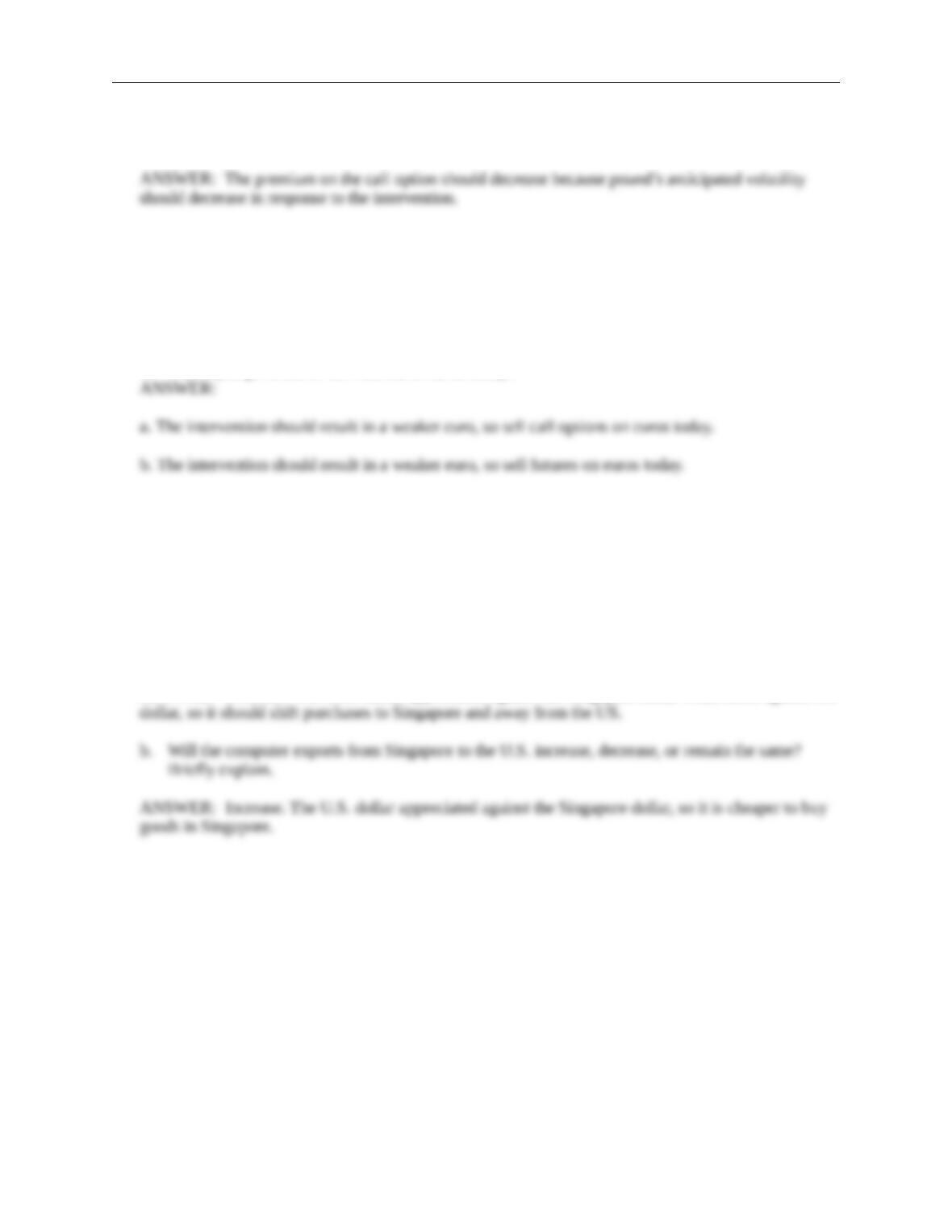
20. Impact of Intervention on Currency Option Premiums. Assume that the central bank of the country
Zakow periodically intervenes in the foreign exchange market to prevent large upward or downward
fluctuations in its currency (the zak) against the U.S. dollar. Today, the central bank announced that it
would no longer intervene in the foreign exchange market. The spot rate of the zak against the dollar
was not affected by this news. Will the news affect the premium on currency call options that are traded
on the zak? Will the news affect the premium on currency put options that are traded on the zak?
Explain.
21. Impact of Information on Currency Option Premiums. As of 10:00 a.m., the premium on a specific
one-year call option on British pounds is $.04. Assume that the Bank of England had not been
intervening in the foreign exchange markets in the last several months. However, it announces at 10:01
a.m. that it will begin to frequently intervene in the foreign exchange market in order to reduce
fluctuations in the pound’s value against the dollar over the next year, but it will not attempt to push the
pound’s value higher or lower than what is dictated by market forces. Also, the Bank of England has no
plans to affect economic conditions with this intervention. Most participants who trade currency
options did not anticipate this announcement. When they heard the announcement, they expected that
© 2018 Cengage Learning. All Rights Reserved. May not be copied, scanned, or duplicated, in whole or in part, except for use as
permitted in a license distributed with a certain product or service or otherwise on a password-protected website for classroom use.
Government Influence on Exchange Rates 7
the intervention would be successful in achieving its goal. Will this announcement cause the premium
on the one-year call option on British pounds to increase, decrease, or to be unaffected? Explain.
22. Speculating Based on Intervention. Assume that you expect that the European central bank (ECB)
plans to engage in central bank intervention in which it plans to use euros to purchase a substantial
amount of U.S. dollars in the foreign exchange market over the next month. Assume that this direct
intervention is expected to be successful at influencing the exchange rate.
a. Would you purchase or sell call options on euros today?
b. Would you purchase or sell futures on euros today?
23. Implications of a Fixed Currency for International Trade. Assume the Hong Kong dollar
(HK$) value is tied to the U.S. dollar and will remain tied to the U.S. dollar. Last month, a HK$ =
0.25 Singapore dollars. Today, a HK$=0.30 Singapore dollars. Assume that there is much trade in the
computer industry among Singapore, Hong Kong, and the U.S. and that all products are viewed as
substitutes for each other and are of about the same quality. Assume that the firms invoice their
products in their local currency and do not change their prices.
a. Will the computer exports from the U.S. to Hong Kong increase, decrease, or remain the same?
Briefly explain.
ANSWER: Decrease. The H.K. dollar appreciated against the Singapore dollar while fixed against US
24. Implications of a Revised Peg. The country of Zapakar has much international trade with the
U.S. and other countries, as it has no significant barriers on trade or capital flows. Many firms in
Zapakar export common products (denominated in zaps) that serve as substitutes for products
produced in the U.S. and many other countries. Zapakar’s currency (called the zap) has been pegged at
8 zaps =$1 for the last several years. Yesterday, the government of Zapakar reset the zap’s currency
value so that is now pegged at 7 zaps=$1.
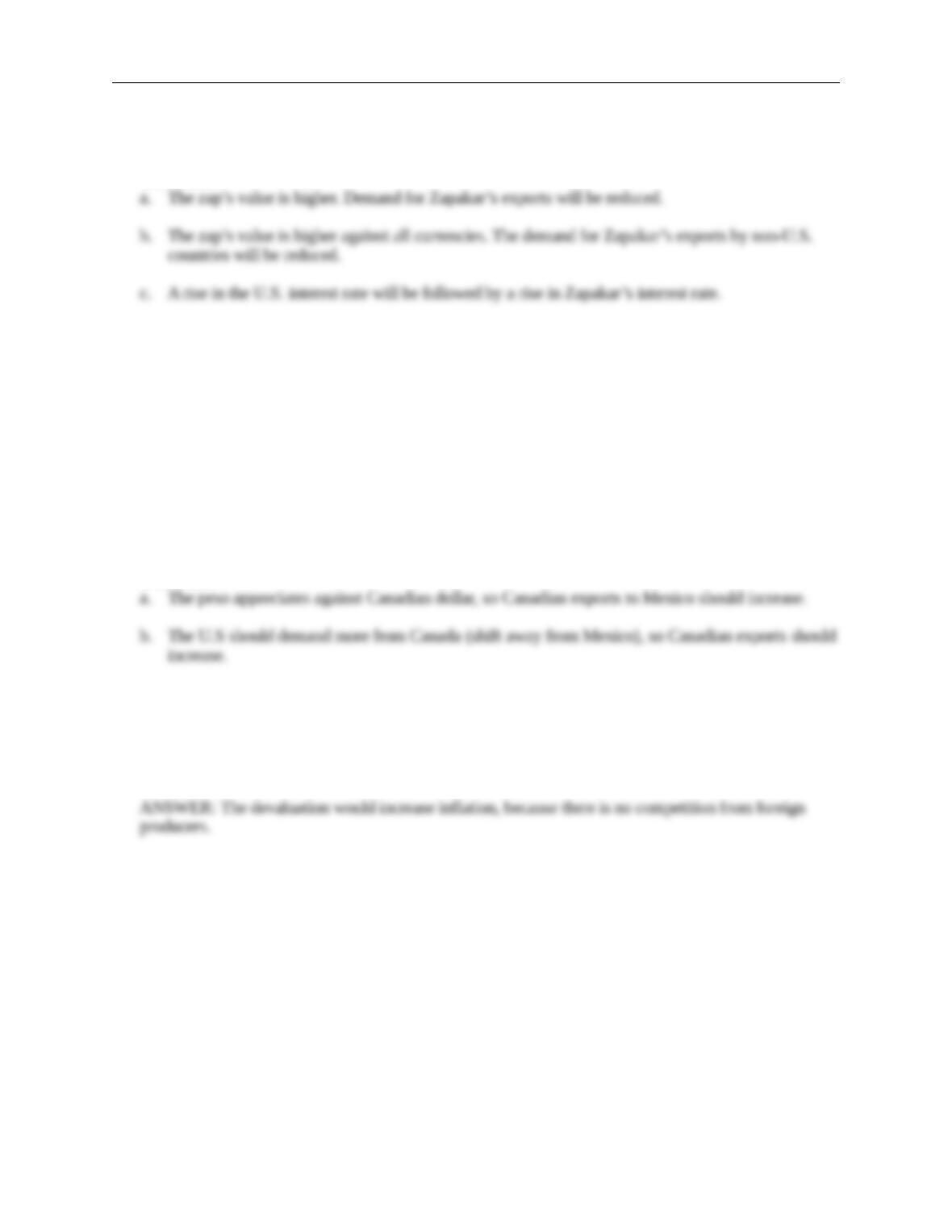
a. How should this adjustment in the pegged rate against the dollar affect the volume of exports by
Zapakar firms to the U.S.?
b. Will this adjustment in the pegged rate against the dollar affect the volume of exports by Zapakar
firms to non–U.S. countries? If so, explain.
© 2018 Cengage Learning. All Rights Reserved. May not be copied, scanned, or duplicated, in whole or in part, except for use as
permitted in a license distributed with a certain product or service or otherwise on a password-protected website for classroom use.
Government Influence on Exchange Rates 8
c. Assume that the Federal Reserve significantly raises U.S. interest rates today. Do you think
Zapakar’s interest rate would increase, decrease, or remain the same?
ANSWER:
25. Pegged Currency and International Trade. Assume that Canada decides to peg its currency (the
Canadian dollar) to the U.S. dollar and that the exchange rate will remain fixed. Assume that Canada
commonly obtains its imports from the U.S. and Mexico. The U.S. commonly obtains its imports from
Canada and Mexico. Mexico commonly obtains its imports from the U.S. and Canada. The traded
products are always invoiced in the exporting country’s currency. Assume that the Mexican peso
appreciates substantially against the U.S. dollar during the next year.
a. What is the likely effect (if any) of the peso’s exchange rate movement on the volume of Canada’s
exports to Mexico? Explain.
b. What is the likely effect (if any) of the peso’s exchange rate movement on the volume of Canada’s
exports to the U.S.? Explain.
ANSWER:
26. Impact of Devaluation. The inflation rate in Yinland was 14% last year. The government of Yinland
just devalued its currency (the yin) by 40 % against the dollar. Even though it produces similar types of
products as the U.S., it has much trade with the U.S. and very little trade with other countries. It
presently has trade restrictions imposed on all non-U.S. countries. Will the devaluation of the yin
increase or reduce inflation in Yinland? Briefly explain.
© 2018 Cengage Learning. All Rights Reserved. May not be copied, scanned, or duplicated, in whole or in part, except for use as
permitted in a license distributed with a certain product or service or otherwise on a password-protected website for classroom use.