POINT/COUNTER-POINT:
Should Firms That Go Public Engage in International Offerings?
POINT: Yes. When a U.S. firm issues stock to the public for the first time in an initial public offering
(IPO), it is naturally concerned about whether it can place all of its shares at a reasonable price. It will be
able to issue its stock at a higher price by attracting more investors. It will increase its demand by
spreading the stock across countries. The higher the price at which it can issue stock, the lower is its cost of
using equity capital. It can also establish a global name by spreading stock across countries.
COUNTER-POINT: No. If a U.S. firm spreads its stock across different countries at the time of the IPO,
there will be less publicly–traded stock in the U.S. Thus, it will not have as much liquidity in the secondary
market. Investors desire stocks that they can easily sell in the secondary market, which means that they
require that the stocks have liquidity. To the extent that a firm reduces its liquidity in the U.S. by spreading
its stock across countries, it may not attract sufficient U.S. demand for the stock in the U.S. Thus, its
efforts to create global name recognition may reduce its name recognition in the U.S.
WHO IS CORRECT? Use the Internet to learn more about this issue. Which argument do you support?
Offer your own opinion on this issue.
Answers to End of Chapter Questions
1. Motives for Investing in Foreign Money Markets. Explain why an MNC may invest funds in a
financial market outside its own country.
2. Motives for Providing Credit in Foreign Markets. Explain why some financial institutions prefer to
provide credit in financial markets outside their own country.
3. Exchange Rate Effects on Investing. Explain how the appreciation of the Australian dollar against the
U.S. dollar would affect the return to a U.S. firm that invested in an Australian money market security.
© 2018 Cengage Learning. All Rights Reserved. May not be copied, scanned, or duplicated, in whole or in part, except for use as
permitted in a license distributed with a certain product or service or otherwise on a password-protected website for classroom use.
International Financial Markets 2
4. Exchange Rate Effects on Borrowing. Explain how the appreciation of the Japanese yen against the
U.S. dollar would affect the return to a U.S. firm that borrowed Japanese yen and used the proceeds for
a U.S. project.
5. Bank Services. List some of the important characteristics of bank foreign exchange services that
MNCs should consider.
6. Bid/ask Spread. Utah Bank’s bid price for Canadian dollars is $.7938 and its ask price is $.81. What
is the bid/ask percentage spread?
7. Bid/ask Spread. Compute the bid/ask percentage spread for Mexican peso retail transactions in which
the ask rate is $.11 and the bid rate is $.10.
8. Forward Contract. The Wolfpack Corporation is a U.S. exporter that invoices its exports to the
United Kingdom in British pounds. If it expects that the pound will appreciate against the dollar in the
future, should it hedge its exports with a forward contract? Explain.
9. Euro. Explain the foreign exchange situation for countries that use the euro when they engage in
international trade among themselves.
10. Indirect Exchange Rate. If the direct exchange rate of the euro is $1.25, what is the euro’s indirect
exchange rate? That is, what is the value of a dollar in euros?
11. Cross Exchange Rate. Assume Poland’s currency (the zloty) is worth $.17 and the Japanese yen is
worth $.008. What is the cross rate of the zloty with respect to yen? That is, how many yen equal a
zloty?
12. Syndicated Loans. Explain how syndicated loans are used in international markets.
© 2018 Cengage Learning. All Rights Reserved. May not be copied, scanned, or duplicated, in whole or in part, except for use as
permitted in a license distributed with a certain product or service or otherwise on a password-protected website for classroom use.
International Financial Markets 3
13. Loan Rates. Explain the process used by banks in the Eurocredit market to determine the rate to
charge on loans.
14. International Markets. What is the function of the international money market? Briefly describe the
reasons for the development and growth of the European money market. Explain how the international
money, credit, and bond markets differ from one another.
15. Evolution of Floating Rates. Briefly describe the historical developments that led to floating exchange
rates as of 1973.
16. Greece Credit Crisis. Explain why the Greece credit crisis can cause contagion effects throughout
Europe.
17. Eurocredit Loans.
a. With regard to Eurocredit loans, who are the borrowers?
b. Why would a bank desire to participate in syndicated Eurocredit loans?
c. What is LIBOR and how is it used in the Eurocredit market?
ANSWER:
© 2018 Cengage Learning. All Rights Reserved. May not be copied, scanned, or duplicated, in whole or in part, except for use as
permitted in a license distributed with a certain product or service or otherwise on a password-protected website for classroom use.
International Financial Markets 4
18. Foreign Exchange. You just came back from Canada, where the Canadian dollar was worth $.70. You
still have C$200 from your trip and could exchange them for dollars at the airport, but the airport
foreign exchange desk will only buy them for $.60. Next week, you will be going to Mexico and will
need pesos. The airport foreign exchange desk will sell you pesos for $.10 per peso. You met a tourist
at the airport who is from Mexico and is on his way to Canada. He is willing to buy your C$200 for
1,300 pesos. Should you accept the offer or cash the Canadian dollars in at the airport? Explain.
19. Foreign Stock Markets. Explain why firms may issue stock in foreign markets. Why might U.S.
firms issue more stock in Europe since the conversion to the euro in 1999?
20. Financing With Stock. Chapman Co. is a privately owned MNC in the U.S. that plans to engage in an
initial public offering (IPO) of stock, so that it can finance its international expansion. At the present time,
world stock market conditions are very weak but are expected to improve. The U.S. market tends to be
weak in periods when the other stock markets around the world are weak. A financial
manager of Chapman Co. recommends that it wait until the world stock markets recover before it issues
stock. Another manager believes that Chapman Co. could issue its stock now even if the price would be
low, since its stock price should rise later once world stock markets recover. Who is correct? Explain.
Advanced Questions
21. Effects of September 11. Why do you think the terrorist attack on the U.S. was expected to cause a
decline in U.S. interest rates? Given the expectations for a potential decline in U.S. interest rates and
stock prices, how were capital flows between the U.S. and other countries likely affected?
© 2018 Cengage Learning. All Rights Reserved. May not be copied, scanned, or duplicated, in whole or in part, except for use as
permitted in a license distributed with a certain product or service or otherwise on a password-protected website for classroom use.
International Financial Markets 5
22. International Financial Markets. Walmart established two retail outlets in the city of Shanzen, China,
which has a population of 3.7 million. These outlets are massive and contain imports in addition to
products purchased locally. As Walmart generates earnings beyond what it needs in Shanzen, it may
remit those earnings back to the United States. Walmart is likely to build additional outlets in Shanzen
or in other Chinese cities in the future.
a. Explain how the Walmart outlets in China would use the spot market in foreign exchange.
b. Explain how Walmart might utilize the international money market when it is establishing other
Walmart stores in Asia.
c. Explain how Walmart could use the international bond market to finance the establishment of new
outlets in foreign markets.
23. Interest Rates. Why do interest rates vary among countries? Why are interest rates normally similar
for those European countries that use the euro as their currency? Offer a reason why the government
interest rate of one country could be slightly higher than the government interest rate of another
country, even though the euro is the currency used in both countries.
24. Interpreting Exchange Rate Quotations. Today you notice the following exchange rate quotations:
*$1 is equal to 3.00 Argentine pesos
*1 Argentine peso = 0.50 Canadian dollars
*You need to purchase 100,000 Canadian dollars with U.S. dollars. How many U.S. dollars will you
need for your purchase?
25. Pricing ADRs. Today, the stock price of Genevo Company (based in Switzerland) is priced at SF80
per share. The spot rate of the Swiss franc (SF) is $.70. During the next year, you expect that the stock
© 2018 Cengage Learning. All Rights Reserved. May not be copied, scanned, or duplicated, in whole or in part, except for use as
permitted in a license distributed with a certain product or service or otherwise on a password-protected website for classroom use.
International Financial Markets 6
price of Genevo Company will decline by 3%. You also expect that the Swiss franc will depreciate
against the U.S. dollar by 8% during the next year. You own American depository receipts (ADRs) that
represent Genevo stock. Each share that you own represents one share of the stock traded on the Swiss
stock exchange. What is the estimated value of the ADR per share in one year?
26. Explaining Variation in Bid/Ask Spreads. Go to the currency converter at
http://finance.yahoo.com/currency and determine the bid/ask spread for the euro. Then determine the
bid/ask spread for a currency in a less developed country. Why do you think is the main reason for the
difference in the bid/ask spreads between these two currencies?
27. Direct Versus Indirect Exchange Rates. Assume that during this semester, the euro appreciated
against the dollar. Did the direct exchange rate of the euro increase or decrease? Did the indirect
exchange rate of the euro increase or decrease?
28. Transparency and Stock Trading Activity. Explain the relationship between transparency of firms
and investor participation (or trading activity) among stock markets. Based on this relationship, how
can governments of countries increase the amount of trading activity (and therefore liquidity) of their
stock markets?
29. How Governance Affects Stock Market Liquidity. Identify some of the key factors that can allow for
stronger governance and therefore increase participation and trading activity in a stock market.
© 2018 Cengage Learning. All Rights Reserved. May not be copied, scanned, or duplicated, in whole or in part, except for use as
permitted in a license distributed with a certain product or service or otherwise on a password-protected website for classroom use.
International Financial Markets 7
30. International Impact of the Credit Crisis. Explain how the international integration of financial
markets caused the credit crisis to spread across many countries.
31. Issuing Stock in Foreign Markets. Bloomington Co. is a large U.S.-based MNC with large
subsidiaries in Germany. It has issued stock in Germany in order to establish its business. It could have
issued stock in the U.S. and then used the proceeds in order to support the growth in Europe. What is a
possible advantage of issuing the stock in Germany to finance German operations? Also, why might the
German investors prefer to purchase the stock that was issued in Germany rather than purchase the
stock of Bloomington on a U.S. stock exchange?
32. Interest Rates Among Countries. As of today, the interest rate in Countries X, Y, and Z, are similar.
In the next month, Country X is expected to have a weak economy, while Countries Y and Z are
expected to experience a 6% increase in economic growth. However, conditions this month will also
cause an increase in default risk of borrowers in Country Z in the next month because of political
concerns, while the default risk of Countries X and Y remain unchanged. During the next month, which
country should have the highest interest rate? Which country should have the lowest interest rate?
33. Greece Bailout Negotiations. In July 2015, Greece was negotiating to obtain its third bailout from
several European governments over a five–year period. Greece argued that austerity measures should
not be imposed. Offer some reasoning for this argument.
The European governments insisted on very strict austerity measures as a condition for providing
loans. Offer some reasoning for the very strict austerity measures.
CRITICAL THINKING
© 2018 Cengage Learning. All Rights Reserved. May not be copied, scanned, or duplicated, in whole or in part, except for use as
permitted in a license distributed with a certain product or service or otherwise on a password-protected website for classroom use.
International Financial Markets 8
Impact of Shareholder Rights and Accounting Laws Select a country outside the U.S. and conduct an
online search of the country’s shareholder rights or accounting laws. Write a short essay in which you briefly
describe the shareholder rights or accounting laws of that country. Would you consider investing in stocks of
firms in that country based on your review of this country? Do you believe that the shareholder rights and
accounting laws have encouraged the development of the stock market in this country? Explain.
ANSWER
Solution to Continuing Case Problem: Blades, Inc.
1. One point of concern for you is that there is a tradeoff between the higher interest rates in Thailand and
the delayed conversion of baht into dollars. Explain what this means.
2. If the net baht received from the Thailand operation are invested in Thailand, how will U.S. operations
be affected? (Assume that Blades is currently paying 10 percent on dollars borrowed, and needs more
financing for its firm.)
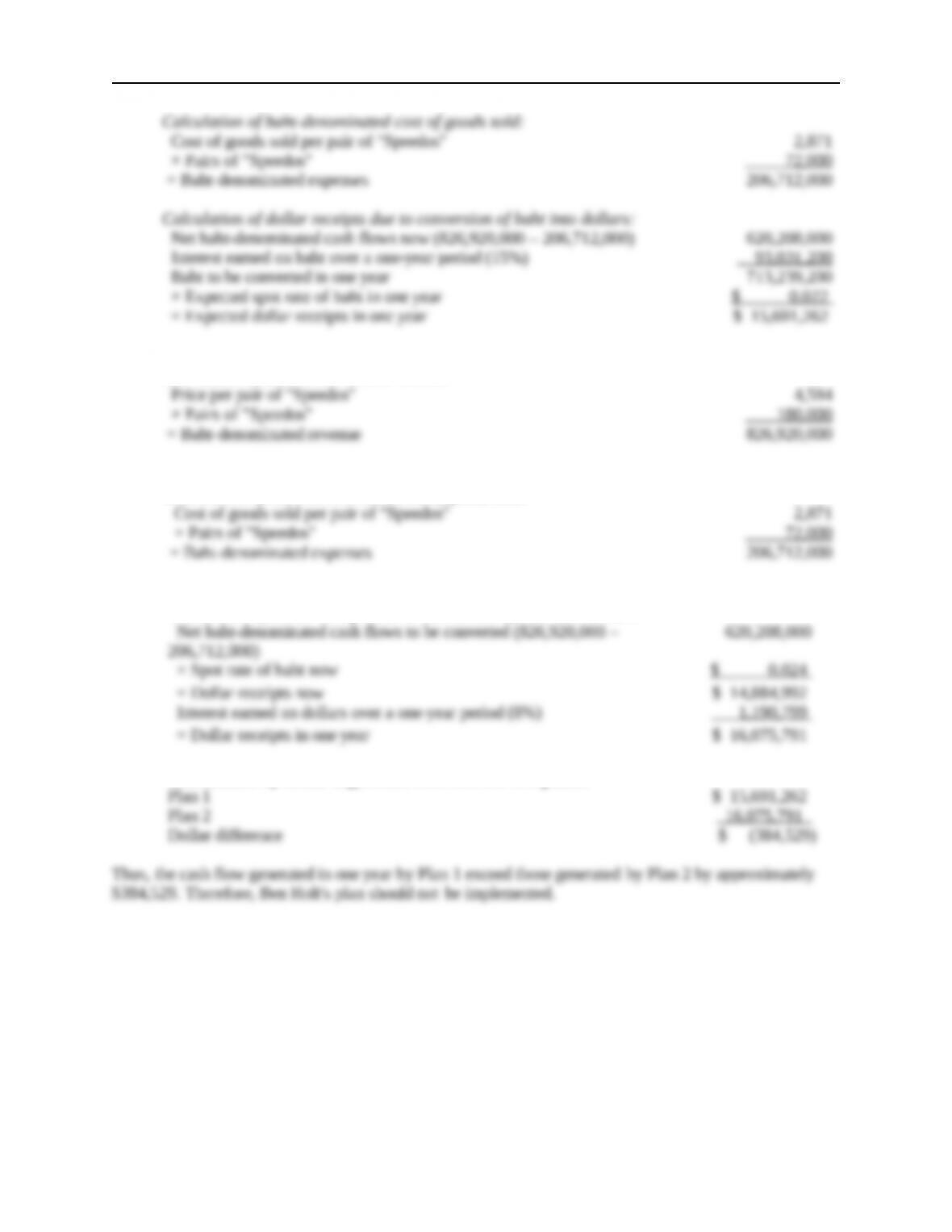
3. Construct a spreadsheet that compares the cash flows resulting from two plans. Under the first plan,
net baht-denominated cash flows (received today) will be invested in Thailand at 15 percent for a one–
year period, after which the baht will be converted to dollars. The expected spot rate for the baht in one
year is about $0.022 (Ben Holt’s plan). Under the second plan, net baht-denominated cash flows are
converted to dollars immediately and invested in the U.S. for one year at 8 percent. For this question,
assume that all baht-denominated cash flows are due today. Does Holt’s plan seem superior in terms of
dollar cash flows available after one year? Compare the choice of investing the funds versus using the
funds to provide needed financing to the firm.
© 2018 Cengage Learning. All Rights Reserved. May not be copied, scanned, or duplicated, in whole or in part, except for use as
permitted in a license distributed with a certain product or service or otherwise on a password-protected website for classroom use.
International Financial Markets 9
Plan 2—Immediate Conversion
Calculation of baht-denominated revenue:
Calculation of baht-denominated cost of goods sold:
Calculation of dollar receipts due to conversion of baht into dollars:
Calculation of dollar difference between the two plans:
Solution to Supplemental Case: Gretz Tool Company
a. Citicorp could facilitate the following financial transactions:
1. Foreign Exchange. Citicorp could provide whatever currency was needed by Gretz in the foreign
exchange market.
© 2018 Cengage Learning. All Rights Reserved. May not be copied, scanned, or duplicated, in whole or in part, except for use as
permitted in a license distributed with a certain product or service or otherwise on a password-protected website for classroom use.
International Financial Markets 10
2. Short-Term Financing. Citicorp could provide short-term loans to Gretz in whatever currency is
desired through the international money market. (Citicorp would be the creditor here.) Citicorp
could also accept short-term deposits in various currencies through the international money market.
3. Medium-Term Financing. Citicorp could provide medium-term loans to Gretz in whatever
currency is desired through the international credit market (Citicorp would be the creditor here).
4. Long-Term Financing. Citicorp could place bonds issued by Gretz in the international bond market
(Citicorp would normally serve as an intermediary rather than the creditor here). Citicorp could
also help Gretz place newly issued stock in foreign stock markets.
b. Normally, a subsidiary would prefer to borrow the currency that it uses to invoice its products. Thus,
the future cash inflows would be in the same currency that is needed to pay back the loan, and
exchange rate risk is avoided. Since the British subsidiary probably invoices its products in British
pounds, this is the logical currency to borrow.
However, the high interest rate on the British pound may cause the subsidiary to consider borrowing a
different currency. Yet, it must recognize the risk involved. The currency borrowed would initially be
converted to pounds. At a future point in time, pounds will be converted to that currency to repay the
loan. Thus, the risk is that the currency borrowed appreciates against the franc over the period of
concern. This concept is covered in detail in later chapters. At this point, the objective is to simply
make the student aware of the possible alternatives and the risk-return tradeoff involved.
Small Business Dilemma
Use of the Foreign Exchange Markets by the Sports Exports Company
1. Explain how the Sports Exports Company could utilize the spot market to facilitate the exchange of
currencies. Be specific.
2. Explain how the Sports Exports Company is exposed to exchange rate risk and how it could use the
forward market to hedge this risk.
© 2018 Cengage Learning. All Rights Reserved. May not be copied, scanned, or duplicated, in whole or in part, except for use as
permitted in a license distributed with a certain product or service or otherwise on a password-protected website for classroom use.