23. Impact of Country Perspective on Target Valuation. Targ Co. of the U.S. has been targeted by
3 firms that consider acquiring it: (1) Americo (from the U.S.), Japino (of Japan), and Canzo (of
Canada). These 3 firms do not have any other international business, have similar risk levels, and have
a similar capital structure. Each of the 3 potential acquirers has derived similar expected dollar cash
flow estimates for Targ Co. The long-term risk free interest rate is 6% in the U.S.. 9% in Canada, and
3% in Japan. The stock market conditions are similar in each of the countries. There are no potential
country risk problems that would result from acquiring Targ Co. All potential acquirers expect that the
Canadian dollar will appreciate by 1 percent a year against the U.S. dollar and will be stable against the
Japanese yen. Which firm will likely have the highest valuation of Targ Co.? Explain.
24. Valuation of a Foreign Target. Gaston Co. (a U.S. firm) is considering the purchase of a target
company based in Mexico. The net cash flows to be generated by this target firm are expected to be
300 million pesos at the end of one year. The existing spot rate of the peso is $.14, while the expected
spot rate in one year is $.12. All cash flows will be remitted to the parent at the end of one year. In
addition, Gaston hopes to sell the company for 800 million pesos (after taxes) at the end of one year.
The target has 10 million shares outstanding. If Gaston purchases this target, it would require a 25
percent return. The maximum value that Gaston should pay for this target company today is ____
pesos per share. Show your work.
ANSWER:
25. Divestiture of a Foreign Subsidiary. Rudecki Co. (a U.S. firm) has a Polish subsidiary that is
considering divesting. This subsidiary is completely focused on research and development for
Rudecki’s other business. Rudecki has cash outflows (paid in zloty, the Polish currency) for the
laboratories and scientists in Poland. Although the subsidiary does not generate any sales, its research
and development lead to new products and higher sales of products that are solely in the U.S. and are
denominated in dollars. There is no foreign competition. Last week, a firm offered to purchase the
subsidiary for $10 million, and the offer is still available. Today Rudecki has revised its forecasts of
the zloty upward for all future periods. Will today’s adjustment in exchange rate forecasts increase,
decrease, or have no effect on the net present value of a divestiture of this subsidiary from Rudecki’s
perspective? Briefly explain. [Keep in mind that the NPV of the divestiture is not the same as the
NPV that results from acquiring a project.]
26. Poison Pills and Takeovers. Explain how a foreign target could use poison pills to prevent a takeover
or change the terms of a takeover.
© 2018 Cengage Learning. All Rights Reserved. May not be copied, scanned, or duplicated, in whole or in part, except for use as
permitted in a license distributed with a certain product or service or otherwise on a password-protected website for classroom use.
International Corporate Governance and Control 2
27. Governance of MNCs by Shareholders. Explain the various ways in which large shareholders can
attempt to govern an MNC and improve its management.
28. Divestiture of a Foreign Subsidiary. Ved Co. (a U.S. firm) has a subsidiary in Germany that
generates substantial earnings in euros each year. It will soon decide whether to divest the subsidiary.
One week ago, a company offered to purchase the subsidiary from Ved Co., and Ved has not yet
responded to this offer.
a. Since last week, the expected stream of euro cash flows has not changed, but the forecasts of the
euro’s value in future periods have been revised downward. When deciding whether a divestiture
is feasible, Ved Co. estimates the NPV of the divestiture. Will Ved’s estimated NPV of the
divestiture be larger or smaller or the same as it was last week? Briefly explain.
b. If the long-term interest rate in the U.S. suddenly declines, and all other factors are unchanged, will
the NPV of the divestiture be larger or smaller or the same as it was last week? Briefly explain.
ANSWER:
29. Valuation of a Planned Divestiture. Dallen Co. has a subsidiary in Mexico that does research and
development and produces prescription pills that are transported to and sold in the U.S. The parent
used its own funds to build the subsidiary. Dallen Co. pays for the operations in Mexico in Mexican
pesos, but all of its revenue from selling the pills in the U.S. is in dollars. It has no other international
business. Dallen’s competitors are local firms in the U.S. that have no international operations. Two
days ago, Dallen received an offer from a firm to buy Dallen’s subsidiary, and the offer is in effect for
a few days.
a. Yesterday, an event occurred that makes the parent of Dallen Co. believe that the Mexican peso
will weaken substantially in the future. Do you think the event that occurred yesterday will
increase, decrease, or have no impact on the likelihood that Dallen will accept the offer and sell
its subsidiary at the existing offer price? Briefly explain.
© 2018 Cengage Learning. All Rights Reserved. May not be copied, scanned, or duplicated, in whole or in part, except for use as
permitted in a license distributed with a certain product or service or otherwise on a password-protected website for classroom use.
International Corporate Governance and Control 3
b. Today, an event occurred that caused the risk-free interest rate in the U.S. to increase. Do you
think the event that just occurred today will increase, decrease, or have no impact on the
likelihood that Dallen will accept the offer and sell its subsidiary at the existing offer price?
Briefly explain.
30. Divestiture Decision. Kylee Co. (a U.S. firm) has a British subsidiary that will generate cash flows of
3 million pounds at the end of each of the next two years. It uses the prevailing spot rate of the British
pound of $1.80 as a forecast of the future value of the pound. Its required rate of return on this
business is 16 percent. Kylee just received an offer from a British company who wants to buy the
subsidiary for $8,000,000. Assume that Kylee would not be subject to any tax on the sale.
a. Should Kylee Co. sell the business? Show your work.
ANSWER:
Year 1 Year 2
b. Assume that there is news today that causes Kylee to think that the British pound will strengthen
substantially the next two years. Assume the offer price remains unchanged. If Kylee reassesses
whether to divest based on this information, do you think the potential news will increase the net
present value of the divestiture (make the divestiture more beneficial for Kylee), reduce the net
present value of the divestiture, or have no impact on the estimated net present value of the
divestiture? Briefly explain.
c. Assume that today the prevailing long-term U.S. risk-free interest rate decreased, and that this has
no effect on Kylee’s cash flows from operations. Assume the offer price remains unchanged. Do
you think this information about the decline in the U.S. risk-free interest rate will increase the net
present value of the divestiture, reduce the net present value of the divestiture, or have no impact
on the estimated net present value of the divestiture? Briefly explain.
© 2018 Cengage Learning. All Rights Reserved. May not be copied, scanned, or duplicated, in whole or in part, except for use as
permitted in a license distributed with a certain product or service or otherwise on a password-protected website for classroom use.
Solution to Continuing Case Problem: Blades, Inc.
1. Using a spreadsheet, determine the NPV of the acquisition of Skates’n’Stuff. Based on your
numerical analysis, should Blades establish a subsidiary in Thailand or acquire Skates’n’Stuff?
2. If Blades negotiates with Skates’n’Stuff, what is the maximum amount (in Thai baht) Blades should
be willing to pay?
3. Are there any other factors Blades should consider in making its decision? In your answer, you should
consider the price Skates’n’Stuff is asking relative to your analysis in question 1, other potential
businesses for sale in Thailand, the source of the information your analysis is based on, the
production process that will be employed by the target in the future, and the future management of
Skates’n’Stuff.
© 2018 Cengage Learning. All Rights Reserved. May not be copied, scanned, or duplicated, in whole or in part, except for use as
permitted in a license distributed with a certain product or service or otherwise on a password-protected website for classroom use.

International Corporate Governance and Control 5
Fifth, Blades Inc. has to consider the management of Skates’n’Stuff after the acquisition. For
example, Blades may maintain the existing employees of Skates’n’Stuff but restructure the operations
in a manner that would increase the quality of the roller blades produced there.
© 2018 Cengage Learning. All Rights Reserved. May not be copied, scanned, or duplicated, in whole or in part, except for use as
permitted in a license distributed with a certain product or service or otherwise on a password-protected website for classroom use.
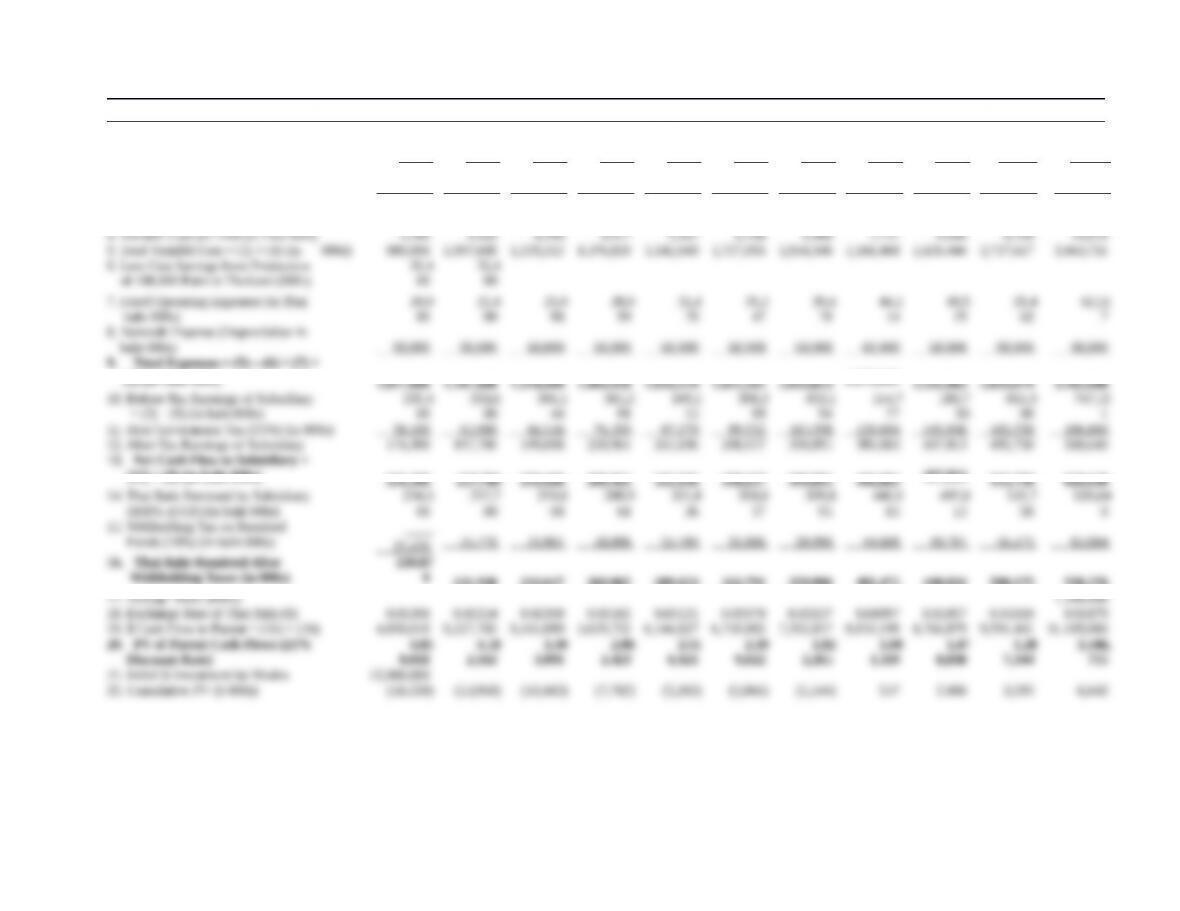
International Corporate Governance and Control 6
Year 0 Year 1 Year 2 Year 3 Year 4 Year 5 Year 6 Year 7 Year 8 Year 9 Year 10
1. Units Sold to Retailers in Thailand 280,000 280,000 280,000 280,000 280,000 280,000 280,000 280,000 280,000 280,000 280,000
2. Price per Unit (in Thai baht) 4,500 5,040 5,645 6,322 7,081 7,931 8,882 9,948 11,142 12,479 13,976
3. Revenue from Sales to Retailers
in Thailand = (1) × (2) (in 000s) 1,260,000
1,411,200 1,580,544 1,770,209 1,982,634 2,220,551 2,487,017 2,785,459 3,119,714 3,494,079
3,913,369
4. Variable Cost per Unit (in Thai baht) 3,500 3,920 4,390 4,917 5,507 6,168 6,908 7,737 8,666 9,706 10,870
9. Total Expenses = (5) – (6) + (7) +
(8) (in baht 000s)
1,027,600
1,147,600
1,314,400
1,464,928
1,633,519
1,822,342
2,033,823 2,270,681
2,535,963
2,833,079
3,165,848
13. Net Cash Flow to Subsidiary =
(12) + (8) (in baht 000s)
234,300
257,700
259,608
288,961
321,836
358,657
399,895
446,083 497,813
555,750
620,640
Withholding Taxes (in 000s)
0
231,930
233,647
260,065
289,653
322,791
359,906
401,475
448,032
500,175
558,576
17. Salvage Value (000s) 1,100,000
21. Initial $ Investment by Blades 23,000,000
© 2018 Cengage Learning. All Rights Reserved. May not be copied, scanned, or duplicated, in whole or in part, except for use as
permitted in a license distributed with a certain product or service or otherwise on a password-protected website for classroom use.

International Corporate Governance and Control 7
Solution to Supplemental Case: Redwing Technology Company
a. The earnings performance translated in dollars is misleading because they are distorted by varying
exchange rates. The actual earnings in each local currency in each subsidiary should be assessed,
since the subsidiary has no control over the exchange rate used for translation. The translation causes
earnings to be overstated when the local currency is strong (against the dollar) and understated when
the local currency is weak. The following table shows the earnings of each subsidiary when
measured in the local currency. Based on this table, the Canadian subsidiary experienced a consistent
growth in earnings over time, averaging about a 14 percent increase per year. Conversely, the South
African subsidiary experienced consistent declines in earnings over time, with an average annual
earnings growth rate of –4.38%. The Japanese subsidiary experienced a decline in earnings in all but
one year, and its average annual earnings growth rate was –1.03%. When measured in this way, the
executive in charge of the Canadian subsidiary appears to have achieved the best perfor mance. The
results are much different when earnings are measured in U.S. dollars for all subsidiaries. The
Canadian performance would not be as high while the South African and Japanese performance
would be higher. Yet, the chief executives of the respective subsidiaries cannot control the translated
exchange rate. It can be argued that they should not be rewarded or penalized because of the
translation effect caused by a volatile exchange rate (although there could be exceptions when they
are personally responsible for hedging any remitted earnings or any inflows of funds coming from
other countries).
Earnings (in millions) Denominated in the Local Currency
Annual Annual Annual
Years Percentage South Percentage Percentage
Ago Canada Increase Africa Increase Japan Increase
5 C$16.80 — R210.00 — Y7,500.00 —
4 19.92 18.57% 200.00 –4.76% 7,441.86 –.77%
3 22.68 13.85 187.50 –6.25 7,608.69 2.24
2 25.92 14.28 180.00 –3.74 7,454.54–2.03
1 28.44 9.72 175.00 –2.78 7,187.50–3.58
b. Based on its high annual growth rate of earnings, the Canadian subsidiary would likely deserve a cash
infusion from the parent to push for additional growth. The parent would probably feel that its funds
are more likely to generate decent returns there than in other countries.
c. Even if the earnings are remitted, Canada would still be the best bet. There was an assumption that
last year’s exchange rate would be a reasonable guess for exchange rates in future years for each
currency. This means that the parent will invest funds at the same exchange rate as the rate in which
subsidiary earnings will be converted back to dollars in the future, for each subsidiary. Thus, no
subsidiary is expected to have an exchange rate advantage over the others.
d. The earnings of the Canadian and South African subsidiaries only appear to be highly correlated
when translated in U.S. dollars. Their earnings in local currencies were not highly correlated. Thus,
some diversification benefits would be lost if the Canadian subsidiary was sold (not to mention that it
is the best-performing subsidiary) or if the South African subsidiary was sold.
© 2018 Cengage Learning. All Rights Reserved. May not be copied, scanned, or duplicated, in whole or in part, except for use as
permitted in a license distributed with a certain product or service or otherwise on a password-protected website for classroom use.

International Corporate Governance and Control 8
Small Business Dilemma
Multinational Restructuring by the Sports Exports Company
1. Are there any reasons why the business that has been so successful in the United Kingdom might not
be successful in other European countries?
ANSWER: When this business was first created, it was based on a perception that British consumers
2. If the business is diversified throughout Europe, will this substantially reduce the exposure of the
Sports Exports Company to exchange rate risk?
ANSWER: No. The European expansion will result in payments of euros for the exports. So the
3. Now that several countries in Europe participate in a single currency system, will this affect the
performance of new expansion throughout Europe?
© 2018 Cengage Learning. All Rights Reserved. May not be copied, scanned, or duplicated, in whole or in part, except for use as
permitted in a license distributed with a certain product or service or otherwise on a password-protected website for classroom use.