Solution to Supplemental Case: Madison Co.
a. While economic exposure adversely affected the firm’s performance in a recent period, it should
favorably affect the firm’s performance in the future. A weak Canadian dollar (which has been
forecasted) would favorably affect Madison, Inc. under the prevailing operational structure. If the
structure is revised, Madison will be less exposed to the Canadian dollar’s exchange rate movements.
Therefore, it will not benefit as much from the weaker Canadian dollar. Economic exposure can be
beneficial when currencies move in a particular direction. The shareholders would be better off if the
firm remains exposed while the Canadian dollar is expected to weaken.
One may argue that the Vice-president should also be better off if Madison remains exposed, based on
the forecast of the Canadian dollar. However, a counter argument is that the Vice-president may be
better off if economic exposure is reduced. If by chance the Canadian dollar unexpectedly continued
to appreciate, Madison’s earnings would be adversely affected, and the Vice-president could lose his
job. This issue usually generates much classroom discussion. Students should attempt to put
themselves in the place of the Vice-president. If the Vice-president does not receive a bonus tied to
earnings, he may prefer a strategy that is least risky in order to preserve his job (even if this strategy
conflicts with satisfying shareholders).
b. The prevailing operational structure allows the firm to benefit from a weaker Canadian dollar. Yet, if
the Canadian dollar appreciates, the Vice-president could be fired. Thus, the Vice-president may
choose a structure that reduces economic exposure, even though the expected earnings are reduced.
Shareholders would have preferred that Madison remained exposed, since the expected return is
higher, and do not suffer the same severe consequences as the Vice-president if the Canadian dollar
appreciates.
If the Vice-president’s compensation was somewhat tied to earnings, there would be less chance of a
conflict of interests. The Vice-president would be more encouraged to preserve the exposure because
he would directly realize some of the benefits resulting from higher performance. In addition, the
firm should have an implicit policy that does not place all the blame on the Vice-president if the
policy of maintaining the prevailing structure backfires. If the Canadian dollar appreciates and
earnings are adversely affected, is the poor performance the fault of the Vice-president? Is it the fault
of the employees that developed the forecasts of the Canadian dollar? These issues generate
interesting discussions. It should be emphasized that employees should not be fired any time they
incorrectly forecast a currency to move in a particular direction. And the Vice-president should not be
fired when his decision was based on input from others that he thought was reliable.
Small Business Dilemma
Hedging the Sports Exports Company’s Economic Exposure to Exchange Rate Risk
1. How could Logan adjust his operations to reduce his economic exposure? What is a possible
disadvantage of such an adjustment?
ANSWER: Jim could determine whether the material could be purchased from a British
manufacturer, so that he would have some payables in pounds to offset some of the receivables in
pounds. However, this solution does not completely eliminate the exposure because the amount of
© 2018 Cengage Learning. All Rights Reserved. May not be copied, scanned, or duplicated, in whole or in part, except for use as
permitted in a license distributed with a certain product or service or otherwise on a password-protected website for classroom use.
Managing Economic Exposure and Translation Exposure 2
receivables denominated in pounds would still exceed the amount of payables denominated in
pounds. Furthermore, the costs of ordering material from the United Kingdom may be more costly
and possibly subject to delays because of the long distance. Jim would not necessarily be able to
ensure that the material would arrive on time when dealing with a supplier that is located in the
United Kingdom.
2. Offer another solution to hedging the economic exposure in the long run as Jim’s business grows.
What are disadvantages of this solution?
ANSWER: Jim may attempt to hire a person in the United Kingdom to do the production there.
Part 3—Integrative Problem
Exchange Rate Risk Management
Vogl Company is a U.S. firm conducting a financial plan for the next year. It has no foreign subsidiaries,
but more than half of its sales are from exports. Its foreign cash inflows to be received from exporting and
cash outflows to be paid for imported supplies over the next year are shown in the following table:
Currency Total Inflow Total Outflow
Canadian dollars (C$) C$32,000,000 C$2,000,000
New Zealand dollars (NZ$) NZ$5,000,000 NZ$1,000,000
Mexican pesos (MXP) MXP11,000,000 MXP10,000,000
Singapore dollars (S$) S$4,000,000 S$8,000,000
The spot rates and one-year forward rates as of today are:
Currency Spot Rate One-Year Forward Rate
C$ $ .90 $ .93
NZ$ .60 .59
MXP .18 .15
S$ .65 .64
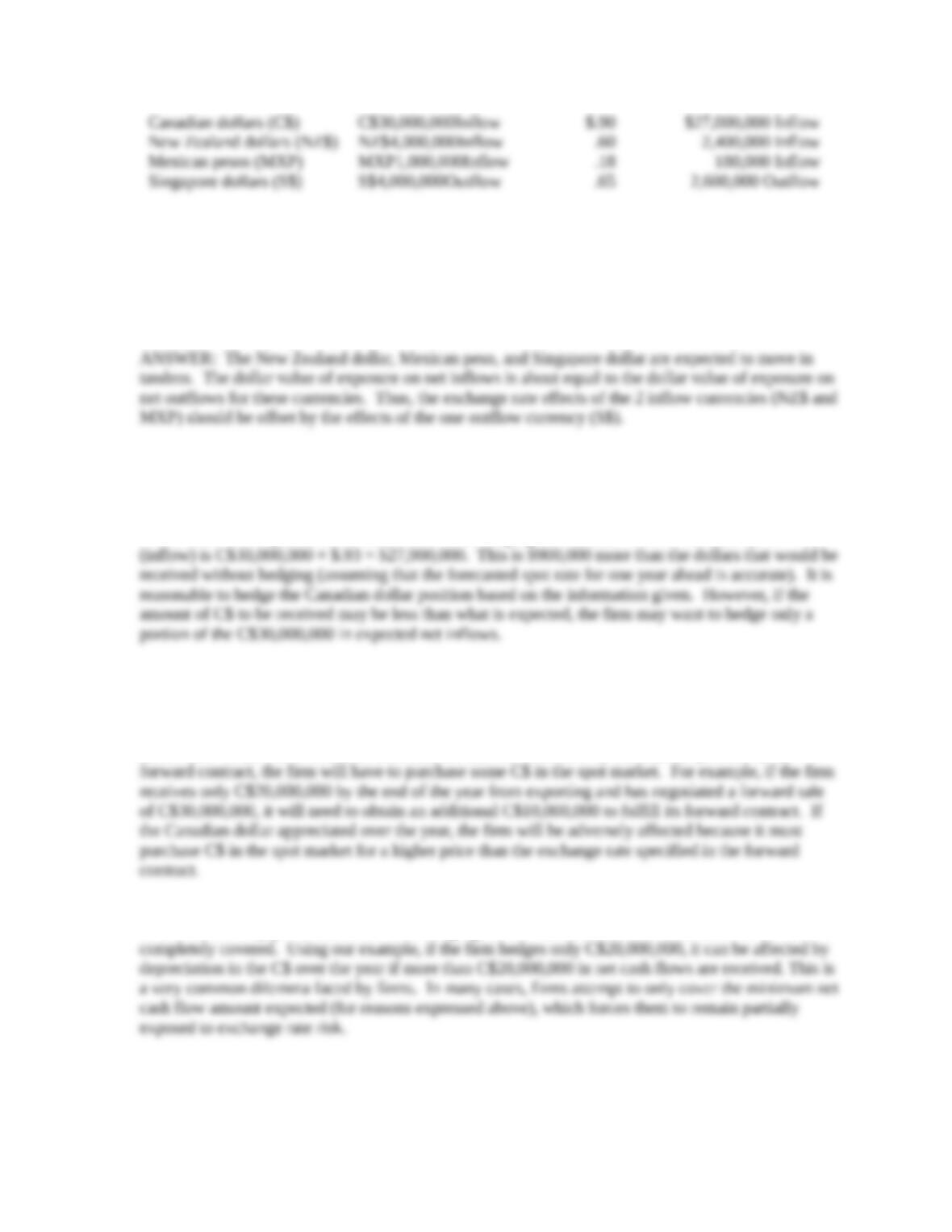
1. Based on the information provided, determine the net exposure of each foreign currency in dollars.
ANSWER:
Currency Net Inflow or Outflow
Spot
Exchange
Rate
Net Inflow or
Outflow
Measured in Dollars
© 2018 Cengage Learning. All Rights Reserved. May not be copied, scanned, or duplicated, in whole or in part, except for use as
permitted in a license distributed with a certain product or service or otherwise on a password-protected website for classroom use.
Managing Economic Exposure and Translation Exposure 3
2. Assume that today’s spot rate is used as a forecast of the future spot rate one year from now. The
New Zealand dollar, Mexican peso, and Singapore dollar are expected to move in tandem against the
U.S. dollar over the next year. The Canadian dollar’s movements are expected to be unrelated to
movements of the other currencies. Since exchange rates are difficult to predict, the forecasted net
dollar cash flows per currency may be inaccurate. Do you anticipate any offsetting exchange rate
effects from whatever exchange rate movements do occur? Explain.
3. Given the forecast of the Canadian dollar along with the forward rate of the Canadian dollar, what is
the expected increase or decrease in dollar cash flows that would result from hedging the net cash
flows in Canadian dollars? Would you hedge the Canadian dollar position?
ANSWER: The expected dollar cash flows from hedging the net cash flows of C$30,000,000
4. Assume that the Canadian dollar net inflows may range from C$20,000,000 to C$40,000,000 over the
next year. Explain the risk of hedging C$30,000,000 in net inflows. How can Vogl Company avoid
such a risk? Is there any tradeoff resulting from your strategy to avoid that risk?
ANSWER: If the C$ received are less than the amount to be sold by the firm as specified in the
The firm can avoid this risk by only hedging the transaction amount that it knows will occur.
However, this may prevent the firm from hedging the full transaction, which means it will not be
5. Vogl Company recognizes that its year-to-year hedging strategy hedges the risk only over a given
year, and does not insulate it from long-term trends in the Canadian dollar’s value. It has considered
establishing a subsidiary in Canada. The goods would be sent from the U.S. to the Canadian
© 2018 Cengage Learning. All Rights Reserved. May not be copied, scanned, or duplicated, in whole or in part, except for use as
permitted in a license distributed with a certain product or service or otherwise on a password-protected website for classroom use.
Managing Economic Exposure and Translation Exposure 4
subsidiary and distributed by the subsidiary. The proceeds received would be reinvested by the
Canadian subsidiary in Canada. In this way, Vogl Company would not have to convert Canadian
dollars to U.S. dollars each year. Has Vogl eliminated its exposure to exchange rate risk by using this
strategy? Explain.
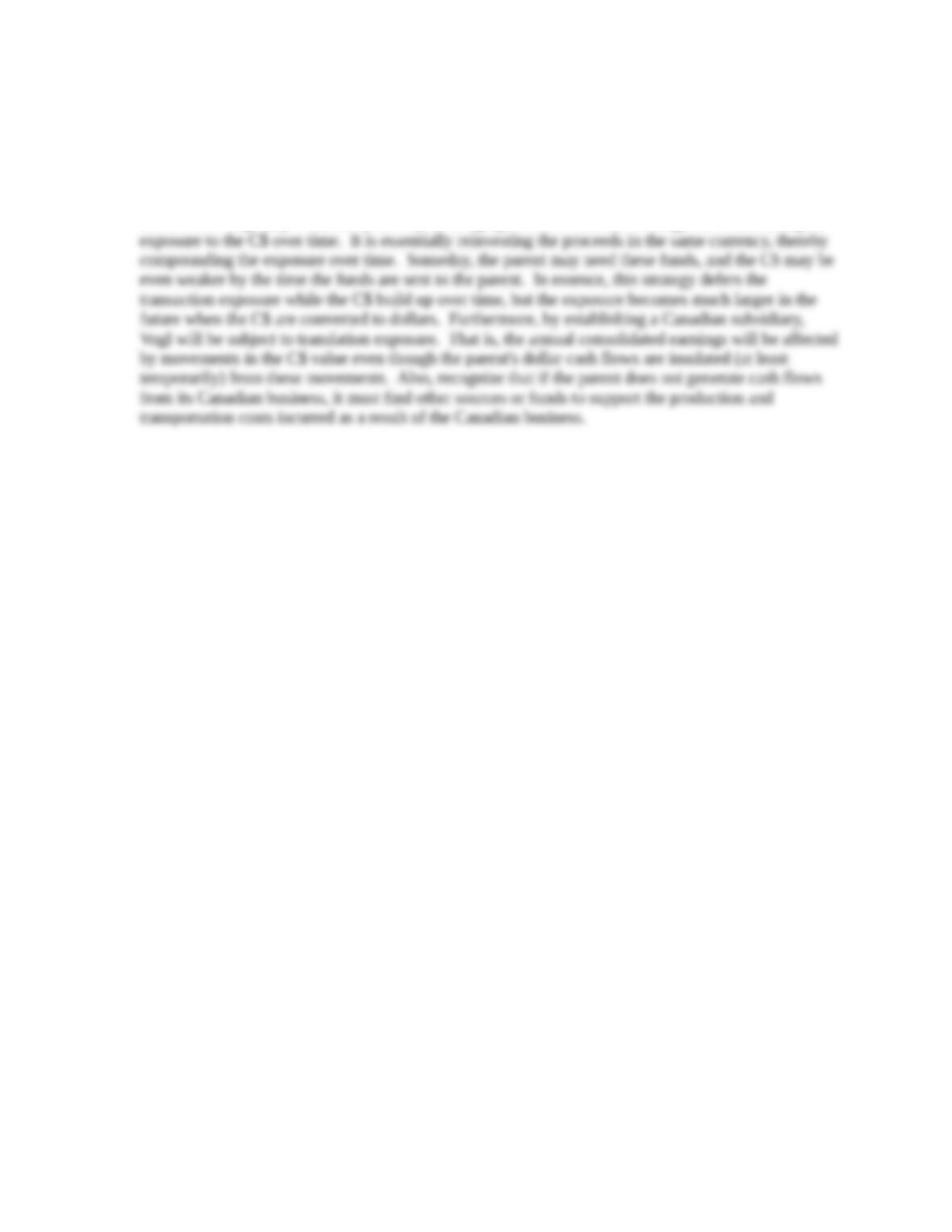
ANSWER: Vogl may avoid the year-to-year hedging decision with this strategy but is increasing its
© 2018 Cengage Learning. All Rights Reserved. May not be copied, scanned, or duplicated, in whole or in part, except for use as
permitted in a license distributed with a certain product or service or otherwise on a password-protected website for classroom use.